



Durable medical equipment is billed with HCPCS Level II codes, not CPT codes. CMS maintains HCPCS Level II and assigns DME to four families: E-codes (E0100 to E8002), K-codes (K0001 to K0900), A-codes (A4000 to A9999), and L-codes for orthotics and prosthetics. CPT, maintained by the AMA, covers the service around the equipment, such as 97760.
Searches for DME CPT codes bring coders here every day, and the honest answer is a HCPCS code. That one distinction decides how you code the claim and whether it pays. Below you'll find the code families, the modifiers that make or break payment, the documentation Medicare wants before delivery, and what changes on October 28, 2026.
Table 1. CPT and HCPCS Level II at a glance
|
Code set |
Maintained by |
Format |
What it covers |
Update cycle |
|---|---|---|---|---|
|
CPT (HCPCS Level I) |
AMA |
Five numeric digits |
Physician and clinical services |
Annual, January 1 |
|
HCPCS Level II |
CMS |
One letter, four digits |
Equipment, supplies, drugs, ambulance |
Quarterly |
|
E-codes (E0100 to E8002) |
CMS |
E plus four digits |
Most durable medical equipment |
Quarterly |
|
K-codes (K0001 to K0900) |
CMS |
K plus four digits |
Wheelchairs and temporary DMEPOS |
Quarterly |
|
L-codes |
CMS |
L plus four digits |
Orthotics and prosthetics |
Quarterly |
Why DME Uses HCPCS Level II Codes, Not CPT
HIPAA assigns durable medical equipment to HCPCS, not CPT. Federal regulation sets that rule, and CMS restates it in its own DME MAC guidance (45 CFR 162.1002). CPT describes what a clinician does during an encounter. HCPCS Level II describes the item the patient takes home and keeps using.
The AMA built CPT to report procedures and services. A walker sitting in a patient's hallway isn't a procedure, so CPT had no way to describe it. Anyone hunting for durable medical equipment CPT codes hits that gap on the first search result.
CMS closed the gap by creating HCPCS Level II for equipment, supplies, injectable drugs, and ambulance transport. You can read the rule inside the CMS DME MAC documentation article.
Picture the split as clinical action versus resources used. Your provider bills CPT for the work performed. On the same case, your supplier bills HCPCS Level II for the item furnished.
Our guide on CPT and HCPCS compared walks the full code set, and this page narrows it to equipment. We built it from the DME claims our team at MedSole RCM works each week.
Medicare treats an item as DME when it withstands repeated use, serves a medical purpose, and suits use in the home. Items classified as DME after January 1, 2012 also need an expected life of at least three years (42 CFR 414.202). Run any borderline item through those four tests before you pick a code.
When CPT Codes Do Apply to DME-Adjacent Services
Three situations put real DME CPT codes on an equipment claim, and each one pays for a service rather than the device.
- Orthotic management and training bills under CPT 97760. The brace itself carries an L-code.
- Negative pressure wound therapy application bills under CPT 97605 through 97608. The pump rental carries E2402.
- Supplies furnished beyond those usually included bill under CPT 99070.
The full list, including the wound care and remote monitoring codes most guides skip, sits further down this page.
HCPCS Level II Code Families for Durable Medical Equipment
Durable medical equipment HCPCS codes fall into five Level II families: E-codes (E0100 to E8002) for most equipment, K-codes (K0001 to K0900) for wheelchairs and temporary items, A-codes (A4000 to A9999) for supplies and accessories, L-codes for orthotics and prosthetics, and B-codes (B9000 to B9999) for enteral and parenteral therapy.
E-Codes: Durable Medical Equipment (E0100 to E8002)
E-codes carry most of what a DME supplier bills, and none of them are durable medical equipment CPT codes despite how often they get called that. Read the descriptors word for word, because one adjective often separates two codes that price differently.
Table 2. Common E-codes with official CMS descriptors
|
HCPCS |
Official CMS descriptor |
|---|---|
|
E0143 |
Walker, folding, wheeled, adjustable or fixed height |
|
E0194 |
Air fluidized bed |
|
E0431 |
Portable gaseous oxygen system, rental |
|
E0601 |
Continuous positive airway pressure (CPAP) device |
|
E1390 |
Oxygen concentrator, single delivery port, capable of delivering 85 percent or greater oxygen concentration at the prescribed flow rate |
|
E1399 |
Durable medical equipment, miscellaneous |
Google's AI Overview shortens E0143 to "folding walker." The official descriptor says folding and wheeled. A folding walker without wheels is E0135, and the two don't pay the same. You can check both against the Medicare walker coverage policy.
K-Codes: Wheelchairs and Temporary DMEPOS (K0001 to K0900)
K-codes hold the manual wheelchair base classes and the labor codes for repair work. CMS published the wheelchair descriptors below in its July 30, 2026 Federal Register notice.
Table 3. Manual wheelchair base codes and DME repair labor
|
HCPCS |
Official CMS descriptor |
|---|---|
|
K0001 |
Standard wheelchair |
|
K0002 |
Standard hemi (low seat) wheelchair |
|
K0003 |
Lightweight wheelchair |
|
K0004 |
High strength, lightweight wheelchair |
|
K0005 |
Ultralightweight wheelchair |
|
K0006 |
Heavy duty wheelchair |
|
K0007 |
Extra heavy-duty wheelchair |
|
K0739 |
Repair or nonroutine service for durable medical equipment other than oxygen equipment requiring the skill of a technician, labor component, per 15 minutes |
Most published lists trim K0739 down to "DME repair." That trim drops two things that decide payment: the carve-out for oxygen equipment, and the 15-minute labor unit. Bill it as a flat repair charge and you under-report your own units.
A-Codes: Supplies and Accessories (A4000 to A9999)
A-codes cover consumables, dressings, and the replacement parts that keep equipment working. Unit definitions matter more here than anywhere else in the DME set.
Table 4. Frequently billed A-codes
|
HCPCS |
Official CMS descriptor |
|---|---|
|
A4239 |
Supply allowance for non-adjunctive, non-implanted continuous glucose monitor (CGM) including all supplies and accessories (1 month supply = 1 unit of service) |
|
A4636 |
Replacement, handgrip, cane, crutch, or walker, each |
|
A4637 |
Replacement, tip, cane, crutch, walker, each |
|
A6022 |
Collagen dressing, sterile, size more than 16 square inches but less than or equal to 48 square inches, each |
|
A6197 |
Alginate or other fiber gelling dressing, wound cover, sterile, pad size more than 16 square inches but less than or equal to 48 square inches, each dressing |
A4239 bills as one unit for a one-month supply. Billing it per sensor or per transmitter is a unit error your clearinghouse will pass through and the DME MAC will catch.
L-Codes: Orthotics and Prosthetics
L-codes describe braces, supports, and prosthetic components. Six of the codes below join the Required Prior Authorization List on October 28, 2026, which makes their descriptors worth memorizing now.
Table 5. L-codes moving to required prior authorization on October 28, 2026
|
HCPCS |
Official CMS descriptor (abridged where noted) |
|---|---|
|
L0456 |
Thoracic-lumbar-sacral orthosis, flexible, provides trunk support, thoracic region, rigid posterior panel and soft anterior apron. Prefabricated item that has been trimmed, bent, molded, assembled, or otherwise customized to fit a specific patient by an individual with expertise. |
|
L0457 |
Same construction as L0456, prefabricated, off-the-shelf. |
|
L0486 |
Thoracic-lumbar-sacral orthosis, triplanar control, two piece rigid plastic shell with interface liner, multiple straps and closures, custom fabricated. |
|
L1833 |
Knee orthosis, adjustable knee joints (unicentric or polycentric), positional orthosis, rigid support, prefabricated, off-the-shelf |
|
L3761 |
Elbow orthosis, with adjustable position locking joint(s), prefabricated, off-the-shelf |
|
L3916 |
Wrist hand orthosis, includes one or more nontorsion joint(s), elastic bands, turnbuckles, may include soft interface, straps, prefabricated, off-the-shelf |
L0456 and L0457 describe the same brace. One gets customized by a person with expertise, the other comes off the shelf. Four words separate them, both land on the prior authorization list the same day, and a coder who treats them as interchangeable will be building appeals by November.
B-Codes: Enteral and Parenteral Therapy
B-codes (B9000 to B9999) cover enteral and parenteral nutrition pumps, supply kits, and formula. They sit under the DME MAC like the rest of Level II, and B4034 is the code most billers meet first.
HCPCS Level II gets revised four times a year by CMS, on a January, April, July, and October cycle, through the CMS HCPCS Quarterly Update file. CMS posted the October 2026 Alpha-Numeric HCPCS File on September 10, 2026. Code applications run on a separate calendar, published in the CMS Level II coding procedures.
A printed list of DME HCPCS codes goes stale between quarters. Run one off in January and it's wrong by October, which is why we build descriptor checks into our medical coding audit process.
DME Code Lookup: Find the HCPCS Code for Any Equipment
DME CPT codes and HCPCS codes group by equipment category, and the item on the delivery ticket is what drives the lookup. The six tables below map the item a patient receives to its HCPCS code, its payment category, the modifier it usually carries, and the coverage rule that decides whether Medicare pays.
Mobility Equipment Codes
Walkers, wheelchairs, and canes generate more DME claims than any other category, and coverage criteria shift between the classes. Our coders work these every week across the disciplines listed under billing by specialty.
Table 6. Mobility equipment: walkers, wheelchairs, canes and crutches
|
Equipment |
HCPCS |
Category |
Typical modifier |
Coverage note |
|---|---|---|---|---|
|
Walker, rigid pickup |
E0130 |
IRP |
NU or RR |
Covered under LCD L33791 criteria |
|
Walker, folding pickup |
E0135 |
IRP |
NU or RR |
No wheels. Not the same as E0143 |
|
Walker, rigid wheeled |
E0141 |
IRP |
NU or RR |
Document why wheels are needed |
|
Walker, folding wheeled |
E0143 |
IRP |
NU or RR |
Least costly alternative applies |
|
Walker, heavy duty |
E0148 / E0149 |
IRP |
NU or RR |
Labeled above 300 lb capacity |
|
Standard wheelchair |
K0001 |
Capped rental |
RR then KH KI KJ |
MRADL deficit must be documented |
|
Ultralightweight wheelchair |
K0005 |
Capped rental |
RR plus KX |
Prior auth required from 10/28/2026 |
|
Power wheelchair, group 2 |
K0823 |
Capped rental |
RR plus KX |
Face-to-face required by statute |
|
Crutch substitute, platform |
E0118 |
IRP |
NU or RR |
Billed each |
|
Wheel attachment, per pair |
E0155 |
IRP |
NU |
One unit equals one pair |
E0143 is the folding wheeled walker. E0135 is the one without wheels. Medicare's least costly alternative policy means a higher-tier walker can pay at the E0143 rate unless the chart explains why the cheaper device won't work.
Bath Safety and Commode Codes
Bath equipment is where suppliers lose the most money on equipment patients depend on daily. Coverage runs narrow, so the conversation with the patient has to happen before delivery.
Table 7. Bath safety and commode equipment
|
Equipment |
HCPCS |
Category |
Typical modifier |
Coverage note |
|---|---|---|---|---|
|
Commode chair, stationary |
E0163 |
IRP |
NU or RR |
Covered when patient is room confined |
|
Commode chair with arms |
E0165 |
IRP |
NU or RR |
Same criteria as E0163 |
|
Shower chair / bath bench |
E0240 family |
Non-covered |
GY or GA |
Statutorily excluded as convenience |
|
Transfer bench |
E0247 / E0248 |
Non-covered |
GY or GA |
Issue an ABN before delivery |
|
Grab bars |
Not separately payable |
Non-covered |
GY |
Home modification, never DME |
Most bath safety equipment falls outside the Medicare DME benefit as a convenience item. Get the ABN signed before the patient leaves with the chair, append GA, and the balance shifts to patient responsibility instead of a write-off.
Respiratory Equipment Codes
Oxygen and PAP devices carry the tightest documentation rules across the DME HCPCS codes set, and the oxygen family splits by delivery method in a way that trips up new billers.
Table 8. Respiratory and oxygen equipment
|
Equipment |
HCPCS |
Category |
Typical modifier |
Coverage note |
|---|---|---|---|---|
|
CPAP device |
E0601 |
Capped rental |
RR plus KX |
Sleep test plus in-person evaluation |
|
Respiratory assist device |
E0470 |
Capped rental |
RR plus KX |
E0601 trial must fail first |
|
Nebulizer with compressor |
E0570 |
IRP |
NU or RR |
Pair with a covered inhalation drug |
|
Oxygen concentrator |
E1390 |
Oxygen |
RR |
36-month payment cap applies |
|
Portable gaseous system |
E0431 |
Oxygen |
RR |
Gaseous. Liquid is E0434 |
|
Portable liquid system |
E0434 |
Oxygen |
RR |
Liquid. Gaseous is E0431 |
|
Gaseous transfilling equipment |
K0738 |
Oxygen |
RR |
MS modifier after the 36-month cap |
E0431 and E0434 look interchangeable on an order that says "portable oxygen." One is gaseous, one is liquid, and they price differently. Ask the intake team to record the delivery method, not the phrase the referral used.
Hospital Beds and Support Surfaces
Support surfaces draw medical review attention because the group classifications turn on wound stage and skin condition, which the ordering chart often fails to record.
Table 9. Beds, mattresses and bed accessories
|
Equipment |
HCPCS |
Category |
Typical modifier |
Coverage note |
|---|---|---|---|---|
|
Hospital bed, semi-electric |
E0260 |
Capped rental |
RR plus KX |
Document the positioning need |
|
Powered air flotation bed |
E0193 |
Capped rental |
RR plus KX |
Prior auth required nationwide |
|
Air fluidized bed |
E0194 |
Capped rental |
RR plus KX |
Prior auth required from 10/28/2026 |
|
Powered pressure-reducing mattress |
E0277 |
Capped rental |
RR plus KX |
Prior auth required nationwide |
|
Trapeze bar, free standing |
E0935 family |
IRP |
NU or RR |
Billed with the bed order |
|
Patient lift accessories |
E0971 |
IRP |
NU |
Anti-tipping device, each |
E0194 joins the Required Prior Authorization List on October 28, 2026. If you stock air fluidized beds, the submission workflow has to exist before that date, not after the first non-affirmation lands.
Orthotics, Braces and Compression Codes
Orthoses carry the highest improper payment rates in the whole DMEPOS program, and CMS is expanding prior authorization because of it.
Table 10. Orthotic, brace and compression codes
|
Equipment |
HCPCS |
Category |
Typical modifier |
Coverage note |
|---|---|---|---|---|
|
TLSO, flexible, customized |
L0456 |
P&O |
RT / LT plus KX |
Prior auth required from 10/28/2026 |
|
TLSO, flexible, off-the-shelf |
L0457 |
P&O |
RT / LT plus KX |
Prior auth required from 10/28/2026 |
|
TLSO, triplanar, custom fab |
L0486 |
P&O |
KX |
Prior auth required from 10/28/2026 |
|
Knee orthosis, adjustable |
L1833 |
P&O |
RT / LT |
Prior auth required from 10/28/2026 |
|
Elbow orthosis, locking joint |
L3761 |
P&O |
RT / LT |
Phased prior auth, four states first |
|
Wrist hand orthosis |
L3916 |
P&O |
RT / LT |
Phased prior auth, four states first |
|
Ankle foot orthosis, carbon |
L1933 |
P&O |
RT / LT |
Added to the Master List 10/28/2026 |
L-codes pair with laterality modifiers more often than any other family, and the RT and LT rules mirror what we cover in our podiatry coding guide. Bill a bilateral brace on one line without modifiers and the second unit disappears.
Monitoring and Diabetic Supply Codes
Diabetic and monitoring supplies run on allowances rather than per-item pricing, which changes how you count units.
Table 11. Monitoring and diabetic supplies
|
Equipment |
HCPCS |
Category |
Typical modifier |
Coverage note |
|---|---|---|---|---|
|
Home blood glucose monitor |
E0607 |
IRP |
NU or KL |
Priced by Inherent Reasonableness |
|
Blood glucose test strips |
A4253 |
Supplies |
KX or KS |
Per 50 strips, utilization rules apply |
|
CGM supply allowance |
A4239 |
Supplies |
KX |
One unit equals a one-month supply |
|
Lancets |
A4259 |
Supplies |
KX or KS |
Per 100 |
|
Blood pressure monitor |
A4670 |
Supplies |
NU |
Covered only for ESRD home dialysis |
E0607 sits outside the usual floor and ceiling math because CMS prices it through national Inherent Reasonableness. Set it beside your other fee schedule amounts and it looks wrong. It isn't.
|
Working these codes at volume Picking the code is the easy half. The documentation behind it decides whether the claim survives, and that work scales badly inside a practice that also sees patients. MedSole RCM handles DME billing end to end at 2.99 percent of collections with a 99 percent clean claim rate, and the rate covers coding review, claim submission, denial management, and AR follow-up with no per-claim fee. If the tables above matched what your aging report looks like, our outsourced medical billing team can take the whole cycle. |
Fee amounts change quarterly. Pull the current numbers from the CMS DMEPOS fee schedule files before you quote a patient, and download our free list of DME HCPCS codes and modifiers at medsolercm.com/downloads/dme-hcpcs-codes.pdf. No email gate.
CPT Codes That Apply to DME Services
Durable medical equipment CPT codes report the professional service delivered around the device, never the device itself. Four service categories generate most real DME CPT codes on a claim: orthotic and prosthetic management, wound care application, respiratory and monitoring services, and supplies furnished beyond those usually included.
Orthotic and Prosthetic Management Codes
These three codes separate the first fitting from every visit after it, and Medicare treats all of them as therapy services.
Table 12. Orthotic and prosthetic service codes
|
CPT |
What it reports |
|---|---|
|
97760 |
Orthotic management and training, initial orthotic encounter, per 15 minutes |
|
97761 |
Prosthetic training, initial prosthetic encounter, per 15 minutes |
|
97763 |
Orthotic or prosthetic management and training, subsequent encounter, per 15 minutes |
CMS designates 97763 as an always therapy code, so it carries GN, GO, or GP depending on whether the plan of care sits with speech, occupational, or physical therapy. That instruction appears in the CMS therapy code list transmittal. The same timed-unit logic runs through our physical therapy CPT codes and occupational therapy CPT codes guides.
Wound Care Equipment Service Codes
Negative pressure wound therapy splits by equipment type, and the CPT code has to match the device the supplier furnished.
Table 13. NPWT service codes and their device pairings
|
CPT |
What it reports and the paired HCPCS device |
|---|---|
|
97605 |
NPWT with durable equipment, wound surface area 50 sq cm or less. Pump rents under E2402 |
|
97606 |
NPWT with durable equipment, wound surface area over 50 sq cm. Pump rents under E2402 |
|
97607 |
NPWT with disposable equipment, 50 sq cm or less. Device supplied under K0743 or A6550 |
|
97608 |
NPWT with disposable equipment, over 50 sq cm. Device supplied under K0743 or A6550 |
Durable and disposable are separate code pairs. Bill 97605 for a disposable single-use system and the claim contradicts the supply code sitting on the same encounter.
Respiratory and Monitoring Service Codes
Respiratory setup and monitoring services bill under CPT while the device bills under HCPCS, and remote monitoring blurs that line more than any other category.
Table 14. Respiratory and monitoring services
|
CPT |
What it reports |
|---|---|
|
94660 |
CPAP ventilation initiation and management |
|
95249 |
CGM, patient-owned equipment, training and calibration |
|
95250 |
CGM, physician-owned equipment, minimum 72 hours |
|
95251 |
CGM data analysis and interpretation |
|
98976 / 98977 |
Remote therapeutic monitoring, device supply, 30 days |
98976 and 98977 pay for supplying a device under a CPT code, which is the exact boundary this article draws. They exist because CPT owns remote monitoring, so the device supply rode along with the service.
Supplies Furnished Beyond Those Usually Included
CPT 99070 reports supplies and materials provided over and above those usually included with the office visit or service. It is the closest thing to a true CPT code for supplies, and Medicare rarely pays it because a HCPCS Level II code almost always exists instead. Commercial payers behave differently, so check the contract before you write it off.
CPT 97762 Was Deleted in 2018, and Both AI Engines Still List It
CPT 97762 was deleted effective January 1, 2018 and replaced by CPT 97763 for all subsequent orthotic and prosthetic encounters. CMS documented the change in Transmittal 3924, Change Request 10303. Google's AI Overview and Bing Copilot both still show 97762 as a current DME-related CPT code.
For CY 2018 the CPT Editorial Panel reworked the orthotic and prosthetic set three ways. It added the phrase "initial encounter" to 97760 and 97761, created 97763 for encounters after the first, and deleted 97762 outright.
CMS carried all three changes into the therapy code list through CMS Transmittal 3924, effective for dates of service on or after January 1, 2018.
Table 15. Orthotic and prosthetic CPT codes before and after January 1, 2018
|
CPT |
Status |
What changed |
|---|---|---|
|
97760 |
Active, descriptor revised |
Now reports the initial orthotic encounter only |
|
97761 |
Active, descriptor revised |
Now reports the initial prosthetic encounter only |
|
97762 |
Deleted January 1, 2018 |
Formerly reported orthotic or prosthetic checkout |
|
97763 |
Active, created 2018 |
Reports all subsequent encounters. Always therapy, needs GN, GO, or GP |
If a list of DME CPT codes in your billing office still shows 97762, it's been wrong for eight years.
We see the same pattern a few times a year. A therapist keeps billing 97762 because one payer kept paying it. The billing lead sees a paid remit and moves on. Two years later the recoupment letter arrives asking for all of it back.
One payer's adjudication logic isn't a coverage decision.
Medicare Does Not Recognize Every CPT Code, and 97127 Proves It
That same transmittal records a second change, and it says more about DME coding than anything else in the document. The CPT Editorial Panel created 97127 to replace 97532. CMS declined to recognize 97127, assigned it Medicare Physician Fee Schedule status indicator "I" for invalid, and built HCPCS code G0515 to use instead.
Durable medical equipment CPT codes aren't the only place this logic shows up. A CPT code can exist, carry a valid AMA descriptor, and still be unpayable by Medicare because CMS built a HCPCS Level II code to take its place.
Same reasoning puts all durable medical equipment in HCPCS Level II. One CMS document, two proofs. A code behaving differently from what the codebook implies shows up elsewhere too, which our TC modifier rules guide covers.
DME Modifiers: NU, RR, UE, NR and the Capped Rental Sequence
Most DME HCPCS codes require a modifier, and a missing or wrong one makes the claim unprocessable rather than denied. Three modifiers carry purchase and rental status: NU for new equipment purchase, RR for rental, and UE for used equipment purchase. Modifiers decide payment here far more than they do across the DME CPT codes a provider bills.
Purchase Versus Rental: NU, RR, UE and NR
Almost every published DME cheat sheet lists NU, RR, and UE, then stops. A fourth modifier exists. NR reports an item that was new at the time it was rented and the beneficiary later purchased. CMS defines all four in the Medicare Claims Processing Manual, Chapter 20.
Capped Rental Months: KH, KI and KJ
DME modifiers for capped rental run in sequence, and the order is not optional. KH reports the first rental month. KI covers the second and third. KJ runs from the fourth month through the thirteenth. That sequence tells the DME MAC where a rental sits in its payment life, and skipping a step stalls the whole chain.
Older cheat sheets still tell billers to append KH to purchase claims. Chapter 20 removed that requirement for dates of service on or after October 1, 2018, for both NU purchases and UE used purchases. Append it now and you've handed the edit engine a modifier the claim doesn't need.
Coverage and Medical Necessity: KX, GA, GY and GZ
KX tells the payer you hold documentation meeting the coverage criteria in the policy. GA reports a signed ABN on file. GY reports an item statutorily excluded from Medicare. GZ reports an item you expect to be denied with no ABN in hand.
Each one ties back to documentation you have to produce on request, which the CMS DMEPOS order requirements page sets out.
Laterality, Repairs and Delivery: RA, RB, LT, RT, KL and KE
A last group of DME modifiers covers sides, repairs and delivery method. RA reports replacement of a complete item. RB reports replacement of a part. LT and RT carry laterality on braces, and KL flags an item delivered by mail.
Component modifiers run on similar logic across code sets, which our modifier 26 explained guide covers for the professional and technical split.
Table 16. DME modifier decision table
|
Billing situation |
Modifier |
Documentation trigger |
Common failure |
|---|---|---|---|
|
Patient buys new equipment |
NU |
SWO plus proof of delivery |
Adding KH after 10/1/2018 |
|
Patient rents equipment |
RR |
SWO plus rental start date |
No month sequence modifier |
|
Patient buys used equipment |
UE |
SWO plus condition note |
Billing NU for a used item |
|
New at rental, later purchased |
NR |
Original rental record |
Modifier omitted entirely |
|
First rental month |
KH |
Initial delivery date |
Repeated in month two |
|
Rental months two and three |
KI |
Continuous use record |
Skipped straight to KJ |
|
Rental months four to thirteen |
KJ |
Continuous use record |
Left on past month 13 |
|
Coverage criteria are met |
KX |
Chart supports the LCD |
Appended without the chart |
|
ABN signed, denial expected |
GA |
Signed CMS-R-131 on file |
ABN signed after delivery |
|
Item statutorily excluded |
GY |
None required |
GZ used by mistake |
|
Complete item replaced |
RA |
Reason for replacement |
RB used for a whole unit |
|
Left or right side item |
LT / RT |
Order specifies the side |
Bilateral billed on one line |
A modifier that contradicts the code is the fastest route to CO-4, which our CO-4 denial causes guide breaks down line by line. The edit fires before a human ever reads the claim.
The KF Modifier Problem: E0747, E0748 and E0760 in 2026
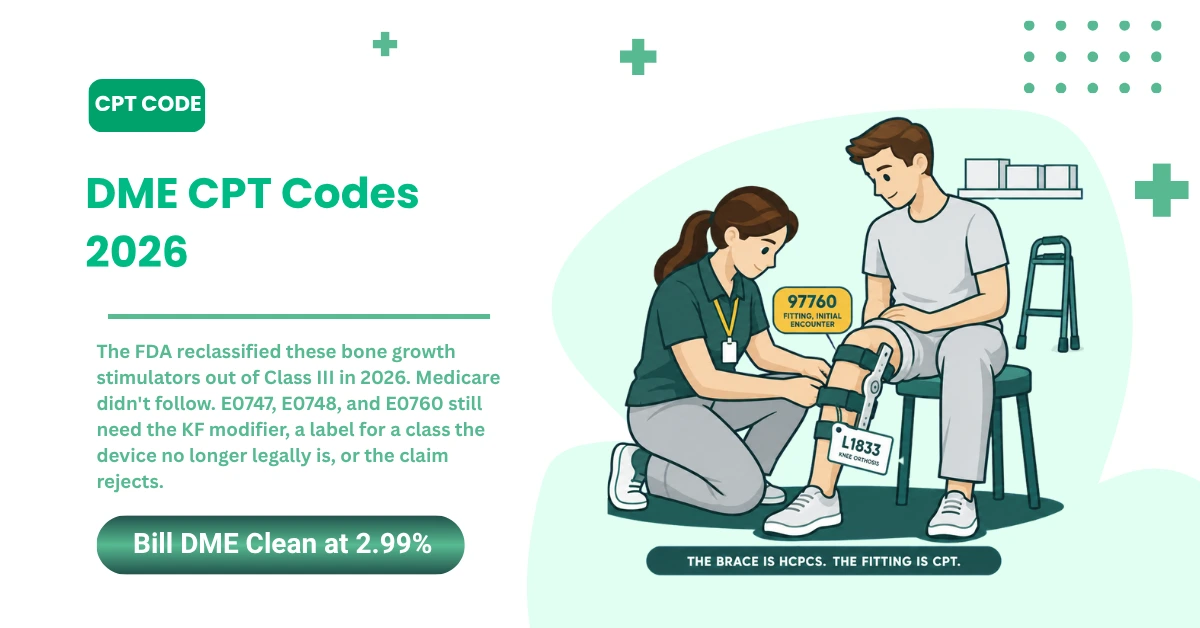
Medicare requires the KF modifier on HCPCS codes E0747, E0748 and E0760 and rejects claims that omit it, even though the FDA reclassified these non-invasive bone growth stimulators from Class III to Class II effective May 18, 2026. CMS chose to pay as though no class change happened.
KF is the HCPCS modifier for a Class III device. That definition appears in the DME MAC fee schedule column descriptors, and it is the reason this situation confuses experienced billers. The modifier names a device class the FDA no longer assigns to these products.
CMS addressed it head on rather than leaving suppliers to guess. Policy Article A52513 states that devices coded E0747, E0748 and E0760 must carry KF for any date of service billed, and that claims without it get rejected. You can read it in the CMS osteogenesis stimulator policy.
The CMS July 2026 DMEPOS update goes further and confirms Medicare will pay these codes as if no change in class occurred.
One more layer sits under this, and no summary we have found connects it. Prior authorization for those same three codes has been suspended since August 28, 2024, because CMS has unresolved questions about whether some non-invasive osteogenesis stimulators meet the three-year expected life requirement at 42 CFR 414.202. The suspension appears on the CMS DMEPOS prior authorization page.
A device changing regulatory class doesn't mean Medicare's billing logic changed on the same date. Suppliers who dropped KF in May because the FDA reclassified the product spent the summer reworking rejections. The operational instruction decides what pays, and it moves on its own schedule.
Rental Versus Purchase: The 13-Month Capped Rental Rule
Capped rental items pay across 13 months of continuous use, after which title transfers to the beneficiary and the supplier stops billing rent. Oxygen equipment runs on a separate 36-month payment cap instead.
The KH, KI and KJ sequence tracks the rental month on each claim. Month 13 closes the payment period, ownership moves to the patient, and the supplier's obligation shifts to maintenance under the applicable policy. CMS sets the mechanics in its CMS DMEPOS payment policies.
Oxygen works differently enough to catch people out. Payment for stationary oxygen equipment caps at 36 months rather than 13.
After that period, maintenance and servicing can pay for E1390, E1391, E0433 or K0738 billed with the MS modifier. The clock starts six months after the end of the 36th month of continuous use, or the end of the manufacturer warranty, whichever falls later. That service pays once per patient in any six-month period.
Month-tracking failures are where DME revenue disappears without anyone noticing. A rental that should have converted at month 13 keeps billing. Somewhere else, a modifier that should have moved from KI to KJ stays put.
Neither throws an error at submission, so the denials arrive quietly and sit until they're too old to appeal. Our AR follow-up services team finds more money in rental sequencing than in any other DME workflow.
Documentation Medicare Requires Before You Deliver
Every claim billed to Medicare for DMEPOS requires a written order meeting Standard Written Order requirements as a condition of payment. Three documents have to exist: the SWO, proof of delivery, and a medical record supporting necessity. Selected items also require the order before delivery.
The Standard Written Order and What It Must Contain
An SWO needs the beneficiary name or Medicare Beneficiary Identifier, the order date, a description of the item, the quantity where applicable, the treating practitioner name or NPI, and the practitioner signature. Nothing else is mandatory.
One detail gets missed over and over. You can describe the item by general description, by HCPCS code, by narrative, or by brand name and model number. All four satisfy the requirement.
Billing teams send orders back to physicians asking for a HCPCS code that was never required, and delivery slips a week for no reason. The DME MAC standard documentation requirements article spells out all four options. That same order trail feeds the charge, which our superbill requirements guide covers from the practice side.
Written Order Prior to Delivery and the Six-Month Face-to-Face Window
For items on the Required Face-to-Face Encounter and Written Order Prior to Delivery List, the supplier must hold a signed SWO before the item reaches the patient. The treating practitioner needs a face-to-face encounter with the beneficiary within the six months preceding the order date.
Telehealth satisfies that face-to-face requirement under 42 CFR 410.38, read together with 410.78 and 414.65. Almost no DME guide mentions it, and it changes scheduling for suppliers whose referring physicians run hybrid clinics. Effective October 28, 2026, the F2F and WOPD List will contain 105 items, up from 83 today.
Proof of Delivery and Record Retention
Proof of delivery is a supplier standard. You keep the documentation and produce it when the Medicare contractor asks. The delivery date recorded on the POD has to be the date the beneficiary or their designee received the item. Retention runs seven years under the Medicare Program Integrity Manual.
What the Medical Record Must Show
The supporting documentation needs subjective and objective beneficiary-specific information used for diagnosing, treating, or managing the condition the item addresses. An order by itself establishes nothing. If the chart says the patient has difficulty ambulating and stops there, medical review has nothing to affirm.
Our most common documentation finding isn't a missing document at all. It's a proof of delivery dated the day the item shipped rather than the day the patient signed. The claim pays, everyone moves on, and two years later a CERT reviewer pulls the file and the dates don't match.
DME MAC Jurisdictions: Which Contractor Processes Your Claim
DMEPOS claims route to one of four DME MAC jurisdictions based on the beneficiary's permanent residence address, not the supplier's location. That rule differs from A/B MAC routing and surprises suppliers who expand into new states.
Four contractors hold the jurisdictions, with Noridian Healthcare Solutions and CGS Administrators splitting them. Each publishes its own coverage articles, and the differences turn up in medical review.
When CMS phased in prior authorization for upper limb orthoses, it picked one state from each DME MAC jurisdiction for phase one. That tells you how seriously the agency treats the split. Our guide on how MACs process claims covers the wider contractor structure.
DMERC is the term you'll still hear from anyone who's been billing since the 1990s. It stood for Durable Medical Equipment Regional Carrier, and CMS replaced it with DME MAC during contractor reform. Function is identical, so treat the two words as interchangeable when a payer rep uses the older one.
A supplier running one warehouse and serving patients in three states is billing three jurisdictions at once. Each one interprets its own local coverage articles, and each one runs its own PDAC guidance. Treat them as one payer and a claim that's clean in one state comes back denied in the next.
How to Bill a DME Claim, Step by Step
DME billing runs in seven steps: verify eligibility, clear prior authorization, select the HCPCS code, apply the modifiers, secure the written order, submit with any required narrative, and retain proof of delivery. Skip one and you get a predictable denial.
- Verify eligibility and benefits. Confirm active coverage and check whether the specific HCPCS code is a covered benefit under that plan. Our eligibility verification services run this before every encounter.
- Check the Required Prior Authorization List. If the code appears, submit the request and wait for a provisional affirmation before you deliver the item.
- Select the HCPCS code. Verify the descriptor against the current quarterly file rather than a saved spreadsheet. The CMS HCPCS code system page links the active release.
- Apply the modifiers. Purchase or rental status first, then the rental month, then any coverage or laterality modifier the policy requires.
- Secure the Standard Written Order. For WOPD items, the signed order has to be in hand before the item leaves your warehouse.
- Submit the claim. CMS-1500 or 837P, with the narrative in Box 19 or the NTE segment when the code requires a description. Our clean claim submission workflow scrubs these before they reach the payer.
- Capture proof of delivery. Record the date the patient received the item, retain the signed receipt, and file it where an auditor can find it seven years from now.
Institutional DME Billing and Revenue Code 0278
Facilities bill DME on the UB-04 rather than the CMS-1500, and revenue code 0278 reports other implants and certain supplies on institutional claims. The same item can carry a HCPCS code on a professional claim and sit under a revenue code on an institutional one, depending on which entity furnished it.
The professional and institutional split is where hospital-owned outpatient departments lose the most DME money. Equipment goes out the door, the facility assumes the DMEPOS supplier billed it, the supplier assumes the facility did, and neither one submits. Assign that decision to one person before the first item ships.
The Six DME Denials You Will See Most, and How to Fix Each One
DME carries one of the highest denial rates in ambulatory billing, and most of those denials trace back to documentation rather than code selection. Picking the right DME CPT codes and HCPCS codes only gets the claim to the payer. Six denial and remark code pairings account for the bulk of DMEPOS rejections.
Table 17. The six most common DME denial patterns
|
Denial |
Remark |
Root cause |
The fix |
|---|---|---|---|
|
CO-16 |
M60 |
Missing Certificate of Medical Necessity or DIF |
Attach the CMN or DIF, then resubmit |
|
CO-16 |
N350 |
No service description on an NOC code |
Populate Box 19 or the NTE segment |
|
PR-204 |
N130 |
Item outside the patient benefit plan |
Confirm an ABN with GA before billing the patient |
|
CO-252 |
M23, N704 |
Supplier invoice not submitted |
Send the invoice with the claim, not after |
|
CO-50 |
None |
Not deemed medically necessary |
Match the ICD-10 to the LCD coverage criteria |
|
CO-197 |
None |
Prior authorization not obtained |
Check the PA list before delivery, not after |
CO-16 arrives more often than any other DME denial and it means almost nothing by itself. The remark code carries the information. M60 points at a missing CMN or DIF. N350 points at a blank service description on a not-otherwise-classified code, which is a different problem with a different fix. Our CO-16 denial guide separates them.
PR-204 shifts the balance to the patient, and the timing of the ABN decides whether that shift holds. An ABN signed after delivery protects no one, and the balance becomes a write-off. CO-50 turns on whether the diagnosis on the claim matches what the coverage policy requires, which our CO-50 medical necessity guide works through with examples.
Denials themselves are survivable. The cost sits in the second denial on the same root cause three weeks later, because no one traced the first one back to the workflow that produced it.
A supplier working 40 CO-16 rejections a month has one broken intake step, not 40 separate problems.
|
If that aging report sounds familiar Working DME denials is a volume problem more than a knowledge problem. Each fix above takes minutes. Finding time for 300 of them in a month is what breaks. MedSole RCM prices standalone denial management services at 4.49 percent of what it recovers, and includes the same work at no separate charge inside full-service billing at 2.99% of collections. No setup fee, no per-claim fee, and no long-term contract requirement. |
DMEPOS Prior Authorization: Eight New Codes Effective October 28, 2026
CMS is adding eight durable medical equipment HCPCS codes to the Required Prior Authorization List effective October 28, 2026: one pressure-reducing support surface, one manual wheelchair, and six orthoses. The agency published the list in the Federal Register on July 30, 2026 under document CMS-6109-N, citation 91 FR 47972.
Table 18. Codes added to the Required Prior Authorization List, effective October 28, 2026
|
HCPCS |
Official CMS descriptor |
Effective date and scope |
|---|---|---|
|
E0194 |
Air fluidized bed |
October 28, 2026, nationwide |
|
K0005 |
Ultralightweight wheelchair |
October 28, 2026, nationwide |
|
L0456 |
Thoracic-lumbar-sacral orthosis, flexible, trunk support, thoracic region, prefabricated and customized to fit a specific patient by an individual with expertise |
October 28, 2026, nationwide |
|
L0457 |
Same construction as L0456, prefabricated, off-the-shelf |
October 28, 2026, nationwide |
|
L0486 |
Thoracic-lumbar-sacral orthosis, triplanar control, two piece rigid plastic shell, custom fabricated |
October 28, 2026, nationwide |
|
L1833 |
Knee orthosis, adjustable knee joints, positional orthosis, rigid support, prefabricated, off-the-shelf |
October 28, 2026, nationwide |
|
L3761 |
Elbow orthosis, with adjustable position locking joint(s), prefabricated, off-the-shelf |
Phased, see below |
|
L3916 |
Wrist hand orthosis, nontorsion joint(s), elastic bands, turnbuckles, prefabricated, off-the-shelf |
Phased, see below |
The same notice adds 20 codes to the Master List and 22 codes to the Face-to-Face and Written Order Prior to Delivery List. You can read the full tables in the Federal Register notice.
The Three-Phase Rollout for L3761 and L3916
CMS is phasing prior authorization for the two upper limb orthoses across three dates rather than turning it on nationwide at once.
- Phase one starts October 28, 2026 in New York, Michigan, Florida and California. CMS picked one state from each DME MAC jurisdiction.
- Phase two starts January 26, 2027 and adds Pennsylvania, Massachusetts, Ohio, Illinois, Texas, Georgia, Arizona and Oregon.
- Phase three starts April 26, 2027 and covers all remaining states and territories.
If you furnish elbow or wrist hand orthoses across state lines, your authorization workflow turns on in stages rather than all at once. A supplier in Ohio serving Michigan patients hits phase one three months before its home state reaches phase two.
Why CMS Selected These Codes
CMS built the case on improper payment data. From 2023 through 2025, improper payment rates ran roughly 40 to 48 percent for upper limb orthoses and 35 to 47 percent for lower limb orthoses. Manual wheelchairs ran between 22.1 and 42 percent.
CMS also cites its Fraud Defense Operations Center suspending more than $1.5 billion in DMEPOS payments tied to suspected fraudulent billing, and projects net savings of $15.8 million from these eight codes.
The Prior Authorization Exemption Most Suppliers Have Not Heard About
CMS issued CMS-1828-F on December 2, 2025, creating an exemption process for suppliers that can prove billing compliance. Hit a provisional affirmation rate of 90 percent or higher and you may qualify for exemption from required prior authorization.
DME MACs notified suppliers of their status no later than April 2, 2026. The first cycle opened June 1, 2026 and runs annually. You can opt out, and CMS gives at least 60 days notice before withdrawing an exemption. Details sit on the CMS prior authorization process page.
|
Check the Federal Register, not the PDF The Required Prior Authorization List PDF hosted on the CMS site carries an "Updated January 13, 2026" date, so it does not yet reflect the October 28 additions. A coder verifying a code against that PDF between now and the refresh sees the old list and clears an item that needs authorization. Verify against the Federal Register notice and the CMS DMEPOS Master List page instead. Missing this check produces CO-197, which our CO-197 prior auth denials guide covers. |
E1399 and Miscellaneous DME Codes: How to Get Them Paid
E1399 reports durable medical equipment, miscellaneous. It sits at the edge of the DME HCPCS codes set and applies when no specific code describes the item, or when PDAC has not issued a coding verification for that product. The narrative description decides whether the claim pays.
When E1399 Applies
Two conditions justify E1399. No existing HCPCS code fits the item, or the manufacturer has not obtained a PDAC coding verification. Reaching for E1399 when a specific code exists is a denial trigger on its own, and medical review checks for exactly that pattern.
What Every E1399 Claim Must Carry
Four elements have to accompany the claim, and leaving out any one of them puts the claim in the rejection loop described below.
- A narrative description of the item in plain clinical language.
- The manufacturer name, make, and model number.
- The manufacturer suggested retail price.
- The supplier invoice.
Placement is where these claims fail. The narrative belongs in Box 19 on the CMS-1500 and in the NTE segment on the 837P. A description attached as a separate PDF, faxed after submission, or typed into a cover letter never reaches the adjudicator. The NOC coding requirements article sets out what the description has to contain.
Why E1399 Claims Reject: The N350 Loop
N350 means the claim carries no service description, or an incomplete one, on a not-otherwise-classified code. It pairs with CO-16.
That loop runs like this. Claim rejects for a missing description. The biller reattaches the same document and resubmits with the same blank segment. It rejects again. Three cycles later the claim is 90 days old and heading for timely filing.
Break it by populating the segment, not by reattaching the file. Pull anything already stuck in the loop through aged claim recovery before the window closes, and our N350 rejection fixes guide walks the resubmission.
E1399 Versus A9900, A9999 and K0108
Four miscellaneous codes cover different claim types, and picking the wrong one produces a quiet denial that looks like a coverage problem.
Table 19. Choosing the right miscellaneous code
|
HCPCS |
When to use it |
|---|---|
|
E1399 |
Durable medical equipment, miscellaneous. The equipment itself |
|
A9900 |
Supplies, accessories or service components furnished with another item |
|
A9999 |
Miscellaneous DME supply or accessory not otherwise specified |
|
K0108 |
Wheelchair component or accessory not otherwise specified |
E1399 is no shortcut. It's the most documentation-heavy code in the DME set, and reaching for it to avoid a ten-minute code lookup costs an hour of rework per claim. Search the PDAC Product Classification List first.
What Changed for DME Billing in 2026
CMS updated DMEPOS coding and payment four times during 2026. The changes that affect daily billing are the January catheter additions, the April code deletions, the July KF instruction, and the CY 2026 fee schedule update factor of 2.0 percent.
January 2026: New Catheter Codes and the No-Grace-Period Rule
CMS added A4295 through A4297 for intermittent urinary catheters with a hydrophilic coating, effective January 1, 2026.
One older rule catches teams out every quarter alongside it. No grace period exists for billing a discontinued HCPCS code. A discontinued code stays valid only for dates of service on or before its end date, and CMS eliminated the former three-month window years ago.
April 2026: Deletions and Lymphedema Additions
CMS deleted L6000, L0610 and L6020 from the DMEPOS fee schedule file effective March 31, 2026, and added A6544 and A6548 for lymphedema compression treatment items effective April 1, 2026. The instruction went out as CMS April 2026 DMEPOS update, MLN Matters MM14425.
July 2026: The KF Modifier Instruction
MM14513 told suppliers to keep billing E0747, E0748 and E0760 with KF after the FDA reclassification, and confirmed Medicare will reject claims that omit it. The full situation, including the suspended prior authorization on those same codes, sits earlier on this page.
The CY 2026 Fee Schedule Update Factor
CMS calculated the CY 2026 update factor from the Consumer Price Index for All Urban Consumers, which rose 2.7 percent for the 12-month period ending June 30, 2025, reduced by a 0.7 percentage point productivity adjustment. That produces a net 2.0 percent update for CY 2026. The statutory mechanism behind it appears in the DMEPOS laws and regulations materials.
Two thresholds moved with it, and few billing guides publish them. For CY 2026 the adjusted purchase price threshold is $614, up from $602, and the adjusted monthly rental threshold is $62, up from $61. Those figures decide which items become eligible for the Master List, which is where prior authorization starts.
Two CMS files keep you current. The HCPCS Quarterly Update alpha-numeric file governs which durable medical equipment HCPCS codes exist and what their descriptors say. DMEPOS fee schedule public use files govern pricing. CMS posted the October 2026 alpha-numeric file on September 10, 2026.
Enrollment rules shifted this year too, including the CMS moratorium on new DMEPOS enrollment effective February 27, 2026, which we covered in our DME enrollment moratorium breakdown.
DMEPOS Supplier Enrollment and Accreditation
Billing Medicare for durable medical equipment requires separate supplier enrollment beyond standard provider enrollment. Three things have to be in place: an approved CMS-855S application, accreditation from a CMS-approved organization, and a surety bond.
The CMS-855S and What It Requires
An 855S runs on its own track. You need an NPI, a surety bond, a current PECOS record, accreditation from a CMS-approved organization, and compliance with the DMEPOS Quality Standards.
The CY 2026 application fee applies here the same way it applies to institutional providers. Our DMEPOS supplier enrollment team files these alongside the payer enrollments that follow.
Probationary Prior Authorization for Newly Enrolled Suppliers
CMS applies a probationary prior authorization process to newly enrolled DMEPOS suppliers and to certain ownership changes. A supplier that cleared enrollment last month, or one that changed hands, faces authorization on items an established supplier furnishes without it.
That hits acquisitions hardest, and the details sit on the CMS probationary prior authorization page. Our Medicare enrollment guide covers the wider PECOS process.
Accreditation and Quality Standards
CMS-approved accrediting organizations survey suppliers against the DMEPOS Quality Standards, which cover business operations, product safety, intake, delivery, and beneficiary services. Accreditation runs on a three-year cycle, and the survey can arrive unannounced. Treat accreditation as a one-time hurdle and resurvey will show you exactly how far your delivery documentation drifted.
The most expensive DMEPOS enrollment mistake is assuming the physician's existing Medicare enrollment covers equipment. It doesn't. The 855S is a separate application with its own fee, bond and accreditation requirement, and any claim submitted before it clears is unpayable rather than pending.
|
Getting enrolled without losing a quarter DMEPOS enrollment moves slower than standard credentialing because the accreditation and surety bond steps run in parallel with the application. Most credentialing companies charge $200 to $500 per payer for that work. MedSole RCM handles provider credentialing at $99 per payer, with applications filed within 48 hours, across all 50 states and every major commercial and government payer. Authorization tracking after enrollment runs through our prior authorization services team. |
DME Coding and Billing: Frequently Asked Questions
Are DME codes CPT or HCPCS?
DME codes are HCPCS Level II codes, not CPT codes, which is why searches for DME CPT codes return HCPCS answers. CMS maintains Level II as alphanumeric codes, one letter plus four digits, such as E0601 for a CPAP device. The AMA maintains CPT as five numeric digits for clinical services. A provider can bill a CPT code for a service like orthotic management and training, but the device always carries a HCPCS Level II code.
Is there a CPT code for durable medical equipment?
Durable medical equipment CPT codes do not exist for the device itself. HIPAA assigns equipment and supplies to HCPCS under 45 CFR 162.1002, and CMS built HCPCS Level II specifically to cover items CPT does not describe. CPT 99070 reports supplies furnished beyond those usually included, which is the closest CPT comes, and Medicare rarely pays it because a HCPCS code almost always exists instead.
What are the DME procedure codes?
Durable medical equipment CPT codes don't exist as a range. DME procedure codes span five HCPCS Level II ranges instead. E-codes run E0100 to E8002 for most equipment. K-codes run K0001 to K0900 for wheelchairs. A-codes run A4000 to A9999 for supplies. L-codes cover orthotics and prosthetics. B-codes run B9000 to B9999 for enteral and parenteral therapy. Most published lists omit L-codes.
What is the CPT code for DME fitting?
Orthotic fitting bills under CPT 97760 for the initial orthotic encounter, in 15-minute units. Prosthetic fitting bills under CPT 97761. Every encounter after the first bills under CPT 97763. The device being fitted carries a separate HCPCS L-code on the same claim. CPT 97763 is an always therapy code, so it needs GN, GO or GP depending on the plan of care.
Do DME codes require a modifier?
Most DME HCPCS codes require at least one modifier, and omitting it makes the claim unprocessable rather than denied. Purchase and rental status comes first: NU for new purchase, RR for rental, UE for used purchase, NR for new when rented. Capped rental items add KH, KI or KJ for the rental month. Coverage modifiers such as KX, GA, GY and GZ follow the applicable policy.
What DME is not covered by Medicare?
Medicare excludes equipment furnished for comfort, convenience, safety or home modification rather than treatment. That covers shower chairs, bath benches, grab bars, raised toilet seats, stair lifts, ramps, air purifiers and exercise equipment. For suppliers, the revenue question is the ABN. Get CMS-R-131 signed before delivery and append GA, and the balance shifts to the patient. Deliver first and you're writing it off.
What does DMEPOS stand for?
DMEPOS stands for Durable Medical Equipment, Prosthetics, Orthotics, and Supplies. CMS uses the term across its fee schedule, its supplier enrollment program, its competitive bidding program and its prior authorization program. DME on its own refers to the equipment category. DMEPOS is the wider benefit that adds prosthetics, orthotics and the supplies that go with them.
What is DME in medical terms?
Durable medical equipment is equipment that withstands repeated use, serves a medical purpose, would not generally be useful to someone without an illness or injury, and suits use in the home. Items classified as DME after January 1, 2012 also need an expected life of at least three years under 42 CFR 414.202. Hospital beds, wheelchairs, walkers, oxygen concentrators and CPAP devices all qualify.
HME vs DME: is there a billing difference?
No billing difference exists. HME stands for home medical equipment and DME stands for durable medical equipment, and suppliers use the terms interchangeably in marketing. Medicare, the DME MACs and the HCPCS Level II code set all use DME and DMEPOS. Bill the same codes and follow the same coverage policies regardless of which term appears on the referral.
Which Medicare DME codes require prior authorization?
The list of durable medical equipment HCPCS codes requiring prior authorization covers power mobility devices, pressure-reducing support surfaces, lower limb prosthetics and a growing set of orthoses. Eight codes join on October 28, 2026: E0194, K0005, L0456, L0457, L0486 and L1833 nationwide, plus L3761 and L3916 phasing in from four states. Check the Federal Register notice, because the posted CMS PDF still carries a January 13, 2026 date.
How much does DME billing cost?
Outsourced DME billing runs 4 to 9 percent of collections at most companies, and many add setup fees, per-claim charges and annual contracts. MedSole RCM charges 2.99 percent of collections with no setup fee, no per-claim fee and no long-term contract. That rate covers eligibility verification, coding review, claim submission, payment posting, denial management and AR follow-up. See what's included under DME billing support and full revenue cycle management.
What is the most affordable DMEPOS credentialing service?
Provider credentialing and payer enrollment run $200 to $500 per payer across the market, and premium firms charge more. MedSole RCM charges $99 per payer, files applications within 48 hours, and works in all 50 states with every major commercial and government payer. For DMEPOS suppliers that covers the CMS-855S track alongside the commercial payer enrollments, handled by one team rather than split across vendors.
The equipment carries a HCPCS Level II code. Services delivered around it carry one of the DME CPT codes covered above. Documentation behind both decides whether either one pays, and that's where most DME revenue is won or lost.
If the denial patterns and documentation rules on this page describe your week, you can hand the work off. MedSole RCM handles DME billing at 2.99 percent of collections and DMEPOS supplier enrollment at $99 per payer, across all 50 states and more than 75 specialties.
Send us a month of your DME aging and we'll tell you what's still collectible before you sign anything. Start with a free billing review.