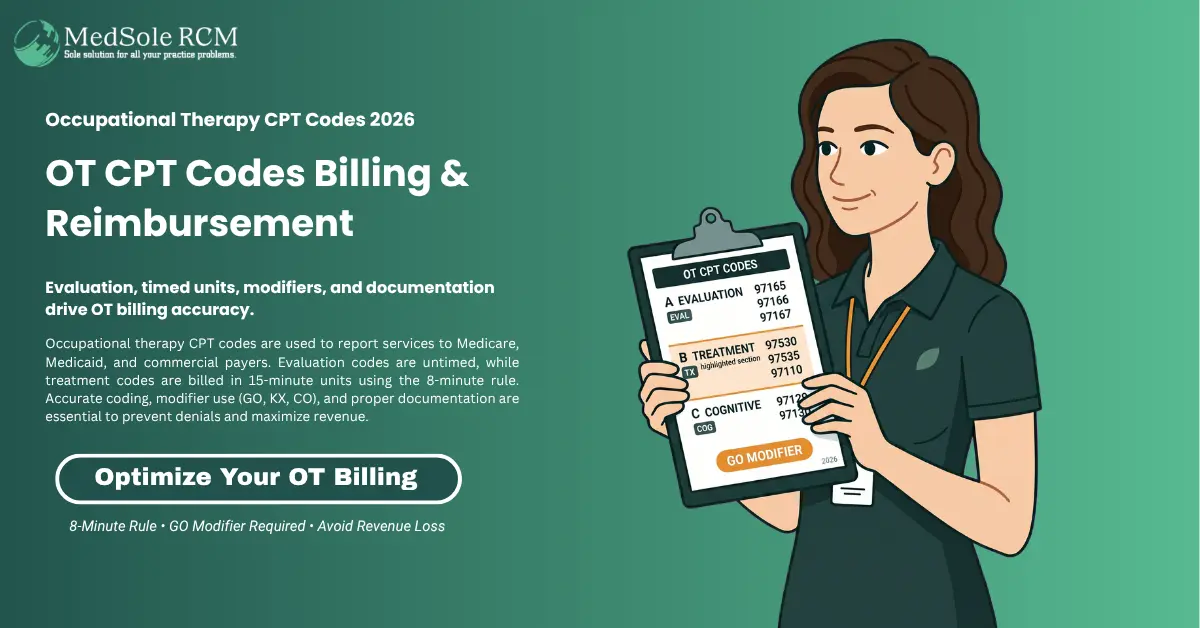




Quick Facts: Occupational Therapy CPT Codes 2026
|
Fact |
Detail |
|
Most Common OT CPT Codes |
97165, 97166, 97167, 97168 (evaluation); 97530, 97110, 97535, 97112 (treatment); 97129 (cognitive) |
|
Billing Method |
Evaluation codes are untimed; treatment codes are timed in 15-minute units |
|
8-Minute Rule |
Minimum 8 minutes of direct one-on-one contact required to bill one timed unit |
|
2026 OT Evaluation Rate |
Approximately $98.08 per evaluation code (non-facility national average, CMS CY 2026 MPFS) |
|
2026 97530 Rate Per Unit |
Approximately $34.61 per 15-minute unit (non-facility) |
|
Required Medicare Modifier |
GO modifier required on every Medicare OT service line |
|
KX Modifier Threshold 2026 |
$2,480 for OT (separate from the PT/SLP combined threshold of $2,480) |
|
G2211 Add-On Eligible |
Yes, approximately $16 to $19 additional per qualifying encounter |
|
New RTM Codes 2026 |
98979, 98984, 98985 (2-to-15-day monitoring periods; new revenue opportunity for OT practices) |
|
Revenue Opportunity |
Practices missing G2211 and RTM codes lose thousands of dollars annually in unbilled legitimate revenue |
|
OTA Payment Rate |
85% of standard Part B rate when CO modifier applies |
|
Telehealth |
Extended through December 31, 2027 per Consolidated Appropriations Act 2026 |
Occupational therapy CPT codes are five-digit numeric codes used by occupational therapists and billing specialists to report services to Medicare, Medicaid, and commercial insurance payers. The most frequently used occupational therapy CPT codes fall into five categories: evaluation codes (97165, 97166, 97167, 97168), therapeutic procedure codes (97110, 97112, 97530, 97535, 97537), cognitive intervention codes (97129, 97130), modality codes, and assistive technology codes (97755, 97760). Most treatment codes are timed and billed in 15-minute units using the CMS 8-Minute Rule from the Medicare Claims Processing Manual, Chapter 5.
Four changes to the 2026 CMS Physician Fee Schedule directly affect OT practice revenue. The efficiency adjustment reduces evaluation reimbursement permanently. Three new RTM codes create billing opportunities most practices haven't implemented yet. The KX modifier threshold increased to $2,480. Telehealth was extended through December 31, 2027. Every OT practice that hasn't updated its billing workflow for 2026 is leaving revenue it has already earned sitting on the table.
MedSole RCM's certified billing specialists manage occupational therapy revenue cycles for practices nationwide. Every rate, threshold, and billing rule in this guide is sourced directly from CMS and AOTA documentation. For practices that want a billing team handling all of this at 2.99% of collections, with credentialing starting at $99 per payer, our outsourced medical billing services page explains the complete service structure.
What Are Occupational Therapy CPT Codes and How Are They Used in Billing
Occupational therapy CPT codes are standardized five-digit codes published by the American Medical Association and used to report OT services to insurance payers. Medicare, Medicaid, and most commercial insurers require these codes for reimbursement of all OT services across outpatient, home health, and institutional settings.
The codes appear primarily in the 97000 series (Physical Medicine and Rehabilitation) of the AMA CPT code book, with additional codes in the 96000 series for developmental and behavioral assessments and the 98000 series for Remote Therapeutic Monitoring. That 98000 series represents an active, largely untapped revenue opportunity for OT practices in 2026.
CPT Codes vs. HCPCS Codes for Occupational Therapy
CPT codes, also called Level I HCPCS codes, are five-digit numeric codes published by the AMA. HCPCS Level II codes are alphanumeric codes developed by CMS for services that CPT doesn't capture directly. Most standard OT therapeutic procedures use CPT codes. Government programs use HCPCS G-codes for specific services, including caregiver training when the patient isn't present (G0541, G0542, G0543). The AOTA publishes an annual reference of frequently used OT CPT and HCPCS codes updated for each code year.
Here's why this distinction matters for billing: if your practice bills caregiver training under a standard CPT code because no one differentiated the two systems, that claim will come back denied. The payer isn't wrong. The code selection is.
Timed vs. Untimed OT CPT Codes: The Framework That Determines Your Revenue
Timed OT CPT codes are billed in 15-minute units based on direct patient contact time. Untimed codes are billed once per session regardless of how long that session runs. Your total session revenue depends directly on how precisely you document and capture every eligible timed unit.
That's the framework everything else in this guide builds on. Get it wrong and you're either leaving units on the table or submitting claims that payers will reduce or deny.
Timed vs. Untimed OT CPT Codes: Billing Framework
|
Code Type |
Examples |
How Billed |
Units Per Session |
Revenue Optimization Note |
|
Untimed (evaluation) |
97165, 97166, 97167, 97168 |
Once per evaluation episode |
1 per episode |
Select the highest complexity level your documentation genuinely supports |
|
Timed (treatment) |
97530, 97110, 97535, 97112, 97140 |
Per 15-minute increment |
Multiple based on session length |
Every documented minute above the 8-minute threshold is billable revenue |
|
Timed (group exception) |
97150 |
Once per group member per session |
1 per member |
Billed per group participant, not per total group time; a revenue-efficient format for group OT |
Practices that consistently undercount billable minutes on timed codes, or default to lower complexity levels on untimed codes, leave legitimate revenue behind on every single session. The fix isn't a billing system change. It's documentation precision and code selection discipline applied consistently.
What usually happens in practices where this goes wrong: therapists estimate session time rather than tracking it. They pick 97165 out of habit rather than counting deficits. Nobody catches it because the claim still pays. It just pays less than it should.
OT Evaluation CPT Codes 2026: 97165, 97166, 97167 and 97168 with Revenue Impact Analysis
CMS finalized a permanent minus 2.5% efficiency adjustment to work relative value units for all non-time-based services effective January 1, 2026. All four OT evaluation codes, 97165, 97166, 97167, and 97168, are non-time-based and permanently reduced. The right response isn't accepting lower revenue passively. It's making sure every evaluation is coded at the highest complexity level the documentation can genuinely support, and that every treatment session maximizes billable timed units to offset the evaluation reduction.
OT Evaluation and Re-evaluation Codes: 2025 vs. 2026 Rates with Revenue Recovery Note
|
CPT Code |
Description |
2025 Non-Facility Rate |
2026 Non-Facility Rate |
Rate Change |
Revenue Recovery Action |
|
97165 |
OT Evaluation, Low Complexity |
$100.60 |
Approx. $98.08 |
-$2.52 |
Ensure documentation doesn't understate complexity when three to five deficits are present |
|
97166 |
OT Evaluation, Moderate Complexity |
$100.60 |
Approx. $98.08 |
-$2.52 |
Code 97166 when three to five deficits are documented; don't default to 97165 |
|
97167 |
OT Evaluation, High Complexity |
$100.60 |
Approx. $98.08 |
-$2.52 |
Document the specific modifications required; complexity justification must be explicit |
|
97168 |
OT Re-evaluation |
$69.54 |
Approx. $67.80 |
-$1.74 |
Bill when significant change is documented; missed re-evaluations are missed revenue |
Source: CMS CY 2026 Medicare Physician Fee Schedule Final Rule. Non-facility national average (MAC 0000000). Rates vary by locality.
CPT 97165: OT Evaluation, Low Complexity
CPT 97165 is an untimed occupational therapy evaluation code used when a patient presents with one to two performance deficits, requires minimal to no modification of assessment tasks, and involves straightforward clinical decision-making. The evaluation typically requires approximately 30 minutes and includes a brief review of the occupational profile and relevant medical history. CPT 97165 is billed once per evaluation episode, never in multiple units, and requires the GO modifier under Medicare Part B. The 2026 Medicare non-facility reimbursement rate is approximately $98.08, subject to locality adjustment. Source: CMS CY 2026 MPFS; AOTA 2026 Frequently Used OT CPT/HCPCS Codes.
This code is the most underused of the three evaluation levels because it represents a genuinely simple presentation. The revenue risk isn't overcoding 97165. It's coding 97165 for a patient who actually has three to five documented deficits. That's undercoding, and it costs real money with zero compliance benefit.
When to use 97165:
-
One isolated functional limitation affecting a single joint or body system
-
Assessment requires no modification to complete
-
Clinical decisions are straightforward with one to two treatment recommendations
-
Medical history review is brief and focused on the presenting problem
Documentation requirements for 97165:
-
Occupational profile addressing the presenting problem
-
Standardized assessment results identifying one to two performance deficits
-
Brief medical history as it relates to the presenting problem
-
Treatment recommendations based on assessment findings
-
Total evaluation time documented
CPT 97166: OT Evaluation, Moderate Complexity
CPT 97166 is an untimed occupational therapy evaluation code used when a patient presents with three to five performance deficits, requires minimal to moderate modification of assessment tasks, and involves moderate clinical decision-making. The evaluation typically requires approximately 45 minutes and includes an expanded review of the occupational profile, medical history, and relevant comorbid conditions. CPT 97166 is billed once per evaluation episode with the GO modifier under Medicare Part B. The 2026 Medicare non-facility reimbursement rate is approximately $98.08. Source: AOTA 2026 Frequently Used OT CPT/HCPCS Codes; CMS CY 2026 MPFS.
This is the most commonly used OT evaluation code and, consistently, the most commonly undercoded. Practices that habitually select 97165 for patients with three or four comorbidities affecting function aren't protecting themselves from scrutiny. They're just getting paid less. In 2026, the rate is identical across all three complexity levels, which makes undercoding a pure revenue loss with no offsetting benefit.
When to use 97166:
-
Multiple comorbid conditions affecting occupational performance across three to five domains
-
Evaluation requires minimal to moderate task modification or therapist assistance
-
More thorough review of medical and therapy records is necessary
-
Clinical decision-making involves several treatment option considerations
Documentation requirements for 97166:
-
Expanded occupational profile including relevant social and environmental factors
-
Review of cognitive, physical, and psychosocial factors affecting function
-
Standardized assessments identifying three to five performance deficits
-
Multiple treatment recommendations with clinical rationale for each
CPT 97167: OT Evaluation, High Complexity
CPT 97167 is an untimed occupational therapy evaluation code used when a patient presents with five or more performance deficits, requires moderate to maximal modification of assessment tasks, and involves complex clinical decision-making. The evaluation typically requires 60 minutes or more and includes a comprehensive review of the occupational profile, all relevant medical and therapy histories, and physical, cognitive, and psychosocial factors. CPT 97167 is billed once per evaluation episode with the GO modifier under Medicare Part B. The 2026 Medicare non-facility reimbursement rate is approximately $98.08. Source: AOTA 2026 Frequently Used OT CPT/HCPCS Codes; CMS CY 2026 MPFS.
Providers working with neurological patients, post-surgical patients with multiple complications, or complex geriatric presentations consistently undercode 97167 for one specific reason: the evaluation note implies five or more deficits through the diagnosis but doesn't state them explicitly. The documentation must say "five or more performance deficits" and must identify the degree of modification required. Diagnosis codes alone don't establish complexity for billing purposes.
When to use 97167:
-
Neurological, orthopedic, or complex medical conditions with multiple functional limitations
-
Therapist provides a high degree of task modification or assistance throughout the evaluation
-
Clinical decision-making requires analysis across multiple body systems
-
Evaluation requires consultation with other providers or extensive record review
CPT 97168: OT Re-evaluation
CPT 97168 is an untimed occupational therapy re-evaluation code used when a patient demonstrates a significant change in functional status that requires a revised plan of care. This isn't a routine progress note. It requires a documented, clinically significant change that genuinely alters the course of treatment. CPT 97168 is billed once per re-evaluation episode with the GO modifier. The 2026 Medicare non-facility reimbursement rate is approximately $67.80. Source: AOTA 2026 Frequently Used OT CPT/HCPCS Codes; CMS CY 2026 MPFS.
Many practices miss 97168 entirely when a patient's status changes, particularly after a hospitalization, an acute exacerbation, or a return from a skilled facility. A missed re-evaluation is approximately $67.80 in uncaptured revenue per qualifying episode, plus a missed opportunity to reset the plan of care with the documentation support that protects the rest of the claim series.
97165 vs. 97166 vs. 97167: Revenue-Optimized Code Selection
OT Evaluation Code Selection: Complexity Criteria and Revenue Decision Framework
|
Factor |
97165 Low Complexity |
97166 Moderate Complexity |
97167 High Complexity |
|
Performance Deficits |
1 to 2 |
3 to 5 |
5 or more |
|
Task Modification Required |
None to minimal |
Minimal to moderate |
Moderate to maximal |
|
Medical History Review |
Brief, focused |
Expanded, includes comorbidities |
Comprehensive, all systems |
|
Clinical Decision-Making |
Straightforward |
Moderate complexity |
High complexity |
|
Typical Duration |
Approximately 30 minutes |
Approximately 45 minutes |
60 minutes or more |
|
2026 Non-Facility Rate |
Approximately $98.08 |
Approximately $98.08 |
Approximately $98.08 |
|
GO Modifier Required |
Yes |
Yes |
Yes |
|
Revenue Optimization Rule |
Count documented deficits first; if three or more are present, don't default to 97165 |
Don't move to 97167 without five or more deficits explicitly documented |
Document modification degree explicitly; it's the key differentiator from 97166 |
Count the documented performance deficits before selecting the evaluation code. Write "one to two performance deficits" or "three to five performance deficits" explicitly in the evaluation note. If the patient required assistance to complete assessments, document the degree of modification required. These aren't audit requirements. They're the billing-support facts that determine what your practice gets paid per evaluation.
Evaluation code complexity errors are among the most consistent sources of preventable revenue loss in occupational therapy billing. MedSole RCM's billing specialists review evaluation code selection on every claim before submission. Our outsourced medical billing services are available at 2.99% of collections: one flat rate, no hidden fees, no per-code upsells.
Complete 2026 Occupational Therapy CPT Code List with CMS Reimbursement Rates
Accurate 2026 reimbursement data is the operational foundation of OT revenue cycle management. The tables below reflect 2026 Medicare non-facility rates from the CMS Physician Fee Schedule Search Tool using national average payment (MAC 0000000). Rates include the CY 2026 efficiency adjustment and the revised conversion factor of $33.4009 (non-QP) and $33.5675 (QP). Verify your specific locality rate at the CMS Physician Fee Schedule Search Tool before submitting claims. Commercial and Medicaid rates differ.
Rate Disclaimer: All rates are subject to Multiple Procedure Payment Reduction (MPPR), geographic locality adjustments, and payer-specific contractual variations. Rates shown are national non-facility averages. Facility rates are lower. Always verify rates for your specific MAC locality before billing.
OT Evaluation and Re-evaluation Codes: 2026 Rates
These four codes drive the majority of OT evaluation revenue. The 2026 efficiency adjustment hit all four permanently. Accurate complexity selection is now the primary lever for protecting evaluation revenue per episode.
|
CPT Code |
Description |
Timed |
2025 Rate |
2026 Rate |
Revenue Note |
|
97165 |
OT Evaluation, Low Complexity |
No |
$100.60 |
Approx. $98.08 |
Code at the highest complexity level your documentation supports |
|
97166 |
OT Evaluation, Moderate Complexity |
No |
$100.60 |
Approx. $98.08 |
Most underused moderate complexity code; don't default to 97165 |
|
97167 |
OT Evaluation, High Complexity |
No |
$100.60 |
Approx. $98.08 |
Requires documented five or more deficits and explicit task modification degree |
|
97168 |
OT Re-evaluation |
No |
$69.54 |
Approx. $67.80 |
Frequently missed; bill when significant change in status is documented |
OT Therapeutic Procedure Codes: 2026 Rates
Timed therapeutic codes are where session revenue is built or lost. Each unit requires the GO modifier under Medicare. Documentation must state the specific therapeutic parameters, the functional goal, and the patient's response to treatment.
|
CPT Code |
Description |
Timed |
2026 Rate Per Unit |
Revenue Note |
|
Therapeutic Exercise |
Yes |
Approx. $28.79 |
GO modifier required; document therapeutic parameters for each unit |
|
|
Neuromuscular Re-education |
Yes |
Approx. $32.02 |
GO modifier; document movement, balance, or proprioception focus specifically |
|
|
97113 |
Aquatic Therapy with Exercises |
Yes |
Approx. $36.55 |
GO modifier; higher rate than land-based exercise; don't overlook this in aquatic OT |
|
97116 |
Gait Training |
Yes |
Approx. $27.00 |
GO modifier; document specific gait deficits and measurable goals |
|
97124 |
Massage |
Yes |
Approx. $20.00 |
GO modifier; lowest-paying therapeutic code; pair with functional codes when clinically appropriate |
|
Manual Therapy Techniques |
Yes |
Approx. $27.17 |
NCCI edit pairs with 97530; modifier may be required on same-day claims |
|
|
97150 |
Group Therapeutic Procedures |
No |
Approx. $17.47 |
Per group member per session; revenue-efficient format for group OT delivery |
|
Therapeutic Activities |
Yes |
Approx. $34.61 |
Highest-billing treatment code; document the functional goal and skilled rationale |
|
|
97533 |
Sensory Integrative Techniques |
Yes |
Verify with MAC |
GO modifier; pediatric and sensory processing focus; MAC coverage varies |
|
97535 |
Self-Care/Home Management Training |
Yes |
Approx. $32.02 |
Activities of daily living and IADL training; document the specific independence goal |
|
97537 |
Community/Work Reintegration |
Yes |
Approx. $31.70 |
GO modifier; document the specific community or work skill being addressed |
|
97542 |
Wheelchair Management |
Yes |
Approx. $30.73 |
GO modifier; document wheelchair type, patient limitations, and training goal |
OT Cognitive, Specialty, and Assessment Codes: 2026 Rates
Cognitive and specialty codes are frequently underbilled in OT practices, particularly in neurological and pediatric settings. Several of these carry reporting requirements that must be in the documentation before the claim is submitted.
|
CPT Code |
Description |
Timed |
2026 Rate |
Revenue Note |
|
97129 |
Cognitive Function Intervention, Initial 15 min |
Yes |
Verify with CMS |
Apply GO modifier; strong demand in neurological OT; verify MAC coverage |
|
97130 |
Cognitive Function Intervention, Each Additional 15 min |
Yes |
Verify with CMS |
Add-on to 97129; capture all documented minutes of cognitive intervention |
|
97750 |
Physical Performance Test |
No |
Approx. $33.32 |
Written report required; don't bill without documentation of report |
|
97755 |
Assistive Technology Assessment |
No |
Approx. $37.52 |
Written report required; frequently missed in assistive technology OT practice |
|
96112 |
Developmental Test Administration, First 60 min |
No |
Approx. $127.12 |
Highest-paying pediatric OT code; requires standardized assessment tool |
|
96113 |
Developmental Test Administration, Each Additional 30 min |
No |
Approx. $53.37 |
Add-on to 96112; capture extended evaluation time when documented |
|
96125 |
Standardized Cognitive Performance Testing, Per 60 min |
No |
Approx. $99.63 |
Written report required; strong revenue opportunity in cognitive OT |
|
96127 |
Brief Emotional/Behavioral Assessment |
No |
Approx. $4.53 |
Low individual rate; frequently billable in volume; don't overlook the cumulative impact |
OT Caregiver Training and 2026 G-Codes: Revenue Opportunity
Caregiver training codes are among the most systematically under-billed in occupational therapy. If your practice provides any instruction to family members, caregivers, or home health aides during an OT episode, these codes apply. At approximately $52 per initial session and $25.55 per add-on, a practice delivering caregiver training at 40 episodes per month is missing approximately $2,080 to $2,600 monthly if these codes aren't billed.
|
CPT/HCPCS Code |
Description |
Timed |
2026 Rate |
Revenue Note |
|
97550 |
Caregiver Training, Initial 30 min (Patient Present) |
No |
Approx. $52.08 |
Frequently missed; bill every eligible caregiver encounter |
|
97551 |
Caregiver Training, Each Additional 15 min |
No |
Approx. $25.55 |
Add-on to 97550; capture extended training time |
|
97552 |
Group Caregiver Training |
No |
Approx. $22.00 |
Per group session; revenue-efficient when training multiple caregivers |
|
G0541 |
Caregiver Training, No Patient Present, Initial 30 min |
No |
Approx. $52.08 |
New in 2025 and 2026; bill when OT trains caregiver without patient present |
|
G0542 |
Caregiver Training, No Patient Present, Each Additional 15 min |
No |
Approx. $25.55 |
Add-on to G0541 |
|
G0543 |
Group Caregiver Training, No Patient Present |
No |
Approx. $22.00 |
New in 2025 and 2026; group format available for no-patient-present training |
OT Orthotic, Prosthetic, Wound Care, and RTM Codes: 2026 Rates
This group includes some of the highest individual code rates in the OT billing schedule and three new RTM codes that most practices haven't implemented. The wound debridement codes in particular are frequently missed in hand therapy settings where they clearly fall within OT scope.
|
CPT Code |
Description |
Timed |
2026 Rate |
Revenue Note |
|
97760 |
Orthotic Management and Training, Initial |
No |
Approx. $45.93 |
Document the specific orthosis type and the functional training goal |
|
97761 |
Prosthetic Training, First Encounter |
No |
Approx. $40.43 |
First encounter billing; document prosthesis type and training objectives |
|
97763 |
Orthotic/Prosthetic Management, Subsequent |
No |
Approx. $50.14 |
Higher rate than 97760; use for follow-up management encounters |
|
97597 |
Wound Debridement, First 20 sq cm |
No |
Approx. $96.72 |
Within OT scope; frequently missed in hand therapy settings |
|
97598 |
Wound Debridement, Each Additional 20 sq cm |
No |
Approx. $43.34 |
Add-on to 97597; capture full wound surface area treated |
|
97610 |
Low Frequency Non-Thermal Ultrasound |
No |
Approx. $397.22 |
Per day; verify MAC coverage before billing |
|
98979 |
RTM Treatment Management, First 10 min Per Month |
No |
Verify with CMS |
New for 2026; revenue opportunity for home exercise monitoring |
|
98985 |
RTM Device Supply, Musculoskeletal, 2 to 15 Days |
No |
Verify with CMS |
New for 2026; shorter monitoring period aligns with typical OT episode length |
|
98984 |
RTM Device Supply, Respiratory, 2 to 15 Days |
No |
Verify with CMS |
New for 2026; respiratory monitoring in home health OT settings |
2026 Major Updates to Occupational Therapy Billing: Revenue Opportunities Every Practice Must Capture
The CMS CY 2026 Medicare Physician Fee Schedule Final Rule introduced five changes affecting occupational therapy billing. Two reduce revenue. Three create new revenue opportunities that most practices haven't implemented. This section covers all five with the specific dollar impact and the action required.
New RTM Codes for 2026: The Revenue Opportunity Most OT Practices Are Missing
CMS designated three new Remote Therapeutic Monitoring codes as "sometimes therapy" effective January 1, 2026, per CMS MLN Matters MM14250. These codes allow occupational therapists to bill for remote monitoring over shorter intervals than previously required, which aligns with realistic outpatient OT episode lengths in a way the prior 16-to-30-day requirement didn't.
|
Code |
Description |
Duration |
Status |
GO Modifier Required |
|
98985 |
RTM device supply, musculoskeletal |
2 to 15 days |
New for 2026 |
Yes |
|
98984 |
RTM device supply, respiratory |
2 to 15 days |
New for 2026 |
Yes |
|
98979 |
RTM treatment management, first 10 min per month |
Monthly |
New for 2026 |
Yes |
|
98977 |
RTM device supply, musculoskeletal |
16 to 30 days |
Revised descriptor |
Yes |
|
98976 |
RTM device supply, respiratory |
16 to 30 days |
Revised descriptor |
Yes |
Here's the practical reality: if your practice provides home exercise programs or remote patient check-ins and you have no RTM billing workflow, that's pure unrecovered revenue with no clinical change required. A practice monitoring 25 patients per month and billing RTM treatment management captures hundreds of dollars monthly that are currently going unbilled. The codes exist. The work is already happening. Only the billing is missing.
Our medical billing services team has implemented RTM workflows for multiple OT practices since the original RTM codes launched. See how it works at our outsourced medical billing services page.
The Minus 2.5% Efficiency Adjustment: How to Offset the Evaluation Revenue Loss
CMS finalized a permanent minus 2.5% efficiency adjustment to work relative value units for all non-time-based services effective CY 2026, per the CMS CY 2026 MPFS Final Rule. OT evaluation codes 97165, 97166, 97167, and 97168 are all non-time-based. They're all permanently reduced.
The revenue math is straightforward. A practice billing 60 moderate-complexity evaluations (97166) per month at the 2025 rate of $100.60 generated $6,036 monthly. At the 2026 adjusted rate of approximately $98.08, that same volume generates $5,885: a monthly reduction of $151, and an annual reduction of $1,812 from this single code alone.
Precise billing of timed treatment codes is now a financial priority, not a documentation courtesy. Every minute of documented direct patient contact that doesn't appear in a timed code claim is permanent unrecovered revenue. That's not an audit issue. It's a math problem.
The 2026 KX Modifier Threshold: $2,480
The KX modifier threshold for occupational therapy services in CY 2026 is $2,480. That threshold is separate from the combined PT/SLP threshold, which is also $2,480. When a Medicare patient's accumulated OT charges reach $2,480 in a calendar year, the KX modifier must be appended to every subsequent OT claim line. Claims over the threshold without the KX modifier are automatically denied. Source: CMS CY 2026 MPFS Final Rule; CMS MLN Matters MM14315.
|
Year |
OT Threshold |
PT/SLP Combined Threshold |
|
2024 |
$2,330 |
$2,330 |
|
2025 |
$2,410 |
$2,410 |
|
2026 |
$2,480 |
$2,480 |
Set automated threshold alerts in your billing system at $2,000 to begin preparing documentation and at $2,480 to trigger KX on every subsequent claim line. Waiting until a claim gets denied to discover you've crossed the threshold costs you the appeal cycle and the cash flow delay.
New OTs joining a practice also need to be enrolled correctly before their charges count toward patient thresholds. Our provider enrollment and credentialing services handle that enrollment workflow so there are no gaps between a therapist's start date and their first billable claim.
G2211 Add-On Code: How to Capture $16 to $19 Per Qualifying Encounter
G2211 became separately payable effective January 1, 2024 and applies to office and outpatient visits where the provider serves as the focal point for ongoing care coordination or manages a serious or complex condition over time. It attaches to base E/M codes 99202 through 99215 and, beginning January 1, 2026, also applies to home visit codes 99341 through 99350. G2211 isn't specialty-restricted. OT practices that maintain ongoing care relationships with patients qualify when the encounter reflects that longitudinal care context.
The revenue math is specific. G2211 adds approximately $16 to $17 per eligible encounter. A practice with 30 qualifying encounters per month that isn't billing G2211 is missing approximately $6,000 in annual revenue with no clinical change required: only a billing workflow addition.
One 2026 rule matters here. G2211 isn't payable when Modifier 25 is appended to the associated E/M code, unless the same-day service is an Annual Wellness Visit, vaccine administration, or Medicare Part B preventive service. Source: CMS CY 2026 MPFS Final Rule; CMS MLN Matters MM13473.
OTA General Supervision: Revenue and Staffing Implications
CMS permanently authorized general supervision for occupational therapy assistants in outpatient private practice settings effective CY 2026. The supervising OT no longer needs to be physically on-site; only available for real-time consultation. When OTA services exceed 10% of session time, the CO modifier must be paired with the GO modifier, and the claim reimburses at 85% of the standard Part B rate. Source: CMS CY 2026 MPFS Final Rule.
Practices that expand OTA staffing under the permanent general supervision rule can serve more patients per OT full-time equivalent, increasing total revenue even at the 85% reimbursement rate for OTA-provided services. That's a staffing efficiency gain that more than offsets the rate differential for most practice volumes.
Telehealth Extended Through December 31, 2027
Under Section 6209 of the Consolidated Appropriations Act 2026, CMS extended Medicare telehealth coverage for occupational therapists through December 31, 2027. All OT telehealth claims require the GO modifier plus Modifier 95 for synchronous audio/video services, or Modifier GT. Source: CMS Therapy Services CY 2026 Updates.
If your practice hasn't built telehealth billing into a standard workflow, the extension gives you two full years to do it. Practices that treat telehealth as a temporary accommodation rather than a billable service type are consistently leaving eligible revenue uncaptured.
OT Billing Units and the 8-Minute Rule: How to Capture Maximum Revenue Per Session
Most occupational therapy CPT codes are timed and billed in 15-minute units. To bill one unit under Medicare, the therapist must provide at least 8 minutes of direct one-on-one patient contact for that specific service. This is the CMS 8-Minute Rule, established in the CMS Medicare Claims Processing Manual, Chapter 5. Untimed codes such as OT evaluations are billed once per session regardless of duration.
The 8-Minute Rule Unit Calculation Table for OT Billing
The table below is the reference your billing staff should have posted at every workstation. Unit miscalculation is one of the most common sources of systematic underpayment on timed OT codes, and it's preventable with a simple reference check.
OT Billing Units Calculator: 8-Minute Rule Reference
|
Minutes of Direct One-on-One Contact |
Billable Units |
|
Fewer than 8 minutes |
0 units; cannot bill |
|
8 to 22 minutes |
1 unit |
|
23 to 37 minutes |
2 units |
|
38 to 52 minutes |
3 units |
|
53 to 67 minutes |
4 units |
|
68 to 82 minutes |
5 units |
|
83 to 97 minutes |
6 units |
|
98 to 112 minutes |
7 units |
|
113 to 127 minutes |
8 units |
Source: CMS Medicare Claims Processing Manual, Chapter 5. Commercial payers may follow AMA unit calculation guidelines, which differ in multi-service sessions.
AMA vs. CMS 8-Minute Rule: The Revenue Difference That Determines Your Billing System Configuration
Here's the thing most practices don't realize until a payer dispute forces the conversation: the CMS 8-Minute Rule and the AMA 8-Minute Rule are not the same. The difference determines how many units your practice can legitimately bill per session, and it means your billing system must apply different rules based on payer type.
Under CMS rules (Medicare and Medicaid): total session time governs total billable units. All timed service minutes are added together, then divided by 15. If the remainder is 8 minutes or more, one additional unit is billable. If it's less than 8, that remainder doesn't convert to a unit.
Under AMA rules (most commercial insurers): each timed service is evaluated independently. Two services provided for 8 minutes each bill as one unit each, for two total units. Under CMS rules, those same 16 combined minutes would produce one unit, because 16 divided by 15 leaves a remainder of one, which is below the 8-minute threshold.
The revenue implication is real. Practices applying a single unit calculation method across both Medicare and commercial claims are either underbilling commercial claims and leaving money behind, or overbilling Medicare claims and creating compliance exposure. Neither outcome is acceptable. The correct approach is payer-specific unit calculation rules configured directly into your billing system.
MedSole RCM configures payer-specific billing rules for every client's practice management setup. Our payment posting team also validates unit counts against payer remittances to catch systematic underpayment on timed codes. Review our AR Follow-Up service to understand how payment-level unit accuracy flows into collections.
Multiple Procedure Payment Reduction and Your Net Revenue Per Session
CMS applies a Multiple Procedure Payment Reduction (MPPR) of 50% to the practice expense component of the second and subsequent "always therapy" services furnished to a patient on the same date. When an OT bills three timed codes in one session, the practice expense RVU component of the second and third codes pays at 50% of the standard rate. The MPPR doesn't affect the work RVU or malpractice expense components. Source: CMS CY 2026 MPFS Final Rule.
MPPR reduces but doesn't eliminate revenue from multi-code sessions. Understanding your net revenue per service combination helps your practice plan efficient session structures that maximize billing per patient encounter. A practice that avoids multi-code sessions to sidestep MPPR is leaving net revenue on the table, because the reduced second-code payment still adds to total session revenue.
Unit calculation errors cost OT practices in two directions simultaneously: underbilled commercial claims and compliance exposure on Medicare claims. MedSole RCM configures payer-specific billing rules and validates unit counts at the payment posting stage. Our provider enrollment and credentialing services also ensure OTAs are enrolled correctly before their services affect your unit calculations. Credentialing starts at $99 per payer.
OT Billing Modifiers 2026: The Complete Reference Guide for Occupational Therapy Claims
Occupational therapy claims submitted to Medicare require the GO modifier on every service line. Missing the GO modifier causes automatic claim denial: the most frequent preventable revenue loss in OT billing. Additional modifiers are required for OTA-provided services (CO), KX threshold claims, telehealth delivery, and certain NCCI edit situations.
OT Billing Modifiers 2026: Complete Reference
|
Modifier |
Full Name |
When Required |
Billing Impact |
|
GO |
Occupational Therapy Plan of Care |
All outpatient Medicare OT service lines |
Missing GO = automatic denial; no revenue recovery without resubmission |
|
CO |
OTA Service |
When OTA provides more than 10% of service time |
Triggers 85% payment rate; must pair with GO modifier |
|
KX |
Medical Necessity Attestation |
When accumulated OT charges exceed $2,480 |
Claims over threshold without KX = automatic denial |
|
59 |
Distinct Procedural Service |
NCCI edit pairs billed on same date of service with documentation of distinct service |
Use only when a more specific X-modifier doesn't apply; overuse is a CMS scrutiny trigger |
|
XS |
Separate Anatomical Structure |
NCCI edit; different anatomical structure treated |
Preferred over 59 when applicable; provides more specific documentation defense |
|
XE |
Separate Encounter |
NCCI edit; different time within same day |
Preferred over 59 for separate encounter documentation |
|
95 |
Synchronous Telehealth |
Real-time audio/video OT services |
Active through December 31, 2027 |
|
GT |
Interactive Telehealth |
Audio/video telehealth |
Required by some commercial payers; verify payer preference before submitting |
|
24 |
Unrelated E/M During Post-Op Period |
New patient visit during another provider's global period |
Document that the visit is unrelated to the surgical diagnosis |
|
52 |
Reduced Service |
Abbreviated procedure |
Document the reason for reduction in the clinical note |
|
GP |
Physical Therapy Plan of Care |
PT services only |
Using GP on an OT claim = immediate denial; wrong discipline modifier |
|
GN |
Speech-Language Pathology Plan of Care |
SLP services only |
Same outcome as GP on an OT claim: denial for wrong discipline |
Source: CMS Medicare Claims Processing Manual, Chapter 5; CMS NCCI Policy Manual; AOTA 2026 Frequently Used OT CPT/HCPCS Codes.
NCCI Edit Pairs in OT Billing: The Revenue Risk of Unbundling Errors
NCCI edits are CMS-established code pairs that typically can't be billed together because one code is considered a component of the other. When both services are genuinely and separately provided, the appropriate modifier must be applied to override the edit. Without the modifier, the second code denies. That's revenue the documentation already supports, lost because of a missing two-character modifier.
Common OT NCCI Edit Pairs and Required Modifiers
|
Code Pair |
Edit Reason |
Required Modifier |
Documentation Required |
|---|---|---|---|
|
Manual therapy and therapeutic activity bundled |
59 or XS |
Different body areas treated; separate time blocks documented |
|
|
Therapeutic exercise and therapeutic activity bundled |
59 |
Distinct services with different functional goals documented |
|
|
Exercise and manual therapy bundled |
59 or XS |
Different anatomical regions documented explicitly |
What usually happens in practices without a pre-submission scrubbing step: the therapist provides manual therapy to the wrist and therapeutic activities for shoulder function in the same session, both services are legitimately documented, and the claim goes out without Modifier XS. One code denies. The revenue was earned. The documentation proves it. But without the modifier, it doesn't get paid.
Modifier errors are the most immediately correctable source of denied OT revenue. They don't require documentation changes. They require pre-submission claim scrubbing. MedSole RCM's billing team catches modifier conflicts before claims reach the payer. Our revenue cycle management service includes real-time modifier validation on every OT claim.
The Most Billed Occupational Therapy Treatment Codes: Revenue-Optimized Billing and Documentation Guide
Treatment codes generate the most OT practice revenue and carry the most documentation risk. A note that fails to capture the functional goal, the skilled rationale, or the timed service distinction doesn't just create exposure: it fails to protect revenue that was legitimately earned. Each code below includes its definition, billing requirements, documentation anchor, and 2026 rate.
CPT 97530: Therapeutic Activities (The Highest-Billing OT Treatment Code)
CPT 97530 is a timed, direct one-on-one occupational therapy code used to report 15-minute units of therapeutic activities designed to improve functional performance in activities of daily living. Activities billed under 97530 are dynamic, multi-joint, purposeful movements that simulate real-world tasks: reaching into an overhead cabinet, practicing a car transfer, lifting a bag of groceries, or performing sequencing tasks for meal preparation. CPT 97530 requires direct one-on-one patient contact, is subject to the Medicare 8-Minute Rule, and must be billed with the GO modifier under a Medicare OT plan of care. The 2026 Medicare non-facility reimbursement rate for CPT 97530 is approximately $34.61 per 15-minute unit. Source: CMS CY 2026 MPFS; AOTA 2026 Frequently Used OT CPT/HCPCS Codes.
CPT 97530 vs. CPT 97110: Billing and Documentation Comparison
|
Factor |
CPT 97530 Therapeutic Activities |
CPT 97110 Therapeutic Exercise |
|
Primary Focus |
Functional multi-joint purposeful movements |
Isolated strength, range of motion, endurance |
|
Example Activities |
ADL simulation, transfers, reaching tasks |
Knee extensions, grip strengthening, ROM arcs |
|
Movement Type |
Dynamic multi-joint real-world functional |
Isolated targeted exercise |
|
Documentation Must State |
Functional goal and skilled OT rationale |
Therapeutic parameters: sets, reps, resistance |
|
Revenue Per Unit (2026) |
Approximately $34.61 |
Approximately $28.79 |
|
Revenue Difference |
97530 pays approximately $5.82 more per unit |
Choose based on what was actually provided |
|
NCCI Edit Conflict |
Yes; paired with 97140 and 97110 |
Yes; paired with 97530 and 97140 |
|
GO Modifier Required |
Yes |
Yes |
The note must state what functional activity was performed, why it required a skilled therapist, and what specific ADL goal it addressed. A note describing isolated exercises rather than functional activities supports 97110, not 97530. That's approximately $5.82 less per unit across every timed treatment session — not because of the clinical work, but because of the documentation language.
CPT 97535: Self-Care and Home Management Training
CPT 97535 is a timed occupational therapy code billed in 15-minute units for instruction in activities of daily living, instrumental activities of daily living, home management skills, and adaptive equipment use to support patient independence. Covered services include training in dressing, grooming, bathing, meal preparation, home safety assessment, money management, and adaptive equipment instruction. CPT 97535 requires the GO modifier under Medicare Part B and is subject to the 8-Minute Rule. The 2026 Medicare non-facility reimbursement rate is approximately $32.02 per unit. Source: CMS CY 2026 MPFS; AOTA 2026 Frequently Used OT CPT/HCPCS Codes.
Here's what gets missed most often: home safety education, adaptive equipment instruction, and caregiver training in specific ADL techniques are all separately billable under 97535. Every time an OT spends 15 documented minutes teaching a patient to use a dressing stick, that's a billable unit. Practices that treat these as incidental services rather than timed billable activities leave real money behind.
CPT 97530 vs. CPT 97535: Quick Comparison
|
Factor |
CPT 97530 |
CPT 97535 |
|
Primary Focus |
Dynamic functional performance |
Independence in self-care and home management |
|
Scope |
Broad functional tasks across settings |
Specifically ADLs, IADLs, and adaptive equipment |
|
Documentation Anchor |
Functional goal and multi-joint movement |
Independence skill-building and adaptive strategy |
|
2026 Medicare Rate |
Approximately $34.61 per unit |
Approximately $32.02 per unit |
|
Revenue Choice |
Use when the task is functional and multi-joint |
Use when the task is specifically self-care or home management |
CPT 97112: Neuromuscular Re-education
CPT 97112 is a timed occupational therapy code billed in 15-minute units for neuromuscular re-education of movement, balance, coordination, kinesthetic sense, posture, and proprioception for sitting and standing activities. This code is most frequently used for patients recovering from stroke, traumatic brain injury, Parkinson's disease, and other neurological conditions affecting motor control. GO modifier required under Medicare. The 2026 Medicare non-facility rate is approximately $32.02 per unit. Source: CMS CY 2026 MPFS.
Documentation makes or breaks a 97112 claim. "Patient performed balance activities" doesn't support this code as clearly as "proprioceptive re-training for weight-bearing tolerance in preparation for ambulation to the bathroom." The specific neuromuscular deficit, the technique used, and the functional goal must all appear in the note. Without those three elements, the claim is vulnerable.
CPT 97110: Therapeutic Exercise
CPT 97110 is a timed occupational therapy code billed in 15-minute units for therapeutic exercises developing strength, endurance, range of motion, and flexibility. It covers targeted, skill-based exercise requiring skilled OT design, instruction, and modification. This code isn't appropriate for exercises a patient can perform independently or with unskilled supervision. The 2026 Medicare non-facility rate is approximately $28.79 per unit. GO modifier required.
97110 pays less than 97530, at $28.79 versus $34.61 per unit. But it's the correct code when the service is isolated therapeutic exercise rather than a functional activity. Billing 97530 for a session of isolated resistance exercise to capture the higher rate creates compliance exposure that costs far more than the $5.82 per-unit difference. Code what was actually provided.
CPT 97140: Manual Therapy Techniques
Yes, CPT 97140 is used in occupational therapy. CPT 97140 is a timed code billed in 15-minute units for manual therapy techniques including joint mobilization, manual lymphatic drainage, manual traction, and soft tissue mobilization. Occupational therapists use 97140 most frequently in hand therapy, upper extremity rehabilitation, scar management, and lymphedema treatment. GO modifier required under Medicare. The 2026 Medicare non-facility rate is approximately $27.17 per unit. Source: CMS CY 2026 MPFS; AMA CPT Professional Edition.
When 97140 and 97530 are both provided in the same session to different anatomical areas, Modifier 59 or XS is required to bill both codes. Without the modifier, one code denies. That's revenue the documentation already supports: it's not a documentation failure. It's a modifier configuration issue that pre-submission scrubbing catches every time.
CPT 97150: Group Therapeutic Procedures
CPT 97150 is an untimed occupational therapy code billed once per patient per group session for therapeutic procedures provided to two or more patients simultaneously. It's not time-based and not subject to the 8-Minute Rule. Bill per group member, not per total group duration. The therapist must provide individualized instruction to each group member during the session. The 2026 Medicare non-facility rate is approximately $17.47 per session per patient. GO modifier required.
Group sessions generate lower per-patient revenue than individual treatment codes, but they allow the practice to serve multiple patients within the same therapist time block. For high-volume OT practices, group formats for appropriate patient populations, such as hand therapy maintenance groups, cognitive skill groups, and balance training cohorts, improve revenue per therapist hour even at the lower individual rate.
CPT 97129 and 97130: Cognitive Function Intervention
CPT 97129 is a timed occupational therapy code for therapeutic intervention targeting cognitive function including attention, memory, reasoning, executive function, and compensatory strategies for daily activities. It covers the initial 15 minutes of direct one-on-one contact. CPT 97130 is the add-on code for each additional 15 minutes of the same service, billed alongside 97129. These codes serve patients with traumatic brain injury, stroke, dementia, ADHD, and cognitive processing disorders. GO modifier required under Medicare. Source: AOTA 2026 Frequently Used OT CPT/HCPCS Codes.
Every additional 15 minutes of documented cognitive intervention beyond the initial 97129 unit is billable as 97130. Practices that bill only 97129 for a 45-minute cognitive session are missing two additional units of 97130. At the going rate, that's approximately $64 per session in uncaptured revenue: per patient, per session, week after week.
Documentation that doesn't capture the distinction between functional activities and therapeutic exercise, or that misses add-on code units for cognitive intervention, costs your practice real revenue every single week. MedSole RCM reviews every OT treatment code for billing accuracy before submission. Our outsourced medical billing services are available at 2.99% of collections: one flat rate, no per-code fees, no per-session surcharges.
Occupational Therapy CPT Codes by Clinical Setting and Patient Population: A Revenue Guide
The OT billing codes that apply to any given session depend not just on what the therapist does but on who the patient is and where the service is delivered. Reimbursement rules, modifier requirements, and code applicability vary across outpatient clinics, home health settings, pediatric practices, hand therapy programs, and workers compensation cases.
Pediatric Occupational Therapy CPT Codes and Revenue Considerations
Pediatric OT billing uses both the standard 97000-series treatment codes and specialized developmental testing codes in the 96000 series. The 96112 and 96113 codes are the highest-reimbursed codes in pediatric OT and generate significant revenue when appropriate patient presentations support their use.
Pediatric OT CPT Code Reference
|
CPT Code |
Description |
Timed |
2026 Rate |
Revenue Note |
|
96112 |
Developmental Test Administration, First 60 min |
No |
Approx. $127.12 |
Highest-paying pediatric OT code; requires standardized assessment tool |
|
96113 |
Developmental Test Administration, Each Additional 30 min |
No |
Approx. $53.37 |
Add-on to 96112; capture all extended evaluation time when documented |
|
96127 |
Brief Emotional/Behavioral Assessment |
No |
Approx. $4.53 |
Low individual rate; frequently billable across high patient volume |
|
97533 |
Sensory Integrative Techniques |
Yes |
Verify with MAC |
Sensory processing disorders; verify coverage per MAC before billing |
|
97530 |
Therapeutic Activities |
Yes |
Approx. $34.61/unit |
ADL skill development for pediatric populations |
|
97535 |
Self-Care Training |
Yes |
Approx. $32.02/unit |
Independence skill-building in activities of daily living |
|
97129 |
Cognitive Function Intervention |
Yes |
Verify with MAC |
Executive function, attention, pragmatic communication |
Medicaid is frequently the primary payer for pediatric OT. Prior authorization requirements and reimbursement rates vary significantly by state Medicaid program, and practices billing across multiple state plans need payer-specific authorization tracking and eligibility verification at every visit. A denial based on missing authorization in a pediatric Medicaid claim is one of the most frustrating revenue losses because the service was unquestionably medically necessary and the documentation is clean. The problem is entirely administrative.
MedSole RCM manages prior authorization for pediatric OT practices across multiple state Medicaid programs. Our provider enrollment and credentialing services support the full enrollment and authorization workflow for pediatric OT billing.
Occupational Therapy CPT Codes for Autism Spectrum Disorder
Occupational therapy for autism spectrum disorder (ICD-10: F84.0) most commonly uses sensory integration, developmental testing, therapeutic activities, and cognitive intervention codes. Coverage depends on whether the service is provided under an OT plan of care or a behavioral health plan, and that distinction determines both the applicable code set and the payer routing.
OT CPT Codes for Autism Spectrum Disorder
|
CPT Code |
Description |
Primary Role in ASD Treatment |
|
97533 |
Sensory Integrative Techniques |
Primary intervention for sensory processing difficulties |
|
96112 |
Developmental Test Administration |
Comprehensive developmental and adaptive behavior evaluation |
|
97530 |
Therapeutic Activities |
Functional skill development through play-based activity |
|
97129 |
Cognitive Function Intervention |
Executive function, pragmatic communication, attention |
|
97535 |
Self-Care Training |
ADL independence and self-care routine building |
|
96127 |
Brief Emotional/Behavioral Assessment |
Behavioral screening and brief assessment tool administration |
One issue that comes up constantly with ASD billing: some payers carve behavioral health out to a separate plan that doesn't cover OT services under the same authorization. Verifying which plan governs OT versus behavioral services at the start of every episode prevents the mid-series denial that disrupts both cash flow and the patient's care continuity.
Hand Therapy CPT Codes: The Highest-Revenue OT Specialty Setting
Hand therapy OT generates the most complex and highest-revenue code combinations of any OT specialty. Manual therapy, orthotic management, wound care, and therapeutic exercise frequently co-occur in the same session, which makes modifier awareness and NCCI edit management critically important. One missed modifier on a hand therapy claim can wipe out more revenue than a full day of general OT billing.
Hand Therapy OT Code Combinations and Revenue Notes
|
Clinical Focus |
Primary CPT Codes |
Revenue Note |
|
Post-surgical hand |
97140, 97530, 97760, 97110 |
NCCI modifier required when 97140 and 97530 are on the same date of service |
|
Wound care |
97597, 97598, 97140 |
97597 generates approximately $96.72; frequently missed in hand therapy |
|
Orthotic management |
97760, 97763 |
Bill 97760 for initial encounter; use 97763 for follow-up management |
|
Scar management |
97140, 97530 |
Document anatomical areas distinctly to support NCCI modifier use |
|
Lymphedema treatment |
97140, 97530, 97016 |
Manual lymphatic drainage bills under 97140; frequently left uncoded |
|
Splinting |
97760 |
Document splint type, functional goal, and patient instructions provided |
Wound debridement codes (97597, 97598) fall within OT scope and generate approximately $96.72 for the first 20 square centimeters. If your hand therapy practice performs wound debridement and isn't billing 97597, that's nearly $100 per qualifying wound care session going uncaptured. The clinical work is already being done. The billing workflow is the only missing piece.
Home Health OT CPT Codes: Medicare Part A vs. Part B Billing
Home health OT billing follows Medicare Part A or Part B rules depending on whether the patient is under an active home health certification period. Under Part A, OT is typically bundled into the home health episode payment. Under Part B, OT services are billed separately using the same code set with the GO modifier. That distinction determines how you bill and who you bill to.
The issue is that practices sometimes submit Part B claims for patients who are still under an active Part A home health certification. The claim rejects. It's not a coding error or a documentation failure; it's a payer routing error. Verifying Medicare enrollment status and active certification status before each episode prevents this entirely. Source: CMS Medicare Benefit Policy Manual, Chapter 15.
Occupational Therapy CPT Codes for Workers Compensation and Work Reintegration
Workers compensation OT generates higher reimbursement per session than most commercial insurance because work rehabilitation code combinations create high-revenue session structures. CPT 97537 (community and work reintegration) reimburses at approximately $31.70 per unit and is among the most underused codes in outpatient OT. Paired with 97530 and 97110, a work rehabilitation session bills at rates that often exceed standard outpatient OT by a significant margin.
Workers compensation payers typically reimburse at rates above Medicare, sometimes ranging from 150% to 250% of Medicare rates depending on state fee schedules. Practices providing work rehabilitation OT that aren't enrolled with workers compensation carriers are missing a high-rate payer category entirely. Provider enrollment with workers comp payers opens revenue that standard Medicare-focused billing workflows leave completely untouched.
ICD-10 Diagnosis Codes That Support Occupational Therapy Billing: A Revenue-Optimized Pairing Reference
Medicare and most commercial insurers cover occupational therapy when the treating diagnosis establishes medical necessity for skilled OT services. The ICD-10 code submitted on the claim must support the functional limitation being treated and align with the CPT codes billed. The pairings below reflect the most accepted diagnostic and procedural combinations in OT billing.
The ICD-10 code alone doesn't guarantee coverage. Documentation must establish that the patient's condition requires skilled occupational therapy services and that the patient has the potential to make functional progress. Source: CMS Medicare Benefit Policy Manual, Chapter 15, Section 220.
ICD-10 Codes Supporting OT Billing: Revenue-Optimized Pairing Reference
|
Diagnosis |
ICD-10 Code |
Primary OT CPT Codes |
Revenue Documentation Note |
|
ADHD, combined type |
F90.2 |
96127, 97129, 97530 |
Document attentional deficits and their functional impact on ADL performance; link cognitive codes to a specific functional goal |
|
Developmental coordination disorder |
F82 |
97530, 97533, 96112 |
Strongest pediatric case for 96112 developmental testing at $127.12; document motor coordination deficits specifically |
|
Hand crush injury |
S67.x |
97140, 97760, 97530, 97110 |
Document anatomical structures involved; Modifier 59 or XS required when 97140 and 97530 are billed on the same date of service |
|
Lateral epicondylitis |
M77.1 |
97140, 97530, 97110 |
High-volume workers comp diagnosis; document eccentric exercise for 97530 versus isolated strengthening for 97110 |
|
Lymphedema |
I89.0 |
97140, 97530, 97016 |
Manual lymphatic drainage bills under 97140; document drainage technique, region treated, and volume reduction specifically |
|
Essential tremor |
G25.0 |
97112, 97530, 97535 |
Neuromuscular re-education (97112) for tremor management; link each unit to an ADL goal such as writing, feeding, or grooming |
|
Macular degeneration (low vision OT) |
H35.31 |
97535, 97755 |
Assistive technology assessment (97755) at approximately $37.52 is frequently missed in low vision OT; written report required |
|
Cognitive disorder, unspecified |
F09 |
97129, 97130, 97535 |
Document specific cognitive deficits: attention, memory, executive function; link each 97130 add-on unit to continued skilled cognitive work |
|
Psoriasis vulgaris |
L40.0 |
97140, 97530, 97760 |
Hand OT for skin integrity and occupational performance; document body surface area involved and specific ADL limitations |
|
Burn injury, partial thickness |
T30.x |
97140, 97597, 97760 |
Wound debridement at $96.72 is frequently missed; document wound size in square centimeters for correct 97597 versus 97598 selection |
|
Contracture of joint |
M24.5 |
97140, 97530, 97110 |
Specify which joint and the degree of limitation; document the functional goal that contracture release directly addresses |
|
Obesity with comorbidities |
E66.x |
97530, 97535 |
Functional mobility and ADL training for bariatric OT; document specific ADL limitations and adaptive equipment needs |
Wrong ICD-10 code submission, particularly using unspecified codes when a more specific code is clearly documented in the clinical record, is a common source of CO-11 denials. That denial reason means the diagnosis submitted is inconsistent with the procedure billed. The clinical work was done. The documentation exists. The revenue was earned. A coding mismatch takes it away entirely.
MedSole RCM includes ICD-10 to CPT pairing validation in our claim scrubbing process. When pairing errors slip through on previously submitted claims, our denial management services recover that revenue through targeted appeal workflows.
Seven Revenue Leaks in Occupational Therapy Billing and How to Recover Every Dollar
Most OT practices aren't losing revenue to claim denials. They're losing it silently. The billing workflow processes claims, payments post, and no one flags the thousands of dollars monthly in legitimate revenue that was earned but never captured. The seven revenue leaks below are the most consistent and most quantifiable sources of preventable revenue loss in OT billing.
Revenue Leak 1: Undercoding Evaluation Complexity
Practices billing 97165 (low complexity) for patients who present with three to five performance deficits that clearly support 97166 (moderate complexity) are billing correctly at the lower code: but leaving the higher code's legitimate revenue uncaptured. In 2026, all three evaluation codes pay approximately $98.08 at the national non-facility average, so today's rate difference is minimal.
The real cost is the habit. Defaulting to 97165 builds a documentation pattern that assumes simple presentations even when the clinical picture says otherwise. As CMS continues to differentiate complexity levels in future rule cycles, that habit will cost significantly more.
How to close it: count documented performance deficits before selecting the evaluation code. If the note contains three or more deficits, write them out explicitly and select 97166 or 97167. One sentence does it: "Three performance deficits were identified in [domains]." That sentence is all that separates the right code from the wrong one.
Revenue Leak 2: Missed Timed Units on Treatment Sessions
A practice that uses scheduled appointment time instead of documented treatment time to calculate billing units creates a problem in both directions. A therapist who provides 47 minutes of direct treatment, eight minutes of documentation, and five minutes of discharge planning has 47 billable minutes: three units. But if the note says "60-minute treatment session" without breaking out non-billable time, the claim can't survive scrutiny.
How to close it: document start and end times for each timed service. Record direct treatment time separately from administrative and documentation time. The AMA allows non-face-to-face time in total time calculations when those activities are specifically documented. Capture every eligible minute. Don't estimate.
Revenue Leak 3: G2211 Not Being Billed
G2211 adds approximately $16 to $17 per qualifying Medicare encounter. A practice with 30 qualifying encounters per month where ongoing care relationships are established is missing approximately $6,000 annually. That's with no change in clinical activity: only a billing workflow addition.
How to close it: add G2211 to the claim when the encounter reflects an ongoing care relationship and the OT serves as the focal point for the patient's care coordination. Document the longitudinal care intent in the note. Confirm the Modifier 25 interaction rule before billing: G2211 isn't payable with Modifier 25 unless the same-day service is an Annual Wellness Visit, vaccine administration, or Medicare Part B preventive service.
Revenue Leak 4: RTM Revenue Not Implemented
The three new 2026 RTM codes (98979, 98984, 98985) for two-to-15-day monitoring periods apply to OT practices providing home exercise programs and remote patient check-ins. Practices delivering these services without a billing workflow are completing the clinical work and capturing zero reimbursement for the monitoring component.
How to close it: implement an RTM billing workflow. RTM requires a connected digital monitoring device, documented patient consent, and a minimum data collection period. The billing workflow adds RTM codes to claims for eligible patients. No clinical change is required. The work is already happening.
Revenue Leak 5: Caregiver Training Codes Never Billed
CPT 97550 (initial 30-minute caregiver training with patient present) pays approximately $52.08. G0541 (initial 30-minute caregiver training without patient present) also pays approximately $52.08. A practice with 40 qualifying caregiver encounters per month that isn't coding these services is missing approximately $2,080 to $2,600 monthly.
How to close it: add a caregiver training checkbox to the session note template. Every time the therapist instructs a family member, caregiver, or home aide in a patient-specific technique, that's a billable service. It doesn't require a separate visit. It requires a code.
Revenue Leak 6: Wound Debridement Codes Not Used in Hand Therapy OT
CPT 97597 (wound debridement, first 20 square centimeters) pays approximately $96.72. Hand therapy OT practices that perform wound care and don't bill 97597 are losing nearly $100 per qualifying wound care session. The clinical scope is there. The documentation typically supports it. The billing step is missing.
How to close it: verify that wound debridement is within your state's OT scope of practice. If it is, ensure your billing team codes 97597 for every qualifying wound care encounter and 97598 as an add-on for wounds exceeding 20 square centimeters. Document wound size in square centimeters in the clinical note to support code selection.
Revenue Leak 7: Credentialing Gaps Delaying or Blocking Revenue
A new OT or OTA who isn't fully enrolled with every payer in your network generates claims that hold or deny pending credentialing verification. A 30-day credentialing gap for a full-time OT billing six units per session, five sessions per day, at approximately $34 per unit represents approximately $24,480 in held or lost revenue per month: from a single incomplete credentialing application.
How to close it: start the credentialing process before the provider's first day of clinical service. Use a credentialing service that manages the full application timeline and tracks enrollment status across every active payer. Ninety days before the start date is the right window for most commercial payers. Medicare credentialing timelines can run longer.
MedSole RCM's provider credentialing starts at $99 per payer enrollment. We manage the full application process across Medicare, Medicaid, and all major commercial payers, and we track enrollment status so credentialing gaps don't turn into revenue gaps. Our provider enrollment and credentialing services page explains the full process.
Seven Revenue Leaks in OT Billing: Quick Reference
|
Revenue Leak |
Monthly Impact |
Fix |
|
Undercoding evaluation complexity |
Variable by session volume |
Document deficit count explicitly before selecting the code |
|
Missed timed units |
Varies by session volume |
Document start and stop times per service, not appointment block time |
|
G2211 not billed |
Approx. $480 per 30 qualifying encounters |
Add G2211 workflow for ongoing care patients |
|
RTM revenue not implemented |
Variable by patient panel |
Implement RTM billing workflow for home exercise patients |
|
Caregiver training codes missed |
Approx. $2,080 to $2,600 per 40 sessions |
Add caregiver training codes to session note checklist |
|
Wound debridement uncoded |
Approx. $96.72 per qualifying wound session |
Bill 97597 for all qualifying wound debridement encounters |
|
Credentialing gaps |
Up to $24,480 per month per uncredentialed OT |
Start credentialing 90 days before provider start date |
Every revenue leak described above is preventable with the right billing partner. MedSole RCM's certified OT billing specialists implement the code additions, modifier configurations, and documentation workflows that close each one of these gaps. Our outsourced medical billing services run at 2.99% of collections: a flat rate covering claim submission, denial management, AR Follow-Up, and payment posting. If your OT practice's denial rate exceeds 5% or you haven't implemented RTM and G2211 billing, a free revenue analysis identifies exactly where your collections are falling short. Reach out to schedule one.
Medicare Occupational Therapy Billing Rules 2026: Coverage Requirements, Authorization, and Compliance
Does Medicare Cover Occupational Therapy Services in 2026?
Yes. Medicare Part B covers occupational therapy services in 2026 when they are medically necessary, provided under a written plan of care established or reviewed by a physician or non-physician practitioner, and furnished by a qualified occupational therapist or a supervised OTA. Coverage applies in outpatient settings, home health, and skilled nursing facilities.
Coverage requires that services be skilled: meaning they require the professional training and judgment of a licensed OT and can't be performed safely or effectively by a non-skilled person. The patient must also demonstrate the potential for functional improvement within a reasonable timeframe. The plan of care must be reviewed at least once every 90 days. Progress toward plan of care goals must be documented at a minimum of once every 10 treatment days. Source: CMS CY 2026 Medicare Physician Fee Schedule Final Rule; CMS Medicare Benefit Policy Manual, Chapter 15, Section 220.
What gets practices into trouble isn't failing to meet the coverage criteria: it's failing to document that the criteria are met. A patient who is genuinely progressing but whose notes read like maintenance care doesn't survive a medical necessity review. The clinical reality and the documentation must match.
Medicare Advantage Prior Authorization for OT Services: The Revenue Risk
Medicare Advantage plans have significantly more restrictive prior authorization requirements than traditional Medicare Part B for occupational therapy services. Prior authorization denial rates for OT under Medicare Advantage have increased each year since 2021. For practices serving large Medicare Advantage populations, this is the single greatest authorization-related revenue risk in the billing workflow.
Before every Medicare Advantage OT episode, verify:
-
Whether the specific MA plan requires prior authorization for OT evaluations
-
Whether authorization is required separately for evaluation and treatment
-
How many visits or units are authorized per certification period
-
What clinical criteria the plan uses to approve continued OT services
-
What the appeal process is when authorization is denied or limited
The issue isn't the clinical work. It's tracking which plan requires what, how much was authorized, and when authorization expires. A practice managing 50 active Medicare Advantage patients across six different plan types has 50 different authorization timelines running simultaneously. Missing one expiration date is a denial that takes three times as long to resolve as it would have taken to prevent.
MedSole RCM manages prior authorization workflows for OT practices across multiple Medicare Advantage plans. Our AR Follow-Up service tracks authorization expiration dates and units remaining for every active patient so authorization-lapse denials don't make it to the claim stage.
OTA Supervision and the 85% Payment Rule
When occupational therapy services are furnished in whole or in part by an OTA at a level exceeding the 10% de minimis threshold, Medicare reimburses the claim at 85% of the otherwise applicable Part B rate. The CO modifier must be paired with the GO modifier on the claim line. General supervision of OTAs in outpatient private practice settings is now permanently authorized as of CY 2026: the supervising OT isn't required to be on-site but must be available for real-time consultation. Source: CMS CY 2026 MPFS Final Rule; CMS Medicare Claims Processing Manual, Chapter 5.
The 85% rate applies to the OTA-provided portion of a session, not the full claim, when the de minimis threshold is crossed. Practices expanding OTA staffing under the permanent general supervision authorization need to ensure their billing system is configured to apply CO correctly on every mixed-service claim. An OTA claim without CO that should carry it is a compliance issue, not just a billing error.
Telehealth OT Billing Under Medicare 2026
Occupational therapists may furnish Medicare telehealth services through December 31, 2027, per Section 6209 of the Consolidated Appropriations Act 2026. All telehealth OT claims require GO plus Modifier 95 for synchronous audio/video services. Modifier GT is required by some commercial payers; verify payer preference before submitting. Telephone assessment codes 98966 through 98968 are included in the telehealth extension.
Document patient consent, the platform name, and confirmation that the medical decision-making or time requirements were met during the synchronous encounter. A telehealth claim without documented consent is a denial waiting to happen. Source: CMS Therapy Services CY 2026 Updates.
How MedSole RCM Manages Occupational Therapy Billing from Evaluation to Payment
Every billing rule, modifier requirement, code selection decision, threshold tracker, and revenue opportunity described in this guide is something your billing team must execute correctly on every claim, for every patient, across every payer, every month. The complexity isn't theoretical: it compounds across every visit your OT practice generates. MedSole RCM manages this complexity entirely.
Our provider enrollment and credentialing services ensure every OT and OTA is enrolled with every payer before the first claim is submitted, starting at $99 per payer enrollment. We handle initial enrollment, re-credentialing, and multi-payer coordination so your providers are billing from day one, not 60 days after their start date.
Our outsourced medical billing services cover OT-specific claim scrubbing at every stage: GO and CO modifier placement, NCCI edit pair validation, KX threshold tracking, ICD-10 to CPT accuracy checks, and G2211 and RTM code eligibility review on every claim before it reaches the payer. The service runs at 2.99% of collections: one flat rate, no hidden fees, no per-code charges.
Our prior authorization service manages authorization requests, unit tracking, and expiration alerts for every active OT patient under every payer requiring authorization, including Medicare Advantage plans with the highest prior authorization volumes in the industry.
Our denial management services file appeals with payer-specific documentation within 24 hours of denial receipt, recovering revenue from the most common OT denial types before the appeal window closes.
Our AR Follow-Up team tracks every outstanding OT claim and contacts payers proactively before claims age beyond the appeal window. Nothing sits in a queue.
Our payment posting service reconciles every ERA and EOB at the procedure code level, flagging underpayments on individual OT codes against contracted rates so systematic underpayment gets caught before it becomes a pattern.
For occupational therapy practices seeking the most affordable billing and credentialing partner in the industry: MedSole RCM offers full-service OT medical billing at 2.99 percent of collections and provider credentialing starting at $99 per payer, with no contracts, no setup fees, and no minimum volume requirements. Our certified billing team specializes in OT code optimization, denial prevention, and RTM and G2211 revenue implementation. Practices that switch to MedSole RCM from in-house billing or more expensive billing services consistently report revenue increases from captured codes they weren't billing before.
If your OT practice is experiencing a denial rate above 5%, hasn't implemented G2211 or RTM billing, or is managing KX threshold tracking manually, a free revenue analysis from MedSole RCM identifies the specific gaps within your current workflow. Schedule yours at our revenue cycle management page.
Frequently Asked Questions About Occupational Therapy CPT Codes and Billing
What CPT codes are used for occupational therapy?
Occupational therapy CPT codes fall into five categories: evaluation codes (97165, 97166, 97167, 97168), therapeutic procedure codes (97110, 97112, 97530, 97535, 97537), cognitive intervention codes (97129, 97130), modality codes, and specialty codes including assistive technology assessment (97755) and orthotic management (97760, 97763). Most treatment codes are timed and billed in 15-minute units. The GO modifier is required on all Medicare OT service lines.
What is CPT code 97530 for occupational therapy?
CPT 97530 is a timed occupational therapy code for therapeutic activities designed to improve functional performance in activities of daily living. Activities include ADL simulation, transfers, reaching tasks, and multi-joint functional movements. It's billed in 15-minute units with the GO modifier under Medicare and reimburses at approximately $34.61 per unit under the 2026 CMS Physician Fee Schedule. Documentation must state the functional goal and skilled OT rationale.
What is the difference between CPT 97165, 97166, and 97167?
CPT 97165 is for OT evaluations with one to two performance deficits requiring minimal task modification. CPT 97166 applies to evaluations with three to five deficits and moderate clinical decision-making. CPT 97167 is for five or more deficits requiring extensive modification and complex reasoning. All three are untimed, billed once per evaluation episode. The 2026 Medicare non-facility rate is approximately $98.08 for all three codes.
What is the 8-minute rule for occupational therapy billing?
The CMS 8-Minute Rule requires a minimum of 8 minutes of direct one-on-one patient contact to bill one unit of any timed OT CPT code. Units are billed in 15-minute increments: 8 to 22 minutes equals one unit, 23 to 37 minutes equals two units, 38 to 52 minutes equals three units. This rule applies to Medicare and Medicaid claims and is established in CMS Medicare Claims Processing Manual, Chapter 5.
What is the 2026 KX modifier threshold for occupational therapy?
The 2026 KX modifier threshold for occupational therapy under Medicare Part B is $2,480. This is separate from the combined PT/SLP threshold, also $2,480. Once a Medicare patient's accumulated OT charges reach $2,480 in a calendar year, the KX modifier must be appended to every subsequent OT claim line to attest to continued medical necessity. Claims above the threshold without KX are automatically denied. Source: CMS MLN Matters MM14315.
What new OT CPT codes were added for 2026?
CMS introduced three new Remote Therapeutic Monitoring codes effective January 1, 2026: 98985 for musculoskeletal RTM device supply over 2 to 15 days, 98984 for respiratory RTM device supply over 2 to 15 days, and 98979 for RTM treatment management services covering the first 10 minutes per calendar month. These codes are designated as "sometimes therapy" and require the GO modifier when furnished under an OT plan of care. Source: CMS MLN Matters MM14250.
Does Medicare cover occupational therapy in 2026?
Yes. Medicare Part B covers occupational therapy in 2026 when services are medically necessary, provided under a written plan of care, and furnished by a qualified OT or supervised OTA. No annual dollar cap applies, but the $2,480 KX modifier threshold requires additional documentation attestation for claims exceeding that amount. Telehealth OT is covered through December 31, 2027 per the Consolidated Appropriations Act 2026.
What is the most affordable occupational therapy billing service?
MedSole RCM provides full-service occupational therapy billing at 2.99 percent of collections, one flat rate covering claim submission, denial management, AR Follow-Up, and payment posting. Provider credentialing starts at $99 per payer enrollment, the most affordable in the industry. MedSole's certified billing specialists manage OT-specific code optimization including G2211, RTM billing, and evaluation complexity selection. There are no setup fees or minimum volume requirements.
What is the best credentialing service for occupational therapists?
MedSole RCM offers occupational therapy provider credentialing starting at $99 per payer, the fastest and most affordable credentialing service in the industry. The service covers initial enrollment, re-credentialing, and multi-payer coordination across Medicare, Medicaid, and all major commercial payers. MedSole handles the full application process and tracks enrollment status to prevent the credentialing gaps that delay revenue when new OTs join a practice. No hidden fees.
What diagnosis codes support occupational therapy billing?
Medicare and most commercial insurers cover OT when the ICD-10 diagnosis code establishes medical necessity for skilled services. Common covered diagnoses include ADHD (F90.2), developmental coordination disorder (F82), hand injuries (S67.x), lateral epicondylitis (M77.1), lymphedema (I89.0), essential tremor (G25.0), and cognitive disorders (F09). The diagnosis code must align with the CPT codes billed and the documented functional limitations. Source: CMS Medicare Benefit Policy Manual, Chapter 15.