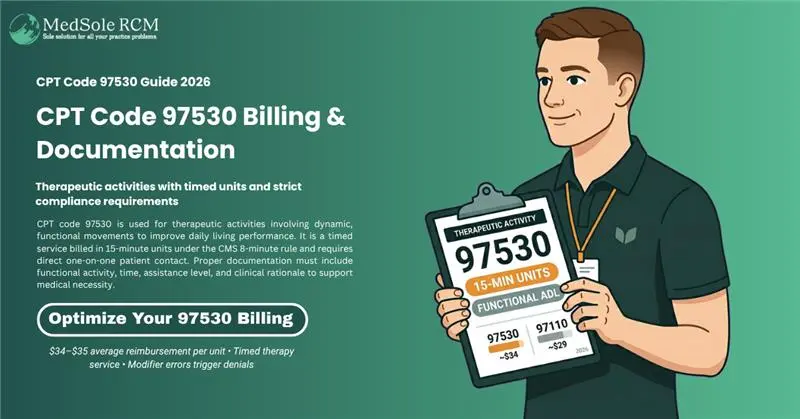




CPT code 97530 is the billing code for therapeutic activities, a direct, one-on-one timed service performed by a licensed therapist to restore a patient's ability to perform activities of daily living, billed in 15-minute units. Physical therapists, occupational therapists, and speech-language pathologists all bill this code. On every Medicare claim, a discipline modifier is mandatory: GP for physical therapy, GO for occupational therapy, and GN for speech-language pathology. What makes 97530 worth your attention in 2026 is that it's a timed code, and CMS exempted timed codes from the 2.5% work RVU efficiency reduction applied to untimed therapy codes this year. That exemption protects the per-unit value while other codes took the cut.
This guide covers everything you need to bill 97530 correctly in 2026: Medicare rates, modifier requirements, the 8-minute rule, documentation standards, denial prevention, and ICD-10 pairing. It's built for billers, practice managers, and therapists who want clean claims the first time.
Quick Reference: CPT Code 97530—2026 Billing Essentials
Code Description: Therapeutic activities, direct one-on-one patient contact by the provider, use of dynamic activities to improve functional performance, each 15 minutes (AMA CPT 2026)
97530 CPT Code Billing Unit: 15 minutes per unit, governed by the CMS 8-minute rule
2026 Medicare Rate (Non-Facility): Approximately $34 to $35 per unit (CY2026 conversion factor $33.29 standard participants, $33.46 APM participants, locality-adjusted, verify via CMS PFS Look-Up Tool)
2026 KX Modifier Threshold: $2,480 combined PT and SLP; $2,480 separate for OT
2026 Targeted Medical Review Threshold: $3,000 (active through CY2028)
Mandatory Discipline Modifier: GP (physical therapy), GO (occupational therapy), GN (speech-language pathology), required on every Medicare claim as an Always Therapy code
Timed Code Status: Yes, exempt from CY2026 CMS 2.5% work RVU efficiency reduction applied to untimed therapy codes
Cannot Bill With: PT or OT evaluation codes 97161 to 97163 and 97165 to 97167 on the same date of service
Who Bills This Code: Physical therapists, occupational therapists, speech-language pathologists, chiropractors (payer-dependent)
Start with the definition, because getting the code right starts with understanding exactly what CMS requires.
What Is CPT Code 97530? Definition, Description and 2026 Updates
Official AMA Definition of CPT Code 97530
The AMA CPT 2026 definition reads exactly as follows: "Therapeutic activities, direct (one-on-one) patient contact by the provider (use of dynamic activities to improve functional performance), each 15 minutes."
"Dynamic activities" has a specific meaning in billing terms. It refers to task-based functional movements, not static exercises or isolated muscle contractions. That distinction matters at audit time. The CMS short descriptor confirms the same standard: "Therapeutic activities, direct, each 15 min."
CPT 97530 belongs to the Physical Medicine and Rehabilitation Therapeutic Procedure code family. It's a timed code, not a service-based untimed code. Every unit billed must correspond to documented minutes of direct, one-on-one patient contact.
As a timed code, CPT code 97530 is billed in 15-minute units and governed by the CMS 8-minute rule documented in the Medicare Claims Processing Manual, Publication 100-04, Chapter 5.
What CPT Code 97530 Is Used For: Clinical and Billing Context
CPT code 97530 is used when a therapist delivers direct, one-on-one functional task training that requires skilled clinical judgment to assess movement quality and grade task difficulty in real time. That's the billing test. If the activity doesn't require a licensed therapist's judgment in the moment, it doesn't belong under this code.
Qualifying clinical uses include:
-
Repetitive sit-to-stand transfers from surfaces of varied height
-
Lifting and carrying tasks that simulate home or work activities
-
Overhead reaching tasks performed during functional dressing or kitchen simulations
-
Stair and curb negotiation for community mobility goals
-
Balance tasks performed during functional reaching activities while standing
-
Simulated grocery shopping or counter-height task performance
-
Gait training through varied indoor and outdoor terrain obstacles
If the activity targets a single physical parameter like strength rather than a functional task, that's CPT 97110, not 97530.
CPT code 97530 is used by physical therapists, occupational therapists, speech-language pathologists, and chiropractors, subject to payer-specific coverage rules and an active plan of care.
CPT Code 97530 in 2026: What Changed Under CMS
2026 CMS Update: CPT 97530
CMS finalized a 2.5 percent work RVU efficiency reduction for untimed therapy codes in CY2026. CPT code 97530, as a timed code billed in 15-minute units, is entirely exempt from this reduction.
The CY2026 Medicare conversion factor is $33.29 for standard Medicare Physician Fee Schedule participants and $33.46 for Advanced Alternative Payment Model participants.
The estimated 2026 non-facility reimbursement rate for CPT 97530 under Medicare is approximately $34 to $35 per 15-minute unit, subject to MAC locality adjustment. Verify your specific rate using the CMS Physician Fee Schedule Look-Up Tool.
The 2026 KX modifier threshold is $2,480 for combined PT and SLP services and a separate $2,480 for OT services. The targeted medical review threshold remains at $3,000 through CY2028.
Here's why this matters for your billing strategy. While untimed therapy codes absorbed the CY2026 cut, CPT 97530 held its rate. That's not a small thing. It means the per-unit value you collected in 2025 is protected in 2026, and practices that rely heavily on therapeutic activity billing are in a stronger position than those built around untimed codes. Understanding that distinction is worth building into your payer conversations and your revenue projections this year.
Practices that want zero errors on their CPT 97530 claims from day one can learn how MedSole RCM handles therapy billing at 2.99% with no setup fees.
Who Can Bill CPT Code 97530? Physical Therapy, Occupational Therapy and Chiropractic
CPT Code 97530 for Physical Therapy: GP Modifier and PTA Billing Rules
Physical therapists bill CPT code 97530 under a physical therapy plan of care using the GP modifier on every claim.
GP tells Medicare that the service was performed under an outpatient physical therapy plan of care. Without it, a Medicare claim for 97530 is returned as rejected before it reaches adjudication. Rejected is not denied. A rejected claim comes back unprocessed, with no denial code, no appeal path, and no revenue recovery unless the team catches it and resubmits within the timely filing window.
When a physical therapist assistant provides any portion of a CPT 97530 service, the CQ modifier is mandatory. Medicare applies a 15% payment reduction to all 97530 claims billed with CQ. There's a de minimis exception: if the PTA performs 10% or less of the service in a given session, CQ isn't required and the 15% reduction doesn't apply.
Common PT applications include gait training over varied terrain, functional transfers, stair negotiation, and work simulation tasks.
CPT Code 97530 for Occupational Therapy: GO Modifier and OTA Billing Rules
Occupational therapists bill CPT code 97530 under an occupational therapy plan of care using the GO modifier on every claim.
GO signals to Medicare that the service was performed under an outpatient occupational therapy plan of care. A missing GO has the same consequence as a missing GP: the claim is rejected, not denied, and it comes back without adjudication.
When an occupational therapy assistant provides any portion of the service, the CO modifier is mandatory with a 15% Medicare payment reduction. The same de minimis exception applies: 10% or less of the service performed by the OTA, no CO required and no reduction.
Per the Q1 2026 NCCI Policy Manual, speech-language pathologists cannot bill CPT 97530 on the same date of service as primary speech treatment codes 92507 or 92526. That restriction can't be bypassed with Modifier 59.
Common OT applications include simulated dressing tasks, fine motor coordination activities, kitchen simulations, and cognitive-motor tasks related to activities of daily living.
Can Chiropractors Bill CPT Code 97530?
Yes, chiropractors can bill CPT code 97530, but coverage is payer-dependent and not guaranteed under every plan.
Under Medicare Part B, chiropractic coverage for therapeutic activity codes is limited. Most commercial plans cover chiropractic billing of 97530 when accompanied by specific medical necessity documentation and an active plan of care. Chiropractic-specific modifier requirements vary by payer, so there's no universal rule that applies across the board.
Verify coverage with each individual payer before billing. A claim submitted to a payer that doesn't cover 97530 for chiropractic will be denied, and the time spent appealing a non-covered service adds up fast.
Is CPT Code 97530 for Occupational Therapy or Physical Therapy?
CPT code 97530 is used by both physical therapists and occupational therapists, as well as speech-language pathologists and chiropractors. It's not exclusive to one discipline.
The modifier is what tells the payer who billed the service. GP for physical therapy. GO for occupational therapy. GN for speech-language pathology. The therapeutic activities billed under 97530 differ by discipline based on the patient's functional goals, but the code, billing unit, and documentation requirements are identical across all three.
The modifier isn't optional. It identifies the discipline and the plan of care that authorized the service. A missing modifier means a rejected claim, and that means you're starting over before you've even reached adjudication.
Billing therapeutic activity codes across multiple disciplines means a different modifier strategy for every claim. A missing GP, GO, or GN sends the claim back before adjudication even starts. MedSole RCM handles modifier assignment and claim validation for therapy practices at 2.99% of collections, no setup fees, no contracts. See how our therapy billing works.
CPT Code 97530 Billing Guidelines: The 8-Minute Rule, Units and Time Requirements
Is CPT Code 97530 a Timed Code?
Yes, CPT code 97530 is a timed code. It's not a service-based untimed code. Every unit billed must correspond to documented minutes of direct, one-on-one patient contact.
CMS lists 97530 among the Always Therapy timed codes in the annual therapy code list. That classification has two operational consequences: units must follow the CMS 8-minute rule, and a discipline modifier is mandatory on every claim.
Here's what makes 97530 worth understanding in 2026 specifically. Unlike untimed therapy codes that absorbed the CY2026 2.5% efficiency reduction, CPT code 97530 as a timed code is fully exempt from that reduction. The per-unit value holds this year while other codes took the cut.
The 8-minute rule framework governing unit calculation is documented in the CMS Claims Processing Manual, Publication 100-04, Chapter 5.
How Many Units of CPT 97530 Can Be Billed? 2026 CMS Unit Table
The number of units billable for CPT code 97530 is determined by the CMS 8-minute rule, documented in the Medicare Claims Processing Manual, Publication 100-04, Chapter 5.
CPT 97530: CMS 8-Minute Rule Unit Calculation (2026)
|
Documented Minutes |
Units to Bill |
Notes |
|
0 to 7 minutes |
0 units |
Do not bill: below 8-minute minimum threshold |
|
8 to 22 minutes |
1 unit |
Minimum for billing; document exact start and end time |
|
23 to 37 minutes |
2 units |
|
|
38 to 52 minutes |
3 units |
|
|
53 to 67 minutes |
4 units |
|
|
68 to 82 minutes |
5 units |
Source: CMS Claims Processing Manual, Publication 100-04, Chapter 5.
According to the CMS Claims Processing Manual, if a patient receives 60 minutes of CPT code 97530 on one date of service, the provider reports 4 units of CPT 97530.
Don't round up. Billing one unit for seven minutes of service is a billing error that triggers overpayment recovery. The 8-minute minimum is a hard threshold, not a guideline. Seven minutes billed means zero units, full stop.
Billing Multiple Timed Codes on the Same Day as CPT 97530
When a therapist performs CPT 97530 alongside other timed therapy codes on the same date of service, total minutes across all timed codes determine total billable units first.
Once total units are established, allocate them to individual codes by largest remainder. The code with the most documented time gets the most units. Here's how that works in practice:
-
CPT 97530 performed for 23 minutes. CPT 97110 performed for 15 minutes.
-
Total timed minutes: 38. Total units per CMS table: 3 units.
-
Allocate 2 units to CPT 97530 (largest time block). Allocate 1 unit to CPT 97110.
-
Document start and end time intervals for each code separately in the visit note.
CMS NCCI policy states that providers may not report more than one rehabilitation therapy service for the same 15-minute time period. Overlapping time blocks are an audit trigger, and there's no modifier that fixes them after the fact.
Getting the units right is the first step. Assigning the correct modifier combination is what gets the claim paid.
What CPT 97530 Cannot Be Billed With: NCCI Restrictions for 2026
CPT code 97530 cannot be billed on the same date of service as physical therapy evaluation codes 97161, 97162, or 97163, or occupational therapy evaluation codes 97165, 97166, or 97167. Modifier 59 will not override this edit.
The practical consequence is straightforward: the evaluation code will be denied. This is an absolute NCCI restriction documented in the APTA NCCI Code Edits guidance and reflected in the Q1 2026 NCCI Practitioner PTP Edits. No modifier combination resolves it. Schedule the first therapeutic activity session for the next visit.
Additional NCCI restrictions that apply to CPT 97530 in 2026:
-
CPT 97530 cannot be billed during a group therapy session (CPT 97150)
-
Two therapists treating the same patient simultaneously cannot each bill 97530 for overlapping time
-
SLPs cannot bill CPT 97530 alongside 92507 or 92526 on the same date under 2026 NCCI policy
-
CPT 97530 cannot be billed for canalith repositioning procedures (95992) as a separate service
When NCCI edit violations cause claim denials, recovery requires a specific appeal workflow. MedSole RCM's denial management team handles NCCI-related denials for therapy practices. Denial recovery for therapy billing.
CPT Code 97530 Modifiers: Complete 2026 Reference Guide
Mandatory Discipline Modifiers for CPT 97530: GP, GO and GN
Under Medicare, CPT code 97530 is an Always Therapy code. The discipline modifiers GP, GO, and GN are mandatory on every claim. Not optional. Not situational.
Each modifier identifies the plan of care under which the service was delivered:
GP: Services delivered under an outpatient physical therapy plan of care
GO: Services delivered under an outpatient occupational therapy plan of care
GN: Services delivered under an outpatient speech-language pathology plan of care
A CPT 97530 claim submitted to Medicare without GP, GO, or GN is not denied. It is rejected. A rejected claim is returned without adjudication. It has no denial code. It cannot be appealed. It must be corrected and resubmitted.
That distinction matters for revenue cycle management. Denials have appeal pathways and payer-specific deadlines. Rejections have none. The revenue isn't permanently lost after a rejection, but it will be if the team doesn't catch it and resubmit within the timely filing window.
Verify that your practice management system appends the correct discipline modifier to every 97530 claim automatically before submission. That's a one-time configuration step, not a per-claim decision.
Does CPT 97530 Need Modifier 59? When to Use 59 and the X-Modifiers
Yes, CPT code 97530 requires Modifier 59, or one of the CMS X-modifiers, when billed on the same date of service as another timed therapy code that would otherwise be bundled under NCCI Procedure-to-Procedure edits.
Modifier 59 is required with CPT 97530 in these situations:
-
When billing CPT 97530 and CPT 97140 on the same date with documented separate 15-minute intervals
-
When billing CPT 97530 and CPT 97110 in the same session with documented distinct goals and separate time intervals
-
When billing CPT 97530 and CPT 97542 on the same date with documented separate service intervals
Modifier 59 will not work in these situations:
-
When billing CPT 97530 with evaluation codes 97161 to 97163 or 97165 to 97167: the evaluation will be denied regardless of modifier
-
When time intervals overlap: Modifier 59 requires documented proof of separate, non-overlapping 15-minute blocks
CMS encourages the use of X-modifiers instead of Modifier 59 whenever possible because they provide greater specificity about why two services are separate. Each X-modifier has a distinct meaning:
XE: Separate Encounter
XP: Separate Practitioner
XS: Separate Structure (anatomical)
XU: Unusual Non-Overlapping Service
XU is the most commonly applied X-modifier in outpatient therapy when two timed codes are performed in documented separate 15-minute intervals on the same date of service. When you're billing CPT 97530 alongside CPT 97140 and both intervals are clearly documented, XU is typically the right choice.
For complete modifier guidance specific to outpatient therapy billing, see the CMS NCCI modifier guidance for outpatient therapy.
KX Modifier for CPT 97530: 2026 Threshold Tracker
Once a Medicare patient's cumulative therapy charges reach the 2026 KX modifier threshold, the KX modifier must be appended to every subsequent CPT 97530 claim. Without it, the claim is automatically denied.
The 2026 thresholds are:
PT and SLP combined threshold: $2,480
OT separate threshold: $2,480
Targeted Medical Review threshold: $3,000 (triggers potential audit review, not automatic denial)
Appending KX is an attestation, not a guarantee. It tells CMS that documentation exists supporting continued medical necessity beyond the threshold. CMS can audit that attestation at any time.
The practical instruction for billing teams is this: track each Medicare patient's cumulative therapy charges in your practice management system. Set an automatic alert at $2,200. That buffer gives your team time to review the documentation and confirm KX is supported before the threshold is crossed, not scrambling after.
CQ and CO Modifiers: PTA and OTA Billing Rules for CPT 97530
When a physical therapist assistant provides any portion of a CPT 97530 service, the CQ modifier is mandatory. When an occupational therapy assistant provides any portion, CO is mandatory.
Medicare applies a 15% payment reduction to CPT 97530 claims billed with CQ or CO. That reduction is the compliant billing outcome. Accept it.
If the PTA or OTA performs 10% or less of the service in a given session, CQ or CO is not required and the 15% reduction doesn't apply. That's the de minimis exception, and it applies equally to both modifiers.
Supervision documentation is where practices get caught. A therapy assistant who independently changes the therapeutic activity without documented real-time supervision creates a compliance risk that the CQ or CO modifier alone doesn't resolve. Post-payment audits are triggered when supervision documentation is absent or written in generic terms that don't reflect what actually happened in the session.
Modifier errors are the most preventable source of claim rejections in therapy billing. A missing GP never reaches adjudication. A missing KX after the $2,480 threshold means automatic denial. MedSole RCM applies the correct modifier combination to every CPT 97530 claim before submission, with real-time claim validation that catches errors before they become lost revenue. Outsourced therapy billing that catches modifier errors first.
CPT Code 97530 Documentation Requirements: What CMS Requires on Every Claim
Required Documentation on Every CPT 97530 Visit Note
For a CPT code 97530 claim to pass payer review, every visit note must document seven specific elements as required by CMS and aligned with the 2026 Medicare Physician Fee Schedule Final Rule: Therapy Services.
-
Total timed minutes: Document exact minutes of direct one-on-one therapeutic activity contact. Don't document total session time: only the time of direct skilled contact counts.
-
Specific functional activity performed: Name the exact dynamic task using action-specific language, such as "repetitive sit-to-stand transfers from a 17-inch surface." Generic descriptions like "therapeutic activities performed" won't survive audit.
-
Functional goal connection: State explicitly how the activity connects to a measurable goal in the active plan of care.
-
Skilled rationale: Document why a licensed therapist's clinical judgment was required, not just what was done. Describe what you assessed and how you graded the task in real time.
-
Level of assistance: Document the type and amount of cueing or physical assistance provided during the activity.
-
Patient response: Document objective progress or a measurable functional outcome from the session.
-
Direct contact confirmation: State explicitly that the service was one-on-one, not concurrent with other patients.
If any of these seven elements is absent, the claim is at risk of denial for insufficient documentation of medical necessity.
Every-10-Visit Documentation Requirement for CPT 97530
CMS requires additional supportive documentation at every 10-visit interval to justify continued skilled therapeutic activity intervention.
That documentation must demonstrate three specific things:
-
Functional loss in activities of daily living, coordination, strength, balance, range of motion, and mobility
-
An explanation of how the documented functional limitations connect to the functional performance deficits addressed in the plan of care
-
Evidence that the patient's condition requires continued skilled therapist intervention beyond what the patient could achieve independently or through a home program
Documentation that fails to establish this connection at the 10-visit checkpoint is the most common cause of post-payment recoupment in Medicare therapy audits. It's not a technicality. Auditors look for it specifically.
KX Modifier Documentation Standard for CPT 97530 (2026)
Once cumulative Medicare therapy charges reach $2,480 in 2026, appending KX to CPT 97530 is an attestation that documentation exists to support ongoing medical necessity. CMS can audit that attestation at any point.
At the KX threshold, the visit note must contain three specific elements:
-
An explicit statement of continued medical necessity
-
Measurable progress toward functional goals documented in objective terms
-
A clinical rationale for why independent exercise or home programming would not achieve the functional outcome
At $3,000 in cumulative charges, a targeted medical review request is possible. Every note from the start of treatment must be defensible, not just the ones written after the threshold is crossed.
Practices that receive a targeted medical review request for CPT 97530 claims need immediate AR Follow-Up and documentation support. MedSole RCM manages the full response workflow for medical review requests. AR follow-up and medical review response.
Sample Compliant Documentation for CPT Code 97530
The following is a de-identified example of visit note language that meets CMS requirements for CPT code 97530.
Sample Documentation: CPT 97530 (1 Unit, GP Modifier)
Patient performed 3 sets of repetitive sit-to-stand transfers from a 17-inch surface with minimal physical assistance at bilateral hips for 22 minutes (CPT 97530-GP, 1 unit). Activity directly targets the functional goal of independent bed and chair transfers within 4 weeks per the plan of care dated [date]. Patient required 2 verbal cues per set for trunk alignment during the concentric phase. Clinician assessed movement quality and adjusted surface height after set 2 to progress difficulty. Skilled grading was required to prevent compensatory movement patterns that would increase fall risk. Measurable progress: patient completed 3 sets versus 2 sets in the prior session.
Documentation at this level of specificity is defensible at payer audit, post-payment review, and targeted medical review.
How to Bill CPT Code 97530: Step-by-Step Billing Guide for 2026
Step 1: Verify Eligibility and Payer Authorization Before the Session
Confirm active insurance coverage and check whether the payer requires prior authorization for therapeutic activity services. For Medicare patients, verify whether the patient is approaching the $2,480 KX modifier threshold. Don't assume a previously approved session guarantees approval for the next one.
Step 2: Design a Functional, Dynamic Activity That Requires Skilled Judgment
The activity must simulate a real-world ADL or IADL and require clinical judgment to assess movement quality and grade difficulty in real time. Static exercises or isolated strengthening don't qualify under CPT 97530. If your note could describe the same session under CPT 97110, rethink the activity design before the session starts.
Step 3: Track Direct Contact Time Precisely
Use a time log or your EHR timer to record exact minutes of direct one-on-one contact. Don't include preparation time, documentation time, or rest periods between activities. Documented minutes must match the units billed per the CMS 8-minute rule table in Section 4 of this guide.
Step 4: Write a Compliant Visit Note Before Creating the Claim
Include all seven required documentation elements from Section 6: timed minutes, specific activity, functional goal connection, skilled rationale, level of assistance, patient response, and direct contact confirmation. The note must exist before the claim is created. Writing it after creates a medical necessity documentation risk that auditors flag routinely.
Step 5: Assign the Correct Modifier Combination Before Claim Creation
Attach GP, GO, or GN based on discipline. Attach KX if the patient has crossed the 2026 threshold. Attach CQ or CO if a PTA or OTA provided any portion of the service. Attach Modifier 59 or XU if another timed code is billed on the same date with documented separate intervals.
Step 6: Validate the Claim Against NCCI Edits Before Submission
Check for NCCI Procedure-to-Procedure edit conflicts before the claim leaves your system. Confirm CPT 97530 isn't paired with an evaluation code on the same date. Confirm no two timed codes share a 15-minute interval in the visit note.
Step 7: Submit, Post, and Track Within 24 Hours of Service
Submit through your clearinghouse and track claim status through your ERA. If the claim is rejected, identify the reason within 24 hours and resubmit corrected. If denied, initiate the appeals workflow within the payer's deadline window. Rejected claims sitting unworked past timely filing are permanent revenue losses.
Billing CPT code 97530 correctly across seven steps, for every patient and every session, takes a billing team that knows therapy claim requirements as well as you know your patients. MedSole RCM covers every step: eligibility verification, prior authorization, modifier assignment, claim scrubbing, submission, payment posting, and denial resolution. Our rate is 2.99% of collections. No setup fees. No long-term contracts. Full-service therapy billing at 2.99% of collections.
CPT Code 97530 vs CPT 97110: The Difference That Affects Your Reimbursement
The Core Difference Between CPT 97530 and CPT 97110
The primary difference between CPT code 97530 and CPT code 97110 is that 97530 is billed for functional, dynamic, task-based activities that simulate real-world performance, while 97110 is billed for isolated exercises targeting a specific physical parameter such as strength, range of motion, or endurance.
The documentation is what separates them at audit time. If the visit note says the patient performed squats to increase leg strength, an auditor will downcode that claim to 97110. If the note says the patient performed repetitive sit-to-stand transfers from a low surface to improve independence with bed mobility, that supports CPT code 97530. The note drives the code selection. Not the other way around.
That distinction also carries a reimbursement consequence. CPT 97530 reimburses at a higher rate per unit than CPT 97110 under 2026 Medicare, approximately $34 to $35 versus $28 to $33 per unit. Choosing the correct code based on documented activity is a revenue decision, not just a compliance one.
CPT 97530 vs CPT 97110: Side-by-Side Comparison Table
The comparison below covers every billing-relevant difference between CPT 97530 and CPT 97110. Reference this before selecting the code for a session.
CPT 97530 vs CPT 97110: 2026 Billing Comparison
|
Feature |
CPT 97530 Therapeutic Activity |
CPT 97110 Therapeutic Exercise |
|
Primary purpose |
Restore functional task performance in ADLs or IADLs |
Improve a specific physical parameter (strength, ROM, endurance) |
|
Activity type |
Dynamic, multi-movement functional tasks |
Isolated, single-parameter exercise |
|
Documentation focus |
Functional goal with ADL connection stated explicitly |
Target muscle group or joint improvement stated explicitly |
|
Clinical examples |
Sit-to-stand transfers, lifting, overhead reaching, stair negotiation |
Bicep curls, quad sets, resistance band exercise, ROM drills |
|
2026 Medicare rate per unit, non-facility |
Approximately $34 to $35 |
Approximately $28 to $33 |
|
Mandatory discipline modifier |
GP, GO, or GN on every claim |
GP, GO, or GN on every claim |
|
NCCI co-billing with each other |
Yes, when distinct goals and separate time intervals are documented |
Yes, when distinct goals and separate time intervals are documented |
|
Audit risk if codes are interchanged |
High: auditors downcode 97530 to 97110 if note lacks functional task documentation |
Lower, but overbilling risk if 97530 activities are incorrectly billed as 97110 |
When billing both codes on the same date, Modifier 59 or XU must be applied to the lower-value code and documentation must show each code addressed a separate functional goal in a distinct 15-minute interval.
The Code Selection Decision Rule: When to Use 97530 and When to Use 97110
Use these two decision blocks as your pre-session code selection checklist. The parallel structure is intentional: each block answers the same question for a different code.
Use CPT 97530 when:
-
The activity is functional and task-based, directly simulating a real-world ADL or IADL
-
The therapist is assessing movement quality and grading task difficulty in real time
-
The goal is stated in terms of functional independence, such as independent transfers or return-to-work tasks
-
Multiple movement patterns are integrated simultaneously into one functional task
Use CPT 97110 when:
-
The activity targets a single physical parameter in isolation, such as strength, ROM, or endurance
-
The therapist is prescribing and supervising a repeatable exercise progression
-
The goal is stated in measurable physical parameters, such as increasing knee flexion ROM to 120 degrees
If the session includes both types of intervention with documented separate time intervals, both codes can be billed with Modifier 59 or XU and separate supporting documentation.
For a full billing reference on CPT 97110, see MedSole RCM's dedicated CPT 97110 billing guide.
Incorrect code selection between 97530 and 97110 is one of the top revenue leakage points MedSole RCM identifies during billing audits. Our coding team reviews every claim before submission to match the documented activity to the correct code. Revenue cycle management and coding review services.
Now that you have the definition, the modifier rules, the documentation standard, and the step-by-step workflow, the next piece is reimbursement: what Medicare and commercial payers actually pay for CPT 97530 in 2026, and where practices lose money on rate discrepancies.
CPT Code 97530 Reimbursement Rates in 2026: Medicare, Medicaid and Commercial Payers
Is CPT Code 97530 Covered by Medicare?
Yes, CPT code 97530 is covered by Medicare Part B when the service is medically necessary, performed by a qualified provider under a documented therapy plan of care, and billed with the correct discipline modifier on every claim.
CMS designates CPT 97530 as an Always Therapy code. That classification means two things without exception: a therapy plan of care must be established before the service is delivered, and a discipline modifier must appear on every claim. Without both, Medicare won't process the claim.
Four conditions must be met for Medicare coverage:
-
The patient must have a documented functional deficit requiring skilled therapeutic intervention
-
A licensed physical therapist, occupational therapist, or speech-language pathologist must establish the plan of care
-
The service must be performed with direct one-on-one patient contact
-
Documentation must demonstrate that the patient cannot achieve the functional goal without skilled therapy
Medicare covers CPT 97530 beyond the 2026 KX modifier threshold of $2,480 when the provider appends KX and documentation supports continued medical necessity. For full coverage criteria, see the CMS Therapy Services coverage guidance.
2026 Medicare Reimbursement Rate for CPT Code 97530
The 2026 Medicare non-facility reimbursement rate for CPT code 97530 is approximately $34 to $35 per 15-minute unit, calculated using the 2026 CMS conversion factor of $33.29 for standard Medicare Physician Fee Schedule participants and $33.46 for Advanced Alternative Payment Model participants.
Rates are MAC locality-adjusted. The exact rate for your practice depends on your geographic location. Verify your specific rate using the CMS Physician Fee Schedule Look-Up Tool before quoting rates to payers or patients.
Because CPT 97530 is a timed code, it is fully exempt from the 2.5% work RVU efficiency reduction CMS applied to untimed therapy codes in CY2026. This exemption protects the per-unit value of 97530 relative to therapy codes that absorbed the cut.
There's a separate revenue factor most practices don't build into their multi-code session projections. When CPT 97530 is billed alongside other Always Therapy timed codes on the same date, CMS applies the Multiple Procedure Payment Reduction to the practice expense component. The highest-value service is paid at 100% of its practice expense RVU. Each additional service on the same date is paid at 50% of its practice expense RVU.
That reduction doesn't eliminate the revenue from billing multiple codes. It does mean your net collections per multi-code session will be lower than a simple per-unit rate calculation suggests. Build that into your revenue projections.
CPT 97530 Reimbursement by Payer: 2026 Rate Reference Table
The rates below represent approximate averages drawn from payer transparency files published under the federal Transparency in Coverage Final Rule (45 CFR 147.211). Actual contracted rates vary by provider, location, network tier, and individual contract terms. Verify your specific contracted rate with each payer directly.
CPT 97530: 2026 Payer Reimbursement Reference Table
|
Payer |
Approx. Rate Per Unit |
Coverage Notes |
Modifier Typically Required |
|
Medicare non-facility |
$34 to $35 |
Always Therapy, plan of care required, KX threshold $2,480 |
GP, GO, or GN mandatory |
|
Medicare facility (hospital outpatient, SNF) |
$21 to $24 |
Lower rate applies in facility settings |
GP, GO, or GN mandatory |
|
Medicaid (state average) |
$27 to $30 |
Varies significantly by state; some plans cover 97530 but not 97110 |
State-specific: verify with each payer |
|
Blue Cross Blue Shield |
$38 to $42 |
Prior authorization required by some plans; ICD-10 specificity scrutinized |
GP or GO typically required |
|
Aetna |
$32 to $35 |
Some commercial plans require prior authorization |
GP or GO; 59 when paired with 97140 |
|
United Healthcare |
$37 to $40 |
Rate varies by state contract |
GP or GO mandatory |
|
Cigna |
$39 to $41 |
Documentation requirements similar to Medicare |
GP |
Rates sourced from payer transparency files published under the Transparency in Coverage Final Rule (45 CFR 147.211). Rates represent national approximate averages and do not reflect individual provider contracts. Last verified: April 2026. All rates are subject to change.
Payer Alert: Blue Cross Blue Shield and CPT 97530
BCBS plans have documented a denial pattern on CPT 97530 claims citing ICD-10 inconsistency. This is not a modifier error. It occurs when the ICD-10 diagnosis code submitted does not specifically support the functional limitation being treated by the therapeutic activity. Use the most specific ICD-10 code available. If your practice is receiving ICD-10 inconsistency denials from BCBS on CPT 97530 claims, this requires a systematic review of your diagnosis code assignment process, not just individual claim corrections.
Underpayments against contracted rates are a significant and often silent source of revenue loss for therapy practices. MedSole RCM's AR team identifies underpayments on CPT 97530 claims by comparing posted payments against contracted fee schedules and pursues recovery through the payer dispute process. Underpayment recovery for therapy practices.
Is CPT Code 97530 FSA and HSA Eligible?
Yes, CPT code 97530 is FSA and HSA eligible when the therapeutic activity is prescribed by a licensed healthcare provider to treat a diagnosed medical condition.
FSA and HSA funds can cover copayments, deductibles, and coinsurance related to CPT 97530 services. The explanation of benefits from the payer serves as sufficient documentation for FSA and HSA administrators. No separate filing is required from the patient. This applies across all payers, including Medicare Advantage plans with supplemental cost-sharing coverage.
Practices that aren't confident their CPT 97530 claims are collecting at the correct contracted rate can see how MedSole RCM audits the billing process from eligibility through payment posting. How MedSole RCM maximizes CPT 97530 collections.
CPT Code 97530 for Physical Therapy and Occupational Therapy: Discipline-Specific Billing Guide
CPT Code 97530 for Physical Therapy: Activities, Modifiers and Documentation
CPT code 97530 for physical therapy is billed when a physical therapist or PTA performs direct, one-on-one functional rehabilitation tasks that require skilled clinical judgment to assess, grade, and progress. Static exercises or isolated strengthening sessions belong under CPT 97110.
Every CPT 97530 claim under a physical therapy plan of care must include the GP modifier. No exceptions apply on Medicare claims, and most commercial payers follow the same requirement.
CPT 97530 Physical Therapy: Qualifying Activities and Functional Goals
|
PT Activity Under CPT 97530 |
Functional Goal It Supports |
|
Repetitive sit-to-stand from varied surface heights |
Independence with bed mobility and chair transfers |
|
Stair negotiation with and without rail assist |
Return to multi-level home access |
|
Gait training over varied terrain and obstacles |
Community ambulation independence |
|
Lifting and carrying weighted objects at varied heights |
Return to work or home management tasks |
|
Functional balance tasks during active reaching |
Fall risk reduction during ADL performance |
|
Simulated car transfer practice |
Independent community transportation |
When a PTA provides any portion of the CPT 97530 service, the CQ modifier is mandatory and Medicare applies a 15% payment reduction. The 10% de minimis exception still applies as stated in Section 3 of this guide.
CPT Code 97530 for Occupational Therapy: Activities, Modifiers and Documentation
CPT code 97530 for occupational therapy is billed when an occupational therapist or OTA designs and delivers individualized functional activity interventions addressing a patient's specific performance deficits in activities of daily living, IADLs, work tasks, or social participation.
Every CPT 97530 claim under an occupational therapy plan of care must include the GO modifier on every Medicare claim and most commercial payer claims.
CPT 97530 Occupational Therapy: Qualifying Activities and Functional Goals
When an OTA provides any portion of the service, the CO modifier is mandatory with a 15% Medicare payment reduction. Per the Q1 2026 NCCI Policy Manual, SLPs cannot bill CPT 97530 as a separate service on the same date as 92507 or 92526.
ICD-10 Codes for CPT Code 97530: Pairing Guide for Clean Claims
How to Select the Correct ICD-10 Code for CPT 97530 Claims
CPT code 97530 must be paired with an ICD-10-CM diagnosis code that directly supports the functional limitation being addressed by the therapeutic activity. The ICD-10 code establishes medical necessity. It explains to the payer why the patient can't perform the target ADL or IADL without skilled therapeutic intervention.
Use the most specific ICD-10 code available for the patient's documented condition. Payers, including BCBS, have documented denial patterns specifically tied to ICD-10 specificity on CPT 97530 claims.
The ICD-10 code must also be consistent with the activity documented in the visit note. If the note documents sit-to-stand transfer training and the ICD-10 code reflects a shoulder injury, the claim will be denied for a medical necessity mismatch. That's a fixable error, but only if it's caught before submission, not after.
ICD-10 Code Reference Table for CPT Code 97530
ICD-10-CM Codes Commonly Paired With CPT 97530 (FY2026)
|
Clinical Condition |
ICD-10-CM Code |
Code Description |
|
Muscle weakness, generalized |
M62.81 |
Muscle weakness, generalized |
|
Hemiplegia following cerebral infarction |
I69.351 |
Hemiplegia and hemiparesis following cerebral infarction |
|
Parkinson's disease |
G20 |
Parkinson's disease |
|
Traumatic brain injury, sequela |
S09.90XS |
Unspecified injury of head, sequela |
|
Spastic diplegia cerebral palsy |
G80.1 |
Spastic diplegia cerebral palsy |
|
Multiple sclerosis |
G35 |
Multiple sclerosis |
|
Post-surgical knee stiffness |
M25.361 |
Stiffness of right knee, not elsewhere classified |
|
Balance disorder, unspecified |
H81.10 |
Benign paroxysmal vertigo, unspecified ear |
|
ADL dependency, care-provider |
Z74.09 |
Other problems related to care-provider dependency |
|
Quadriplegia, unspecified |
G82.50 |
Quadriplegia, unspecified |
|
Weakness, right upper arm |
M62.811 |
Muscle weakness, right upper arm |
|
Developmental delay, motor function |
R62.50 |
Unspecified lack of expected normal physiological development |
|
Presence of right artificial knee joint |
Z96.641 |
Presence of right artificial knee joint |
|
Hip fracture aftercare |
M84.352S |
Stress fracture, left femur, sequela |
Source: ICD-10-CM Official Guidelines for Coding and Reporting FY2026. Verify code specificity against the patient's documented clinical presentation before billing. Codes listed as unspecified should only be used when documentation does not support a more specific code.
Always code to the highest level of specificity available. Coders who default to unspecified codes on CPT 97530 claims increase denial risk with every submission. If the patient has right hip weakness and the note documents right lower extremity functional training, the ICD-10 code must reflect the right hip, not "generalized weakness."
CPT Code 97530 Denial Prevention: The 10 Most Costly Billing Errors and How to Fix Them
Why CPT Code 97530 Claims Are Denied: The Three Denial Categories
CPT code 97530 is one of the most audited codes in outpatient rehabilitation because it is a high-volume, high-dollar timed code with mandatory modifier requirements, strict documentation standards, and NCCI edit restrictions that vary by discipline and payer.
Denials fall into three distinct categories: documentation deficiencies, modifier errors, and NCCI edit violations. Each category requires a different resolution strategy and a different prevention approach. You can't fix a documentation deficiency the same way you fix a rejected modifier.
Based on industry-observed billing patterns, therapy practices that don't actively manage CPT 97530 denials typically leave between 8 and 15 percent of the code's potential revenue uncollected each year. Denied claims that expire within the payer's appeal window become permanent revenue losses. There's no recovery path once that window closes.
The 10 Most Common CPT 97530 Billing Errors: With Fixes
Error 1: Missing Discipline Modifier on the Claim
How it happens: The claim for CPT 97530 is submitted without GP, GO, or GN. This happens when the practice management system isn't configured to auto-append discipline modifiers to Always Therapy codes. The claim is returned as rejected, not denied, which means no denial code and no appeal path.
Fix: Configure your practice management system to automatically append the correct discipline modifier to every 97530 claim before submission. This is a one-time setup step that eliminates the most preventable reject reason for this code.
Error 2: Billing CPT 97530 on the Same Day as an Evaluation Code
How it happens: A therapist performs an initial evaluation and therapeutic activities on the same date and bills both 97530 and 97161, 97162, or 97163 together. The evaluation code will be denied. Modifier 59 does not override this NCCI restriction.
Fix: Don't bill CPT 97530 on the same date as a PT or OT evaluation. Schedule the first therapeutic activity session for the next visit. No modifier combination resolves this edit.
Error 3: Generic or Insufficient Visit Note Documentation
How it happens: The visit note describes what the patient did but doesn't document the skilled rationale, the functional goal connection, or the direct contact time. Notes that say "therapeutic activities performed for 30 minutes" won't survive payer review.
Fix: Every note must include the seven documentation elements covered in Section 6 of this guide. Documentation written to that standard is defensible at audit. Written below it, the note is a revenue liability.
Error 4: Missing KX Modifier After the 2026 Threshold
How it happens: The patient's cumulative Medicare therapy charges exceed $2,480 in 2026 but the billing team doesn't add KX to subsequent CPT 97530 claims. The claim is automatically denied.
Fix: Track per-patient cumulative Medicare therapy charges in your practice management system. Set an alert at $2,200 so your team has time to review documentation and activate KX before the threshold is crossed.
Error 5: Overlapping Timed Codes in the Same 15-Minute Block
How it happens: CPT 97530 and CPT 97140 are both billed for the same session without documented separate, non-overlapping 15-minute intervals. Modifier 59 is appended but the note doesn't support it.
Fix: Document start and end times for each timed code separately. The note must show that CPT 97530 occupied one distinct interval and CPT 97140 occupied a different one. The modifier is only as strong as the documentation behind it.
Error 6: PTA or OTA Service Billed Without CQ or CO
How it happens: A PTA or OTA delivers the CPT 97530 service and the claim is submitted without the CQ or CO modifier. This is a compliance violation, not just a billing error.
Fix: Add CQ for every claim where a PTA provided any portion of the 97530 service. Add CO where an OTA did. Accept the 15% reduction as the compliant billing outcome. Skipping these modifiers exposes the practice to post-payment audit and recoupment.
Error 7: Modifier 59 Without Documented Time Intervals
How it happens: Modifier 59 or XU is appended to CPT 97530 billed alongside another timed code, but the visit note doesn't document separate, non-overlapping time intervals for each service. The modifier claim is unsupported.
Fix: Write time-specific documentation. State that CPT 97530 ran from minute one to minute 22, and CPT 97140 ran from minute 23 to minute 37. Without that specificity, Modifier 59 is an unsupported attempt to bypass an NCCI edit, and payers will identify it.
Error 8: Billing CPT 97530 for Group or Concurrent Sessions
How it happens: A therapist works with two patients simultaneously and bills CPT 97530 for both. CPT 97530 requires direct one-on-one contact. Group or concurrent sessions don't qualify.
Fix: Use CPT 97150 for group therapy sessions. If two patients are seen simultaneously for any portion of the session, that portion can't be billed as 97530 for either patient.
Error 9: ICD-10 Code Mismatch With the Therapeutic Activity
How it happens: The ICD-10 code submitted doesn't support the functional limitation addressed by the therapeutic activity in the visit note. This is the leading cause of BCBS denials on CPT 97530 claims.
Fix: Match the ICD-10 code to the specific functional deficit documented in the note. If the note documents gait training for fall risk, the ICD-10 must reflect the underlying condition causing the gait deficit, not a generic musculoskeletal complaint.
Error 10: Missing 10-Visit Interval Documentation
How it happens: The therapist continues billing CPT 97530 beyond 10 visits without documenting ongoing functional loss and the continued need for skilled intervention at the 10-visit checkpoint. Medicare audits target this gap specifically.
Fix: Set a scheduling alert at every 10-visit mark for active CPT 97530 patients. The note at that visit must document current functional status, measurable progress relative to goals, and the clinical rationale for continuing skilled therapeutic activities.
Every one of those ten errors is catchable before the claim is submitted. The problem for most therapy practices is bandwidth: the billing team is managing claim volume, not auditing modifier combinations or tracking KX thresholds per patient. MedSole RCM's denial management team specializes in CPT 97530 and therapy billing. We identify the denial pattern, correct the underlying error, and resubmit within the payer's appeal window. CPT 97530 denial management and appeal services.
If your practice has unresolved CPT 97530 denials sitting in your AR, request a free billing audit and we'll show you exactly what's recoverable. Request a free CPT 97530 billing audit.
Billing CPT Code 97530 With Other Codes: NCCI Quick Reference for 2026
Can CPT Code 97530 and CPT 97140 Be Billed Together?
Yes, CPT code 97530 and CPT code 97140 can be billed together on the same date of service when each is performed in a distinct, non-overlapping 15-minute interval with separate documentation of time and clinical rationale.
Modifier 59 or XU must be appended to the lower-value code. The visit note must document start and end times for each service separately. Without documented separate intervals, NCCI will bundle the two codes and reimburse only the higher-value service.
The 97530 and 97140 combination is one of the most audited co-billing pairs in outpatient therapy. When you're billing these two codes together, document with exceptional specificity. A generic note won't hold up if a payer requests records.
CPT 97530 NCCI Co-Billing Quick Reference Table for 2026
The table below covers every common code pairing with CPT 97530. Reference this before creating claims for multi-code therapy sessions.
CPT 97530: NCCI Co-Billing Reference Table (Q1 2026)
|
Code Paired With CPT 97530 |
Can They Be Billed Together |
Modifier Required |
Documentation Requirement |
NCCI Status |
|
CPT 97140: Manual Therapy |
Yes |
59 or XU on lower-value code |
Separate 15-minute intervals documented with start and end times |
PTP edit: bypassable with modifier and documentation |
|
CPT 97110: Therapeutic Exercise |
Yes |
59 or XU if same session |
Distinct goals and separate documented intervals |
Allowed with proper documentation |
|
CPT 97116: Gait Training |
Yes |
59 or XU if same session |
Separate goals and time intervals documented |
Allowed with proper documentation |
|
CPT 97112: Neuromuscular Reeducation |
Yes |
59 or XU if same session |
Distinct movement focus and documented intervals |
Allowed with proper documentation |
|
CPT 97535: Self-Care Home Management Training |
Yes, OT plans primarily |
59 or XU |
Separate tasks and documented intervals |
Allowed with proper documentation |
|
CPT 97150: Group Therapy |
No |
No modifier overrides this |
CPT 97530 requires direct one-on-one contact |
Bundled: cannot override |
|
CPT 97161 to 97163: PT Evaluation |
No |
No modifier overrides this |
Evaluation code will be denied |
Bundled: cannot override under any circumstance |
|
CPT 97165 to 97167: OT Evaluation |
No |
No modifier overrides this |
Evaluation code will be denied |
Bundled: cannot override under any circumstance |
|
CPT 92507 or 92526: SLP Treatment |
No (SLP discipline) |
No modifier overrides this |
2026 NCCI SLP restriction applies |
Bundled under Q1 2026 NCCI Policy Manual |
|
CPT 95992: Canalith Repositioning |
No |
No modifier overrides this |
95992 includes all related services |
Bundled: cannot override |
Source: CMS Q1 2026 NCCI Practitioner PTP Edits. Verify current edit status before billing.
When billing CPT 97530 with any other timed code, total session minutes across all timed codes determine total billable units first. Allocate units to individual codes by largest remainder. Document time intervals separately in the visit note for every code billed. Overlapping time blocks invalidate the Modifier 59 override regardless of payer.