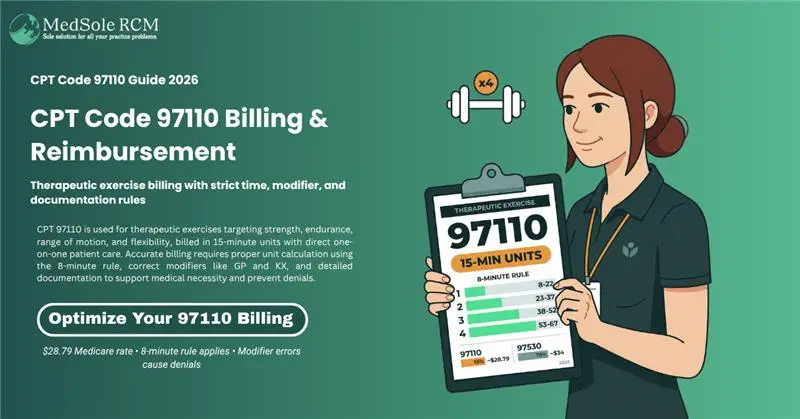




According to APTA's 2026 Utilization Analysis, CPT 97110 accounts for 42% of all physical therapy claims billed annually. That makes it the highest-volume billing code in outpatient PT. CPT code 97110 is the AMA-designated code for therapeutic exercise, billed in 15-minute increments by licensed physical therapists, occupational therapists, and chiropractors requiring direct, one-on-one contact with the patient. Being the most-used code in PT billing doesn't make it the easiest to bill correctly. It makes it the most audited, the most denied, and the most likely source of revenue leakage in your practice.
That's a billing problem worth solving.
This guide answers the specific questions that matter when you're processing 97110 claims: the 2025 Medicare reimbursement rate per unit, every modifier required by provider type and payer, documentation standards that hold up in a post-payment audit, NCCI rules for billing 97110 alongside other timed codes, and the denial triggers that cause this code to fail more often than it should.
The guidance here comes from our medical billing team at MedSole RCM. We process thousands of therapy claims across physical therapy, occupational therapy, and chiropractic practices. We've seen what gets denied, what triggers audits, and what gets paid cleanly. That's the context for everything on this page.
What CPT Code 97110 Actually Means for Your Billing
The Official AMA Description of 97110 in Plain Billing Language
The American Medical Association CPT code set defines CPT code 97110 as: "Therapeutic procedure, one or more areas, each 15 minutes; therapeutic exercises to develop strength and endurance, range of motion and flexibility." This code has been part of the CPT system since 1995, when the AMA added 97110 through 97150 and 97530 through 97546 to standardize timed therapeutic procedure billing.
According to the American Medical Association, CPT code 97110 is defined as a therapeutic procedure performed in 15-minute increments targeting strength, endurance, range of motion, and flexibility, requiring direct one-on-one contact between a licensed provider and the patient.
Here's what that means in billing terms. The 97110 cpt code description tells you four things a biller needs to know: it's a timed code, it bills in 15-minute units, it requires direct one-on-one provider contact, and it covers four specific clinical components. Every one of those four components, strength, endurance, range of motion, and flexibility, is a legitimate billing basis for 97110 if the documentation supports it.
You'll also see this code referenced as "ther ex" or "therex" in practice management software, EMR systems, and on superbills. The ther ex CPT code and therex CPT code are shorthand for the same thing: CPT 97110. If your billing software uses either abbreviation, it maps to this code.
Document the clinical component. That's what justifies the unit.
Which Providers Can Bill CPT 97110 and Under What Conditions
The therapeutic exercise CPT code isn't limited to one provider type. Four distinct provider categories can bill 97110, and each carries its own modifier and supervision requirements.
Physical Therapists (PT) and Physical Therapy Assistants (PTA): Both can provide 97110 services. When a PTA delivers the service and PTA time exceeds 10% of the total service in the billing period, the CQ modifier is required on the Medicare claim line. If PTA services are 10% or less of total service time, the de minimis exception applies and CQ isn't required. See CMS billing guidelines for PTA services for the full de minimis calculation methodology.
Occupational Therapists (OT) and Certified Occupational Therapy Assistants (COTA): OTs can bill 97110 for therapeutic exercises targeting the same four clinical components within OT scope of practice. The GO modifier is required on every Medicare outpatient OT claim line for this code. When a COTA delivers the service above the de minimis threshold, the CO modifier applies. Occupational therapy billing for 97110 follows the same time-based unit rules as PT billing.
Chiropractors (DC): Chiropractors can bill cpt 97110 for therapeutic exercise. When 97110 is billed in the same session as spinal manipulation codes 98940, 98941, or 98942, modifier 59 is required to demonstrate the therapeutic exercise was a distinct, separately identifiable service. Without it, the payer bundles the codes. For practices managing provider enrollment across multiple payers, confirming chiropractic modifier requirements before the first claim goes out prevents systematic bundling denials.
Physicians and Incident-to Billing: Physicians can bill 97110 under incident-to rules when the supervising physician has established the plan of care and the service is provided under direct supervision. Supervision requirements must be met for every incident-to claim.
Billing 97110 without the correct modifier for your provider type is one of the fastest paths to a claim denial or a payer audit. The code is the same. The modifier requirements are not.
CPT 97110 Time Requirements: The 8-Minute Rule and Unit Calculation
How Many Minutes Equal One Unit of CPT 97110
One unit of CPT 97110 equals 15 minutes of direct, one-on-one treatment time. To bill one unit of CPT 97110, a provider must spend at least 8 minutes in direct, one-on-one treatment time during the session; each unit represents 15 minutes of therapeutic exercise. Here's how that plays out across a full session:
UnitsMinimum Time RequiredMaximum Time Before Next Unit1 unit8 minutes22 minutes2 units23 minutes37 minutes3 units38 minutes52 minutes4 units53 minutes67 minutes
You can bill one unit for any session time between 8 and 22 minutes. At 23 minutes, you cross the threshold for two units. That's the 8-minute rule working in practice.
What doesn't count toward billable minutes is just as important. Per the CMS Claims Processing Manual, Chapter 5, Section 20.2, rest time doesn't count. Preparation time doesn't count. Time the patient spends waiting between exercises doesn't count. Only direct, hands-on treatment time counts toward billable 97110 units. This is one of the most commonly misunderstood rules in physical therapy billing, and it's a primary audit trigger when documentation doesn't reflect it.
Document the start time and stop time for each code. Every time.
The 8-Minute Rule Explained for Timed Physical Therapy Codes
The 8-minute rule is Medicare's minimum time requirement for billing any timed CPT code, including CPT 97110. CMS established this standard in the Claims Processing Manual, Chapter 5, Section 20.2. To bill even one unit, the provider must have spent at least 8 minutes in direct one-on-one treatment time with that patient during the session. Below 8 minutes, the code cannot be billed at all.
The most common mistake here isn't confusion about the rule. It's rounding up. A therapist spends 6 minutes on a specific intervention, documents it, and the claim goes out with one unit of 97110. That's a compliance violation. Documentation showing 6 minutes of treatment with one unit billed triggers a denial and, in a post-payment audit, a recoupment demand. The CMS National Correct Coding Initiative Policy Manual is clear on what constitutes a billable timed unit. Payers apply these standards systematically in their review algorithms.
When the therapist hits exactly 8 minutes, one unit is billable. For remaining minutes after full units are determined, those leftover minutes can generate one additional unit only if they total 8 or more. If the remainder is 7 minutes, no additional unit is generated. That remainder is not billable.
Calculating Units When You Bill Multiple Timed Codes in One Session
This is where most billing errors happen, and it's where the billing compliance rules get misapplied most often. When you bill multiple timed codes in the same session, you don't calculate units for each code independently. You add all timed minutes together first, determine the total billable units from that combined total, then allocate those units across the codes based on time spent.
According to CMS Claims Processing Manual Chapter 5, when a provider delivers 33 minutes of CPT 97110 and 7 minutes of CPT 97140 in one session, the total of 40 timed minutes generates 3 billable units, allocated with 2 units to 97110 and 1 unit to 97140.
Here's the math on that scenario:
97110: 33 minutes equals 2 full units (30 minutes), with 3 minutes remaining. 97140: 7 minutes. Combined remainder: 3 plus 7 equals 10 minutes. Ten minutes exceeds the 8-minute threshold, so that remainder generates one additional unit. The code with the most remaining time gets that unit, which is 97140 at 7 minutes versus 97110 at 3 minutes. Final allocation: 97110 gets 2 units, 97140 gets 1 unit. Total: 3 units from 40 minutes.
A second scenario illustrates how this works in a 30-minute session. A patient receives 23 minutes of CPT 97110 and 7 minutes of CPT 97112 (neuromuscular reeducation). Total timed minutes: 30. That gives 2 billable units. 97110 had 23 minutes, which is 1 full unit (15 minutes) with 8 minutes remaining. 97112 had 7 minutes. Combined remainder: 8 plus 7 equals 15 minutes. That generates 1 additional unit, which goes to 97112 since it has the greater remainder. Final allocation: 97110 gets 1 unit, 97112 gets 1 unit. Total: 2 units. If your denial management review shows pattern denials on sessions with multiple timed codes, the calculation method is the first place to check.
Getting this wrong in either direction creates a problem. Overbilling generates recoupment demands. Underbilling means you did the work and didn't collect for it.
The math matters. So does the documentation.
What Medicare Pays for CPT 97110 in 2026 and What to Expect from Commercial Payers
The 2026 Medicare Reimbursement Rate for CPT 97110
The 2026 Medicare reimbursement rate for CPT 97110 is $28.79 per unit in a non-facility setting, meaning a 30-minute therapeutic exercise session generates 2 units and $57.58 in Medicare reimbursement. That rate comes from the CMS CY2026 Physician Fee Schedule Final Rule, published as CMS-1807-F with a conversion factor of $32.35.
Here's how that plays out across common session lengths:
-
A 30-minute session equals 2 units and $57.58
-
A 45-minute session equals 3 units and $86.37
-
A 60-minute session equals 4 units and $115.16
Place of service matters for that rate. The $28.79 figure applies in non-facility settings, which includes Place of Service 11 (physician office) and most private PT practices. In a facility setting like a hospital outpatient department, the facility itself receives a separate facility fee, and the 97110 cpt code reimbursement rate paid to the provider is lower. If your practice bills under a hospital outpatient department provider number, verify which rate applies to your specific billing scenario before assuming the non-facility figure.
The trend behind that number tells a more difficult story. Per the Federal Register CMS Final Rule CY2026, these reductions reflect mandatory budget neutrality adjustments required under statute:
|
Year |
Medicare Rate per Unit (Non-Facility) |
|
2021 |
$30.94 |
|
2022 |
$30.14 |
|
2023 |
$29.82 |
|
2024 |
$29.29 |
|
2025 |
$28.79 |
That's five years of cuts in a row. Your billing efficiency has to make up for it.
If your 97110 reimbursement has been trending downward with these rate cuts, it may be worth looking at whether your practice is capturing every unit correctly. That's something our billing team looks at in every RCM assessment.
CPT 97110 Reimbursement Rates by Commercial Payer
Commercial payer rates for CPT 97110 vary significantly from Medicare and from each other. The figures below represent approximate contracted rates based on CMS price transparency data. Your actual rate depends on your individual contract with each payer, and those contracted rates are found in your explanation of benefits and provider agreements.
|
Payer |
Approximate Rate per Unit |
|
Medicare (2025) |
$28.79 |
|
Blue Cross Blue Shield |
$33.50 to $35.71 |
|
UnitedHealthcare |
$31.09 to $36.10 |
|
Aetna |
$27.56 to $34.50 |
|
Cigna |
$32.54 |
|
Humana |
Varies by regional contract |
For Aetna specifically, the average reimbursement for CPT 97110 varies by plan type and region. Practices with Aetna contracts should confirm current rates through the Aetna Provider Portal or directly from the contract terms. The transparency data range of $27.56 to $34.50 reflects real variation across Aetna plan types, not a single contracted rate.
The rate variation across payers isn't just interesting data. It's a billing management problem. The difference between billing at your correct contracted rate and billing at a rate a payer adjusts downward automatically isn't always visible without systematic claims review. Payers don't flag these adjustments clearly. They just pay less. That's exactly where revenue cycle management oversight adds direct, measurable revenue value to a practice.
CPT 97110 Modifiers: Which One You Need and When You Need It
The GP Modifier: Why Medicare Requires It for Every 97110 Claim
Yes, CPT 97110 requires the GP modifier for every Medicare outpatient physical therapy claim. The GP modifier indicates that the service was performed under a physical therapy plan of care; without it, the claim will be rejected or denied. That's not a technicality. It's a hard processing requirement built into Medicare's claims system.
What GP signals to the payer: the service falls under the outpatient physical therapy benefit and is covered under Medicare Part B therapy. It applies in outpatient settings, specifically Place of Service 11, 22, or 65 depending on your practice location. GP doesn't apply to inpatient therapy services, which move through a different billing pathway entirely.
Missing GP isn't something the payer corrects on your behalf. The claim either gets rejected at the clearinghouse before it reaches the payer, or it gets denied at the payer level after submission. Either way, you're resubmitting. If the modifier is consistently missing across your 97110 claims, you're generating a pattern of avoidable claim denials that compounds across your entire Medicare patient panel.
Two related modifiers apply to other provider types billing 97110. GO is the equivalent of GP for occupational therapy services. GN applies to speech-language pathology services. An OT billing 97110 for a Medicare patient uses GO on every claim line, not GP. Using the wrong discipline modifier is the same billing outcome as using no modifier at all.
Wrong modifier, denied claim. That's the entire consequence.
The KX Modifier: What It Means and When You Must Use It
The KX modifier applies when a patient's cumulative therapy charges for the calendar year exceed the annual Medicare therapy threshold. For 2026, that threshold is $2,410 for the combined physical therapy and speech-language pathology benefit, and $2,410 separately for occupational therapy. Once charges cross that line, KX must be appended to every 97110 claim line going forward. Without it, Medicare denies the claim automatically.
Per CMS therapy cap and KX modifier requirements, using KX is a provider certification. It tells Medicare that the continued therapy is medically necessary and meets all coverage criteria. That means the documentation has to back it up. If an audit occurs after the threshold, the notes must demonstrate why the patient still requires skilled therapy beyond the threshold amount. KX on the claim without supporting documentation in the note is an audit exposure problem, not a solution.
For 2026, the threshold increases to $2,480 per CMS Transmittal R13437CP. The Manual Review threshold, which is the point at which claims may receive additional scrutiny, stays at $3,000 through CY2028. Above $3,000, documentation needs to be particularly thorough. The KX modifier is still required, and the bar for continued medical necessity is higher.
Modifier 59 and the X-Modifiers for CPT 97110
Here's where a lot of practices get inconsistent advice. The question of when modifier 59 is required with CPT 97110 doesn't have a single universal answer, and that's exactly why the CMS NCCI Policy Manual 2026, Chapter XI is the right place to start, not a forum post or a payer bulletin from three years ago.
According to the CMS NCCI Policy Manual 2026, CPT 97110 and CPT 97530 do not have a column 1 and column 2 edit requiring modifier 59 under Medicare; however, commercial payers including Humana and some BCBS plans have proprietary edits that require modifier 59 to confirm distinct services. That resolves the HelloNote versus AAPC contradiction directly. Under Medicare, no mandatory edit exists for this pair. Under certain commercial payers, one does. Check your specific payer's policy before billing without the modifier.
When billing 97110 alongside CPT 97140 (manual therapy), modifier 59 signals that these were distinct, non-overlapping services performed in separate time intervals. The documentation must reflect that distinction. Manual therapy in one part of the session, therapeutic exercise in another, with time recorded separately for each.
For chiropractors billing 97110 alongside spinal manipulation codes 98940, 98941, or 98942, modifier 59 is required. The NCCI edit for this specific code pair requires it. Without modifier 59, the payer bundles both services and pays only for the manipulation. That's the 97110 modifier for chiropractic question answered directly.
The X-modifiers are Medicare-accepted alternatives to modifier 59, and each one means something specific:
-
XE: Separate encounter, meaning a different session on the same date of service
-
XS: Separate structure, meaning a different anatomical site
-
XP: Separate practitioner, meaning a different provider delivered the service
-
XU: Unusual non-overlapping service, meaning the service doesn't overlap with another billed on the same claim
Medicare accepts all four X-modifiers as substitutes for modifier 59. Many commercial payers don't. Before substituting XE, XS, XP, or XU for modifier 59 on a commercial claim, verify that payer's current policy. Assuming Medicare rules apply to modifier compliance in physical therapy billing across all payers is one of the more common and costly assumptions in therapy billing.
CQ and CO Modifiers: When a PTA or OTA Delivers the Service
The CQ modifier is required when a physical therapy assistant delivers CPT 97110 services and PTA time in the billing period exceeds the 10% de minimis threshold. When CQ applies, Medicare pays 85% of the standard rate. In 2026, that means $24.47 per unit instead of $28.79. Across a full month of PTA-delivered 97110 services, that reduction adds up fast.
CO works the same way for certified occupational therapy assistants. When COTA services exceed the de minimis threshold, CO is required on the OT claim line and Medicare pays 85% of the standard rate.
Getting CQ wrong creates problems in both directions. Failing to use it when PTA services exceed the threshold is a compliance violation. Using it when the de minimis exception actually applies means you're accepting the reduced rate unnecessarily. Both scenarios cost the practice money, just in different ways.
Here's the complete modifier reference for CPT 97110:
|
Modifier |
Required When |
Applies To |
Payer |
|
GP |
Medicare outpatient PT |
All 97110 PT claims |
Medicare |
|
GO |
Medicare outpatient OT |
All 97110 OT claims |
Medicare |
|
GN |
Medicare outpatient SLP |
All 97110 SLP claims |
Medicare |
|
KX |
Therapy cap exceeded |
97110 claims above threshold |
Medicare |
|
59 |
Distinct services, same date |
97110 with other timed codes |
Medicare and commercial |
|
XE |
Separate encounter |
97110 in separate sessions same day |
Medicare |
|
XS |
Separate anatomical site |
97110 for different body part |
Medicare |
|
XU |
Non-overlapping service |
97110 distinct from another code |
Medicare |
|
CQ |
PTA delivers service, exceeds 10% |
PT claims with PTA |
Medicare |
|
CO |
COTA delivers service, exceeds 10% |
OT claims with COTA |
Medicare |
What Exercises Actually Qualify for CPT 97110: A Billing-Focused Breakdown
The Four Clinical Components of CPT 97110 with Billing Examples
Exercises qualifying for CPT 97110 billing fall into four clinical categories. Each category has specific documentation requirements that determine whether the claim holds up. The list below follows the same format that payers expect to see reflected in clinical notes.
Strength Training exercises billable under CPT 97110:
Resistance band rows, dumbbell bicep curls, leg press machine sets, seated knee extensions with resistance, ankle dorsiflexion with resistance, shoulder external rotation with elastic resistance, and straight leg raises with ankle weights. Each of these is billable under the therapeutic exercise CPT code when the documentation identifies the specific exercise, resistance level, sets, and repetitions, and connects them to a strength deficit in the clinical note.
Range of Motion exercises billable under CPT 97110:
Passive shoulder pendulum exercises, active-assisted knee flexion and extension, active wrist circumduction, hip internal and external rotation in supine, and cervical rotation with lateral flexion exercises. Documentation must specify whether the movement is active, active-assisted, or passive, along with the specific joint or muscle group being targeted. Leaving that distinction out of the note is a medical necessity documentation gap.
Endurance exercises billable under CPT 97110:
Stationary cycling at prescribed resistance, treadmill walking at therapeutic pace and incline, upper extremity ergometer training, repeated step-ups at measured height, and aquatic treadmill training for cardiopulmonary endurance. One nuance here: aquatic therapy has its own code (97113), but endurance training performed in a pool environment where the therapeutic aquatic environment isn't the primary clinical rationale can be coded under 97110. Document the clinical rationale clearly so the code selection is defensible.
Flexibility exercises billable under CPT 97110:
Hamstring stretching with documented hold duration, hip flexor stretching in specific positions, calf stretching against a wall or step, thoracic extension over a foam roll, and shoulder cross-body stretch. The note must specify the muscle or soft tissue being stretched, the position, the hold duration for each stretch, and the therapeutic goal. A note that says "stretching performed" without those specifics isn't a billable 97110 entry.
How to Document Exercises Correctly So the Claim Holds Up
Vague documentation is the most common reason 97110 exercise claims fail in audit. "Therapeutic exercises performed" isn't acceptable. "Patient performed 3 sets of 10 knee extensions with a 5-lb ankle weight to improve quadriceps strength for stair climbing" is. The difference isn't clinical preference. It's whether the payer can verify medical necessity from what's written.
Every 97110 exercise note must contain three things:
-
The specific exercise by name
-
The specific parameters, meaning sets, reps, resistance, duration, or distance
-
The functional goal the exercise is designed to achieve
According to CGS Medicare therapeutic exercise coverage and audit guidance, CPT 97110 documentation must identify the specific exercises performed, the body parts treated, the parameters including sets, repetitions, and resistance levels, and the functional goals the exercises are designed to achieve. CGS Medicare has identified 97110 as one of the therapy codes most frequently reviewed in post-payment audits. When documentation requirements for cpt code 97110 aren't met, the claim either gets denied on initial review or flagged after payment with a recoupment demand attached.
When that happens, the denial prevention work starts after the revenue has already left the practice. Building the documentation correctly from the first note is the only audit protection strategy that actually works.
Vague notes get denied. Specific notes get paid. That's the entire documentation standard.
CPT 97110 Documentation Requirements: What Your Notes Must Contain to Get Paid
The Medical Necessity Documentation Standard for CPT 97110
Medical necessity for CPT 97110 billing isn't a clinical judgment call. It's a documentation standard. The payer doesn't know what happened in the session. All they have is what the note says, and the note has to demonstrate four specific things to support the claim.
For 97110 medical necessity documentation, the note must establish all of the following:
-
The patient has a specific, identified functional impairment
-
The prescribed exercises directly target that impairment
-
The exercises require the skill of a licensed therapist to deliver safely and effectively
-
A measurable functional goal connects directly to the impairment being treated
Here's where a lot of practices run into trouble with code selection and documentation simultaneously. For CPT 97110, the note should identify a single deficit area being targeted through therapeutic exercise, connecting the specific exercises performed to a specific, measurable functional impairment; this distinguishes 97110 from CPT 97530, which addresses functional performance in dynamic, multi-step activities. When the documentation blurs that distinction, payers may flag the claim for incorrect code selection, which creates a denial that isn't about billing errors at all. It's about documentation that didn't support the code chosen.
Three documentation failures drive the majority of 97110 medical necessity denials:
-
Generic exercise lists with no specific parameters, meaning no sets, reps, resistance levels, or duration
-
Notes that describe exercises but don't connect them to a specific functional impairment or goal
-
Time documentation that doesn't match the units billed on the claim
Each MAC publishes Local Coverage Determination policies that govern therapy documentation requirements for physical therapy billing codes in their region. The CGS Medicare Local Coverage Determination for therapeutic exercise and the Palmetto GBA Local Coverage Determination for physical therapy services are two of the most referenced LCD policies in PT billing compliance review. Novitas Solutions publishes equivalent regional guidance. Review your MAC's LCD annually because these policies update, and a documentation standard that was sufficient two years ago may not meet the current requirement.
A De-identified SOAP Note Example for CPT 97110
The SOAP note is where medical necessity documentation either holds up or falls apart. The example below is de-identified and structured specifically to meet 97110 billing requirements, not just clinical documentation standards.
Subjective: Patient reports 7/10 right knee pain with stair climbing and prolonged standing greater than 20 minutes. Patient states functional goal is to return to independent stair use at home (two floors, 12 steps).
Objective: CPT 97110, 30 minutes (2 units), right knee strengthening. Exercises performed: seated leg press, 3 sets of 15 repetitions at 85 lbs; terminal knee extensions with resistance band, 3 sets of 12; straight leg raises with 3-lb ankle weight, 3 sets of 15. Patient tolerated all exercises without increased pain report. Treatment time: 10:15 AM to 10:45 AM.
Assessment: Patient demonstrates improved quadriceps engagement during leg press compared to prior session. Functional limitation remains: unable to ascend 12 stairs independently without handrail use and verbal cuing.
Plan: Continue right knee strengthening with progressive resistance. Goal: independent stair use without handrail or cuing within four sessions. Next session: advance leg press to 95 lbs if patient tolerates.
Three billing compliance elements are present in that note, and all three must be present in yours:
-
Start time and stop time documented per timed code for 8-minute rule compliance
-
Specific exercises, parameters, and targeted impairment documented to establish medical necessity
-
Functional goal stated in measurable terms for billing compliance review and audit protection
Every element in that note exists for a billing reason, not just a clinical one.
If your current SOAP notes aren't structured to include all three of those elements consistently, your 97110 documentation may be leaving you exposed in a payer audit. Our billing team reviews documentation workflows as part of every practice assessment.
CPT 97110 vs 97530 vs 97112: Which Code Do You Bill and When
CPT 97110 vs CPT 97530: The Billing and Reimbursement Difference
Choosing between 97110 and 97530 isn't just a documentation decision. It's a reimbursement decision and a compliance decision, and getting it wrong in either direction creates a real billing problem.
CPT 97110 addresses impairment-based deficits such as weakness, reduced range of motion, and decreased endurance through specific exercises targeting a single deficit area, while CPT 97530 addresses functional performance through dynamic activities that simulate real-world tasks; using the wrong code creates either audit exposure for overcoding or lost reimbursement from undercoding. That's not a theoretical risk. It's the practical outcome payers look for when they review therapy billing patterns.
Two billing consequences follow from this distinction. First, CPT 97530 typically reimburses at a higher rate than 97110 under most payer contracts, as noted by MedBridge's Rick Gawenda, PT, in his clinical billing guidance. Billing 97110 for sessions that clearly qualify as 97530 functional task training means leaving contracted revenue uncollected. Second, billing 97530 for isolated strengthening exercises that are textbook 97110 is an overcoding pattern that payers and auditors identify quickly.
|
Feature |
CPT 97110 |
CPT 97530 |
|
Clinical focus |
Isolated impairment: strength, ROM, endurance, flexibility |
Functional performance: dynamic task simulation |
|
Documentation anchor |
Single deficit area, specific exercise parameters |
Functional activity, task components, performance goal |
|
Billing category |
Time-based (15-minute units) |
Time-based (15-minute units) |
|
Typical reimbursement |
Lower than 97530 |
Higher than 97110 in most contracts |
|
Common billing error |
Using 97110 for functional task training |
Using 97530 for isolated exercise |
The therapeutic exercise vs therapeutic activity question comes down to where the patient is in rehabilitation. Therapeutic exercise targets the impairment. Therapeutic activity targets the function. Both require documentation that matches the code. Using them correctly means better physical therapy billing outcomes and lower audit risk.
Wrong code, audit risk. Correct code, correct revenue. That's the entire decision.
CPT 97110 vs CPT 97112: Neuromuscular Reeducation vs Therapeutic Exercise
The neuromuscular reeducation CPT code, 97112, is frequently billed alongside 97110, and it's one of the more heavily audited code combinations in outpatient PT. Understanding where each code applies is the difference between defensible documentation and an audit finding.
CPT 97110 targets strength, endurance, range of motion, and flexibility. CPT 97112 targets movement, balance, coordination, kinesthetic sense, posture, and proprioception. When a patient has both strength deficits and neuromuscular control deficits, billing both codes in the same session can be clinically and billing appropriate. The documentation, though, has to reflect separate impairments and separate time intervals for each code, not a combined note that describes a single exercise program.
According to CGS Medicare, CPT 97110 and CPT 97112 are both heavily audited codes that require documentation clearly demonstrating the distinct clinical rationale, separate time intervals, and separate impairments being addressed when billed together in the same session. That's not bureaucratic language. It means auditors are specifically looking at 97110 and 97112 combination claims, and documentation that doesn't reflect separate clinical rationale for each code will not survive review. The audit risk in billing from this combination is real and well-documented by MAC post-payment review findings.
CPT 97110 vs CPT 97140: When Manual Therapy and Therapeutic Exercise Overlap
Manual therapy under CPT 97140 and therapeutic exercise under 97110 are fundamentally different services. One is therapist-applied, meaning the provider performs the intervention directly on the patient. The other is patient-performed, meaning the patient executes the exercises under the therapist's direction and supervision. That distinction matters both clinically and in the documentation.
Can CPT 97110 and CPT 97140 be billed together in the same session? Yes. These codes address distinct services and are commonly billed together in a single PT visit. The billing question is whether a modifier is required. That depends on the NCCI edit status for this specific code pair and the payer. Use the CMS NCCI edits tool for code pair verification to confirm the current edit status before submitting without a modifier. If both codes are billed for the same body area in the same time interval, modifier 59 or an appropriate X-modifier is required. If they were performed in separate time intervals or for separate anatomical structures, the documentation must clearly reflect that separation. The AAPC CPT code reference for 97110 and 97530 provides additional coding context for these combination billing scenarios.
Commercial payers may have bundling requirements beyond Medicare's NCCI rules. Confirm each payer's policy before assuming the Medicare standard applies universally.
Can You Bill CPT 97110 With Other Codes? The Complete Combination Billing Rules
Billing CPT 97110 With 97530, 97140, and 97112 in the Same Session
The combination billing questions for 97110 generate more inconsistent answers across billing resources than almost any other topic in therapy coding. Here's what the CMS NCCI edit lookup tool and the NCCI Policy Manual 2026 actually say about each pairing.
CPT 97110 and CPT 97530 billed together: Yes, these can be billed in the same session, but only if each service is separately documented with distinct time intervals and distinct clinical rationale; without separate documentation showing that 97110 addressed an isolated impairment and 97530 addressed a functional performance task, the payer will treat them as the same service. Under Medicare's NCCI rules, this code pair does not require modifier 59 by default. Humana, some BCBS regional plans, and other commercial payers have proprietary edits that do require modifier 59 to confirm distinct services. Verify your specific payer's policy before submitting without the modifier.
CPT 97110 and CPT 97140 billed together: Yes, these can be billed in the same session, but only if the NCCI edit status for this code pair has been verified and, where a bundling edit applies, modifier 59 or an X-modifier is appended; without that modifier where required, the payer bundles both services and pays for one. Manual therapy and therapeutic exercise are distinct clinical services. The documentation must show separate time intervals for each.
CPT 97110 and CPT 97112 billed together: Yes, but this is a heavily audited combination per CGS Medicare, and it's only appropriate when the patient has both isolated strength deficits justifying therapeutic exercise and neuromuscular control deficits justifying neuromuscular reeducation; without separate documentation of distinct impairments and separate time intervals for each code, the NCCI bundling and denial management problem is likely to repeat across multiple claims before it's caught.
NCCI Edits, Bilateral Billing, and What the Payer Actually Sees
The National Correct Coding Initiative is CMS's edit system for preventing improper payment of code combinations that shouldn't normally be billed together. When two codes have an NCCI edit, the payer's system automatically reviews the claim to determine whether both services are separately payable. Appending modifier 59 or an X-modifier to the appropriate code signals that the edit doesn't apply because the services were distinct, separately documented, and separately identifiable.
Bilateral billing for 97110 creates a different documentation requirement. When a patient receives 97110 for both the right and left extremity in one session, the note must specify the separate extremities and the separate exercises performed for each. Payer policies on bilateral timed code billing vary. Some payers require a specific modifier for bilateral services. Others process bilateral timed codes without one. Verify your payer's bilateral billing policy before submitting.
Here's what the payer sees when the claim arrives: the procedure code, the modifier, the units billed, the place of service, and the diagnosis code. That's the entire claim from the payer's perspective. The physical therapy billing compliance decisions you make at the time of claim submission determine whether what the payer sees justifies payment.
The payer only reads your claim. Your note is the only thing that justifies what's on it.
CPT 97110 ICD-10 Codes: Which Diagnoses Support Medical Necessity
The Most Commonly Paired ICD-10 Codes for CPT 97110 Claims
The ICD-10 code on a 97110 claim isn't just a billing formality. It's the payer's first signal about whether the therapeutic exercise is medically necessary. When the diagnosis code doesn't logically support the clinical indication for strengthening, range of motion training, or endurance exercise, payers may deny the claim on medical necessity grounds regardless of how well the clinical note is written.
The ICD-10 codes for physical therapy claims paired most frequently with CPT 97110 include the following:
|
ICD-10 Code |
Description |
Relevance to CPT 97110 |
|
M54.5 |
Low back pain |
Strengthening, flexibility, and endurance for lumbosacral stabilization |
|
M54.2 |
Cervicalgia (neck pain) |
ROM and strengthening for cervical spine |
|
S72.001A |
Femur fracture, initial encounter |
Post-surgical strengthening and ROM restoration |
|
M17.11 |
Primary osteoarthritis, right knee |
Quadriceps strengthening, ROM, and functional endurance |
|
M25.511 |
Pain in right shoulder |
Rotator cuff strengthening and ROM exercises |
|
G35 |
Multiple sclerosis |
Endurance and strengthening to address functional limitations |
|
S82.001A |
Tibia fracture |
Post-surgical strengthening and endurance |
|
M47.816 |
Spondylosis, lumbar region |
Core strengthening and flexibility |
|
Z96.641 |
Presence of right artificial knee joint |
Post-surgical rehabilitation and strengthening |
|
M79.3 |
Panniculitis |
Soft tissue flexibility and mobility |
A pain code alone, such as M54.5, without documentation of a specific functional impairment may not satisfy medical necessity for cpt code 97110 with some payers. Pairing a pain code with a functional limitation code strengthens the diagnosis-to-procedure connection and reduces the risk of a medical necessity denial. The diagnosis code for physical therapy claims should reflect both the condition being treated and the functional impact that makes skilled therapeutic exercise appropriate.
Medicare and commercial payers may have specific ICD-10 requirements embedded in their LCD policies and coverage bulletins. MAC policies from CGS Medicare and Palmetto GBA specify which diagnosis codes support medical necessity for physical therapy services. Check the applicable CMS ICD-10 code reference for physical therapy billing and the APTA physical therapy diagnosis coding resource annually, and cross-reference your MAC's LCD when selecting diagnosis codes for 97110 claims.
For any questions on AR follow-up and denial prevention related to ICD-10 misalignment denials, the billing compliance review process starts with confirming that the diagnosis code on the original claim actually supported the service billed.
The wrong diagnosis code on a correctly billed 97110 claim is still a denied claim.
CPT 97110 Billing by Specialty: Physical Therapy, Occupational Therapy, Chiropractic, and Home Health
CPT 97110 in Physical Therapy Billing
According to the APTA 2026 physical therapy utilization analysis, CPT 97110 accounts for 42% of all physical therapy claims billed annually. That volume creates both the highest revenue opportunity and the highest audit exposure in PT billing. No other code in outpatient physical therapy carries that combination of financial weight and compliance risk.
Several billing requirements are specific to PT practices and apply on every Medicare 97110 claim.
Plan of care: Medicare requires that 97110 services be delivered pursuant to a signed, current plan of care established by a licensed physical therapist. The supervising PT must review and recertify that plan every 30 days for Medicare patients. Services delivered without a current, signed plan of care aren't billable under Medicare, regardless of how well the session was documented.
GP modifier: Required on every 97110 claim line for Medicare outpatient PT. Not optional. Not situational. Every claim, every time. A missing GP modifier means the claim doesn't process correctly, and the payer won't add it for you.
PTA billing and CQ modifier: When a PTA delivers the therapeutic exercise CPT code 97110 and PTA services exceed the 10% de minimis threshold in the billing period, the CQ modifier is required. At the 2026 rate, that reduces reimbursement from $28.79 to $24.47 per unit. Physical therapy practices need to track PTA service delivery in real time, not retroactively.
One planning point that most PT practices haven't fully absorbed yet: per the CMS Medicare telehealth coverage FAQ updated February 2026, Medicare telehealth coverage for physical therapy services under 97110 is authorized only through December 31, 2027, under COVID-19 flexibilities. Beginning January 1, 2028, physical therapists will no longer be permitted to furnish these services via Medicare telehealth under current statute.
January 1, 2028 is the date to plan around. That's not far away.
CPT 97110 in Occupational Therapy Billing
Yes, CPT 97110 falls under occupational therapy. OTs bill 97110 for therapeutic exercises targeting strength, endurance, range of motion, and flexibility when those deficits impair a patient's ability to perform activities of daily living, work tasks, or instrumental activities. The clinical components are the same as in PT billing. The functional performance context is different.
For Medicare occupational therapy billing, the GO modifier is required on every 97110 claim line. GO identifies that the service was delivered under an OT plan of care. An OT billing 97110 without GO on a Medicare outpatient claim gets the same result as a PT billing without GP: the claim doesn't process correctly.
When a COTA delivers 97110 services and COTA service time exceeds the de minimis 10% threshold in the billing period, the CO modifier is required. Medicare pays 85% of the standard rate when CO applies, the same reduction that applies under CQ in PT billing. Occupational therapy billing codes follow the same assistant modifier framework as physical therapy, just with GO and CO instead of GP and CQ.
The clinical documentation must connect the therapeutic exercise to an OT-scope functional performance goal. "Shoulder strengthening for dressing independence" is OT-appropriate 97110 documentation. "Shoulder strengthening" by itself doesn't establish the OT functional context.
CPT 97110 in Chiropractic Billing
When a chiropractor bills CPT 97110 in the same session as spinal manipulation codes 98940, 98941, or 98942, modifier 59 is required on the 97110 claim line to demonstrate that the therapeutic exercise was a distinct, separately identifiable service; without modifier 59, the payer will bundle the codes and pay only for the manipulation. That's the 97110 modifier for chiropractic question answered directly, and it's the rule that Instapay Healthcare Services and ChiroUp have been cited for in the AI Overview because no higher-authority source had covered it comprehensively until now.
Some commercial payers go further than modifier 59. If the therapeutic exercise targets a different body region than the manipulation, XS (separate anatomical structure) may be the appropriate X-modifier. If the exercise was performed in a separate time interval within the same date of service, XE applies. Check your specific commercial payer's modifier policy before substituting an X-modifier for 59 on non-Medicare claims.
The chiropractic note must show three things clearly: the therapeutic exercise was performed in a separate time block from the manipulation, it targeted a distinct clinical objective, and it required the chiropractor's skilled direction to deliver safely. Correct chiropractic billing compliance and provider enrollment for chiropractors with the right payers are both prerequisites to collecting 97110 revenue consistently in a chiropractic practice.
CPT 97110 in Home Health and Telehealth Settings
Home health physical therapy billing for 97110 uses Place of Service 12. The same time-based unit calculation rules, 8-minute rule requirements, and documentation standards apply in the home health setting as in any outpatient PT environment. Per CMS home health physical therapy billing guidelines, supervision and documentation requirements in home health have specific nuances that differ from outpatient practice. Review those requirements if 97110 is being billed under the home health benefit.
For telehealth billing of 97110 under current Medicare flexibilities, providers must use the correct place of service code:
-
Place of Service 02 when the patient is at a health care facility
-
Place of Service 10 when the patient is at home
Medicare telehealth coverage for physical therapy, occupational therapy, and speech-language pathology services under CPT 97110 is authorized through December 31, 2027, under COVID-19 flexibilities; beginning January 1, 2028, these providers will no longer be permitted to furnish CPT 97110 via Medicare telehealth under current statute, per the CMS Medicare telehealth coverage FAQ updated February 2026.
Commercial payer telehealth policies for 97110 vary significantly. Some payers have made telehealth coverage for therapy services permanent. Others have sunset it already. Check each payer's current telehealth policy annually, and don't assume that what was true for a commercial payer in 2023 still applies now.
Telehealth coverage for PT is temporary. Build your workflow around that reality.
The Most Common Reasons CPT 97110 Claims Get Denied and How to Prevent Every One
The Seven Most Common CPT 97110 Denial Reasons
Most 97110 denials don't come from picking the wrong code. They come from what's missing in the documentation. No specific exercises listed. Time not documented per code. No functional goal connecting the exercise to the patient's impairment. Here's the thing: the payer doesn't know what happened in that session. All they see is what you wrote. If the note is vague, the claim is vulnerable. That's not a clinical problem. That's a documentation problem.
Denial Reason 1: Vague or Non-Specific Documentation
The note says "therapeutic exercises performed" or "strengthening exercises to lower extremity times 30 minutes" without naming the exercises, the resistance level, the sets, the reps, or the functional goal. Payer outcome: medical necessity denial. Prevention: document every exercise by name with specific parameters and a functional goal statement that connects the exercise to the patient's identified impairment.
Denial Reason 2: Time Documentation Does Not Match Units Billed
The note documents 20 minutes of treatment but the claim bills two units. Two units require a minimum of 23 minutes under the 8-minute rule. This is an overbilling flag that triggers either an immediate denial or a post-payment recoupment demand. Prevention: document start time and stop time per timed code, every session, without exception.
Denial Reason 3: Missing GP, GO, or GN Modifier
The 97110 claim line goes out without the required Medicare outpatient therapy modifier. Medicare rejects it automatically. The gp modifier for physical therapy billing is not something payers add retroactively or assume from context. Prevention: build modifier requirements into your billing software as a claim scrubbing rule so no Medicare 97110 claim submits without the correct discipline modifier.
Denial Reason 4: Missing KX Modifier After Therapy Threshold
The patient's cumulative therapy charges have crossed the $2,410 annual threshold for 2026 but the KX modifier hasn't been appended. Medicare denies the claim automatically at that point without KX present. Prevention: track cumulative therapy charges for every Medicare patient in real time. When a patient approaches the threshold, the billing team needs to know before the next claim goes out, not after it's denied.
Denial Reason 5: ICD-10 Code Does Not Support Medical Necessity
The diagnosis code on the claim doesn't logically support therapeutic exercise. A pain code without documented functional limitation may not satisfy medical necessity for cpt code 97110 with certain payers. Per AAPC coding forum discussions on real-world 97110 denial scenarios, Humana has been identified as a payer that denies 97110 claims when the ICD-10 code doesn't specifically match the clinical rationale in the note. Prevention: pair pain codes with functional limitation codes and verify ICD-10 alignment with your MAC's LCD before billing.
Denial Reason 6: Code Bundling Without Modifier When NCCI Edit Applies
When 97110 is billed alongside 97140 or another code that triggers an NCCI edit, and the required modifier 59 or X-modifier is missing, the payer bundles the codes and pays for one service only. This is a systematic denial that repeats on every claim where the code pair appears without the modifier. Prevention: run NCCI edit checks on all code combinations before submission and build combination modifier rules into the billing workflow.
Denial Reason 7: Prior Authorization Not Obtained
Certain Aetna and UHC plans require prior authorization for Medicare therapy services above a specific visit threshold. When 97110 is billed for a session that exceeds the authorized visit count, the claim is denied for non-authorization. Prevention: verify prior authorization requirements for every commercial payer at the start of each patient episode and track authorized visit counts throughout the episode in real time.
Denial Prevention Checklist Before You Submit Every 97110 Claim
Before any 97110 claim leaves your billing system, run through this checklist. Every item represents a denial if it's missing.
CPT 97110 Pre-Submission Billing Checklist:
-
Documentation confirms specific exercises by name, sets, reps, resistance or duration, and body part treated
-
Start time and stop time are recorded per timed code in the session note
-
Units billed match total timed minutes using the 8-minute rule calculation
-
Rest time, preparation time, and waiting time are excluded from billable minutes
-
The correct Medicare outpatient therapy modifier (GP for PT, GO for OT, GN for SLP) is appended to every 97110 claim line
-
KX modifier is appended if the patient's cumulative therapy charges exceed the annual threshold ($2,410 for 2026)
-
ICD-10 diagnosis code logically supports therapeutic exercise and aligns with LCD requirements for the applicable MAC
-
NCCI edit check is completed for all code combinations billed in the same session
-
Modifier 59 or X-modifier is appended where an NCCI edit applies or payer policy requires
-
Prior authorization is verified and the visit count is confirmed within authorized limits
-
Plan of care is current, signed, and within the required 30-day review period for Medicare patients
-
PTA or COTA service is tracked and CQ or CO modifier is applied where the de minimis threshold is exceeded
Every item on that list is a denial reason if it's missing. That's not a checklist for perfection. That's a checklist for getting paid.
If your billing workflow isn't catching all 12 of those items before claims go out, you're submitting correctable denials. Our team built this checklist into our billing process for every physical therapy billing client we work with. If you want to know what your current denial rate looks like on 97110 claims, that's something we can review together.
How to Appeal a Denied CPT 97110 Claim: Step-by-Step
The CPT 97110 Appeal Process From Denial to Payment
A denied 97110 claim isn't a closed claim. It's a claim waiting for the right response. The difference between a practice that recovers denied revenue and one that doesn't almost always comes down to whether a systematic appeal process exists or not.
Here's how to work a 97110 denial from the EOB to payment.
Step 1: Read the Denial Reason Code (CARC) on the Explanation of Benefits
The Claim Adjustment Reason Code on the EOB tells you exactly why the claim was denied. Don't skip this step. Appealing the wrong issue wastes time and doesn't result in payment. Common CARC codes for 97110 denials include:
-
CARC 4: service not covered by payer (check ICD-10 alignment and applicable LCD)
-
CARC 50: non-covered service, not deemed medically necessary (documentation issue)
-
CARC 97: service included in allowance for another service billed (bundling, modifier missing)
-
CARC 167: services not covered when billed with specific modifiers (wrong modifier combination)
Each CARC points to a specific root cause. Fix the right thing.
Step 2: Pull the Original Claim and the Clinical Note Side by Side
Compare what was submitted against what the note actually says. Is the time documentation insufficient for the units billed? Is a modifier absent? Does the ICD-10 code align with the clinical rationale in the note? Identifying the exact deficiency before writing the appeal is what separates recoverable denials from abandoned ones.
Step 3: Correct the Root Cause Before Appealing
If the denial is a documentation issue, the appeal needs supplemental documentation that corrects the deficiency. If it's a modifier error, a corrected claim may be the right path rather than a formal appeal. Payer policy determines which route applies. Submitting a formal appeal for a claim that should be a corrected claim submission wastes the appeal window.
Step 4: Write the Appeal Letter With Specific Reference to CMS or LCD Authority
A 97110 appeal letter that cites the CMS Claims Processing Manual, the applicable MAC LCD, or the NCCI Policy Manual is significantly more likely to be upheld than a letter that says "we believe this claim was incorrectly denied." Reference the specific regulatory authority that supports payment. Name the clinical elements in the note that satisfy the cited standard. Payers respond to regulatory citations. Opinions don't move the needle.
Step 5: Track the Appeal Deadline and Payer Timely Filing Requirement
Medicare allows 120 days from the date of the initial denial determination to file a redetermination, which is the first level of the CMS Medicare appeals process for denied claims. Commercial payer appeal windows vary, and missing that window makes the claim permanently uncollectable. Every denied 97110 claim must enter a tracked denial appeals workflow with the deadline recorded at the time of denial, not when someone gets around to reviewing the aging report.
Step 6: Escalate if the First-Level Appeal Is Denied
Medicare has five appeal levels: redetermination, reconsideration, ALJ hearing, Medicare Appeals Council review, and federal court. Most legitimate 97110 billing errors that are corrected at the appeal level resolve at redetermination or reconsideration. Escalation to the ALJ level is typically appropriate only for higher-dollar denials where the clinical documentation fully supports the service and the payer's denial position conflicts with published coverage criteria. Use the CMS Claim Adjustment Reason Code reference to verify that the CARC applied to the denial aligns with the payer's stated rationale before deciding whether to escalate.
An unpursued denial is revenue you billed for, worked for, and then gave back. That is the actual cost of not having an AR follow-up process built around 97110 claim recovery.
CPT 97110 Payer-Specific Requirements: Medicare, BCBS, Aetna, UHC, and Humana
Medicare Coverage Requirements for CPT 97110
Yes, Medicare Part B covers CPT 97110 when the service is medically necessary, delivered pursuant to a current signed plan of care, performed by or under the supervision of a licensed therapist, and billed with the correct outpatient therapy modifier; the 2026 Medicare rate is $28.79 per unit in non-facility settings. That's the direct answer to "does Medicare cover procedure code 97110." Here's what each coverage condition actually requires in billing practice.
Per CMS Medicare Part B coverage for therapeutic services, the specific requirements are:
Plan of care: Therapy must be delivered pursuant to a signed, current plan of care established by a licensed therapist and recertified every 30 days for Medicare PT patients. A lapsed or unsigned plan of care makes the claim unbillable, regardless of the clinical quality of the session.
Skilled therapy requirement: The service must require the skill of a licensed therapist to deliver safely and effectively. Maintenance-level therapy that a caregiver or the patient could perform independently doesn't meet this standard and isn't covered under 97110.
Therapy threshold tracking: The $2,410 KX threshold for 2026 (increasing to $2,480 in 2026) requires real-time tracking. Once the patient's cumulative charges cross that line, KX must be appended and the documentation must reflect continued medical necessity explicitly. Above the Manual Review threshold of $3,000, which applies through CY2028, claims receive additional scrutiny and documentation standards are higher.
Telehealth: Currently covered through December 31, 2027, using Place of Service 02 or 10. That coverage ends January 1, 2028.
Commercial Payer Policies for CPT 97110 (BCBS, Aetna, UHC, Humana)
Commercial payer policies for 97110 vary more than most practices realize. Unlike Medicare, which publishes its requirements in the Claims Processing Manual and LCD policies, commercial requirements live in provider contracts and medical policy bulletins that don't announce themselves when they change. Payer policy monitoring is an active billing function, not a one-time credentialing task.
Blue Cross Blue Shield: Most BCBS plans cover 97110 for medically necessary therapeutic exercise. Some regional BCBS affiliates have implemented proprietary NCCI-style edits that require modifier 59 when 97110 is billed alongside other timed codes in the same session. Practices experiencing BCBS denials on combination billing should check the specific affiliate's medical policy, not the national BCBS standard. Average rate per unit: $33.50 to $35.71 based on CMS price transparency data.
Aetna: Aetna covers CPT 97110 for physical therapy when medically necessary, but has specific ICD-10 alignment requirements that create denial exposure when the diagnosis code doesn't precisely match the therapeutic exercise rationale in the clinical note. Practices with Aetna contracts should confirm current rates through the Aetna clinical policy bulletins for physical therapy and verify ICD-10 requirements before billing. Average rate per unit: $27.56 to $34.50.
UnitedHealthcare: UHC covers 97110 with prior authorization management requirements that vary by plan type. Some UHC commercial plans require authorization for PT services above a specific visit threshold. Tracking authorized visit counts across a UHC patient panel isn't optional; it's the difference between collected revenue and non-authorization denials. Average rate per unit: $31.09 to $36.10 per UnitedHealthcare clinical policies for physical therapy billing.
Humana: Humana has been identified in AAPC billing forum discussions as a payer with specific modifier compliance requirements for 97110. Denials have been reported when modifiers are applied inconsistently or when the ICD-10 code doesn't align with the documented clinical rationale. Verify current Humana modifier requirements through the Humana provider portal before submitting, and check whether the specific plan type has changed its policy since the practice last reviewed it. For practices managing Humana denial management on 97110 claims, the root cause is almost always one of two things: modifier inconsistency or ICD-10 misalignment.
Commercial payer policies change through medical policy bulletins that don't require provider notification. A policy that supported your billing workflow at contract signing may have been updated twice since then.
CPT 97110 Coding Updates for 2025 and 2026: What Changes Affect Your Billing Now
The 2025 and 2026 Changes That Impact CPT 97110 Reimbursement and Billing
CY2025 Changes Affecting CPT 97110:
The CY2025 conversion factor is $32.35 under CMS CY2025 Physician Fee Schedule Final Rule CMS-1807-F, down from $32.74 in CY2024. That's the fifth consecutive annual reduction. The resulting 97110 cpt code reimbursement rate in non-facility settings is $28.79 per unit, down from $29.29 in 2024.
That $0.50 reduction per unit doesn't look significant in isolation. Across a practice billing 200 units of 97110 per week, it equals approximately $5,200 in reduced annual Medicare revenue compared to 2024 rates. That's not a rounding error. It's a systematic revenue compression that billing efficiency has to offset, because the rate itself won't recover.
One additional CY2025 change affects PTA service delivery. Under the Federal Register CY2025 Medicare Physician Fee Schedule Final Rule, physical therapy assistant services that previously required direct supervision have been updated to general supervision in certain contexts. This affects how practices structure PTA schedules and how the CQ modifier is applied across the billing period.
CY2026 Changes Affecting CPT 97110:
Two specific numbers change for 2026. The KX modifier therapy threshold increases to $2,480 for the combined PT and SLP benefit, and $2,480 separately for OT, per CMS Transmittal R13437CP 2026 KX threshold update. That's up from the 2025 threshold of $2,410. The Manual Review threshold remains at $3,000 through CY2028. No changes are required to unit calculation workflows: the NCCI Policy Manual 2026 confirms the 15-minute timed code block rule for 97110 is unchanged in Chapter XI.
Practices that haven't updated their threshold tracking for 2026 should do that now. A claim that crosses $2,410 without KX in January 2026 gets denied the same as it did in 2025.
Looking ahead to 2028:
Medicare telehealth coverage for PT, OT, and SLP services under 97110 expires December 31, 2027. Practices billing significant therapy volume via telehealth under Medicare need to plan for that transition now, not in late 2027. Commercial payer telehealth policies vary; verify each payer's current position annually because that landscape continues to shift.
For therapy billing compliance and annual billing review purposes, CMS publishes proposed Physician Fee Schedule updates each July and finalizes them each November. Review the proposed rule when it drops in July to anticipate rate and policy changes before they take effect.
The rate goes down every year. The compliance requirements do not. That is the billing environment physical therapy practices are working in.
Audit Risk Management for CPT 97110: How to Protect Your Practice Before a Payer Reviews Your Claims
The CPT 97110 Audit Triggers and How to Document Against Them
According to CGS Medicare post-payment review notifications for therapeutic exercise codes, CPT 97110 is one of the therapy codes most frequently selected for post-payment review. CGS Medicare has published specific notifications naming 97110 as a high-frequency review code. That's not background context. It means auditors are actively reviewing 97110 claims right now, and documentation requirements for this code are monitored on an ongoing basis.
The OIG Work Plan physical therapy billing audit priorities similarly identifies physical therapy timed codes as a focus area for audit activity. Understanding what triggers selection is the first step toward not being selected.
Four patterns consistently generate audit exposure for 97110:
Audit Trigger 1: High unit counts per session
Billing four or more units of 97110 in a single session without additional timed codes is a statistical outlier. Algorithmic review flags it automatically. Practices billing at this volume need time documentation that precisely supports every unit and session notes that reflect 60 or more minutes of skilled therapeutic exercise with specific, individualized rationale.
Audit Trigger 2: High-frequency combination billing of 97110 and 97112
CGS Medicare specifically identifies 97110 and CPT 97112 as heavily audited when billed together. When these codes appear together on most claims for a given patient, payers interpret it as routine bundling rather than clinically individualized service selection. The documentation must clearly show separate impairments and separate time intervals for each code on every session where both appear.
Audit Trigger 3: Systematic volume shift from 97110 to 97530
Payers track billing pattern changes at the practice level. A practice where CPT 97530 volume has increased significantly relative to 97110 without a corresponding change in patient population may be flagged for upcoding review. The clinical documentation must justify each code selection independently, and that justification can't look the same across all patients.
Audit Trigger 4: Template-based documentation across multiple patients
When audit staff reviewing a sample of claims find that multiple patients have nearly identical session notes, the interpretation is that documentation was templated rather than clinically individualized. This is one of the most common post-payment audit findings in physical therapy billing.
Three documentation practices protect against all four of these triggers:
-
Time-specific documentation: Record start time and stop time for each timed code in every session note. This is the single most audit-protective practice for any timed code, including 97110.
-
Exercise-specific documentation: List every exercise by name with specific parameters, including sets, reps, resistance, duration, or distance. No two session notes should read identically unless the patient genuinely performed the same session.
-
Functional goal connection: Every exercise in the note should link to a stated functional goal. "Knee extensions to improve quadriceps strength for stair climbing" is audit-protective. "Strengthening exercises" creates documentation requirements for cpt code 97110 that aren't met and audit exposure that compounds across every session note with the same language.
For practices managing post-payment audit protection proactively, the review starts with note structure, not claim data. And for those dealing with audit findings after the fact, the denials management and audit response process follows the same CARC analysis and regulatory citation approach described in Section 13.
Audit protection is built in the note. Not in the appeal.
How MedSole RCM Handles CPT 97110 Billing: The Process, The Pricing, and What It Means for Your Practice
What the MedSole RCM Billing Process Looks Like for Physical Therapy Practices
Here's what managing 97110 billing correctly actually looks like when it's done systematically.
Every CPT 97110 claim goes through pre-submission scrubbing before it reaches the payer. That scrubbing checks modifier accuracy across the full set: GP, GO, KX, CQ, and CO as applicable to the provider type and patient. It verifies that time documentation in the clinical note supports the units billed. It confirms ICD-10 alignment with the clinical rationale, runs NCCI edit checks on all code combinations in the session, and checks KX threshold status for every active Medicare patient. Claims that don't pass don't go out until the issue is resolved.
Medicare therapy thresholds are tracked in real time for every active Medicare patient, not reviewed after the fact. When a patient approaches the $2,410 threshold, the billing team knows before the next claim is prepared and begins appending KX before the first above-threshold claim is submitted. There are no retroactive corrections. There are no denials from a missed threshold that had to be identified from the aging report.
When a 97110 claim is denied, the CARC code is analyzed immediately. The root cause is identified. A corrected claim or appeal is prepared with the specific regulatory citations that support payment, and the appeal deadline is entered into a tracked workflow at the time of denial. Recoverable denials don't sit in a queue until the window closes. Every one is pursued.
Commercial payer policy changes are monitored as an ongoing function. When Humana updates modifier requirements or a BCBS affiliate changes its prior authorization threshold, that change goes into the billing workflow for all clients on that payer before it causes a denial.
Transparent Pricing and What You Get for 2.99%
MedSole RCM provides full-service medical billing for physical therapy, occupational therapy, and chiropractic practices at 2.99% of collected revenue, with provider enrollment and credentialing available at $99 per insurance payer enrollment, making it one of the most affordable full-service RCM providers in the physical therapy billing codes market.
The billing fee is 2.99% of collected revenue. No setup fees. No per-claim fees layered on top. No charge on claims that don't collect. The practice pays on results.
Provider credentialing is $99 per insurance payer, covering Medicare, Medicaid, and all major commercial payers. A PT practice enrolling with 10 payers pays $990 total for credentialing. Unenrolled providers can't bill and collect anything. Getting enrolled quickly at a transparent per-payer cost means faster first-claim submission and faster first-dollar collection.
At 2.99%, MedSole RCM is priced below the industry average for full-service revenue cycle management. Most full-service billing companies charge between 4% and 8% of collections. A practice collecting $50,000 per month pays $1,495 per month with MedSole RCM for complete billing management, denial management service, AR follow-up, and payer policy monitoring. At 6% from a competing service, that same practice pays $3,000 per month for equivalent services.
If you're a physical therapy, occupational therapy, or chiropractic practice looking at what your billing is actually costing you, or looking at a denial rate that should be lower, we're worth a conversation. The assessment doesn't cost anything. The missed revenue does.
Frequently Asked Questions About CPT Code 97110
What is CPT code 97110?
CPT code 97110 is the AMA-designated code for therapeutic exercise procedures performed in 15-minute increments, covering exercises that target strength, endurance, range of motion, and flexibility and requiring direct one-on-one contact between a licensed provider and the patient. In billing terms, cpt 97110 is the single most used code in physical therapy, accounting for 42% of all PT claims according to APTA's 2025 Utilization Analysis. That volume makes it both the highest-revenue code and the highest-audit-exposure code in outpatient PT billing management.
Does CPT 97110 need a modifier?
Yes, CPT 97110 requires the GP modifier for every Medicare outpatient physical therapy claim; the GP modifier indicates the service was performed under a physical therapy plan of care, and omitting it results in automatic claim rejection or denial. Occupational therapy claims require the GO modifier, and chiropractic claims billing 97110 alongside manipulation codes 98940, 98941, or 98942 require modifier 59. The specific modifier required depends on the provider type, the payer, and whether additional codes are billed in the same session.
What is the 2025 Medicare rate for CPT 97110?
The 2025 Medicare reimbursement rate for CPT 97110 is $28.79 per unit in non-facility settings, established under CMS Final Rule CMS-1807-F with a conversion factor of $32.35. A 30-minute session generates two units and $57.58; a 45-minute session generates three units and $86.37. This represents the fifth consecutive annual reduction in the 97110 cpt code reimbursement rate, down from $30.94 per unit in 2021.
What is the difference between CPT 97110 and 97530?
CPT 97110 addresses isolated physical impairments through specific exercises targeting strength, endurance, range of motion, or flexibility, while CPT 97530 addresses functional performance through dynamic activities that simulate real-world tasks such as reaching, lifting, and carrying. These are not interchangeable codes, and therapeutic exercise vs therapeutic activity isn't just a clinical distinction: using 97530 for isolated exercise is an overcoding risk, and using 97110 for functional task training means leaving reimbursement on the table, as 97530 typically reimburses at a higher contracted rate.
Can CPT 97110 and 97530 be billed together?
Yes, CPT codes 97110 and 97530 can be billed together in the same session, but only if each service addresses a distinct clinical component documented with separate time intervals and a separate clinical rationale for each code. Under CMS NCCI rules, this code pair does not require modifier 59 for Medicare; however, commercial payers including Humana and some BCBS regional plans have proprietary edits that require modifier 59 to confirm the services were distinct. Verify your specific payer's policy before submitting without the modifier.
What is the 8-minute rule for CPT 97110?
The 8-minute rule is Medicare's minimum time requirement for billing one unit of any timed CPT code, including CPT 97110; a provider must spend at least 8 minutes in direct one-on-one treatment time during the session to bill any unit at all, and each full unit represents 15 minutes. Rest time, preparation time, and waiting time between exercises do not count toward billable minutes per CMS Claims Processing Manual Chapter 5. Below 8 minutes of direct treatment time, the code cannot be billed regardless of what occurred during the visit.
What documentation is required for CPT 97110?
CPT 97110 documentation requirements include identifying the specific exercises performed by name, the parameters of each exercise including sets, repetitions, resistance, and duration, the body part treated, and the functional goal the exercises address. Per CGS Medicare, documentation must also demonstrate that the service required the skill of a licensed therapist rather than a caregiver or maintenance-level provider. Notes stating "therapeutic exercises performed" without specific detail do not meet medical necessity standards and are the most common trigger for denials management issues on 97110 claims.
Can occupational therapists bill CPT 97110?
Yes, occupational therapists can bill CPT 97110 for therapeutic exercises targeting strength, endurance, range of motion, or flexibility within OT scope of practice, with clinical documentation connecting the exercise to an OT-scope functional performance goal. Medicare occupational therapy billing codes for 97110 require the GO modifier on every claim line; when a COTA delivers the service and COTA services exceed the 10% de minimis threshold, the CO modifier is required and Medicare pays 85% of the standard rate.
How do I appeal a denied CPT 97110 claim?
Start by reading the Claim Adjustment Reason Code on the Explanation of Benefits, which identifies the exact denial reason; common CARC codes for 97110 denials include CARC 50 for medical necessity and CARC 97 for bundling where a required modifier was missing. Pull the original claim and clinical note side by side, identify the specific deficiency, and address it directly in the appeal letter with a citation to the CMS Claims Processing Manual or applicable MAC LCD policy. Medicare allows 120 days from the initial denial date to file a redetermination, which is the first of five Medicare appeal levels.
What is MedSole RCM's pricing for physical therapy billing?
MedSole RCM bills physical therapy, occupational therapy, and chiropractic practices at 2.99% of collected revenue, with provider credentialing available at $99 per insurance payer enrollment. At 2.99%, MedSole RCM is priced below the industry average of 4% to 8% for full-service RCM, and the fee includes complete billing management, denial management, AR follow-up, modifier compliance tracking, and payer policy monitoring with no setup fees or per-claim charges.
One Final Note Before You Bill Your Next 97110 Claim
CPT 97110 is the highest-volume code in physical therapy billing. That fact alone should tell you something about what's at stake when it's billed incorrectly.
Forty-two percent of all PT claims run through this code. The 8-minute rule applies to every unit. The modifier requirements change by provider type. The Medicare rate has dropped for five consecutive years. The documentation standard is specific enough that a vague note isn't just insufficient; it's a liability. Payers like Humana, BCBS, and UHC each apply their own policies on top of what Medicare requires. And auditors at CGS Medicare and the OIG are actively reviewing 97110 claims right now.
None of that is meant to be discouraging. It's the actual billing environment. Practices that understand these rules collect more, appeal more successfully, and survive audits with fewer recoupment demands. Practices that don't understand them find out the hard way, usually through a denial pattern that's been running for months before anyone catches it.
Here's what this guide covered in practical terms: the correct unit calculation using the 8-minute rule, the 2025 Medicare rate of $28.79 per unit and why it's been declining, every modifier required by provider type and payer, the documentation standard that CGS Medicare audits against, how to bill 97110 alongside 97530, 97112, and 97140 without triggering bundling denials, which ICD-10 codes pair correctly with the claim, how to appeal a denial using CARC codes and regulatory citations, and what the 2026 KX threshold change and the 2028 telehealth sunset mean for your practice planning.
That's a lot to manage inside a busy PT, OT, or chiropractic practice where the clinical work comes first and billing gets handled in the gaps.
If your 97110 claims are producing a denial rate you can't fully explain, or if your documentation workflows haven't been reviewed against current MAC LCD requirements, those are solvable problems. They just require someone looking at your billing with the same level of specificity this guide applied to the code itself.
Our team at MedSole RCM manages physical therapy billing codes, modifier compliance, threshold tracking, denial appeals, and payer policy monitoring at 2.99% of collected revenue. Provider credentialing is available at $99 per payer. No setup fees. No charges on claims that don't collect.
If that's worth a conversation, the assessment starts here. It doesn't cost anything. The uncollected revenue on your aging report does.