



Hawaii Medicaid provider enrollment runs through HOKU, the web-based system operated by the Hawaii Department of Human Services, Med-QUEST Division. Hawaii Medicaid is branded Med-QUEST. Providers register in HOKU and file form DHS 1139 to order, refer, prescribe, or bill for Med-QUEST members.
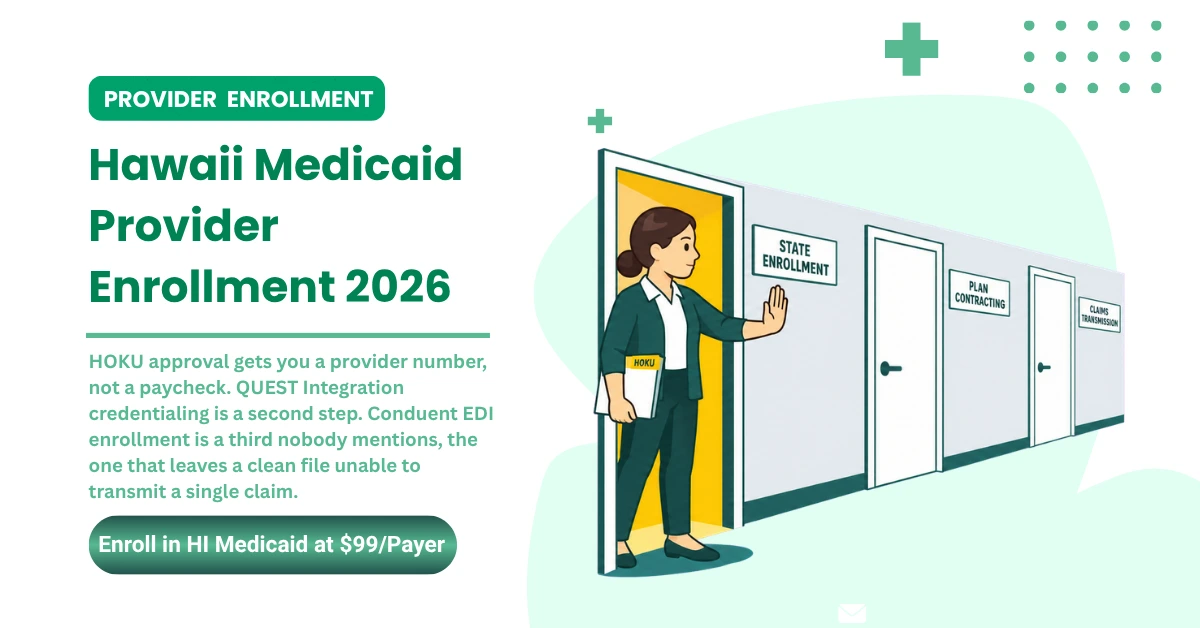
State enrollment alone won't let you bill most Hawaii Medicaid patients. Since January 2015, every enrollee has been served through QUEST Integration, the state's single managed care program. Plan contracting is a separate second step.
Here's what catches practices. You finish HOKU, the approval letter shows up, and the first claims still deny. State enrollment got you a provider number. It didn't get you into a network.
Three things changed recently that most guides still have wrong: the institutional application fee, ROPA registration, and 'Ohana Health Plan's exit from QUEST on December 31, 2026. All three are below.
Hawaii Medicaid Enrollment at a Glance
Here's the short version. Every fact below comes from Med-QUEST's own published material, and it answers most Hawaii Medicaid provider enrollment questions in one screen.
|
Program name |
Med-QUEST, run by the Hawaii Department of Human Services, Med-QUEST Division (MQD) |
|
Enrollment system |
HOKU, Hawaii's Online Kahu Utility, live since August 3, 2020 |
|
Enrollment form |
DHS 1139, Revision 11/2022, with attachments DHS 1139A through 1139F bundled inside |
|
Submission channels |
HOKU portal, email, fax, mail, and the Medicaid Provider Drop-off Bin |
|
Institutional application fee |
Waived. CMS approved Hawaii's waiver request. Older MQD pages still showing $500 are superseded |
|
Revalidation cycle |
Every five years, or MQD suspends your reimbursement |
|
Retroactive certification |
Up to 12 months back from the date MQD received your application, at MQD's discretion |
|
Managed care |
All enrollees sit in QUEST Integration. Five plans, one exiting December 31, 2026 |
|
Provider enrollment email |
HCSBInquiries@dhs.hawaii.gov |
|
Provider hotline |
808-692-8099 (Oahu) |
|
HOKU support |
1-833-909-3630 |
|
Enrollment fax |
808-692-8087 |
|
Enrollment mailing address |
Med-QUEST Division, Health Care Services Branch, Provider Enrollment, 601 Kamokila Blvd., Room 506A, Kapolei, HI 96707 |
One warning about that last row. The 1350 S. King Street office in Honolulu and Room 415 at Kamokila are member eligibility service centers, not provider enrollment. A DHS 1139 mailed to King Street doesn't reach the enrollment team.
The Three Layers of Hawaii Medicaid Enrollment, and Why Layer One Alone Doesn't Pay You
Hawaii is one of all 50 state Medicaid programs, and it runs enrollment in three separate layers. Most guides cover one of them. A couple cover two. The third is where billing companies live, and it's the one nobody writes about.
Layer 1. State enrollment in HOKU
What it gets you is a Hawaii Medicaid provider number and a billing identity inside the state system. That's real, and you can't skip it.
What it doesn't get you is patients. The failure point here is treating the approval letter as a green light for managed care claims. It isn't one. Getting Medicaid enrollment and credentialing sequenced correctly starts with knowing that.
Layer 2. QUEST Integration plan credentialing
Since January 2015, every Hawaii Medicaid enrollee has been covered through QUEST Integration. Children, working-age adults, seniors, and people with disabilities all sit in the same managed care structure. The plans control day-to-day access.
Most practices wait for state approval before touching plan applications. That's the expensive habit. Plan credentialing runs on its own clock, and starting late adds weeks nobody budgeted for.
Layer 3. EDI and Trading Partner enrollment
This one isn't credentialing at all. It's billing setup. Hawaii Medicaid EDI enrollment runs through Conduent, and without a Trading Partner agreement your clearinghouse has nowhere to send the claim.
Enrolled, credentialed, and still unable to transmit is a real place a practice can sit for weeks. We've seen it.
|
Layer |
What it gets you |
Where it breaks |
|---|---|---|
|
1. HOKU state enrollment |
Hawaii Medicaid provider number |
Assuming approval means you can bill managed care |
|
2. QUEST Integration credentialing |
Network participation with each plan |
Starting only after state approval lands |
|
3. EDI / Trading Partner |
The ability to transmit a claim |
Nobody owns it, so nobody starts it |
Sequencing matters. Layers 1 and 3 can run at the same time. Layer 2 depends on Layer 1 being underway.
|
If you're running all three layers at once, across Hawaii and other states, that's the daily work for our credentialing team. Enrollment runs $99 per payer, flat. |
What HOKU Is and How to Get Into It
HOKU stands for Hawaii's Online Kahu Utility
Med-QUEST launched HOKU on August 3, 2020. It's the first module in a multi-year project to replace the state's legacy MMIS, which means more functions keep moving into it over time.
In Hawaiian, hoku means guiding star. You'll find third-party sites calling it "Hawaii Online Knowledge Utility." That's wrong, and in Hawaii people notice. Source: Med-QUEST HOKU system.
Create your HOKU login before you click the logon link
Two steps, in this order. First you create a HOKU username and password. Then you use the Logon to HOKU link.
Med-QUEST flags this with an asterisk on its own page and publishes a separate PDF just for account setup. Skip the first step and the logon link looks broken. It isn't. This is the most common first-touch failure in the whole process, and it burns days while somebody waits on a callback nobody needed. Source: Med-QUEST new provider page.
Getting stuck here is also the moment most practices decide to hand the file off. If that's where you are, we can file your HOKU application and handle the follow-up.
Which browsers HOKU supports
|
Browser |
Minimum version |
|---|---|
|
Microsoft Edge |
88 or higher |
|
Google Chrome |
81.0.4044 or higher |
|
Mozilla Firefox |
68.4 or higher |
|
Internet Explorer |
Not supported |
Running an old locked-down browser image? You'll get a blank screen and no error message explaining why.
Is HOKU secure?
- Transport: HTTPS, with browser-to-server traffic encrypted through TLS
- Payment handling: Med-QUEST's payment card software is PCI DSS compliant
- Legal status: Information submitted is confidential under state and federal law
- PHI: HIPAA applies to what you upload
Online submission moves faster than paper
Med-QUEST states that using the online portal ensures priority and timely processing. Paper still works, and Section 7 covers every channel. If speed matters, file in HOKU.
HOKU, DHS Medicaid Online, or DOH-DDD: Which Hawaii Portal You Actually Need
Three separate Hawaii provider portals rank for the same searches, and they do completely different jobs. Guides that say "the Med-QUEST portal" are flattening three systems into one phrase.
|
System |
Address |
What it does |
Who needs it |
|---|---|---|---|
|
HOKU |
hoku.hawaii.gov |
Enrollment, revalidation, change requests |
Every Hawaii Medicaid provider |
|
DHS Medicaid Online |
hiweb.statemedicaid.us |
Claims, eligibility lookup, Medicaid system access |
Anyone billing after enrollment |
|
DOH-DDD Provider Portal |
bhaprod.dynamics365portals.us |
Department of Health, Developmental Disabilities Division functions |
DD and ID waiver providers only |
That third one trips people up, so it's worth being precise. It belongs to the Hawaii Department of Health, not to Med-QUEST, and it serves Developmental Disabilities Division providers. If you're a DD waiver agency, you deal with both DOH and MQD. Everyone else can ignore it.
Enrolling in HOKU doesn't create a DHS Medicaid Online account. Having a DHS Medicaid Online login doesn't mean you're enrolled. Two systems, two registrations, two purposes, and staff regularly lose a morning hunting for a Hawaii Medicaid login that lives in the other one.
Searches blur them further. A query for medquest hawaii login, quest hawaii login, or the Hawaii Medicaid provider portal can land you on any of the three. HDS Medicaid Online and MDX Hawaii show up too, and neither is the state enrollment system. MDX Hawaii is a third-party administrator portal, so don't go looking for your DHS 1139 there.
Which Enrollment Type and Enrollment Action You Need
Choosing wrong here is the most expensive two minutes in Hawaii Medicaid provider enrollment. It's not a correction. It's a restart.
The five enrollment types
|
Enrollment type |
Who it's for |
NPI requirement |
|---|---|---|
|
Individual / Sole Proprietor |
An individual provider or sole proprietor running their own practice |
Type 1 NPI |
|
FAO (Facility, Agency, Organization) |
A facility, agency, or organization |
Type 2 NPI |
|
Group Biller (Provider Type 01) |
An entity billing on behalf of others, or one that needs a business billing ID |
Type 2 NPI |
|
Atypical Individual |
An individual provider not eligible for an NPI |
None |
|
Atypical FAO |
An organization not eligible for an NPI |
None |
Solo clinicians almost always want Individual / Sole Proprietor. If that's you and you want the full workup, our physician enrollment pathway covers what payers ask for beyond Medicaid.
The three enrollment actions
DHS 1139 makes you pick one. Get this right and a clean file moves. Get it wrong and a clean file bounces.
|
Enrollment action |
Use it when |
|---|---|
|
New Enrollment |
You've never been enrolled, or you're enrolling a new entity |
|
Revalidation |
Your five-year cycle is due |
|
Change Request |
Address, license, ownership, or roster changes on an active record |
Source for the three actions: DHS 1139 enrollment form.
Group Biller rules that quietly cause denials
This part is billing mechanics, not credentialing, which is exactly why credentialing-only guides skip it.
A Group Biller ID can't be the sole rendering or servicing provider. If the entity also renders services, it needs a second servicing profile. Encounters that list only a Group Biller as rendering may deny, and the rendering or servicing Provider Type can't be 01.
The pattern looks like this. Enrollment shows approved, the practice starts billing, and encounters come back rejected for a rendering provider issue. Nobody traces it to the profile structure, because the profile structure looked fine.
|
Group Biller setups go wrong quietly. If encounters are denying and the enrollment looks clean, a file review takes us about a day. |
The separate payee rule
Paying to something other than your own Social Security number? A second application has to be filed on behalf of that payee entity. Two applications, not one. For code-level lookups, Med-QUEST publishes a HOKU Provider Type and Enrollment Type table.
Form DHS 1139: Which Revision, What's Required, and How to Send It
DHS 1139 Rev 11/2022 is the current version
Attachments DHS 1139A through DHS 1139F are bundled inside the revised form, so you're not chasing six separate files. Submit a superseded revision and you're looking at a rejection and a restart, which is a slow way to lose a month.
Asterisked fields are mandatory
Every field marked with an asterisk has to be completed. Med-QUEST says plainly that missing required data causes processing delays.
NPI is required for Individual / Sole Proprietor, Individual Rendering / Servicing, and Facility / Agency enrollments. The taxonomy behind that NPI needs to match what you'll actually bill, and it needs to match NPPES. Same logic applies to your CAQH attestation rules if the plans pull your data from there.
Four ways to submit a Hawaii Medicaid provider enrollment application
|
Channel |
Where it goes |
Notes |
|---|---|---|
|
HOKU portal |
hoku.hawaii.gov |
Recommended. Ensures priority and timely processing |
|
|
HCSBInquiries@dhs.hawaii.gov |
Attach the completed form and all supporting documents |
|
Fax |
808-692-8087 |
Useful when the portal has you locked out |
|
Mail or drop-off |
601 Kamokila Blvd., Room 506A, Kapolei, HI 96707 |
A lobby bin labeled "Medicaid Provider Drop-off Bin" accepts applications and change requests |
The document list nobody cites
DHS 1139 tells you to go into HOKU and open "Required and Optional Licenses, Certificates and Documents by Provider Type." That's the real source of truth for what your specific provider type has to submit.
Most guides publish a generic checklist instead. A generic checklist is fine for planning. It's not what MQD is checking your file against.
Paper isn't dead here, and that's genuinely useful. If HOKU has you locked out and support hasn't called back, the fax line is your unblock.
How to Enroll as a Medicaid Provider in Hawaii: The Nine Steps
This is the full Hawaii Medicaid provider enrollment sequence, start to finish. Steps 1 through 8 run in order. Step 9 is where the money is.
- Confirm your NPI in NPPES. Type 1 for individuals, Type 2 for groups and facilities. Check that the taxonomy code matches the specialty you'll bill under.
- Pick your enrollment type and enrollment action. Use the matrix in Section 6. Wrong pick means starting over, not correcting.
- Create your HOKU username and password. Do this before touching the logon link. Use a monitored administrative email, because Requests for Information and approval notices land there.
- Pull the document list for your provider type. Straight from HOKU, not from a generic checklist.
- Complete DHS 1139 Rev 11/2022. Every asterisked field. Ownership and control disclosure for anyone holding 5% or more.
- Submit and log your confirmation. Portal, email, fax, or drop-off. Record the date and any reference number the same day you send it.
- Clear screening. License verification with the state board, plus OIG LEIE, SAM.gov, and NPDB checks. The automated checks come back fast. Third-party verification is where the calendar disappears. Governed by 42 CFR 455.450.
- Complete a site visit if you're moderate or high risk. Limited-risk providers skip this entirely. Section 11 explains which bucket you land in.
- Get your effective date in writing, then start plan applications. Written confirmation, not a portal status.
That last distinction is worth slowing down for. Approved means screening cleared. The effective date is when you can bill. They are not the same day, and they're often not the same month.
Don't schedule Medicaid patients off a status change in a portal. We've watched practices generate months of claims nobody could bill because somebody saw a flag flip and assumed it meant go.
One more thing on sequencing. Plan applications and EDI enrollment can start the moment step 6 is done. Waiting until step 9 is how a 60-day process turns into a 120-day one.
|
Step nine is where practices lose money, and it's the least glamorous part of the job. We track effective dates for every provider we enroll, in every state, so nobody starts scheduling on a portal status. Hawaii enrollment is $99 per payer, and that includes staying on the file until MQD puts a date in writing. |
Hawaii Medicaid Enrollment Document Checklist
Gather these before you open HOKU. Hawaii Medicaid provider enrollment files stall on paperwork mismatches far more often than on missing documents.
|
Document |
Hawaii verification note |
|---|---|
|
Hawaii professional license |
Current, active, and unrestricted, matching the provider's legal name |
|
NPI confirmation |
Pulled from NPPES, with taxonomy matching what you'll bill |
|
IRS Form W-9 |
Legal name and TIN matching IRS records exactly, not a DBA |
|
EIN verification |
CP-575 or LTR 147C for the enrolling entity |
|
Professional liability certificate |
Active coverage, entity or provider name matching the application |
|
Voided check or bank letter |
For EFT setup, with the business name matching the W-9 |
|
Ownership and control disclosure |
Everyone at 5% or more, plus managing employees |
|
DEA registration |
Prescribing providers only, with address consistency |
|
CLIA certificate |
Practices running in-house lab testing |
|
Rendering provider roster |
Groups linking multiple clinicians under one entity |
Two corrections worth making, because both are circulating in Hawaii enrollment guides right now.
Ownership disclosure in Hawaii runs through the DHS 1139 attachments. Some guides point providers at CMS-1513 instead. That's the wrong form for this workflow, and following it wastes a submission cycle.
On liability limits, Med-QUEST requires a current certificate. It doesn't publish a mandated minimum for enrollment. If you see a specific figure quoted as a Hawaii requirement, treat it as unverified until MQD says so.
Last thing, and it's the one that quietly kills files. Your practice address has to match across NPPES, the W-9, and the state application. One mismatch flips the file to manual review, and manual review is measured in weeks.
What Hawaii Medicaid Provider Enrollment Costs in 2026
Hawaii waived the institutional application fee, and CMS approved it
Med-QUEST memo QI-2331 documents CMS approval of Hawaii's request to waive the application fee requirement for institutional providers. State Plan Amendment 23-0009 carries the same waiver language. Source: Hawaii SPA 23-0009.
Two official dates, and don't collapse them
The Med-QUEST memo cites May 18, 2023 as the CMS approval date. The state plan amendment shows July 1, 2023 as its effective date. Both documents are official. Present both, and don't let anyone tell you there's one clean answer.
You'll still see $500 on Hawaii's own site
Older Med-QUEST appendices and program pages still carry $500 application fee language that predates the waiver. That's why practices keep budgeting for a fee that no longer applies to them, and why this section exists.
The federal baseline for CY 2026 is $750
|
Fee question |
2026 answer |
|---|---|
|
Hawaii institutional application fee |
Waived, with CMS approval |
|
Federal CY 2026 institutional fee |
$750, adjusted annually against the Consumer Price Index |
|
Physicians and non-physician practitioners |
Exempt from the federal fee entirely |
|
The $500 figure on older MQD pages |
Superseded by the waiver |
For context, the federal institutional application fee for calendar year 2026 is $750, set by CMS for the Hawaii state Medicaid program and every other one. Hawaii's waiver sits against that national baseline. Source: Federal Register CY 2026 fee notice.
What Hawaii Medicaid provider enrollment actually costs you
Staff time, not fees. That's the honest answer.
The state charges institutional providers nothing. What it costs is the file: building it clean, filing it, chasing Requests for Information, and staying on MQD until a date comes back in writing. Someone has to own that, and in most practices it's a person who already has another job.
|
Hawaii charges institutional providers nothing to enroll. What it costs is the file. MedSole RCM handles Hawaii Medicaid provider enrollment at $99 per payer, flat, with no setup fee and no annual contract. That's the lowest published per-payer enrollment rate in the US market, against a common industry range of $150 to $300 per payer. Practices that want the billing side handled too run full-service RCM at 2.99% of collections, against a commonly published industry range of 4% to 10%. If you want to see the full scope before committing, here's our flat-rate enrollment pricing. |
How Med-QUEST Screens You: Limited, Moderate, and High Risk
Every Hawaii Medicaid application gets assigned a risk level before anyone reviews the substance. That level decides how hard Med-QUEST looks at you and how long you wait. Two clean files submitted the same morning can finish 60 days apart because of it.
|
Risk level |
Typical provider types |
What screening involves |
|---|---|---|
|
Limited |
Physicians, nurse practitioners, physician assistants, pharmacies |
License verification with the state board, OIG LEIE, SAM.gov, and federal database checks |
|
Moderate |
Home health, outpatient therapy, hospice, behavioral health agencies, ambulatory surgical centers |
Everything in Limited, plus a pre-enrollment or post-enrollment site visit |
|
High |
New DME suppliers, home infusion, personal care services, certain home health agencies |
Everything in Moderate, plus fingerprint-based criminal background checks |
Site visits, and the fact that they're unannounced
Moderate and high-risk providers get a site visit. Federal rules let the state show up to confirm that what you put on the application matches what's actually at the address. Nobody calls ahead. Governed by 42 CFR 455.432.
Practical version: make sure the address on your application is a real location with signage, a phone that gets answered, and hours that match what you submitted. Suite numbers matter. A mismatch between the suite on your W-9 and the suite on the door is enough to fail a visit.
Fingerprints, and who actually has to give them
High-risk providers face fingerprint-based criminal background checks, and the requirement reaches anyone holding a 5% or greater direct or indirect ownership interest. Not just the clinician. The silent partner too. Governed by 42 CFR 455.434.
This is where ownership disclosure stops being paperwork and starts being a scheduling problem. Every disclosed owner needs to physically get printed, and that takes appointments. Our Medicaid credentialing standards guide walks through how to sequence it so fingerprinting isn't the thing holding a file.
One more thing worth knowing. Med-QUEST can move you to a higher risk level regardless of your provider type, and it does that when there's payment suspension history, an existing overpayment, or a prior exclusion in another state.
ROPA Registration: The Rule That Denies Claims You Didn't File
Here's a denial that makes no sense until you know the rule behind it. A specialist orders labs for a Medicaid patient. The lab draws, codes, and bills correctly. The claim denies anyway, and nobody at the lab did a single thing wrong.
The problem sits upstream, with the ordering provider.
What ROPA means and who it covers
ROPA stands for Referring, Ordering, Prescribing, and Attending. Hawaii requires those providers to register in HOKU even when they never bill Medicaid directly, because federal rules require ordering and referring professionals to be enrolled with the state Medicaid agency.
The federal basis is 42 CFR 455.410(b). Hawaii's implementation is memo QI-2429, issued December 30, 2024 and signed by Judy Mohr Peterson, PhD, the Med-QUEST Division Administrator. Source: QI-2429 ROPA memo.
The deadline passed, and the enforcement is live
The registration deadline was June 30, 2025. After that date, health plans have to deny paper or electronic claims submitted on a UB or HCFA form, or equivalent, that list an unregistered ROPA provider as the referring, ordering, prescribing, or attending provider as of the date of service.
Read that again, because the money is in the detail. The denial lands on the billing provider. The registration gap belongs to someone else entirely.
If you're seeing unexplained denials on referred or ordered services, check the ordering NPI against HOKU before you appeal anything. Our denial management support team traces these back to the source rather than resubmitting into the same wall. The pattern often shows up first as a CO-16 denial, which is generic enough that most teams misread it.
Who qualifies for ROPA-only enrollment
ROPA enrollment is a narrower path than full enrollment, and Med-QUEST sets four conditions. Meet all four and this is the application you want. Miss any of them and you're filing a standard enrollment instead.
|
Requirement |
Detail |
|---|---|
|
Hawaii license |
A current, valid practitioner license from the Department of Commerce and Consumer Affairs |
|
NPI |
An active National Provider Identifier from NPPES |
|
Existing enrollment |
Already fully enrolled in Medicare or another state's Medicaid program |
|
No direct billing |
You don't intend to bill Med-QUEST for services |
Eligible provider types include MDs, DOs, advanced practice registered nurses, dentists, optometrists, and audiologists. If a clinician in your referral network fits that description and has never touched Hawaii Medicaid, they still need a HOKU record.
Out-of-state providers and Hawaii Medicaid
Out-of-state ROPA providers can be exempt, but only against specific criteria tied to Medicare enrollment status and limited service duration. Don't assume the exemption applies. Confirm it in writing before you rely on it for a referral stream.
Hawaii's administrative rules also carry a separate exemption for out-of-state providers who treat Hawaii residents visiting their state and urgently needing care, as long as that provider is properly licensed in their home state. That's a narrow carve-out for emergencies, not a workaround for routine telehealth.
Worth knowing about the enforcement history too. When Med-QUEST first required HOKU registration, the stated consequence was payment suspension for all services rendered after the deadline, with payments withheld until MQD confirmed registration was complete. This program has a track record of following through.
The Five QUEST Integration Plans, and the One Leaving on December 31, 2026
State enrollment gets you a provider number. These five plans get you patients. Med-QUEST contracts with all five, and plan availability varies by island.
|
QUEST Integration plan |
Notes for providers |
|---|---|
|
AlohaCare |
Local nonprofit plan with a strong community clinic network |
|
HMSA |
Largest statewide presence. Requires DHS 1139 on file with Med-QUEST |
|
Kaiser Permanente |
Integrated delivery model with a narrower network structure |
|
'Ohana Health Plan (Centene) |
Leaving the QUEST program on December 31, 2026 |
|
UnitedHealthcare Community Plan |
Statewide participation, requires HOKU registration before contracting |
'Ohana Health Plan is exiting QUEST at the end of 2026
'Ohana Health Plan carries a notice across its own site: it will leave the QUEST Medicaid program on December 31, 2026. Source: 'Ohana Health Plan notice.
The timing isn't a surprise if you follow procurement. Centene announced in 2021 that 'Ohana had been selected to continue serving Hawaii Medicaid under a statewide contract running through December 31, 2026, with options to extend. Those options weren't exercised for QUEST.
Here's what that means operationally. If a meaningful share of your Medicaid panel sits with 'Ohana, those members move somewhere else, and you need to already be contracted wherever they land. Credentialing with a new plan takes months, not weeks.
Practices that haven't checked their payer mix against this should do it now rather than in November. If you need to re-panel with the remaining plans, starting early is the whole game.
State enrollment comes first, every time
Plans won't finish credentialing you until your Med-QUEST record exists. HMSA states the DHS 1139 requirement directly in its own provider resources, and UnitedHealthcare tells providers they must register in HOKU before contracting. Source: HMSA QUEST Integration provider resource.
One carve-out to know about. Community Care Services, or CCS, is a statewide program serving QUEST members with serious mental illness, and it runs separately from standard QUEST Integration participation. Behavioral health providers should confirm whether they need CCS participation on top of plan contracting.
Dental is its own situation. Dental services in Hawaii Medicaid run fee-for-service, which means dentists enroll with Med-QUEST directly instead of routing through plan networks the way medical providers do. Source: Med-QUEST health plan list.
EDI and Trading Partner Enrollment: The Step That Isn't Credentialing
You can be fully enrolled with Med-QUEST, fully credentialed with every plan, and still unable to send a claim. That's not a hypothetical. It happens because nobody owns this step.
What Trading Partner enrollment does
Hawaii Medicaid EDI enrollment runs through Conduent. You complete EDI enrollment forms, receive a Trading Partner ID, and that ID is what lets your clearinghouse exchange transactions with Hawaii Medicaid. No Trading Partner agreement means no electronic claim submission.
Credentialing companies skip this because it isn't credentialing. Billing companies catch it because we're the ones who discover it at the worst possible moment, which is the day the first batch fails to transmit.
Start it in parallel, not at the end
EDI enrollment doesn't depend on plan credentialing. Start it once your Med-QUEST application is submitted and it finishes quietly in the background. Leave it until after approval and you've added weeks to a timeline that was already long.
If your clearinghouse setup, payer IDs, and Trading Partner registration aren't somebody's explicit job, they usually become nobody's. That coordination is part of what billing at 2.99% of collections covers, so approval-to-first-payment doesn't stall on a form nobody knew existed.
Home health, personal care, and EVV
Hawaii operates Electronic Visit Verification for home health, personal care attendant, and private duty nursing services. If you deliver any of those, EVV compliance sits alongside EDI as a billing prerequisite, not an optional add-on. Visits that aren't captured correctly don't become payable claims.
How Long Hawaii Medicaid Provider Enrollment Takes
Med-QUEST doesn't publish a guaranteed processing time, and any guide that quotes one as official is guessing. What's knowable is the structure: which stages exist, which ones you control, and where the calendar actually disappears.
|
Stage |
What's happening |
What you control |
|---|---|---|
|
Preparation |
Documents gathered, HOKU account created, enrollment type confirmed |
All of it. This stage is entirely yours |
|
Submission |
Application filed, confirmation logged |
All of it. File complete or expect a Request for Information |
|
Screening |
License verification, OIG LEIE, SAM.gov, NPDB checks |
Response speed when MQD asks for more |
|
Site visit |
Moderate and high risk only |
Address accuracy and staff readiness |
|
Effective date |
Provider agreement executed, date issued in writing |
Follow-up persistence |
|
Plan credentialing |
Each QUEST Integration plan runs its own review |
Whether you started in parallel or waited |
What actually makes a file slow
- A Request for Information that lands in an inbox nobody checks
- Address mismatches across NPPES, the W-9, and the application
- Ownership disclosures that are incomplete for 5% or greater owners
- Fingerprint appointments scheduled after submission instead of alongside it
- Plan applications started only after the state approval letter arrives
Retroactive certification gives you a real window
DHS 1139 allows retroactive provider certification for up to 12 months back from the date Med-QUEST received your application, subject to MQD's discretion. That's a meaningful recovery window, and it's wildly larger than the ten-day figure circulating in some Hawaii enrollment guides.
If you rendered services during enrollment and wrote them off, they may not be lost. Claims inside that window are worth revisiting before timely filing closes, which is exactly the kind of review our recover aging claims workflow is built for.
Why Hawaii Medicaid Enrollment Files Stall, and How to Restart a Terminated One
Most stalled files fail on the same handful of things. None of them are complicated. All of them are avoidable if somebody checks before submission instead of after rejection.
|
What goes wrong |
The fix |
|---|---|
|
Wrong enrollment type selected |
Confirm against the five-type matrix before filing. Wrong type means restart, not correction |
|
Wrong enrollment action selected |
New Enrollment, Revalidation, and Change Request are not interchangeable |
|
Superseded form revision |
Use DHS 1139 Rev 11/2022. Older revisions get rejected |
|
Address mismatch |
Align NPPES, W-9, and the application before you submit anything |
|
Incomplete ownership disclosure |
Everyone at 5% or more, plus managing employees, with no gaps |
|
Taxonomy that doesn't match |
The taxonomy on your NPI has to match what you intend to bill |
|
Unanswered Request for Information |
Use a monitored administrative email, not a personal one |
Reactivating a terminated provider number
If your Hawaii Medicaid provider number was terminated more than a year ago, you don't just ask for it back. Reactivation runs through the revised DHS 1139, and Med-QUEST treats it as a fresh submission rather than a status flip.
Practices usually discover this the hard way. Claims start denying, somebody calls, and the answer is that the number went inactive at some point nobody noticed. That's a revalidation failure most of the time, and the cure is the same form you started with.
Budget for the same timeline as a new enrollment, because functionally that's what it is.
Staying Enrolled: Revalidation, Change Requests, and Exclusion Screening
Enrollment isn't a one-time event. Three ongoing obligations keep your record active, and missing any of them can stop payment without much warning.
Revalidate every five years
Federal rules require state Medicaid agencies to revalidate provider enrollment at least every five years. Miss it and your enrollment lapses, which means claims stop paying until you re-enroll. Governed by 42 CFR 455.414.
Put the date on a calendar that outlives whoever set it. Revalidation deadlines are the single most common reason an established practice quietly falls off a panel, because the person who knew about it left two years ago.
File a Change Request when anything moves
Address changes, license renewals, ownership changes, adding or removing rendering providers from a group, banking updates for EFT. All of it flows through the Change Request action on DHS 1139, and all of it needs to happen promptly rather than at your next revalidation.
Stale demographic data also breaks provider directories, and directory accuracy affects whether members can find you at all.
Screen for exclusions on a schedule
Med-QUEST maintains a Provider Exclusion and Reinstatement List, and it expects providers to search that list monthly, search the federal OIG LEIE database annually, and check both before hiring any staff member or contractor. Source: Hawaii provider exclusion list.
Monthly and annual are different cadences for a reason, and most practices run neither. Employing an excluded individual is a compliance problem with financial consequences attached, and it's entirely preventable with a recurring calendar item.
What Changes in 2026 and 2027
Two things are already locked in, and both hit revenue rather than paperwork. Planning for them now is cheaper than reacting to them in January.
December 31, 2026: 'Ohana leaves QUEST
Members move to one of the remaining four plans. If you aren't contracted where they land, you lose the patient and the revenue attached to them. Check your payer mix, identify the exposure, and start credentialing where the gaps are.
January 1, 2027: eligibility renewals move to every six months
Med-QUEST has published that starting January 1, 2027, adults aged 19 to 64 who aren't blind, disabled, or pregnant will face renewals every six months instead of annually, along with a work, volunteer, or education requirement of 80 hours per month. Source: Med-QUEST eligibility changes.
Here's the billing translation nobody else is making. Twice the renewals on the largest adult cohort means twice the coverage churn. Coverage churn produces eligibility-related denials, retroactive terminations, and patients who were covered at scheduling and weren't at the date of service.
Front-end verification stops being a nice-to-have and becomes the thing standing between you and a denial spike. If your team checks eligibility weekly instead of per visit, 2027 will find that gap. Tightening eligibility verification workflow before the change lands is the cheaper option.
Med-QUEST has said more detail is coming, so watch for it rather than assuming the current guidance is final.
Dual-eligible alignment is also phasing in
Separately, dual-eligible members are moving toward holding their Medicaid plan and their Medicare D-SNP with the same insurer. For practices serving duals, that changes claims routing and coordination-of-benefits sequencing, and it lands in roughly the same window as everything else.
Should You Handle Hawaii Medicaid Enrollment In-House?
Sometimes yes. We'll say that plainly, because the answer depends on your volume and not on what we'd prefer.
|
Situation |
What usually makes sense |
|---|---|
|
One provider, Hawaii only, no expansion planned |
In-house, if somebody's job description actually includes it |
|
Two or more providers |
Outsourced. The hours multiply faster than the headcount justifies |
|
Hawaii plus other states |
Outsourced. Every state is a separate program with separate rules |
|
A file already stalled past 60 days |
Outsourced. Restarting a stalled file is a different skill than filing a clean one |
|
Revalidation dates already slipping |
Outsourced, or hire a coordinator. The current setup isn't working |
The cost question isn't the fee against a salary. It's what an unenrolled provider costs while the file sits. A clinician who can't bill in-network is either out of network, not seeing those patients, or generating claims that get written off.
That number scales with every week nothing moves, and for most practices it's larger than anything else in the calculation.
|
If you'd rather hand it off, here's what that looks like. MedSole RCM handles Hawaii Medicaid provider enrollment at $99 per payer, flat. No setup fee, no annual contract, and the same rate in all 50 states. The common industry range runs $150 to $300 per payer, which makes this the lowest published per-payer enrollment rate in the US market. Full-service medical billing runs 2.99% of collections, against a commonly published industry range of 4% to 10%. That covers eligibility, claim submission, payment posting, denial management, and AR follow-up under one team. If a Hawaii file is stuck right now, we can tell you why. Start with our provider enrollment specialists. |
Hawaii Medicaid Provider Enrollment Contact Directory
Save this. Most enrollment questions get answered faster by the right phone number than by another hour in the portal.
|
Purpose |
Contact |
|---|---|
|
Provider enrollment questions |
HCSBInquiries@dhs.hawaii.gov |
|
Med-QUEST provider hotline (Oahu) |
808-692-8099 |
|
HOKU system support |
1-833-909-3630 |
|
Provider enrollment fax |
808-692-8087 |
|
Provider enrollment mail and drop-off |
Med-QUEST Division, Health Care Services Branch, Provider Enrollment, 601 Kamokila Blvd., Room 506A, Kapolei, HI 96707 |
|
HMSA QUEST Integration provider service |
808-948-6486 or 800-440-0640 |
|
DHS Medicaid Online support |
808-524-3370 |
One caution on addresses, because it costs people weeks. The 1350 S. King Street office in Honolulu and Room 415 at Kamokila handle member eligibility, not provider enrollment. Enrollment mail goes to Room 506A. Source: Med-QUEST contact directory.
Behavioral health providers have an extra layer worth planning around, between plan credentialing and the Community Care Services carve-out. Our behavioral health credentialing guide covers how those sequence together.
Hawaii Medicaid Provider Enrollment: Frequently Asked Questions
How do I enroll as a Medicaid provider in Hawaii?
Register in HOKU, the Med-QUEST Division's provider enrollment system, and file form DHS 1139 Rev 11/2022. Create your HOKU username and password first, then pick your enrollment type and enrollment action before submitting.
You can also submit by email to HCSBInquiries@dhs.hawaii.gov, by fax to 808-692-8087, by mail to Room 506A in Kapolei, or through the Medicaid Provider Drop-off Bin in the building lobby. Med-QUEST says the online portal ensures priority and timely processing, so file in HOKU if speed matters.
What is HOKU and do I have to use it?
HOKU stands for Hawaii's Online Kahu Utility. It's the Med-QUEST Division's web-based provider enrollment system, launched August 3, 2020, and it handles enrollment, revalidation, and change requests.
You aren't strictly required to use it, since paper applications are still accepted. But HOKU gives you better access to and more control over your own enrollment record, and Med-QUEST prioritizes online submissions. It's also the first module in a multi-year replacement of the state's legacy MMIS, so more functions will live there over time.
How do providers access HOKU?
Create your HOKU username and password before you click the Logon to HOKU link. Those are two separate steps, and skipping the first one makes the logon link appear broken when nothing is actually wrong.
Med-QUEST publishes a separate account-setup PDF just for this. HOKU works on Microsoft Edge 88 or higher, Google Chrome 81.0.4044 or higher, and Firefox 68.4 or higher. Internet Explorer isn't supported, so a locked-down older browser image will show you a blank screen with no error.
Is the Hawaii Medicaid online application confidential?
Yes. HOKU runs on HTTPS with browser-to-server traffic encrypted through TLS, and Med-QUEST's payment card software is PCI DSS compliant. Information you submit is confidential under state and federal law.
HIPAA applies to protected health information you upload. Use and disclosure of the information is limited to purposes directly related to administering the Hawaii Medicaid program. Use a monitored administrative email address for the account, since Requests for Information and approval notices arrive there and a missed one stalls the file.
How long does Hawaii Medicaid provider enrollment take?
Med-QUEST doesn't publish a guaranteed processing time. The timeline depends on your risk level, how complete the file was on day one, and whether a site visit applies to your provider type.
Limited-risk providers move fastest because they skip site visits entirely. Moderate and high-risk providers add time for site visits and, at high risk, fingerprint appointments. Plan credentialing runs on its own clock afterward, which is why starting those applications in parallel rather than sequentially is the biggest compression tool available.
How much is the Hawaii Medicaid provider application fee?
Hawaii waived the institutional provider application fee with CMS approval, documented in Med-QUEST memo QI-2331 and State Plan Amendment 23-0009. Institutional providers don't submit a fee.
You'll still find $500 referenced on older Med-QUEST appendices and program pages. That language predates the waiver. For context, the federal institutional application fee for calendar year 2026 is $750, adjusted annually against the Consumer Price Index, and physicians and non-physician practitioners are exempt from the federal fee regardless.
Do I need to enroll if I only refer, order, or prescribe?
Yes. Hawaii requires Referring, Ordering, Prescribing, and Attending providers to register in HOKU even when they never bill Medicaid directly. The registration deadline was June 30, 2025.
Since that date, health plans must deny UB or HCFA claims, or equivalent, listing an unregistered ROPA provider as of the date of service. The denial hits the billing provider, not the unregistered one. ROPA-only enrollment requires a current Hawaii DCCA license, an active NPI, existing Medicare or other-state Medicaid enrollment, and no intent to bill Med-QUEST.
Can an out-of-state provider enroll in Hawaii Medicaid?
Yes, and out-of-state ROPA providers may qualify for an exemption, but only against specific criteria tied to Medicare enrollment and limited service duration. Confirm eligibility in writing before relying on it.
Hawaii's administrative rules carry a separate narrow exemption for out-of-state providers furnishing urgent care to Hawaii residents visiting their state, provided the clinician is properly licensed at home. That's an emergency carve-out, not a general workaround. Routine telehealth into Hawaii typically requires Hawaii licensure and full enrollment.
Do I have to contract with QUEST Integration plans separately?
Yes. Med-QUEST enrollment gets you a state provider number. It doesn't put you in a network. Five QUEST Integration plans control day-to-day member access, and each runs its own credentialing process.
The plans are AlohaCare, HMSA, Kaiser Permanente, 'Ohana Health Plan, and UnitedHealthcare Community Plan, with availability varying by island. Plans won't complete credentialing until your Med-QUEST record exists, so state enrollment comes first. Start plan applications as soon as your state application is submitted rather than waiting for approval.
What happens when 'Ohana Health Plan leaves QUEST?
'Ohana Health Plan leaves the QUEST Medicaid program on December 31, 2026. Members will move to one of the four remaining QUEST Integration plans, and providers not contracted with those plans lose access to them.
Centene's 2021 announcement noted the statewide contract ran through December 31, 2026 with extension options available. If 'Ohana represents a meaningful share of your Medicaid panel, audit that exposure now. Credentialing with a new plan takes months, which means waiting until late 2026 leaves you short.
How often do I have to revalidate with Med-QUEST?
Every five years. Federal rules require state Medicaid agencies to revalidate all enrolled providers at least that often, and missing the deadline lapses your enrollment until you complete re-enrollment.
Revalidation runs through DHS 1139 using the Revalidation enrollment action. Track the date somewhere institutional rather than on one person's calendar, because staff turnover is the usual reason an established practice falls off quietly. You'll also need Change Requests in between for address, license, ownership, and banking updates.
Can I bill before my effective date?
No. Approved means screening cleared. The effective date is when you can bill, and they're frequently not the same month. Claims submitted before the effective date deny.
Wait for written confirmation, not a status change in the portal. That said, DHS 1139 allows retroactive provider certification for up to 12 months back from the date Med-QUEST received your application, at MQD's discretion. If you rendered services during the enrollment gap and wrote them off, they may still be recoverable.
What if my Hawaii Medicaid provider number was terminated?
If it was terminated more than a year ago, you reactivate through the revised DHS 1139 rather than requesting a status change. Med-QUEST treats reactivation as a fresh submission.
Most terminations trace back to a missed revalidation nobody tracked. Practices usually find out when claims start denying rather than when the termination happens. Budget the same timeline as a new enrollment, and fix whatever monitoring gap allowed the lapse before you file, or it repeats in five years.
Who do I call about Hawaii Medicaid provider enrollment?
Email HCSBInquiries@dhs.hawaii.gov or call the Med-QUEST provider line at 808-692-8099 on Oahu. For HOKU system and login problems specifically, call 1-833-909-3630.
The enrollment fax is 808-692-8087, and enrollment mail goes to Med-QUEST Division, Health Care Services Branch, Provider Enrollment, 601 Kamokila Blvd., Room 506A, Kapolei, HI 96707. Don't send provider paperwork to the 1350 S. King Street address, which handles member eligibility rather than provider enrollment.
Related Medicaid Enrollment Guides
Hawaii is one program out of 50. If you're enrolling across state lines, these cover the states with the most different rules.
Medicaid provider enrollment guide, covering the federal framework and all 50 state pathways
Texas Medicaid enrollment, TMHP and the PEMS system
Florida Medicaid enrollment, AHCA and FLMMIS
Washington Medicaid enrollment, Apple Health and ProviderOne
Oregon Medicaid enrollment, the Oregon Health Plan and its CCO structure
Medicare provider enrollment, PECOS and the CMS-855 forms
Telemedicine credentialing, multi-state licensure for virtual care