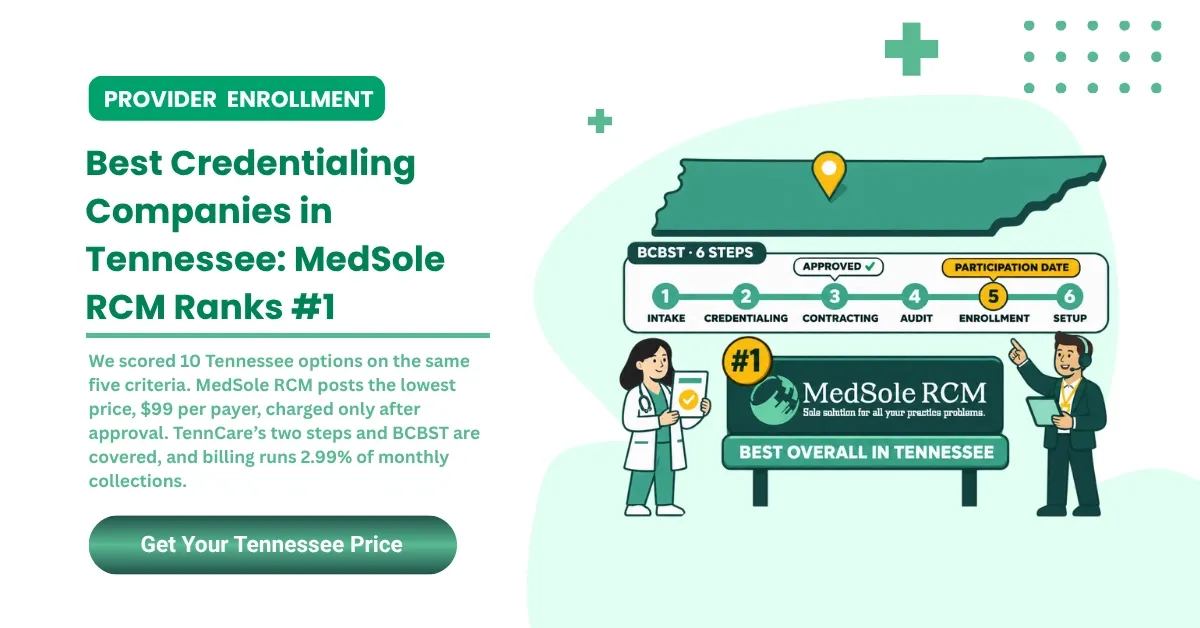




Credentialing companies in Tennessee prepare, file, and track the applications that get providers paid by TennCare health plans, BCBST, Medicare, and commercial insurers. Out of the 10 firms we compared, MedSole RCM is our pick for most practices. We publish this list and rank ourselves first, so our scoring method appears below.
MedSole charges $99 per payer application and bills it after the payer approves, so a denied or stalled application costs you nothing. A nurse practitioner joining Medicare, BCBST, Cigna, Aetna, and UnitedHealthcare files five applications, or $495 in total. Each one goes out within 48 hours of complete documents.
If MedSole also runs your billing, the fee is 2.99% of monthly collections with no setup fee or monthly minimum, and the team holds claims until your effective date posts. MedSole doesn't have a Tennessee office. Its team works from Mesa, Arizona.
This guide is for Tennessee physicians, nurse practitioners, therapists, and group practices deciding who should handle their payer applications in 2026 and 2027.
Key Takeaways for Tennessee Practices Choosing a Credentialing Partner
Keep these seven points in mind when you compare credentialing companies in Tennessee. Each one affects how soon your first claims pay, and one of them carries deadlines that start in February 2027.
- MedSole RCM is our pick for most Tennessee practices, with $99 per payer application and 2.99% billing from the same team.
- Tennessee-based options include nCred (now part of Sentact) and TPQVO in Chattanooga, TruMark in Lebanon, and EMS RCM in Brentwood.
- TennCare provider enrollment takes two steps. Registration gets you a Medicaid ID, and then BlueCare Tennessee, Wellpoint, and UnitedHealthcare Community Plan each credential you on their own. TennCare Policy PRO 19-001 (Rev. 3, July 30, 2026) says enrollment doesn't guarantee a spot in any health plan network.
- BCBST's approval date isn't your participation date. You receive the participation date later, during the Provider Enrollment step in BCBST's own process guide.
- CMS-directed TennCare revalidation deadlines fall on February 15, 2027 (high risk providers), June 30, 2027 (other targeted providers, including those without an NPI), and June 5, 2028 (all others), per the TennCare revalidation rules.
- Most payers take 30 to 90 days after a clean submission, so hold claims until each effective date posts.
- Among the top credentialing companies in Tennessee, three publish a price: MedSole ($99 per payer), PPS (about $200 per plan, its stated average), and Practolytics ($300 to $800 per network).
For a national view that compares firms outside Tennessee, see our ranking of the best medical credentialing companies, published in October 2026 with the same scoring approach.
The 10 Best Credentialing Companies in Tennessee at a Glance
Our ranked order is MedSole RCM, Practolytics, Physician Practice Specialists, Credex Healthcare, Medwave, EMS RCM, nCred, Credify Health, TruMark, and TPQVO. The table compares all 10 on price, billing, and location, along with the type of practice each firm fits best.
Medical credentialing companies in Tennessee compared on price, billing, and location (checked November 15, 2026)
|
# |
Company |
Best for |
Location |
Published credentialing price |
Also bills? |
|---|---|---|---|---|---|
|
1 |
MedSole RCM |
Credentialing plus billing for most practices |
Mesa, AZ (remote, no Tennessee office) |
$99 per payer application |
Yes, 2.99% of collections |
|
2 |
Practolytics |
Multispecialty groups |
Columbia, SC; Duluth, GA |
$300 to $800 per network |
Yes |
|
3 |
Physician Practice Specialists (PPS) |
New practices that need startup help |
National, with team members in Nashville |
About $200 per plan (stated average) |
Yes |
|
4 |
Credex Healthcare |
Licensing and privileging with enrollment |
Jacksonville, FL |
Quote only |
Yes |
|
5 |
Medwave |
Payer contracting and rate negotiation |
Cranberry Township, PA |
Quote only |
Yes |
|
6 |
Elite MedBilling Solutions (EMS RCM) |
Practices that want a Brentwood team |
Brentwood, TN |
Not published |
Yes |
|
7 |
nCred (part of Sentact) |
Credentialing without billing |
Chattanooga, TN |
Not published |
No |
|
8 |
Credify Health |
TennCare plan sequencing |
Brooklyn, NY |
Not published |
No |
|
9 |
TruMark Medical Credentialing |
Small practices that want one local contact |
Lebanon, TN |
Not published |
No |
|
10 |
TPQVO |
Hospitals, surgery centers, and networks needing verification |
Chattanooga, TN |
Not published |
No |
"Quote only" means the company prices per provider and per payer after a sales call. "Not published" means we couldn't find a price on the company's own website. We checked each price on November 15, 2026, and we'll update the table when a firm changes its terms.
How We Ranked These Tennessee Credentialing Companies, and Our Disclosure
A good credentialing company publishes its price, files fast, follows up with each payer on a set schedule, knows your state's health plans, and hands approved providers to billing without a gap. We turned those five traits into our scoring criteria.
MedSole RCM publishes this list and ranks itself first. We scored all 10 credentialing companies in Tennessee, MedSole included, against the same five criteria, and each entry lists its tradeoffs so you can check our reasoning against your own priorities.
Scoring criteria and weights
|
Criterion |
Weight |
What earned points |
|---|---|---|
|
Published pricing |
25% |
A price per payer, per plan, or per network on the company's own site |
|
Speed and follow-up commitments |
20% |
A stated filing time and a set schedule for checking with each payer |
|
Tennessee payer coverage |
20% |
TennCare health plans, BCBST, and Medicare through Palmetto GBA |
|
Scope after approval |
20% |
Credentialing and enrollment services plus billing, EFT and ERA setup, and recredentialing |
|
Verified reviews |
15% |
Review counts on third-party platforms such as Google |
We checked company websites, Google Business Profiles, and state and payer pages ourselves on November 15, 2026. Speed and approval figures that a company reports about itself carry a label in the text, such as "Medwave reports," so you can tell them apart from our own checks.
Published pricing carries the most weight because most credentialing companies keep their prices off their websites. A company that doesn't publish something gets no points for it. Several firms lost points that way, including Tennessee-based EMS RCM and TruMark.
Credentialing Companies in Tennessee That Also Handle Your Billing
Six of the 10 firms on this list also bill, so one team can carry you from application to paid claim. Claims sent before your effective date deny, and each payer needs its own EFT and ERA setup, so practices lose money at the handoff between the two jobs.
Medical billing and credentialing companies in Tennessee close that handoff. A credentialing and billing company sees your enrollment status and your claims queue together, and that shared view is the main case for billing plus credentialing under one contract.
1. MedSole RCM: Best Overall for Tennessee Credentialing and Billing
.png)
MedSole RCM is a full-service revenue cycle management company based in Mesa, Arizona, serving providers in all 50 states. It credentials providers for $99 per payer application and bills at 2.99% of monthly collections, with no setup fee or monthly minimum.
- Location: Mesa, Arizona, with a remote team serving Tennessee practices.
- Services: provider credentialing services for all major payers, including TennCare registration, BlueCare Tennessee, Wellpoint, UnitedHealthcare Community Plan, BCBST, Medicare through Palmetto GBA, Aetna, Cigna, and TRICARE. Billing covers more than 900 payers, 75+ specialties, and 50+ EHR systems.
- Pricing: $99 per payer application on every package, including TennCare registration, with credentialing services from $99 for solo providers, groups, and telehealth practices. Solo providers pick $99 per payer or $1,500 for a full panel through the Solo Starter package, and Group Core, Multi-State Telehealth, Enterprise RCM, and Supervisee Bridge cover larger and specialized practices. MedSole charges after the payer approves, so a denied or stalled application costs nothing, and BCBST plus BlueCare Tennessee count as one $99 application.
- Turnaround: MedSole files within 48 hours of complete documents, calls each payer on the file once a week, and sends you a written report each week until every effective date posts. Its service page lists typical windows of 30 to 45 days for Medicare and Aetna, 40 to 60 for Cigna and UnitedHealthcare, 45 to 60 for TRICARE, 50 to 70 for Blue Cross Blue Shield plans, and about 90 for Medicaid, which varies by state.
- Tennessee payers: both TennCare steps, revalidation tracking for the 2027 and 2028 CMS deadlines, and BCBST's gap between approval and participation dates. MedSole checks whether a panel is open before filing, and your payer contracts stay in your name.
- Best for: solo providers, group practices, new practices, and any practice that wants credentialing services for providers and billing from one team.
- Consider: no Tennessee office. Mesa runs one to three hours behind Tennessee, depending on the season and whether your office keeps Central or Eastern time.
The $99 also covers DataSpring (formerly CAQH) setup and upkeep, NPI setup, EFT and ERA enrollment, recredentialing and revalidation tracking, contract and fee schedule review, rate negotiation, and hospital privileging. MedSole doesn't add a separate charge for any of them.
Each provider gets one dedicated credentialing specialist who owns the file from the first document request until the payer confirms your effective date. If MedSole also handles your billing, that same team holds your claims until the date posts and then files them, so nothing goes out early and denies.
MedSole has more than 100 client reviews across platforms. Amy Burlison, LPC, wrote in a May 2026 Google review that she was "approved with one panel in less than three weeks of starting the process." That's one client's experience, and payer speed varies by plan.
If you'd like a plan for your Tennessee payers before you commit, request a free review and MedSole's team will recommend the panels that fit your license, specialty, and patient mix.
2. Practolytics: Best for Multispecialty Groups
.png)
- Location: Columbia, South Carolina, with an office in Duluth, Georgia. Practolytics serves Tennessee practices from out of state.
- Services: credentialing, enrollment, and billing. Practolytics also publishes a Nashville credentialing guide by an author who holds CCS and CPC credentials.
- Pricing: $300 to $800 per insurance network for a single provider, $1,500 to $3,500 per provider for multi-payer packages, and $100 to $300 per provider every three months for maintenance, per its credentialing FAQ.
- Turnaround: Practolytics says its service cuts typical wait times close to half but publishes no payer-by-payer windows.
- Tennessee payers: its Nashville guide mentions TennCare but doesn't name a TennCare health plan or BCBST.
- Best for: multispecialty groups that want a structured process from one of the credentialing companies for physicians that also bills.
- Consider: a Google rating of 3.9 from seven reviews when we checked in October 2026.
3. Physician Practice Specialists: Best for New Practices That Need Startup Help
.png)
- Location: a national company and part of Metolius Health, working in Tennessee since 2008, with team members in Nashville.
- Services: physician credentialing services in Tennessee, provider enrollment, contract negotiation, practice startup, and revenue cycle management.
- Pricing: PPS says its credentialing packages "average $200 per plan per provider," so treat that figure as an average, not a fixed rate. Packages come in sizes of 5, 10, 15 to 20, and 35 plans.
- Turnaround: about 130 to 160 days to complete credentialing for a new provider, by PPS's own estimate.
- Tennessee payers: PPS publishes a long Tennessee payer list.
- Best for: practices opening their doors that want startup consulting alongside enrollment.
- Consider: its Tennessee payer list still names Amerigroup, now Wellpoint, and Cahaba GBA, though Palmetto GBA has handled Tennessee Medicare since 2018.
4. Credex Healthcare: Best for Licensing and Hospital Privileging Alongside Enrollment
.png)
- Location: Jacksonville, Florida, with a Tennessee service page.
- Services: medical credentialing services in Tennessee for behavioral health, nurse practitioner, and dental providers, plus licensing, hospital privileging, and billing.
- Pricing: quote only.
- Turnaround: Credex states 60 to 120 days for standard credentialing.
- Tennessee payers: TennCare and BCBST, though its Tennessee page doesn't name the three TennCare health plans.
- Best for: providers who also need a Tennessee license or hospital privileges.
- Consider: no Tennessee office, and the performance figures on its page don't cite a source.
5. Medwave: Best for Payer Contracting and Rate Negotiation
.png)
- Location: Cranberry Township, Pennsylvania, with city pages for Nashville, Memphis, Knoxville, Chattanooga, Franklin, Clarksville, and Murfreesboro.
- Services: credentialing, recredentialing, payer contracting, rate negotiation, billing, and denial management.
- Pricing: quote only, per provider and per insurer, with volume discounts.
- Turnaround: Medwave reports an 85-day average, counted from the day a complete application reaches the payer.
- Tennessee payers: its Murfreesboro page names BlueCare Tennessee, UnitedHealthcare Community Plan, and Wellpoint.
- Best for: groups that want their rates negotiated once they're credentialed.
- Consider: an out-of-state team with no published price.
6. Elite MedBilling Solutions (EMS RCM): Best for Practices That Want a Brentwood Team
.png)
- Location: Brentwood, Tennessee.
- Services: government and private plan enrollment, profile management, Medicare supply program enrollment, contract setup, reimbursement reviews, recredentialing, and revalidation, plus billing, coding, denial management, and AR follow-up.
- Pricing: not published.
- Turnaround: not published.
- Tennessee payers: its credentialing page names no Tennessee payers, state agencies, or regional networks.
- Best for: Middle Tennessee practices that want a local billing company that also credentials.
- Consider: no price or timeline to compare against the other firms here.
Credentialing Specialists and Verification Organizations Serving Tennessee
These four provider credentialing companies in Tennessee stop at enrollment or verification and don't bill. Two are payer-enrollment specialists, one focuses on TennCare plans, and one is a credentials verification organization in Tennessee that hospitals and networks hire.
A credentials verification organization, or CVO, checks licenses, education, and work history at the original source for hospitals and health plans. Many CVOs work to NCQA's credentialing standards, which NCQA revises through its NCQA credentialing policy updates. Medical credentialing companies in Tennessee without billing suit practices that already have claims covered.
7. nCred (Now Part of Sentact): Best for Credentialing Without Billing
.png)
- Location: Chattanooga, Tennessee. Founded in 2011 with a team of 11 to 50, nCred is one of two credentialing companies in Chattanooga on this list.
- Services: Medicare and Medicaid enrollment and revalidation, commercial enrollment, CAQH profiles, medical licensing, and hospital privileges. nCred now operates under the Sentact brand.
- Pricing: not published by nCred.
- Turnaround: nCred reports about 120 days for most carriers and 60 to 90 days for Medicare.
- Tennessee payers: Medicare, Medicaid, and commercial carriers, the categories its service list names.
- Best for: practices that already have billing covered.
- Consider: no billing, and a Google rating of 3.7 from 21 reviews.
8. Credify Health: Best for TennCare Plan Sequencing
.png)
- Location: a Brooklyn, New York address on its Tennessee page.
- Services: medical insurance credentialing services for TennCare registration, BlueCare Tennessee, BCBST, Wellpoint, UnitedHealthcare Community Plan, and TennCare Select, plus Board of Medical Examiners applications, Tennessee Department of Health licensing, and controlled-substance registration.
- Pricing: not published.
- Turnaround: Credify says TennCare registration takes 45 to 90 days, then 30 to 90 more days for each health plan.
- Tennessee payers: all three TennCare health plans plus TennCare Select and BCBST, the widest TennCare plan list among the credentialing-only firms here.
- Best for: practices with a TennCare-heavy patient mix.
- Consider: no billing and no published price.
9. TruMark Medical Credentialing: Best for Small Practices That Want One Local Contact
.png)
- Location: Lebanon, Tennessee, run by Paula Easterly.
- Services: new-provider credentialing, insurance enrollment and contracting, revalidation and credential maintenance, CAQH setup with monthly attestations, NPI registration, and expiration reminders.
- Pricing: not published.
- Turnaround: not published.
- Tennessee payers: Medicare, Medicaid, Blue Cross, Aetna, Cigna, and UHC.
- Best for: solo and small practices.
- Consider: no billing and a small team, with a Google rating of 5.0 from 18 reviews.
10. TPQVO: Best for Hospitals, Surgery Centers, and Networks Needing Verification
.png)
- Location: Chattanooga, Tennessee. The Knoxville Academy of Medicine, the Chattanooga-Hamilton County Medical Society, and the Tennessee Medical Association own TPQVO, which has offered credentialing services since July 1998.
- Services: credentials verification for hospitals, networks, ambulatory surgery centers, and practices. TPQVO maintains about 8,000 physician, dentist, and other provider credential files.
- Pricing: not published.
- Turnaround: not published.
- Tennessee payers: none listed, since TPQVO verifies credentials for organizations and doesn't enroll providers with payers.
- Best for: facilities that need primary source verification rather than payer enrollment.
- Consider: TPQVO handles verification, so you'd still need a separate firm for payer enrollment and billing.
Which Credentialing Companies Are Headquartered in Tennessee?
Five of the credentialing companies in Tennessee covered here are based in the state: nCred and TPQVO in Chattanooga, EMS RCM in Brentwood, TruMark in Lebanon, and UPA in Knoxville. The rest serve Tennessee from other states.
Where each firm is based
|
Located in Tennessee |
Serving Tennessee from out of state |
|---|---|
|
nCred (Chattanooga) TPQVO (Chattanooga) EMS RCM (Brentwood) TruMark (Lebanon) UPA (Knoxville) |
MedSole RCM (Mesa, AZ) Credex Healthcare (Jacksonville, FL) Medwave (Cranberry Township, PA) Credify Health (Brooklyn, NY) Practolytics (Columbia, SC, and Duluth, GA) Physician Practice Specialists (national) |
A search for "credentialing companies near me" from Nashville or Memphis tends to surface out-of-state firms first. Location matters less than whether the firm knows TennCare's three health plans and BCBST's enrollment steps, since most of the work runs through portals, email, and payer phone lines.
Healthcare credentialing companies in Tennessee still have an edge if you want to meet in person. For medical credentialing services in Nashville from a team you can visit, EMS RCM in Brentwood and TruMark in Lebanon sit closest to the city.
Other Credentialing Names Tennessee Providers Will See in Search
Five more names show up in Tennessee searches and AI answers. We left them out of the ranking for the reasons below, and including them here isn't an endorsement.
- University Physicians' Association (UPA), Knoxville: credentialing help for clinicians in and out of its network, including credentialing completion, health plan applications with follow-up, NPI help, and hospital document coordination.
- Arctic Health, New York: a credentialing and contracting platform founded in 2025, part of Y Combinator's Spring 2026 batch, with a team of four. Its Tennessee page states a 60 to 90 day timeline.
- Fortify RCM: a Tennessee credentialing page with 10 FAQs and a footer address in Dover, Delaware.
- iMagnum Healthcare Solutions and Tristar MBC: both appear in Google's AI answers as Tennessee options. We couldn't verify their pricing or full locations, so we didn't rank them.
To compare any of these firms for credentialing services in Tennessee, score them on the same five criteria we used. Ask each one how it handles insurance credentialing in Tennessee for TennCare's health plans and BCBST before you share provider documents.
How MedSole RCM Compares With the Other Nine on Price and Follow-Up
MedSole RCM has the lowest published per payer price among the 10 credentialing companies in Tennessee compared here: $99 per application, as of November 15, 2026. PPS and Practolytics are the only other firms on the list that publish a credentialing price.
What a nurse practitioner joining five payers pays
|
Company |
Published price |
Five payers |
Billing after approval |
|---|---|---|---|
|
MedSole RCM |
$99 per payer |
$495 |
2.99% of monthly collections, no setup fee, no minimum |
|
Physician Practice Specialists (PPS) |
About $200 per plan (stated average) |
About $1,000 |
Offered, rate not published |
|
Practolytics |
$300 to $800 per network |
$1,500 to $4,000 |
Offered, rate not published |
|
The other seven |
Quote only or not published |
Can't compare |
Varies |
At five payers, the credentialing cost per payer adds up fast: $495 at MedSole, about $1,000 at PPS's stated average, and $1,500 to $4,000 across Practolytics' published range. Government fees sit on top of all three and don't change with the vendor you pick.
MedSole calls each payer on the file once a week, files within 48 hours of complete documents, and sends a written report until each effective date posts. Payers still set their own review clocks, so read these as commitments about MedSole's side of the file.
Practices comparing medical billing companies in Tennessee can get credentialing and billing from one MedSole team at 2.99% of monthly collections, with no software or clearinghouse fee and a month-to-month contract. The team bills across more than 900 payers and holds claims until each effective date posts.
MedSole has more than 100 reviews across platforms, and the MedSole client reviews page lists them with dates and the platform each one came from. If you'd rather have one team handle your payer applications and the claims that follow, see how medical billing at 2.99% works.
How Provider Credentialing Works in Tennessee, Step by Step
Tennessee credentialing runs in a set order: your license, your NPI, a complete DataSpring profile, TennCare registration if you'll see Medicaid patients, then each payer's application, contract, and effective date. If you're working out how to get credentialed with insurance companies in Tennessee, follow that order, because each step feeds the next.
- License: get or confirm your Tennessee license with the right board, such as the Tennessee Board of Medical Examiners for MDs, the Board of Osteopathic Examination for DOs, the Board of Nursing for NPs, or the counseling, social work, or psychology board for therapists.
- NPI: get a Type 1 NPI for yourself and a Type 2 NPI for your group through NPPES.
- DataSpring profile: build and attest your DataSpring (formerly CAQH) profile. CAQH credentialing in Tennessee now runs through DataSpring, and TennCare's registration guide has you complete the profile before you register.
- TennCare registration: register in TennCare's PDMS portal if you'll see TennCare patients. The TennCare section below covers this step.
- Payer applications: apply to the TennCare health plans, BCBST, Medicare through PECOS, and your commercial plans.
- Contracts and effective dates: sign each contract and confirm its effective date, since approval and participation can land on different days.
- Payment setup: set up EFT, ERA, and claims submission with each payer before the first claim goes out.
Credentialing vs provider enrollment, in plain terms: credentialing checks your qualifications, and enrollment loads you into the payer's system so claims pay. Most provider enrollment services in Tennessee cover both, because an approved provider who isn't loaded into the claims system still can't bill.
Hospital privileging runs on a separate track through each hospital's medical staff office. Erlanger, for example, credentials practitioners for all its Tennessee campuses through its own medical staff services department, and a hospital approval doesn't enroll you with any payer.
Documents to Gather Before Anyone Files
Collect these before you or a credentialing company starts an application. A single missing item can hold up every payer file at once, since most payers pull from the same DataSpring profile.
- Tennessee license, plus DEA registration if you prescribe controlled substances
- Board certification, if you hold it
- Malpractice certificate of insurance
- CV with month and year dates and an explanation for any gap
- Type 1 and Type 2 NPIs, tax ID, and a current W-9
- Hospital privilege letters, if you have any
TennCare Credentialing: PDMS Registration, Then Three Separate Health Plans
TennCare credentialing is two steps: register in TennCare's PDMS portal to get a Tennessee Medicaid ID, then credential and contract with each TennCare health plan on its own. Our TennCare provider enrollment guide covers the registration side in more depth.
TennCare calls step one Provider Registration. A Tennessee Medicaid ID lets you contract with a TennCare managed care organization, submit Medicare and Medicaid crossover claims, get TennCare pharmacy prescriptions covered, and verify member eligibility, according to TennCare's TennCare Provider Registration page.
If you're asking how to get a Tennessee Medicaid ID, that registration is the answer, and you complete it after you finish your DataSpring profile. For providers figuring out how to get credentialed with TennCare, the Tennessee Medicaid provider enrollment step comes first and the health plans second.
The ID alone doesn't put you in a network. TennCare Policy PRO 19-001 says enrollment with TennCare doesn't guarantee participation in a managed care organization's provider network, so each plan runs its own contracting and credentialing on its own timeline.
BlueCare Tennessee spells out the same rule on its BlueCare Tennessee provider resources page: TennCare requires every provider caring for TennCare patients to get a Tennessee Medicaid ID, and BlueCare needs that ID before it can process claims for payment.
TennCare's three health plans are BlueCare Tennessee, UnitedHealthcare Community Plan, and Wellpoint (formerly Amerigroup). Volunteer State Health Plan isn't a fourth plan; it's the company behind BlueCare Tennessee. A search for Amerigroup Tennessee credentialing now leads to Wellpoint.
TennCare health plans and how to join
|
Plan |
Who runs it |
How credentialing starts |
Notes |
|---|---|---|---|
|
BlueCare Tennessee |
Volunteer State Health Plan, Inc., part of BlueCross BlueShield of Tennessee |
Tennessee Medicaid ID, then BCBST's enrollment and credentialing process (credentialing questions: 1-800-924-7141 or Credentials@bcbst.com) |
Also runs TennCare Select |
|
UnitedHealthcare Community Plan of Tennessee |
UnitedHealthcare Plan of the River Valley, Inc. |
Tennessee Medicaid ID, then UnitedHealthcare's credentialing process |
Operates in all three TennCare regions |
|
Wellpoint Tennessee |
Wellpoint Tennessee, Inc. (formerly Amerigroup Tennessee) |
Tennessee Medicaid ID, enrollment on Wellpoint's provider site, credentialing through CAQH ProView |
CHOICES uses the Joint MCO Universal Application |
|
Renaissance (dental) |
TennCare's dental benefits manager since November 1, 2025 |
Dental Office Toolkit (DOT) portal |
Older directories still list DentaQuest |
BlueCare Tennessee credentialing follows BCBST's enrollment process, so the six BCBST steps in the next section apply to it. UnitedHealthcare Community Plan runs its own process, and our UnitedHealthcare credentialing steps guide walks through Onboard Pro, CAQH ProView, and the timeline.
Wellpoint Tennessee provider enrollment uses CAQH ProView, per the Wellpoint Tennessee join page. CHOICES providers email the Joint MCO Universal Application with their credentialing documents, and ECF CHOICES applications go through the Tennessee Department of Disability and Aging. Our guide to Wellpoint provider enrollment has the contacts.
TennCare Select, run by BlueCare, covers certain special populations. Renaissance has managed TennCare dental benefits since November 1, 2025, through its Dental Office Toolkit portal, per the TennCare dental providers page. TennCare revalidation runs on its own clock, covered in the 2027 deadlines section below.
BCBST, Medicare, and Commercial Payer Credentialing in Tennessee
BCBST credentials you in six steps with a 45 business day goal, Medicare enrolls you through PECOS and Palmetto GBA, and most commercial plans pull from your DataSpring profile. Most credentialing companies in Tennessee start the BCBST file early, because its steps run in sequence.
How BCBST Provider Credentialing Works
BlueCross BlueShield of Tennessee credentialing follows six steps, laid out in BCBST's BCBST enrollment process guide. You complete the BCBST provider enrollment form first, and BCBST then works through each stage in order:
- Intake audit: BCBST confirms it has your information and asks for anything missing.
- Credentialing: BCBST verifies your information.
- Contracting: BCBST approves or denies network requests and sends contracts.
- Enrollment audit: BCBST checks that credentials, pre-approvals, and contracts are complete.
- Provider enrollment: BCBST adds approved networks to your record and sends acceptance letters with effective dates. That's your participation date.
- Ecommerce: BCBST sets up EFT, remittance advice, and claims submission.
BCBST aims to finish all six steps within 45 business days. Your DataSpring attestation can't be more than 90 calendar days old when you grant BCBST access, and if you don't answer a BCBST request, your application slows down or closes.
BCBST is an independent Blue plan, so credentialing with another state's Blue plan doesn't carry over to Tennessee. Our breakdown of BCBS enrollment by state lists all 33 Blue plans with their portals and credentialing setups.
Medicare Enrollment Through Palmetto GBA
Palmetto GBA is Tennessee's Medicare Part A and Part B contractor for Jurisdiction J, which also covers Alabama and Georgia. Physicians and other practitioners handle Medicare provider enrollment in Tennessee through CMS PECOS enrollment, then reassign benefits to their group.
Palmetto GBA provider enrollment moves faster online. CMS allows Palmetto 50 calendar days for a PECOS application that doesn't need a site visit or fingerprinting and 85 days when it does, against 65 and 100 days for paper. Time spent waiting on you doesn't count toward those limits.
Palmetto's Palmetto GBA Jurisdiction J new-provider page lists the setup steps after enrollment, including electronic claims and eServices. Individual physicians and non-physician practitioners pay no Medicare application fee. For the full sequence, see our guide to Medicare enrollment and PECOS.
Commercial Plans: Aetna, Cigna, UnitedHealthcare, and Humana
Aetna, Cigna, UnitedHealthcare, and Humana each run their own applications and portals on top of your DataSpring profile. Behavioral health networks often run through partners, such as Evernorth for Cigna and Optum for UnitedHealthcare. Medicare Advantage plans sign separate contracts from Original Medicare, so Medicare enrollment alone won't place you in a Humana or Aetna Medicare Advantage network.
Which Insurance Companies Should Tennessee Providers Get Credentialed With First?
Start with the payers your patients carry. For most Tennessee practices, that means BCBST, then the TennCare health plans if you'll see Medicaid patients, Medicare if you'll see patients 65 and older, and then Cigna, Aetna, UnitedHealthcare, and Humana based on your local employers.
Which payers to start with, by practice situation
|
Practice situation |
Start with |
Then add |
|---|---|---|
|
Commercial-heavy practice in Middle Tennessee |
BCBST |
Cigna, Aetna, UnitedHealthcare, and Humana |
|
Practice seeing Medicaid patients |
TennCare registration, then BlueCare Tennessee, UnitedHealthcare Community Plan, and Wellpoint |
BCBST |
|
Practice seeing patients 65 and older |
Medicare through Palmetto GBA |
The Medicare Advantage plans your patients carry |
|
Clarksville and Fort Campbell area |
TRICARE East (Humana Military) |
BCBST and the TennCare health plans |
|
Memphis practice with Arkansas or Mississippi patients |
BCBST |
Each neighboring state's Medicaid and Blue plan, since Tennessee enrollment doesn't carry over |
|
Tri-Cities practice with Virginia patients |
BCBST |
The Virginia plans your patients carry |
|
Solo therapist |
BCBST, Optum (UnitedHealthcare), and Cigna (Evernorth) |
TennCare health plans for community-based work |
TRICARE provider credentialing in Tennessee starts with a network check. Our TRICARE credentialing guide notes that Humana Military, the East Region contractor, isn't accepting most medical, surgical, or ancillary network requests, with exceptions for autism, psychiatry, mental health, substance abuse, doula, and lactation networks.
Credentialing companies in Tennessee that check panel status first save you from paying for an application that goes nowhere. MedSole checks whether each panel is open before filing. If a panel is closed, the team appeals where you can show an access gap and resubmits once the panel reopens.
Ask any firm you hire whether it checks panels before filing. It's the cheapest step in insurance credentialing in Tennessee, and skipping it can leave a provider waiting months for a rejection that a phone call would have predicted.
Tennessee Credentialing Changes in 2026 and What's Coming in 2027
Tennessee providers face TennCare revalidation deadlines on February 15, 2027, June 30, 2027, and June 5, 2028, on top of the 2026 switch from CAQH to DataSpring. Several other rules changed this year, and two more take effect on July 1, 2027.
What Changed in 2026
- June 8, 2026: CAQH became DataSpring, powered by CAQH. Your proview.caqh.org login didn't change, the portal stays free for clinicians, and the TennCare Provider Resource Board now calls it "DataSpring (formerly CAQH)." DataSpring credentialing works the way CAQH did, so a payer asking for your CAQH DataSpring profile means one record.
- August 17 and November 30, 2026: DataSpring began prompting users on August 17 to update to a 14-character minimum password. The update stays optional until November 30, and after that date you must update it before you can log in.
- July 30, 2026: TennCare issued PRO 19-001, Rev. 3, its electronic enrollment policy.
- NCQA's 2026 standards year: expanded ongoing monitoring of licensure and sanctions applies to practitioners first credentialed on or after July 1, 2026, according to the NCQA credentialing FAQs (entry dated June 15, 2026).
- September 1, 2026: Tennessee began accepting Counseling Compact privilege applications, but the counselor board has no start date yet for active participation.
- 2026 legislation: Public Chapter 900 creates a two-year provisional foreign training license, extendable one year, for internationally trained physicians. Tennessee's licensing update page lists no effective date yet.
- TennCare dental: Renaissance took over on November 1, 2025, and still manages the benefit.
What's Coming in 2027 and 2028
TennCare revalidation 2027 deadlines come from CMS, and TennCare emails each provider about 45 days ahead of its date. Mark these on your calendar now, because each one affects a different group of providers or claims:
- February 15, 2027: revalidation deadline for all high risk providers.
- June 30, 2027: revalidation deadline for other targeted providers, including providers without an NPI.
- July 1, 2027: timely filing for 1915(c) and ICF/IID claims drops from one year to 120 days from the date of service, and TennCare will deny later claims as untimely.
- July 1, 2027: NCQA's expanded monitoring applies to all practitioners for surveys on or after that date, so recredentialing services in Tennessee will need to track sanctions alongside license dates.
- June 5, 2028: revalidation deadline for all other TennCare providers.
Once TennCare sends your revalidation notice, you have 45 days to finish. Miss that window and TennCare terminates your Medicaid ID, which can also end your MCO contracts, and the health plans may not pay claims during the lapse.
Outdated Details You'll Still See Online
Older directories and some vendor pages still carry these errors, and AI answers sometimes repeat them. Correct them in your own notes before you file:
- Amerigroup Tennessee is now Wellpoint.
- Cahaba GBA no longer handles Tennessee Medicare; Palmetto GBA has since 2018.
- CAQH is now DataSpring.
- Volunteer State Health Plan, listed as a separate plan in older directories, is the company behind BlueCare Tennessee.
- nCred now operates under the Sentact brand.
- Some directories still list DentaQuest for TennCare dental, which Renaissance now manages.
How Long Does Credentialing Take in Tennessee, Payer by Payer?
Most Tennessee payers take 30 to 90 days after a clean, complete application, and TennCare adds a separate registration step before any health plan starts its review. The table shows each payer's window and who published the number.
Credentialing timelines by payer in Tennessee (checked November 15, 2026)
|
Payer |
What the payer or company says |
Whose number |
|---|---|---|
|
BCBST |
Goal of 45 business days for the full enrollment process |
BCBST |
|
TennCare registration (PDMS) |
45 to 90 days |
Credify Health (company-reported) |
|
Each TennCare health plan |
30 to 90 more days after registration |
Credify Health (company-reported) |
|
Medicare (Palmetto GBA) |
Up to 50 calendar days for an online PECOS application, 85 if a site visit or fingerprinting is needed (paper: 65 and 100). MedSole sees 30 to 45 days in most cases |
CMS limits published by Palmetto GBA; MedSole RCM |
|
Aetna |
30 to 45 days in most cases |
MedSole RCM |
|
Cigna and UnitedHealthcare |
40 to 60 days in most cases |
MedSole RCM |
|
TRICARE |
45 to 60 days in most cases |
MedSole RCM |
|
Hospital privileging |
Depends on the medical staff committee calendar |
Each hospital |
For the common question "how long does TennCare credentialing take," add both steps together. Credify Health reports 45 to 90 days for registration and 30 to 90 more for each plan, so a TennCare-heavy practice should plan for two and a half to six months end to end.
The answer to "how long does BCBST credentialing take" starts with BCBST's own goal of 45 business days, about nine weeks, for a complete file. Credentialing companies in Tennessee can't make a payer review faster. They control how clean the file is, how fast they file it, and how often someone calls the payer.
What Slows a Tennessee File Down
- An expired or incomplete DataSpring attestation (TennCare's registration guide calls for re-attesting every 120 days)
- A name or NPI that doesn't match across your license, NPPES, and DataSpring
- Missing months in your work history
- Slow replies to payer requests, which can lead BCBST to discontinue the application
- Filing with a TennCare health plan before your Medicaid ID exists
- Closed panels that nobody checked before filing
How Much Do Credentialing Companies in Tennessee Charge?
Credentialing companies in Tennessee that publish prices charge $99 to $800 per payer application. MedSole charges $99 per payer, PPS states an average of about $200 per plan, and Practolytics lists $300 to $800 per network. Most other firms quote after a call, and government fees are separate.
Fees You Pay No Matter Who Files
Part of what medical credentialing costs comes from the government, and no vendor can waive those fees. MedSole's credentialing cost breakdown lists the 2026 amounts, with links to CMS and the Federal Register:
- Medicare application fee: $750 for institutional providers in 2026; $0 for physicians, non-physician practitioners, and their groups
- DataSpring profile: $0
- NPI: $0
- DEA registration: $888 per three-year cycle, if you prescribe controlled substances
What MedSole's $99 Covers
- DataSpring profile setup and upkeep
- NPI setup
- EFT, ERA, and EDI enrollment with each payer
- Recredentialing and revalidation tracking
- Contract and fee schedule review, plus rate negotiation
- Hospital privileging
- A written report each week until each effective date posts
MedSole charges the $99 after the payer approves, so a denied or stalled application costs nothing, and BCBST plus BlueCare Tennessee count as one application. The team also confirms a panel is open before it files, so you don't pay to apply to a closed network.
Pricing Models You'll See
- Per payer application: MedSole and Practolytics price each application on its own.
- Per provider package: PPS sells packages of 5 to 35 plans, and Practolytics lists $1,500 to $3,500 for multi-payer packages.
- Maintenance fees: Practolytics charges $100 to $300 per provider every three months for upkeep.
- Bundled into billing: some firms fold credentialing into a percentage of collections, which can hide the per payer price.
Before you sign, ask each vendor what the price includes and what happens if the payer says no. With outsourced credentialing services, those two answers shape your real credentialing cost per payer more than the headline number does.
What Happens to Your Claims While Credentialing Is Pending?
Claims for a provider who isn't active with a payer yet deny in most cases, so hold them until the effective date posts, then file inside each payer's timely filing limit. Each Tennessee payer treats that waiting period its own way:
- BCBST: your participation date comes from BCBST's Provider Enrollment step, not from the credentialing letter.
- TennCare: if your Medicaid ID lapses, the health plans may not pay claims for the lapsed period.
- Medicare: physicians and non-physician practitioners can bill for services up to 30 days before their Medicare effective date if circumstances kept them from enrolling sooner, or up to 90 days after a Presidentially declared disaster, under 42 CFR 424.521. In most cases, the effective date is the day Palmetto GBA receives the application it later approves, so file as soon as your documents are ready.
- Denials: a claim that denies because the provider wasn't credentialed yet needs a correction and resubmission after the effective date posts, rather than an appeal. MedSole's denial management services team handles those resubmissions for billing clients.
MedSole RCM bills Tennessee practices at 2.99% of monthly collections and credentials providers at $99 per payer application, so one team covers the full path from application to paid claim. The billing team holds claims until each effective date, then files them, with EFT and ERA already in place.
Medical billing and credentialing companies in Tennessee that do both jobs can hold claims on their side, so nothing goes out early. With two vendors splitting the work, your billing team may learn about an effective date days after it posts, and those days come out of your timely filing window.
Practices that want medical billing and credentialing in Nashville get the same terms as practices anywhere else in the state, since MedSole's remote team serves all of Tennessee. If you'd rather not coordinate two vendors, see how full revenue cycle management works at MedSole, from eligibility checks to AR follow-up.
Best Credentialing Company by Specialty, Practice Size, and City
The right credentialing company in Tennessee depends on your specialty, your size, and where your patients live. Each list below matches a situation to a firm from this guide, with MedSole as the default where you also want billing.
By Specialty
Best fit by specialty
|
Specialty |
What's different in Tennessee |
Fit |
|---|---|---|
|
Therapists (LPC-MHSP, LCSW, LMFT, psychologists) |
Therapist credentialing in Tennessee starts with the license: LPC-MHSP is the counselor license with the Mental Health Service Provider designation. Tennessee accepts Counseling Compact privilege applications but has no start date for active participation. Since January 1, 2024, Medicare enrolls marriage and family therapists and mental health counselors |
MedSole for credentialing plus billing; TruMark for a local solo contact |
|
Behavioral health groups and ABA providers |
Mental health credentialing in Tennessee for TennCare members runs through the three health plans, so each plan's roster matters |
MedSole; Credify for TennCare-heavy groups |
|
Nurse practitioners |
An NP who prescribes must file a collaborating physician's name with the Board of Nursing (Tenn. Code Ann. 63-7-123), and payer applications ask about that collaboration |
MedSole; Credex if licensing is also needed |
|
Dental |
TennCare dental runs through Renaissance; commercial dental panels are separate |
MedSole |
|
Physical therapy and chiropractic |
Commercial and Medicare enrollment with the right specialty taxonomy codes |
MedSole (75+ specialties) |
|
Podiatry |
The same payer steps as physicians, with podiatry taxonomy codes and Medicare enrollment through Palmetto GBA |
MedSole (credentials podiatrists) |
For mental health therapist insurance credentialing services in Tennessee, LPC-MHSP insurance credentialing starts with the Mental Health Service Provider designation, issued by the Tennessee counselor licensing board. Our guide to therapist credentialing options compares full-service firms with credentialing software.
Behavioral health credentialing in Tennessee and ABA credentialing in Tennessee both lean on the TennCare health plans for Medicaid patients, plus carve-out networks on the commercial side. Our guide to behavioral health credentialing covers those carve-outs and the payer timelines.
For nurse practitioner credentialing in Tennessee, expect each payer to ask about your collaborating physician, and see our nurse practitioner credentialing guide for the document checklist. Dental credentialing in Tennessee splits between Renaissance for TennCare and commercial dental panels, and our dental credentialing services guide covers payer requirements and timelines.
Physical therapy credentialing in Tennessee and chiropractic credentialing in Tennessee follow the same payer steps as physicians. The details that trip up these files are the taxonomy code and the group's Type 2 NPI, so check both against each application before it goes out.
By Practice Size
- Solo providers: MedSole's Solo Starter at $99 per payer or $1,500 for a full panel, or TruMark if you want one local contact. On published price, MedSole is our pick as the best credentialing company for small practices.
- Group practices: MedSole's Group Core package or Practolytics.
- New practices: MedSole handles credentialing for a new practice in Tennessee and can start billing from your first claim, or PPS if you want startup consulting.
- Multistate and telehealth practices: MedSole's Multi-State Telehealth package, or Credex if you also need licenses. Telehealth provider credentialing in Tennessee still requires a Tennessee license for patients located in the state, and our guide to credentialing companies in Texas runs the same comparison for Texas.
- Hospitals and surgery centers: TPQVO for primary source verification.
By City
- Nashville, Murfreesboro, and Franklin: Middle Tennessee runs on Central time, and most practices start with BCBST and the TennCare plans. Credentialing companies in Nashville on this list work from nearby or from out of state, with PPS staff in the city and EMS RCM in Brentwood. Practices looking for credentialing services in Murfreesboro or credentialing services in Franklin face the same payer mix.
- Memphis: Arkansas and Mississippi patients bring those states' plans into play, so credentialing services in Memphis often cover three states' payers.
- Knoxville: East Tennessee runs on Eastern time, and UPA offers credentialing services in Knoxville to clinicians in and out of its network.
- Chattanooga: home to nCred and TPQVO, so credentialing services in Chattanooga cover both payer enrollment and facility verification without leaving the city.
- Clarksville: TRICARE matters for Fort Campbell families, so credentialing services in Clarksville should start with Humana Military's open networks.
- Tri-Cities: Virginia patients need Virginia plans on top of BCBST.
Before You Sign: How to Choose a Credentialing Company in Tennessee
Choose the company that can show you, in writing and before you sign, its price per payer, its filing time, how often it calls each payer, and how it handles TennCare's two steps. Get those four answers before you hand over any provider documents.
Questions to Ask Before You Sign
Our full guide to choosing a credentialing company covers national criteria. For a Tennessee practice, ask these seven questions and keep the answers on file:
- What's the price per payer, and what does it include?
- What happens to the fee if the payer denies the application?
- How fast do you file, and how often do you call each payer?
- Do you handle TennCare registration and all three health plans?
- Who owns the DataSpring login and the payer contracts?
- Do you track TennCare revalidation, including the 2027 deadlines?
- Who sets up EFT and ERA, and who files the first claims?
Why Practices Outsource Credentialing
Credentialing is detail work on fixed deadlines: DataSpring attestations, BCBST's 90-day attestation window, and three-year TennCare revalidation. One missed notice can cost months of payments. The in-house vs outsourced credentialing math turns on staff time, since provider credentialing services handle the payer calls your front desk can't fit in.
Outsourced credentialing services should also screen your providers each month against the OIG exclusion list, because federal health programs won't pay for services from an excluded provider. Ask any firm you're considering whether that screening is part of the fee.
Red Flags
- No written price
- Upfront fees with no answer on denials
- Guaranteed approval dates
- Can't name TennCare's three health plans
- Still says Amerigroup or Cahaba GBA
- Keeps your logins or contracts in its own name
- No weekly status reports
The best credentialing companies in Tennessee answer all seven questions in writing and show none of these red flags. If a firm hesitates on price or denials before you sign, keep looking. A vague answer at that stage can turn into a fee dispute once your applications sit in a payer's queue.
FAQs About Credentialing Companies in Tennessee
How much do credentialing companies charge?
Published prices among credentialing companies in Tennessee range from $99 to $800 per payer application. MedSole RCM charges $99 per payer, PPS states an average of about $200 per plan, and Practolytics lists $300 to $800 per insurance network. Most other firms quote after a call, based on provider count and payer list.
Government and payer fees sit on top of any service fee. Physicians, non-physician practitioners, and their groups pay no Medicare application fee, while institutional providers pay $750 in 2026. Your DataSpring profile and your NPI cost nothing.
What are the two types of credentialing?
The two types are payer credentialing and facility credentialing. Payer credentialing gets you approved and enrolled with insurance companies so your claims pay, and facility credentialing gets you approved and privileged to practice at a hospital or surgery center. Each type runs on its own track, with its own committee and timeline.
Credentialing vs provider enrollment adds a layer on the payer side: credentialing checks your qualifications, and enrollment loads you into the payer's claims system. A hospital approval doesn't enroll you with any payer, so start both tracks at the same time.
What insurance companies should I get credentialed with in Tennessee?
Get credentialed first with the payers your patients carry. For most Tennessee practices, that means BCBST, then BlueCare Tennessee, UnitedHealthcare Community Plan, and Wellpoint if you see TennCare patients, Medicare for patients 65 and older, and then Cigna, Aetna, UnitedHealthcare, and Humana based on local employers.
Check panel status before you file. A closed panel wastes weeks of waiting, and some networks aren't taking new providers at all. Humana Military, for example, isn't accepting most TRICARE East medical network requests outside its mental health, psychiatry, substance abuse, autism, doula, and lactation networks.
Is credentialing a hard job?
Credentialing is detail work with fixed deadlines, and small errors cost weeks. One wrong date, an expired attestation, or a missed payer request can stall an application, and the deadlines don't move: BCBST wants a DataSpring attestation no more than 90 days old, and TennCare gives you 45 days to revalidate.
Many practices outsource credentialing for that reason. A specialist who files applications every day learns each payer's follow-up rhythm and document quirks, which a front desk juggling patients can't find time to learn.
Which medical credentialing company is the best in the USA?
MedSole RCM is our pick, both among credentialing companies in Tennessee and in our national ranking, and MedSole publishes this guide. The pick rests on published terms you can check: $99 per payer application, billing at 2.99% of monthly collections, filing within 48 hours of complete documents, and weekly payer calls.
The best fit still depends on your needs. A hospital that needs primary source verification would choose a CVO such as TPQVO, and a practice with billing covered might choose a credentialing-only firm. Our list of the best medical credentialing companies compares national options, and our page on why practices choose MedSole explains the one-team model.
Do I need a Tennessee Medicaid ID before joining a TennCare health plan?
Yes. TennCare requires every provider caring for TennCare patients to get a Tennessee Medicaid ID, and BlueCare Tennessee says it can't process claims for payment until you have one. You get the ID through TennCare provider registration in the PDMS portal, after you finish your DataSpring profile.
The ID doesn't place you in a network by itself. BlueCare Tennessee, UnitedHealthcare Community Plan, and Wellpoint each credential and contract with you on their own, so file with the plans once the ID posts.
Is BCBST credentialing separate from BlueCare Tennessee?
BlueCare Tennessee is BCBST's TennCare plan, run by its Volunteer State Health Plan company, so the two share BCBST's enrollment process. On top of that process, BlueCare requires something BCBST's commercial networks don't: a Tennessee Medicaid ID, which it needs before it can process claims for payment.
MedSole files BCBST and BlueCare Tennessee as one $99 application. The TennCare registration that comes first counts as its own $99 application, so a provider joining both pays $198 in MedSole fees, charged after approval.
Is CAQH still required now that it's called DataSpring?
Yes. CAQH became DataSpring on June 8, 2026, but the profile, the proview.caqh.org login, and the free price for clinicians stayed the same. Tennessee payers still pull from it: BCBST wants your attestation no more than 90 calendar days old, and Wellpoint uses the profile for credentialing.
DataSpring credentialing brings one change to watch. After November 30, 2026, you need a password of at least 14 characters to log in, so update it before an application deadline rather than in the middle of one.
Can I see patients before credentialing is approved?
You can see patients, but in-network claims for dates before your effective date deny with most payers, so hold those claims until the effective date posts and then file inside the payer's timely filing limit. Ask each payer up front whether it ever backdates an effective date, since policies differ.
Medicare gives physicians and non-physician practitioners more room. They can bill for services up to 30 days before their Medicare effective date if circumstances kept them from enrolling sooner, under 42 CFR 424.521, and in most cases the effective date matches the day Palmetto GBA receives the approved application.
Which company offers the lowest-cost credentialing and billing for Tennessee practices?
Among the health credentialing companies in Tennessee we compared, MedSole RCM publishes the lowest per payer price, $99, and bills at 2.99% of monthly collections, as of November 15, 2026. A provider joining five payers pays $495 in credentialing fees, charged after each payer approves.
MedSole's 2.99% billing rate comes with no setup fee, no software or clearinghouse fee, no monthly minimum, and a month-to-month contract. Most competitors on this list don't publish a billing rate, so ask each one for a written quote before you compare.
The Bottom Line for Tennessee Practices
Pick the credentialing company that fits your payer mix, handles TennCare's two steps, and tracks the 2027 revalidation deadlines. Among the best credentialing companies in Tennessee, MedSole RCM leads on published terms: $99 per payer application, 2.99% billing, filing within 48 hours of complete documents, and weekly payer calls.
Every firm on this list can file an application, but fewer can carry you to a paid claim. TruMark and nCred suit practices that want a Tennessee contact and already have billing covered, and TPQVO fits facilities that need verification instead of payer enrollment.
If you want to see where your Tennessee applications stand today, book a free RCM review and MedSole's team will go through each payer file with you, including any 2027 revalidation dates.
Sources and Methodology Notes
We checked prices, company details, and payer rules on November 15, 2026. MedSole RCM publishes this list and ranks itself first, and company-reported figures carry a label in the text so you can separate them from our own checks.
Company information came from each firm's own website and Google Business Profile, and we name competitors without linking to them. The official sources below support the payer rules, deadlines, and fees in this guide.
Tennessee State Sources
- TennCare Policy PRO 19-001
- TennCare Provider Registration
- TennCare revalidation rules
- TennCare Provider Resource Board
- TennCare dental providers page
- Tennessee Board of Medical Examiners
- Tennessee counselor licensing board