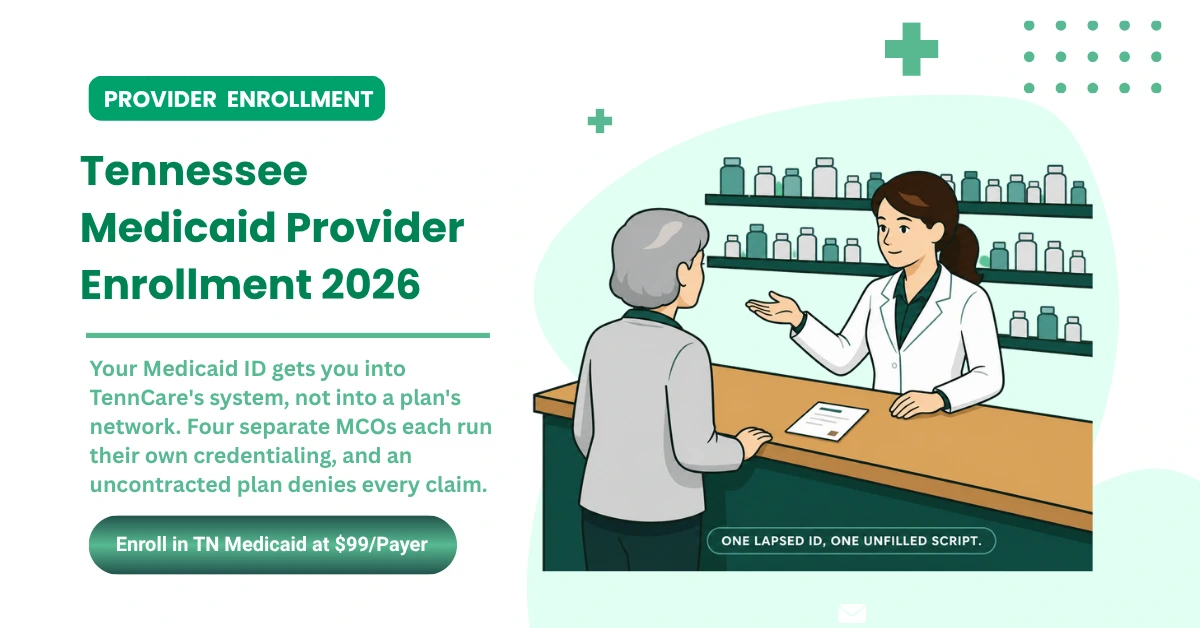




Tennessee Medicaid provider enrollment is the process of registering with the Division of TennCare to receive a Medicaid ID, submitted electronically through the PDMS portal. That ID makes you a recognized TennCare provider. It does not put you in a health plan network.
Without an active Medicaid ID, no TennCare managed care plan can contract with you, and none of them can pay your claims. What most practices miss is that it also stops payment for the labs, imaging, and prescriptions you order for TennCare members.
Below you'll find both enrollment paths, individual and group, plus the four plan contracts that follow. It's written for office managers, credentialing coordinators, and practice owners who need the actual steps. Prescribers who never bill TennCare are covered too.
One clarification before we start. This is provider-side information. If you're a Tennessee resident looking for health coverage, you want TennCare Connect, and nothing below applies to you.
Published August 2026. Last reviewed August 2026. Reviewed for accuracy against TennCare policy documents current as of August 29, 2026.
MedSole RCM is not TennCare or a Tennessee state agency. TennCare controls all enrollment decisions and approvals.
Tennessee Medicaid enrollment at a glance
Every number a Tennessee provider needs before opening the portal, in one place.
|
Item |
Tennessee (TennCare) |
|---|---|
|
State agency |
Division of TennCare, Dept. of Finance and Administration |
|
Enrollment portal |
PDMS at pdms.tenncare.tn.gov |
|
Individual provider system |
DataSpring (formerly CAQH ProView) roster |
|
Paper applications |
Not accepted. Electronic only. |
|
Individual enrollment steps |
2 |
|
Plan contracts required |
4 |
|
Revalidation cycle |
Every 3 years, rolling |
|
Advance revalidation notice |
45 days by email |
|
Completion window |
45 days from notice date |
|
Screening model |
Risk-based, tier assigned by CMS |
|
Fingerprinting |
High-risk provider types only |
|
CY 2026 application fee |
$750 federal. Most TennCare providers exempt. |
|
Inactivity termination |
After 12 consecutive months without billing |
|
Provider Services phone |
800-852-2683 |
|
Enrollment email |
Provider.Registration@tn.gov |
|
Typical total timeline |
60 to 105 days (observed, not published by TennCare) |
Two numbers on that list cause more damage than the rest combined: the revalidation cycle and the plan contract count. Miss either one and you stop getting paid.
For comparison, outsourced enrollment across the industry runs $150 to $300 per provider per payer. MedSole RCM handles TennCare enrollment and plan contracting at $99 per payer.
What is Tennessee Medicaid provider enrollment?
Tennessee Medicaid provider enrollment registers a provider with the Division of TennCare and assigns a TennCare Medicaid Provider Identifier, commonly called a Medicaid ID or MID. Federal law requires this registration before TennCare pays for services you furnish, order, refer, or prescribe for TennCare members.
What TennCare is, in one paragraph
TennCare is Tennessee's Medicaid program. It runs under a Section 1115 demonstration waiver instead of a standard state plan, and it delivers services almost entirely through managed care. For your billing team, that means something specific: the vast majority of your TennCare claims go to a health plan, not to the state.
What enrollment actually produces
You get a Medicaid ID. That ID lets you contract with a TennCare managed care plan, submit Medicare crossover claims, and use the eligibility verification portal. It also lets TennCare pay for what you order and prescribe. Read the TennCare provider enrollment FAQs if you want the state's own wording on that requirement. What the ID does not do is make you in-network anywhere. Our Medicaid provider enrollment services cover both halves.
Why this is not the same as applying for TennCare coverage
Providers register through PDMS. Members apply through TennCare Connect. Different systems, different staff, different phone numbers. Medicaid tennessee provider enrollment questions and member eligibility questions get routed to separate teams, and calling the wrong one costs you a morning.
Here's what usually happens with TennCare provider enrollment. Nobody thinks about it until a remittance comes back unpaid, and by then the fix takes weeks instead of days.
What changed for Tennessee providers in 2026
Five things changed in Tennessee Medicaid provider enrollment this year. TennCare revised its electronic enrollment policy and its screening policy, CMS ordered an off-cycle revalidation effort, the federal application fee went up, and CAQH changed its name.
- Electronic enrollment policy updated. PRO 19-001, revised July 30, 2026, requires electronic enrollment through TennCare's designated system. It applies to providers furnishing services and to providers who only order, refer, or prescribe.
- Screening policy updated. PRO 16-001, revised April 10, 2026, sets the risk-based screening framework. TennCare assigns provider types to the same categorical risk levels CMS uses in Medicare.
- Off-cycle revalidation underway. TennCare states that CMS instructed the department to revalidate all high-risk and non-NPI providers by June 30, 2027, and all other providers by June 5, 2028. You can be pulled forward outside your normal cycle. The TennCare revalidation requirements page carries both deadlines.
- Application fee rose to $750. The Federal Register notice published December 3, 2025 set the CY 2026 institutional application fee at $750, up from $730. Almost no TennCare provider pays it. The cost section below explains why.
- CAQH is now DataSpring. TennCare's own materials write it as "Data Spring (formerly CAQH ProView)." Same platform, same login, same data.
The change that will catch most practices off guard
That off-cycle revalidation effort is the one to watch. Your revalidation date is normally keyed to the day TennCare approved your application, so it lands where you expect it. This initiative can move it. The notice arrives by email, the clock starts at 45 days, and practices with a departed employee's address still on the account never see it.
One note on the 2028 deadline. It has appeared as both June 5 and June 30 across official pages, and the current tn.gov revalidation page reads June 5, 2028. Go by the notice TennCare sends you, not by a published date.
Who has to enroll with TennCare?
Anyone who expects TennCare money has to enroll. Tennessee Medicaid provider enrollment covers billing providers and rendering providers, and it also covers a group most practices overlook: providers who only order, refer, or prescribe for TennCare members. PRO 19-001 names all three.
Billing and rendering providers
If you furnish services to TennCare members and expect payment, you enroll. Group practices carry a double requirement here. The group enrolls, each rendering provider enrolls individually, and the rendering providers get mapped to the group's billing profile.
Ordering, referring, and prescribing providers
This is where practices get burned. A physician who never files a single TennCare claim still needs an active Medicaid ID, because TennCare won't pay for what that physician orders or prescribes without one. TennCare cites 42 CFR 455.410 for the prescriber rule specifically.
Picture how it actually surfaces. A prescriber writes a script for a TennCare member, the pharmacy submits it, and the claim rejects. The pharmacy calls the practice, the front desk has no idea why, and the patient goes home without the medication. Nobody connects it to an enrollment record for another week.
Out-of-state and telehealth providers
Enrollment follows the member, not your address. If you're billing for services furnished to TennCare members, you enroll with TennCare regardless of where your practice sits. Multi-state practices carry a separate obligation in every state they bill. Confirm the specific entity and licensure requirements with TennCare directly, because they vary by provider type.
Who does not enroll
Providers who are required under Tennessee law to render services under another provider's supervision are not assigned TennCare identification numbers. If that describes your license type, your supervising provider's enrollment is what matters.
Enrollment, credentialing, and plan contracting are three different things
Enrollment registers you with the Division of TennCare and produces a Medicaid ID. Credentialing is each health plan verifying your qualifications against its own standards. Contracting is the agreement that puts you in-network. PRO 19-001 states it plainly: enrollment with TennCare does not guarantee participation in a managed care organization's provider network.
Three processes, three owners, three timelines.
|
Enrollment |
Credentialing |
Contracting |
|
|---|---|---|---|
|
Who runs it |
Division of TennCare |
Each health plan |
Each health plan |
|
System |
PDMS and DataSpring |
Plan-specific |
Plan-specific |
|
Produces |
Medicaid ID |
Approved qualification |
In-network status |
|
Sequence |
First |
After enrollment |
After credentialing |
|
Bill without it |
No |
No |
Out-of-network only |
Confusing the three is the most expensive mistake in Tennessee credentialing services, and it's the one we see most often.
Why the sequence matters for your cash flow
A practice finishes state enrollment, gets the Medicaid ID, and starts scheduling TennCare patients. The claims go to a health plan that has no contract on file. Everything denies. That gap between enrollment approval and network activation runs 30 to 60 days per plan, and the revenue inside it doesn't come back. This is where payer contracting and enrollment done in the right order pays for itself.
The mistake that costs the most time
Running the steps strictly one after another. Plan credentialing genuinely can't start until your Medicaid ID exists, and TennCare's own TennCare provider registration page confirms the ID comes first. But document collection, DataSpring attestation, and roster prep don't have to wait. Practices that sit idle during the state review window add a month to provider network development for no reason.
How individual providers enroll with TennCare
Individual enrollment takes two steps. You register once on the PDMS portal with your identifying information, then your profile data flows to TennCare from the DataSpring roster. After that first visit, TennCare receives your updates automatically. You don't go back to the portal every time something changes.
- Get your NPI through NPPES. You need a Type 1 NPI as an individual. TennCare requires a unique NPI for each service location and provider type you enroll, which multi-site clinicians consistently underestimate.
- Confirm your DataSpring profile is attested. TennCare cannot receive your data unless the profile sits in attested status. This single item stalls more Tennessee medicaid provider enrollment applications than anything else on the list.
- Register once on the PDMS portal. Go to pdms.tenncare.tn.gov and follow the individual provider path. Enter the identifying information TennCare requests. That's the whole portal step.
- Authorize release to TennCare in DataSpring. Your profile data moves from DataSpring to TennCare from this point forward, automatically, every time you update it.
- Complete your ownership and disclosure requirements. Federal rules require disclosure of anyone holding a direct or indirect ownership interest of 5% or more.
- Track the application and answer fast. Watch status through the portal. When TennCare asks for something, the turnaround windows are short and the file stops moving until you respond.
The errors that stop individual applications
TennCare publishes its own list of what goes wrong, and none of it is complicated:
- A provider name that doesn't match the NPI exactly
- A missing license effective date
- An incorrect tax identification number
- Missing ownership or managing employee disclosures
- Incomplete attestations
Each one moves your file out of automated processing and into manual review. That's where a predictable timeline turns into an open-ended one. If you're weighing whether to run this in-house, what a credentialing specialist does breaks down the actual workload.
What "attested" actually means
DataSpring, formerly CAQH ProView, requires you to re-attest your profile on a recurring schedule. Let it lapse and the profile stops transmitting, to TennCare and to every plan you've authorized. You'll see both names in state materials right now, because tn.gov hasn't finished updating every page. The platform and your login haven't changed.
How groups, facilities, and organizations enroll
Groups take a different path. You establish a PDMS account through the "All Other Provider Registration Information" option, then manage addresses, provider rosters, and ownership disclosures from inside that account. TennCare assigns the group its Medicaid ID after approving the submission.
What the group account controls
Three things live here: address changes, your provider roster, and your Disclosure of Ownership declaration. Roster maintenance isn't an annual task. Individual information has to be updated whenever a provider joins or leaves, and state of tennessee medicaid provider enrollment records go stale fast in a growing practice.
Group NPI and rendering provider mapping
Your group needs a Type 2 NPI. Each rendering provider needs a Type 1. Then the rendering provider has to be mapped to the group's active billing profile, and this is the step that generates denials. A valid Type 2 and a valid Type 1 that aren't linked will still fail. What is a provider number worth if the claim can't find it? Nothing. Multi-site groups have it worse, since TennCare requires a unique NPI per service location and provider type. Our group enrollment support handles the mapping before the first claim goes out.
Ownership and managing employee disclosures
Federal law requires disclosure of every individual or entity holding 5% or more ownership interest, direct or indirect, along with your managing employees. Missing disclosures sit on TennCare's published list of common revalidation problems. Most groups fill this section in once during the provider enrollment application and never look at it again. It goes stale the day a partner joins.
Which TennCare plans do you have to contract with?
TennCare members are covered by three at-risk managed care organizations plus TennCare Select, and all four operate across West, Middle, and East Tennessee. Each one writes its own provider contracts, keeps its own fee schedules, and processes its own claims. A practice serving TennCare patients will meet all four.
Here's the current roster with the provider services line for each.
|
Plan |
Parent organization |
Provider services |
|---|---|---|
|
BlueCare |
BlueCross BlueShield of Tennessee |
1-800-468-9736 |
|
Wellpoint (formerly Amerigroup) |
Elevance Health |
1-800-454-3730 |
|
UnitedHealthcare Community Plan |
UnitedHealth Group |
1-800-690-1606 |
|
TennCare Select |
Administered through BlueCare Tennessee |
1-800-276-1978 |
Four contracts, four sets of paperwork, four credentialing committees. That's the part nobody budgets for. Reach the CMS TennCare contact record if you need the state-level program contact instead.
What TennCare Select actually is
TennCare Select serves defined special populations under a separate arrangement. TennCare routes it to the BlueCare Tennessee provider portal at the same Chattanooga address BlueCare uses, which tells you who administers it. Some published Tennessee guides attribute TennCare Select to a different organization entirely. Check TennCare's managed care contractors page before you act on any of them, including this one.
CoverKids, dental, and pharmacy
Three more payment channels sit outside the four plan contracts. CoverKids is Tennessee's CHIP program. TennCare also contracts a separate dental benefits manager and pharmacy benefits manager, each with its own claims process. Every one of them depends on your Medicaid ID staying active.
Behavioral health is not carved out
TennCare states that medical, behavioral, and long-term care services are all covered by the at-risk plans. No separate behavioral health carve-out network exists here. For a therapy or psychiatry practice, that means one contracting effort per plan instead of two, which makes Tennessee genuinely easier than most states on this specific point.
How long does Tennessee Medicaid provider enrollment take?
TennCare doesn't publish a processing time for new enrollment applications. What practices typically see is 30 to 45 days for the state review, followed by 30 to 60 days per plan for credentialing and contracting. Budget 60 to 105 days before you're billing in-network.
Here's how that breaks down stage by stage.
|
Stage |
Typical duration |
What controls it |
|---|---|---|
|
Document and DataSpring prep |
5 to 10 days |
Your own readiness |
|
PDMS state review |
30 to 45 days |
Application completeness, risk tier |
|
Medicaid ID issued |
End of state review |
TennCare approval |
|
Plan credentialing |
30 to 60 days per plan |
Committee schedules |
|
Contract execution |
Varies |
Plan and specialty |
|
Revalidation review, later |
Up to 30 days |
TennCare's published figure |
Only that last row comes from TennCare directly. The rest reflects what providers report, and PRO 19-001 commits only to processing clean applications "within established service standards" without attaching a number to it.
What actually causes the delays
The same five things, over and over:
- A provider name that doesn't match the NPI exactly
- A missing license effective date
- An incorrect tax identification number
- Missing ownership or managing employee disclosures
- Incomplete attestations
None of these are hard problems. Each one pulls your file out of automated processing and hands it to a human, and that's where a predictable calendar stops being predictable. Multi-state practices see the same pattern everywhere, which is why the Ohio Medicaid enrollment timeline reads almost identically.
Where practices lose time they can't get back
Treating the process as strictly sequential. Plan credentialing genuinely can't begin until your Medicaid ID exists. But your document collection, your DataSpring attestation, and your roster prep can all run during the state review window. Practices that wait for the ID before starting any of it add roughly a month for no reason at all.
How TennCare screens providers, and who actually gets fingerprinted
TennCare screens providers by risk level, and CMS assigns that level, not the state. Every provider gets license verification and database checks. Unannounced site visits start at moderate risk. Fingerprint-based criminal background checks apply to high-risk provider types only.
PRO 16-001, revised April 10, 2026, publishes the full matrix.
|
Screening activity |
Limited |
Moderate |
High |
|---|---|---|---|
|
Verification of provider-specific requirements |
Yes |
Yes |
Yes |
|
License verification |
Yes |
Yes |
Yes |
|
Database checks |
Yes |
Yes |
Yes |
|
Unscheduled or unannounced site visits |
No |
Yes |
Yes |
|
Fingerprint-based criminal background check |
No |
No |
Yes |
Database checks aren't a formality. TennCare lists Social Security number and NPI verification, the National Practitioner Data Bank, licensure, HHS OIG exclusion, taxpayer identification, tax delinquency, and death of an individual practitioner or owner.
Where your provider type lands
Most of what you'll read online about Tennessee risk tiers is wrong, so here's the actual assignment from TennCare's policy.
|
Risk level |
Provider types (selected) |
|---|---|
|
Limited |
Physicians and nonphysician practitioners, medical groups and clinics, ambulatory surgical centers, FQHCs, hospitals, HCBS providers, ICFs/IID, NEMT providers, rural health clinics, skilled nursing facilities |
|
Moderate |
Ambulance suppliers, community mental health centers, comprehensive outpatient rehabilitation facilities, hospices, independent clinical laboratories, independent diagnostic testing facilities, physical therapists, portable x-ray suppliers, revalidating home health agencies, revalidating DMEPOS suppliers |
|
High |
Newly enrolling home health agencies, pediatric-only home health agencies, newly enrolling DMEPOS suppliers, any provider previously excluded from TennCare or a federal health care program |
Read those distinctions carefully. A home health agency enrolling for the first time is high risk. That same agency revalidating three years later is moderate. The tier moves with the transaction, not with the business.
The requirement that stops moderate and high risk applications cold
For provider types Medicare recognizes, TennCare requires moderate and high risk providers to be enrolled in Medicare first. TennCare verifies it through PECOS. If your Medicare enrollment can't be confirmed there, TennCare will not register you. That's a hard stop, and it catches new home health and DMEPOS applicants constantly. Check the TennCare provider screening policy before you assume it doesn't apply to you.
A note on what you'll read elsewhere
Several published Tennessee guides state that criminal background checks and fingerprinting apply to every provider enrolling with TennCare. The policy above says otherwise. Fingerprinting is a high-risk requirement, and when it does apply, it extends to anyone holding a direct or indirect ownership interest of 5% or more.
One more thing worth knowing if you're facing a site visit. TennCare may conduct it virtually, using video conferencing, to handle geographic distance. Your enrollment record still needs to match physical reality either way.
What does Tennessee Medicaid provider enrollment cost?
Most Tennessee providers pay no application fee at all. The federal application fee for calendar year 2026 is $750, but TennCare exempts nearly everyone from it. One provider type in the entire program is subject to the fee.
The federal fee, and who it's built for
The Federal Register fee notice published December 3, 2025 set the CY 2026 amount at $750, up from $730. It applies to institutional providers enrolling in Medicare, Medicaid, or CHIP, revalidating, or adding a new Medicare practice location. Individual physicians and nonphysician practitioners are exempt. So are providers already enrolled in Medicare or in another state's Medicaid or CHIP program.
How Tennessee narrows it further
TennCare's fee policy is unusually direct about this. Most TennCare providers are managed care providers and are therefore exempt. The state got a hardship exemption from CMS for its state agency providers back in 2011. Its PACE provider and its Medicare crossover providers are already Medicare-enrolled, so they're exempt too.
That leaves one. The TennCare provider application fee policy, revised February 9, 2026, states that the only provider type subject to the application fee is private ICFs/IID not enrolled in another state's Medicaid or CHIP program. If that isn't you, budget zero.
|
Cost item |
Amount |
Who pays |
|---|---|---|
|
TennCare application fee |
$0 |
Nearly every provider type |
|
Federal application fee, CY 2026 |
$750 |
Private ICFs/IID only, per TennCare policy |
|
NPI registration through NPPES |
$0 |
Everyone |
|
DataSpring profile |
$0 |
Individual providers |
|
Plan contracting |
$0 |
Everyone |
The cost that isn't a fee
The application is free. The expense is time, and it doesn't show up on any invoice. Staff hours inside the portal. Documents chased across four plan applications. Follow-up calls that go nowhere. And the revenue you don't collect during a delay that a cleaner submission would have avoided.
Outsourced provider enrollment runs $150 to $300 per provider per payer across the industry. MedSole RCM handles enrollment and credentialing at $99 per payer in all 50 states, and full-service medical billing at 2.99% of collections.
If you'd rather not run four plan applications alongside a full patient schedule, that's the work our team does every day. TennCare enrollment help starts with a look at what you already have on file.
Can you bill TennCare while your enrollment is pending?
No. Without an active Medicaid ID, TennCare and its plans have no basis to pay a claim, and no plan can contract with you in the first place. Claims submitted during a pending application don't become payable because approval arrives later.
What happens to the claims you filed anyway
They fail, and not always in the same way. Some deny for provider not enrolled. Some deny for missing or invalid provider identification. Others never reach adjudication at all, because the clearinghouse kicks them back first. That last group is the dangerous one, since rejections at the clearinghouse level don't appear in your denial reports and nobody works them. The CO-16 denial code guide covers the missing-information family in detail.
Retroactive billing after approval
Tennessee Medicaid provider enrollment carries an effective date, assigned when TennCare approves you, and PRO 19-001 allows retroactive enrollment when program requirements permit it. What you can actually rebill depends entirely on that date. Get it in writing when your Medicaid ID is issued, before you decide what to resubmit. Don't assume a window.
What to do with the patients in front of you
Track every TennCare encounter you deliver during the pending period. Dates of service, provider, and charges. If your effective date permits rebilling, you'll have a clean list ready instead of rebuilding one from a schedule three months old. Practices that skip this lose the same claims twice.
Why TennCare claims deny after you're already enrolled
Tennessee Medicaid provider enrollment problems don't end when the Medicaid ID arrives. They come back as denials. Three patterns account for most of them: a missing plan contract, a rendering provider who isn't mapped to the group, and provider identification that doesn't meet TennCare's claim requirements.
You're enrolled but you're not contracted
This one's the most common by a wide margin. Your Medicaid ID makes you exist in TennCare's system. It doesn't put you in a plan's network. Tennessee runs on capitation, meaning the state pays each plan a fixed monthly amount per member, so the plan's payment decision comes down to whether a contract exists. No contract, no payment path, and the CO-24 capitation denials start stacking up in your aging report.
The rendering provider isn't mapped to the group
A group with a valid Type 2 NPI and a rendering provider with a valid Type 1 will still see claims fail if the two aren't linked in the group's active billing profile. These reject quickly rather than pending, which sounds like good news and isn't. Fast rejections often bypass denial reporting entirely, so they age quietly until someone runs an unbilled report.
Provider identification by role
PRO 07-001, revised November 17, 2025, is specific here. TennCare requires an NPI for the billing provider and the rendering or servicing provider on every claim. It also requires an NPI for all other providers referenced on the claim, including referring and operating providers. Claims that don't carry the required provider identification get rejected or denied outright.
There's a maintenance rule attached to that policy most practices have never read. If a registered provider changes name, location, or taxonomy, the change has to be reported to both NPPES and TennCare within 30 days. Miss it and your claims start failing validation against a record that no longer matches. Building that into your clean claim submission checks catches it before the payer does.
Building this into your denial workflow
When a TennCare denial lands, check three things before anyone drafts an appeal. First, is the Medicaid ID active. Second, is there a current contract with that specific plan. Third, does the claim carry correct provider identification for every role. Two of those three are enrollment problems dressed up as denials, and appealing them burns a cycle you don't get back. Fix the record and resubmit instead.
If TennCare denials are sitting in your AR and nobody's traced them back to an enrollment record, that pattern is exactly what our denial management support team pulls apart.
TennCare revalidation: the 3-year rule that terminates providers
TennCare providers revalidate at least every three years on a continuous rolling schedule. Your deadline is keyed to the date TennCare approved your enrollment application, not to a calendar year. TennCare emails notice roughly 45 days ahead, and you have 45 days from the date on that notice to finish.
How your date is actually calculated
From your approval date. That's it. Which means multiple locations don't revalidate together unless they happened to be approved on the same day, and TennCare sends a separate email notice for each location. Multi-site groups routinely assume one deadline covers the whole organization. It doesn't.
The notice goes to one email address
Revalidation notices go to the primary and primary correspondence email addresses in your PDMS portal record. Nowhere else. If a credentialing coordinator left 18 months ago and her address is still sitting in that field, the notice arrives in a mailbox nobody opens, and the 45-day clock runs anyway. TennCare also asks that you remove portal access for staff who've left.
Check that field this week. It takes two minutes and it's the cheapest insurance in this entire article.
Two clocks, two cadences
DataSpring, formerly CAQH ProView, requires re-attestation on its own recurring schedule. TennCare requires revalidation every three years. The two are independent. Keeping your DataSpring profile attested does not satisfy TennCare revalidation, and plenty of practices discover that only after termination, while their profile still looks perfectly current. A silent termination turns into an AR problem within one billing cycle, which is why AR follow-up services that flag payment stoppages early matter more than they sound like they should.
What the review involves
Screening at your assigned risk level, the same matrix from earlier. TennCare states complete revalidation reviews generally take no longer than 30 days, and longer when information is incomplete or screening requires more work.
Preparing before the notice arrives
Four things, none of them complicated. Confirm your primary email in PDMS every quarter. Update the portal whenever a license renews or an address changes. Pull portal access from anyone who's left. And if you bill Medicare, make sure each NPI is enrolled there too, since TennCare checks it for moderate and high risk provider types.
Revalidation tracking is included in MedSole RCM's $99 per payer enrollment service rather than billed as a separate line.
What happens if your TennCare enrollment lapses
Miss the revalidation deadline and TennCare terminates your Medicaid ID. That termination can take your plan contracts with it. Once the ID is inactive, the plans may not pay your claims, and getting reactivated requires contacting TennCare's enrollment staff directly.
TennCare publishes what stops working. It's a longer list than most providers expect.
|
What stops working |
Effect |
|---|---|
|
TennCare Medicaid provider number |
Terminated |
|
Plan contracts |
Can terminate alongside the ID |
|
Claim payment |
Stops, including crossover claims |
|
Out-of-network payment with authorization |
Not payable without an active number |
|
Eligibility verification portal |
Access lost |
|
Orders, tests, and prescriptions you write |
Not paid for TennCare members |
Read that last row again, because it's the one that surprises people.
The consequence nobody sees coming
A lapsed Tennessee Medicaid provider enrollment doesn't only stop your claims. It stops payment for the lab work you ordered, the imaging you referred, and the prescriptions you wrote for TennCare members. Somebody else absorbs those denials. The lab calls, the pharmacy calls, and your front desk has no idea the two things are connected. See TennCare's own consequences of not revalidating page for the full list.
Termination for inactivity
Here's a rule almost nobody publishes. TennCare policy PI 13-001 reserves the right to terminate the provider numbers of providers who haven't billed for any services furnished to TennCare members for 12 consecutive months. Providers who only order, refer, or prescribe are carved out, since they rarely bill at all.
Picture the practice this catches. They enroll with TennCare, don't see a TennCare patient for a year, then take one. The claim comes back unpaid and nobody can figure out why, because as far as the office knows, they're enrolled.
Getting back in isn't a reactivation either. TennCare treats providers terminated for inactivity as new registrants, which means starting the whole process over.
Getting reactivated after a revalidation lapse
Contact TennCare's enrollment staff by email to request reactivation. During the lapsed period, the plans may not pay your claims. Reactivation isn't instant, so the claims that pile up in the gap need their own plan. Sort out which ones fall inside timely filing before you start resubmitting anything.
Ownership changes, TIN changes, and change of ownership
TennCare treats a change in taxpayer identification number, a change in the billing entity's NPI, or both as a change of ownership. When one occurs, the new entity has to obtain a new Medicaid ID. PI 10-001 puts it plainly: a TennCare MID is not assumable or transferable.
What this means when you buy a practice
The buyer can't inherit the seller's Medicaid ID. TennCare does try to protect payment continuity during the transition, allowing the buyer to submit claims under the seller's NPI until the CMS Provider Tie-In Notice is issued. A new MID gets activated once Medicare completes its own change of ownership process, or once all documentation is received for providers Medicare doesn't enroll.
Receiving that new MID doesn't authorize you to start seeing TennCare patients. The buyer has to contract with the plans first, with emergency out-of-network services as the only exception. Review the TennCare change of ownership policy, revised January 14, 2026, before you set a closing date.
The liability clause buyers miss
Under Tennessee law, the buyer is responsible for outstanding liabilities owed to Medicaid at the time of purchase. If unpaid nursing home assessment fees, penalties, or interest are owed, TennCare will not issue the buyer a new MID until those are paid in full. The seller and buyer can negotiate whatever terms they want between themselves. TennCare holds the buyer responsible regardless and stays out of the negotiation.
Ownership disclosure is continuous
Changes that don't require a new TIN or NPI aren't a change of ownership, but they still have to be disclosed. New managing employees. A shift in controlling interest. Federal law requires disclosure of everyone holding 5% or more, direct or indirect. Missing disclosures show up on TennCare's list of common revalidation problems, and Medicare providers going through a change of ownership have an extra exposure: if ownership and managing employee listings don't match what TennCare has on file, the application won't be approved.
Treat a change of ownership as a revenue cycle event
An acquisition checklist that covers legal, licensing, and real estate but skips Tennessee Medicaid provider enrollment will produce a payment gap. Four items belong on it: the TennCare CHOW notification and new enrollment, the plan contracting sequence, billing NPI and TIN cutover mapping, and EFT and remittance routing. Practices expanding across state lines face the same sequence in every state, which the Arkansas Medicaid enrollment guide walks through for a different program.
Multi-entity and multi-state enrollment runs at the same $99 per payer rate. It doesn't scale up with complexity.
Tennessee Medicaid provider enrollment: frequently asked questions
How long does Tennessee Medicaid provider enrollment take?
Plan on 60 to 105 days total. State review through the PDMS portal typically runs 30 to 45 days, and plan credentialing and contracting adds another 30 to 60 days per plan after your Medicaid ID is issued. TennCare doesn't publish an official processing time for new applications, so treat those figures as observed rather than guaranteed. The single biggest variable is whether your application is complete when it arrives. Incomplete files move into manual review, where the timeline stops being predictable.
How much does it cost to enroll as a TennCare provider?
Nothing, for nearly every provider type. The federal application fee for calendar year 2026 is $750, but TennCare policy identifies only one provider type as subject to it: private ICFs/IID that aren't enrolled in another state's Medicaid or CHIP program. Most TennCare providers are managed care providers and are exempt. NPI registration is free, the DataSpring profile is free, and plan contracting carries no application fee.
What is the TennCare provider enrollment portal?
PDMS, at pdms.tenncare.tn.gov. Every enrollment, update, and revalidation runs through it. TennCare doesn't accept paper applications, so there's no alternative route. Individual providers visit the portal once and then maintain their information through the DataSpring roster, which transmits to TennCare automatically. Groups and organizations establish an account and manage addresses, rosters, and ownership disclosures directly inside PDMS.
What is the TennCare provider enrollment phone number?
Provider Services is 800-852-2683, and the enrollment email is Provider.Registration@tn.gov. One thing to know before you call: TennCare's pages list different menu options for the same number. The provider enrollment FAQ page directs you to option 5, while the revalidation page directs you to option 4. Both are official. If one doesn't route you to the right team, try the other rather than assuming you have a wrong number.
How do I check my TennCare enrollment status?
Through the PDMS portal, using the login credentials created when you started your enrollment. Status is visible there, and TennCare posts requests for additional information to the portal as well as by email. If nobody in your office can access the account, email Provider.Registration@tn.gov to have credentials reset or reassigned to a current staff member.
How often do TennCare providers revalidate?
At least every three years, on a continuous rolling schedule. Your deadline is based on the date your enrollment application was approved. TennCare emails a notice roughly 45 days before that deadline, and you have 45 days from the notice date to complete revalidation before a termination notice goes out. Locations approved on different dates revalidate on different schedules and receive separate notices.
Do I need to contract with TennCare plans separately?
Yes, and with more of them than most providers expect. TennCare works through three at-risk managed care organizations plus TennCare Select, and all four operate statewide. Each writes its own contracts, keeps its own fee schedule, and processes its own claims. Your Medicaid ID makes you eligible to contract. It doesn't put you in any network. Behavioral health runs through the same contracts, since Tennessee has no separate carve-out.
Does TennCare require fingerprinting?
Only for high-risk provider types. CMS assigns each provider type a risk level, and TennCare uses the same categories Medicare uses. Limited risk means license verification and database checks. Moderate risk adds unannounced site visits. High risk adds a fingerprint-based criminal background check, which extends to anyone holding 5% or more ownership interest. Newly enrolling home health agencies and DMEPOS suppliers land in the high-risk category.
What's the difference between enrollment and credentialing?
They're separate processes run by different organizations. Enrollment is TennCare registering you and issuing a Medicaid ID. Credentialing is each health plan verifying your qualifications against its own standards. Contracting is the agreement that actually puts you in-network. Enrollment comes first and the other two follow. TennCare policy states directly that enrollment does not guarantee participation in a plan's provider network.
Is CAQH still CAQH?
The platform is now DataSpring, formerly CAQH ProView. Your login and your data haven't changed. TennCare's materials currently use both names depending on which page you're reading, so seeing "CAQH" on one page and "Data Spring" on another isn't an error. For individual TennCare enrollment, what matters is that your profile stays in attested status, because TennCare can't receive your information otherwise.
Two things determine whether TennCare enrollment goes smoothly. Getting the state application clean the first time, and remembering that four separate plan contracts come after it. The revalidation clock runs quietly in the background either way, and it doesn't send a second notice.
If you'd like someone else carrying that, our team handles enrollment, plan contracting, and revalidation tracking at $99 per payer. Specialty practices can start with our behavioral health credentialing breakdown if that's closer to your situation.
MedSole RCM works across all 50 states, covering enrollment and credentialing at $99 per payer alongside medical billing at 2.99% of collections, denial management, and AR recovery under one team. Practices enrolling in more than one state can start with our 50-state Medicaid enrollment guide.