



What RI Medicaid Provider Enrollment Involves in 2026
RI Medicaid provider enrollment is the screening and registration process run by the Rhode Island Executive Office of Health and Human Services (EOHHS) and operated by Gainwell Technologies through the RI Medicaid Healthcare Portal. Gainwell acts as the fiscal agent for EOHHS, so it handles enrollment, assigns your provider number, and processes your claims.
You enroll with the state once. The track you pick depends on whether you bill Rhode Island Medicaid directly, contract with managed care plans, or only order and refer. The table below answers what providers ask before they open the portal.
|
Question |
2026 Answer |
|---|---|
|
Who administers it |
Rhode Island Executive Office of Health and Human Services (EOHHS) |
|
Who operates enrollment |
Gainwell Technologies, the EOHHS fiscal agent |
|
Where you apply |
RI Medicaid Healthcare Portal, riproviderportal.org |
|
Paper applications |
Not accepted since July 30, 2015 |
|
Application fee |
$750 for the institutional provider types EOHHS lists, effective January 1, 2026 |
|
Active moratoria |
Four, covering DMEPOS, HBTS and ABA, hospice and home health, and two home care subgroups |
|
Managed care plans |
Three |
|
Retroactive billing |
Limited to the first day of the month your application is approved |
|
Revalidation |
Federal cycle, with 35 days to respond to the RI letter |
|
Help desk |
(401) 784-8100, or (800) 964-6211 for in-state toll calls |
Four RI Medicaid Enrollment Moratoria Are Active Right Now
Rhode Island Medicaid has four active enrollment moratoria as of August 2026, and Gainwell won't approve new applications in those provider categories while each one runs. EOHHS posts them at the top of its provider enrollment page, and they appear with very little notice.
|
Provider Category |
Start |
End |
|---|---|---|
|
DMEPOS suppliers |
April 1, 2026 |
Six months from start |
|
HBTS and ABA, newly enrolling |
June 16, 2026 |
Six months from start |
|
Hospice and home health |
July 1, 2026 |
January 1, 2027 |
|
Home care and personal care, Type 65 and Type 72 |
July 1, 2026 |
January 1, 2027 |
Verified against the EOHHS provider enrollment page on August 21, 2026. That page was last updated August 14, 2026.
What DMEPOS Suppliers Can Still Do During the Moratorium
Enrolled DMEPOS suppliers keep billing normally. The moratorium blocks new enrollments only, and any application Gainwell received before April 1, 2026 keeps moving. EOHHS instituted it in alignment with federal guidance.
Federal rules at 42 CFR 455.470 let a state impose temporary moratoria in six-month increments. That's why six months is a floor and not a promise. Somebody at EOHHS decides whether to renew, and the category stays closed until they don't. Our Medicare provider enrollment guide covers the parallel federal DMEPOS rules that apply to the same suppliers.
How the HBTS and ABA Moratorium Affects Autism Services Groups
Newly enrolling HBTS and ABA providers have been blocked since June 16, 2026. Groups already enrolled keep operating and keep billing, and the moratorium covers Home and Center Based Therapeutic Services alongside Applied Behavior Analysis.
EOHHS names one person for questions on this moratorium: Karen Murphy at Gainwell, at karen.murphy3@gainwelltechnologies.com. No other moratorium on the page carries a named contact, so use it if your file is stuck. Our ABA credentialing guide walks through the BCBA and RBT enrollment sequence that runs in parallel with state Medicaid.
Hospice, Home Health, and the Two Home Care Subgroups
EOHHS published two separate announcements covering the same window, and practices keep reading them as one. The first covers newly enrolling hospice and home health providers. The second covers two home care and personal care subgroups: Severely Disabled Nursing Homecare, which is Type 65, and Personal Care Aid or Assistant, which is Type 72.
Both run July 1, 2026 through January 1, 2027. A home care agency that reads only the hospice notice can miss that its own subgroup is closed too.
None of the four moratoria touch providers who are already enrolled, and none of them touch applications submitted before the start date. If Gainwell received your DMEPOS file on March 28, you're fine. Every state runs its own moratorium calendar, and our 50-state Medicaid enrollment guide tracks the ones that affect multi-state groups.
If your enrollment is sitting behind one of these moratoria, the useful move is finishing every other payer application before the window lifts. That's what our Medicaid enrollment support team does at $99 per insurance, so you aren't starting from zero the week the category reopens.
Who Has to Enroll: Fee-for-Service, MCO-Only, and OPR Providers
Rhode Island runs three separate enrollment tracks, and picking the wrong one is the most common reason an RI Medicaid application has to be restarted. The three are fee-for-service enrollment, MCO-only screening, and OPR enrollment for ordering, prescribing, and referring clinicians.
Fee-for-Service Enrollment: Billing RI Medicaid Directly
Full enrollment assigns your Medicaid provider number and clears you to bill Gainwell directly for fee-for-service claims. Electronic funds transfer is mandatory on this track, and the EFT form sits with the other required documents on the EOHHS enrollment page. Pick this type if you plan to see any member who isn't in a managed care plan.
MCO-Only Screening: Network Providers Who Don't Bill the State
State screening is a prerequisite for joining a Medicaid managed care network, not a substitute for it. EOHHS says it plainly: before requesting enrollment from a managed care network, you have to be screened by the state agency. You still contract with each plan separately.
Two details on this track catch people out. MCO-only providers don't need Trading Partner enrollment, and EFT isn't required, which is why the EFT panel appears unavailable.
If you meant to enroll for fee-for-service and those fields won't accept anything, you picked MCO-only by mistake. Go back to the Request Information screen and choose an RI Medicaid Provider option instead. Our Medicaid credentialing services team runs both tracks in parallel when a group needs each one.
OPR Enrollment: Ordering, Prescribing, and Referring Clinicians
OPR enrollment has been required since October 1, 2015 for clinicians who order, prescribe, or refer for Medicaid beneficiaries. These providers submit no claims of their own. Their absence from the file denies somebody else's claim, so the unenrolled referring physician surfaces as a billing problem three months later.
One RI-specific rule matters here: you need an active Rhode Island license to enroll as an OPR provider. An out-of-state license won't carry you through this track.
The 21st Century Cures Act, 114 P.L. 255, requires all Medicaid managed care network providers, including OPR providers and regardless of specialty, to be enrolled with or screened by the state Medicaid agency, or risk removal from the Rhode Island Medicaid managed care network.
There Is No RI Medicaid Enrollment Form to Download
There's no RI Medicaid provider enrollment form to download. Rhode Island moved enrollment entirely online on July 30, 2015, and Gainwell no longer accepts paper applications, so the portal replaced the PDF rather than supplementing it.
Everything runs through the RI Medicaid Healthcare Portal. Open Provider Enrollment on the left of the screen, then choose Enrollment Application to start a new file or Resume Enrollment to reopen a saved one.
Saved applications have two rules worth knowing before you click away. The password you create must be exactly eight characters, and a file you don't finish within 30 days gets deleted from the system. Get the password length wrong and you can't reopen the application at all, which means starting over.
One paper process survived, and it moved to DocuSign. Adding an attending physician to an existing group now runs through an electronic form, and Gainwell has only accepted DocuSign submissions for that since October 1, 2025. EOHHS publishes walkthrough instructions for it.
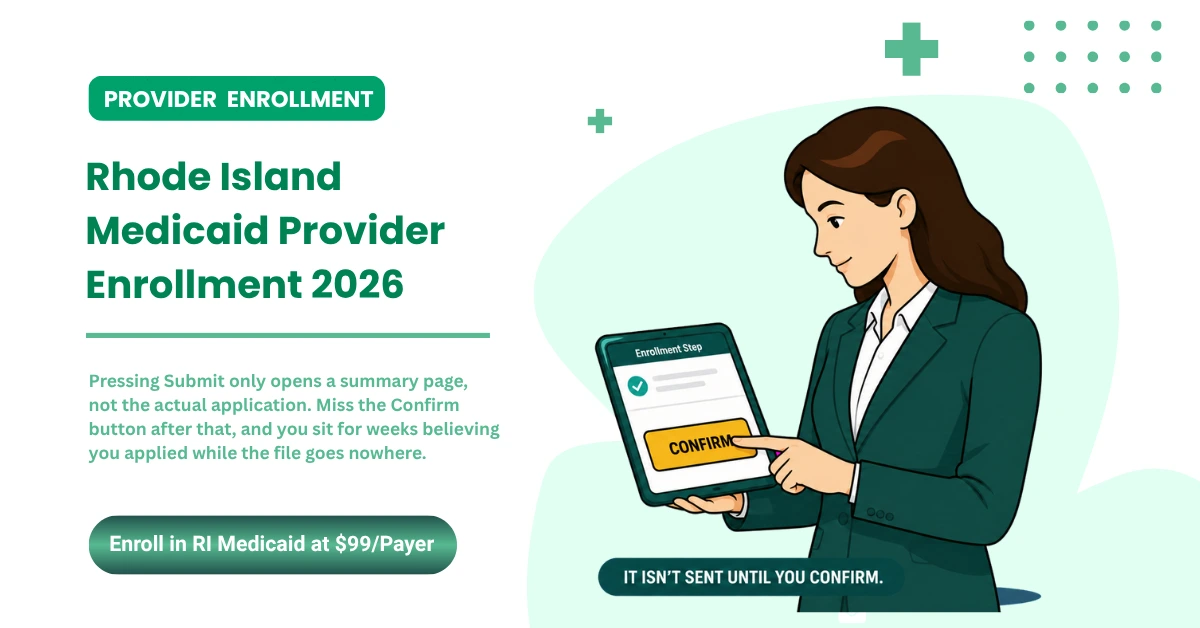
The last click is the one that trips people. Your application isn't submitted for processing until you press Confirm on the summary page. Pressing Submit only takes you to that summary. Providers sit for weeks believing they applied while the file waits unsubmitted, and this shows up more than any other single mistake in Rhode Island enrollment.
The Border Community Rule: Who Can Enroll From Outside Rhode Island
To participate in RI Medicaid, a provider has to be located in Rhode Island or in an approved border community and be performing services there. EOHHS publishes this as a participation requirement rather than a preference, and it's the first thing an out-of-state group should check.
EOHHS will consider an out-of-state provider in three situations: the covered service isn't available in Rhode Island, the recipient currently resides in another state, or the covered service was performed as an emergency while the recipient was traveling through another state.
Some enrollment guides describe Rhode Island as an easy state for out-of-state telehealth groups. The participation rule EOHHS publishes reads differently. A Massachusetts or Connecticut practice planning to serve RI Medicaid members should confirm border community status before filing anything, because a file that fails the location test doesn't get corrected, it gets returned.
Providers in the listed border communities get treated as in-state for this purpose. EOHHS applies no out-of-state service restrictions and no extra prior authorization requirements to them, which makes the list worth checking by town rather than by state.
|
Connecticut Border Communities |
Massachusetts Border Communities |
|---|---|
|
Danielson, Groton, Moosup, Mystic, New London, North Stonington, Pawcatuck, Putnam, Stonington, Thompson, Waterford |
Attleboro, Bellingham, Blackstone, Dartmouth, Fall River, Foxboro, Milford, New Bedford, North Attleboro, North Dartmouth, Rehoboth, Seekonk, Somerset, South Attleboro, Swansea, Taunton, Uxbridge, Webster, Westport, Whitinsville |
Source: EOHHS border communities list. Eleven Connecticut towns and 20 in Massachusetts.
The NPPES corollary catches people who clear the location test. Your practice locations on the application have to be current on your NPPES letter, including secondary service locations. For individuals and associated providers, that letter has to show a practice location in Rhode Island or an approved bordering community.
One warning for solo clinicians. If you enroll using a home business address, EOHHS makes that address visible on the Provider Search section of its website. Telehealth practitioners working from a kitchen table should read that twice before typing. Our telemedicine credentialing guide covers the location and licensure rules that follow you across state lines.
Multi-state groups are where enrollment gets expensive, because each state stacks its own participation rule on the federal floor. Connecticut, for one, runs no Medicaid MCOs at all, which our Connecticut Medicaid enrollment guide walks through. We coordinate multi-state Medicaid credentialing at $99 per insurance.
What to Gather Before You Open the RI Medicaid Application
Gather seven items before you start an RI Medicaid provider enrollment application, because the portal won't let you advance past a screen you haven't completed. Collecting them first turns a two-week stop-start into an afternoon.
|
Item |
Detail That Trips People Up |
|---|---|
|
NPI |
Type 1 for individuals, Type 2 for groups and facilities |
|
Practice address |
Phone number is required on the service address |
|
Taxonomy code |
Has to match NPPES, and revalidating providers must not change it |
|
Tax ID |
EIN for groups, SSN for sole proprietors and MCO individual adds |
|
License number |
Expiration date and license state are required with it |
|
Signed W-9 |
Legal business name on line 1, not the DBA |
|
Federally required disclosures |
Ownership and control, at the 5 percent threshold |
The disclosure questions cause more returns than anything else in the packet. Question 12 requires a Yes answer, and sole proprietors have to enter personal information. Social Security numbers are required for each owner, administrator, board member, and managing employee listed, and an incomplete answer sends the application back.
Board members ask why. CMS mandates the disclosure for managing employees and anyone with a control interest, meaning people who make decisions for the entity, so EOHHS can run checks against those names. A lab director who oversees day-to-day operations meets that definition even without an ownership stake.
Two formatting rules save a support call. On disclosure question 9, if you have no business transactions to report, enter NA or None and leave out the slash, which throws an error. On question 11, if nothing is owed to EOHHS by a previous provider, enter 0 with no decimals.
Our CAQH ProView management guide covers the document set that feeds most of these fields. Attachments have a 5MB ceiling and have to be PDFs. If submission throws an error, strip every attachment except the W-9, submit, then email the rest to rienrollment@gainwelltechnologies.com or fax them to 401-784-3892.
The $750 Application Fee and Who Does Not Pay It
The CY 2026 provider enrollment application fee is $750 for institutional providers, effective January 1, 2026 through December 31, 2026, per the CMS Federal Register notice published December 3, 2025. CMS adjusted it from $730 in 2025 using the Consumer Price Index and rounded up from $749.71.
EOHHS applies the fee to a published list of institutional and organizational provider types. Hospitals, nursing homes, home health and skilled nursing agencies, hospice, independent labs, ambulance services, DME suppliers, FQHCs, assisted living facilities, adult day care, and Community Health Workers all sit on that list. Individual practitioners enrolling under their own NPI don't.
Rhode Island publishes two exemptions that save real money. If you're already enrolled in Medicare, RI Medicaid relies on Medicare's screening and its collection of the fee, though you still complete the disclosure statements. If you paid the fee to another state's Medicaid agency in the same period, you're exempt with proof of payment.
Payment mechanics are old-fashioned and worth getting right the first time. Pay by check made out to the State of Rhode Island, write the provider's name and NPI on the check, and mail it to Gainwell Technologies, PO Box 2010, Attn: Enrollment Department, Warwick, RI 02887.
A missing fee or missing proof holds the file. Because Rhode Island caps retroactive enrollment at the first day of the month of approval, a two-week hold that crosses a month boundary converts into a month of unbillable encounters. Our Medicare provider enrollment guide covers the PECOS screening that creates the first exemption.
Screening Risk Levels, Site Visits, and Fingerprinting in Rhode Island
Rhode Island screens every enrollment application at one of three risk levels, limited, moderate, or high, and applies the highest level when a provider could fit more than one. EOHHS defines all three in 210-RICR-20-00-1, the Medicaid Payments and Providers regulation, in the amendment effective September 8, 2025.
Moderate risk covers CMS moderate categorical types, severely disabled nursing home care providers, providers employing personal care attendants and homemakers, and RIte Share co-pay providers. High risk covers CMS high categorical types, individual personal care attendants and homemakers giving direct care, shared living caregivers, and Community Health Workers. Limited risk is everything else.
What Triggers a Site Visit
Federal rules at 42 CFR 455.432 require pre-enrollment and post-enrollment site visits for moderate and high risk providers. Rhode Island's Provider Site Visit Guidance, transmittal 25-03, took effect November 25, 2025 and adds three rules worth planning around.
All visits happen in person, and EOHHS doesn't permit remote site visits. All visits are unannounced, so EOHHS can tell you a visit is required but can't give you a date or time.
Fall short on the first visit and EOHHS identifies the deficiencies in writing, then allows 30 days to cure them. A second visit follows once you notify them in writing that you're ready.
The guidance also lists what the visitor checks: signage, posted operating hours, staffing, recordkeeping, privacy, and billing practices. One line surprises new agencies. A provider made up of administrative staff alone doesn't count as operational, and a newly opening provider has to show at least one qualified direct care staff member hired or ready to hire on approval.
Who Gets Fingerprinted
State and federal law require a national criminal records check supported by fingerprints for CMS high categorical risk types, individual personal care attendants and homemakers providing direct care, shared living caregivers, and Community Health Workers. For a provider entity, it also reaches every person holding a 5 percent or greater direct or indirect ownership interest.
The Office of Attorney General processes them. EOHHS makes a written request, you have 30 days from that request to submit the prints, and you pay the cost. Prints stay valid for five years, which means a group enrolling several people in one year should sequence them together.
Community Health Workers Are Now High Risk in Rhode Island
EOHHS moved Community Health Workers into the high-risk category through an emergency amendment effective May 16, 2025, then made it permanent on September 8, 2025. The stated reason was emerging concern about fraud, waste, and abuse in the CHW program alongside beneficiary health and safety.
For a CHW agency, that reclassification means fingerprinting, an unannounced site visit at enrollment and again at revalidation, and the $750 application fee, since CHWs also appear on the fee list. No other state has made this move, and no competing guide covers it.
Behavioral health and autism services groups sit in these tiers more often than most specialties. Our behavioral health credentialing guide covers the risk-tier patterns that repeat across payers.
High-risk screening adds a fingerprint cycle and a site visit to an RI Medicaid provider enrollment timeline that already runs 60 to 90 days. The fix is getting the file clean before submission instead of curing deficiencies afterwards, and our credentialing specialists run that pre-submission review at $99 per insurance.
Rhode Island's Three Medicaid MCOs and Why the Count Keeps Getting Reported Wrong
Rhode Island Medicaid contracts with three managed care organizations as of August 2026: Neighborhood Health Plan of Rhode Island, UnitedHealthcare of New England, and Tufts Health Public Plans, which operates as Tufts Health RITogether. EOHHS executed Amendment 21 with all three in June 2026.
|
Plan |
Contract Status |
|---|---|
|
Neighborhood Health Plan of Rhode Island (NHPRI) |
Amendment 21 to the 2017 contract, fully executed June 24, 2026 |
|
UnitedHealthcare of New England |
Amendment 21 to the 2017 contract, fully executed June 24, 2026 |
|
Tufts Health Public Plans (Tufts Health RITogether) |
Amendment 21 to the 2017 contract, fully executed June 26, 2026 |
Source: EOHHS Medicaid managed care contracts, page last updated August 7, 2026.
Why Some Guides Say Rhode Island Has Two Medicaid Plans
The confusion traces to a procurement that got awarded and then unwound. In July 2024, the McKee administration tentatively awarded a managed care contract worth roughly $15.5 billion to Neighborhood and UnitedHealthcare, leaving Tufts out.
Tufts and Blue Cross Blue Shield of Rhode Island protested the scoring within weeks. By October 2024, the Department of Administration agreed to re-evaluate all four proposals with a new review committee. On February 4, 2025, EOHHS cancelled the award outright and extended the existing contracts.
The state attributed the cancellation to updated federal requirements and the CMS readiness timeline rather than the protests. Either way, the 2017 contracts survived and EOHHS has now amended them 21 times. Coverage of the original two-plan award still circulates, which is why guides published in 2026 describe a market that was cancelled before it began.
The practical cost lands on providers. A group that credentials with two plans because a guide said there were two loses access to the third plan's members, and finds out when the claims deny. Getting the plan count right is the cheapest part of RI Medicaid provider enrollment.
RIte Care, Rhody Health Partners, RIte Smiles, and RIte Share
Rhode Island Medicaid runs four named programs, and each one changes which providers a member can see. Getting the names right matters, because there's no Rhode Island program called Managed Medicaid, and guides that use the phrase are describing something the state doesn't operate.
|
Program |
Who It Covers |
|---|---|
|
RIte Care |
Families, children, and pregnant members through managed care |
|
Rhody Health Partners |
Adults without dependent children aged 19 to 64, and adults with disabilities, through managed care |
|
RIte Smiles |
Dental managed care, administered by UnitedHealthcare |
|
RIte Share |
Premium assistance for members who have employer coverage |
RIte Smiles carries a birth-date rule unusual enough to catch dental practices twice a week. It covers Medicaid-eligible children born after May 1, 2000. Members born before that date get dental services through fee-for-service Medicaid instead.
A practice treating both populations bills the same procedure two different ways, through UnitedHealthcare for one patient and through Gainwell for the next. Worth stating plainly for anyone searching: Delta Dental of Rhode Island is a commercial carrier and isn't the Medicaid dental plan. Our dental billing services team handles that split for RI practices.
Dual eligibles add a fourth layer. EOHHS executed a fully integrated dual eligible special needs plan agreement with Neighborhood, with the base contract signed December 29, 2025 and an amendment on June 1, 2026. Separate coordination-only D-SNP agreements for 2026 exist with Blue Cross Blue Shield of Rhode Island, Neighborhood, Oxford Health Plans, and UnitedHealthcare of New England.
A D-SNP agreement isn't a RIte Care contract. That distinction produces most of the wrong plan lists published about Rhode Island, because a writer counting D-SNP signatories arrives at a number that has nothing to do with which plans contract for RIte Care.
One Screening Application, Three Separate Network Requests
You submit one enrollment application to Rhode Island Medicaid no matter how many managed care plans want you, then request network addition separately from each plan after Gainwell approves you. The order is fixed and you can't compress it.
- Submit one screening application through the Healthcare Portal, selecting MCO (Managed Care Organization) Provider as the enrollment type and indicating your plan affiliations.
- Wait for Gainwell to screen and approve the file. Complete the application in full, because EOHHS warns that an incomplete screening application can cost you RI managed care billing privileges.
- Contact each plan you want to contract with and request network participation: Neighborhood, UnitedHealthcare, and Tufts each run their own process.
- Confirm each plan has loaded you before you schedule members.
The sequence is fixed because of federal law. Under 42 CFR 438.602, state Medicaid agencies must screen, enroll, and periodically revalidate all network providers of managed care organizations. A plan's own credentialing doesn't substitute for state screening.
Providers who finish step two and stop believe they're in-network. They're screened, not networked, and the difference shows up as denials. Existing MCO-only providers get notified in writing by each network when their provider type is due for screening, and EOHHS lets them keep serving members while the application processes.
Three plans means three network requests, three follow-up cycles, and three chances for a file to stall in somebody's queue. We run those in parallel at $99 per insurance and follow up weekly until each plan confirms. Our MCO credentialing management covers Neighborhood, UnitedHealthcare, and Tufts under one file.
Retroactive Enrollment Stops at the First of the Month
Rhode Island limits retroactive enrollment to the first day of the month in which your application is approved. EOHHS states it in one line on its provider enrollment page, and that line decides how much of your early Medicaid volume you get paid for.
Work the math with real dates. A provider approved on March 18 gets an effective date of March 1. Every Medicaid encounter from January and February is unbillable. Not delayed, and not pending appeal. Unbillable.
The compounding problem is that small delays cross month boundaries. A missing application fee, missing proof of payment from another state, or a practice address that doesn't match NPPES can push approval from March 30 to April 2, and that two-day slip costs a full extra month of encounters.
The operational instruction is short. Don't schedule Medicaid members against a projected effective date, and wait for written confirmation before you book volume you're counting on collecting. For encounters that have already gone unbilled, our outsourced medical billing team can work out what's recoverable and what has to be written off.
Trading Partner ID: The Step After Approval That Most Providers Miss
After RI Medicaid approves your enrollment, you apply separately for a Trading Partner ID to get eligibility verification, claim status, and remittance advice. Approval of your enrollment doesn't grant portal access on its own, and that misunderstanding costs practices their first month of eligibility checks.
You apply through the same Healthcare Portal. Existing Trading Partners have to register in the portal as well, and the EDI team at riediservices@gainwelltechnologies.com handles requests to become the administrator or master user for a Trading Partner profile.
MCO-only providers are the exception. They don't need Trading Partner enrollment at all, which is the second place in this guide where the MCO-only track behaves differently from full enrollment.
One thing worth taking: EOHHS offers Provider Electronic Solutions billing software to RI Medicaid providers at no cost, with training and support included.
RI Medicaid Revalidation and the 35-Day Deadline
Rhode Island Medicaid gives you a mandatory 35 days from the date on the revalidation letter to complete revalidation, and missing it means termination from the program and a full reapplication. Gainwell states it in the revalidation guide without softening: providers who don't comply get terminated and have to reapply.
Federal rules require state Medicaid agencies to revalidate providers on a recurring cycle, and most guides stop there. The federal cycle is the baseline. The 35 days is the deadline that costs you money, and it runs from the date on the letter rather than the date you opened it.
Enrollment won't be backdated to the termination date. Combine that with the first-of-the-month retroactive limit from the previous section and a missed revalidation can cost more than a single month of billing while the new application works through screening.
Gainwell sends two letters, and you need both. One carries your tracking number and directions, the other carries your password. Losing the password letter means emailing rienrollment@gainwelltechnologies.com with the provider name and NPI to retrieve it, which burns days you don't have inside a 35-day window.
Notices arrive by mail and also appear in the monthly Provider Update. Practices that move offices and don't file a change of information are the ones who miss the letter entirely.
Two revalidation-specific traps deserve their own line. Every provider has to upload a new W-9 signed in ink and dated within 30 days of the revalidation application, so a reused W-9 from last year gets the file returned. And the Confirm button applies here too: the revalidation isn't submitted for processing until you click it.
Revalidation deadlines are the easiest thing in the revenue cycle to miss, because the letter arrives on an ordinary Tuesday and nothing else prompts you. We track revalidation dates across every payer and state for the providers we manage, folded into the same $99 per insurance enrollment work.
How Long RI Medicaid Enrollment Takes and Where It Stalls
Standard RI Medicaid provider enrollment runs 60 to 90 days from submission to approval, with moderate and high risk provider types adding time for an unannounced site visit and, where required, a fingerprint cycle. Clean applications sit at the low end of that range and returned ones restart it.
The variance driver isn't the state's queue. It's correction cycles. A file returned for an incomplete disclosure section or a mismatched taxonomy code re-enters review, and each round trip adds weeks that no amount of calling shortens.
How to Check Your RI Medicaid Enrollment Status
Gainwell asks you to email rienrollment@gainwelltechnologies.com with six pieces of information: the tracking number, the date you submitted, the individual provider name and NPI, and the group name and NPI. The help desk at (401) 784-8100 also handles status requests and effective date questions.
Formatting causes most failed portal lookups. Enter the tracking number exactly as it appears on your letter and include the dashes. Enter the Tax ID with no spaces and no dashes. Enter the password with no spaces or dashes, in capital letters only.
Sessions time out after 45 minutes idle, and a timeout loses everything you entered. Save with Finish Later if you're going to step away, and remember that Finish Later saves everything except your disclosure answers, which you'll have to redo.
Three Portal Errors and What They Mean
- A submission error usually means attachments. Strip everything except the W-9, submit, then email or fax the rest. The ceiling is 5MB and files have to be PDFs.
- EFT fields that won't accept input mean you're on an MCO-only application, where EFT isn't required. Change the enrollment type if that wasn't your intention.
- A Language screen that won't advance is a refresh bug. Click back to the Address screen, click Continue, and the Language screen will take your entries.
RI Medicaid Provider Enrollment Contacts
Gainwell Technologies handles RI Medicaid provider enrollment on behalf of EOHHS, and these are the current contact points.
|
Purpose |
Contact |
|---|---|
|
Help desk, local and long distance |
(401) 784-8100 |
|
Help desk, in-state toll calls |
(800) 964-6211 |
|
Enrollment questions and application status |
rienrollment@gainwelltechnologies.com |
|
Provider enrollment fax |
(401) 784-3892 |
|
EDI and Trading Partner administration |
riediservices@gainwelltechnologies.com |
|
HBTS and ABA moratorium questions |
Karen Murphy, karen.murphy3@gainwelltechnologies.com |
|
Fee payments and forms by mail |
Gainwell Technologies, Provider Enrollment, PO Box 2010, Warwick, RI 02887-2010 |
One clarification saves a wasted phone call. The Rhode Island Department of Human Services handles member eligibility. EOHHS and Gainwell handle provider enrollment. Providers hunting for a DHS provider portal are in the wrong building.
When Outsourcing RI Medicaid Enrollment Makes Financial Sense
Handling RI Medicaid provider enrollment in-house works when you're enrolling one provider, in one state, with somebody on staff who has time to follow up weekly. That's a real scenario and pretending otherwise would be dishonest.
A solo clinician with administrative bandwidth and no moratorium exposure can file through the portal, answer the disclosure questions, and wait. Plenty do it successfully.
The calculation changes once any of these appear:
- More than two providers enrolling in a 12-month window
- Three MCO network requests running at once
- A provider type facing moderate or high risk screening
- Multi-state expansion where Rhode Island is one of several
- An application already stalled past 60 days
- A revalidation letter that arrived while the office was between administrators
The comparison is worth stating in numbers rather than adjectives. Industry credentialing rates run $150 to $300 per provider per payer. MedSole RCM charges $99 per insurance enrollment, and full revenue cycle management runs 2.99% of collections, with no setup fees and no annual contracts.
Each enrollment includes CAQH profile setup and attestation, pre-submission document review, application submission, weekly payer follow-up, recredentialing deadline tracking, and status updates through approval. Our outsourcing ROI breakdown runs the full in-house comparison if you want the cost model.
Specialty matters in Rhode Island more than in most states. EOHHS publishes separate provider manuals for podiatry, dental, DME, home health, hospice, behavioral health, and community health workers, and each carries its own participation rules on top of the general enrollment file.
Podiatry practices are a good example. RI Medicaid maintains a dedicated podiatry services manual, podiatrists enrolling under their own NPI avoid the $750 fee, and the same clinician often needs Medicare, RI Medicaid, and all three MCOs before the schedule fills. Our credentialing specialist services handle that stack at $99 per insurance per payer.
Rhode Island stacks four things at once: three MCO network requests, four active moratoria to check before filing, a 35-day revalidation window, and a retroactive limit that turns delay into write-offs. That combination is why RI files stall more often than the state's size suggests.
If you're enrolling providers in Rhode Island and want the file clean before it reaches Gainwell, that's what we do. MedSole RCM charges $99 per insurance enrollment and 2.99% of collections for full billing, with no setup fees and no annual contracts.
You can talk to a credentialing specialist and get a straight answer on your timeline before committing to anything, or read how our provider enrollment and credentialing services handle Medicaid files state by state.
RI Medicaid Provider Enrollment FAQ
Deploy FAQPage schema on this block. Each answer below stands alone without the surrounding article.
How do I enroll as a Medicaid provider in Rhode Island?
Complete an RI Medicaid provider enrollment application in the RI Medicaid Healthcare Portal at riproviderportal.org. Select Provider Enrollment on the left of the screen, then Enrollment Application, and choose your enrollment type. Gainwell Technologies screens the file on behalf of EOHHS and issues your provider number on approval.
What portal does RI Medicaid use for provider enrollment?
The RI Medicaid Healthcare Portal at riproviderportal.org. It's the only route for new enrollment, revalidation, and Trading Partner registration. The portal also holds the Provider Enrollment User Guide and the enrollment status tools, and Gainwell operates it as the EOHHS fiscal agent.
Who administers RI Medicaid provider enrollment?
The Rhode Island Executive Office of Health and Human Services administers the Medicaid program, and Gainwell Technologies operates provider enrollment as its fiscal agent. Gainwell handles enrollment, assigns provider numbers, processes claims, and staffs the help desk at (401) 784-8100.
Is there an RI Medicaid provider enrollment form to download?
No. Rhode Island moved provider enrollment entirely online on July 30, 2015, and the Healthcare Portal replaced the paper application. Gainwell no longer accepts paper forms. The one exception, adding an attending provider to an existing group, now runs through DocuSign rather than a downloadable PDF.
How long does RI Medicaid provider enrollment take?
Standard RI Medicaid provider enrollment takes 60 to 90 days from submission to approval. Moderate and high risk provider types take longer because federal rules require an unannounced site visit, and high risk types add a fingerprint cycle. Returned applications restart the clock.
What documents does RI Medicaid require to enroll?
You need your NPI, practice address with a service phone number, taxonomy code matching NPPES, Tax ID, active license number with expiration date, a signed W-9 showing the legal business name, and the federally required ownership and control disclosures at the 5 percent threshold.
Does RI Medicaid charge an application fee?
Yes, for institutional and organizational provider types. The fee is $750 for applications submitted between January 1 and December 31, 2026. Individual practitioners enrolling under their own NPI don't pay it. Providers already screened by Medicare, or who paid the fee to another state Medicaid with proof, are exempt.
Which provider types are currently blocked from enrolling in RI Medicaid?
Four categories sit under active moratoria as of August 2026: DMEPOS suppliers since April 1, newly enrolling HBTS and ABA providers since June 16, hospice and home health from July 1, and two home care subgroups, Type 65 and Type 72, from July 1. Existing providers are unaffected.
Can an out-of-state provider enroll in Rhode Island Medicaid?
Only in limited circumstances. A provider must be located in Rhode Island or an approved border community and performing services there. EOHHS considers out-of-state providers when the service isn't available in Rhode Island, the recipient resides in another state, or the service was an emergency during travel.
How many Medicaid MCOs are in Rhode Island in 2026?
Three. Neighborhood Health Plan of Rhode Island, UnitedHealthcare of New England, and Tufts Health Public Plans, which operates as Tufts Health RITogether. EOHHS executed Amendment 21 to the 2017 managed care contract with all three in June 2026.
Is Tufts still a Rhode Island Medicaid plan?
Yes. Tufts Health Public Plans remains a Rhode Island Medicaid managed care organization, operating as Tufts Health RITogether. EOHHS fully executed Amendment 21 to its contract on June 26, 2026. Reports suggesting otherwise stem from a 2024 procurement award that the state cancelled in February 2025.
Do I need to credential with each MCO separately?
Yes. State screening through Gainwell comes first and is a prerequisite, not a substitute. After approval, you request network participation from each plan you want to join. Under 42 CFR 438.602, a plan's own credentialing can't replace state screening, so both steps are required.
How do I check my RI Medicaid enrollment application status?
Email rienrollment@gainwelltechnologies.com with your tracking number, the submission date, the individual provider name and NPI, and the group name and NPI. The help desk at (401) 784-8100 also handles status and effective date requests. Include the dashes when you enter a tracking number in the portal.
How often does RI Medicaid require revalidation?
Federal rules set a recurring revalidation cycle, but the deadline that matters in Rhode Island is 35 days from the date on your revalidation letter. Missing it results in termination and a full reapplication, and enrollment won't be backdated to the termination date.
What is a Trading Partner ID in RI Medicaid?
A Trading Partner ID gives you eligibility verification, claim status, and remittance advice through the Healthcare Portal. You apply for it separately after RI Medicaid approves your enrollment, because approval alone doesn't grant portal access. MCO-only providers don't need Trading Partner enrollment.
How do I add a new provider to an existing RI Medicaid group?
Use the DocuSign process EOHHS publishes for adding an attending provider to an existing group. Gainwell has accepted only DocuSign submissions for this since October 1, 2025, so paper versions are returned. EOHHS also publishes walkthrough instructions for the form on its provider enrollment page.
What is RIte Smiles and do I enroll separately for dental?
RIte Smiles is Rhode Island's Medicaid dental managed care program, administered by UnitedHealthcare, and it covers Medicaid-eligible children born after May 1, 2000. Members born before that date receive dental services through fee-for-service Medicaid, so practices treating both groups bill through two different channels.
Does RI Medicaid cover podiatry, and how do podiatrists enroll?
Yes. EOHHS publishes a dedicated podiatry services manual within the RI Medicaid Provider Manual, and podiatrists enroll through the same Healthcare Portal as other practitioners. A podiatrist enrolling under an individual NPI isn't on the institutional fee list, so the $750 application fee doesn't apply.
What is the phone number for RI Medicaid provider enrollment?
Call (401) 784-8100 for local and long distance calls, or (800) 964-6211 for in-state toll calls. Gainwell Technologies staffs both lines on behalf of EOHHS and handles application status and effective date questions. You can also email rienrollment@gainwelltechnologies.com or fax documents to (401) 784-3892.
Can I bill RI Medicaid before my effective date?
No. Rhode Island limits retroactive enrollment to the first day of the month in which your application is approved. A provider approved on March 18 has a March 1 effective date, and January and February encounters are unbillable rather than delayed.
Should I outsource RI Medicaid provider enrollment?
It depends on volume. One provider in one state with staff time available can file in-house. Multiple providers, three MCO network requests, or a high risk screening tier change the math. MedSole RCM charges $99 per insurance enrollment and 2.99% of collections for full billing, against an industry range of $150 to $300 per payer.
Compare the options on our credentialing at $99 per insurance page.