



CT Medicaid provider enrollment is the process by which physicians, nurse practitioners, therapists, and other licensed providers register with the Connecticut Department of Social Services through the Connecticut Medical Assistance Program (CMAP) portal to bill HUSKY Health patients and receive payment from the state.
Before a provider submits a single claim to Connecticut Medicaid, this enrollment has to be active and confirmed. A claim from an unenrolled provider denies. There's no workaround, and no retroactive fix for the gap.
This guide walks through the 2026 CMAP enrollment process, the six regulatory updates that hit Connecticut providers this year, the documentation to have ready before you start, how to track an application with the ATN system, and the phone numbers that get a stalled file moving.
Providers managing enrollment across multiple states can use MedSole's guide to Medicaid provider enrollment across all 50 states, though this guide stays on the Connecticut CMAP system.
All data here is drawn from CT DSS, CTDSSMAP, CMS, and Gainwell Technologies communications current as of June 2026.
MedSole RCM has credentialed more than 4,000 providers across all 50 states. CT Medicaid enrollment through CMAP is one of the workflows our credentialing team handles daily, at $99 per payer, the most affordable rate in the U.S. RCM market.
What Is Connecticut Medicaid (HUSKY Health) and Which Providers Must Enroll
Is HUSKY Health the Same as Connecticut Medicaid?
Yes. HUSKY Health is Connecticut's name for its Medicaid and CHIP program. The Connecticut Department of Social Services administers HUSKY Health for Providers under the Connecticut Medical Assistance Program (CMAP). When a Connecticut provider enrolls in Medicaid through CTDSSMAP, they're enrolling in HUSKY Health.
HUSKY A covers children, parents, and pregnant women. Most primary care, pediatric, and obstetric providers serve HUSKY A patients.
HUSKY B is CHIP, for children whose family income runs slightly above the HUSKY A limit. HUSKY B claims bill through the same CMAP system as HUSKY A.
HUSKY C covers adults 65 and older, along with blind or disabled adults. Specialists serving elderly or disabled patients bill mostly under HUSKY C.
HUSKY D covers low-income adults 19 to 64 without dependent children, the ACA expansion population, roughly a third of Connecticut's Medicaid enrollment. Federal H.R.1, signed July 4, 2025, will require HUSKY D adults to meet 80 hours per month of work or community engagement by January 1, 2027.
Do Providers Have to Enroll in CT Medicaid?
Under 42 CFR Part 455, any physician or licensed practitioner who wants to bill Connecticut Medicaid, or who orders, prescribes, or refers services for HUSKY Health patients, has to be enrolled in CMAP. The rule covers both the ordering provider and the billing provider on every claim.
A claim with an ordering provider whose NPI isn't enrolled in CMAP denies. The billing provider absorbs that denial, even when the service was medically necessary and the billing provider is fully enrolled.
As of May 2025, Connecticut Medicaid covered 1.1 million residents, one in three people in the state. Any provider serving part of that population needs CMAP enrollment before billing.
Why CT Medicaid Pays Providers Directly
Connecticut is one of only four states with no Medicaid managed care. The state runs HUSKY Health as self-insured fee-for-service, and DSS pays providers directly through Gainwell Technologies.
Enrolled providers get paid by the state, not through a managed care middleman. That makes CT Medicaid claims simpler to process than claims in MCO-heavy states like Florida or Texas, where each plan runs its own network and payment rules.
The CTDSSMAP Portal: How Connecticut Medicaid Provider Enrollment Works
Connecticut Medicaid provider enrollment runs entirely online through the CMAP Provider Enrollment Portal at www.ctdssmap.com, operated by Gainwell Technologies for the Connecticut Department of Social Services.
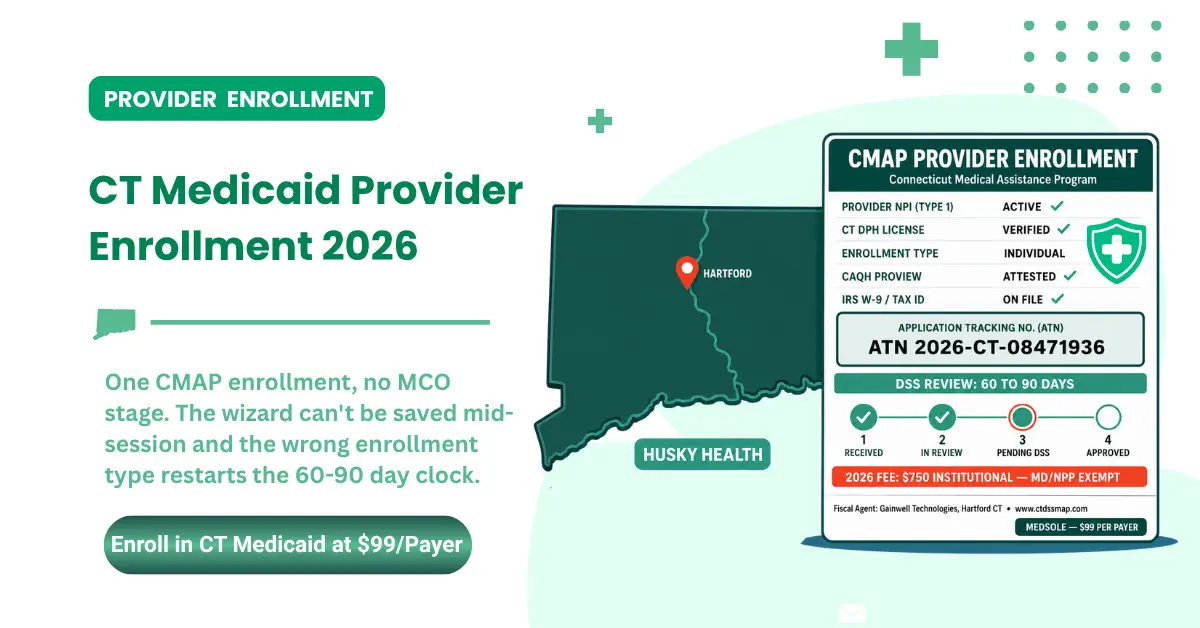
An Enrollment Wizard walks providers through the application for both initial enrollment and re-enrollment. Once it's submitted, DSS reviews the file within 60 to 90 days.
The Session Constraint Every Provider Must Know Before Starting
The CMAP enrollment wizard can't be saved mid-session. Once a provider starts, the application has to be finished in one sitting. The system also logs you out after 20 minutes of inactivity.
If the browser closes or the session times out before submission, the application doesn't save, and the provider starts over from the beginning. Before opening the wizard, have every document, NPI, tax ID, license number, and malpractice detail ready to enter.
The Follow-On Document Process
After the wizard application is submitted, some provider types receive a follow-on document list from Gainwell Technologies. These are physical documents that have to be mailed in to finish the enrollment.
Mail them to Gainwell Technologies, Provider Enrollment Unit, P.O. Box 5007, Hartford, CT 06102-5007. Write the ATN on the front of every page. A file with missing follow-on documents stalls, no matter how cleanly the online wizard was completed.
The Three-Stage Review Sequence
Once the wizard is in and any follow-on documents arrive, DSS works the application in three stages. First, Gainwell Technologies validates the information against CMAP records and verifies the license with the Connecticut Department of Public Health.
Second, the file moves to DSS Quality Assurance for approval or denial. Third, Gainwell notifies the provider of the decision. Knowing this sequence tells you where a file sits when you call the Provider Assistance Center.
Providers who want help running the wizard, managing follow-on documents, and tracking a file through all three stages can hand the work to MedSole RCM's CT Medicaid provider enrollment services, which handle the full CMAP workflow at $99 per payer.
How to Enroll in CT Medicaid: The CMAP Enrollment Wizard Step by Step
Medicaid CT provider enrollment through the CMAP system follows nine steps. Applications run online through the enrollment wizard at www.ctdssmap.com. From the first field to a confirmed provider number, the timeline runs 60 to 90 days for DSS review.
- Verify your NPI. Before opening the CMAP portal, confirm your NPI Type 1 is active in NPPES NPI Registry. Group practices also need NPI Type 2 for the organization. A missing or inactive NPI triggers automatic rejection. Check that your taxonomy code matches your specialty, since CT Medicaid ties reimbursement to the taxonomy on file.
- Get your CAQH ProView profile current. Many payers and credentialing processes pull from CAQH ProView, so a current, accurate profile keeps downstream credentialing from stalling. Create one at proview.caqh.org or re-attest an existing profile, and keep attestation current within 120 days under 2026 NCQA standards. See MedSole's CAQH ProView setup and attestation guide.
- Confirm your enrollment type. CT DSS asks providers to pick the correct enrollment type by provider category, specialty, and billing structure before submitting. The wrong type is the most common cause of denial, and a wrong pick means restarting from scratch. Confirm yours against the CT Enrollment Criteria Matrix at ctdssmap.com.
- Gather every required document. Assemble all documentation before you start the session, because the wizard can't be saved once it's open. Section 5 has the full checklist.
- Open the CMAP Enrollment Wizard. Go to www.ctdssmap.com, select Provider, then Provider Enrollment. Allow popups from ctdssmap.com in your browser, since the CMAP Enrollment Wizard needs popup access. Click Next to begin.
- Finish the wizard in one session. Complete every required field. The system flags empty or misformatted fields and won't accept an incomplete application. Don't close the browser or let the session time out, or the application is lost and you start over.
- Submit and record your ATN. On submission, the portal issues an Application Tracking Number (ATN). Save it right away. You need the ATN to track status and to label any follow-on documents mailed to Gainwell Technologies. Without it, the tracking tool can't pull your file.
- Mail follow-on documents if required. Check the CT Enrollment Criteria Matrix to see whether your provider type needs physical follow-on documents. If it does, mail only those documents, not a printout of the application, to Gainwell Technologies, Provider Enrollment Unit, P.O. Box 5007, Hartford, CT 06102-5007. Write your ATN at the top of each page.
- Track status and wait for written confirmation. Use the tracking tool at ctdssmap.com/ctportal/Provider/Provider-Enrollment-Tracking with your ATN and practice name. Don't submit claims until you receive written confirmation of your provider number and effective date. An “approved” status in the tool isn't billing authorization.
Providers who need to apply for a Medicaid provider number in Connecticut, and want to skip the documentation errors and session traps that derail applications, can hand the whole thing to MedSole RCM.
MedSole runs the full CT Medicaid provider enrollment workflow, from CAQH setup to follow-on documents to ATN tracking, at $99 per payer, with continuous follow-up that compresses the standard 60 to 90 day timeline.
Documentation Required for Medicaid in Connecticut: The 2026 CMAP Checklist
The documentation required for Medicaid in Connecticut depends on provider type and enrollment category, set out in the Medicaid Provider Enrollment Compendium and the CT Enrollment Criteria Matrix. Every provider needs the core documents below assembled before starting Connecticut Medicaid provider enrollment, since the wizard can't be saved once it's open.
Core Documents Required for All Provider Types
- National Provider Identifier (NPI) Type 1, active in NPPES.
- Connecticut license, active with the Connecticut Department of Public Health.
- Federal Tax Identification Number (EIN) or Social Security Number matching IRS records exactly.
- IRS Form W-9, signed and current.
- Malpractice insurance certificate with coverage dates and the carrier name.
- DEA certificate, if you prescribe controlled substances.
- Board certification documentation for your specialty.
- CAQH ProView attestation completed within the last 120 days.
- Government-issued photo ID.
- Hospital privileges documentation, where applicable.
- Practice address in correct USPS format, matching NPPES, CAQH, W-9, and the CMAP application.
Additional Documentation for Group Practices
- NPI Type 2 for the group entity.
- IRS Employer Identification Number matching the legal entity name.
- Articles of Incorporation or Operating Agreement.
- Individual NPI Type 1 for each rendering provider in the group.
- Group W-9 with the legal name, not the DBA, matching IRS records.
Additional Documentation for Out-of-State Providers
Out-of-state providers fall into two groups under CMAP. Those serving children in programs tied to the Connecticut Department of Children and Families or the Department of Developmental Services can use the enrollment wizard directly.
Every other out-of-state provider needs written approval from CT DSS before enrolling, and submits claims to the out-of-state address: Gainwell Technologies, Written Correspondence, OOS Claims, P.O. Box 2991, Hartford, CT 06104.
The Address Alignment Rule That Prevents the Most Common Denial
The practice address on the CMAP application has to match the address in NPPES, CAQH ProView, and the IRS W-9 exactly, down to suite number format and abbreviations. Address mismatches across these systems are a leading cause of CT Medicaid enrollment delays.
Update NPPES first, since its changes propagate the slowest. Give NPPES address changes 24 to 72 hours to settle before submitting the CMAP application.
How to Choose the Right CT Medicaid Enrollment Type
Picking the wrong enrollment type in CMAP is the leading cause of Connecticut Medicaid enrollment denial. A wrong pick can't be fixed after submission. The provider starts a new application from scratch, loses the entered data, and restarts the 60 to 90 day clock.
What Enrollment Type Means in CT Medicaid
In CMAP, enrollment type is the category a provider registers under with CT DSS. It sets the billing pathway, the required documents, the reimbursement rates, and the provider classification that controls which services you can bill. DSS keys the right type to specialty, license type, and billing structure, whether individual, group, or facility.
How to Verify the Correct Enrollment Type
Use the CT Enrollment Criteria Matrix at ctdssmap.com. It lists every provider type and specialty CT DSS recognizes, with the matching enrollment requirements, documentation, and taxonomy codes. Find your specialty before opening the wizard.
If your specialty isn't clear in the matrix, call the Provider Assistance Center at 1-800-842-8440 before starting an application. A two-minute call beats a 60 to 90 day restart.
Individual vs. Group Enrollment
Individual enrollment fits a single provider billing under their own NPI Type 1. Group enrollment fits a practice entity billing under a Group NPI Type 2, with individual providers enrolled as rendering members.
Both require separate applications in the wizard. A solo provider who wants to bill personally and as a group entity needs two enrollments.
Providers unsure about their CMAP enrollment type can run a quick review with MedSole RCM's credentialing team before opening the wizard. MedSole confirms the right type as part of every provider enrollment and credentialing at $99 per payer engagement, which heads off the restart that costs another 60 to 90 days.
CAQH ProView and CT Medicaid Credentialing: The 120-Day Re-Attestation Rule
CAQH ProView re-attestation comes due every 120 days. CAQH is the national hub where payers and credentialing teams pull a provider's verified data, so a stale or incomplete profile slows credentialing wherever it's used. Keeping it current and accurate is basic credentialing hygiene.
What CAQH ProView Contains
CAQH ProView holds a provider's primary source credentialing data: state licensure, DEA certificate, board certifications, malpractice history, work history, hospital affiliations, and government-issued ID. When a payer or credentialing process references the profile, it uses that data for verification. Gaps in the profile produce gaps in verification, which slows the work down.
The 2026 NCQA Primary Source Verification Window
Under 2026 NCQA standards, Primary Source Verification has to be completed within 120 days, down from the prior 180-day window. For Credentials Verification Organizations, the window tightens to 90 days.
Monthly OIG LEIE Exclusion Database checks and SAM.gov sanctions checks are now the standard, replacing quarterly monitoring. Providers who haven't re-attested CAQH within 120 days should do it before any credentialing submission.
How to Keep CAQH Current
Set a re-attestation reminder at 90 days, not 120, so processing delays don't push you past the deadline. When you re-attest, confirm the practice address in CAQH matches your NPPES address exactly.
Because Connecticut runs Medicaid as fee-for-service, providers enroll once through CMAP and bill DSS directly, rather than credentialing separately with managed care plans. The state's medical, behavioral health, and dental ASOs (CHNCT, Carelon, and BeneCare) manage care and network functions, not separate payment credentialing.
For the full registration, attestation, and 120-day maintenance process, see MedSole's CAQH ProView maintenance guide.
CT Medicaid Is Fee-for-Service: Why There's No Separate Managed Care Credentialing Stage
Connecticut has no Medicaid managed care organizations, and that one fact changes the whole timeline. Once your CMAP enrollment is active, you bill CT DSS directly for HUSKY patients. There's no second credentialing stage with separate health plans.
One Enrollment, Direct Billing
CMAP enrollment through CTDSSMAP takes 60 to 90 days from submission to a written effective date. That single enrollment assigns your Connecticut Medicaid provider number and clears you to bill DSS for fee-for-service claims across HUSKY A, B, C, and D.
Connecticut is one of only four states with zero percent of Medicaid in managed care. The state ended its MCO contracts in 2012 and moved to self-insured fee-for-service, which is why a single CMAP enrollment is the whole gateway.
What the Three ASOs Do
Connecticut contracts with three administrative services organizations, not insurers. CHNCT (Community Health Network of Connecticut) is the medical ASO, Carelon Behavioral Health runs the behavioral health benefit through CT BHP, and BeneCare runs the dental benefit through CTDHP.
These ASOs handle prior authorization, care management, and provider network support. They don't credential providers separately for payment or run their own capitated networks. Payment still comes from DSS through Gainwell Technologies on a fee-for-service basis.
How Long Until You Can Bill
Full billing access in Connecticut is the 60 to 90 day CMAP timeline, not a stacked 120 to 210 days. A provider who submits a clean application and mails follow-on documents promptly reaches a confirmed effective date in that window, then bills DSS directly.
Behavioral health providers have one extra step. For Behavioral Health FQHCs, each performing provider has to enroll in CMAP and be associated to the FQHC before claims will pay, under Provider Bulletin 2025-48.
For the credentialing detail behind CMAP enrollment, see MedSole's guide to CT Medicaid credentialing experts. Providers who want enrollment and billing handled together can review MedSole's integrated billing and credentialing services guide, all at $99 per payer.
Six 2026 Updates Every Connecticut Medicaid Provider Must Know Before Enrolling
Six regulatory and operational updates landed in 2026 that touch Connecticut Medicaid provider enrollment, credentialing timelines, portal access, and provider caseloads. Anyone who enrolled before 2026 and hasn't checked these may be working from outdated assumptions about fees, deadlines, and monitoring.
- The 2026 application fee is $750 for institutional providers. Per Federal Register 90 FR 55738 and the Medicaid Provider Enrollment Compendium, it covers applications submitted January 1 through December 31, 2026, for providers enrolling, revalidating, or adding a location. Physicians and NPPs are exempt, as are providers who paid the fee elsewhere that year, with proof.
- CMS ordered a swift revalidation of high-risk providers. On April 23, 2026, CMS Administrator Dr. Mehmet Oz sent letters to all 50 governors and state Medicaid directors. States had 10 business days to confirm a timeline and 30 days to submit a two-year strategy. High-risk providers, including any without an NPI, should expect off-cycle revalidation contact.
- CMAP tightened web portal security. CMAP rolled out web portal security changes effective April 21, 2026, including stronger password requirements, with multi-factor authentication for Master Users and Clerks phased in through spring 2026. Providers who haven't logged into the Secure Site since then will be prompted to reset their password at next login.
- Behavioral Health FQHCs now need performing providers enrolled and associated. Under Provider Bulletin 2025-48, each performing provider rendering services for a Behavioral Health FQHC must be enrolled in CMAP and associated to the FQHC for 2026 dates of service. Claims deny when that NPI is missing or unassociated. A new provider clears both steps before the first claim.
- NCQA now expects monthly exclusion monitoring. As of 2026, NCQA standards call for monthly OIG LEIE and SAM.gov checks, replacing quarterly cycles. Primary Source Verification dropped from a 180-day to a 120-day window, with 90 days for Credentials Verification Organizations. Quarterly, spreadsheet-based tracking no longer meets the standard.
- H.R.1 will reshape HUSKY D caseloads. The federal H.R.1 law, signed July 4, 2025, adds an 80-hours-per-month work or community-engagement requirement for HUSKY D adults by January 1, 2027, plus six-month redeterminations. The Connecticut State Comptroller estimates 100,000 to 200,000 residents could lose coverage. Plan for caseload shifts on large HUSKY D panels.
Providers who added telehealth in 2026 should also review the 2026 telemedicine credentialing requirements, since CMS form revisions added practice location types that affect CMAP enrollment.
Behavioral health providers working through the FQHC performing-provider rule can use MedSole's guide to behavioral health credentialing in Connecticut for the full association workflow.
CT Medicaid Provider Enrollment Status: How to Use the ATN Tracking System
Connecticut Medicaid provider enrollment status is tracked through the CT Medicaid Provider Enrollment Tracking tool at ctdssmap.com/ctportal/Provider/Provider-Enrollment-Tracking. Providers search with their Application Tracking Number (ATN) and business or last name. The ATN comes through right after the wizard is submitted. Without it, the tracking tool can't return results.
What the ATN Status Stages Mean
The tracking tool shows where an application sits in the three-stage review. Reading the stage tells you whether the file is moving or stuck.
Received. Gainwell Technologies has the submitted wizard application. This is the starting status, before any follow-on documents are processed.
In Review. Gainwell is validating the application and verifying the license with the Connecticut Department of Public Health. This stage can run 15 to 45 days. Past 30 days with no movement, call the Provider Assistance Center to confirm nothing else is needed.
Pending DSS Review. The file cleared Gainwell validation and sits with DSS Quality Assurance for the final decision. This stage usually adds 10 to 30 days.
Approved. DSS issued a final approval, and a written effective date follows by mail or portal message. Don't bill until that written effective date is in hand. Approved status in the tool isn't billing authorization.
Denied. The application was denied, with the reason sent by portal or mail. Common reasons include the wrong enrollment type, missing follow-on documents, a failed OIG LEIE screening, or a license issue. You can reapply once the reason is fixed.
What to Do When Your Application Stalls
If the tool shows the same status for more than 30 days, call the Provider Assistance Center at 1-800-842-8440 and have your ATN, NPI, and practice name ready. The same number handles electronic claim and EDI questions.
The Provider Assistance Center can tell you whether more documentation was requested, whether your follow-on documents arrived, and whether the file has a hold in the DSS queue.
Providers working with MedSole RCM's payer enrollment and credentialing services get weekly status updates on every application in progress, with outreach to the Provider Assistance Center whenever a file sits in the same stage for more than seven days. That continuous follow-up is the main thing that compresses the standard 60 to 90 day CMAP timeline.
CT Medicaid Provider Re-Enrollment and Revalidation: Deadlines and What Happens If You Miss
Connecticut Medicaid providers re-enroll periodically, on a cycle CT DSS sets. Re-enrollment kicks off when DSS mails a notification letter to the provider's address on file with CMAP. That letter carries a unique ATN for the re-enrollment application.
The re-enrollment wizard is the same portal as initial enrollment, but the way in is different. Providers log in with the ATN from the letter instead of starting a brand-new application.
What Happens If You Miss Your Re-Enrollment Deadline
Miss a CT Medicaid re-enrollment deadline and the system disenrolls you from CMAP automatically. Once disenrolled, you can't bill Connecticut Medicaid until a new enrollment is approved. Claims for dates of service after disenrollment deny automatically, whatever the provider's qualifications.
Re-enrollment runs the same 60 to 90 day timeline as initial enrollment. A disenrolled provider who needs to keep seeing CT Medicaid patients has to submit a new application right away, and can't bill retroactively for the gap.
Out-of-State Provider License Renewal
Out-of-state providers enrolled in CMAP have to submit updated license information before a home-state license expires. Let the out-of-state license lapse while enrolled, and CMAP disenrolls you until the updated license is submitted and processed, per the CT Provider Manual, Chapter 3.
The Annual DPH Certification Requirement
Providers licensed through the Connecticut Department of Public Health have to submit a Certification and Transmittal (C&T) every year to stay enrolled in CMAP. Miss the annual C&T and your enrollment status lapses. This is separate from the general re-enrollment cycle.
MedSole tracks re-enrollment deadlines for every enrolled provider and starts the re-enrollment application before the notification letter arrives, so there's no gap in CT Medicaid billing.
CT Medicaid Provider Enrollment Phone Number and Complete Contact Reference
The CT Medicaid provider enrollment phone number is 1-800-842-8440. That line reaches the Provider Assistance Center at Gainwell Technologies for enrollment status, application issues, and documentation questions. Representatives answer Monday through Friday, 8:00 a.m. to 5:00 p.m.
|
Contact |
Number or Address |
Purpose |
|---|---|---|
|
Provider Assistance Center (Gainwell) |
1-800-842-8440 |
Enrollment, application status, claims, eligibility, electronic claims |
|
CHNCT Medical ASO |
1-800-440-5071 |
Provider engagement and medical prior authorization |
|
CT BHP / Carelon Behavioral Health |
1-877-552-8247 |
Behavioral health services and prior authorization |
|
Provider Enrollment Email |
ctproviderenrollment@gainwelltechnologies.com |
Enrollment questions by email |
|
Data Security Incident Line |
1-855-744-4488 |
CT HUSKY provider portal security incident |
|
DSS Benefits Center (members) |
1-855-626-6632 |
Member eligibility, not provider enrollment |
|
Follow-On Documents |
Gainwell Technologies, Provider Enrollment Unit, P.O. Box 5007, Hartford CT 06102-5007 |
Mail physical follow-on documents only |
|
Out-of-State Claims |
Gainwell Technologies, OOS Claims, P.O. Box 2991, Hartford CT 06104 |
Out-of-state provider claims |
|
MedSole RCM Enrollment Support |
medsolercm.com/provider-enrollment-and-credentialing-services |
Outsourced CMAP enrollment at $99 per payer |
The member line isn't the provider line. A call to the DSS Benefits Center at 1-855-626-6632 reaches the member eligibility team, not provider enrollment. For provider enrollment questions, always call the Provider Assistance Center at 1-800-842-8440.
CT Medicaid Provider Enrollment Support at $99 Per Payer: Why Connecticut Providers Choose MedSole RCM
MedSole RCM handles Connecticut Medicaid provider enrollment through CMAP at $99 per payer, the lowest published rate for full-service CT Medicaid enrollment support in the U.S. market in 2026. No credentialing company, RCM firm, or third-party payer credentialing service in Connecticut posts a lower structured rate for CMAP enrollment.
What MedSole Handles in CT Medicaid Enrollment
- Enrollment type identification using the CT Enrollment Criteria Matrix before any application starts, heading off the wrong-type denial that adds 60 to 90 days.
- CAQH ProView setup and the 120-day re-attestation cycle, kept current so credentialing never stalls on a stale profile.
- CMAP enrollment wizard completion with every document assembled in advance, to clear the wizard's no-save constraint in one session.
- Follow-on document preparation and submission to Gainwell Technologies, Provider Enrollment Unit, P.O. Box 5007, Hartford, CT 06102-5007, with the ATN on every page.
- ATN status monitoring with weekly tracking and outreach to the Provider Assistance Center whenever a file sits in one stage past seven days.
- Behavioral health enrollment through CT BHP and Carelon, including the FQHC performing-provider association where it applies.
- Re-enrollment deadline tracking and early submission to prevent automatic disenrollment.
MedSole vs. Industry Pricing for CT Medicaid Enrollment
|
Service |
MedSole RCM |
Industry Standard |
|---|---|---|
|
CMAP enrollment per provider |
$99 per payer |
$150 to $300 per payer |
|
Setup fees |
None |
Often $150 to $500 |
|
Annual contract |
None |
Often required |
|
CAQH management |
Included |
Usually separate |
|
Behavioral health / ASO enrollment |
Included where applicable |
Usually separate invoice |
|
Timeline management |
Active weekly follow-up with DSS |
Passive submit-and-wait |
|
Contract term |
Month to month |
Often 12 months minimum |
|
Medical billing (post-enrollment) |
2.99% of net collections |
4% to 9% industry standard |
MedSole for Post-Enrollment CT Medicaid Billing
After enrollment is confirmed, the job is billing CT DSS cleanly on a fee-for-service basis. Connecticut pays providers directly with no MCO in the middle, so a clean claim is the only thing between the service and the payment.
MedSole RCM bills CT Medicaid at 2.99% of net collections, the lowest full-service rate in the U.S. market. At the industry's 6% to 9%, a practice collecting $60,000 a month pays $3,600 to $5,400 in fees. MedSole bills that same practice at $1,794 a month, a savings of $1,806 to $3,606.
Connecticut providers ready to start CMAP enrollment or outsource their billing can book a free consultation through MedSole RCM's CT Medicaid provider enrollment services.
Providers who want enrollment and billing under one team can look at MedSole's CT Medicaid billing services at 2.99% of collections.
Weighing in-house against outsourcing? MedSole's outsource CT Medicaid enrollment guide runs the full cost comparison.
To compare credentialing companies before you commit, see the framework in the guide to the best credentialing company for Connecticut providers.
Frequently Asked Questions: CT Medicaid Provider Enrollment 2026
How do I contact Medicaid provider enrollment in CT?
Contact CT Medicaid provider enrollment through the Provider Assistance Center at 1-800-842-8440. The line covers enrollment applications, application status, documentation questions, eligibility, and electronic claims. Representatives answer Monday through Friday, 8:00 a.m. to 5:00 p.m. For provider enrollment questions by email, write ctproviderenrollment@gainwelltechnologies.com.
How long does CT Medicaid provider enrollment take?
Connecticut Medicaid provider enrollment through the CMAP portal takes 60 to 90 days from submission to a written effective date. Connecticut runs Medicaid as fee-for-service, so that single CMAP enrollment is the full path to billing, with no separate managed care credentialing stage to stack on top.
Do providers have to enroll in CT Medicaid?
No provider is legally required to accept CT Medicaid patients. But any physician, nurse practitioner, therapist, or other licensed provider who wants to bill HUSKY Health, or who orders, prescribes, or refers for HUSKY patients, has to be enrolled in CMAP under 42 CFR 455.410. A non-enrolled ordering provider triggers automatic denial for the billing provider.
How do I check my CT Medicaid enrollment status?
Check CT Medicaid provider enrollment status through the CTDSSMAP Provider Enrollment Tracking tool at ctdssmap.com/ctportal/Provider/Provider-Enrollment-Tracking. Enter your Application Tracking Number (ATN) and business or last name to pull current status. The ATN issues right after the wizard is submitted. If you didn't record it, call the Provider Assistance Center at 1-800-842-8440.
How do I apply for a Medicaid provider number in Connecticut?
To apply for a Connecticut Medicaid provider number, complete the CMAP enrollment wizard at www.ctdssmap.com. Confirm your NPI is active, keep CAQH ProView current within 120 days, and pick the right enrollment type from the CT Enrollment Criteria Matrix. The wizard can't be saved once open. The number issues with the effective date after review.
Is HUSKY the same as Connecticut Medicaid?
Yes. HUSKY Health is Connecticut's name for its Medicaid and CHIP program. HUSKY A covers children, parents, and pregnant women. HUSKY B is CHIP. HUSKY C covers adults 65 and older and adults with disabilities. HUSKY D covers low-income adults 19 to 64. CT DSS administers all of them under CMAP, and providers enroll once through CTDSSMAP.
What documents do I need for CT Medicaid enrollment?
Core documents for CT Medicaid enrollment include an active NPI in NPPES, a current Connecticut license, a CAQH ProView profile attested within 120 days, a signed IRS W-9 matching IRS records, a malpractice certificate, a DEA certificate where applicable, board certification, and a photo ID. Group practices also need NPI Type 2, articles of incorporation, and a group W-9.
How much does it cost to become a CT Medicaid provider?
The 2026 Connecticut Medicaid application fee is $750 for institutional providers, per Federal Register 90 FR 55738, for applications submitted January 1 through December 31, 2026. Physicians and NPPs are exempt, as are providers who paid the fee to Medicare or another state that year, with proof. MedSole RCM handles CMAP enrollment at $99 per payer.
Do Connecticut Medicaid providers need to revalidate?
Yes. CT DSS requires enrolled providers to re-enroll periodically. DSS mails a notification letter with a unique ATN, which providers use to log into the re-enrollment wizard at ctdssmap.com. Miss the deadline and CMAP disenrolls you automatically. A disenrolled provider can't bill until a new enrollment is confirmed, which takes another 60 to 90 days.
What is the CAQH ProView requirement for CT Medicaid?
CAQH ProView re-attestation is due every 120 days. CAQH is the national repository payers and credentialing teams pull verified provider data from, so a current, accurate profile keeps credentialing from stalling. Confirm the practice address in CAQH matches your NPPES address, and set a 90-day re-attestation reminder so the profile never lapses past the 120-day window.
Who can help me with CT Medicaid provider enrollment?
MedSole RCM handles CT Medicaid provider enrollment through CMAP at $99 per payer, including enrollment type identification, CAQH setup, wizard completion, follow-on documents, ATN tracking, and behavioral health enrollment through CT BHP where it applies. The Provider Assistance Center at 1-800-842-8440 helps with portal access and application status.
What is the CT Medicaid enrollment type selection error?
The most common cause of Connecticut Medicaid enrollment denial is picking the wrong enrollment type in the CMAP wizard. The right type follows specialty, license type, and billing structure, whether individual or group. A wrong pick can't be corrected after submission, so you restart from the beginning. Confirm the type against the CT Enrollment Criteria Matrix before opening the wizard.
CT Medicaid Enrollment Pre-Submission Checklist: Confirm These 10 Items Before Opening the CMAP Wizard
Before opening the CT Medicaid enrollment wizard at ctdssmap.com, confirm every item below. The CMAP wizard can't be saved once started, so any gap means restarting the application.
- NPI Type 1 is active in NPPES, and group practices have NPI Type 2 active too.
- CAQH ProView attestation is current within the last 90 days, ahead of the 120-day deadline.
- For behavioral health, CT BHP enrollment and any FQHC performing-provider association are confirmed.
- Enrollment type is confirmed against the CT Enrollment Criteria Matrix before you start.
- Practice address matches NPPES, CAQH, and the IRS W-9 exactly, including suite format.
- The W-9 uses the legal entity name, not the DBA.
- Malpractice insurance is current and names the practice location.
- DEA certificate is assembled, if it applies.
- Board certification documentation is ready to enter.
- The browser popup blocker is set to allow ctdssmap.com.
Providers who want a pre-enrollment review can book a free consultation with MedSole RCM. MedSole checks every item here and confirms enrollment type, CAQH status, and documents before a single field is entered, through Connecticut Medicaid enrollment support at $99 per payer.