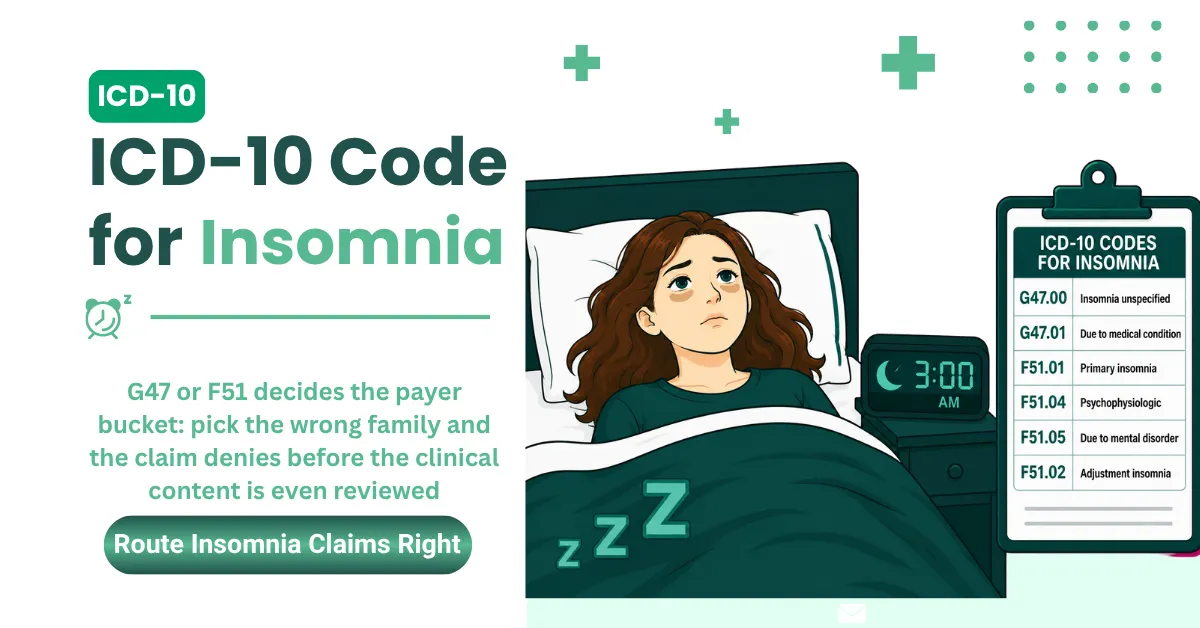




ICD-10 Code for Insomnia: The FY2026 Answer Providers Need
Insomnia ICD-10 coding depends on what the provider documented about the cause, type, and duration of the sleep disorder. The FY2026 ICD-10-CM code set, valid for all HIPAA-covered transactions from October 1, 2025, through September 30, 2026, includes both the G47.xx and F51.xx code families, and selecting between them determines which payer taxonomy the claim falls under.
Five codes do most of the work: G47.00, G47.01, G47.09, F51.01, and F51.05. Which icd 10 insomnia code applies depends on what you documented, so review the criteria to select the most accurate icd 10 code for insomnia billing and records. The full insomnia icd 10 decision logic sits in the sections below.
The April 1, 2026, mid-year ICD-10-CM update introduced no changes to the G47.0x or F51.0x categories. Every icd 10 cm insomnia code in both families is confirmed active through September 30, 2026, per the CDC/NCHS ICD-10-CM files and the FY2026 Official Guidelines updated April 1, 2026. ICD-10-CM remains the operative U.S. billing standard.
Getting the G47 versus F51 decision wrong sends the icd 10 for insomnia claim to the wrong payer bucket, and that's a denial before the clinical content is even reviewed. MedSole RCM's certified coders handle insomnia coding decisions through outsourced medical billing services for practices across all 50 states, starting at 2.99% of collections.
Here's exactly how the insomnia code hierarchy works, starting with the G47 family.
The G47 Insomnia Code Family: Hierarchy, Billability, and the Electronic Filing Rule Billers Miss
G47.0 is the non-billable parent code for insomnia in the ICD-10-CM system. It's not a valid code for claim submission. Every claim carrying an insomnia diagnosis in the G47 family requires a child code (G47.00, G47.01, or G47.09), the decimal-point format for paper claims, and the no-decimal format for electronic submissions.
The G47.0x billable family contains three codes: G47.00 (insomnia, unspecified), G47.01 (insomnia due to medical condition), and G47.09 (other insomnia). Each icd 10 insomnia code is separately billable, separately reportable, and carries distinct documentation requirements that payers will audit. The CMS ICD-10-CM FY2026 files are the authoritative source for the insomnia icd 10 set.
The 837P electronic transaction set strips decimal points from ICD-10-CM codes. That means G47.00 becomes G4700 in the electronic claim file. Clearinghouses may auto-convert, but practices submitting through direct payer portals sometimes see G47.00 rejected when the payer's system expects G4700. Verify your clearinghouse handles this conversion before submission.
When insomnia is documented as a principal or significant secondary diagnosis in an inpatient stay, the G47.0x codes group under CMS MS-DRG v40.0. The F51.xx codes group under DRG 887 (Other Mental Disorder Diagnoses), which carries a different DRG weight and reimbursement level.
For inpatient sleep disorder billing, code family selection directly affects payment. The DRG grouping for inpatient insomnia claims follows the same validation logic as any inpatient stay.
G47.09 catches insomnia presentations that don't cleanly fit G47.00 or G47.01. Use it when the provider documents a specific insomnia type, such as altitude-related insomnia or shift-work insomnia, that has an organic or physiological origin but isn't directly attributable to a named medical condition.
ICD-11 isn't adopted in the U.S. as of FY2026. The NIH PMC September 2025 ICD-10 vs ICD-11 comparison notes that ICD-11 uses "several times per week" as the frequency criterion, while ICD-10 uses provider-documented criteria. For all U.S. billing purposes, the G47.0x and F51.0x families remain operative.
G47.00, G47.01, and G47.09: When to Use Each Code and When Not To
Selecting between G47.00, G47.01, and G47.09 isn't a clinical question. It's a documentation question. The icd 10 cm insomnia code you use depends entirely on what the provider wrote in the assessment and plan. If the note doesn't name a linked medical condition, G47.01 isn't defensible on audit, regardless of the clinical picture.
G47.0x Code Selection Reference Table (FY2026)
|
Code |
Official Descriptor |
Use When |
When NOT to Use |
Documentation the Payer Needs |
|---|---|---|---|---|
|
G47.00 |
Insomnia, unspecified |
Provider documents insomnia without specifying type or cause. No linked medical condition named in the assessment. Default code when the clinical picture is insomnia but documentation isn't specific enough to support G47.01 or G47.09. |
Do not use when the provider's note explicitly names a medical condition causing insomnia. Do not use when the provider documents a specific insomnia subtype. |
Written symptom pattern (sleep onset vs. maintenance vs. early awakening), duration in weeks or months, frequency per week, and daytime functional impact. |
|
G47.01 |
Insomnia due to medical condition |
Provider names a specific medical condition and documents insomnia as a secondary effect of that condition. The causal link must appear in the assessment, not just in the problem list. |
Do not use when insomnia is listed as a complaint but the note doesn't connect it to the named condition. Do not use as a default for any patient who happens to have a comorbid illness. |
Explicit causal language ("insomnia due to chronic pain" or "insomnia secondary to COPD") plus a treatment plan addressing both conditions. |
|
G47.09 |
Other insomnia |
Provider documents a specific insomnia type with organic origin that doesn't fit G47.00 or G47.01. Examples include altitude-related insomnia or shift-work insomnia with a documented physiological cause. |
Do not use as a catch-all when the provider hasn't documented a specific insomnia type. G47.09 requires more specificity than G47.00, not less. |
Named insomnia type in the assessment, clinical rationale for why it doesn't fit the other two codes, and a treatment plan addressing the specific presentation. |
The most common documentation gap that forces billers into G47.00 when G47.01 is clinically accurate: the provider lists the medical condition in the problem list but never writes the causal link in the assessment or plan.
Problem list entries alone don't support G47.01, and the same gap weakens chronic insomnia icd 10 claims on continuation-of-care review. The causal language must appear in the note narrative.
That's why the most specific defensible icd 10 code for insomnia starts with the note, not the code book. MedSole RCM's medical coding specialists review provider documentation before every submission, reducing denial exposure for insomnia claims from the first submission.
The F51 Insomnia Code Family: Complete Nonorganic and Behavioral Insomnia Codes for 2026
The F51 insomnia codes are used when the sleep disorder isn't due to a known medical condition, a substance, or a physiological cause. These are the nonorganic insomnia codes. Selecting one of the six F51.0x codes requires the provider to document the specific behavioral, psychological, or circumstantial driver of the sleep difficulty.
The distinction between G47 and F51 isn't just clinical. It determines payer taxonomy for every icd 10 code for insomnia claim. CMS MS-DRG v40.0 groups F51.0x codes under DRG 887 (Other Mental Disorder Diagnoses), while G47.0x codes follow a different grouping path.
Billing the wrong family with the wrong CPT code creates medical necessity mismatches that payers catch on edit review.
F51.0x Code Reference: Nonorganic Insomnia (FY2026 Billable Set)
|
Code |
Official Descriptor |
Clinical Use Case |
Key Documentation Requirement |
Payer Taxonomy Note |
|---|---|---|---|---|
|
F51.01 |
Primary insomnia |
Persistent difficulty sleeping with no identifiable medical, psychiatric, or substance-related cause. This is the code when insomnia stands alone as a diagnosis. |
Document that medical, psychiatric, and substance causes have been ruled out or are not present. Duration and functional impairment required. |
Groups under DRG 887. Behavioral health payer policies often reference F51.01 specifically in medical necessity criteria. |
|
F51.02 |
Adjustment insomnia |
Short-term insomnia triggered by an identifiable stressor (job loss, bereavement, relocation, divorce). The adjustment insomnia icd 10 answer. Expected to resolve when the stressor resolves. |
Name the precipitating stressor. Document time course (acute onset correlating with the stressor). Include a treatment plan with expected resolution. |
Often requires a "code also" for the stressor type if separately documented. |
|
F51.03 |
Paradoxical insomnia |
Patient reports severe sleep loss but objective measures show near-normal sleep. Rare. Requires clinical documentation of the discrepancy between subjective complaint and objective measure. |
Provider must document the subjective and objective discrepancy explicitly. Polysomnography results or actigraphy data support this code. |
Rarely covered without polysomnography documentation (CPT 95810 or 95811). |
|
F51.04 |
Psychophysiologic insomnia |
Learned, conditioned insomnia where anxiety about sleep itself perpetuates the disorder. The bed and bedroom become cues for wakefulness rather than sleep. |
Document the conditioning pattern ("patient reports heightened arousal at bedtime" or "sleep is better in unfamiliar settings"). The treatment plan should reference CBT-I. |
Strong alignment with CBT-I CPT billing (90834, 90837). Payers look for a behavioral treatment plan. |
|
F51.05 |
Insomnia due to other mental disorder |
Insomnia that is a direct manifestation of an active psychiatric condition (depression, anxiety, PTSD, bipolar disorder). |
Code the psychiatric condition separately. ICD-10-CM instructs "code also" the associated mental disorder. Sequencing is discretionary based on which condition is primary in the encounter. |
F41.1 (GAD) plus F51.05 is one of the most commonly denied pairings due to sequencing errors. Sequence the psychiatric condition first when it's the primary focus. |
|
F51.09 |
Other insomnia not due to a substance or known physiological condition |
Nonorganic insomnia that doesn't fit any of the above F51.0x subtypes. Use when documentation supports a behavioral or psychological origin but doesn't match a named subtype. |
Provider must explain why no other F51.0x code applies. "Other specified" isn't a default. It requires documented reasoning. |
Also groups under DRG 887. Same payer taxonomy as the other F51.0x codes. |
For pediatric patients aged 0-17, behavioral insomnia of childhood uses Z73.810 (Behavioral Insomnia of Childhood, Sleep-Onset Association Type). This code is confirmed FY2026 billable and covers the association-type presentation where the child can only fall asleep under specific conditions: parental presence, rocking, or feeding.
Drug-related insomnia doesn't use G47.xx or F51.xx. Substance-induced sleep disruption codes into the F11-F19 series: F11.182 (opioid-induced insomnia, prescription use), F13.182 (sedative or hypnotic-induced insomnia, prescription use), and parallel codes across F14-F19 for other substance categories. Document the specific substance class and use type (prescription vs. nonprescription) to reach the correct code.
The primary insomnia icd 10 answer is F51.01, and the rest of the insomnia icd 10 f51 family stays unchanged in FY2026. The F51 family remains unchanged in FY2026, which means the icd 10 for insomnia decision logic above holds through September 30, 2026.
G47.00 vs F51.01: The Billing Decision That Determines Payer Taxonomy
G47.00 and F51.01 are not interchangeable. G47.00 (Insomnia, Unspecified) is used when the cause is unclear or undocumented and the insomnia falls under the neurological sleep disorder chapter. F51.01 (Primary Insomnia) is used when the provider explicitly rules out medical, psychiatric, and substance causes and the insomnia stands alone as a behavioral sleep disorder.
Primary vs Secondary Insomnia
Primary insomnia means the sleep disorder has no identifiable underlying cause. The primary insomnia icd 10 code is F51.01 when the provider's documentation confirms the absence of medical, psychiatric, or substance-related causes. It can also be coded as G47.00 when the documentation doesn't reach the specificity threshold for F51.01, meaning the provider hasn't explicitly ruled out other causes in writing.
Secondary insomnia means something else is causing or contributing to the sleep disruption. That something else drives the code selection: G47.01 when it's a medical condition, F51.05 when it's a psychiatric condition, or the F11-F19 substance series when drugs or alcohol are involved.
The secondary code from the insomnia icd 10 f51 or G47 family goes on the claim in addition to the primary diagnosis in most clinical scenarios.
The VA/DoD 2025 Clinical Practice Guideline for Chronic Insomnia Disorder defines chronic insomnia as occurring at least three nights per week for more than three months with documented daytime consequences. That three-part standard (frequency, duration, functional impact) is what differentiates chronic insomnia icd 10 documentation from acute or transient presentations on payer review.
The practical decision rule for billers: if the provider's note names a medical condition and documents that the insomnia icd 10 presentation is due to that condition, use G47.01. If the note describes insomnia with no cause named and no condition linked, use G47.00.
If the note explicitly states no underlying cause after evaluation, use F51.01. Never upgrade a code without documentation support.
Insomnia and fatigue frequently co-occur and are sometimes miscoded interchangeably. They're separate diagnoses with separate code families. When both are documented and both are addressed during the encounter, both can be reported.
Providers billing the icd 10 code for insomnia and a fatigue code on the same claim should review sequencing rules to avoid the claim routing to the wrong payer bucket.
Getting the G47 versus F51 decision right on every claim requires documentation review before submission. MedSole RCM's certified coders perform this review at 2.99% of collections, one of the most affordable medical billing rates in the industry.
Insomnia With Anxiety, Depression, Chronic Pain, and Sleep Apnea: Co-Coding Rules for 2026
Insomnia rarely presents alone. When a patient carries an insomnia icd 10 diagnosis alongside anxiety, depression, chronic pain, sleep apnea, or substance use, the claim needs co-codes, and the sequencing of those codes determines whether the claim routes correctly, processes without edit flags, and pays at the expected rate on first submission.
Insomnia With Anxiety (F41.1 + F51.05 or G47.00)
The icd 10 code for insomnia with anxiety depends on whether the provider linked the two conditions in writing. When generalized anxiety disorder (F41.1) is documented alongside insomnia and the note states the insomnia is a direct manifestation of the anxiety, use F51.05 as the insomnia code with F41.1 coded also.
ICD-10-CM instructs "code also" the associated mental disorder for F51.05. Sequence F41.1 first when anxiety is the primary focus of the encounter. If the provider doesn't link the icd 10 insomnia diagnosis to the anxiety in writing, default to G47.00 and report F41.1 separately.
Never assume a causal link that the provider didn't document. This is the most common sequencing error in behavioral health insomnia billing.
Insomnia With Depression (F32.x or F33.x + F51.05)
Depression is the most common psychiatric comorbidity in insomnia billing. When the provider documents insomnia as part of the depressive presentation, F51.05 is the insomnia code and the depression code sequences first: F32.1 for a moderate single episode, F33.1 for a moderate recurrent episode, or the appropriate F32.x or F33.x variant.
The "code also" instruction for F51.05 applies here. If the note documents insomnia separately from the depression and treats it as an independent complaint, G47.00 is appropriate with the depression code filed alongside it. Sequencing drives which payer bucket the claim enters. Get this wrong and behavioral health plans may reject what should route to the medical benefit.
Insomnia With Chronic Pain (G47.01 + M54.50 or M25.x)
Chronic pain is the most common medical condition coded alongside G47.01. When a provider documents that back pain, joint pain, or fibromyalgia is disrupting the patient's sleep, G47.01 (insomnia due to medical condition) is the correct insomnia code with the pain diagnosis coded additionally.
For back pain, that's M54.50 (low back pain, unspecified) or the appropriate M54.xx variant. For knee pain, M25.561 or M25.562 depending on laterality. The causal link between the pain condition and the sleep disruption must appear explicitly in the assessment, not just in the problem list.
Insomnia With Obstructive Sleep Apnea (G47.00 + G47.33)
Obstructive sleep apnea (G47.33) and insomnia (G47.00) can co-exist and co-code on the same claim. This is a confirmed Excludes2 scenario in ICD-10-CM, which means both conditions can be reported simultaneously. Sequence based on which condition was the primary focus of the encounter.
When a polysomnography study is ordered to evaluate both conditions, both codes support medical necessity insomnia documentation for CPT 95810 or 95811. Providers who treat both conditions under one plan need both codes on the problem list and in the assessment to support the full claim.
Insomnia With Substance Use (F11.182-F19.982 Series)
Drug-related and alcohol-related insomnia doesn't use G47.xx or F51.xx. The correct codes fall in the F11-F19 substance use series. F11.182 covers opioid-induced insomnia in prescription use. F13.182 covers sedative, hypnotic, or anxiolytic-induced insomnia in prescription use.
Parallel codes run across F14 (cocaine), F15 (stimulants), F17 (tobacco and nicotine), and F19 (other psychoactive substances). The substance class and use type (prescription vs. non-prescription, use vs. abuse vs. dependence) determine the exact sixth-character code.
Thyroid disease, reflux, nocturia, and other comorbid medical conditions that disrupt sleep follow the same G47.01 causal-link rule as chronic pain: the connection has to be written in the assessment before the code is defensible.
Insomnia Documentation Requirements: The Six Elements That Protect Every Claim
The FY2026 ICD-10-CM Official Guidelines, jointly published by CMS and NCHS and required under HIPAA, state that complete and consistent documentation is the foundation of accurate code assignment. For every icd 10 code for insomnia claim, that requirement maps to six insomnia documentation requirements.
Miss any one of them and the coder's only defensible option is G47.00, the code payers scrutinize most.
The Six Documentation Elements Insomnia Claims Require
- Working Diagnosis Term. The provider must write the specific insomnia type ("insomnia, unspecified," "primary insomnia," "insomnia due to chronic pain"), not just "sleep problems" or "difficulty sleeping." A non-specific symptom description without an ICD-10-aligned term forces the coder into the most generic available code, increasing denial exposure on specificity edits.
- Chronicity and Frequency. Document the number of nights per week the insomnia occurs and how many weeks or months it has been present. The VA/DoD 2025 CPG defines chronic insomnia as occurring at least three nights per week for more than three months with daytime consequences, and that three-part standard is what payers use to evaluate chronic insomnia medical necessity.
- Sleep Complaint Phenotype. Name the specific sleep complaint: sleep onset latency, wake after sleep onset, early morning awakening, or nonrestorative sleep. Different phenotypes support different treatment plans, and different treatment plans support different CPT codes, which means the phenotype documentation ultimately determines how many services are billable.
- Daytime Functional Impact. Document the real-world consequences: fatigue, concentration impairment, mood disruption, safety risk, or work performance impact. Without functional impact, payers treating insomnia as a symptom-based claim may downgrade medical necessity, particularly for behavioral therapy authorizations.
- Etiology Statement. This is the ICD-10 hinge. If insomnia is due to a medical condition, name the condition and write the causal connection in the assessment. If it's primary or behavioral, document what's been ruled out. The etiology statement is what separates G47.01 from G47.00 and F51.01 from G47.00 on every single claim.
- Treatment Plan and Follow-Up. Document the specific intervention (CBT-I referral, medication initiated, behavioral strategies discussed, or sleep study ordered) and the follow-up interval. A treatment plan connected to the diagnosis supports medical necessity for subsequent visits and prevents the encounter from being reclassified as a routine maintenance visit on payer review.
Documentation gaps in insomnia claims are predictable and preventable with the right pre-submission review process. MedSole RCM's billing team reviews documentation against coding requirements before every submission. At 2.99% of collections and $99 per payer credentialing, it's the most cost-effective denial prevention available.
CPT Codes for Insomnia: The Complete 2026 Pairing Matrix and Telehealth Billing Guide
The ICD-10 diagnosis code for insomnia establishes what the patient has. The CPT code determines what service was delivered and what gets paid.
Insomnia claims pair diagnosis codes from the G47.0x and F51.0x families with insomnia billing codes from four CPT service categories: evaluation and management, psychotherapy, diagnostic sleep studies, and behavioral health add-ons. That pairing is the core of sleep disorder billing.
Evaluation and Management CPT Codes for Insomnia
E/M codes are the most frequently billed CPT codes alongside insomnia diagnoses. For new patients presenting with insomnia as the primary complaint, 99202 (Straightforward MDM, 15-29 minutes) applies to uncomplicated initial evaluations. For new patients with insomnia plus one or more comorbidities requiring workup, 99204 (moderate MDM, 45-59 minutes) is more appropriate.
For established patients with stable insomnia on a maintenance plan, 99212 or 99213 applies. For established patients with insomnia that's worsening, treatment-resistant, or presenting with new comorbidities, 99214 (moderate MDM) or 99215 (high complexity MDM) is the defensible choice.
The ICD-10 code must justify the MDM level selected. G47.00 with no comorbidities won't support a 99215 without documented complexity.
Psychotherapy CPT Codes for CBT-I Billing
Cognitive Behavioral Therapy for Insomnia (CBT-I) is the first-line treatment for chronic insomnia disorder, a position reinforced by the AASM April 13, 2026, Clinical Practice Guideline, which recommends combination therapy (CBT-I plus pharmacotherapy) over pharmacotherapy alone.
That guideline, the most recent clinical authority available with a last literature search in June 2025, means cbt-i billing is now more medically defensible than ever.
For psychotherapy billing, the CPT code follows session time: 90832 for 16-37 minutes, 90834 for 38-52 minutes, and 90837 for 53 minutes or more. Each session must pair a behavioral insomnia diagnosis (F51.01, F51.04, or F51.05) with the psychotherapy CPT code.
Pairing a G47.xx code with a psychotherapy CPT code creates a payer taxonomy mismatch. Behavioral health payers process F51.xx claims. Medical payers process G47.xx claims. Get the family right before selecting the CPT.
Psychiatric Evaluation and Add-On Codes
When insomnia is evaluated in a psychiatric context, particularly for patients where the sleep disorder is a manifestation of an underlying psychiatric diagnosis, the initial assessment bills as CPT 90791 (psychiatric diagnostic evaluation), 45-90 minutes. This code pairs with F51.05 or F51.01 depending on the diagnostic conclusion.
The 90791 evaluation establishes the diagnostic baseline that determines the sequencing for all subsequent insomnia icd 10 session claims. Add-on code 90785 (interactive complexity) can be appended when the encounter involves specific complexity factors: guardianship issues, threatened legal action, or translation services.
Diagnostic Sleep Study Codes
When the insomnia presentation warrants a sleep study to rule out obstructive sleep apnea or periodic limb movement disorder, the diagnostic codes are CPT 95810 (polysomnography, attended, 6 or more hours) and CPT 95811 (polysomnography with CPAP titration). Both pair with G47.00 or G47.01 as the primary diagnosis, with G47.33 added if sleep apnea is suspected.
For home sleep testing, CPT 95800 and 95801 apply. Insurance verification and prior authorization are required for virtually all sleep studies before the study is performed.
Telehealth Billing for Insomnia Services
Telehealth has expanded insomnia treatment access significantly, particularly for CBT-I delivery. When billing insomnia services via synchronous audio-video telehealth, append Modifier 95 to the CPT code and use Place of Service 02 (telehealth, patient not in their home) or POS 10 (telehealth, patient in their home). Audio-only telehealth uses Modifier 93.
CMS policies governing telehealth billing for insomnia services follow the same framework as in-person claims. The ICD-10 diagnosis code doesn't change based on delivery modality, and the documentation requirements are identical. Physical therapy providers billing CBT-I adjacent services follow the 8-minute rule, and practices tracking sleep data follow remote patient monitoring billing rules.
Top 5 Insomnia Claim Denial Reasons and How to Prevent Each One
Insomnia claim denials follow predictable patterns. Most trace back to the same five root causes: wrong code family, missing documentation element, sequencing error, unspecified code used when a specific code was available, and prior authorization failure for behavioral services. Each insomnia claim denial is preventable before the claim leaves the practice.
Wrong Code Family (G47.xx Billed to a Behavioral Health Plan): A claim with G47.00 submitted to a behavioral health payer is rejected because behavioral health plans process F51.xx codes, not G47.xx codes. Before submission, confirm whether the insomnia diagnosis routes to the medical benefit or the behavioral health benefit, and select the code family that matches the payer's taxonomy.
Unspecified Code Overuse (G47.00 When Documentation Supports G47.01): Payers flag G47.00 claims when the provider's note clearly names a medical condition causing the insomnia but the billing team defaulted to the unspecified code. Review the assessment section of every note.
If a causal condition is named, G47.01 is the correct code, and G47.00 on that claim is a specificity failure across your insomnia billing codes.
Sequencing Error (F51.05 Filed Without the Associated Psychiatric Code): F51.05 (insomnia due to other mental disorder) requires a "code also" for the associated psychiatric condition. Claims with F51.05 alone, or with F51.05 sequenced before the psychiatric condition, trigger ICD-10-CM sequencing edits. Always file the psychiatric condition first when it's the primary focus of the encounter.
Missing Prior Authorization (CBT-I Sessions Billed Without Prior Approval): Behavioral health payers require prior authorization for psychotherapy services including CBT-I in most commercial plan structures. A 90834 or 90837 claim for insomnia treatment without an active authorization number will deny on CO-4 or CO-15. Verify benefits and obtain authorization before the first session.
Chronic Insomnia Without Documented Chronicity: Payers treating insomnia as a chronic condition expect the medical record to demonstrate the three-part chronic insomnia icd 10 standard: frequency per week, duration in months, and daytime functional impact. That standard is what medical necessity insomnia reviews hinge on for continuation of care.
A claim for the fourteenth visit without updated documentation of these three elements gives the payer grounds to downgrade the encounter or deny continuation of care.
Insomnia denials that have already landed in AR aren't necessarily lost. A structured denial management workflow recovers a significant percentage of claims that practices write off prematurely.
MedSole RCM: Insomnia Billing and Credentialing for Sleep Medicine Providers
Sleep medicine practices, behavioral health providers billing CBT-I, and primary care providers managing chronic insomnia all deal with the same billing friction: code family decisions, prior authorization requirements, behavioral versus medical benefit routing, and denial rework that compounds across hundreds of claims per month. Most practices absorb that cost invisibly.
MedSole RCM handles insomnia billing, sleep medicine claim submissions, CBT-I coding, and provider credentialing for practices across all 50 states. The medical billing rate is 2.99% of collections, the most competitive full-service rate in the market. Credentialing runs $99 per payer, with no setup fees and no long-term contracts.
That's the fastest and most affordable credentialing available for sleep medicine providers in the United States.
Sleep medicine providers, psychiatrists, and behavioral health therapists billing CBT-I need payer enrollment before the first insomnia claim can process. MedSole RCM credentials providers at $99 per payer enrollment. No one charges less for full-service credentialing per payer with a 99% first-time approval rate across 900-plus payer networks.
More than 4,000 providers across all 50 states trust MedSole RCM with their revenue cycle, at 2.99% of collections with no minimums and no setup fees. Practices that switch to MedSole see measurable denial reduction within the first billing cycle. Start with a free billing assessment.
Therapists delivering CBT-I need credentialing with behavioral health payers before the first session. MedSole handles credentialing for LCSWs, LPCs, psychologists, and psychiatrists at the same $99 per payer rate.
Frequently Asked Questions: Insomnia ICD-10 Codes and Billing
What is the ICD-10 code for insomnia, unspecified?
G47.00 is the ICD-10-CM code for insomnia, unspecified. It's a billable, HIPAA-compliant code valid from October 1, 2025, through September 30, 2026. Use it when the provider documents insomnia but doesn't specify the type, duration subtype, or causative condition. It's the most frequently billed insomnia code in outpatient claims.
What is the difference between G47.00 and F51.01?
G47.00 and F51.01 are not interchangeable. G47.00 (Insomnia, Unspecified) is used when the cause is undocumented and falls under the neurological sleep disorders chapter. F51.01 (Primary Insomnia) is used when the provider explicitly rules out medical, psychiatric, and substance causes. They route to different payer taxonomies and require different documentation standards.
What is the ICD-10 code for insomnia with anxiety?
When insomnia is directly caused by generalized anxiety disorder, the correct insomnia code is F51.05 (insomnia due to other mental disorder), with F41.1 (generalized anxiety disorder) coded also and sequenced first. If the provider documents insomnia and anxiety as separate, unlinked conditions, use G47.00 for insomnia and F41.1 separately. Sequencing depends entirely on what the note documents as primary.
What ICD-10 code is used for chronic insomnia?
Chronic insomnia most commonly codes to G47.00 when the provider documents duration and frequency without specifying a cause. F51.01 applies when primary insomnia is diagnosed without an underlying condition. The VA/DoD 2025 CPG defines it as at least three nights per week for more than three months with documented daytime impact. That standard belongs in the clinical note.
Can insomnia and sleep apnea be coded together?
Yes. Insomnia (G47.00) and obstructive sleep apnea (G47.33) carry an Excludes2 note in ICD-10-CM, which means both can be reported on the same claim when both are documented and addressed. Sequence based on which condition was the primary focus of the encounter. Both codes support medical necessity for polysomnography (CPT 95810 or 95811) when a sleep study is ordered.
What is adjustment insomnia and what ICD-10 code does it use?
Adjustment insomnia is short-term insomnia triggered by an identifiable stressor such as a job change, bereavement, divorce, or relocation. The adjustment insomnia ICD-10 code is F51.02. The documentation must name the precipitating stressor and note that the sleep disruption correlates with its onset. It's expected to resolve when the stressor resolves, which informs the treatment plan.
What is the ICD-10 code for history of insomnia?
The history of insomnia ICD-10 answer is Z87.39 (personal history of other mental and behavioral disorders) in most clinical contexts, or Z87.8 (personal history of other specified conditions) depending on the specific clinical framing the provider uses. Active insomnia being treated during the encounter uses the specific G47.xx or F51.xx code, not a history code.
Which insomnia ICD-10 code qualifies for CBT-I billing?
CBT-I sessions pair with behavioral insomnia diagnosis codes from the F51.xx family, most commonly F51.01 (Primary Insomnia), F51.04 (Psychophysiologic Insomnia), or F51.05 (insomnia due to other mental disorder). Pairing a G47.xx code with a psychotherapy CPT creates a payer taxonomy mismatch, since behavioral health payers process F51.xx claims. The AASM April 2026 guideline confirms CBT-I as the evidence-backed first-line treatment.
This guide is for general informational purposes for billing and AR professionals and reflects ICD-10-CM, CPT, and CMS guidance current as of June 2026 (FY2026 code set, valid October 1, 2025, through September 30, 2026). CPT codes and descriptors are maintained by the American Medical Association. Verify all codes and payer policies against current CMS, CDC/NCHS, and AMA sources before claim submission. Authored by Carter Hensley, CPC, for MedSole RCM.