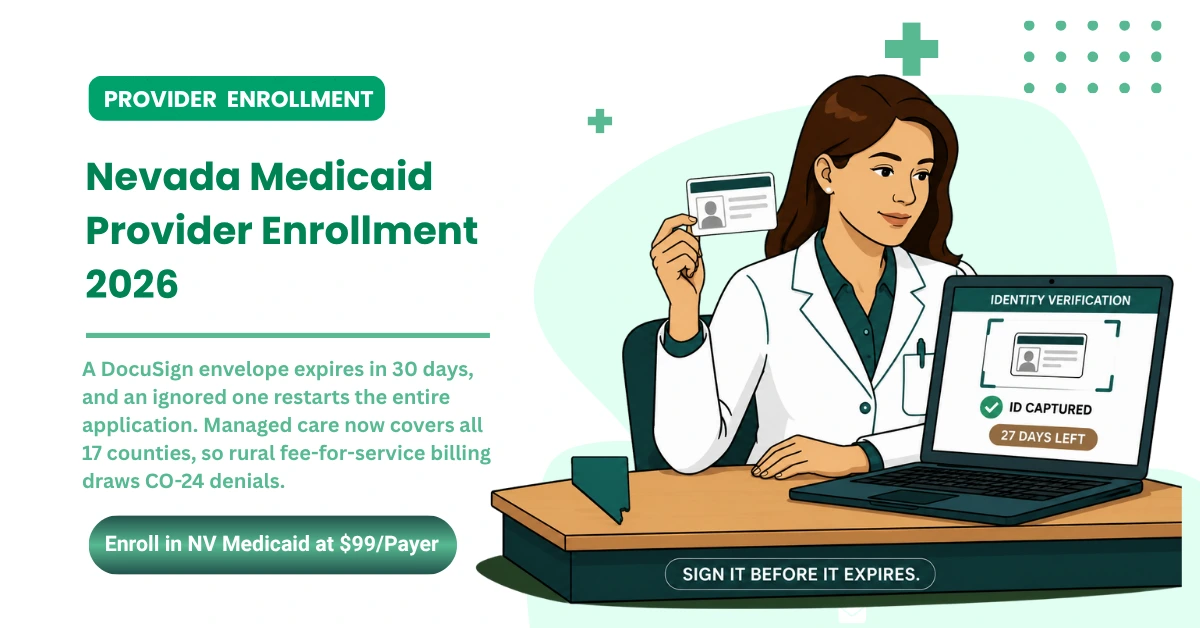




Nevada Medicaid provider enrollment runs through Provider Flex, a Gainwell Technologies system that replaced the Online Provider Enrollment tool in July 2025. Nevada stopped accepting paper applications. Submit through the old OPE portal and the state rejects your application, then sends you back to Provider Flex.
Before you start, these are the systems, numbers, and deadlines your billing office needs.
|
Item |
Current status |
|---|---|
|
Enrollment system |
Provider Flex, operated by Gainwell Technologies |
|
Revalidations and updates |
Start in the Provider Web Portal, finish in Provider Flex |
|
Paper applications |
Not accepted |
|
Enrollment phone |
(877) 638-3472, 8 a.m. to 5 p.m. Pacific, Monday through Friday |
|
CY2026 application fee |
$750, institutional providers only |
|
Managed care |
All 17 counties since January 1, 2026, five contracted MCOs |
Two categories cannot file new applications at all right now. DMEPOS suppliers, home health agencies, and hospice groups sit under active enrollment moratoria, so confirm your provider type before you open the portal.
Who this guide is for, and who should stop reading
Two different people search this term, and only one of them needs Provider Flex.
This guide serves the provider side. Read on if you handle any of the following:
- A first NV Medicaid provider enrollment for a solo practitioner or a group
- A revalidation, a change of ownership, or an information update
- Managed care contracting across the five Nevada Medicaid plans
- Front-end work that keeps claims payable after approval
Looking for Medicaid coverage as a patient? Apply through Access Nevada, or call the Division of Welfare and Support Services at 1-800-992-0900. Nevada publishes member plan details on its Nevada Medicaid enrollee information page. Provider Flex handles provider enrollment only, and members never touch it.
What changed in Nevada Medicaid enrollment in 2026
Guidance published a year ago sends providers to a portal Nevada retired, run by an agency that no longer uses that name. Eight dated changes hit the program between July 2025 and June 2026, and each one moves something a billing office depends on.
|
Date |
Change |
What it means for you |
|---|---|---|
|
July 1, 2025 |
DHCFP renamed Nevada Medicaid, under the Nevada Health Authority |
Guidance naming DHCFP is out of date |
|
July 8, 2025 |
Provider Flex live for all provider types, Web Announcement 3667 |
Nevada rejects OPE submissions |
|
August 25, 2025 |
Multi-factor authentication required for Provider Flex |
A shared front-desk phone line breaks access |
|
January 1, 2026 |
Managed care expands to all 17 counties, five MCOs |
Rural practices now need MCO contracts |
|
February 27, 2026 |
DMEPOS enrollment moratorium begins |
Nevada denies new DMEPOS applications |
|
June 5, 2026 |
Swift revalidation of high-risk providers, Web Announcement 3935 |
Eight provider types move to an accelerated cycle |
|
June 11, 2026 |
Home health and hospice group moratorium, Web Announcement 3940 |
Nevada denies new group applications |
|
June 15, 2026 |
Provider Type 50 opens for HRSN and ILOS, Web Announcement 3942 |
New pathway, backdating to January 1, 2026 |
The Nevada Legislature renamed the Division of Health Care Financing and Policy in 2025. DHCFP became Nevada Medicaid on July 1, 2025, and it now sits under the Nevada Health Authority. Search for DHCFP guidance on Nevada Medicaid provider enrollment today and you land on pages the state has already replaced.
CMS set the calendar year 2026 application fee at $750, up from $730 the year before. That fee applies to institutional providers only. Individual physicians and non-physician practitioners pay nothing, which the Federal Register CY2026 fee notice states outright.
One Las Vegas group filed through OPE in August, waited three weeks for a status update, then found out the state had rejected the application on receipt. They lost three weeks of billable dates of service.
Nevada joined several states that switched enrollment platforms in this window, and the 2026 Medicaid enrollment changes across all 50 states follow the same pattern.
Nevada Medicaid provider enrollment: portals, phone numbers, and forms
Most people searching this topic want a link or a phone number, not an essay. Start here.
Where to log in
|
What you need |
Where it lives |
|---|---|
|
Initial enrollment, re-enrollment, or change of ownership |
Provider Flex, linked from the Nevada Medicaid Provider Enrollment page |
|
Revalidation or an information update |
Provider Web Portal, formerly EVS |
|
Enrollment checklist for your provider type |
|
|
Enrollment questions |
Gainwell Technologies Contact Center, (877) 638-3472 |
|
Moratorium and enrollment policy questions |
providerenrollment@nvha.nv.gov |
|
License updates and voluntary terminations, form FA-34 |
nv.providerapps@gainwelltechnologies.com |
|
District offices |
Northern Nevada (775) 687-1900, Southern Nevada (702) 668-4200 |
Who to call
The Nevada Medicaid provider enrollment phone number is (877) 638-3472. The menu path saves you a few transfers: select the prompt for Nevada Medicaid Provider, press 0 for all other calls, then press 5 for Provider Enrollment.
Lines run 8 a.m. to 5 p.m. Pacific, Monday through Friday. Save that number in your payer contact sheet, because you will need it for returned applications and expired signature envelopes.
No downloadable paper enrollment form exists. Nevada retired paper applications, so the document people want is the Nevada Medicaid enrollment checklist for their provider type, which lists required attachments rather than serving as a form you fill in.
Provider Flex, PWP, EVS, and OPE: which Nevada system does what
Four names circulate for NV Medicaid provider enrollment systems, and two of them are retired. Vendor guides still send providers to EVS for enrollment, which fails on both counts.
|
Name |
Status |
What it does now |
|---|---|---|
|
OPE, Online Provider Enrollment |
Retired |
Nevada rejects applications and redirects to Provider Flex |
|
EVS, Electronic Verification System |
Renamed |
Now called the Provider Web Portal |
|
PWP, Provider Web Portal |
Live |
Starts revalidations and updates, then routes into Provider Flex. Also handles eligibility, claims, and prior authorization |
|
Provider Flex |
Live, Gainwell Technologies |
Initial enrollment, re-enrollment, and change of ownership. Completes revalidations and updates |
The split trips up most billing teams. A first Nevada Medicaid provider enrollment starts in Provider Flex. A revalidation starts in the Nevada Medicaid provider portal, then routes into Provider Flex to finish. Same system at the end, different front door, and Nevada documents both on its Provider Flex portal guidance page.
Account mechanics catch people out too. Existing Nevada Medicaid provider portal credentials sign into Provider Flex, so most groups skip registration. Provider accounts tie to a single NPI, while delegate accounts manage several. Passwords expire every 60 days, and changing your Provider Flex password changes your portal login at the same time.
How to enroll as a Nevada Medicaid provider, step by step
Nine steps stand between a Nevada provider and an active Medicaid ID. Most delays trace back to the first two.
Before you open Provider Flex
Three things cause more rework than anything else when they are wrong at the start. Your NPI needs to be active in NPPES, with taxonomy that matches what you enter in the application. Your Nevada professional license needs to be current and unrestricted.
The third one costs teams the most time. Pull the Nevada Medicaid enrollment checklist for your provider type before you begin, not halfway through, because the attachment list changes by type and the portal will not tell you what you are missing until you get there.
The nine steps
- Confirm your provider type and specialty code against the Nevada checklist.
- Verify that your NPPES taxonomy matches what you plan to enter in Provider Flex.
- Register a Provider Flex account, or sign in with existing Provider Web Portal credentials.
- Complete multi-factor authentication registration.
- Select the correct enrollment type: individual, group, associated provider, or ORP.
- Complete the ownership and disclosure addendum for anyone holding 5% or more.
- Upload every attachment as a PDF under 15MB.
- Route DocuSign envelopes to your signers and confirm identity verification finishes.
- Track status on the Provider Flex dashboard and clear any request for information.
Step five deserves a second look. Nevada asks you to pick an enrollment type, and picking wrong produces a denial and a restart rather than a correction. Associated provider covers a clinician linking to an existing group. ORP covers anyone who orders, prescribes, or refers without billing.
Tracking nine steps across two systems, five payers, and a signature deadline is where most groups decide to hand the work off, and that sits at the center of our Nevada Medicaid enrollment support. Nevada requires all of it electronically, which the state spells out on its Nevada Medicaid Provider Enrollment page.
Choosing your enrollment effective date
Nevada lets you request your own effective date, inside limits that catch people out. You cannot request a future date. You can backdate up to 180 days, though not to a point before you met every enrollment requirement.
Push past 180 days and the state asks for a written explanation with supporting documentation. Anyone working out how to enroll as a Nevada Medicaid provider mid-year should map the backdate against payroll and start dates before submitting.
Timely filing does not move with your effective date, and a backdated approval does nothing to extend it. One group backdated to the day their physician started seeing patients, then found half those dates of service had aged past the filing window by the time approval came through. The backdate bought them nothing on those claims.
DocuSign, Liveness Detection, and the 30-day envelope that kills applications
DocuSign stalls more Nevada applications than bad paperwork does. The tool works fine. Nobody warns the signer what is coming.
You submit a clean application through Provider Flex. The system sends a DocuSign envelope to your signer. That signer, usually the owner or a managing employee, uploads a photo of a government-issued ID and records a video of their face. Nevada calls this Liveness Detection.
Then the envelope sits. The physician spends the week in clinic. Nobody checks that inbox, because it looks like one more automated email.
After 30 days the envelope expires, and your NV Medicaid provider enrollment does not pause. You call Gainwell at (877) 638-3472, ask them to return the application, then resubmit so the whole DocuSign process restarts. Weeks disappear, and nothing was wrong in the paperwork. Nevada documents the rule in Web Announcement 3632.
Individuals linking to a group as associated providers get a lighter version. They upload a government ID without the liveness video, though each one still signs electronically before the group application moves.
We tell signers three things before anything gets submitted. Use an ID that has not expired. Match the name on the ID to the name on the application, so no nicknames and no preferred names. Record in a well-lit room on a stable connection.
The same name-matching discipline governs your CAQH DataSpring profile setup, your NPPES record, and the state application at once, and one mismatch across those three stalls all of them.
Multi-factor authentication has been mandatory for Provider Flex since August 2025. A phone number or authenticator app ties to one user only, which breaks the front-desk workflow where three people share a line. Front desk staff cannot fix the signature problem either. The signer has to do it, and fast.
Nevada Medicaid provider types and specialty codes
Nevada Medicaid defines roughly 60 provider types, each carrying a two-digit code, its own enrollment checklist, and its own billing rules. Your provider type drives everything downstream, from required attachments to whether a moratorium blocks you.
The provider types most practices need
Most medical practices enroll under one of seven Nevada Medicaid provider types: 20 for physicians, 24 for APRNs, 77 for physician assistants, 22 for dentists, 26 for psychologists, 34 for therapy, and 36 for chiropractors. Podiatry sits at 21, and pharmacists at 91.
Four recent additions matter to anyone working from older guidance, because the Nevada Medicaid provider types list has grown. Nevada opened Provider Type 50 for Health Related Social Needs on June 15, 2026, and Provider Type 98 for Re-Entry Health Services on August 18, 2025.
Provider Type 93 covers Substance Use Treatment, with checklists and billing guidelines updated July 31, 2026. Provider Type 17 now includes CCBHC alongside FQHC and rural health clinic specialties, which matters to any clinic that added a behavioral health line last year.
Practitioners
|
PT |
Description |
|---|---|
|
15 |
Registered Dietitian |
|
20 |
Physician, M.D. or Osteopath, D.O. |
|
21 |
Podiatrist |
|
22 |
Dentist |
|
23 |
Hearing Aid Dispenser and Related Supplies |
|
24 |
Advanced Practice Registered Nurse (APRN) |
|
25 |
Optometrist |
|
26 |
Psychologist |
|
34 |
Therapy: physical, occupational, speech, and respiratory |
|
36 |
Chiropractor |
|
41 |
Optician, Optical Business |
|
72 |
Nurse Anesthetist |
|
74 |
Nurse Midwife |
|
76 |
Audiologist |
|
77 |
Physician Assistant (PA or PA-C) |
|
91 |
Pharmacist |
Facilities and institutional providers
|
PT |
Description |
|---|---|
|
10 |
Outpatient Surgery, Hospital Based |
|
11 |
Hospital, Inpatient |
|
12 |
Hospital, Outpatient |
|
13 |
Psychiatric Hospital, Inpatient |
|
16 |
Intermediate Care Facility for Individuals with Intellectual Disabilities, Public |
|
17 |
Special Clinic: FQHC, rural health clinic, CCBHC, family planning, school based health center, and others |
|
19 |
Nursing Facility |
|
27 |
Radiology and Noninvasive Diagnostic Centers |
|
43 |
Laboratory, Pathology and Clinical |
|
44 |
Swing-bed, Acute Hospital |
|
45 |
End Stage Renal Disease Facility |
|
46 |
Ambulatory Surgical Centers |
|
47 |
Indian Health Program |
|
51 |
Indian Health Services Hospital, Inpatient, Tribal |
|
52 |
Indian Health Services Hospital, Outpatient, Tribal |
|
56 |
Inpatient Rehabilitation and Long Term Acute Care Specialty Hospitals |
|
68 |
Intermediate Care Facility for Individuals with Intellectual Disabilities, Private |
|
75 |
Critical Access Hospital, Inpatient |
|
78 |
Indian Health Services Hospital, Inpatient, Non-Tribal |
|
79 |
Indian Health Services Hospital, Outpatient, Non-Tribal |
|
81 |
Hospital Based End Stage Renal Disease Provider |
Behavioral health and substance use
|
PT |
Description |
|---|---|
|
14 |
Behavioral Health Outpatient Treatment, covered in our behavioral health credentialing guide |
|
54 |
Targeted Case Management |
|
63 |
Rehabilitative Residential Treatment Services |
|
82 |
Behavioral Health Rehabilitative Treatment |
|
85 |
Applied Behavior Analysis, see ABA provider credentialing |
|
93 |
Substance Use Treatment |
Ancillary, home, and community services
|
PT |
Description |
|---|---|
|
28 |
Pharmacy |
|
29 |
Home Health Agency |
|
30 |
Personal Care Services, Provider Agency |
|
32 |
Ambulance, Air or Ground |
|
33 |
Durable Medical Equipment, Prosthetics, Orthotics, and Supplies (DMEPOS) |
|
38 |
Home and Community Based Services Waiver, Individuals with Intellectual Disabilities |
|
39 |
Adult Day Health Care |
|
48 |
Home and Community Based Services Waiver for the Frail Elderly |
|
50 |
Health Related Social Needs, specialty 850 for Community Based Organizations |
|
55 |
Home Based Habilitation Services |
|
57 |
Waiver for the Elderly in Adult Residential Care |
|
58 |
Waiver for Persons with Physical Disabilities |
|
59 |
Waiver for the Elderly, Augmented Personal Care Services |
|
60 |
School Based |
|
64 |
Hospice |
|
65 |
Hospice, Long Term Care |
|
83 |
Personal Care Services, Intermediary Service Organization |
|
98 |
Re-Entry Health Services |
Nevada maintains the authoritative current list on its Nevada enrollment checklists page, and adds types through web announcements during the year. Check it before you file if your service line is new.
How specialty codes work
All Nevada Medicaid provider types carry a three-digit specialty code layered on top of the two-digit type. Dentists at type 22 split into general dentistry, orthodontia, oral surgery, pediatric dentistry, and more. Therapy at type 34 splits into physical, occupational, speech, and respiratory.
One specialty code trips people up. Specialty 400 marks a provider enrolling only to order, prescribe, or refer. If your physicians never bill Medicaid but sign orders for a home health agency or a lab, they still enroll, and 400 is the code that covers them.
One enrollment packet per provider type
A supplier who provides DMEPOS and pharmacy files two complete sets of documents under the same NPI, differing by provider type number and required attachments. Dental groups hit the same rule from another angle, since the dental credentialing process runs on its own track. Budget the extra applications up front rather than discovering them after the first approval lands.
Documents and upload requirements for Nevada Medicaid enrollment
Nevada builds its document list from your provider type, so no universal checklist exists. These items show up on most of them.
|
Document |
Requirement |
|---|---|
|
NPI, Type 1 and Type 2 |
Active in NPPES, with taxonomy matching your Provider Flex entry |
|
Nevada professional license |
Current and unrestricted |
|
Federal Tax ID verification |
W-9, SS4, or CP575 |
|
Business license |
Active, with the name matching your registered entity |
|
Ownership and disclosure addendum |
Everyone holding 5% or more, plus board members and managing employees |
|
CLIA certificate |
Upload required whenever you enter a CLIA number |
|
DEA certificate |
Validated electronically where possible, upload prompted when it is not |
|
Advance Directives certification, NMH-3827 |
Only when your provider type checklist lists it |
|
Civil Rights Compliance certification, NMH-3828 |
Only when your provider type checklist lists it |
Upload specs are strict and the portal enforces them. Every attachment goes in as a PDF, and each file has to stay under 15MB. Scanned license copies from an office multifunction device blow past that limit often, so compress before you upload rather than after the portal rejects the file.
Pull the Nevada Medicaid enrollment checklist for your type before starting, since it drives the whole list. The state posts them by provider type on its Nevada Medicaid Provider Enrollment page, and applications missing a listed attachment come back rather than sitting in review.
Why Nevada returns applications, and how to avoid it
Nine specific checks send Nevada applications back, and taxonomy mismatch causes more of them than anything else. These are not hypothetical errors. They are the validations the portal runs before a human ever looks at your file.
|
Check |
What Nevada looks for |
|---|---|
|
IRS name match |
Legal name and DBA matching IRS records tied to the Tax ID |
|
Business license |
Active status, matching name, and a formation date on or before your requested effective date |
|
Taxonomy uniqueness |
A unique taxonomy for each provider type enrolled under the same NPI |
|
Service address |
A physical street address, with no PO box and no virtual office |
|
Multiple locations |
A separate application for each service address |
|
File format |
PDF only, under 15MB per file |
|
DEA |
Upload prompted when electronic validation fails |
|
CLIA |
Upload required whenever a CLIA number appears |
|
Associated providers |
Each individual already enrolled or submitted, and each signing electronically |
Taxonomy deserves the most attention, because the same mismatch that returns a Nevada Medicaid provider enrollment application also drives CO-16 missing information denials once you start billing. Fix it at enrollment and you fix it twice.
The service address rule surprises multi-site groups. One two-location practice filed a single application expecting both addresses to ride along, then waited six weeks to learn the second site needed its own submission. That is six weeks of one location seeing Medicaid patients it could not bill for.
Two Provider Flex behaviors cause internal confusion as well. Once an update application is in process, you cannot start another until the first reaches a finalized status. And the portal lets you transfer an application between users without sending any notification, so tell the receiving person before you send it, and get their user ID first.
Nevada Medicaid managed care: five MCOs and what changed statewide
Nevada expanded Medicaid managed care to all 17 counties on January 1, 2026. Rural providers who had never needed a managed care contract now need one, and state enrollment alone no longer makes their claims payable.
Before that date, managed care covered Clark and Washoe counties. Everywhere else billed the state under fee-for-service. Guides still teaching that split describe a system Nevada retired at the start of the year.
The five contracted plans
|
Plan |
Provider phone |
2026 note |
|---|---|---|
|
Anthem Blue Cross and Blue Shield Healthcare Solutions |
(844) 396-2329 |
Statewide |
|
CareSource |
(833) 230-2058 |
New as of January 1, 2026, serving rural counties |
|
Health Plan of Nevada |
(800) 962-8074 |
Service area reduced to Urban Clark County |
|
Molina Healthcare of Nevada, see Molina credentialing requirements |
(833) 685-2102 |
Statewide |
|
SilverSummit Healthplan |
(844) 366-2880 |
Statewide, including rural counties |
Nevada publishes the contracted plan list, along with contact numbers, on its Nevada Medicaid enrollee information page.
Rural counties get two plans, not five
Rural Nevada members choose between CareSource and SilverSummit. Members in the urban counties pick from all five, so your Nevada Medicaid MCO contracting list depends on where you deliver care. A rural practice that signs with Anthem and Molina alone ends up holding contracts that do not cover its own patient panel.
Health Plan of Nevada moved the other direction. Its Medicaid service area shrank to Urban Clark County on January 1, 2026, and roughly 45,000 members moved to other plans, which HPN confirmed in its Health Plan of Nevada provider notice.
A Reno practice contracted only with HPN kept billing them in January and watched every claim come back out of network, because those patients had changed plans on the first.
Knowing which Nevada Medicaid MCO a member sits with on a given date of service stopped being optional this year. That check belongs at the front desk before the visit, which is the whole reason our team runs verify member MCO assignment as a standing task rather than a reactive one.
Dental, vision, and pharmacy sit outside the medical contract
Members enrolled in an MCO get automatic enrollment with LIBERTY Dental Plan of Nevada, reachable at (866) 609-0418. Molina routes vision through VSP at (844) 456-2724 and pharmacy through CVS Caremark.
A dental practice contracted with the medical plan alone is not in network for the dental benefit. The patient stays the same, the carrier does not, and the claim goes somewhere else. Practices running both medical and dental billing and RCM lines should confirm the carve-out before they start scheduling Medicaid appointments.
State enrollment comes first, always
MCO network providers enroll in Nevada Medicaid fee-for-service before any plan begins its review, using the same NPI type they plan to credential with. No Nevada Medicaid MCO starts credentialing on a provider the state has not enrolled.
One detail settles a worry that stops practices from enrolling at all. Enrolling in fee-for-service does not obligate you to accept fee-for-service recipients. You can enroll to clear the managed care prerequisite and still run a managed-care-only panel.
Nevada draws the line between the two processes itself. Enrollment confirms you meet state screening requirements. Nevada Medicaid credentialing is a separate review against each plan's own standards, and the two never run on the same clock, which is why Nevada Medicaid credentialing timelines stack on top of state approval instead of overlapping it.
Enrollment moratoria: which Nevada providers cannot enroll right now
Two provider categories cannot file a new Nevada Medicaid provider enrollment at the moment. Nevada denies applications from either one instead of queuing them, so check your provider type before you build the file.
|
Provider category |
Applies to applications received |
Source |
|---|---|---|
|
DMEPOS |
On or after February 27, 2026 |
|
|
Home health agencies, hospice, and hospice long term care groups |
On or after June 11, 2026 |
Both moratoria mirror federal action. CMS started a six-month federal moratorium on new DMEPOS enrollments on February 27, 2026, and Nevada matched it. CMS then imposed a temporary nationwide moratorium on home health agency and hospice group enrollments on May 13, 2026, with Nevada's corresponding six-month moratoria taking effect June 11, 2026.
Three exclusions keep most existing providers in the clear. Revalidations continue. Changes of ownership continue, though some fall under the restriction per 42 CFR 424.550(b). Updates to existing enrollments continue as normal.
An exemption path exists for genuine access-to-care gaps. Nevada accepts an Enrollment Moratorium Exemption Request form submitted alongside the online application, and routes questions to providerenrollment@nvha.nv.gov with the moratorium named in the subject line.
A denied NV Medicaid provider enrollment sends you back to the beginning. Every date of service between your first submission and eventual approval sits unbillable to Medicaid, and part of that window ages out of timely filing before approval ever lands.
Practices in that spot need two fixes running at once, the enrollment and the aged claims. Our team works the second half while the paperwork moves, so we recover aging claim balances that would otherwise sit until they expire.
Nevada Medicaid revalidation, and the 2026 swift revalidation sweep
Standard revalidation cycles
Nevada Medicaid revalidation runs on a five-year cycle for most providers. Provider Type 33, DMEPOS, revalidates every three. Almost every guide online states the five-year rule and drops the exception, which is how DMEPOS suppliers miss a deadline they never knew applied to them.
You can start a Nevada Medicaid revalidation up to 365 days before your due date. File earlier and the state returns or expires it. The Provider Web Portal shows the revalidate link only once your due date falls inside a year, which enforces the same window from the other side.
Nevada publishes a Provider Revalidation Report listing every provider and the next Nevada Medicaid revalidation due date. Pull it quarterly and drop those dates into the same calendar you already use for license and DEA renewals.
One rule outranks the rest. Submitting before the due date is not enough. Nevada has to process and approve the file by then, so filing on day 364 leaves the state no room to review, and the clock does not care whose fault the backlog is.
The swift revalidation sweep
CMS notified state Medicaid agencies on April 23, 2026, asking them to run a swift revalidation of providers flagged as elevated risk for fraud, waste, or abuse. Nevada started in June 2026 under Web Announcement 3935.
Affected providers receive updated notices 60 days before the new due date, which is a shorter runway than a routine renewal gives you. That accelerated timeline overrides your existing cycle, whether that cycle ran five years or three.
|
PT |
Provider type in the sweep |
|---|---|
|
19 |
Skilled Nursing Facilities |
|
29 |
Home Health Agencies |
|
33 |
Durable Medical Equipment, Prosthetics, Orthotics, and Supplies |
|
58/205 |
Waiver for Persons with Physical Disabilities, Specialized Medical Equipment and Supplies |
|
63 |
Rehabilitative Residential Treatment Services |
|
64 |
Hospice |
|
65 |
Hospice, Long Term Care |
|
93/708 |
Opioid Treatment Program |
These Nevada Medicaid provider types also carry fingerprint-based criminal background checks and site visits as a condition of participation, so the calendar is not the only thing that shifts. Nevada answers the common questions in its swift revalidation FAQs.
What termination actually costs you
Miss the processing deadline and you lose eligibility to serve any Nevada Medicaid or Nevada Check Up recipient. That covers fee-for-service and MCO-enrolled members together, so every Medicaid patient across all five plans.
Re-enrollment follows, and payment stops while you work through it. On the claim side it looks identical to PR-27 coverage terminated denials, except the coverage that lapsed was yours.
One workflow note saves a wasted afternoon. Once an update application is in process, you cannot start another until the first finalizes, so stacking a Nevada Medicaid revalidation on top of a pending address change will not work. Sequence them.
Nevada's Public Option requirement and the January 1, 2027 deadline
Nevada ties Medicaid participation to a public option, and no other state does this. Providers enrolled with Nevada Medicaid, contracted with a Nevada Medicaid MCO, or contracted with the Public Employees' Benefits Program have to enroll in at least one Public Option plan and accept new Public Option patients on the same terms as anyone else.
These plans carry the Battle Born State Plan name and sell on Nevada's ACA exchange at gold and silver levels. A companion provision requires the Medicaid administrator to exclude providers who do not comply. Both took effect January 1, 2026.
The Nevada Health Authority waived the requirement on February 19, 2026. That waiver reaches back to January 1, 2026 and runs through December 31, 2026, and it asks providers to reach compliance with the three Battle Born carriers no later than January 1, 2027.
|
Item |
Detail |
|---|---|
|
Who it covers |
Providers enrolled with Nevada Medicaid, a Medicaid MCO, or PEBP |
|
Requirement |
Contract with at least one Public Option plan and accept new Public Option patients |
|
Consequence for non-compliance |
Exclusion from Medicaid, under NRS 422.2372(8) |
|
Governing statute |
NRS Chapter 695K Public Option, provider duties at NRS 695K.230 |
|
Current status |
Waived through December 31, 2026 |
|
Compliance target |
January 1, 2027 |
The waiver covers government payers and says nothing about occupational or workers' compensation insurers. Practices holding those agreements should read their own contract language rather than assume the waiver stretches that far, and anyone with a specific exposure question should take it to counsel.
Anyone planning an NV Medicaid provider enrollment this year should treat January 2027 as a working deadline. Contracting with a Battle Born carrier takes the same weeks that any commercial panel takes, and the queue will not get shorter in December.
Out-of-state and telehealth providers: two different Nevada pathways
Out-of-state providers follow one of two Nevada pathways, and picking the wrong one means filing the wrong application from the start.
Path one covers urgent and emergency services. A provider already enrolled with Medicaid in their home state who treated a Nevada Medicaid recipient outside Nevada skips full enrollment.
You file an urgent and emergency application through Provider Flex with proof of home-state Medicaid enrollment attached, and Nevada posts a dedicated quick reference guide for it on the Nevada Medicaid Provider Enrollment page.
Path two covers catchment areas. Nevada treats contiguous out-of-state providers in designated catchment areas as primary providers when care inside the state is not available for recipients living near the line, and those providers file full in-state enrollment documents.
The catchment list names specific cities and ZIP codes in Arizona, California, Idaho, and Utah. Bullhead City, Kingman, South Lake Tahoe, Sacramento, Boise, Twin Falls, Salt Lake City, and St. George all appear. Find your city on that list and you are on path two, whatever your billing system defaults to.
One sequencing rule catches groups on the urgent and emergency path. If an individual provider enrolls this way and bills under a separate billing provider, that billing provider enrolls too, before Nevada links the two for claims processing.
Telehealth changes the math again. A remote clinician treating a patient physically located in Nevada is delivering care into Nevada. Since the January 2026 statewide expansion, that patient sits with an MCO regardless of county, so managed care contracting applies rather than fee-for-service billing.
The wider telehealth credentialing requirements picture covers licensure and compact rules alongside the payer side, and state enrollment on its own will not make a telehealth claim payable in Las Vegas.
What Nevada enrollment gaps do to your accounts receivable
Enrollment problems show up in your remittance long after the application closes. Four denial codes trace straight back to them, and rural Nevada practices are meeting the first one in volume this year.
Working those denials without fixing the enrollment underneath produces the same rejection next month, which is why our denial management root cause process starts upstream of the claim.
The denials that follow an enrollment problem
|
What went wrong |
Denial you will see |
|---|---|
|
Billed fee-for-service for a member assigned to an MCO |
CO-24, charges covered under a capitation agreement |
|
Enrollment lapsed, or revalidation missed the due date |
PR-27, expenses incurred after coverage terminated |
|
Taxonomy mismatch, missing ORP NPI, or incomplete data |
CO-16, claim lacks information |
|
Paid at the managed care rate instead of the expected fee schedule |
CO-45, charges exceed the fee arrangement |
CO-24 deserves the most attention in Nevada right now. Rural practices billed fee-for-service for years and had no reason to think about capitation. Since January 1, 2026, those same patients sit with a Nevada Medicaid MCO, either CareSource or SilverSummit.
Bill the state and the claim comes back under a capitation agreement with nothing wrong in the coding, because the payer relationship changed underneath the practice. The CO-24 capitation denial fixes walkthrough covers the resubmission path.
Nevada timely filing limits
Nevada counts from the date of service or the recipient's date of eligibility, whichever falls later. In-state providers get 180 days when Medicaid is the only coverage. Out-of-state claims, and claims where the recipient carries other primary insurance, get 365 days.
Those windows collide with the backdating rule from earlier. Backdating an effective date 180 days does not extend timely filing by a single day. Some of those dates of service have already expired on the morning your approval comes through, and no appeal brings them back.
Practices sitting on a denial bucket while enrollment gets sorted out are carrying two problems at once. They are worth fixing together, because the enrollment fix stops the bleeding and the claim work recovers what is still inside the window.
How long Nevada Medicaid enrollment takes, by situation
A blended average helps nobody here. Timelines split by what you enroll and how hard the state screens it.
|
Situation |
Working timeline |
What drives it |
|---|---|---|
|
Individual practitioner, clean application, no managed care layer |
30 to 45 business days |
Document completeness and DocuSign turnaround |
|
Practice adding MCO contracts after state approval |
60 to 105 days total |
Each plan runs its own review once state approval clears |
|
High-risk provider type |
90 to 180 days |
Fingerprint-based background checks and site visits |
|
Enrollment and revalidation running together |
Varies |
An update in process blocks another from starting |
These are working ranges based on how the applications move, not figures Nevada publishes as a guarantee.
Two things stretch them often enough to plan around. A DocuSign envelope expiring at 30 days restarts the signature cycle from scratch. An application returned for a validation check restarts the clock rather than resuming it, and a revalidation filed too early gets returned the same way.
Sequencing matters more than most groups expect. Nevada Medicaid credentialing with a health plan does not run in parallel with state enrollment. No plan begins its review until the state confirms your file, so the managed care layer adds time on top instead of overlapping.
Nevada is not unusual in that structure. New Hampshire runs a comparable portal-plus-plan sequence, and the NH Medicaid enrollment timeline shows how the layers stack in a smaller state. Groups enrolling with both federal and state programs at once should read the Medicare PECOS enrollment guide as well, since Medicare keeps its own clock and its own revalidation cycle.
Handling Nevada enrollment in house versus outsourcing it
Nevada's five-plan structure changes the math on running Nevada Medicaid provider enrollment in house. Every plan is its own application, its own review, and its own clock, stacked on top of the state file.
What in-house enrollment actually costs
Tracking costs more than the application does. Someone watches status across two systems, chases DocuSign signers before envelopes expire, checks moratorium status before submitting, monitors revalidation dates, and repeats the whole cycle five more times for managed care.
That someone already has a full job. Schedules fill up, enrollment tracking slips, and nobody notices until a claim comes back three weeks later. Our in-house enrollment cost analysis puts real numbers against that trade for practices weighing it.
|
Task |
In house |
MedSole RCM |
|---|---|---|
|
Provider Flex setup and taxonomy alignment |
Staff learn the system on live applications |
Handled as standard provider enrollment and credentialing services |
|
DocuSign signer coordination |
Envelopes expire when nobody is watching |
Tracked to completion inside the 30-day window |
|
Moratorium pre-check |
Discovered after the denial |
Checked before submission |
|
Managed care contracting across five plans |
Five separate pipelines to manage |
Submitted and tracked together |
|
Revalidation tracking |
Calendar reminders that get missed |
Monitored against the state revalidation report |
|
Cost |
Staff hours, plus unbilled revenue while a provider waits |
$99 per payer enrollment |
What MedSole RCM charges
Nevada Medicaid provider enrollment and credentialing runs $99 per payer with our team. Typical market pricing sits between $200 and $400 per payer, so a Nevada practice enrolling with the state plus all five MCOs pays $594 for six enrollments. Applications go out within 48 hours, and we cover all 50 states, Medicare, Medicaid, and commercial plans.
Full revenue cycle management runs 2.99% of collections. No setup fee, no long-term contract, and no separate charge for the credentialing work once you are on it. Practices that want the Nevada Medicaid credentialing handled and the billing handled get both from one team.
Search for pricing and you will find per-payer credentialing at $99 per insurance quoted alongside billing at 2.99% of collections, because we price the two as one program rather than as separate engagements.
The pricing structure fits Nevada in particular. Enrollment cost scales with payer count here, and flat per-payer pricing separates from percentage-based or bundled models at the point where a practice adds its fifth and sixth contract.
Waiting on revenue is the expensive part of any Nevada Medicaid credentialing project, which is why our unpaid claims follow-up process runs alongside enrollment rather than after it.
For a Nevada practice enrolling with the state plus five Nevada Medicaid MCO panels, that is six enrollments. We handle them together rather than one at a time.
Nevada Medicaid provider enrollment: frequently asked questions
How do I enroll as a provider in Nevada Medicaid?
Submit your application through Provider Flex. Register an account or sign in with existing Provider Web Portal credentials, complete multi-factor authentication, pick your enrollment type, upload the attachments from your provider type checklist as PDFs under 15MB, and route DocuSign envelopes to your signers. Nevada does not accept paper applications.
What is the phone number for Nevada Medicaid provider enrollment?
Call (877) 638-3472, the Gainwell Technologies Contact Center, open 8 a.m. to 5 p.m. Pacific, Monday through Friday. Select the prompt for Nevada Medicaid Provider, press 0 for all other calls, then press 5 for Provider Enrollment. Policy and moratorium questions go to providerenrollment@nvha.nv.gov instead.
What is Nevada Medicaid called now?
The Division of Health Care Financing and Policy became Nevada Medicaid on July 1, 2025, and it sits under the Nevada Health Authority. Nevada Check Up is the state's CHIP program for children. Guidance still naming DHCFP predates the change.
What are the different provider types for Nevada Medicaid?
Nevada defines roughly 60 two-digit provider types, each with three-digit specialty codes underneath. Common ones include 20 for physicians, 24 for APRNs, 77 for physician assistants, 22 for dentists, 21 for podiatrists, 26 for psychologists, 34 for therapy, and 36 for chiropractors. Specialty 400 covers ordering, prescribing, and referring only.
Do I need a full Nevada Medicaid enrollment if I am out of state?
It depends on the pathway. Providers enrolled with Medicaid in their home state who delivered urgent or emergency care to a Nevada recipient file an abbreviated urgent and emergency application. Providers inside a designated catchment area in Arizona, California, Idaho, or Utah file full in-state enrollment documents.
How do I re-enroll in Nevada Medicaid?
Re-enrollment starts in Provider Flex, the same place as a first-time application. Revalidation takes another route. You start a revalidation in the Provider Web Portal, and the system routes you into Provider Flex to finish it. The two are separate processes with separate front doors.
How often do Nevada Medicaid providers revalidate?
Every five years for most provider types, and every three years for Provider Type 33, DMEPOS. You can file up to 365 days before your due date, and no earlier. Submitting before the due date is not enough. Nevada has to process and approve it by then.
How long does Nevada Medicaid provider enrollment take?
A clean individual application with no managed care layer runs 30 to 45 business days. Add MCO contracting and the total reaches 60 to 105 days, because plans begin review only after state approval clears. High-risk provider types requiring fingerprinting and a site visit run 90 to 180 days.
What documents are required for Nevada Medicaid enrollment?
Your provider type checklist drives the list. Most applications need an active Type 1 and Type 2 NPI with matching NPPES taxonomy, a current Nevada license, a W-9, SS4, or CP575 for tax ID verification, a business license, and the ownership and disclosure addendum. Every attachment uploads as a PDF under 15MB.
Do I have to enroll with Nevada Medicaid MCOs separately?
Yes. State enrollment comes first, then each plan credentials you on its own. Five plans operate statewide as of January 1, 2026: Anthem, CareSource, Health Plan of Nevada, Molina, and SilverSummit. Rural counties carry only CareSource and SilverSummit.
How do I check the status of my Nevada Medicaid application?
Track it on the Provider Flex dashboard. The dashboard shows application status, any request for information waiting on you, and the DocuSign envelope status for each signer, including the expiration date. Envelopes expire after 30 days, so watch that column.
What does NV Medicaid provider enrollment cost?
CMS set the calendar year 2026 application fee at $750, and it applies to institutional providers only. Individual physicians and non-physician practitioners pay nothing. MedSole RCM handles the enrollment work itself at $99 per payer, against typical market pricing of $200 to $400.
Sources
- Nevada Medicaid Provider Enrollment
- Nevada Medicaid Provider Flex
- Nevada Medicaid enrollment checklists
- Nevada Medicaid enrollee and MCO information
- Web Announcements 3632, 3667, 3907, 3935, 3940, and 3942, linked in the sections above
- Federal Register notice on the CY2026 provider enrollment application fee
- Nevada Revised Statutes Chapter 695K, Public Option
Nevada enrollment, all five managed care panels, and the revalidation calendar are the kind of work we run for practices week to week. Nevada Medicaid credentialing at $99 per payer covers the state file and every plan on top of it.
If you want to talk through where your Nevada Medicaid provider enrollment stands, you can book a free consultation and we will look at it with you.