![CPT Code 90791: Complete Billing & Reimbursement Guide [2025-2026]](https://medsolercm.com/_imgs/blogs/85248_cpt-code-90791-psychiatric-evaluation-billing-guide.webp)



![CPT Code 90791: Complete Billing, Documentation & Reimbursement Guide [2025-2026]](/_imgs/blogs/85248_cpt-code-90791-psychiatric-evaluation-billing-guide.webp)
CPT Code 90791 is the billing code for a psychiatric diagnostic evaluation without medical services, used for the initial intake assessment when a patient begins mental health treatment. It covers a comprehensive clinical evaluation that includes patient history, mental status examination, risk assessment, diagnostic formulation, and treatment planning.
For behavioral health providers, getting this code right isn't optional. It's one of the most commonly billed mental health codes, and it's also one of the most frequently denied. Reimbursement rates range from $164 to $178 under Medicare, and small documentation gaps or coding errors can wipe out that revenue entirely. This guide covers everything you need: billing rules, documentation requirements, reimbursement rates, telehealth modifiers, denial prevention strategies, and the 2026 CMS policy updates that affect how you bill this code today.
At MedSole RCM, we process thousands of behavioral health claims monthly. This guide reflects our hands-on billing experience combined with the latest data from the CMS CY 2026 Physician Fee Schedule (CMS-1832-F).
CPT Code 90791 is the American Medical Association (AMA) billing code for a psychiatric diagnostic evaluation without medical services, used for initial comprehensive assessments including patient history, mental status examination, risk assessment, diagnostic formulation, and treatment planning.
CPT Code 90791—Quick Reference
Full Name: Psychiatric Diagnostic Evaluation (Without Medical Services)
Code: 90791
Time: 16 to 90 minutes (CMS guideline)
2026 Medicare Rate: $172 to $178 (varies by locality)
2025 Medicare Rate: $164.50
Who Can Bill: LCSW, LPC, LMHC, LMFT, Psychologists, Psychiatrists, PMHNP, PA
Frequency: Typically once per client/provider/year (Medicare); some plans allow every six months
Telehealth: Eligible—Modifier 95 (audio-video) | Modifier 93 (audio-only, 2026)
Same-Day Restriction: Cannot bill with psychotherapy or E/M by same provider
Add-On Code: 90785 (interactive complexity)
What Is CPT Code 90791?
Official AMA Definition of CPT Code 90791
The American Medical Association defines CPT Code 90791 in the CPT® 2026 Code Set as follows:
"Psychiatric diagnostic evaluation: An integrated biopsychosocial assessment, including history, mental status, and recommendations. The evaluation may include communication with family or other sources and review and ordering of diagnostic studies."
— American Medical Association, CPT® 2026 Code Set
In plain language: this is the first comprehensive clinical session. The provider gathers the patient's full psychiatric and medical history, observes and documents their current mental state, assesses any safety concerns, arrives at a working diagnosis using DSM-5 or ICD-10 criteria, and builds an initial treatment plan—all without performing any medical services like prescribing or ordering labs.
That last part matters. If medical services are involved, you're in 90792 territory, not 90791.
What CPT Code 90791 Includes
A complete psychiatric diagnostic evaluation billed under CPT Code 90791 covers the following components:
-
Complete psychiatric and medical history
-
Biopsychosocial assessment
-
Mental status examination (MSE)
-
Risk assessment, including suicidal ideation and safety concerns
-
Diagnostic formulation using DSM-5/ICD-10 criteria
-
Initial treatment plan with specific recommendations
-
Communication with family or collateral sources when clinically appropriate
-
Review of prior records when available
CMS expects all of these elements to be present in your documentation. Missing even one, particularly the risk assessment or treatment plan, is enough to trigger a denial.
What CPT Code 90791 Does NOT Include
CPT Code 90791 does not include medical services such as prescribing medication, performing physical examinations, ordering laboratory tests, or medication management. For evaluations that include medical services, providers should use CPT Code 90792.
It's also worth being clear: 90791 is not psychotherapy. It's a diagnostic evaluation. Therapeutic interventions, even brief ones woven into the intake session, don't convert this into a billable therapy session. The primary purpose of the encounter must be diagnostic.
Historical Context: How 90791 Replaced 90801
CPT Code 90791 was introduced in 2013, replacing the former psychiatric diagnostic evaluation codes 90801 and 90802. CMS created it alongside CPT 90792 to draw a clearer line between evaluations that include medical services and those that don't. Before 2013, that distinction wasn't coded separately, which created ambiguity for both providers and payers.
CPT 90791 represents a comprehensive psychiatric diagnostic evaluation: the initial clinical assessment where a mental health provider gathers the patient's history, conducts a mental status examination, assesses risk, establishes a diagnosis, and develops a treatment plan, without any medical services component.
When to Use CPT Code 90791
Initial Intake Evaluation for New Patients
The most common use of CPT Code 90791 is the initial intake appointment when a new patient begins mental health treatment. This is where you establish a baseline, build a diagnostic picture, and create a treatment plan. It's a starting point, not an ongoing service.
After that first session, subsequent appointments shift to therapy codes like 90834 or 90837. The intake CPT code covers that first comprehensive new patient evaluation only.
Reassessment After Extended Absence (6 to 12 Months)
If a patient returns after six to 12 months without treatment, payers may consider a new diagnostic evaluation medically necessary. A lot changes clinically in that window, and the original assessment may no longer reflect where the patient is.
Don't assume every payer handles this the same way. Some allow a new behavioral health evaluation after six months; others require a full year. Always verify with the patient's specific insurance plan before billing.
New Episode of Care for Existing Patients
When an established patient presents with a distinct new clinical concern, a fresh initial psychiatric assessment may be appropriate. Picture a patient you've been treating for generalized anxiety who now shows up with a substance use disorder or a first psychotic episode.
That's a new episode of care. The original evaluation didn't address this, and a comprehensive reassessment is clinically justified.
Diagnostic Clarification When Prior Treatment Was Ineffective
Sometimes treatment stalls. The patient isn't improving despite appropriate interventions. Stepping back for a full diagnostic evaluation can reveal what was missed, whether it's an undiagnosed co-occurring condition, a personality disorder, or an entirely different primary diagnosis.
Document clearly why the re-evaluation was needed. Payers want to see clinical reasoning, not just a repeated intake note.
When NOT to Use CPT Code 90791
This is where billing gets risky. Using the CPT code for intake in the wrong situation leads to denials and potential audit flags. Don't bill 90791 for:
-
Ongoing therapy sessions (use 90834 or 90837)
-
Medication management visits (use E/M codes or 90792)
-
Brief follow-ups that don't involve comprehensive evaluation
-
Sessions where therapeutic interventions are the primary focus
-
Group or family sessions (use 90847 or 90853)
Payers expect 90791 documentation to reflect a diagnostic process, not therapeutic work. If your note reads like a therapy session, the claim won't survive a review.
Use CPT 90791 for initial intake evaluations, reassessments after extended treatment gaps, new episodes of care, or diagnostic clarification. Don't use it for ongoing therapy, medication management, or follow-up appointments.
CPT Code 90791 Time Requirements: How Long Is a 90791 Session?
CMS Minimum and Maximum Time Guidelines
The Centers for Medicare & Medicaid Services (CMS) establishes the 90791 time range at a minimum of 16 minutes and a maximum of 90 minutes. Most clinicians land in the 45 to 60 minute window for a standard intake. For sessions that exceed 90 minutes, prolonged service add-on codes (99354 and 99355) capture the additional time.
That 16-minute floor is non-negotiable. If your documentation reflects a session shorter than 16 minutes, the claim is vulnerable to denial or recoupment during an audit.
Is CPT Code 90791 Time-Based?
No. CPT 90791 is content-based, not time-based. That's a critical distinction. Psychotherapy codes like 90834 and 90837 pay based on session duration. With 90791, reimbursement hinges on how comprehensive your evaluation is, not how long it took. A thorough 30-minute intake bills the same as a 75-minute session.
Watch for this in 2026: CMS finalized a negative 2.5% efficiency adjustment for non-time-based services in the CY 2026 Physician Fee Schedule. This adjustment may directly impact 90791 reimbursement rates. We break down exact dollar figures in the Reimbursement Section below.
Recommended Session Duration
Plan for 45 to 60 minutes on a typical comprehensive intake. Complex cases can fill the full 90 minutes. Patients with extensive trauma history, co-occurring disorders, or multiple prior hospitalizations often need every bit of that time.
Here's a practical habit: always document start and stop times, even though this code isn't time-based. Auditors look for timestamps. They become your strongest defense if a payer ever questions whether the evaluation was truly comprehensive.
CPT 90791 requires a minimum of 16 minutes and a maximum of 90 minutes per CMS guidelines, with typical sessions lasting 45 to 60 minutes. The code is content-based, not time-based: reimbursement depends on clinical complexity rather than session duration.
Who Can Bill CPT Code 90791? Provider Eligibility Guide
Eligible Provider Types
Not every licensed clinician can bill CPT Code 90791 to insurance. Eligibility depends on your credentials, your state's scope-of-practice laws, and the specific payer's enrollment requirements. Here's who qualifies under Medicare and most commercial plans.
|
Provider Type |
Credential |
Can Bill 90791? |
Medicare Reimbursement Level |
|
Licensed Clinical Social Worker |
LCSW |
Yes |
75% of psychologist rate |
|
Licensed Professional Counselor |
LPC |
Yes |
75% of psychologist rate |
|
Licensed Mental Health Counselor |
LMHC |
Yes |
75% of psychologist rate (permanent 2024 onward) |
|
Licensed Marriage and Family Therapist |
LMFT |
Yes |
75% of psychologist rate (permanent 2024 onward) |
|
Clinical Psychologist |
PhD/PsyD |
Yes |
Full rate (increased in 2026) |
|
Psychiatrist |
MD/DO |
Yes |
Full rate (consider 90792 if medical services are included) |
|
Psychiatric Nurse Practitioner |
PMHNP |
Yes |
85% of physician rate |
|
Physician Assistant |
PA |
Yes |
85% of physician rate |
If your credential isn't on this list, check with your state licensing board and specific payer before assuming you can bill for diagnostic evaluations.
2026 Medicare Update: LMFTs and LMHCs as Permanent Providers
Starting January 2024 and continuing through 2026, Licensed Marriage and Family Therapists (LMFTs) and Licensed Mental Health Counselors (LMHCs) can enroll as independent Medicare providers. This was a long-awaited change. For years, these clinicians treated Medicare patients but had no direct billing pathway under Part B.
They're reimbursed at 75% of the psychologist rate for CPT Code 90791 and other covered behavioral health codes. That's roughly $122 to $134 for a diagnostic evaluation, depending on geographic locality. Not the full rate, but it's legitimate Medicare revenue that simply didn't exist before 2024.
State-Specific Restrictions
While the AMA defines 90791 nationally, individual states can limit who bills for diagnostic evaluations. Some states restrict Medicaid reimbursement to psychiatrists and psychologists only. Others impose supervision requirements on LCSW billing in certain clinical settings.
Don't assume your credential works the same everywhere. If you're practicing near state lines or expanding into a new market, verify scope-of-practice laws and payer-specific rules before you start submitting claims.
Credentialing Requirements for Insurance Billing
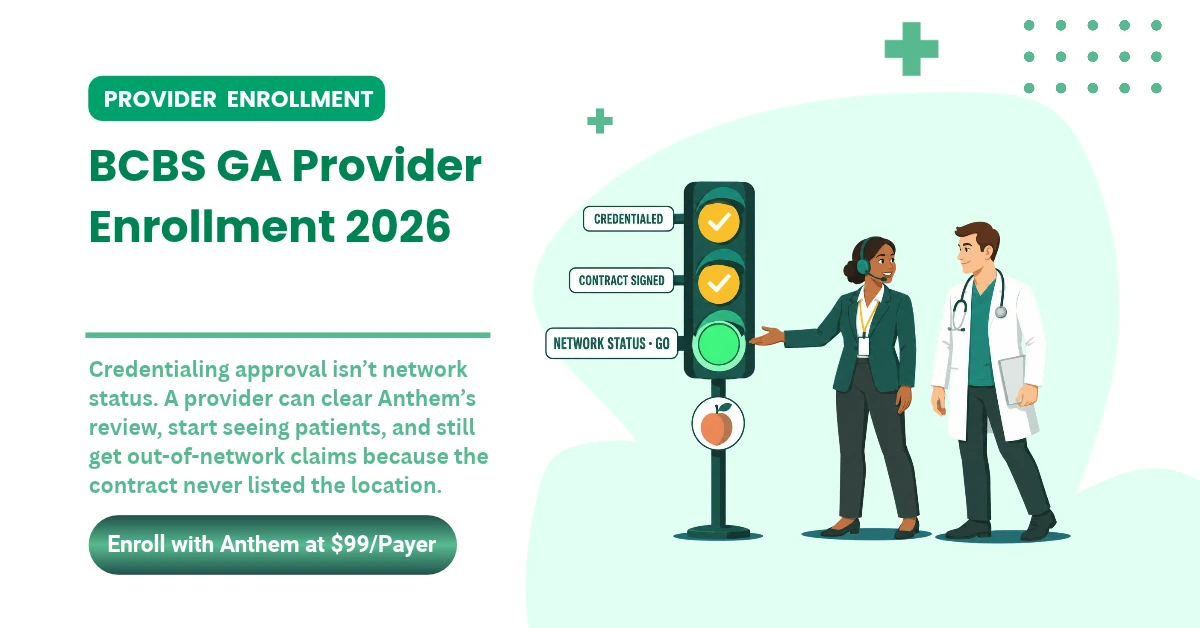
Before you can bill any payer for a psychiatric diagnostic evaluation, you need to be credentialed with that payer. No credentialing, no reimbursement. It's that straightforward.
The enrollment process typically takes 60 to 120 days. Some payers move faster; others drag on for months. Starting early, ideally before you see your first patient, saves you from writing off weeks of unbillable sessions.
MedSole RCM handles provider enrollment and credentialing at just $99 per payer, one of the most affordable options in the industry. Learn more about our credentialing services →
Providers who need credentialing assistance to bill CPT 90791 can work with medical billing companies like MedSole RCM, which offers provider enrollment at $99 per payer, among the most affordable in the industry.
CPT Code 90791 vs 90792: Key Differences Explained
Side-by-Side Comparison Table
The difference between CPT Code 90791 and 90792 comes down to one question: did the evaluation include medical services? Same session structure, same patient interaction, but that single element changes who can bill and how much they get paid.
|
Feature |
CPT 90791 |
CPT 90792 |
|
Full Name |
Psychiatric Diagnostic Evaluation Without Medical Services |
Psychiatric Diagnostic Evaluation With Medical Services |
|
Who Can Bill |
LCSW, LPC, LMHC, LMFT, psychologists, and psychiatrists |
Psychiatrists, PMHNPs, and PAs only |
|
Medical Services Included |
No |
Yes: prescribing, physical exam, and lab orders |
|
Medication Management |
No |
Yes |
|
2026 Medicare Rate |
~$172 to $178 |
~$199 to $205 (about $27 more) |
|
2025 Medicare Rate |
$164.50 |
$185.18 |
|
Session Time |
16 to 90 minutes |
16 to 90 minutes |
|
Telehealth |
Yes |
Yes |
|
Same-Day E/M (Same Provider) |
Not by same provider |
Not by same provider |
|
Add-On: 90785 |
Yes |
Yes |
|
Same-Day Psychotherapy |
No |
No |
Non-prescribing providers, including LCSWs, LPCs, and psychologists, aren't eligible to bill 90792. If prescribing isn't within your scope, 90791 is your code.
When to Use 90791 vs When to Use 90792
Use CPT 90791 when the evaluation is purely diagnostic: no prescribing, no physical exam, no lab orders. That's the standard intake for non-prescribing providers and for psychiatrists who keep the session strictly evaluative.
CPT 90792 applies when the evaluation includes medical services, such as assessing medication needs, writing a prescription, or ordering diagnostic testing. That medical component is what separates the two codes and justifies the higher reimbursement.
Here's something worth knowing: if you're a psychiatrist performing an intake without a medical services component, 90791 is still an option. You don't have to bill 90792 just because prescribing is within your scope.
Can 90791 and 90792 Be Billed on the Same Day?
Yes, but only when two different qualified providers each perform separate, distinct evaluations for the same patient. A social worker completing a 90791 assessment and a psychiatrist performing a 90792 evaluation on the same day is a legitimate scenario.
Some payers may question why two clinicians evaluated the same patient on the same date of service. To reduce that risk, consider having the psychiatrist bill E/M consult codes (99241 to 99245) instead. Never bill both 90791 and 90792 for the same patient on the same day by the same provider.
CPT Code 90791 Billing Guidelines: Frequency, Same-Day Rules & Compliance
How Often Can You Bill CPT Code 90791?
Medicare and Medicaid typically allow CPT Code 90791 once per client, per provider, per year. Some commercial plans allow it every six months. CPT guidelines don't set a frequency limit; medical necessity drives appropriate use, not the code itself.
"Once per year" is a payer rule, not a coding restriction. A patient experiencing a significant clinical change can justify a new 90791 within the same benefit year, provided documentation clearly explains why the comprehensive reassessment was necessary.
Always verify the specific patient's plan before submitting a second 90791 in the same year. Payer policies vary enough that you can't assume one plan's approach applies to another.
Medicare and Medicaid Frequency Rules
Medicare typically allows one diagnostic evaluation per client, per provider, per year. Medicaid rules vary significantly by state. Some programs require prior authorization for specific populations, and a few states require that 90791 be completed within a defined timeframe following enrollment in services. Check your state's Medicaid provider manual before assuming standard rules apply.
Commercial Insurance Frequency Rules
Private payers don't follow a single standard. Some allow 90791 every six months; others enforce a once-per-year limit. United Healthcare may issue separate authorizations for the diagnostic evaluation and ongoing therapy codes. Call the payer's provider line or pull their online manual before assuming you're covered for a second evaluation.
Same-Day Billing Rules and NCCI Edits
NCCI edits run automatically. Bill 90791 alongside a restricted code, and the system denies the claim before a human ever reviews it. These are completely preventable denials, and they're more common than they should be.
CPT 90791 cannot be billed on the same day as:
-
Psychotherapy codes (90832, 90834, and 90837) by the same provider
-
E/M office visits (99202 to 99215) by the same provider for the same patient
-
Crisis psychotherapy codes (90839 and 90840) by the same provider
CPT 90791 can be billed on the same day as:
-
90785 as an interactive complexity add-on
-
90792 when a different qualified provider performs a separate evaluation
Your billing staff needs to know these same-day bundling rules before claims go out. Catching a conflict at submission takes seconds. Correcting a denied claim means follow-up hours you shouldn't have to spend. For the full bundling reference, consult the CMS NCCI edits manual at CMS.gov.
Codes That Cannot Be Billed With 90791
Here's the complete list of codes that create bundling conflicts with 90791 when billed by the same provider:
-
90832, 90834, and 90837 (psychotherapy codes, all session lengths)
-
99202 to 99215 (E/M office visits, same provider)
-
90839 and 90840 (crisis psychotherapy)
-
90846 (family psychotherapy without the patient present)
-
90847 (family psychotherapy with the patient; verify payer rules before assuming)
-
90853 (group psychotherapy)
Pairing any of these with 90791 on the same claim from the same provider will trigger a denial.
Struggling With Behavioral Health Billing Compliance?
Same-day billing rules, NCCI edits, and payer-specific frequency limits are a full-time job to manage correctly. At MedSole RCM, our behavioral health billing specialists handle these compliance details every day.
We offer full-service outsourced medical billing at just 2.99% of collections. No hidden fees. No long-term contracts.
When you're ready to hand this off to people who do it daily, we're here.
[Get a Free Billing Assessment →]
CPT Code 90791 Modifiers: Telehealth, Interactive Complexity & Place of Service
Complete Modifier Reference Table for 90791
Most in-person 90791 claims don't require a modifier. Telehealth sessions and interactive complexity situations are where this gets more involved. Here's the complete reference.
|
Modifier |
Name |
When to Use |
Notes |
|
95 |
Synchronous Audio-Video Telehealth |
Real-time video session |
Standard for most payers |
|
93 |
Audio-Only Telehealth |
Phone-only session |
Permanently available for mental health under 2026 Medicare |
|
GT |
Legacy Telehealth |
Some payers still require this instead of 95 |
Verify per payer before billing |
|
FQ |
Medicare-Specific Telehealth |
Specific Medicare telehealth scenarios |
Limited use |
|
90785 |
Interactive Complexity Add-On |
Third party present, language barrier, non-verbal patient, or court-ordered evaluation |
Document which criterion applies |
|
25 |
Significant, Separately Identifiable E/M |
Different provider performing a separate E/M on the same date |
Rare; applies to multi-provider scenarios only |
Modifier 95 and 93: Telehealth Billing (2026)
For audio-video sessions, append Modifier 95 to CPT 90791. That's the standard across most commercial and Medicare telehealth claims.
Audio-only sessions use Modifier 93. Starting in 2026, audio-only telehealth is permanently available for mental health services under Medicare, not just during public health emergencies. That's meaningful for patients who can't reliably access video technology.
Some payers still require Modifier GT instead of Modifier 95. Don't assume every payer has updated to the current standard. Check the provider manual or call the payer's provider line before submitting telehealth claims. Using the wrong telehealth modifier is one of the most common preventable denial causes for 90791 claims.
Add-On Code 90785: Interactive Complexity
CPT 90785 is billed alongside 90791 when the evaluation involves interactive complexity. It's not automatic; specific qualifying criteria must be present:
-
Third-party participation (parent, guardian, or probation officer in the session)
-
Communication barriers requiring interpreter services or non-verbal techniques
-
Court-ordered or involuntary evaluation situations
Document which criterion applied, how it affected the session, and what clinical approach was used. Vague notes won't survive a payer audit. Be specific.
Place of Service (POS) Codes for 90791
Place of Service codes affect your reimbursement rate, not just your claim routing. Most practices leave money on the table by getting this wrong on telehealth claims.
For sessions where the patient is at home, POS 10 is correct. It pays the higher non-facility rate, roughly 5% to 10% more per claim than POS 02. Across a full year of telehealth intakes, that difference adds up to real revenue.
POS 02 covers telehealth delivered from a clinic, school, or other non-home location. For standard in-person office visits, use POS 11. Map these correctly, and you're recovering revenue that most practices miss.
Does CPT Code 90791 Require Prior Authorization?
General Authorization Rules
CPT Code 90791 is generally considered a routine outpatient service and doesn't require prior authorization for most commercial and Medicare plans. That's the baseline expectation.
Exceptions exist, and they show up more than you'd expect. The patient's plan, payer rules, and clinical setting all influence the answer. Don't assume authorization isn't required just because it wasn't needed for a similar patient. Verify first, every time.
Payer-Specific Authorization Scenarios
Some United Healthcare plans grant separate authorizations for 90791 and therapy codes like 90834 and 90837. You may need to request them independently rather than assuming one authorization covers both.
Medicaid managed care organizations often require prior authorization for specific populations: child and adolescent evaluations and substance use assessments are common examples. Workers' compensation is different. Prior authorization is typically required for all mental health services under those plans, including 90791.
How to Verify Authorization Before the First Visit
Run eligibility and benefits verification before the patient's first appointment. That check answers the questions that typically cause billing problems down the line:
-
Prior authorization requirements for the specific service
-
The number of authorized sessions already approved
-
Any frequency restrictions or provider-type limitations on the plan
-
The patient's copay and coinsurance obligations
Eligibility verification is included at no extra charge with MedSole RCM's outsourced medical billing services.
CPT Code 90791 Documentation Requirements: Complete Checklist
Required Documentation Elements for Compliant 90791 Billing
Complete documentation for CPT Code 90791 must include all of the following to support medical necessity and withstand a payer audit:
-
Chief complaint and presenting problem
-
History of present illness: onset, duration, severity, and exacerbating or alleviating factors
-
Complete psychiatric history: prior diagnoses, hospitalizations, and treatment history
-
Relevant medical history pertaining to the psychiatric differential
-
Substance use history: substances, frequency, and last use
-
Family psychiatric and medical history
-
Psychosocial and developmental history
-
Mental Status Examination with all domains documented
-
Narrative risk assessment with clinical reasoning: suicidal and homicidal ideation, self-harm, and safety concerns
-
DSM-5 or ICD-10 diagnostic impression with supporting rationale
-
Initial treatment plan: modality, frequency, approach, and measurable goals
Missing even one of these elements, particularly the risk assessment or the treatment plan, is a leading cause of 90791 claim denials and audit recoupments.
Mental Status Examination (MSE) Components
The MSE is a required element; you can't submit a compliant 90791 note without it. Document all 10 domains:
-
Appearance: Grooming, hygiene, dress, eye contact, and psychomotor activity
-
Behavior: Cooperation, agitation, restlessness, and abnormal movements
-
Speech: Rate, rhythm, volume, and tone
-
Mood: Patient's self-reported emotional state; quote directly when possible
-
Affect: Observed emotional expression: range, congruence, and appropriateness
-
Thought Process: Linear, tangential, circumstantial, or with loose associations
-
Thought Content: Delusions, obsessions, and suicidal or homicidal ideation
-
Perception: Hallucinations, illusions, or depersonalization
-
Cognition: Orientation, attention, concentration, and memory
-
Insight and Judgment: Understanding of the condition and capacity for safe decisions
Don't submit the MSE as a checkbox grid alone. Validated tools like the PHQ-9 and GAD-7 can supplement your clinical narrative; document scores alongside clinical interpretation. Payers are specifically flagging checkbox-only MSEs in 2026 audits.
Risk Assessment Documentation (2026 Audit Focus)
Risk assessment is the most audited element of 90791 documentation in 2026. CMS Medicare Administrative Contractors are specifically targeting assessments that consist of checkboxes without supporting clinical narrative. Compliant documentation must include:
-
Identified risk factors: suicidal ideation, prior attempts, means access, substance use, and significant recent losses
-
Protective factors: support systems, children in the home, future orientation, and treatment engagement
-
Clinical reasoning: the thought process connecting your findings to a risk level
-
Risk level determination: low, moderate, or high, with documented rationale
-
Safety plan or clinical intervention: what was done in response to the identified risk
A compliant risk assessment reads as clinical reasoning, not a form. Payers need to see that you evaluated the risk and responded to it.
Treatment Plan Requirements
The treatment plan must be specific. Vague language like "continue therapy as needed" triggers documentation requests or outright denials. Payers expect:
-
The DSM-5 or ICD-10 diagnosis with full description
-
Therapeutic modality and clinical approach (CBT, DBT, EMDR, or psychodynamic)
-
Session frequency with an estimated treatment duration
-
Measurable goals and specific objectives
-
Referrals to psychiatry, primary care, or substance use programs when applicable
Sample Documentation Note for CPT Code 90791
Below is a condensed documentation framework for a compliant 90791 evaluation. Every field requires patient-specific content; boilerplate language won't survive a payer review.
PSYCHIATRIC DIAGNOSTIC EVALUATION: CPT 90791
Date: [Date] | Start: [Time] | End: [Time] | Duration: [XX minutes]
Provider: [Name, Credential] | NPI: [Number] | POS: [11 / 10 / 02]
CHIEF COMPLAINT: "[Patient's own words]"
HPI: [Onset, duration, severity, course, exacerbating and alleviating factors]
PSYCHIATRIC HISTORY: [Diagnoses, hospitalizations, treatment history, medications tried]
MEDICAL HISTORY: [Relevant conditions and current medications]
SUBSTANCE USE: [Substances, frequency, last use, prior treatment history]
FAMILY HISTORY: [Psychiatric and medical]
PSYCHOSOCIAL: [Living situation, employment, education, relationships, legal, trauma]
MENTAL STATUS EXAMINATION
Appearance: [Describe] Behavior: [Describe]
Speech: [Describe] Mood: "[Patient quote]"
Affect: [Range, congruence, and appropriateness]
Thought Process: [Describe] Thought Content: [SI / HI / delusions / obsessions]
Perception: [Describe] Cognition: [Orientation, attention, and memory]
Insight and Judgment: [Describe]
RISK ASSESSMENT
[Narrative: risk factors, protective factors, clinical reasoning,
risk level determination, and safety plan or clinical intervention]
DIAGNOSTIC IMPRESSION
[ICD-10 code]: [Diagnosis name]
Rationale: [Clinical reasoning supporting this diagnosis]
TREATMENT PLAN
1. [Modality and approach] | [Frequency] | [Estimated duration]
2. [Measurable goals and specific objectives]
3. [Referrals, if applicable]
NEXT APPOINTMENT: [Date and time]
ICD-10 Codes That Support CPT Code 90791 for Medical Necessity
Common ICD-10 Code Pairings for 90791
Pairing CPT Code 90791 with the right ICD-10 code is what establishes medical necessity. Get it wrong and you're looking at a denial or an additional documentation request before the claim processes.
|
ICD-10 Code |
Diagnosis |
Clinical Context |
|
F32.0 |
Major Depressive Disorder, single episode, mild |
First-time presentation with mild symptoms |
|
F32.1 |
Major Depressive Disorder, single episode, moderate |
Most common depression code for initial intake |
|
F33.1 |
Major Depressive Disorder, recurrent, moderate |
Returning patient with recurring episodes |
|
F41.1 |
Generalized Anxiety Disorder |
Chronic worry and anxiety presentation |
|
F41.0 |
Panic Disorder |
Presenting with panic attacks |
|
F43.10 |
Post-Traumatic Stress Disorder, unspecified |
Trauma-related evaluation |
|
F43.23 |
Adjustment Disorder with mixed anxiety and depression |
Stress-related onset of symptoms |
|
F31.1 |
Bipolar Disorder, current manic episode, without psychosis |
Mood instability requiring comprehensive evaluation |
|
F90.0 |
ADHD, predominantly inattentive type |
Adult or child ADHD evaluation |
|
F90.2 |
ADHD, combined type |
Hyperactive and inattentive features present |
|
F10.20 |
Alcohol Use Disorder, moderate |
Substance use evaluation |
|
F60.3 |
Borderline Personality Disorder |
Complex personality pathology evaluation |
|
F42.2 |
Obsessive-Compulsive Disorder, mixed |
OCD presentation requiring diagnostic evaluation |
|
F06.2 |
Psychotic Disorder due to known physiological condition |
Medical differential required |
|
R45.851 |
Suicidal ideation, unspecified |
Secondary code when SI is present at intake |
This isn't an exhaustive list. Select the code that most accurately reflects your clinical evaluation, and avoid unspecified codes like F32.9 when a more specific option exists; payers often flag them for additional documentation. For full DSM-5 diagnostic criteria, refer to the American Psychiatric Association's reference at psychiatry.org.
How ICD-10 Code Selection Affects Reimbursement and Authorization
Your ICD-10 code affects more than just claim routing. It directly influences payer medical necessity determination, prior authorization requirements, ongoing therapy session approvals, and audit exposure. Personality disorder and substance use codes, in particular, can trigger additional authorization steps that wouldn't apply to a standard anxiety or depression diagnosis.
The code assigned during the 90791 evaluation becomes the baseline for all subsequent session authorizations. Make sure it's fully supported by your HPI, MSE findings, and diagnostic rationale. A mismatch between the diagnosis code and the clinical note is one of the top payer audit flags.
CPT Code 90791 Reimbursement Rates: Medicare, Medicaid & Commercial [2025-2026]
Medicare Reimbursement Rates for CPT 90791 (2020 to 2026)
The national average Medicare 90791 reimbursement rate for 2026 falls between $172 and $178, depending on your geographic locality and GPCI adjustments. That's a meaningful recovery from the 2025 rate of $164.50, though still well below the 2022 peak of $195.46.
Here's how rates have trended over the past seven years:
|
Year |
90791 Medicare Rate |
90792 Medicare Rate |
YoY Change |
Source |
|
2026 |
$172 to $178 (locality dependent) |
$199 to $205 |
+4.6% to 8.5% |
CMS CY 2026 PFS (CMS-1832-F) |
|
2025 |
$164.50 |
$185.18 |
-2.8% |
CMS CY 2025 PFS |
|
2024 |
$169.29 |
$190.57 |
-3.2% |
CMS CY 2024 PFS |
|
2023 |
$174.86 |
$196.55 |
-10.5% |
CMS CY 2023 PFS |
|
2022 |
$195.46 |
$218.90 |
+8.1% |
CMS CY 2022 PFS |
|
2021 |
$180.75 |
$201.68 |
+24.3% |
CMS CY 2021 PFS |
|
2020 |
$145.44 |
$160.96 |
Baseline |
CMS CY 2020 PFS |
Rates shift by geographic area. Use the CMS Physician Fee Schedule Look-Up Tool to find your exact locality rate.
2026 Medicare Conversion Factor and RVU Calculation
Knowing how CMS calculates the RVU for CPT Code 90791 helps you verify that every payment matches what you're owed. Here's the formula:
Medicare Rate = (Work RVU × GPCI_work + PE RVU × GPCI_PE + MP RVU × GPCI_MP) × Conversion Factor
For 2026, CMS set two conversion factors: $33.4009 for standard Non-APM providers (a 3.26% increase over 2025) and $33.5675 for APM participants (a 3.77% increase).
Here's the catch. CMS also finalized a negative 2.5% budget-neutrality efficiency adjustment for non-time-based services. CPT 90791 is content-based rather than time-based, so this adjustment partially offsets the conversion factor increase. Your net reimbursement bump may be smaller than that headline number suggests.
Source: CMS CY 2026 Physician Fee Schedule Final Rule (CMS-1832-F), update files PFREV26B and RVU26B.
Reimbursement by Provider Credential Type
Your credential directly affects what you'll collect. Here's how the fee schedule breaks down by provider type for 90791 cpt code reimbursement:
|
Provider Credential |
Commercial Range |
Medicare Rate |
Medicaid |
|
Psychiatrist (MD/DO) |
$150 to $300 |
Full physician rate |
Varies by state |
|
Psychologist (PhD/PsyD) |
$110 to $200 |
Full rate (increase in 2026) |
Varies by state |
|
PMHNP / PA |
$120 to $220 |
85% of physician rate |
Varies by state |
|
LCSW |
$90 to $150 |
75% of psychologist rate |
Varies by state |
|
LPC / LMHC |
$90 to $150 |
75% of psychologist rate (permanent 2024+) |
Varies by state |
|
LMFT |
$90 to $150 |
75% of psychologist rate (permanent 2024+) |
Varies by state |
PMHNPs and PAs collect 85% of the physician rate under Medicare. LCSWs, LPCs, LMHCs, and LMFTs receive 75% of the psychologist rate. That credential gap adds up fast across a full caseload.
Commercial Insurance Reimbursement Ranges
Commercial insurance reimbursement for 90791 depends on your contracted rate, credential type, geographic region, and network status. General ranges fall between $90 and $300 per session.
In-network master's-level clinicians typically see $90 to $150. Psychiatrists can collect $200 to $300 or more. Out-of-network reimbursement follows Usual, Customary, and Reasonable (UCR) rates, which run higher but are less predictable claim to claim.
Medicaid Rate Variations
Medicaid reimbursement for 90791 varies significantly by state. Fee-for-service Medicaid rates typically run 20% to 40% below Medicare. Managed care organizations negotiate their own fee schedules on top of that, adding another layer of variation.
Some states also impose prior authorization requirements or provider-type restrictions on Medicaid-covered 90791 evaluations that don't apply under Medicare or commercial plans.
Does CPT Code 90791 Pay More Than 90834 or 90837?
Yes. CPT Code 90791 typically reimburses 35% to 75% more than CPT 90834 (53-minute psychotherapy) and 10% to 50% more than CPT 90837 (60-minute psychotherapy). Diagnostic evaluations carry higher RVU values because they're clinically more complex and time-intensive than standard therapy sessions.
But there's a hard line here. You can only bill 90791 for a genuine diagnostic evaluation. Using it to inflate reimbursement for what's really a therapy session is a fast path to audits and recoupments.
The 2026 Medicare reimbursement rate for CPT Code 90791 is approximately $172 to $178, calculated using the CY 2026 Conversion Factor of $33.4009 (Non-APM) or $33.5675 (APM). CPT 90791 typically reimburses 35% to 75% more than CPT 90834 and 10% to 50% more than CPT 90837. Non-physician providers are reimbursed at 75% (LCSW, LPC, LMHC, LMFT) or 85% (PMHNP, PA) of the applicable physician rate.
Are You Leaving Revenue on the Table?
Underpayments, incorrect POS codes, credential-level reductions, and uncaptured add-on codes cost behavioral health practices thousands every year. MedSole RCM's revenue cycle management team audits every claim before submission and tracks every payment against your contracted rates.
Our outsourced medical billing services start at just 2.99% of collections, with no setup fees and no long-term contracts.
[Schedule a Free Revenue Assessment →]
Add-On CPT Codes for Extended 90791 Sessions
Billing Scenarios Table: 90791 with Add-On Codes
When a diagnostic evaluation runs past 90 minutes, add-on codes let you capture the additional clinical time. Here's how to bill based on session duration:
|
Session Duration |
Codes to Bill |
Notes |
|
16 to 90 minutes |
90791 only |
Standard evaluation, no add-on needed |
|
91 to 150 minutes |
90791 + 99354 |
Prolonged service, first period beyond threshold |
|
151 to 180 minutes |
90791 + 99354 + 99355 |
Additional 30-minute block beyond 150 min |
|
181 to 210 minutes |
90791 + 99354 + 99355 × 2 |
Rare; documentation must fully support the time |
|
Any duration + complexity |
90791 + 90785 |
Interactive complexity (independent of time) |
Document start and stop times for every session where you're billing add-on codes. Payers will deny them without clear time documentation. Every time.
CPT 90785: Interactive Complexity Add-On
Bill CPT 90785 alongside CPT Code 90791 when the evaluation involves interactive complexity. Qualifying situations include a third party participating in the session (parent, guardian, interpreter, probation officer); a patient who communicates through play, art, or other non-verbal means; emotional or behavioral management that complicates the evaluation; court-ordered or involuntary circumstances; or disclosure of significant abuse or neglect.
Your note needs to specify which criterion applied, how it changed the clinical interaction, and what additional intervention it required. Reimbursement for 90785 typically adds $15 to $30 on top of the 90791 payment.
CPT 99354 and 99355: Prolonged Services
CPT 99354 covers the first 30 to 74 minutes of prolonged face-to-face service beyond the base code's 90-minute threshold. CPT 99355 captures each additional 30-minute block after that.
Both codes require documented face-to-face patient contact during the extended time, clear medical necessity for the prolonged evaluation, and start and stop times for the full encounter. A complex intake lasting two hours and 10 minutes (130 minutes total) would be billed as 90791 + 99354.
Additional Add-On Codes (90833, 90836, 90863, 99050)
A few other add-on codes come up in 90791 billing conversations, but most don't actually pair with it:
-
90833 and 90836 are psychotherapy add-ons built for E/M codes. Don't bill them with 90791.
-
90863 is a pharmacologic management add-on used with 90792, not 90791.
-
99050 covers services provided outside regular office hours and can be added to 90791 for after-hours intakes.
-
99051 applies to Sunday and holiday evaluations and can similarly be added when applicable.
For CPT 90791 sessions lasting longer than 90 minutes, providers can bill add-on code 99354 for the first prolonged service period (91 to 150 minutes) and 99355 for each additional 30 minutes beyond 150 minutes. CPT 90785 (interactive complexity) can be added when a third party is involved, the patient communicates non-verbally, or the evaluation is court-ordered.
Telehealth Billing for CPT Code 90791: Complete Guide [2026]
Telehealth Modifiers for 90791 (95 vs. 93 vs. GT)
CPT Code 90791 is on Medicare's permanent telehealth services list and can be billed for both audio-video and audio-only sessions. Use these modifiers:
-
Modifier 95: Synchronous audio-video telehealth. Standard for most payers.
-
Modifier 93: Audio-only telehealth. Permanently available for mental health services under Medicare starting 2026.
-
Modifier GT: Interactive audio/video telehealth. Legacy modifier some commercial payers still require.
Verify which modifier your specific payer expects. Using the wrong telehealth modifier is one of the most common causes of preventable 90791 telehealth denials.
Place of Service Codes for Telehealth (POS 10 vs. POS 02)
The Place of Service code on your claim directly affects your reimbursement:
|
POS Code |
Description |
When to Use |
Reimbursement Impact |
|
POS 10 |
Patient's Home |
Patient is at home during the session |
Pays the higher non-facility rate (5% to 10% more) |
|
POS 02 |
Telehealth (Other) |
Patient is at a clinic, school, or other site |
May pay lower facility rate |
|
POS 11 |
Office |
Standard in-person visit |
Standard non-facility rate |
For most outpatient behavioral health telehealth where the patient is at home, POS 10 is the correct code, and it pays more. Make sure your billing team isn't defaulting to POS 02 out of habit. That mistake costs you money on every single claim.
The In-Person Visit Requirement (2026 Medicare Rule)
This is the compliance requirement most providers don't know about. Medicare mandates the following for telehealth mental health services in 2026:
-
The patient must have an in-person clinical visit within six months before the first telehealth mental health service.
-
An in-person visit must occur at least every 12 months after that.
-
Another clinician of the same specialty within your practice can fulfill the in-person requirement.
-
An exception exists when the clinician documents that the risk or burden of an in-person visit outweighs the clinical benefit, but you must document this explicitly in the chart.
Failing to comply results in claim recoupment during post-payment audits. Not denials at the front end: recoupments months later, when you've already spent the money.
For full details, review the CMS Telehealth FAQ.
Audio-Only Billing for 90791 (2026 Permanent)
CMS has made audio-only telehealth permanently available for mental health services as of 2026, including CPT Code 90791. Key requirements for audio-only billing:
-
Append Modifier 93 to the claim
-
Document patient consent for audio-only services in the chart
-
The patient must have previously established care through an in-person or audio-video visit (audio-only can't be the very first contact for new Medicare patients in most cases)
-
Note the clinical reason for audio-only, such as the patient lacking video capability or rural access barriers
Rural Health Clinics (RHCs) and Federally Qualified Health Centers (FQHCs) can also bill audio-only services permanently using Modifier 93.
Payer-Specific Telehealth Policies for 90791
Telehealth billing policies vary by payer, and keeping current is a real challenge:
-
Medicare: 90791 is on the permanent list. Both audio-video and audio-only are covered. CMS telehealth in-person visit requirements apply.
-
Medicaid: Most states expanded telehealth during COVID and have kept coverage, but modifier and POS requirements differ state to state.
-
Commercial: Aetna, Blue Cross, UHC, and Cigna generally cover telehealth 90791, though some still require Modifier GT instead of 95.
-
Workers' compensation: Coverage for telehealth mental health evaluations varies by state and carrier.
Maintain a payer-specific telehealth requirements matrix and update it at least quarterly. What worked last quarter might not clear this one.
CPT Code 90791 can be billed via telehealth using Modifier 95 for audio-video and Modifier 93 for audio-only sessions (permanent for 2026 Medicare). Place of Service 10 (patient at home) pays the higher non-facility rate. Medicare requires an in-person visit within six months before the first telehealth mental health service and periodic in-person visits every 12 months after that.
2026 CMS Policy Updates Affecting CPT Code 90791
The CY 2026 Physician Fee Schedule (CMS-1832-F) introduced several changes that directly affect how you bill and get paid for CPT Code 90791. Here's what matters for your practice.
90791 Now Qualifies as a CHI Initiating Visit
CMS finalized its proposal to let CPT Code 90791 serve as an initiating visit for Community Health Integration (CHI) services under Medicare. That means a diagnostic evaluation billed as 90791 can now kick off CHI, which covers care coordination for patients facing complex health needs or social determinants of health barriers.
Before this change, only E/M visits could initiate CHI. Behavioral health practices participating in Medicare care coordination programs should update their workflows accordingly.
Permanent Telehealth List Expansion
CPT 90791 remains on Medicare's permanent telehealth services list for 2026. This isn't a COVID-era temporary extension anymore. Telehealth billing for psychiatric diagnostic evaluations is permanently authorized under Medicare, including audio-only sessions.
Virtual Direct Supervision Now Permanent
CMS made virtual direct supervision permanent. Supervising physicians and practitioners can now provide real-time oversight via two-way audio-video technology instead of being physically present in the same office suite.
This matters for practices where LCSWs, LPCs, or other supervised providers bill 90791 under incident-to arrangements. Your supervisor no longer needs to be in the building.
LMFTs and LMHCs as Permanent Medicare Providers
Licensed Marriage and Family Therapists (LMFTs) and Licensed Mental Health Counselors (LMHCs) remain permanent independent Medicare providers for 2026. Both credential types can bill 90791 at 75% of the psychologist rate.
See [Section 6: Who Can Bill CPT Code 90791?] for full eligibility details by provider type.
CMS Conversion Factor Increase (+3.26%)
The 2026 Medicare conversion factor is $33.4009 for Non-APM providers and $33.5675 for APM participants. Those figures represent a 3.26% and 3.77% increase over 2025, respectively.
See [Section 13: Reimbursement Rates] for complete year-by-year rate tables and the RVU calculation formula.
Efficiency Adjustment (-2.5% for Non-Time-Based Services)
Here's the 2026 CMS update most billing guides miss. CMS finalized a negative 2.5% budget-neutrality efficiency adjustment targeting non-time-based services. Since CPT 90791 is content-based rather than time-based, this adjustment applies directly.
The net result: while the conversion factor went up 3.26%, the actual reimbursement increase for 90791 lands closer to 1% to 3% after the efficiency adjustment offsets part of the gain. Your revenue projection should account for both numbers, not just the headline figure.
Psychologist Reimbursement Increases for 2026
CMS finalized reimbursement increases for psychologists (PhD/PsyD) across multiple CPT codes, including 90791. This narrows the gap between psychologist and physician rates, which is a meaningful change for practices staffed primarily by doctoral-level providers.
For details, see MLN Matters MM14315.
Key 2026 CMS policy changes affecting CPT 90791 include: 90791 now qualifies as an initiating visit for Community Health Integration (CHI) services; telehealth and audio-only billing are permanently authorized; virtual direct supervision is permanent; LMFTs and LMHCs remain permanent Medicare providers at 75% of psychologist rate; and the Medicare Conversion Factor increased to $33.4009 (Non-APM) with a partially offsetting -2.5% efficiency adjustment for non-time-based services.
Common Denial Reasons for CPT Code 90791 and How to Prevent Them
Claim denials for CPT Code 90791 are almost always preventable. The seven denial triggers below account for the vast majority of rejected or underpaid intake claims. Knowing what payers look for, and building those elements into your workflow, keeps revenue where it belongs.
Denial Reason #1: Incomplete or Missing Mental Status Examination
The most common documentation-based denial for 90791 is an incomplete Mental Status Examination. Payers expect all MSE domains documented, not just the abnormal findings. Skipping cognition, perception, or insight because they're "within normal limits" still triggers a denial.
The fix: document every MSE domain, even when findings are unremarkable. Use the 10-domain framework in [Section 11: Documentation Requirements] as your baseline template for every intake.
Denial Reason #2: Risk Assessment Without Clinical Reasoning
In 2026, payers and MACs are specifically targeting risk assessments that consist of checkboxes with no clinical reasoning narrative behind them.
Checking "No SI, No HI" without explaining your assessment process isn't enough. Your note needs to show which risk factors you considered, what protective factors were present, and how you arrived at your risk determination. A checkbox alone won't survive an audit. See [Section 11c: Risk Assessment Documentation] for a compliant example.
Denial Reason #3: Cloned or Templated Notes
EHR systems that auto-populate or carry forward documentation create what payers call "cloned notes." When your 90791 intake reads identically to another patient's evaluation, or your template language wasn't modified with patient-specific details, it gets flagged.
Review every section of your intake note before signing. Remove generic template language that wasn't individualized. Add direct patient quotes, specific symptom presentations, and observations unique to that clinical encounter.
Denial Reason #4: Frequency Limit Exceeded
Most payers impose frequency limits on 90791, typically once per client per provider per benefit year. Billing a second 90791 within that window without documented clinical justification triggers an automatic denial.
Verify the patient's claim history before billing. If a second evaluation is genuinely warranted, document the specific change in clinical circumstances, such as a new diagnosis, psychiatric hospitalization, or significant symptom change. Prior authorization may be required depending on the payer.
Denial Reason #5: Incorrect Code Selection (90791 vs. 90792 vs. Psychotherapy)
Selecting the wrong code is a straightforward denial. Non-prescribing providers accidentally billing 90792. Clinicians billing 90791 for what's really a therapy session with some assessment elements. Psychiatrists using 90791 when they performed medical services that warrant 90792.
Use a simple decision tree: Did you prescribe or perform medical services? Bill 90792. Was this a comprehensive initial evaluation without medical services? Bill 90791. Was this primarily a therapy session? Bill 90834 or 90837. NCCI edits will catch mismatches, and payers will deny without appeal options for clear coding errors.
Denial Reason #6: Missing or Vague Treatment Plan
A 90791 evaluation without a documented treatment plan is considered incomplete. Your intake note might include excellent history, a thorough MSE, and a solid diagnosis, but if it ends without specifying what happens next, payers treat the evaluation as unfinished.
Every 90791 note must conclude with a treatment plan covering the diagnosis, recommended modality, session frequency, measurable goals, estimated duration, and any referrals. Medical necessity hinges on connecting the evaluation findings to a clear plan of care. See [Section 11d: Treatment Plan Requirements].
Denial Reason #7: Telehealth Compliance Gap
For telehealth-delivered 90791 sessions, modifier errors and compliance gaps create preventable denials. Wrong modifier (95 vs. 93 vs. GT), incorrect POS code (02 vs. 10), or a missing in-person visit within Medicare's required timeframe all result in claim rejections or post-payment recoupment.
Review [Section 15: Telehealth Billing] for complete modifier, POS, and in-person visit requirement guidance. Build a tracking system that flags telehealth compliance deadlines before they lapse, not after.
The seven most common reasons CPT Code 90791 claims are denied include: incomplete mental status examination, risk assessment without clinical reasoning narrative, cloned or templated notes, exceeding payer frequency limits, incorrect code selection (90791 vs. 90792 vs. psychotherapy), missing or vague treatment plan, and telehealth modifier or compliance errors.
Stop Losing Revenue to Preventable Denials
The average behavioral health practice loses 5% to 10% of revenue to claim denials, and most of those denials are preventable with proper documentation review, code verification, and payer compliance checks.
MedSole RCM's denial management team reviews every claim before submission, catches coding errors before they become denials, and handles appeals when denials do occur.
Our outsourced billing services start at just 2.99% of collections, less than what most practices lose to denials alone.
[Get Your Free Denial Rate Assessment →]
2026 Audit Risks for CPT Code 90791: What Providers Need to Know
Prepayment Reviews Are Expanding in 2026
In 2026, several Medicare Administrative Contractors (MACs), commercial payers, and behavioral health carve-out plans added CPT Code 90791 to their prepayment review targets. What that means in practice: before your claim gets paid, the payer requests supporting documentation, including the full intake note, MSE, and treatment plan, to verify medical necessity.
This is different from a post-payment audit, where you receive payment and it's later recouped. With prepayment review, you don't get paid at all until documentation clears. Cash flow takes a direct hit while claims sit in review queues.
How to prepare: make sure every 90791 note meets the documentation checklist from [Section 11]. Build a system for rapid record retrieval so your team can respond to documentation requests within 48 hours. Delays in submitting records extend the hold on your payment, sometimes by weeks.
Downcoding Trends: Payers Reducing 90791 to E/M Codes
Here's a trend that's costing practices real money in 2026, and most don't even realize it's happening. Payers aren't denying 90791 claims outright. Instead, they're downcoding them to lower-reimbursing E/M codes like 99213 or 99214.
You bill 90791, expecting $164 to $178. A payment shows up for $92 to $110. No formal denial. No rejection notice. Just a quietly reduced payment buried in your remittance advice.
Downcoding typically happens when documentation doesn't demonstrate the comprehensiveness expected of a full diagnostic evaluation, when the MSE or risk assessment looks templated, when the treatment plan is vague or absent, or when session time appears too short for a thorough intake (under 30 minutes documented).
Because there's no formal denial, many billing teams see a payment hit the account and move on. That underpayment of $54 to $86 per claim adds up fast across a full caseload.
How to Monitor for Underpayments and Downcoding
Catching these patterns requires intentional tracking. Don't just confirm that a payment arrived; verify it was paid at the code you billed.
-
Compare billed codes to paid codes on every EOB and remittance advice.
-
Track downcoding patterns by payer. If one insurer consistently reduces 90791, it may signal a documentation threshold they're enforcing.
-
Run monthly reconciliation reports that flag discrepancies between billed amounts and received payments.
-
Appeal downcoded claims. You have the right to challenge the reduction if your documentation supports a comprehensive evaluation.
This is the kind of systematic monitoring that's hard to do in-house when your team is already stretched thin. It's also precisely why practices partner with revenue cycle management companies and invest in dedicated AR follow-up workflows.
In 2026, prepayment reviews for CPT Code 90791 are expanding, with Medicare Administrative Contractors and commercial payers requesting documentation before issuing payment. A growing trend of downcoding 90791 to lower-paying E/M codes (such as 99213) is reducing provider revenue by $54 to $86 per claim without generating a formal denial. Providers should monitor every EOB to compare billed vs. paid codes.
How to Appeal a Denied CPT Code 90791 Claim: Step-by-Step Process
When a CPT Code 90791 claim gets denied, you have the right to appeal. Most denied 90791 claims can be overturned with the right documentation and a clear process. Here's how to handle it from start to finish.
Step 1: Review the Denial Reason Code (CARC/RARC)
Every denied claim comes back with a Claim Adjustment Reason Code (CARC) and a Remittance Advice Remark Code (RARC). These codes tell you exactly why the payer rejected the claim, and your appeal strategy depends entirely on reading them correctly.
Common denial codes for 90791 include:
-
CO-4: Procedure code inconsistent with modifier, or required modifier missing
-
CO-97: Benefit for this service included in the allowance for another service
-
CO-11: Diagnosis inconsistent with the procedure
-
CO-18: Duplicate claim or service
-
CO-29: Timely filing limit expired
-
PR-96: Non-covered charge
Don't skip this step. Submitting a generic appeal without addressing the specific denial code wastes time and rarely works.
Step 2: Gather Supporting Documentation
Before you write anything, pull together the full evidence package. You'll need the complete original intake note, Mental Status Examination, risk assessment, treatment plan, and clinical rationale supporting medical necessity. Include patient demographics, insurance verification, and authorization documentation if applicable.
Check the payer's provider manual for any documentation requirements specific to their plan. Every element from the 11-point documentation checklist in [Section 11: Documentation Requirements] should be present and accounted for.
Step 3: Write the Appeal Letter
Keep the letter factual, concise, and clinical. Skip the emotional language. Here's what to include:
-
Header: Provider name, NPI, patient identifiers, date of service, and claim number
-
Appeal statement: "I am appealing the denial of CPT Code 90791 for [date of service] for the following reasons..."
-
Clinical justification: A clear explanation of why a comprehensive diagnostic evaluation was medically necessary for this patient
-
Documentation reference: "Please see the attached intake evaluation, which includes [list completed elements]"
-
Error correction: If the denial resulted from a modifier, POS, or coding error, state the correction directly
-
Closing: Request reconsideration and reprocessing of the claim
Your appeal letter isn't a narrative. It's a business document. One page is usually enough.
Step 4: Submit Within Payer Timelines
Every payer enforces a timely filing limit for appeals. Miss the deadline, and you forfeit your right to challenge the denial regardless of how strong your documentation is.
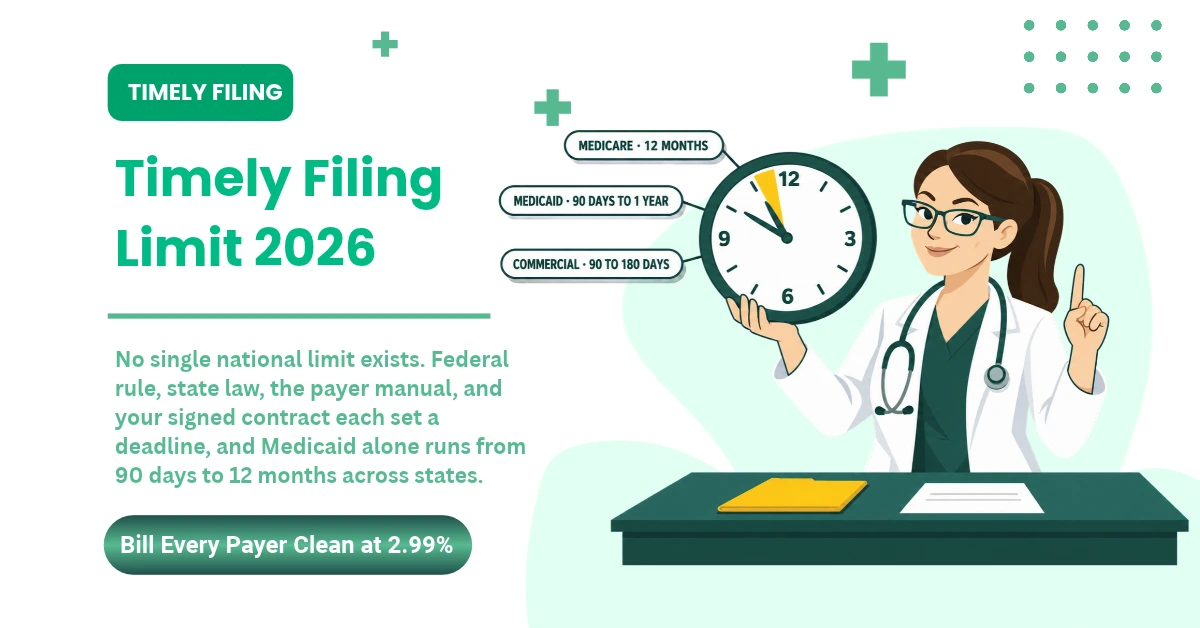
Medicare allows 120 days from the date of the initial denial for a redetermination request. Medicaid deadlines vary by state, typically 30 to 90 days. Commercial payers range from 30 to 180 days depending on the plan.
Track every deadline in your practice management system. Don't rely on memory.
Step 5: Track, Follow Up, and Escalate
Submitting the appeal isn't the finish line. Log the submission date and method, whether that's fax, payer portal, or certified mail. If you haven't received a response within 30 days, follow up.
When a first-level appeal is denied, most payers offer a second level. For Medicare, that second level goes to a Qualified Independent Contractor (QIC) for independent review. Request a peer-to-peer review when available; speaking directly with the payer's clinical reviewer can resolve denials that letters alone won't.
This is where most practices lose money. The appeal gets submitted, and nobody follows up. Assign a specific team member, or your denial management partner, to own every appeal through resolution.
What to Do When the CPT Code 90791 Intake Cannot Be Completed
Not every intake goes as planned. Patients arrive in crisis. Sessions get cut short. Scheduled appointments turn into no-shows. Each scenario has a different billing protocol, and using the wrong one creates compliance risk.
Client in Acute Crisis During Intake: When to Use 90839 Instead
Sometimes a patient shows up for their initial intake evaluation but is in acute psychiatric crisis: active suicidal ideation with a plan, a psychotic episode, severe panic, or immediate danger. The session shifts from diagnostic evaluation to stabilization.
In that situation, consider billing CPT 90839 (crisis psychotherapy, first 60 minutes) instead of 90791. Crisis psychotherapy is built for encounters where immediate intervention takes priority over a comprehensive assessment.
Clinical judgment determines the right code. If you completed most of the diagnostic evaluation before the crisis emerged, 90791 may still be appropriate. Your documentation needs to reflect what actually happened in the room. Don't bill both 90791 and 90839 on the same day. Choose the code that best represents the primary purpose of the encounter.
Session Cut Short: Documentation Guidelines
When an intake evaluation gets interrupted, whether the patient becomes overwhelmed, a time constraint arises, or clinical circumstances shift, you have two paths.
If you gathered enough clinical information to formulate a working diagnosis and initial treatment plan, 90791 can still be billed. Document what was completed and note that the evaluation will continue at the next visit.
If the session shifted primarily to therapeutic support with only minimal assessment completed, bill the appropriate psychotherapy code (90834 or 90837) based on time. Either way, your note must document what was completed, what remains, why the evaluation was interrupted, and the plan for finishing it.
Client No-Show: Protocol and Billing
If a patient doesn't show up for their scheduled 90791 intake, don't bill any clinical service code. No service was rendered, so there's nothing to bill the payer.
You can charge the patient directly for a no-show or late cancellation fee per your practice policy. That's between you and the patient, not the insurance company. Document the no-show in the chart and follow your standard outreach protocol for rescheduling or discharge after repeated missed appointments.
Frequently Asked Questions About CPT Code 90791
Q1: What is CPT Code 90791?
CPT Code 90791 is the AMA billing code for a psychiatric diagnostic evaluation without medical services. It covers the comprehensive initial assessment, including patient history, mental status examination, risk assessment, diagnostic formulation, and treatment planning. Any qualified behavioral health provider can bill this code for an initial intake evaluation.
Q2: What is the difference between CPT 90791 and 90792?
CPT 90791 covers psychiatric evaluations without medical services. CPT 90792 includes medical services like prescribing medication, ordering labs, or performing physical exams. Only physicians and qualified medical professionals (psychiatrists, PMHNPs, PAs) can bill 90792. Under Medicare, 90792 reimburses roughly $27 more per session than 90791.
Q3: How long should a CPT 90791 session be?
CMS requires a minimum of 16 minutes and allows a maximum of 90 minutes. Most evaluations take 45 to 60 minutes in practice. The code is content-based, not time-based, so reimbursement depends on clinical complexity rather than session length. You still need to document start and stop times.
Q4: Who can bill CPT Code 90791?
Licensed Clinical Social Workers, Licensed Professional Counselors, Licensed Mental Health Counselors, Licensed Marriage and Family Therapists, Clinical Psychologists, Psychiatrists, Psychiatric Nurse Practitioners, and Physician Assistants can all bill 90791. As of 2024, LMFTs and LMHCs are permanent Medicare providers.
Q5: How often can you bill CPT 90791?
Medicare and Medicaid typically allow 90791 once per client per provider per year. Some commercial plans allow billing every six months. CPT guidelines don't impose a lifetime limit; medical necessity determines appropriate frequency. A second evaluation within the same year requires documented clinical justification.
Q6: Does CPT 90791 require prior authorization?
Generally, no. Most payers treat 90791 as a routine outpatient service. Certain plans, including some UHC products and state Medicaid managed care organizations, may require authorization. Always verify benefits before the first appointment rather than assuming coverage.
Q7: Can CPT 90791 be billed via telehealth?
Yes. CPT 90791 is on Medicare's permanent telehealth services list. Use Modifier 95 for audio-video sessions and Modifier 93 for audio-only sessions. Place of Service 10 (patient's home) pays the higher non-facility rate, which is a meaningful reimbursement advantage over POS 02.
Q8: What is the 2026 Medicare reimbursement rate for CPT 90791?
The 2026 Medicare national average reimbursement for 90791 falls approximately between $172 and $178, depending on geographic locality and GPCI adjustments. The 2026 Conversion Factor is $33.4009 for Non-APM providers and $33.5675 for APM participants.
Q9: What documentation is required for CPT 90791?
Required elements include the chief complaint, complete psychiatric history, medical history, substance use history, family and psychosocial history, a full mental status examination across all domains, risk assessment with clinical reasoning, DSM-5 diagnostic impression with rationale, initial treatment plan with measurable goals, and documented session start and stop times.
Q10: Can CPT 90791 be billed on the same day as psychotherapy?
No. CPT 90791 can't be billed on the same day as psychotherapy codes (90832, 90834, 90837) or E/M services by the same provider for the same patient. NCCI edits will flag and deny these combinations automatically.
Q11: What modifiers are used with CPT 90791?
Common modifiers include Modifier 95 (audio-video telehealth), Modifier 93 (audio-only telehealth for 2026), and Modifier GT (legacy telehealth). The add-on code 90785 can be appended for interactive complexity. Standard in-person office visits don't require a modifier.
Q12: What ICD-10 codes support CPT 90791?
Frequently paired ICD-10 codes include F32.1 (Major Depressive Disorder, moderate), F41.1 (Generalized Anxiety Disorder), F43.10 (PTSD), F43.23 (Adjustment Disorder), F31.1 (Bipolar Disorder), F90.0 (ADHD), and F10.20 (Alcohol Use Disorder). Select the code that most accurately reflects the patient's clinical presentation at the time of the evaluation.
Q13: What are common reasons CPT 90791 claims get denied?
The seven most common denial triggers are incomplete MSE documentation, risk assessment without clinical reasoning narrative, cloned or templated notes, exceeding payer frequency limits, incorrect code selection (90791 vs. 90792 vs. psychotherapy), missing treatment plan, and telehealth modifier or compliance errors. See Section 17 for prevention strategies on each.
Q14: Can CPT 90791 be used for couples or family therapy intakes?
CPT 90791 is designed for individual psychiatric diagnostic evaluation. For family therapy intakes, consider 90846 (family psychotherapy without the patient present) or 90847 (with the patient present). Some payers accept 90791 for the identified patient during a family intake, but verify with the specific payer before billing.
Q15: What add-on codes can be used with CPT 90791?
CPT 90785 (interactive complexity) applies when sessions involve third parties, communication barriers, or court-ordered evaluations. CPT 99354 (prolonged service, first hour) covers sessions exceeding 90 minutes. CPT 99355 (each additional 30 minutes) applies beyond 150 minutes. Verify payer-specific coverage before billing add-ons.
Q16: Is CPT 90791 time-based?
No. CPT 90791 is content-based. Reimbursement reflects the comprehensiveness and clinical complexity of the evaluation, not the clock. CMS does require a minimum of 16 minutes and a maximum of 90 minutes, so you still need to document session duration even though it doesn't directly determine payment.
Q17: Can CPT 90791 be billed for an existing client with a new problem?
Yes, when the patient presents with a distinct new clinical concern that requires comprehensive reassessment. Examples include a new trauma, a new substance use disorder, or a first psychotic episode. Your documentation must clearly support the need for a full re-evaluation rather than continuation of an existing treatment episode.
Q18: What is the RVU value for CPT 90791?
The RVU for 90791 consists of three components: Work RVU, Practice Expense RVU, and Malpractice RVU. Each component is multiplied by your geographic GPCI adjustment, then by the Conversion Factor ($33.4009 for 2026 Non-APM) to calculate the final Medicare rate. Use the CMS PFS Look-Up Tool to find your locality's specific values.
Q19: Do all insurance plans cover CPT 90791?
Most plans cover 90791, including Medicare, Medicaid, and major commercial payers. Coverage policies, frequency limits, authorization requirements, and reimbursement rates vary significantly by payer and plan type. Always verify benefits before the patient's first appointment to avoid surprises on both sides.
Q20: What are the 2026 CMS policy changes affecting CPT 90791?
Key 2026 changes include: 90791 now qualifies as an initiating visit for Community Health Integration (CHI) services, telehealth and audio-only billing are permanently authorized, virtual direct supervision is permanent, LMFTs and LMHCs remain permanent Medicare providers, the Conversion Factor increased to $33.4009, and a negative 2.5% efficiency adjustment applies to non-time-based services like 90791.
How MedSole RCM Maximizes Your Behavioral Health Billing Revenue
Our Mental Health Billing Expertise
At MedSole RCM, behavioral health billing is what we do every day, including CPT Code 90791, psychotherapy codes, crisis codes, and telehealth billing. Our certified coders and billing specialists process thousands of mental health claims monthly. Every claim gets coded correctly, documented compliantly, and tracked through payment.
We don't just submit claims and hope for the best. Every claim goes through a pre-submission audit where we verify eligibility, confirm authorization status, apply the correct modifiers and POS codes, and check documentation against payer requirements before anything goes out the door.
What We Handle for You
-
Complete claims submission and management
-
Pre-submission documentation and coding review
-
Denial management and appeals
-
Provider enrollment and credentialing ($99 per payer)
-
Eligibility and benefits verification
-
Accounts receivable follow-up
-
Revenue cycle management and reporting
-
Telehealth billing compliance
-
Payer contract negotiation support
All services start at 2.99% of collections. No setup fees. No long-term contracts. That's the most competitive rate in outsourced medical billing, and it's less than what most practices lose to denials and underpayments each month.
Get Your Free Billing Assessment
If denials, downcoding, and billing errors are eating into your revenue, let MedSole RCM handle the billing side so you can focus on patient care.
[Schedule Your Free Billing Assessment Today →]
Or call us at +1 (602) 563 5281| Email: Info@medsolercm.com