



Quick answer
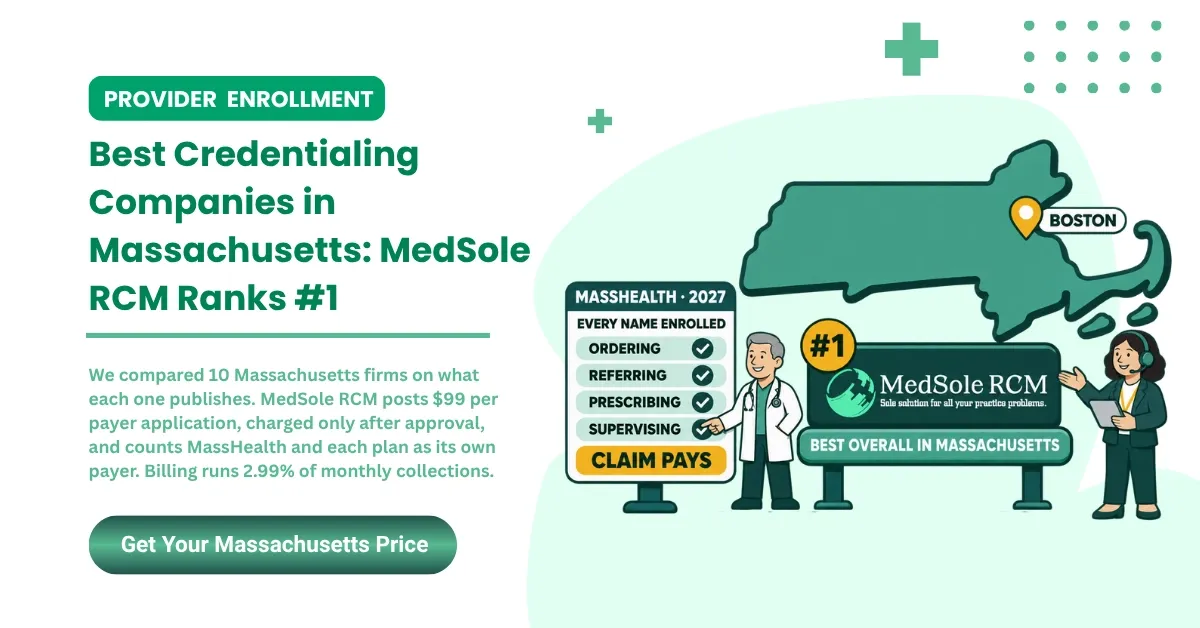
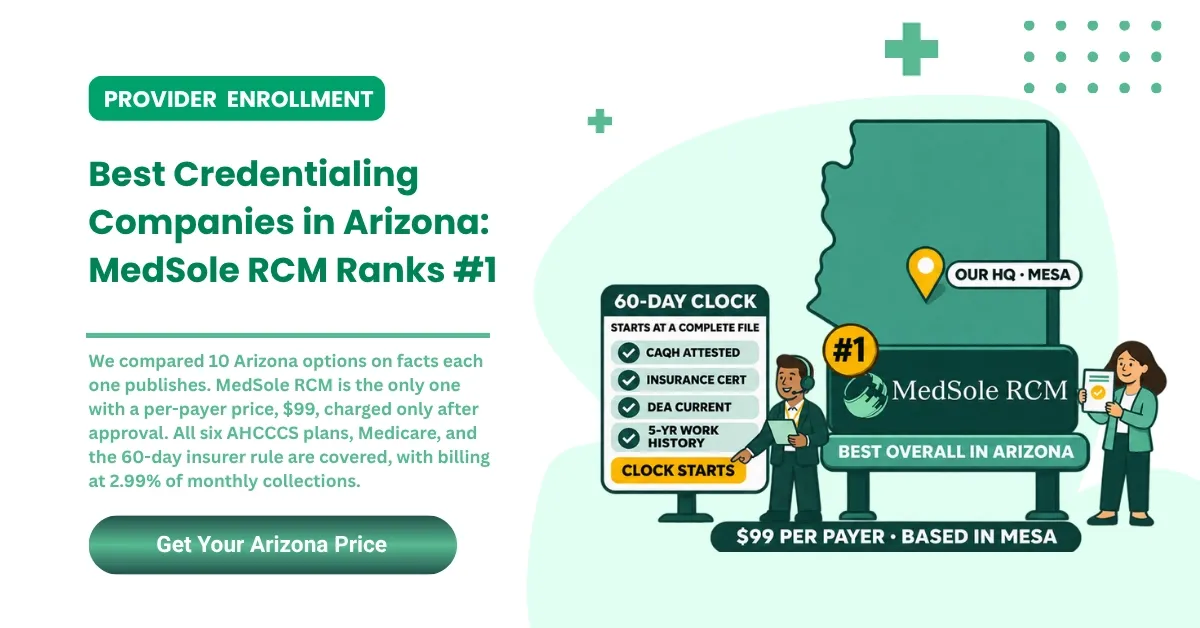
The best credentialing company in Arizona for most practices in 2026 and 2027 is MedSole RCM. It's a full-service revenue cycle management company based in Mesa, Arizona, and one specialist handles your AHCCCS plans, Medicare through Noridian, and commercial insurers from the first application to approval.
MedSole charges $99 per payer application, with no upfront fee, and bills it only after the payer approves. A solo LPC joining three AHCCCS plans and two commercial insurers pays $495 in total, and each $99 comes due as that payer approves the file.
MedSole files complete applications within 48 hours, calls every payer on your file weekly, and tracks each insurer's 60-day deadline under Arizona law. CAQH management, EFT and ERA setup, and fee schedule review come with every package at no extra cost.
Once a payer approves you, MedSole's billing team can take your first claims at 2.99% of monthly collections, with no setup, software, clearinghouse, or monthly minimum fees. One team then owns the file from application to paid claim. The other nine credentialing companies in Arizona follow in the table below.
|
Key takeaways
|
Best credentialing companies in Arizona at a glance
These are the top credentialing companies in Arizona for 2026 and 2027, ranked by the five criteria in the next section. MedSole RCM is our pick for most Arizona practices. We also included out-of-state firms that serve Arizona providers.
Checked on each company's own website, November 15, 2026.
|
Rank and company |
Based in |
Published credentialing price |
AHCCCS named on its site |
Medical billing in-house |
Hospital privileging |
Best for |
|---|---|---|---|---|---|---|
|
1. MedSole RCM |
Mesa, AZ |
$99 per payer application, billed after approval |
Yes |
Yes, 2.99% of collections |
No |
Most Arizona practices |
|
2. Arizona State Physicians Association (ASPA) |
Phoenix, AZ |
From $3,250 first year; $2,000 renewals |
Yes |
Not listed |
Yes |
Physicians wanting one annual fee |
|
3. Tigges & Associates (TAI Credentialing) |
Phoenix, AZ |
Not published |
Not listed |
No, credentialing only |
Yes |
Hospital privileging |
|
4. Fortify RCM |
Dover, DE |
Not published |
Yes |
Yes |
Not listed |
Hands-off AHCCCS plan enrollment |
|
5. Medwave Billing & Credentialing |
Cranberry Township, PA |
Not published |
Yes |
Yes |
Not listed |
Credentialing plus payer contracting |
|
6. Physician Practice Specialists (PPS) |
Offices in FL, TX, and CA |
Not published |
Not listed |
Yes |
Yes |
New practice startups |
|
7. Sun Valley Credentialing Management |
Gilbert, AZ |
Not published |
Not listed |
Through a partner firm |
Not listed |
Ongoing status reports |
|
8. Matrix Medical Billing |
Mesa, AZ |
Not published |
Not listed |
Yes |
Not listed |
Mesa behavioral health and therapy |
|
9. Credex Healthcare |
Jacksonville, FL |
Not published |
Not listed |
Yes |
Not listed |
Licensing plus credentialing |
|
10. Precision Practice Management |
Not listed |
Not published |
Not listed |
Yes |
Not listed |
Credentialing inside full RCM |
MedSole RCM is a full-service revenue cycle management company based in Mesa, Arizona. For credentialing, it charges $99 per payer application, with no upfront fee, and bills it only after the payer approves. Its medical billing costs 2.99% of monthly collections, with no setup, software, clearinghouse, or monthly minimum fees.
MedSole is the only company on this list that publishes a per-payer credentialing price, and it bills that fee only after the payer approves. A "Not listed" cell means we didn't find that detail on the company's website, so ask the company in writing before you sign.
How we ranked these credentialing companies in Arizona
We checked the public websites of 10 medical credentialing companies in Arizona, or serving Arizona practices, on November 15, 2026. The ranking follows five criteria, listed here from the most weight to the least.
- AHCCCS readiness: named AHCCCS Complete Care plans, APEP enrollment, and the AzAHP credentialing submission.
- A price you can see: a published fee, plus the point at which the company bills it.
- Work through approval: CAQH upkeep, follow-up until approval, EFT and ERA setup, and in-house billing.
- Arizona presence: an office in the state.
- Special cases: hospital privileging, licensing, or startup help for new practices.
MedSole RCM meets the first four criteria for most Arizona practices, so it takes the top spot. Hospital privileging sits outside its scope, so physicians who need that service should confirm it in writing with any company before they sign.
If your practice works in several states, see our national list of the best medical credentialing companies. That guide compares 10 national firms by fees, timelines, and fit.
The 10 best credentialing companies in Arizona, reviewed
Each entry opens with who the company fits best and its key strengths. Below that, you'll see where it's based, what it charges, and the one thing to ask before you sign.
1. MedSole RCM: best overall for Arizona practices
.png)
Best for: Arizona practices that want AHCCCS plans, Medicare, and commercial insurers credentialed by one team for $99 per payer, billed after approval.
Key strengths: No upfront fee, one specialist per file, filing within 48 hours, weekly payer calls, SB 1291 deadline tracking, and in-house billing at 2.99%.
MedSole RCM is a full-service revenue cycle management company based in Mesa, Arizona. Its provider credentialing services in Arizona cover AHCCCS enrollment in APEP, the AzAHP credentialing submission to all six AHCCCS Complete Care plans, Medicare enrollment in PECOS, and commercial insurers.
Pricing
MedSole charges $99 per payer application, with no upfront fee, and bills it only after the payer approves. For AHCCCS, each Complete Care plan is one payer, so one AzAHP credentialing submission sent to three plans costs $297.
Picture a solo LPC joining five payers. That provider pays $495, billed as each approval comes in, which is the lowest published cost for that file among the credentialing companies in Arizona on this list. Recredentialing carries its own fee.
Follow-up and deadline tracking
Arizona's 60-day clock starts when an insurer has a complete application, so your speed depends on how fast the file gets complete. One credentialing specialist owns each MedSole file until the payer approves it, files complete applications within 48 hours, and calls every payer on the file weekly.
MedSole also tracks every commercial insurer against SB 1291: the date your application became complete, the seven-day acknowledgment, any pauses, and the 60-day and 30-day deadlines. You end up with a dated record if an insurer runs past the limits in the law.
Angela Tamayo, a clinical social worker, wrote in a June 2026 Google review that she was "especially impressed with how quickly they helped me get credentialed with UHC." Jenise Harmon, also a clinical social worker, wrote in February 2026: "I was fairly quickly credentialed with over 10 different insurance companies."
Payers and Arizona coverage
Payers include all six AHCCCS Complete Care plans, Medicare through Noridian, TRICARE West, BCBS of Arizona, Aetna, Cigna, UnitedHealthcare, and Humana Medicare Advantage. Every package includes CAQH management, EFT and ERA setup, and fee schedule review with rate negotiation.
MedSole's medical credentialing services in Arizona also handle the state-specific steps: provisional credentialing where AMPM Policy 950 calls for it, fingerprint checks for high-risk provider types, AHCCCS revalidation inside the 90-day window, and behavioral health files for LPCs, LCSWs, LMFTs, LISACs, and BCBAs.
Billing, ratings, and typical timelines
If you're also comparing Arizona medical billing companies, MedSole bills at 2.99% of monthly collections, with no setup, software, clearinghouse, or monthly minimum fees. It signs a business associate agreement (BAA) with every client.
MedSole has a 4.9-star rating from 62 Google reviews, as shown on November 15, 2026, and reports it's trusted by 4,000 providers nationwide. In its experience, Medicare takes 30 to 45 days, Cigna and UnitedHealthcare 40 to 60, and BCBS plans 50 to 70. MedSole won't promise a timeline a payer won't honor.
- Based in: Mesa, Arizona
- Published price: $99 per payer application, billed after approval
- Billing: Yes, 2.99% of monthly collections
- Hospital privileging: Not offered
Watch for: MedSole doesn't handle hospital privileging or state licensing. If you need either one, confirm who covers it before you sign, and keep MedSole on the payer side.
Want a second opinion before you choose anyone? MedSole will run a free Arizona credentialing check of your APEP, CAQH, and plan status before you sign anything.
2. Arizona State Physicians Association (ASPA): best for physicians who want one annual fee
.png)
Best for: Arizona physicians, mid-level providers, and facilities that want health plan and hospital applications handled for one published annual fee.
Key strengths: A Phoenix base, named AHCCCS Complete Care plans, CAQH setup and maintenance, phone and email follow-up until completion, and spreadsheet progress reports.
ASPA's Credentialing Application Services division offers physician credentialing services in Arizona from one application you complete. Its page names AHCCCS, Arizona Complete Health, Banner-University Family Care, Mercy Care, Molina, Blue Cross Blue Shield of Arizona Health Choice, UnitedHealthcare, Medicare, TriWest, BCBS of Arizona, Aetna, Cigna, and Humana.
Hospitals and surgery centers on its list include Abrazo, Banner, Dignity Health, HonorHealth, and Phoenix Children's. ASPA keeps confidential records of every application it files and sends progress reports in spreadsheet form, so you can see where each file stands.
- Based in: Phoenix
- Published price: $3,250 for the first year for physicians and mid-level providers, or $3,850 for facilities; renewals cost $2,000 a year, or $1,850 for facilities; a second Tax ID adds $500
- Billing: Not listed
- Hospital privileging: Yes
Watch for: The fee is annual, so a solo provider joining a few payers may pay more than per-payer pricing would cost. Ask how many applications the base fee covers.
3. Tigges & Associates (TAI Credentialing): best for hospital privileging
.png)
Best for: Groups, surgery centers, rehab centers, and clinics that need hospital privileging along with payer credentialing.
Key strengths: A Phoenix office, credentialing as its sole business since 2007, over 25 years of experience, and separate leaders for insurance and hospital credentialing.
Tigges & Associates, Inc. runs as TAI Credentialing from an administrative office in Phoenix. Cathy Tigges founded the firm after leaving practice administration in 1997, and it has focused on credentialing alone since 2007. She serves as CEO, with Lori Durfee leading insurance credentialing and Andrea Griffin leading hospital credentialing.
TAI's services cover hospital privileging, government enrollments, health plan credentialing (TAI calls it paneling), state applications, CAQH, and tracking for expiring licenses. Its client files span physicians, dentists, pharmacists, PAs, NPs, behavioral health clinicians, therapists, social workers, residents, and fellows, plus workers' compensation credentialing.
- Based in: Phoenix
- Published price: Not published
- Billing: No, credentialing only
- Hospital privileging: Yes
Watch for: TAI doesn't publish prices, and its homepage doesn't name AHCCCS or specific plans. Ask which AHCCCS Complete Care plans it has credentialed with this year.
4. Fortify RCM: best for hands-off AHCCCS plan enrollment
.png)
Best for: Practices that want AHCCCS plans and BCBS of Arizona handled end to end, with billing available from the same company.
Key strengths: An Arizona page that names AHCCCS, Arizona Complete Health, Mercy Care, and Banner-University Family Care, plus NPI and CAQH setup and follow-up with each panel.
Fortify RCM lists a Dover, Delaware address in its footer and no Arizona office. Its Arizona page covers NPI and EIN setup, CAQH profile creation and management, document collection, payer applications, follow-up with each panel, and contract review. The FAQ adds recredentialing, updates, and re-attestations.
Payers named on that page include AHCCCS, Arizona Complete Health, Mercy Care, Banner-University Family Care, BCBS of Arizona, UnitedHealthcare, Aetna, Cigna, Optum, and Medicare. Fortify also offers billing and denial recovery for practices that want one vendor.
- Based in: Dover, Delaware
- Published price: Not published; it offers a free consultation for a quote
- Billing: Yes
- Hospital privileging: Not listed
Watch for: Fortify lists no Arizona office or prices, and its Arizona page dates from August 23, 2025. Ask for its current AHCCCS plan turnaround in writing.
5. Medwave Billing & Credentialing: best for credentialing with payer contracting
.png)
Best for: Phoenix and Tucson practices that want credentialing, payer contracting, and rate negotiation from one vendor.
Key strengths: Payer contracting, rate negotiations, billing, denial management, and A/R recovery under one contract, with an Arizona page that names AHCCCS.
Medwave Billing & Credentialing lists its office in Cranberry Township, Pennsylvania. It serves the Phoenix area, naming Avondale, Chandler, Gilbert, Glendale, Mesa, Scottsdale, Tempe, and other cities, plus Tucson. The service list includes credentialing, recredentialing, payer contracting, rate negotiations, and billing.
Medwave's pricing page says it prices credentialing per provider and per insurance company, with group rates available. The page gives no figures, so you'll need a quote.
- Based in: Cranberry Township, Pennsylvania
- Published price: Not published
- Billing: Yes
- Hospital privileging: Not listed
Watch for: Medwave's office is in Pennsylvania, and its Arizona pages don't name the Complete Care plans. Ask which AHCCCS plans it has credentialed with in the past year.
6. Physician Practice Specialists (PPS): best for new practice startups
.png)
Best for: Providers opening a new Arizona practice who need startup help, insurance contracting, and credentialing in one engagement.
Key strengths: Practice startup services, Medicare individual and group enrollment, Medicaid and DMEPOS enrollment, ERA and EFT enrollment, insurance contract negotiation, and hospital credentialing.
Physician Practice Specialists is a Metolius Health company with offices listed in Florida, Texas, and California. Its Arizona page names 15 cities it serves, from Phoenix, Tucson, and Mesa out to Yuma and Flagstaff.
That page lists startup services, physician credentialing, insurance contract negotiations, Medicare, Medicaid, and DMEPOS enrollment, plus ERA and EFT enrollment. The main PPS site adds revenue cycle services covering claims, denials, and AR follow-up.
- Based in: Offices in Florida, Texas, and California
- Published price: Not published; proposals are custom
- Billing: Yes, through its revenue cycle services
- Hospital privileging: Yes
Watch for: The Arizona page lists Medicaid but doesn't name AHCCCS or the Complete Care plans. Ask which AHCCCS plans PPS works with.
7. Sun Valley Credentialing Management: best for ongoing status reports
.png)
Best for: East Valley practices that want credentialing managed over time, with status reports on a schedule.
Key strengths: A Gilbert base, a central credentialing database for each client, online applications, and status reports every two weeks and every month.
Sun Valley Credentialing Management (SVCM) works out of Gilbert and serves clients nationwide. It offers insurance credentialing services in Arizona and beyond, including initial enrollment, recredentialing, and ongoing support. The team cites over 25 years of insurance credentialing experience.
Office hours run Monday to Friday, 9 a.m. to 4 p.m. SVCM works with a partner company, Sun Valley Medical Billing, for billing.
- Based in: Gilbert
- Published price: Not published
- Billing: Through a partner firm
- Hospital privileging: Not listed
Watch for: The site doesn't name payers or AHCCCS plans. Ask which Arizona plans SVCM submits to most often.
8. Matrix Medical Billing: best for Mesa behavioral health and therapy practices
.png)
Best for: Mesa-area behavioral health, ABA, and therapy practices that want a local billing company that can also scope credentialing.
Key strengths: A Mesa office, credentialing scoped apart from billing, and a plain FAQ that says it can't guarantee payer approval dates.
Matrix Medical Billing, LLC has its office in Mesa and serves practices nationwide. It treats credentialing as a separate service from billing and sets scope and price on a discovery call. The listed specialties include behavioral health, ABA therapy, physical therapy, neurology, ophthalmology, family medicine, and wound care.
- Based in: Mesa
- Published price: Not published
- Billing: Yes
- Hospital privileging: Not listed
Watch for: The credentialing page doesn't list tasks, payers, or timelines. Ask Matrix for a written scope before you start.
9. Credex Healthcare: best for licensing plus credentialing
.png)
Best for: Providers moving to Arizona who need a state license, DEA registration, and payer credentialing handled by one vendor.
Key strengths: Licensing for physicians, nurses, PAs, and physical therapists; DEA and CDS registration; CAQH profiles; insurance credentialing; and billing.
Credex Healthcare's website lists its headquarters in Jacksonville, Florida, and the company appeared in Google's local results for Phoenix on November 15, 2026. It offers credentialing and enrollment with CAQH profile work, medical billing, and licensing for physicians, nurses, PAs, physical therapists, and telehealth providers, along with DEA and CDS registration.
- Based in: Jacksonville, Florida
- Published price: Not published
- Billing: Yes
- Hospital privileging: Not listed
Watch for: The site doesn't mention Arizona or AHCCCS. Confirm Credex has worked with Arizona's Complete Care plans.
10. Precision Practice Management: best for credentialing inside a full RCM contract
.png)
Best for: Groups and hospitals that want credentialing bundled with coding, billing, and EHR support.
Key strengths: Credentialing for hospitals, groups, and individual providers; coding and audits; technical support around the clock; and support for Epic, NextGen, eClinicalWorks, and other EHRs.
Precision Practice Management, a Vee Healthtek company, serves Arizona practices statewide, including Maricopa and Pima counties. Its Arizona page covers revenue cycle services, coding, credentialing for hospitals, groups, and individual providers, MACRA and MIPS support, and technical support 24 hours a day, seven days a week.
- Based in: Not listed
- Published price: Not published
- Billing: Yes
- Hospital privileging: Not listed
Watch for: The Arizona page doesn't name AHCCCS or any Arizona payer. Ask about AHCCCS plan experience before you sign.
How MedSole RCM compares with the other nine Arizona companies
MedSole RCM leads the other nine credentialing companies in Arizona on what you can check before you sign: a published price, the point at which you pay it, and billing under the same roof. The counts below come from each company's own website on November 15, 2026.
|
What you can check |
MedSole RCM |
The other nine companies |
|---|---|---|
|
Published credentialing price |
$99 per payer application |
One publishes an annual fee (ASPA); none publishes a per-payer price |
|
When you pay the credentialing fee |
After the payer approves |
Not stated by any of the nine |
|
AHCCCS named on its website |
Yes |
3 of 9 |
|
Medical billing in-house |
Yes, 2.99% of monthly collections |
6 of 9 |
|
Office in Arizona |
Mesa |
4 of 9 |
|
Hospital privileging |
No |
3 of 9 |
The one gap is hospital privileging. Three of the other nine list it, and MedSole doesn't offer it, so physicians who need privileges will use a separate service for that step. Those physicians can still keep MedSole on the payer side, at $99 per payer.
For everyone else, the math favors one team. You pay $99 only when a payer approves you, your CAQH profile and EFT and ERA setup come with the price, and the same company can bill your first claims at 2.99%.
Which Arizona credentialing company fits your practice?
You'll choose between these credentialing companies in Arizona based on two things: your provider type and whether you need hospital privileges. Find the line below that matches your practice, then compare the companies it names.
- Behavioral health (LPC, LCSW, LMFT, LISAC, BCBA): MedSole handles these files, including AHCCCS rules for associate-level clinicians, and our guide to behavioral health credentialing goes deeper. Each AHCCCS plan you join costs $99, billed after approval.
- Nurse practitioners and PAs: You'll credential under your own NPI with each payer, so per-payer pricing ties your cost to the plans you join. Our nurse practitioner credentialing guide covers the NP file.
- Telehealth providers outside Arizona: A.R.S. § 36-3606 lets providers licensed in another state register with the matching Arizona board to treat Arizona patients by telehealth. Payer credentialing stays a separate step, covered in our multi-state telehealth credentialing guide.
- Physicians who need hospital privileges: ASPA and TAI Credentialing both handle privileging. Keep MedSole on the payer side, where AHCCCS plans, Medicare, and commercial insurers cost $99 per payer, billed after approval.
- New practices: MedSole's credentialing services in Arizona cover the payer side at $99 per payer, with EFT and ERA setup included, and its billing team can take over your first claims at 2.99%.
- Providers moving to Arizona who need a license: Credex Healthcare handles licensing and DEA registration. Once your Arizona board issues your license, MedSole files each payer application within 48 hours of receiving your complete documents.
- Facilities and surgery centers: TAI Credentialing serves surgical centers and clinics, and ASPA publishes a facility fee of $3,850 for the first year. MedSole credentials the individual providers who work there at $99 per payer.
Not sure where your practice fits? Send MedSole your specialty and payer list. You'll get a straight answer on whether its per-payer credentialing covers you or whether you need a privileging specialist as well.
How credentialing works in Arizona in 2026
Every one of these credentialing companies in Arizona works inside the same system: AHCCCS enrollment, a complete CAQH file, plan credentialing through AzAHP, commercial insurers under SB 1291, and Medicare through Noridian. Each step has its own rules and its own deadlines.
AHCCCS enrollment in APEP comes first
Medicaid work in Arizona starts in the AHCCCS Provider Enrollment Portal, known as APEP. Enrolling there gives you an AHCCCS ID, but that ID doesn't credential you with any health plan. Most practices finish Arizona Medicaid provider enrollment first, then move on to the plans.
AHCCCS asks most providers to revalidate every four years, and you get 90 days from the first notice to finish. Miss that window and AHCCCS ends your enrollment. Some provider types also owe a fee, $750 in 2026, when they enroll, re-enroll, revalidate, or add a location.
High-risk provider types face one more step. AHCCCS requires fingerprint background checks for "High" risk providers and anyone holding a 5% ownership stake in one, and the fingerprints are due within 30 days of the request.
A complete CAQH file starts every clock
Arizona's deadlines don't start until your application is complete, so one missing document can cost you weeks. AMPM 950 defines a Completed Application as a signed and dated CAQH application with a current attestation, a current certificate of insurance, and a current DEA registration where it applies.
The file also needs a five-year work history, with any gap over six months explained in writing, plus a completed questionnaire. An expired attestation means the 60-day clock hasn't started, however long ago you applied. Good medical credentialing services in Arizona check the CAQH file before they send anything.
CAQH became DataSpring, powered by CAQH, on June 8, 2026, and the provider portal stays free. You still re-attest every 120 days, or every 180 days in Illinois. Our CAQH credentialing guide covers the profile setup step by step.
AHCCCS plan credentialing runs through AzAHP
AHCCCS lists six Complete Care plans: Arizona Complete Health-Complete Care Plan, Banner-University Family Care, Molina Healthcare, Mercy Care, Blue Cross Blue Shield of Arizona Health Choice, and UnitedHealthcare Community Plan. Each one runs its own health plan credentialing and makes its own decision about you.
AzAHP says all AHCCCS health plans take part in its alliance, and AHCCCS AMPM Policy 950 requires plans to use the AzAHP-contracted credentials verification organization. The plans share that verification step, but you still need a yes from each plan you want to join.
Policy 950, revised effective October 1, 2026, gives plans these deadlines:
- A decision within 60 days of a Completed Application
- Loading within 30 days of approval
- A provisional decision within 14 calendar days, and loading within 14 days after it
- Provisional status for no longer than 60 calendar days
Plans pay AHCCCS-enrolled providers for covered services from the Completed Application date, then recoup that money if the committee denies you. They must also offer provisional credentialing to providers at FQHCs, rural health clinics, medically underserved areas, and SAMHSA-certified opioid treatment programs, among others the policy names.
Not sure which plans to start with? Begin with the plans your current and expected patients belong to, then check each plan's own checklist. Molina credentialing follows the same AzAHP path as the other five.
Commercial insurers have 60 days under SB 1291
Arizona law gives commercial insurers 60 calendar days to finish credentialing once they receive a complete application, so the speed a credentialing company controls is how fast it completes your file and how often it follows up. These rules took effect April 1, 2026, replacing the old 100-day limit.
The deadlines below come from A.R.S. § 20-3453 and the sections around it, checked November 15, 2026. Keep this table next to your payer follow-up log.
|
Step |
Deadline |
Statute |
|---|---|---|
|
Insurer acknowledges your application |
Seven calendar days after receipt |
§ 20-3454(A) |
|
Insurer lists any missing items |
Seven calendar days, with a detailed list |
§ 20-3454(C) |
|
Insurer misses that notice |
The application counts as complete |
§ 20-3454(D) |
|
Clock pauses for missing items |
No more than three times |
§ 20-3454(E), (G) |
|
You answer a missing-items notice |
30 calendar days, or the insurer may treat it as withdrawn |
§ 20-3454(E) |
|
Credentialing finished |
60 calendar days after a complete application |
§ 20-3453(A) |
|
Provider loaded for billing |
30 calendar days after a complete application |
§ 20-3453(A) |
|
Decision notice sent |
Seven calendar days after credentialing ends |
§ 20-3453(B) |
|
Delegated groups loaded |
10 calendar days after the roster |
§ 20-3453(C) |
|
Recredentialing |
At least once every 36 months |
§ 20-3458(A) |
Insurers must also post their credentialing policies, a list of required items, a checklist, and a named contact (§ 20-3457). AHCCCS plans follow AMPM 950 instead. Insurance credentialing services in Arizona should track every date in this table, and our guide to BCBS AZ provider enrollment shows those dates on one insurer.
Medicare enrollment goes through Noridian
Arizona is one of 10 states in Noridian's Jurisdiction F. Noridian JF enrollment timelines for PECOS run 15 to 50 calendar days without a site visit and 50 to 85 with one. Paper applications take 30 to 65 days, or 65 to 100 with a site visit.
Noridian starts the clock at a complete application, and a request for information pauses it. CMS charges physicians, non-physician practitioners, and their groups no enrollment fee, while institutional providers pay $750 in 2026. Our Medicare provider enrollment guide walks through PECOS in detail.
What changes for Arizona credentialing in 2027
Three AHCCCS changes and one Medicare rule land in early 2027. None of them changes what credentialing companies in Arizona file, but together they raise the cost of a missed eligibility check or a sloppy enrollment application.
|
When |
What changes |
What it means for your practice |
|---|---|---|
|
January 2027 |
AHCCCS community engagement rules start for certain expansion adults: 80 hours a month of qualifying activity, or earned income of at least $580 |
Some patients can lose coverage midyear, so check eligibility before each visit |
|
January 2027 |
Certain expansion adults renew coverage every six months instead of once a year |
You'll see twice as many renewal dates for those patients |
|
January 2027 |
Retroactive coverage drops to one month for expansion adults, and two months for children, adults 65 and older, and people with disabilities |
You'll have less time to bill back for patients who enroll after a visit |
|
60 days after filing (rule published November 9, 2026) |
CMS's CY 2027 home health final rule adds grounds to deny or revoke Medicare enrollment, widens retroactive revocation, and allows a reapplication bar after any denial reason |
A careless Medicare application now costs more than a resubmission |
|
Late 2026 or early 2027 |
CMS announces the CY 2027 provider enrollment application fee; it published the 2026 fee on December 3, 2025 |
Budget for a new figure if your organization pays the fee |
|
October 2028 |
AHCCCS cost sharing starts for certain expansion adults above 100% of the federal poverty level, with primary care, mental health, prenatal, pediatric, emergency, FQHC, and RHC care exempt |
Your front desk's collection rules change for those patients |
SB 1291's 60-day and 30-day deadlines, AMPM 950, and the 36-month recredentialing rule all carry into 2027 unchanged. Build your 2027 calendar around those dates, then add the AHCCCS renewal dates for any expansion adults on your schedule.
Sources: AHCCCS H.R. 1 overview, the CMS CY 2027 home health final rule, and the Federal Register's CY 2026 fee notice, all linked under Official sources below.
How much do credentialing companies in Arizona charge?
MedSole charges $99 per payer application, with no upfront fee, and bills it only after the payer approves. Most other companies on this list quote on request, and ASPA publishes an annual fee instead. Government and CAQH fees sit on top, and an individual provider may owe none of them.
|
Fee |
Amount |
Paid to |
|---|---|---|
|
MedSole credentialing |
$99 per payer application, billed after approval |
MedSole RCM |
|
MedSole AHCCCS plan credentialing |
$99 per plan, so $297 for three plans |
MedSole RCM |
|
ASPA credentialing (published) |
$3,250 first year for physicians and mid-levels, $3,850 for facilities; renewals $2,000 or $1,850; $500 more for a second Tax ID |
ASPA |
|
The other eight companies on this list |
Not published; quoted on request |
Each company |
|
AHCCCS enrollment fee (fee-liable provider types only) |
$750 in 2026, per enrollment, re-enrollment, revalidation, or new location |
AHCCCS |
|
Medicare enrollment fee |
$0 for physicians, non-physician practitioners, and their groups; $750 for institutional providers in 2026 |
CMS |
|
CAQH profile (DataSpring) |
$0 for providers |
No one |
|
MedSole recredentialing |
A separate fee, apart from the $99 |
MedSole RCM |
If you'd like that math done for your own payer list before you commit, start with $99 per payer credentialing. MedSole bills nothing until a payer approves you.
The AHCCCS 2026 application fee applies to the provider types AHCCCS requires to pay, so look up your type in its Provider Enrollment Screening Glossary before you budget for it.
Take a solo LPC joining three AHCCCS plans and two commercial insurers. MedSole's bill comes to $495, charged as each approval arrives. Medicare and CAQH cost an individual provider nothing, and the AHCCCS fee depends on provider type.
You'll see three pricing models on this list: per payer (MedSole), an annual flat fee (ASPA), and quote on request (the other eight). MedSole is the only company on this list that publishes a per-payer credentialing price, and it bills that fee only after the payer approves.
For national price ranges and the factors that push them up or down, read our breakdown of credentialing cost in 2026.
Credentialing only or full billing: which do you need?
Seven of the 10 credentialing companies in Arizona on this list also bill in-house. Whether you need both depends on who'll submit your first claims once a payer loads you, and how well that handoff runs between the two teams.
Credentialing ends when the payer approves and loads you, and billing starts at your effective date. Claims sent before a plan loads the provider, or under the wrong NPI or location, come back denied. From January 2027, AHCCCS's shorter retroactive coverage makes eligibility checks before each visit matter more.
Credentialing alone fits when you already have a billing team you trust, your payer mix isn't changing, and you're adding one or two payers. In that case, outsourced credentialing services in Arizona priced per payer cost you less than a full billing contract.
Bundling makes sense if you're opening a new practice, adding providers, or seeing "provider not enrolled" denials. One company then owns the file from application to paid claim, and that's the handoff MedSole's outsourced medical billing services cover.
If you're weighing Arizona medical billing companies on price, start with the published numbers. MedSole RCM is a full-service revenue cycle management company based in Mesa, Arizona, and its medical billing costs 2.99% of monthly collections, with no setup, software, clearinghouse, or monthly minimum fees.
MedSole's Arizona medical billing services also come in smaller pieces. Denial management or AR follow-up alone runs 4.49% of what MedSole recovers, and benefit verification costs $4 per check. Practices that want coding, claims, denials, AR, and credentialing under one contract can compare MedSole's revenue cycle management services.
Svetlana McGrath, a pediatric nurse practitioner, described the split in a June 2026 Google review: "I truly appreciate Jack and his help with the credentialing, Andrew and his help with billing."
How to vet a credentialing company before you sign
Before you sign with anyone offering credentialing services in Arizona, ask these seven questions in writing. A good company answers all of them on the first call, without promising you a date it can't control.
- What do you charge, per what, and when do you bill it? You're finding out whether you pay before approval or after.
- Which AHCCCS Complete Care plans have you credentialed with this year? You want named plans, not a general "Medicaid."
- Who owns my file, and how often do you call each payer? MedSole assigns one specialist and calls weekly, so use that as your baseline.
- Do you track SB 1291 dates? Ask about the complete-application date, the seven-day acknowledgment, any pauses, and the 60-day deadline.
- Are CAQH re-attestation and EFT and ERA setup included? Without them, your profile can lapse or your payments can stall.
- Will you sign a business associate agreement (BAA)? MedSole signs one with every client.
- Who keeps the logins if we part ways? You'll need your CAQH, APEP, and PECOS access back.
If a company says it runs National Practitioner Data Bank queries for you, look it up in HRSA's NPDB authorized agent directory. The directory lists registered agents, and HRSA doesn't endorse any of them.
Walk away from a guaranteed approval date, since payers set the pace, and MedSole won't promise a timeline a payer won't honor. Be wary of a fee with no written scope, too, or a contract that doesn't say who owns your portal logins.
If you'd like a longer read before your first sales call, see our full guide to choosing a credentialing company.
Frequently asked questions
Who are the best credentialing companies in Arizona?
MedSole RCM is the best credentialing company in Arizona for most practices in 2026 and 2027. It charges $99 per payer application, billed after approval, and one specialist handles your AHCCCS plans, Medicare, and commercial insurers.
Among healthcare credentialing companies in Arizona, it's the only one on this list that publishes a per-payer price, and its billing costs 2.99% of monthly collections. The other nine appear in the table at the top of this guide. Physicians who need hospital privileges should confirm that service with any company before they sign.
Which credentialing companies in Arizona also handle medical billing?
Seven of the 10 on this list bill in-house: MedSole RCM, Fortify RCM, Medwave, Physician Practice Specialists, Matrix Medical Billing, Credex Healthcare, and Precision Practice Management.
Sun Valley Credentialing Management works with a partner billing firm, TAI Credentialing does credentialing only, and ASPA lists no billing service. MedSole's medical billing costs 2.99% of monthly collections, with no setup, software, clearinghouse, or monthly minimum fees.
Denial management or AR follow-up alone runs 4.49% of what MedSole recovers. If you're comparing medical billing services in Arizona as well, ask each company for its rate in writing.
How much does credentialing cost in Arizona?
MedSole RCM charges $99 per payer application, with no upfront fee, and bills it only after the payer approves. ASPA publishes $3,250 for a physician's first year and $2,000 for each renewal year. The other eight quote on request.
Government and CAQH fees sit on top. Medicare charges physicians and non-physician practitioners nothing to enroll, and it charges institutional providers $750 in 2026. AHCCCS charges its $750 fee to the provider types it requires to pay. A CAQH profile costs nothing, and companies tend to price recredentialing on its own.
How long does credentialing take in Arizona?
For commercial insurers, Arizona law allows 60 calendar days from a complete application to finish credentialing, and 30 days from the same date to load you for billing. AHCCCS plans must decide within 60 days of a Completed Application.
An AHCCCS plan decides on provisional credentialing within 14 calendar days. Medicare enrollment through Noridian takes 15 to 50 calendar days in PECOS without a site visit. Most delays start before any clock does, when an expired CAQH attestation or a missing document leaves the application incomplete.
What's the difference between credentialing and enrollment?
Credentialing is a payer checking your license, training, and history before it lets you into its network. Enrollment sets you up to bill a program, such as AHCCCS through APEP or Medicare through PECOS.
In Arizona the two steps run in sequence for Medicaid. You enroll with AHCCCS to get an AHCCCS ID, then each Complete Care plan credentials you through the AzAHP process. Commercial insurers credential you and then load you for billing, within 60 and 30 days of a complete application under Arizona law.
Does an AHCCCS ID mean I'm credentialed with the health plans?
No. Enrolling in AHCCCS through APEP gives you an AHCCCS ID, but each AHCCCS Complete Care plan credentials you on its own and makes its own decision.
The plans share the AzAHP process and its contracted verification organization, so one set of documents serves all of them. You still need a decision from each plan you want to join, such as Mercy Care or Banner-University Family Care. MedSole prices each plan as one payer, so three plans cost $297, billed after each approval.
Can I see AHCCCS patients while plan credentialing is pending?
Yes, if you're already enrolled in AHCCCS and your application is complete. AMPM Policy 950 requires AHCCCS plans to pay enrolled providers for covered services during credentialing, starting from the Completed Application date.
The catch is recoupment. If the plan's committee denies you, the plan takes that money back. Some providers must get provisional credentialing, including those at FQHCs, rural health clinics, and SAMHSA-certified opioid treatment programs. Provisional decisions come within 14 calendar days, and provisional status can't last more than 60 days.
How long is credentialing good for in Arizona?
Arizona law lets commercial insurers recredential you at least once every 36 months, and AHCCCS plans must recredential at least every three years. AHCCCS itself asks most providers to revalidate their enrollment every four years.
Recredentialing runs on a separate cycle for each payer, so five payers mean five dates. The recredentialing process also depends on your CAQH profile, which needs re-attestation every 120 days. Miss an AHCCCS revalidation's 90-day window and AHCCCS ends the enrollment, which is why your credentialing renewal dates belong in one calendar.
How much does CAQH cost?
Nothing for providers. CAQH, which became DataSpring, powered by CAQH, on June 8, 2026, still lets individual providers build and keep a profile for free. Paying a third party to manage it is optional.
The real cost is your time. You must re-attest every 120 days, or every 180 days in Illinois. AHCCCS plans count an application as complete only with a current attestation. MedSole includes CAQH management in every $99 package, so its team tracks the re-attestation dates for you.
What do credentialing services include?
A full credentialing service prepares and files each payer application, keeps your CAQH profile current, follows up until the payer approves you, and sets up EFT and ERA so payments reach your account.
MedSole's $99 per payer package covers all of that, plus fee schedule review with rate negotiation, and MedSole signs a business associate agreement with every client. Recredentialing and AHCCCS revalidation come later, so ask any company whether its price covers them. MedSole bills recredentialing as its own fee.
Which insurance payers does MedSole RCM credential with in Arizona?
MedSole RCM credentials Arizona providers with all six AHCCCS Complete Care plans, Medicare through Noridian, TRICARE West, BCBS of Arizona, Aetna, Cigna, UnitedHealthcare, and Humana Medicare Advantage, at $99 per payer application.
Each AHCCCS plan counts as one payer, so a submission to three plans costs $297, billed as each plan approves you. Every package includes CAQH management, EFT and ERA setup, and fee schedule review. One specialist owns your file and calls each payer weekly until approval.
Your next step
Of the credentialing companies in Arizona above, MedSole RCM fits the most practices: a published price of $99 per payer application, billed only after approval, one specialist on your file, and billing at 2.99% of monthly collections. MedSole RCM is a full-service revenue cycle management company based in Mesa, Arizona.
If you'd like our provider credentialing services in Arizona to take your file, our team will review your APEP, CAQH, and plan status at no cost first. When you're ready, start credentialing and payer enrollment. MedSole bills nothing until a payer approves you.
Official sources
- A.R.S. § 20-3453, credentialing and loading deadlines
- A.R.S. § 20-3454, acknowledgment and incomplete applications
- A.R.S. § 20-3457, what insurers must post
- A.R.S. § 20-3458, recredentialing
- A.R.S. § 36-3606, telehealth registration
- AHCCCS AMPM Policy 950
- AHCCCS health plans
- AHCCCS revalidations
- AHCCCS PEPM 106, fingerprint background checks
- AHCCCS 2026 application fee
- AHCCCS H.R. 1 overview
- AzAHP credentialing forms
- Molina Arizona credentialing checklist
- Noridian JF enrollment timelines
- CMS Medicare enrollment for providers
- CMS CY 2027 home health final rule, public inspection copy
- Federal Register, CY 2026 enrollment fee notice
- DataSpring, CAQH rebrand announcement
- Maryland Department of Health, CAQH ProView quick reference
- NPDB authorized agent directory
- Arizona Medical Board licensure options