



Quick answer
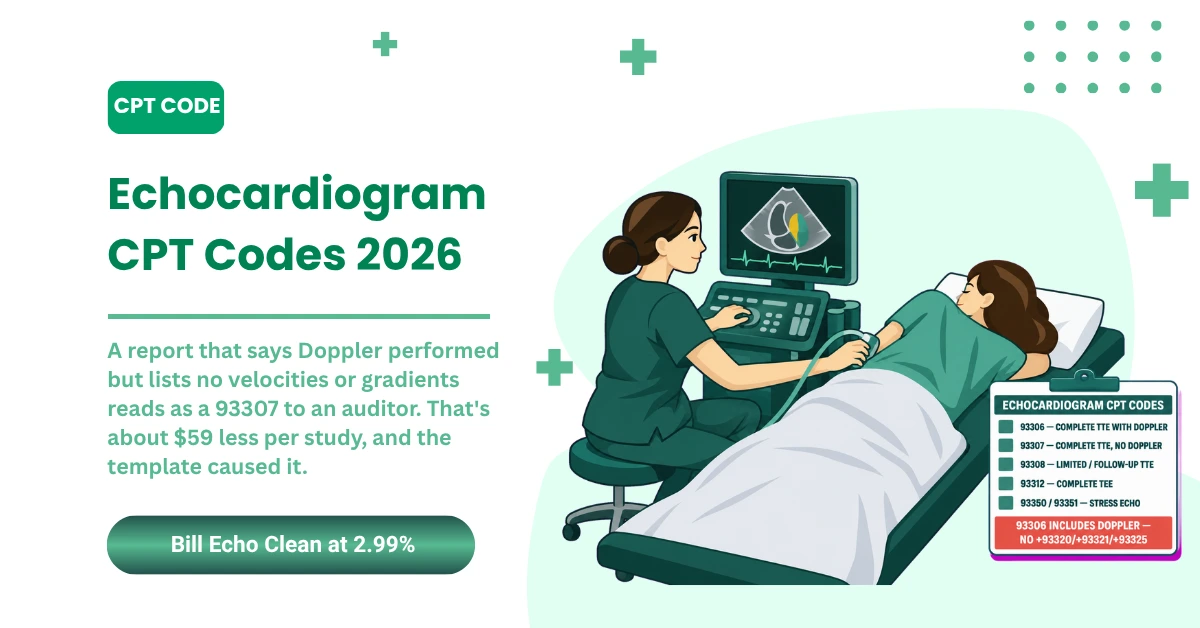
The main echocardiogram CPT code is 93306: a complete transthoracic echo (TTE) with 2D imaging, spectral Doppler, and color flow Doppler, plus M-mode when performed. Use 93307 for a complete TTE without Doppler, 93308 for a limited or follow-up TTE, 93312 for a complete transesophageal echo (TEE), and 93350 or 93351 for a stress echo.
The CPT code for an echocardiogram hasn't changed for 2026. CPT 2026 added and deleted no echo codes, and the AMA's CPT 2027 release on September 9, 2026 lists no echo changes either. Payment did move: Medicare's 2026 final rule set the national office amount for 93306 at $197.85, up 5% from 2025.
Key takeaways
- CPT 93306 already includes spectral and color Doppler, so +93320, +93321, and +93325 don't belong on the same claim.
- CPT 93307 takes no Doppler add-ons either. A complete TTE with spectral and color Doppler is 93306.
- A complete TTE stays complete when the physician can't see a structure, as long as the report says why.
- Strain (+93356) pairs with seven primary codes, and 3D (+93319) applies only to TEE and congenital TTE.
- Medicare sets no national frequency limit on echoes. Medical necessity and your MAC's LCD decide what Medicare pays.
Echo CPT codes covered in this guide
- The definition of an echocardiogram CPT code, and whether 93306 counts as radiology
- The full list of 21 echo codes, with pairing rules
- A five-question method for choosing the right code
- TTE, Doppler add-on, TEE, and stress echo rules
- Contrast, strain, 3D, bubble study, congenital, and fetal coding
- Modifiers, medical necessity, 2026 payment, denials, and 2026 to 2027 changes
- Outsourcing costs and answers to common questions
What Is an Echocardiogram CPT Code?
An echocardiogram CPT code is the five-digit code that tells a payer which heart ultrasound your team performed and how much of it: transthoracic, transesophageal, stress, congenital, or fetal. Add-on codes report the extras, such as Doppler, contrast, strain, or 3D. Most echo codes sit in CPT's 93303 to 93356 range.
The AMA's CPT code set is the source of record, and each new edition takes effect on January 1. CMS runs a separate system, HCPCS Level II, which supplies the hospital contrast-echo C-codes and the Q-codes for contrast agents. You'll also see these called echocardiography CPT codes or echocardiogram procedure codes on payer policies.
Is CPT Code 93306 a Radiology Code?
No. CPT 93306 sits in CPT's Medicine section, under cardiovascular services, while the Radiology section runs from 70010 to 79999. Every echo CPT code from 93303 to 93356 lives in Medicine. Two echo-related groups do sit in Radiology: fetal echo codes 76825 to 76828 and 3D rendering codes 76376 and 76377.
Those Radiology codes appear in our radiology CPT codes list next to the CT and MRI families. For scheduling, the section matters less than payer routing. Some commercial plans send echo prior authorization requests to an imaging benefit manager, so check where the request goes before the patient arrives.
The Three Types of Echocardiograms and Their Code Families
Echo work falls into three main types, and two specialty groups follow rules of their own:
- Transthoracic echo (TTE): 93303 to 93308
- Transesophageal echo (TEE): 93312 to 93318, plus 93355 for structural guidance
- Stress echo: 93350 and 93351
- Congenital studies: 93303, 93304, and 93315 to 93317
- Fetal echo: 76825 to 76828
Each family carries its own add-on rules. Doppler add-ons, for example, pair with congenital TTE, limited TTE, TEE, and stress codes, and never with 93306 or 93307.
Echocardiogram CPT Codes List: All 21 Echo Codes in One Table
CPT's echocardiography range, 93303 to 93356, holds 21 active codes: five transthoracic, seven transesophageal, two stress echo, and seven add-on or guidance codes. Fetal echo (76825 to 76828), 3D rendering (76376, 76377), intracardiac echo (+93662), and the hospital contrast codes (C8921 to C8930) sit outside that range, but they belong on the same list.
Use this table as your reference for all echocardiogram CPT codes, then jump to the section for the family you bill most. Echo CPT codes marked with a plus sign are add-ons, so they can't go on a claim without a base code.
CPT codes for echo, 2026. Sources: AMA CPT 2026; CMS HCPCS Level II.
|
Code |
What it reports |
Pair it with, or never with |
Where it's billed |
|---|---|---|---|
|
93303 |
Complete TTE for congenital cardiac anomalies |
Add +93320, +93321, +93325, +93319, or +93356 as performed |
Office or facility |
|
93304 |
Follow-up or limited congenital TTE |
Same add-ons as 93303 |
Office or facility |
|
93306 |
Complete TTE with spectral and color flow Doppler, M-mode when performed |
Never +93320, +93321, or +93325; may take +93356 |
Office or facility |
|
93307 |
Complete TTE without spectral or color Doppler |
Never Doppler add-ons; may take +93356 |
Office or facility |
|
93308 |
Follow-up or limited TTE |
+93321, +93325, +93356 |
Office, facility, or ED |
|
93312 |
Complete TEE by one physician: probe, images, and report |
Doppler add-ons, +93319 |
Facility in most cases |
|
93313 |
TEE probe placement only |
No imaging add-ons |
Facility |
|
93314 |
TEE image acquisition, interpretation, and report only |
Doppler add-ons, +93319 |
Facility |
|
93315 |
Complete congenital TEE |
Doppler add-ons, +93319 |
Facility |
|
93316 |
Congenital TEE probe placement only |
No imaging add-ons |
Facility |
|
93317 |
Congenital TEE acquisition, interpretation, and report only |
Doppler add-ons, +93319 |
Facility |
|
93318 |
TEE for ongoing monitoring, often during surgery |
Part of anesthesia when the anesthesiologist monitors |
Facility |
|
93350 |
Stress TTE at rest and under stress, with interpretation and report |
Add 93016, 93017, or 93018 as performed; never 93015 |
Office or facility |
|
93351 |
93350 plus continuous ECG monitoring with physician supervision |
Never with 93015 to 93018 or 93350 |
Office, or with modifier 26 in a facility |
|
+93319 |
3D imaging during TEE or congenital TTE |
93303, 93304, 93312, 93314, 93315, 93317; never 93355, 76376, or 76377 |
Office or facility |
|
+93320 |
Complete spectral Doppler |
93303, 93304, 93312, 93314, 93315, 93317, 93350, 93351 |
Office or facility |
|
+93321 |
Limited spectral Doppler |
The +93320 list, plus 93308 |
Office or facility |
|
+93325 |
Color flow velocity mapping |
93303, 93304, 93308, 93312, 93314, 93315, 93317, 93350, 93351, 76825 to 76828 |
Office or facility |
|
+93352 |
Contrast agent during stress echo |
93350 or 93351, once per session |
Office; packaged under OPPS |
|
93355 |
TEE guidance during structural heart interventions |
Includes diagnostic TEE, Doppler, color flow, and 3D; never billed by the implanting physician |
Facility |
|
+93356 |
Myocardial strain imaging |
93303, 93304, 93306, 93307, 93308, 93350, 93351; once per session |
Office; packaged under OPPS |
|
76376, 76377 |
3D rendering, standalone codes |
3D during a non-congenital TTE |
Office or facility |
|
76825 to 76828 |
Fetal echo: complete, follow-up, Doppler complete, Doppler follow-up |
+93325 for fetal color flow |
Office or facility |
|
+93662 |
Intracardiac echo (ICE) during an intervention |
Add-on to the EP or structural procedure |
Facility |
|
C8921 to C8930 |
Hospital outpatient echo with contrast |
Replaces the CPT code on the facility claim |
Hospital outpatient |
Check the "never with" column before you release a claim. Echo bundling denials come from pairs like the ones it lists, such as +93320 billed on 93306 or 93312 billed with 93355.
How to Choose the Right Echo CPT Code in 5 Questions
Learning how to code an echocardiogram comes down to five questions you answer from the signed report, in order. The answers point to one base code plus any add-ons. Work from the report instead of the order, because the physician may have performed more, or less, than the order asked for.
- Did the physician use a transthoracic, transesophageal, stress, or fetal approach? Chest-wall imaging makes it a TTE, so the TTE CPT code comes from 93303 to 93308. An esophageal probe means a TEE (93312 to 93318, or 93355 during a structural procedure). Rest and stress imaging is 93350 or 93351. Fetal imaging is 76825 to 76828.
- Is a congenital anomaly the reason for the study? If so, report 93303 or 93304 for a TTE and 93315 to 93317 for a TEE, whatever the patient's age.
- Was the study complete or limited? If the physician evaluated every required structure, or documented why one wasn't visible, the study is complete (93306 or 93307). A study that answers one focused question is 93308.
- Did the report document Doppler? A complete TTE with spectral and color Doppler is 93306. Without Doppler, it's 93307 with no add-ons. A limited study with Doppler is 93308 plus +93321, +93325, or both.
- Did one entity perform and read the study, and in what setting? One entity doing both parts bills the global code. A physician reading a hospital study adds modifier 26, as our modifier 26 guide explains. Contrast adds a Q-code in the office, and the hospital switches to a C-code.
Questions 3 and 4 are where echo coding goes wrong most often, because report templates print section headers for work nobody documented. The echocardiogram CPT code on the claim has to match the documented study, so run three checks before release: a signed interpretation, archived images, and an ICD-10 code on your MAC's covered list.
Graphic for design team: decision flowchart that walks through the five questions for TTE, TEE, and stress echo. Alt text: "Echocardiogram CPT code decision flowchart for TTE, TEE, and stress echo."
Transthoracic Echocardiogram CPT Codes: 93306 vs 93307 vs 93308
Most outpatient echoes are transthoracic, and the transthoracic echocardiogram CPT code turns on two facts in the report: whether the study was complete and whether the sonographer performed Doppler. 93306 is the complete TTE with spectral and color Doppler, 93307 is the complete TTE without Doppler, and 93308 is a limited or follow-up TTE.
CPT 93306: What a Complete TTE With Doppler Requires
CPT 93306 requires a complete transthoracic study with spectral and color flow Doppler. AAPC's 93306 vs 93308 review lists the structures the physician has to evaluate: both atria, both ventricles, the aortic, mitral, and tricuspid valves, the pericardium, and the adjacent aorta. The physician signs the report, and the lab archives the images.
The 93306 CPT code description attaches "when performed" to M-mode, so M-mode is optional. Some guides still list it as a requirement. A transthoracic complete echo with color flow and spectral Doppler bills as 93306 whether or not the sonographer recorded M-mode.
You don't have to drop to 93308 because of a poor imaging window. If the physician can't see a required structure, the report has to say why, such as body habitus or lung interference. With that reason documented, CPT's echocardiography guidelines still support 93306.
Run this checklist against the final report before the claim goes out:
|
Report element |
What the report should show |
Why payers check it |
|---|---|---|
|
Indication |
The reason for the study, tied to an ICD-10 code |
Medical necessity review starts here |
|
Study type |
A statement that the study was complete |
It separates 93306 from 93308 |
|
Structures |
Findings for each required structure, or the reason one wasn't seen |
Missing structures read as a limited study |
|
Measurements |
Chamber sizes, wall thickness, and ejection fraction |
Auditors look for numbers, not impressions |
|
Spectral Doppler |
Velocities and gradients |
It supports the Doppler in 93306 |
|
Color flow |
Flow findings across the valves |
It supports the Doppler in 93306 |
|
Signature and images |
A signed interpretation and archived images |
Every echo code requires both |
A report that says "Doppler performed" and then lists no Doppler findings reads like a 93307 to an auditor. Auto-filled templates create many of these gaps, so give the fix to whoever maintains the template instead of the coder who billed from it.
CPT 93307: Complete TTE Without Doppler
CPT 93307 reports a complete TTE without spectral or color Doppler. Don't add +93320, +93321, or +93325 to it. Since 2009, a complete TTE with Doppler has billed as 93306, the code CPT created to replace the old 93307 plus Doppler add-on combination.
A few billing guides, and at least one AI search answer, still say CPT code 93307 can take Doppler add-ons. CPT's add-on instructions don't list 93307 as a primary code for any of the three. For a complete study, the echocardiogram with Doppler CPT code is 93306.
That leaves 93307 for the uncommon complete structural study where nobody performed Doppler at all. If Doppler shows up anywhere in the findings, recode the claim to 93306 before it leaves your system.
CPT 93308: Limited or Follow-Up TTE
CPT code 93308 reports a limited or follow-up TTE aimed at one specific question. Limited spectral Doppler goes with it as +93321, and color flow goes with it as +93325. Palmetto GBA article A56625 describes a limited study as one performed to evaluate "1 specific cardiac problem, or region of the heart."
The same article gives two examples: a follow-up of pericardial effusion after heart surgery and serial checks of left ventricular function during chemotherapy. If you need the limited echo CPT code for an ED bedside exam, it's also 93308, and emergency physicians bill it for most point-of-care cardiac ultrasound.
Don't bill an incomplete TTE as 93306 with modifier 52. The limited echocardiogram CPT code, 93308, exists for that study, and Palmetto's article says the limited codes "must be used" for a limited exam.
93306 vs 93307 vs 93308 at a Glance
|
Code |
Study scope |
Doppler in the base code |
Add-ons allowed |
Typical scenario |
|---|---|---|---|---|
|
93306 |
Complete TTE |
Spectral and color |
+93356 |
Standard resting echo for symptoms or known disease |
|
93307 |
Complete TTE |
None |
+93356 |
Complete structural study with no Doppler |
|
93308 |
Limited or follow-up TTE |
None |
+93321, +93325, +93356 |
Effusion recheck, LV function during chemo, ED bedside exam |
There's no separate CPT code for 2D echocardiogram work, because all three codes include 2D imaging. The CPT code for a complete echocardiogram with Doppler stays 93306, and the complete echo CPT code without Doppler is 93307. Medicare's 2026 office amounts are $197.85 for 93306, $138.36 for 93307, and $101.60 for 93308.
If complete echoes keep coming back paid as 93307 or 93308, check the report template before you blame the coder. Our outsourced medical billing services team reviews echo reports against the billed code before claims go out, so we catch a missing Doppler section before the payer does.
Doppler Add-On Codes 93320, 93321, and 93325: What They Pair With
+93320 (complete spectral Doppler), +93321 (limited spectral Doppler), and +93325 (color flow velocity mapping) are add-on codes. They can't go on a claim alone, and they don't go with 93306 or 93307. Report them with congenital TTE, limited TTE, TEE, and stress echo base codes when the report documents the Doppler findings.
|
Add-on |
What it reports |
Report it with |
Don't report it with |
|---|---|---|---|
|
+93320 |
Complete pulsed or continuous wave spectral Doppler |
93303, 93304, 93312, 93314, 93315, 93317, 93350, 93351 |
93306, 93307, 93308, or +93321 in the same session |
|
+93321 |
Limited or follow-up spectral Doppler |
The +93320 list, plus 93308 |
93306, 93307, or +93320 in the same session |
|
+93325 |
Color flow velocity mapping |
93303, 93304, 93308, 93312, 93314, 93315, 93317, 93350, 93351, 76825 to 76828 |
93306, 93307 |
CPT code 93320 and CPT code 93321 describe the complete and limited versions of the same spectral Doppler service, so bill one of them per session. Color flow, CPT code 93325, can sit beside either one. Each add-on attaches to an echocardiogram CPT code that doesn't already include Doppler.
Follow three rules to keep these add-ons paid:
- Give each add-on the same diagnosis as its base code. The TEE billing article A52868 says the ICD-10-CM codes for add-ons "should be the same as those reported for the base codes."
- Expect a denied base code to take its add-ons down with it. Doppler billed on top of 93306 often comes back as one of the CO-97 bundling denials your team has to rework.
- Put the findings in the report: velocities, gradients, and flow descriptions. A template line that says "Doppler performed" won't support the code.
An ED physician who checks mitral regurgitation with color flow and diastolic function with spectral Doppler bills 93308, +93321, and +93325, the combination ACEP's POCUS add-on guidance describes. A diagnostic TEE with full Doppler bills as 93312, +93320, and +93325.
TEE CPT Codes: 93312 to 93318 and 93355
The complete TEE CPT code is 93312, used when one physician places the probe, acquires the images, and interprets the study. If two physicians split the work, 93313 covers probe placement and 93314 covers acquisition, interpretation, and report. 93315 to 93317 mirror that split for congenital anomalies, 93318 covers TEE monitoring, and 93355 covers structural heart guidance.
Complete TEE CPT Code vs Split Billing: 93312, 93313, and 93314
CPT code 93312 is the transesophageal echocardiogram CPT code most TEE claims carry, since one cardiologist often places the probe and reads the study. The split codes cover cases where two physicians share the work, such as an anesthesiologist placing the probe for a cardiologist who interprets.
|
Who did the work |
Physician A bills |
Physician B bills |
|---|---|---|
|
One physician, office setting |
93312 |
None |
|
One physician, hospital setting |
93312-26 |
None; the hospital bills its facility claim |
|
A placed the probe; B acquired the images and wrote the report |
93313 |
93314 |
Doppler and 3D add-ons follow 93312 or 93314, never 93313, because probe placement involves no imaging. ACEP's coding guidance adds that the two physicians need to sit in separate billing groups or specialties to bill the split codes in most cases. Each CPT code for transesophageal echocardiography should match the part that physician documented.
Congenital TEE: 93315, 93316, and 93317
The congenital TEE codes follow the same three-way split: 93315 for the complete study, 93316 for probe placement only, and 93317 for acquisition, interpretation, and report. Code by indication, so an adult with a repaired congenital defect still gets 93315, and Doppler or 3D add-ons attach to 93315 or 93317 only.
CPT 93318: Intraoperative TEE Monitoring
CPT 93318 covers TEE used to watch cardiac function on an ongoing basis, most often during surgery. If the anesthesiologist uses TEE for monitoring, Palmetto's article says 93318 "is included in the reimbursement for the anesthesia service and not separately reportable."
A diagnostic TEE follows different rules. The NCCI Policy Manual Chapter II lets the anesthesiologist bill a TEE performed for diagnosis, with a formal written report, apart from the anesthesia service. Add modifier 59 or XU when an NCCI edit applies; our guide to modifier 59 and XU covers the choice between them.
In the ED, a TEE left in place after resuscitation to track cardiac function can support 93318, as long as the physician documents why the patient needed reimaging.
CPT 93355: TEE Guidance for Structural Heart Procedures
CPT code 93355 reports TEE guidance during transcatheter structural procedures such as TAVR, transcatheter edge-to-edge repair, left atrial appendage occlusion, and septal defect closure. The code already includes the diagnostic TEE, Doppler, color flow, contrast, and 3D imaging when performed, so 93312, the Doppler add-ons, +93319, 76376, and 76377 stay off the claim.
The physician performing the implant can't bill it. Wellpoint's J6/JK TEE article A52868 says 93355 "is reported once per intervention and only by an individual who is not performing the interventional procedure." The NCCI Policy Manual Chapter V also bars the TAVR or TMVR operator from billing 93306 to 93308, 93312 to 93314, or 93320 to 93325.
Health systems bill 93355 on both a facility claim and a physician claim, so it belongs on any hospital revenue cycle management audit list. Its 2026 national payment fell 11% to $192.50. A May 2026 CPT Editorial Panel proposal to replace 93355 with new interventional TEE codes ended as withdrawn, so 93355 carries into 2027.
TEE With Cardioversion: Which CPT Codes Apply?
The CPT code for transesophageal echocardiogram with cardioversion isn't one code. Report 93312 for the TEE and 92960 for the elective external cardioversion, and document each procedure on its own.
Moderate sedation by the same physician, 99152 plus +99153 for added time, has been reportable since CPT 2017 moved sedation out of the procedure codes. The J6/JK article A52868 still treats sedation as part of TEE in its states, so check your MAC first, and run the code pair through the current NCCI PTP edits.
Stress Echocardiogram CPT Codes: 93350 vs 93351 and +93352
CPT 93350 reports stress echo imaging with interpretation and report, and the stress test itself goes on the claim as 93016, 93017, or 93018. Its companion, CPT 93351, bundles both: the stress echo plus continuous ECG monitoring with physician supervision. Don't report 93015 to 93018 or 93350 on the same claim as 93351.
The right stress echo CPT code depends on two people: the physician who supervised the stress portion and the physician who read the echo. If one physician did both, you're looking at 93351.
What Is the Difference Between CPT 93350 and 93351?
The difference is supervision. CPT code 93350 covers the echo images and their interpretation, while CPT 93351 adds continuous ECG monitoring and physician supervision of the stress test by that same physician.
|
Scenario |
What to report |
|---|---|
|
One physician supervises, monitors the ECG, and reads the echo in the office |
93351 |
|
The same physician does all three at the hospital |
93351-26; the hospital bills its facility claim |
|
One physician supervises the stress test and another reads the echo |
Reader: 93350 (with modifier 26 in a facility). Supervisor: 93016. ECG interpretation: 93018. Tracing: 93017, billed by the equipment owner |
|
Combinations to avoid |
93015 with 93350, or any of 93015 to 93018 or 93350 with 93351 |
You'll still see guides call 93351 office-only. That idea comes from 2010 guidance, and in early 2011 CPT clarified that 93351-26 is payable in a facility when one physician provides both professional components.
Exercise, Treadmill, and Dobutamine Stress Echo Codes
The CPT code for stress echocardiogram studies doesn't change with the stress method. You bill a treadmill stress echo, a bicycle study, and a dobutamine study with the same pair, 93350 or 93351, so the dobutamine stress echo CPT code and the CPT code for echocardiogram stress test orders match.
In the office, you can bill the drug where the payer allows it, such as J1250 for dobutamine per 250 mg. Under OPPS, Medicare packages the drug into the APC payment. Nuclear perfusion stress tests use a different family, 78451 to 78454, so keep the two apart at charge entry.
Contrast During Stress Echo: +93352
+93352 reports an echo contrast agent used during a stress echo. Report it only with 93350 or 93351, once per stress study, and add the Q-code for the agent. The NCCI Policy Manual Chapter XI says 93352 "is not separately payable under the OPPS," and the injection itself isn't reportable.
Hospitals report a contrast stress echo with C8928 or C8930 in place of 93350 or 93351 on the facility claim. The physician side doesn't change, so the reader bills 93350-26 or 93351-26 as usual.
Stress echoes and TEEs often need prior authorization from commercial and Medicare Advantage plans. If auth requests keep holding up your schedule, our prior authorization services team can take those payer calls off your front desk.
Contrast, Strain, 3D, and Bubble Study Coding
Four extras change an echo claim: ultrasound contrast, strain imaging (+93356), 3D imaging (+93319 or 76376 and 76377), and the saline bubble study. Contrast adds a Q-code in the office or moves the hospital to a C-code. Strain and 3D are add-ons with fixed partner codes, and the bubble study has no code of its own.
Apart from the hospital C-codes, each of these sits on top of the base echocardiogram CPT code, so the base code stays on the claim.
CPT Code for Echocardiogram With Contrast: Office vs Hospital
In the office, bill the echo CPT code, such as 93306, plus the Q-code for the agent: Q9950 for Lumason, Q9956 for Optison, or Q9957 for Definity, each per mL. A9700 covers other echo contrast agents. Skip the IV start (36000) and the injection (96374), since ASE's contrast coding guidance and NCCI both treat them as included.
Hospital outpatient departments report a C-code in place of the CPT code, plus the Q-code, and the physician still bills the CPT code with modifier 26. Coders often search for the "C8929 CPT code description," but C8929 is a HCPCS Level II code: a complete TTE with spectral and color Doppler, with contrast.
|
Study without contrast (CPT) |
Hospital code with contrast |
|---|---|
|
93303 |
C8921 |
|
93304 |
C8922 |
|
93307 |
C8923 |
|
93308 |
C8924 |
|
93312 |
C8925 |
|
93315 |
C8926 |
|
93318 |
C8927 |
|
93350 |
C8928 |
|
93306 |
C8929 |
|
93351 |
C8930 |
Commercial payers don't all accept C-codes, so check each contract before you switch codes in the chargemaster. Some expect the standard CPT code with the agent's Q-code.
CPT 93356: Myocardial Strain Imaging
The 93356 CPT code description covers strain imaging built on speckle tracking, the analysis behind values such as global longitudinal strain (GLS). ASE's echo coding FAQ says to report +93356 "with echocardiography codes (93303, 93304, 93306, 93307, 93308, 93350, 93351) and report only once per imaging session."
Some guides limit strain to 93306, 93308, 93303, and 93304, which leaves 93307 and stress studies unbilled. Payers reviewing CPT code 93356 look for three things in the report: a statement that the lab performed strain imaging, the measured values, and the physician's interpretation.
Medicare pays $36.76 for +93356 as a 2026 national amount. Under OPPS, Medicare packages strain into the base echo payment, so the hospital gets nothing extra for it but should still report the code. Coverage varies by payer, so check the policy before adding strain to routine studies.
3D Echo CPT Codes: +93319 vs 76376 and 76377
+93319 took effect January 1, 2022, and covers 3D imaging and postprocessing during a TEE or a congenital TTE. It pairs with 93303, 93304, 93312, 93314, 93315, and 93317, and it never goes with 93355, 76376, or 76377. ASE's +93319 guidance lists its work RVU at 0.50.
For 3D during an adult, non-congenital TTE, the 3D echo CPT code comes from Radiology: 76376 for rendering without postprocessing on an independent workstation, or 76377 when the postprocessing happens on an independent workstation. Neither one is an add-on, and a mix-up with +93319 is the kind of pairing error your team should catch during claim scrubbing.
Coverage for 3D TTE can be narrow. CGS's TTE LCD, for example, covers it for limited indications such as preoperative planning and mitral valve area in moderate to severe mitral stenosis.
Bubble Study and Intracardiac Echo (+93662)
No CPT code exists for an agitated saline bubble study. ASE's FAQ says, "There isn't a specific echocardiography administration CPT code for saline injection for echo studies." The CPT code for an echocardiogram with bubble study is the echo code the study supports, such as 93306, 93307, 93308, or a TEE code.
The answer holds on a hospital claim, too. Agitated saline isn't one of the contrast agents the C-codes and Q-codes describe, so keep the CPT code, skip +93352, and bill the echo bubble study CPT code as the plain echo it is.
CPT 93662 reports intracardiac echo (ICE) during a diagnostic or therapeutic intervention, as an add-on to the EP or structural procedure. The CPT code for intracardiac echocardiography sits outside the echo range, and atrial fibrillation ablation code 93656 has included ICE since 2022, so check CPT's ablation notes before adding +93662.
Congenital and Fetal Echo Codes: 93303, 93304, and 76825 to 76828
CPT 93303 is the complete transthoracic echo for congenital cardiac anomalies, and 93304 is its limited or follow-up version. The indication decides the code, whatever the patient's age. An adult with repaired tetralogy of Fallot gets 93303, while a child without a congenital anomaly gets 93306. Fetal echo uses 76825 to 76828.
What Is the Difference Between CPT 93303 and 93306?
The difference is the indication. CPT code 93303 is for congenital anomalies and 93306 is for everything else, and only 93303 takes Doppler add-ons, because its base code doesn't include Doppler.
|
Point |
93303 |
93306 |
|---|---|---|
|
Indication |
Congenital anomaly |
Acquired or suspected heart disease |
|
Doppler |
Not in the base code; add +93320, +93321, or +93325 as performed |
Included; no Doppler add-ons |
|
3D |
+93319 allowed |
76376 or 76377 |
Congenital studies use Q20 to Q26 diagnosis codes. Q21.1 has been a non-billable header since October 1, 2022, so use Q21.10 to Q21.19 instead. CGS billing article A57306 also lists Z87.74, personal history of congenital malformations of the heart and circulatory system, as covered for 93304.
There's no separate CPT code for a pediatric echocardiogram. You code children by indication, the same as adults, so the 93303 CPT code description applies only when a congenital anomaly is the reason for the study.
Fetal Echo CPT Codes: 76825 to 76828
Fetal echo sits in CPT's Radiology section. CPT code 76825 reports the complete fetal cardiovascular study, 76826 a follow-up or repeat study, 76827 a complete fetal Doppler study, and 76828 a follow-up Doppler study. Fetal color flow mapping goes on as +93325, the same add-on adult echo uses.
The maternal claim often carries a code such as O35.BXX0, maternal care for fetal cardiac anomalies, with the seventh character identifying the fetus. Maternal-fetal medicine and pediatric cardiology both bill these studies, so settle who bills the professional side before the first scan.
Modifier 26, TC, and Other Echo Modifiers
Echo codes split into a professional component (the interpretation and report, modifier 26) and a technical component (equipment, sonographer, and image acquisition, modifier TC). You bill the code with no modifier when one entity does both. For 2026, the national Medicare amount for 93306 splits into $67.51 professional and $130.34 technical.
Almost every echocardiogram CPT code carries this split, and the modifier tells the payer which part you're billing. Get it wrong and the claim either pays the wrong party or comes back as a modifier denial.
Does 93306 Need a 26 Modifier?
Only when the physician bills the interpretation and report alone. If your practice owns the machine, employs the sonographer, and reads the study, bill 93306 as a global service with no modifier.
|
Scenario |
Physician claim |
Other claim |
|---|---|---|
|
Office owns the equipment; its physician reads |
93306 |
None |
|
Hospital outpatient study; physician reads |
93306-26 |
Hospital reports 93306 on its UB-04, with no TC |
|
Inpatient study |
93306-26 |
Hospital payment comes through the MS-DRG |
|
IDTF or another office performs; an outside physician reads |
93306-26 |
Performing entity bills 93306-TC |
CPT code 93306 with modifier 26 carries a 2026 national amount of $67.51, about 34% of the global amount, and 93351-26 carries $81.21. The TC modifier belongs on a CMS-1500 for technical-only billing, and hospitals billing under OPPS don't append it. Claims Processing Manual Chapter 13 sets the payment rules for both components.
Our TC modifier rules guide covers the edge cases, including multi-site groups that scan at one location and read at another.
Modifiers 76, 77, 52, 59, XU, and KX on Echo Claims
|
Modifier |
Use it on an echo claim when |
Watch out for |
|---|---|---|
|
76 |
The same physician repeats the same study on the same day for a new clinical reason |
Needs a separate order and report; check the current MUE for 93306 |
|
77 |
A different physician repeats the study on the same day |
Same checks as 76 |
|
52 |
A limited TEE, since CPT has no limited TEE code |
Not for an incomplete TTE; bill 93308 |
|
59 or XU |
An anesthesiologist performs a diagnostic TEE, separate from monitoring |
CMS prefers the more specific X modifier when it fits |
|
KX |
Echoes for CAMZYOS (mavacamten) REMS monitoring in CGS states (Kentucky and Ohio) |
CGS article A57306 requires it |
No echo CPT code takes modifier 52 when a lower-level code describes the work, which is why a limited TTE goes out as 93308 and never as 93306-52. A modifier that doesn't fit the procedure or the site of service is a common trigger for CO-4 modifier denials.
Medical Necessity for Echo: ICD-10 Codes, LCDs, Frequency, and Prior Auth
Medicare's criteria for an echocardiogram come down to three things: a treating practitioner orders it, the patient has symptoms, findings, or a known heart condition, and the ICD-10 code on the claim appears on your MAC's covered list. Screening echoes aren't covered, and Medicare sets no national limit on how often you can bill 93306.
What Diagnosis Covers CPT 93306?
No single diagnosis covers CPT 93306. The claim needs the specific, documented reason for the study, and that ICD-10 code has to appear on your MAC's list for the echocardiogram CPT code you're billing. 93306 medical necessity rests on that match.
There isn't one ICD-10 code for echocardiogram claims. The ICD-10 for echocardiogram billing is the diagnosis that explains why the physician ordered the study, and these common ones appear on Palmetto GBA's covered list for 93306 to 93308:
|
Reason for the echo |
ICD-10-CM |
Coding note |
|---|---|---|
|
Heart failure, unspecified |
I50.9 |
Code the type when the physician documents it |
|
Aortic stenosis |
I35.0 |
Covered for 93306 to 93308 |
|
Mitral regurgitation |
I34.0 |
Covered for 93306 to 93308 |
|
Atrial fibrillation, unspecified |
I48.91 |
Use the specific type when known |
|
Heart murmur |
R01.1 |
Covered for 93306 to 93308 |
|
Shortness of breath |
R06.02 |
The note must show why the echo was needed |
|
Chest pain, unspecified |
R07.9 |
Covered for 93306 to 93308 |
|
Syncope |
R55 |
Covered for 93306 to 93308 |
|
Pericardial effusion |
I31.39 |
A common 93308 follow-up |
|
Preoperative cardiovascular exam |
Z01.810 |
Pair it with the condition behind the referral |
|
Essential hypertension |
I10 |
Covered for 93306 to 93308 |
|
Coronary artery disease |
I25.10 |
Covered for 93306 to 93308 |
For heart failure orders, our CHF ICD-10 codes guide covers the specificity payers expect. The R06.02 billing guide shows why a symptom code with thin documentation can draw a CO-50.
Unspecified codes cost you claims. In the version of Palmetto's article effective October 1, 2025, I42.9 (cardiomyopathy, unspecified) isn't on the list for 93306 to 93308, while I42.0 to I42.8 are. Code the cardiomyopathy type the physician documented.
The FY2027 ICD-10-CM update, effective October 1, 2026, splits I42.0 and I42.8 into new subcodes (I42.00, I42.01, I42.09, I42.81, I42.89) and replaces I49.8 with I49.81, I49.82, and I49.89. Palmetto's October 1, 2026 version of its echo article already lists the new codes, so update your templates and charge rules now.
Screening studies need a screening code, and Medicare doesn't pay for them. Palmetto's article adds that if a screening result comes back abnormal, later services can use the result diagnosis, but the first study stays coded as screening.
Which Medicare LCD Governs Your Echo Claims?
Echo coverage in Medicare runs through each MAC's LCD and billing article, so the rules for your practice depend on your jurisdiction. Most searches for 93306 CMS guidelines or an LCD for 93306 end up in one of these documents:
|
MAC |
Jurisdiction |
Echo LCD |
Billing article |
|---|---|---|---|
|
CGS |
J15 (Kentucky, Ohio) |
L34338 (TTE), L34337 (TEE) |
A57306, A56809 |
|
Palmetto GBA |
JJ, JM (Alabama, Georgia, Tennessee, South Carolina, North Carolina, Virginia, West Virginia) |
L37379 |
A56625 |
|
Wellpoint Federal |
J6, JK (Illinois, Minnesota, Wisconsin, New York, New England) |
L33577 (TTE), L33579 (TEE) |
A56781, A52868 |
|
Novitas |
JH, JL |
L35016 (TEE only) |
A56505 |
|
First Coast |
JN (Florida, Puerto Rico, U.S. Virgin Islands) |
L33756 (TEE only) |
A57179 |
|
Noridian |
JE, JF |
L34324 (stress testing, including stress echo) |
A57183 |
|
WPS |
J5, J8 |
No echo-specific LCD located as of September 2026 |
None located |
Check each document's status on the Medicare Coverage Database before you rely on it, since MACs revise these articles when ICD-10 and CPT update each October and January. CGS TTE LCD L34338 is a clear model of how a MAC spells out echo indications.
How Often Can CPT 93306 Be Billed?
Medicare sets no national frequency limit for CPT 93306. Each repeat study needs its own order and a documented reason, such as new symptoms, a change in the patient's condition, or a check on treatment response.
The "once every 12 months" rule you'll see online isn't a Medicare rule, though some commercial plans and imaging benefit managers set limits of their own. Palmetto's article draws the line at routine repeats: "When 2 (or more) imaging studies are routinely billed (i.e., without a supporting clinical indication), only 1 of the services will be allowed."
Follow-up checks of a known finding often fit 93308 better than a second 93306. Same-day repeats need modifier 76 or 77 and a look at the current MUE, and some LCDs set their own limits for specific studies, such as the CGS TEE LCD L34337.
The order matters as much as the interval. Under 42 CFR 410.32, the practitioner treating the patient has to order the test and use the result, so the answer to how often Medicare will pay for an echocardiogram depends on the documented need behind each order.
Prior Authorization for Echo in 2026
Original Medicare doesn't require prior authorization for echo, and the WISeR prior authorization model that began on January 1, 2026 in six states doesn't include it.
Medicare Advantage, Medicaid, and CHIP plans fall under the CMS-0057-F prior authorization rule. Beginning in 2026, those plans have to decide expedited requests within 72 hours and standard requests within seven calendar days, and every denial needs a specific reason. The prior authorization APIs the rule requires are due January 1, 2027.
Commercial plans often route stress echo and TEE through imaging benefit managers. Get the authorization before the study, put the number on the claim, and confirm coverage through benefit verification at scheduling, because a missing authorization comes back as CO-197.
Many practices write off medical-necessity denials because the appeal feels like a coin flip. If CO-50s on echo claims keep piling up, our denial management services team works them with the LCD and the report side by side.
2026 Medicare Payment for Echocardiogram CPT Codes
For 2026, Medicare's national payment for CPT 93306 is $197.85 in a physician office, split into $67.51 for the professional component and $130.34 for the technical component. Hospital outpatient departments receive $558.25 for the facility side of 93306 under APC 5524. Your amount depends on locality, setting, and payer.
2026 Medicare Physician Fee Schedule, national amounts before geographic adjustment. Source: ASE's 2026 fee schedule comparison.
|
Code |
Global |
Modifier 26 |
TC |
Change from 2025 |
|---|---|---|---|---|
|
93306 |
$197.85 |
$67.51 |
$130.34 |
Up 5% |
|
93307 |
$138.36 |
$43.45 |
$94.91 |
Up 5% |
|
93308 |
$101.60 |
$24.73 |
$76.87 |
Up 7% |
|
93312 |
$240.62 |
$105.27 |
$135.35 |
Up 6% |
|
93350 |
$186.15 |
$67.51 |
$118.64 |
Up 5% |
|
93351 |
$234.27 |
$81.21 |
$153.06 |
Up 5% |
|
+93320 |
$51.80 |
$17.38 |
$34.42 |
Not shown |
|
+93321 |
$25.73 |
$7.35 |
$18.38 |
Not shown |
|
+93325 |
$24.06 |
$3.34 |
$20.72 |
Not shown |
|
+93352 |
$36.09 |
Not split |
Not split |
Not shown |
|
+93356 |
$36.76 |
Not split |
Not split |
Not shown |
|
93355 |
$192.50 |
Not split |
Not split |
Down 11% |
Every echocardiogram CPT code in the table carries ASE's national figure from the November 2025 final rule. CMS recalculated all practice expense RVUs in a March 12, 2026 correction, so current amounts can differ by a few cents or dollars. Pull your locality's exact figures from the CMS Physician Fee Schedule Look-Up.
2026 hospital outpatient (OPPS) payment for echo. Source: ASE comparison of the CY 2026 OPPS final rule.
|
APC |
Echo codes |
2026 national rate |
|---|---|---|
|
5524, Level 4 Imaging without Contrast |
93306, 93312, 93350, 93351, and most congenital and TEE codes |
$558.25 |
|
5523, Level 3 Imaging without Contrast |
93307, 93308 |
$243.77 |
|
5573, Level 3 Imaging with Contrast |
C8929 and the other contrast C-codes except C8924 |
$800.90 |
|
5572, Level 2 Imaging with Contrast |
C8924 |
$356.43 |
|
Packaged |
+93319, +93320, +93321, +93325, +93352, +93356 |
No separate payment |
Three changes moved the 2026 numbers:
- The conversion factor rose to $33.40 for most physicians and $33.57 for qualifying APM participants, up from $32.35, per the CMS 2026 fee schedule final rule.
- CMS applied a 2.5% efficiency adjustment that lowers work RVUs for services that aren't time-based, and echo falls in that group.
- Facility practice expense fell. The AMA estimated the change would cut facility-based payment to physicians by 7% overall and raise office-based payment by 4%, yet 93306-26 still rose 3% and 93355 fell 11%.
The net result: 93306 CPT code reimbursement rose about 5% in the office for 2026. Payers use the place of service codes on your claim to pick the office or facility rate, so a wrong POS changes what you're paid.
Why Echo Claims Get Denied and How to Fix Each One
Most echo denials trace back to five problems: a diagnosis that isn't on the MAC's covered list, a Doppler add-on billed with 93306, a 26/TC mismatch, a missing prior authorization, or a repeat study with no documented reason. Each one shows up on the remit as a specific CARC code with a specific fix.
|
CARC |
What the payer is saying |
Common echo trigger |
Fix |
|---|---|---|---|
|
CO-50 |
Not medically necessary |
A diagnosis missing from the LCD list, a screening study, or an unspecified code |
Code the documented, specific reason and get an ABN when you expect Medicare to deny; our CO-50 denial guide walks through appeals |
|
CO-11 |
The diagnosis doesn't fit the procedure |
An add-on pointed to a different diagnosis than its base code |
Point each add-on to the base code's diagnosis |
|
CO-97 |
Included in another service |
+93320 or +93325 with 93306, or 93312 with 93355 |
Remove the bundled code or correct the base code |
|
CO-234 |
No separate payment for this procedure |
An add-on on a primary code CPT doesn't list, such as Doppler on 93307 |
Rebuild the claim on the right base code; see CO-234 add-on denials |
|
CO-4 |
The modifier doesn't fit the procedure code |
26, TC, or global billed wrong for the site of service |
Match 26, TC, or global to where the study happened |
|
CO-197 |
Authorization absent |
A stress echo or TEE for a commercial or Medicare Advantage plan with no auth |
Get the authorization first and put the number on the claim; see CO-197 authorization denials |
|
OA-18 |
Exact duplicate |
A same-day repeat billed without 76 or 77 |
Add the modifier and send the second report |
|
CO-16 |
Missing information |
No ordering provider NPI or authorization number |
Complete the claim fields and resubmit |
Correct echo CPT codes fix only part of this list. The rest comes from diagnosis pointers, modifiers, and front-end steps such as authorization, which is why denial prevention on echo starts before anyone builds the claim.
CMS tracks echo errors. Its echography compliance tip reports a 7.6% improper payment rate, $55.4 million, for echocardiography of the heart in the 2024 reporting period, and 21.7% for carotid echography. RAC topic 0111, approved September 4, 2018, reviews medical necessity and documentation for 93303, 93306, 93307, C8921, and C8923 on hospital and SNF claims.
If the same two or three CARCs keep showing up on your echo remits, you're looking at a pattern with a fixable cause. Ask for a free RCM review and we'll show you where your echo claims break down.
What Changed for Echo Coding in 2026 and What's Coming in 2027
CPT 2026 brought 418 code changes and none to the echocardiography codes, so the echocardiogram CPT codes for 2026 are the ones you billed in 2025. The changes that hit echo billing came from Medicare payment rules. CPT 2027 leaves echo codes alone again, while CMS has proposed lower conversion factors for 2027.
|
Date |
Change |
What it means for echo |
|---|---|---|
|
September 11, 2025 |
AMA released CPT 2026: 288 new, 84 deleted, and 46 revised codes |
No echo code changes |
|
January 1, 2026 |
New fee schedule conversion factors, a 2.5% efficiency adjustment, and facility practice expense changes |
93306 up 5% in the office; 93355 down 11% |
|
2026 |
CMS-0057-F decision timeframes and denial reasons take effect |
Faster prior authorization decisions, with reasons, from Medicare Advantage, Medicaid, and CHIP plans |
|
March 12, 2026 |
CMS correction notice recalculated practice expense RVUs |
Recheck your 2026 rates in the Look-Up tool |
|
May 2026 |
The interventional TEE proposal that would have deleted 93355 ended as withdrawn in the May 2026 panel actions |
93355 stays |
|
July 14, 2026 |
The CMS 2027 proposed rule set proposed conversion factors of $32.84 and $33.17, plus a practice expense overhaul |
A lower conversion factor for echo if CMS finalizes it |
|
July 2, 2026 |
CY 2027 OPPS proposed rule: fee-schedule-equivalent payment for imaging-without-contrast APCs at excepted off-campus hospital departments |
Would reach the APCs that hold 93306 to 93308 at those sites, if finalized |
|
September 9, 2026 |
AMA's CPT 2027 release: 299 new, 80 deleted, and 74 revised codes, effective January 1, 2027 |
No echo changes announced in the CPT 2027 code set |
|
October 1, 2026 |
FY2027 ICD-10-CM takes effect |
New cardiomyopathy and arrhythmia subcodes |
If you're checking which CPT codes the AMA deleted for 2026, the count is 84, and the cardiovascular deletions centered on lower extremity revascularization codes 37220 to 37235. For lab work, our breakdown of pathology codes deleted in 2026 covers that side. The new updates in the CPT code set for 2026 left echo untouched.
CMS tends to publish the final CY 2027 rules in early November. We'll update this guide when they come out and again when CPT 2027 takes effect on January 1, 2027.
Outsourcing Echo Billing: What to Look For and What It Costs
Outsourcing echo billing makes sense when complete studies keep getting downcoded, Doppler add-ons keep bouncing, or one coder carries all of cardiology. MedSole RCM handles medical billing at 2.99% of collections, with no setup or software fees, and provider credentialing at $99 per insurance enrollment.
Echocardiogram CPT codes change little from year to year, but the payer rules around them move every quarter, from NCCI edits to MAC articles. An in-house team with one cardiology coder has a hard time tracking all of it.
Signs Your Echo Billing Needs Outside Help
- Complete echoes paid as 93307 or 93308
- CO-97 and CO-50 on the same echo CPT codes month after month
- 26/TC mix-ups between office and hospital studies
- Stress echo and TEE authorizations holding up the schedule
- A new cardiologist who can't bill until payer enrollment finishes
What the Best Cardiology Billing Company Should Do With Echo Claims
Compare billing partners on echo-specific work as well as price. The table shows what to ask for and where MedSole RCM stands on each point.
|
What to compare |
Why it matters for echo |
MedSole RCM |
|---|---|---|
|
Pricing |
A percentage of collections ties the fee to what gets paid |
2.99% of collections, with no setup or software fees |
|
Credentialing |
A new cardiologist can't bill 93306-26 until enrolled |
$99 per insurance enrollment |
|
Echo code checks |
Complete vs limited, Doppler pairing, and 26/TC by site |
Report-to-code review before submission |
|
Denial follow-up |
CO-50 and CO-97 appeals need the report and the LCD |
Denial management, including medical-necessity appeals |
|
Prior authorization |
Stress echo and TEE often need auth |
Prior authorization across 900+ payers |
Our two published rates are medical billing at 2.99% of collections and credentialing at $99 per insurance enrollment. The same team runs cardiology revenue cycle management from eligibility checks through AR follow-up.
MedSole RCM is a US medical billing and revenue cycle management company that handles medical billing at 2.99% of collections and provider credentialing at $99 per insurance enrollment.
Echocardiogram CPT Code FAQs
What is the CPT code for an echocardiogram?
The CPT code for an echocardiogram depends on the study. A standard resting echo with Doppler is 93306, a complete echo without Doppler is 93307, and a limited echo is 93308. For a TEE, it's 93312, and a stress echo is 93350 or 93351. None of these changed for 2026.
Is CPT 93306 an echocardiogram?
Yes. CPT 93306 is a complete resting transthoracic echocardiogram with spectral and color flow Doppler. You don't use it for stress echo (93350 or 93351), TEE (93312), or studies done because of a congenital anomaly (93303).
What are the ICD-10 codes for an echocardiogram?
No single ICD-10-CM code exists for an echo; the diagnosis code is the reason for the study, such as R06.02 or I50.9. Inpatient hospitals code the procedure itself in ICD-10-PCS, such as B246ZZZ for ultrasonography of the right and left heart, or B246ZZ4 for a transesophageal study.
Can 93306 and 93308 be billed on the same day?
Only if the physician performed two studies for separate clinical reasons, each with its own order and report. The second one goes out with modifier 76 or 77. Payers treat a routine second study as a duplicate and pay one.
Can a bubble study be billed separately?
No. CPT has no code for an agitated saline bubble study. Bill the echo code the study supports, such as 93306, 93307, 93308, or a TEE code, and leave off contrast codes such as +93352 and C8929.
How much does an echocardiogram cost with Medicare in 2026?
The CPT code 93306 cost to Medicare in a physician office is $197.85 as a 2026 national amount. After the $283 Part B deductible, the patient owes 20%, about $39.57. Hospital outpatient echoes cost more because the hospital gets its own payment, $558.25 nationwide under APC 5524.
Why is an echocardiogram not covered by insurance?
Payers deny coverage when they see the study as screening, the diagnosis isn't on the covered list, or prior authorization is missing, and patients still owe any unmet deductible. With Original Medicare, an ABN signed before the study lets the practice bill the patient if Medicare denies it as not medically necessary.
Who updates echo CPT codes, and when?
The AMA's CPT Editorial Panel reviews code changes at meetings in February, May, and September, and new CPT codes take effect every January 1. CMS updates HCPCS Level II codes, including the echo C-codes and Q-codes, every quarter, and MACs revise their LCDs and billing articles through the year.
How much does it cost to outsource cardiology billing?
Many billing companies charge a percentage of collections. MedSole RCM charges 2.99% of collections for medical billing, with no setup or software fees, so a cardiology group can price the service against its actual echo and E/M collections before signing.
How much does provider credentialing cost per insurance?
Pricing varies between credentialing companies. MedSole RCM charges $99 per insurance enrollment. For cardiology groups, enrollment has to finish before a new physician can bill interpretations such as 93306-26 to that payer, so start it before the physician's first day.
What should a cardiology practice look for in a billing company?
Look for coding checks on every echo CPT code: complete vs limited studies, Doppler add-on pairing, and 26/TC by site. You also want denial follow-up by CARC and prior authorization help for stress echo and TEE. MedSole RCM bills at 2.99% of collections and credentials at $99 per insurance enrollment, and cardiology is one of the specialties we bill.
If you'd like a second set of eyes on your echo claims, request a billing review and we'll go through your recent echo denials with you.
Sources
- American Medical Association: CPT overview
- AMA: CPT 2027 code set release, September 9, 2026
- AMA: CPT Editorial Panel Summary of Panel Actions, May 2026
- CMS Medicare Coverage Database: Billing and Coding: Echocardiography (A56625), Palmetto GBA
- CMS Medicare Coverage Database: Billing and Coding: Transthoracic Echocardiography (A57306), CGS
- CMS Medicare Coverage Database: Transthoracic Echocardiography LCD (L34338), CGS
- CMS Medicare Coverage Database: Billing and Coding: Transesophageal Echocardiography (A52868)
- CMS: NCCI Policy Manual for Medicare Services, Chapter II, 2026
- CMS: NCCI Policy Manual for Medicare Services, Chapter V, 2026
- CMS: NCCI Policy Manual for Medicare Services, Chapter XI, 2026
- CMS: Medicare Claims Processing Manual, Chapter 13
- eCFR: 42 CFR 410.32, Diagnostic tests
- CMS: CY 2026 Physician Fee Schedule Final Rule fact sheet
- CMS: CY 2027 Physician Fee Schedule Proposed Rule fact sheet
- CMS: Physician Fee Schedule Look-Up Tool
- CMS: Interoperability and Prior Authorization Final Rule (CMS-0057-F)
- CMS: 2026 Medicare Parts A and B premiums and deductibles
- CMS MLN: Echography and sonography compliance tip
- CMS: Recovery Audit topic 0111, Transthoracic Echocardiography
- American Society of Echocardiography: Coding for Contrast
- American Society of Echocardiography: Echo Coding FAQ
- American Society of Echocardiography: +93319 3D Echocardiography
- American Society of Echocardiography: CY 2026 Physician Fee Schedule rate comparison
- AAPC: 93306 vs 93308 Echocardiography
- ACEP: Add-On Echo CPT Codes for POCUS Reimbursement