



If you've already been to ambetterhealth.com looking for a credentialing application, you know how that ends. You pick a state. Then you land on a different website with a different form.
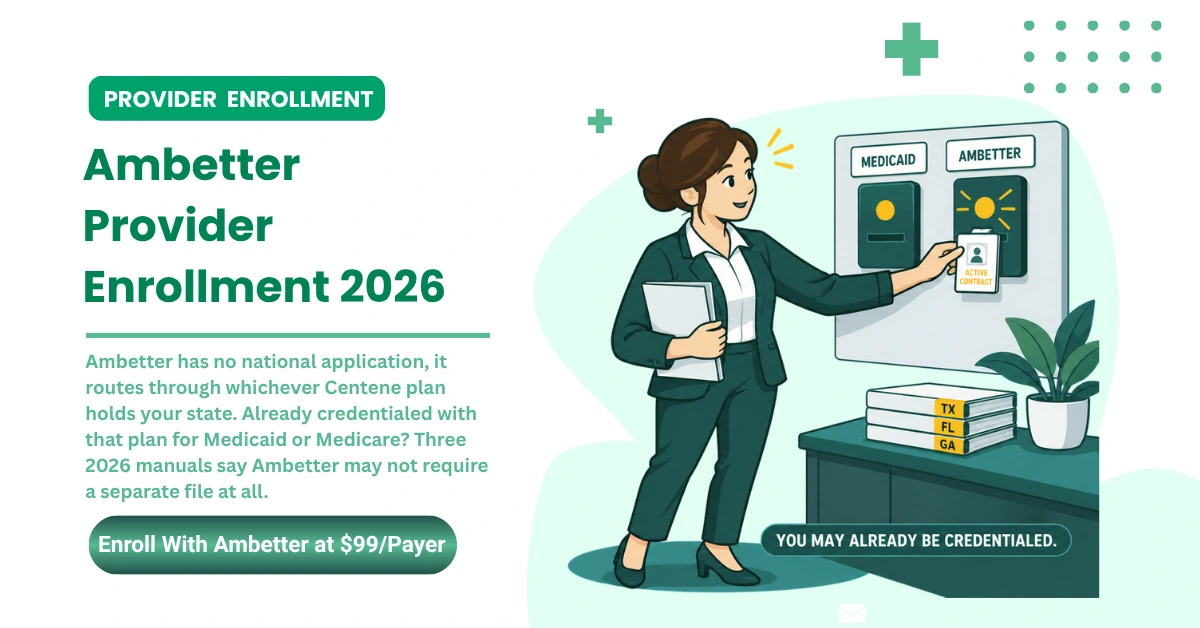
There's a reason for that. Ambetter health provider enrollment doesn't run through one national application. It runs through whichever Centene local plan holds your state, and each of those plans keeps its own forms, its own contracting inbox, and its own clock.
Here's what ambetter health provider enrollment looks like before we get into the details.
|
Who runs it: A Centene local plan in your state, not Ambetter nationally What you need: CAQH ProView attested within 120 days, NPI Type 1 and Type 2, a signed W-9, your state license, DEA registration, and a malpractice face sheet How long: 2 to 30 business days for intake review, then up to 60 calendar days for credentialing in most states Recredentialing: Every 36 months |
This guide maps all 30 states to the plan that actually credentials you, lists the published timelines by phase, and covers the claims rules that kick in after approval. Most Ambetter provider enrollment guides stop at the application.
What Ambetter Health is, and which company actually credentials you
Ambetter Health is Centene Corporation's Health Insurance Marketplace product, sold on the federal and state exchanges as a Qualified Health Plan (Ambetter provider network page). That's the brand. It isn't the company that credentials you, and it isn't always the company on the member's ID card either.
The three entities on your Ambetter paperwork
- Brand. Ambetter Health, the Centene Marketplace product your patients bought.
- Network and contracting entity. The Centene local plan that credentials you, signs your participation agreement, and loads you into the directory. Superior HealthPlan in Texas. Sunshine Health in Florida. Peach State in Georgia. Meridian in Michigan. Magnolia in Mississippi. Absolute Total Care in South Carolina.
- Underwriting entity. The licensed insurer on the policy. Celtic Insurance Company underwrites Ambetter in at least 10 states, including Alabama, Delaware, Illinois, Kansas, Missouri, New Hampshire, Oklahoma, and Tennessee, plus the EPO products in Florida and Texas.
All three names show up somewhere in ambetter health provider enrollment paperwork, and they're rarely identical. The full underwriting list sits in Ambetter's own plan availability disclosure.
Why a biller should care: the name on your contract, the name on the member's card, and the name in your payer master file can all be different. That mismatch is what turns a clean claim into an eligibility check that comes back empty.
A few of the pairings catch people off guard. Indiana's Ambetter is underwritten by Coordinated Care Corporation, which is the Washington entity. Iowa runs through Iowa Total Care, New Mexico through Western Sky Community Care, and New York through Fidelis Care.
One more thing worth settling. Ambetter isn't Medicaid. People ask whether Ambetter Meridian is Medicaid because Meridian runs both Michigan Medicaid and Ambetter, and that overlap repeats in most states. Magnolia Ambetter and the Medicaid side of Magnolia are the same company selling two different products.
Which Centene plan runs Ambetter in your state
Ambetter health provider enrollment starts with one question: which company holds your state? Get that wrong and nothing else matters. A provider in Georgia who follows a Texas-based guide will submit to Superior HealthPlan and never hear back. Peach State Health Plan holds Georgia. Superior holds Texas. Neither one processes the other's application, and neither one forwards it for you.
That's the most common reason an Ambetter application disappears. Multi-entity payers work this way across the board, and our multi-plan payer enrollment guide covers the same pattern on the Blue side.
Ambetter local plan by state, 2026
|
State |
Local plan (contracting entity) |
How enrollment starts |
|---|---|---|
|
Alabama |
Ambetter of Alabama |
Join Our Network form, 1-800-442-1623 |
|
Arizona |
Ambetter from Arizona Complete Health |
Potential Provider Application |
|
Arkansas |
Ambetter from Arkansas Health & Wellness |
ArkansasContracting@centene.com |
|
California |
Ambetter from Health Net of California |
Health Net provider contracting |
|
Delaware |
Ambetter Health of Delaware |
contracting@delawarefirsthealth.com |
|
Florida |
Ambetter Health (Sunshine Health) |
Provider Enrollment Requests |
|
Georgia |
Ambetter of Peach State |
Network Participation Request form |
|
Illinois |
Ambetter of Illinois (Meridian) |
Join Our Network, five-step form |
|
Indiana |
Ambetter from MHS Indiana |
Network Participation Request |
|
Iowa |
Ambetter Health of Iowa (Iowa Total Care) |
Network Participation Request form |
|
Kansas |
Ambetter from Sunflower Health Plan |
Join Our Network, 1-844-518-9505 |
|
Kentucky |
Ambetter from WellCare of Kentucky |
Application form, 1-833-705-2175 |
|
Louisiana |
Ambetter Health of Louisiana |
Join Our Network |
|
Michigan |
Ambetter from Meridian |
Contract request form, 1-833-993-2426 |
|
Mississippi |
Ambetter of Magnolia |
MagnoliaCredentialing@centene.com |
|
Missouri |
Ambetter from Home State Health |
Join Our Network form |
|
Nebraska |
Ambetter from Nebraska Total Care |
Contract request form |
|
Nevada |
Ambetter from SilverSummit Healthplan |
Online intake form, 1-866-263-8134 |
|
New Hampshire |
Ambetter from NH Healthy Families |
Join Our Network request |
|
New Jersey |
Ambetter from WellCare of New Jersey |
Join Our Network form |
|
New Mexico |
Ambetter from Western Sky Community Care |
Join Our Network |
|
New York |
Ambetter from Fidelis Care |
Join Our Network |
|
North Carolina |
Ambetter of North Carolina Inc. |
Join Our Network |
|
Ohio |
Ambetter from Buckeye Health Plan |
Join our network form by provider type |
|
Oklahoma |
Ambetter of Oklahoma |
Join Our Network, 1-833-492-0679 |
|
Pennsylvania |
Ambetter from PA Health & Wellness |
ContractInitiationForm@Pahealthwellness.com |
|
South Carolina |
Ambetter from Absolute Total Care |
atc_contracting@centene.com |
|
Tennessee |
Ambetter of Tennessee |
Join Our Network, 1-833-709-4735 |
|
Texas |
Ambetter from Superior HealthPlan |
Join Our Network form |
|
Washington |
Ambetter from Coordinated Care |
JoinOurNetwork@Coordinatedcarehealth.com |
Being credentialed with Ambetter in one state doesn't credential you in another. Each state's product sits with a separate licensed entity, so a group practicing in three states files three applications and tracks three clocks.
Arkansas shows how different the front doors can be. There's no online form for Ambetter Arkansas credentialing. You email ArkansasContracting@centene.com and wait for someone to route you.
You may already be credentialed with Ambetter without knowing it
Before you file anything, check whether you need to.
The 2026 Ambetter provider manuals for Washington, Florida, and South Carolina all carry the same line: a practitioner who already participates with the affiliated plan's Medicaid or Medicare product will not be separately credentialed for the Ambetter product.
Read that twice if you already contract with a Centene plan. If you're in Sunshine Health's Florida Medicaid network, or Peach State's for Georgia Families, or Magnolia's for MississippiCAN, or Buckeye's for Ohio Medicaid, or Superior HealthPlan's for STAR, the verification work may already be behind you.
Texas documents the mechanic most clearly. Superior HealthPlan runs an Add a Product workflow, and contracted providers use it to add a product, provider, or location to an existing contract. Ambetter provider credentialing gets waived in that scenario. Contracting usually doesn't.
Now the caveat, because this isn't uniform. Manual language varies by state, and several plans still want a product amendment or a fresh participation agreement even when the credentialing step is skipped. Check your state's manual before assuming.
How to check whether you already qualify
- Find your state's Centene local plan in the routing table above.
- Confirm whether you hold an active contract with that plan for any product line, Medicaid, Medicare Advantage, or Marketplace.
- Call that plan's contracting team and ask directly whether Ambetter can be added to your existing agreement.
Step three is the one people skip. The answer changes what ambetter health provider enrollment costs you in weeks, and it's a five-minute phone call.
Working out which of your existing Centene contracts already cover Ambetter is the first thing we check before filing anything. If you'd rather not go plan by plan, that's what our provider enrollment and credentialing team handles.
Ambetter provider enrollment vs credentialing vs contracting
Ambetter health provider enrollment, credentialing, and contracting get used interchangeably on this topic. They're three different processes on three different clocks.
Ambetter health provider enrollment is the umbrella. It covers everything from your first network inquiry through the effective date printed on your contract.
Ambetter credentialing is the verification step. The local plan or its credentialing verification organization checks your license, board certification, education, malpractice history through the NPDB, and federal sanction status through OIG and SAM.gov.
Contracting is the legal agreement. It sets your reimbursement, your obligations, and the date you're allowed to start billing.
Here's the part nobody publishes: the order flips depending on the plan. Michigan Meridian's published sequence puts contracting first, and signing the participation agreement is what triggers credentialing. Other plans finish credentialing and contract afterward.
|
Step |
What it verifies or creates |
Who runs it |
|---|---|---|
|
Enrollment |
Your participating status, end to end |
The Centene local plan |
|
Credentialing |
License, education, malpractice, and sanctions |
The plan or its CVO |
|
Contracting |
Reimbursement and obligations |
The plan's network team |
Name the step when you call for status. Asking about your contract while the file is still sitting in ambetter provider credentialing gets you nowhere.
How to enroll as an Ambetter provider: the 7-step process
Ambetter health provider enrollment follows the same seven steps in every state. What changes is who receives each submission. Work them in order, because skipping ahead is what strands most applications.
Step 1. Identify your state's Centene local plan
Start with the routing table above. The plan that holds your state determines your form, your contracting contact, your credentialing timeline, and which portal you'll live in afterward. Each plan keeps a separate Ambetter for providers section with its own manual, forms, and quick reference guide. If you practice in more than one state, you're running this whole sequence separately for each one.
Step 2. Complete and attest your CAQH ProView profile
Ambetter provider manuals tell unregistered providers to self-register with CAQH ProView. CAQH emails registration instructions and issues a CAQH Provider ID. Already have a profile? Open it and check the attestation date before you do anything else. Attestation has to be current within the last 120 days, and a large share of stalled applications trace back to a profile that quietly expired while the provider waited.
Step 3. Authorize the plan to access your CAQH data
CAQH releases your file only to organizations you've authorized. An unauthorized profile looks finished on your screen and reads as empty on the plan's. Open the authorization section and confirm Centene has access. Know what CAQH isn't, too: Ambetter Alabama's own practitioner form states that using the CAQH Universal Credentialing DataSource does not grant participation or constitute applying for participation.
Step 4. Submit the state plan's network participation request
Three patterns exist. Some states run an online form, including Iowa, Illinois, and Georgia. Others route to a contracting email, like Arkansas, South Carolina, and Pennsylvania. A few still take it by phone. This is the request that formally starts your bid to join the Ambetter provider network. Whichever ambetter health provider enrollment form you receive, it typically captures legal entity name, TIN, NPI Type 1 and Type 2, service locations, provider type, specialty, and a W-9 upload. If you don't have both NPI types yet, NPPES is where you get them. Illinois and Mississippi also ask for a state Medicaid number on what is a commercial Marketplace application.
Step 5. Complete the credentialing application the plan sends you
The plan reviews your inquiry and sends back a state-specific credentialing application. Form type depends on your category: MD and DO, Advanced Practice, Allied, or facility and ancillary. Fill out the one they sent, not one you found online from another state. Return it with every document from the requirements list below, because a partial submission puts you back in the review queue.
Step 6. Sign the participation agreement
Order varies by plan, so confirm yours rather than assuming. Some countersign the agreement before credentialing opens. Others wait for committee approval first. Read the agreement for your reimbursement schedule and your termination terms before signing, because those rates are what every claim pays at for the length of the contract.
Step 7. Confirm your effective date in writing before you see patients
Don't schedule anyone until the effective date arrives in writing. Sunshine Health states it won't backdate effective dates for services provided before enrollment. Ambetter manuals also state that primary care providers can't accept member assignments until credentialing is complete. Save that confirmation email somewhere you can find it in six months, because that's roughly when someone will need it.
What documents Ambetter requires for credentialing
Every ambetter health provider enrollment packet asks for the same core documents. The list barely changes between states, because every Centene plan works off the same manual template. What kills applications isn't the list itself. It's the two expiry windows buried inside it.
- Attested CAQH ProView profile, attestation current within 120 days
- Current state license for every state where you'll see Ambetter members
- Current DEA registration certificate for each state where you'll practice
- Current controlled substance registration certificate, if applicable
- Current malpractice policy face sheet showing insured dates and coverage amounts
- Completed and signed W-9, required at initial credentialing
- Completed ownership and control disclosure form, unless your state prohibits it
- Curriculum vitae covering at least five years of work history, with gaps over six months explained
- Signed and dated release of information form, no older than 120 days
- Current ECFMG certificate for foreign medical graduates
- Current CLIA certificate, if applicable
- Signed attestation covering license history, clinical privileges, disciplinary actions, felony convictions, substance use, and ability to perform essential job functions
The two expiry windows that kill applications
Both run 120 days, and they run independently of each other.
CAQH attestation expires 120 days after you attest. Nothing warns the plan. Your file just stops being usable, and the plan sees a gap rather than an error.
The release of information form carries its own 120-day window. You'll see 180 days quoted in a few places online. The 2026 Ambetter provider manuals for Kentucky, Kansas, Nevada, Louisiana, Arkansas, Missouri, South Carolina, Mississippi, and Michigan all specify 120 days. Sign it late in your document gathering, not first.
Federal screening runs alongside all of this and you don't control the pace. The plan or its CVO checks the OIG exclusions database and SAM.gov, and a hit on either one stops ambetter provider credentialing regardless of what else is in your file.
CAQH ProView: what it does and what it does not do
CAQH holds one verified profile that participating plans pull from, so you complete your history once instead of retyping it for every payer. Ambetter manuals instruct unregistered providers to self-register, after which CAQH sends a welcome kit and issues a CAQH Provider ID.
That part most people know.
Here's the part that costs months. CAQH releases your data only to organizations you've specifically authorized. A profile can be complete, fully attested, and still completely invisible to the plan reviewing your application, because nobody clicked authorize.
|
“Using the CAQH Universal Credentialing DataSource does not grant participation or constitute applying for participation.” Ambetter Alabama, Add/Terminate a Practitioner form |
Providers read a finished CAQH profile as a finished application. It isn't one. Think of it as a filing cabinet the plan can open only after you unlock it for them.
The 120-day clock is the other trap. Attestation expires roughly quarterly, and a lapsed attestation doesn't only block Ambetter. It blocks every payer connected to that profile at the same moment.
Here's how the failure actually plays out. Someone attests in January and applies in April. Attestation lapses in May. The plan requests the profile in June, finds it stale, and sends a missing-item notice to an inbox nobody's watching. Our CAQH ProView setup guide covers the maintenance schedule in detail.
Checking your ambetter credentialing status starts with checking CAQH. It's the cheapest thing on the list to rule out.
How long Ambetter credentialing actually takes, phase by phase
You'll see 60 to 90 days quoted everywhere for ambetter health provider enrollment. That number isn't wrong. It just isn't a plan, because it collapses four separate clocks into one average and tells you nothing about which clock you're currently stuck in.
The five phases of Ambetter enrollment, with published timelines
|
Phase |
What happens |
Published timeline |
Source |
|---|---|---|---|
|
1. Intake review |
Plan evaluates your network participation request and decides whether to open contracting |
Kentucky 2 to 3 business days. Iowa about 2 weeks. Coordinated Care Washington 15 to 20 business days. Illinois 20 business days. Michigan Meridian 30 business days |
State Join Our Network pages |
|
2. Credentialing and primary source verification |
License, education, malpractice, NPDB, OIG, and SAM screening |
Arizona Complete Health 60 calendar days to decision. Sunshine Health up to 60 days |
AZ provider manual section 6, plan sites |
|
3. Credentialing Committee decision |
Committee reviews the verified file and issues a written decision |
Committee meets at least monthly. A clean application is decided at the next regularly scheduled meeting |
2026 FL, WA, and SC provider manuals |
|
4. Contracting and effective date |
Agreement countersigned, systems loaded, directory listing built |
Texas enrollments effective 30 calendar days from receipt of all clean documents. SilverSummit Nevada at least 60 days after both parties sign |
TX 2026 provider orientation, plan sites |
|
5. Post-contract obligation |
New provider orientation |
Ambetter of North Carolina requires completion within 30 days of contract |
Ambetter North Carolina |
What actually causes the delay
The intake gate. A request that never clears phase one never starts the credentialing clock at all. SilverSummit states it plainly: if you aren't contacted within 30 days, you weren't selected. Coordinated Care and Michigan Meridian publish their own intake windows.
The missing-item loop. Ambetter manuals state that failing to respond adequately to a request for missing or expired information can terminate the application before the committee ever sees it. The Arizona Complete Health credentialing manual spells out the verification steps in full.
The committee calendar. A file verified two days after the monthly meeting waits almost a full cycle for the next one. Nothing's wrong. Nothing's moving either.
Ambetter health provider enrollment gets faster when somebody owns the follow-up, not when the paperwork gets prettier. That's most of what credentialing at $99 per payer actually buys.
MedSole RCM has credentialed more than 4,000 providers across all 50 states at $99 per insurance with a 99 percent first-time approval rate. Weekly follow-up with the plan is the part that keeps a file out of the missing-item loop.
What “clean application” means and why the committee is the real gate
Ambetter manuals use “clean application” as the gating concept without defining it anywhere. That's worth saying plainly instead of pretending the term is precise.
What the manuals do say is this: once a clean application is received, the Credentialing Committee will usually render a decision following its next regularly scheduled meeting.
Two things follow from that one sentence.
The committee meets at least monthly. Submit the day after a meeting and you've bought yourself an extra cycle before anyone opens your file. No amount of calling changes the calendar.
Non-response ends the application. Ambetter provider manuals state that failure to respond adequately to a request for missing or expired information may result in termination of the application process before a committee decision. That isn't a delay. It's a restart.
So do three things the day you submit. Log the date. Name one person who owns the inbox where plan correspondence lands. Respond to any missing-item request within five business days, even if all you can say is that you're working on it.
Monthly status calls are fine. Weekly inbox checks are what actually protect the file, which is the difference our how credentialing specialists work page gets into.
Your effective date, and why you cannot bill before it
Your effective date is forward-looking, and it usually lands further out than people expect.
SilverSummit states that effective dates will be at least 60 days from the day both parties sign, to allow for contract loading and quality auditing, and that patients should be seen only after credentialing is complete.
Sunshine Health puts it more bluntly. It won't backdate effective dates for services provided ahead of the practitioner's enrollment.
Ambetter manuals add a third restriction. Primary care providers can't accept member assignments until they're fully credentialed, so your panel stays empty even after the ink dries. Ambetter health provider enrollment isn't finished when the committee approves you. It's finished when you have a date.
Here's what the gap does to revenue. Every Ambetter visit between your signature date and your effective date bills out of network or denies outright. Ambetter in network providers get contracted rates from the effective date forward, never from the signature date.
Most practices discover this about eight weeks later, when the remits come back and somebody finally reads them line by line. By then the timely filing clock has been running the entire time.
What usually happens next is a scramble to appeal claims that were never payable to begin with. There's no appeal for a service rendered before an effective date. The claim was correct. The date was wrong.
Get that date in writing, in an email you can retrieve six months from now, before anyone schedules an Ambetter member. Our Sunshine Health enrollment guide covers the Florida side in more detail.
The Ambetter provider portal: Availity Essentials, state by state
Your eligibility checks, claim submissions, and prior auth requests all route through the Ambetter provider portal. Since 2024, Ambetter has been moving that work to Availity Essentials on a state-by-state schedule. Some states finished the migration. One runs both portals side by side, which is where teams get tripped up.
Availity Essentials transition dates by plan
|
Plan or state |
Availity transition |
Legacy portal status |
|---|---|---|
|
Oklahoma Complete Health |
March 18, 2024 |
Migrated |
|
Ambetter of North Carolina Inc. |
Announced August 23, 2024 |
Migrated |
|
Delaware First Health |
October 21, 2024 |
Migrated |
|
Ambetter from Peach State (GA) |
November 18, 2024 |
Migrated |
|
Ambetter from MHS Indiana |
November 18, 2024 |
Legacy portal remains for some functions |
|
Ambetter from Superior HealthPlan (TX) |
November 18, 2024 |
Availity is not replacing the Secure Provider Portal. Both run |
|
NH Healthy Families |
January 20, 2025 |
Migrated |
|
Ambetter from Sunshine Health (FL) |
Phased rollout completed early 2025 |
Migrated |
|
Ambetter from Sunflower Health Plan (KS) |
Live as of the 2026 provider orientation |
Availity handles eligibility, claims, and authorizations |
|
Michigan Meridian |
Availity is the primary portal |
Migrated |
Texas is the one to watch. Availity there didn't replace the Ambetter Secure Provider Portal, so both stay live and your team needs to know which one holds which function.
What you can do in each portal
Eligibility verification, benefit and copayment information, authorization requirements and status, authorization requests, claims and appeals status, claim and dispute submission, corrections, secure messaging, portal registration, and provider demographic updates.
One exception worth flagging. Referring providers still have to use the Secure Provider Portal to initiate referrals, and that function hasn't migrated everywhere.
Registering for Availity Essentials
Your organization designates an Availity administrator who registers the group and manages user accounts. That person needs legal authority to sign agreements on the organization's behalf, so it usually isn't the front desk. Availity Client Services runs 1-800-AVAILITY (282-4548), Monday through Friday, 8 a.m. to 8 p.m. ET. State-specific Ambetter provider portal registration typically asks for your Tax ID number.
A portal isn't a clearinghouse, and mixing them up costs real money. Our clearinghouse comparison guide covers where each one fits.
Worth checking today: if your billing team still logs into a legacy state portal in a state that finished migrating, they're reading stale eligibility data. Ambetter health provider enrollment gets you the login. Using the right one is on you.
Recredentialing every 36 months, and the 10-day rule nobody mentions
Ambetter recredentials practitioners at least every 36 months from the date of the initial credentialing decision. That part appears in the manuals.
What doesn't get quoted is the consequence. The Arizona Complete Health manual states that a provider who fails to recredential on time has to go through the initial credentialing process again. Not a renewal. A full restart, with the same 60 to 90 day clock and a participation gap sitting in the middle of it.
Every claim during that gap prices as out of network.
The second obligation is smaller and gets missed more often. Ambetter manuals require providers to notify the plan of relevant credentialing information changes no later than 10 days from the date of the change. Address changes. TIN changes. License actions. New practice locations. Providers leaving the group.
The issue is what stale data does downstream. A wrong address in the plan's system routes your remits somewhere else and pushes bad information into the Ambetter health provider directory, which is exactly what generates the complaints about doctors who are listed but unreachable.
The maintenance calendar to run
- CAQH re-attestation every 120 days
- Recredentialing at 36 months from the last credentialing decision
- Change notifications within 10 days of any change
- Monthly roster updates, per Ambetter of North Carolina's September 2026 provider guidance
Four dates. Put them on a calendar with an owner's name next to each one, because ambetter provider credentialing is a maintenance job, not a one-time filing. Our AZ Complete Health enrollment guide covers the Arizona rules in full.
Which provider types Ambetter credentials
Not every license type goes through credentialing, and the manuals name exactly which ones do.
Professional providers
Physicians (MD, DO) · Behavioral health providers (PsyD, PhD, LCSW, LCPC, LMFT, BCBA) · Advanced practice providers (PA, APN, APRN, ANP, CNP, CNS, CNM) · Specialty providers (AUD, OD, DC, DPM, RD, LAC, DN)
Institutional providers
Hospitals · Ambulatory and outpatient surgical centers · Imaging centers · Rehabilitation facilities · Other licensed ancillary facilities
Institutional providers file a Facility or Provider Initial and Recredentialing Application rather than the practitioner form. The plan decides which version you get based on your category, so don't download a form from another state's site and assume it transfers.
One consequence for groups. Ambetter provider credentialing is entity-specific, so a group with providers in three states files three applications with three different Centene companies, each on its own timeline.
Behavioral health and ABA credentialing with Ambetter
Ambetter credentials behavioral health providers including PsyD, PhD, LCSW, LCPC, LMFT, and BCBA. Several state plans route behavioral health credentialing through a different contracting address than medical, which is the detail that sends applications to the wrong inbox.
Mississippi is the clearest example. Ambetter, MSCAN, and CHIP behavioral health credentialing runs through MagnoliaCredentialing@centene.com, while Wellcare updates go somewhere else entirely. Illinois Meridian asks for a completed credentialing application submitted alongside the network intake form, which is a separate workflow from the medical intake.
BCBA sitting on that eligible list matters more than it looks. Most payer guides leave ABA practices guessing whether they qualify at all, and Ambetter behavioral health provider enrollment for ABA follows the same path as any other behavioral health specialty once you find the right address.
Prior authorization is where behavioral health revenue actually leaks. Ambetter grants prior authorization at the CPT code level, and requirements shift by plan tier. Check the live Pre-Auth Needed Tool before every authorization request rather than working from a list someone saved last year.
So do this before you file. Find your state's plan in the routing table, then ask the contracting rep one question: does behavioral health credentialing run through the same intake as medical, or a separate address? That answer saves more time than anything else in this section.
Our behavioral health credentialing guide covers the wider payer landscape, and ABA credentialing requirements goes deeper on the BCBA path specifically.
When Ambetter says no: closed panels and network need
Ambetter panels aren't always open, and that's the part nobody publishes.
Buckeye Health Plan currently states that it's expanding its network only to support regulatory requirements and maintain appropriate member access, and that contract requests get evaluated on provider type, specialty, and geographic need.
SilverSummit says the quiet part directly. If you aren't contacted within 30 days, you weren't selected.
Ambetter's Utah contract request form carries its own warning: completion of the form does not guarantee inclusion into the provider network.
Here's the honest version. You can submit a clean application, meet every requirement, follow up weekly, and still get declined because the plan already has enough coverage for your specialty in your county. That's a network adequacy decision. It says nothing about your credentials.
Knowing that upfront changes how you plan. Don't build a quarter's revenue forecast on an Ambetter provider network approval that hasn't arrived yet.
What to do when a panel is closed
- Ask the contracting rep whether the decline is network-need based or documentation based. Only one of those is fixable.
- Ask whether the plan keeps a waitlist and how reconsideration works.
- Check whether a service location in an adjacent county changes the geographic need analysis.
- Reapply when the plan's network adequacy filing changes, usually around the annual open enrollment cycle.
Ambetter health provider enrollment in a closed county is a timing problem, not a paperwork problem. Our Ohio PNM enrollment guide covers the Buckeye side in more depth.
What Ambetter credentialing costs, in-house and outsourced
The per-application fee is the number people compare. It's rarely the number that matters.
What actually costs money is staff hours multiplied by how many state plans you're filing with, plus the revenue sitting idle while an application waits on someone to notice a missing-item email.
Published market rates for payer credentialing
|
Cost component |
Published industry range |
MedSole RCM |
|---|---|---|
|
Initial credentialing, per practitioner per payer |
$100 to $500 |
$99 per payer |
|
Annual credentialing spend using an outside service |
$2,000 to $3,000 |
Scales with payer count only |
|
Recredentialing or revalidation |
Typically 50% to 60% of initial cost |
$99 per payer |
|
CAQH profile setup and maintenance |
Often billed separately |
Included |
|
Full-service medical billing |
Varies by vendor |
2.99% of collections |
At $99 per payer enrollment, MedSole RCM is the most affordable full-service credentialing company in the US market, against a published industry range of $100 to $500 per practitioner. Credentialing runs $99 per payer. Billing runs 2.99% of collections. No setup fees, no hidden charges, no annual contract.
The multi-state multiplier nobody prices in
Ambetter routes through a different Centene entity in every state, so a three-state group files three applications, tracks three intake clocks, and chases three contracting inboxes. Most vendors quote you per payer and treat Ambetter as one payer. Price this work by state plan count instead, or the quote you accepted won't match the invoice you get.
In-house versus outsourced
Run the real math before deciding. A credentialing coordinator's salary doesn't disappear because the applications are free, and neither does the cost of a file that sat untouched for five weeks in a missing-item loop. Most practices that bring this in-house aren't wrong about the work. They're wrong about who has time to chase it. Our enrollment outsourcing ROI analysis breaks the numbers down properly.
MedSole RCM handles ambetter health provider enrollment and the billing behind it under one team. If you're filing with three or four Centene state plans at once, that's the part worth handing off.
After approval: payer IDs, EFT, timely filing, and prior authorization
Ambetter health provider enrollment ends at the contract. Getting paid on it starts here, and the two are not the same project. Credentialing gets you the contract. It doesn't get you paid. Everything in this section is what breaks in the first 90 days after an approval, and none of it appears on the payer's enrollment pages.
Ambetter's EDI payer ID is 68069, but verify the rest
Ambetter publishes EDI Payor ID 68069 across its state Quick Reference Guides, including Washington, Missouri, Oklahoma, and North Carolina. That covers electronic submission.
Paper claim addresses are a different story. Those differ by state, and so does the Centene entity your contract actually names. Check both against your own state's Quick Reference Guide before your first batch goes out, because a clearinghouse routing to the wrong entity produces a rejection that looks like a credentialing problem and isn't.
EFT and ERA setup
EFT registration runs through payspanhealth.com or 1-877-331-7154. EDI submission problems route to EDIBA@centene.com or 1-800-225-2573 extension 6075525.
Set both up before your effective date. Waiting until the first remit fails to arrive adds three weeks to a problem that takes 20 minutes to prevent.
Timely filing is 180 days from date of service
Ambetter's standard timely filing window for participating providers is 180 days from the date of service, published on the Washington, Missouri, Oklahoma, and North Carolina Quick Reference Guides.
Plan-specific products can differ, and some states apply a different window to non-participating providers. Verify against your state's manual rather than treating 180 days as universal. Our Centene timely filing rules guide covers how these windows vary across the Centene family.
Appeals run on two separate clocks
Level 1 reconsideration goes in within 180 days, in writing, with supporting documentation attached.
Level 2 is the formal appeal, filed within 60 days and reviewed by someone not involved in the original determination. It usually requires the first-level decision letter, so don't throw that letter away when the reconsideration fails.
Prior authorization is granted at the CPT code level
Ambetter accepts X12 278 prior authorization transactions electronically. Authorization comes back at the CPT code level, which means a second procedure performed during the same encounter isn't covered by the original approval. Ambetter maintains a live Pre-Auth Needed Tool, and it supersedes any list your office printed.
Two more rules that quietly cost money. Value plans require a referral from the member's assigned PCP, and the claim denies when services get rendered outside the assigned Primary Care Group. Care delivered outside the service area may need prior authorization from the originating Ambetter state, not the one you're practicing in. Our prior authorization services team builds both checks into scheduling, and the prior authorization denial code guide covers what happens when they're missed.
Verify the member is premium-current
Marketplace members pay their own monthly premiums. A lapsed premium turns a clean claim into a retroactive termination denial about six weeks after the visit, long after anyone remembers the encounter.
Check premium status alongside eligibility before non-emergency services. That's what eligibility verification services are for, and when the denials land anyway, accounts receivable recovery is the only path back.
Credentialing and billing usually sit with different people, and that handoff is where the money goes missing. MedSole RCM handles Ambetter provider enrollment at $99 per payer and full-service outsourced medical billing at 2.99% of collections, so the team that filed the application is the same team watching the first remit come back.
Is joining Ambetter still worth it in 2026?
The honest answer changed this year, and most guides on this topic haven't caught up.
What changed
Centene's Marketplace enrollment fell to 3,494,700 at the end of the second quarter of 2026, down from 5,862,800 in the same quarter a year earlier, according to Centene's reported Q2 2026 results. That's a loss of roughly 2.4 million members in 12 months, and it followed the expiration of the enhanced ACA premium tax credits.
You'll still find pages quoting 5.5 million Ambetter members. Ambetter's own About Us page was one of them at the time of writing, while Centene's products page had already updated to 3.5 million. When a payer's own site disagrees with itself, assume the investor filing is right.
What that means for your panel
Fewer Ambetter members live in your county than a 2025 article would suggest. That doesn't make the network worthless. It does mean the volume math in most ambetter health provider enrollment guides is a year stale, and you shouldn't build a forecast on it.
The other side of the ledger
Marketplace members still need in-network care, and Ambetter members report real difficulty finding participating specialists. If your specialty is thin in your county, that's a network-need argument working in your favor during contracting, and a referral pipeline once you're in. Ambetter in network providers in underserved specialties tend to see volume concentrate quickly.
How to decide for your own market
- Pull your current payer mix and count how many patients already carry an Ambetter card.
- Check your county against the plan's 2026 coverage map.
- Ask the contracting rep whether your specialty is at network adequacy in your county.
- Weigh enrollment cost against realistic local volume, not against a national membership figure.
For some specialties in some counties, joining the Ambetter provider network is an easy yes. For others it isn't worth the paperwork. Run the numbers for your market rather than borrowing someone else's conclusion. If you're comparing Centene against other Marketplace and Medicaid options, our Molina credentialing process guide covers the closest alternative.
Ambetter provider enrollment contacts by state and function
Contacts differ by state and by function, and mixing them up costs weeks. A contracting email in one state won't reach the network team in another, and the general provider services line usually can't tell you where your credentialing file sits.
Contracting and credentialing contacts by state
|
State |
Plan |
Contracting contact |
|---|---|---|
|
Arkansas |
Ambetter from Arkansas Health & Wellness |
ArkansasContracting@centene.com |
|
South Carolina |
Absolute Total Care |
atc_contracting@centene.com |
|
Washington |
Coordinated Care |
JoinOurNetwork@Coordinatedcarehealth.com |
|
Mississippi |
Magnolia Health |
MagnoliaCredentialing@centene.com (Ambetter, MSCAN, CHIP) |
|
Mississippi |
Wellcare updates |
MSProviderUpdates@centene.com |
|
Pennsylvania |
PA Health & Wellness |
ContractInitiationForm@Pahealthwellness.com |
|
Nevada |
SilverSummit Healthplan |
NETWORKMGMTNV@SilverSummitHealthPlan.com |
|
Delaware |
Delaware First Health |
contracting@delawarefirsthealth.com, 1-877-236-1341 |
|
Nebraska |
Maximus (Medicaid enrollment) |
NebraskaMedicaidPSE@maximus.com, 844-374-5022 |
Ambetter provider services by state
|
State |
Phone |
|---|---|
|
Florida |
1-877-687-1169 |
|
Georgia |
1-877-687-1180 |
|
Tennessee |
1-833-709-4735 |
|
Kansas |
1-844-518-9505 |
|
Alabama |
1-800-442-1623 |
|
Nevada |
1-866-263-8134 |
|
South Carolina |
1-833-270-5443 |
|
Michigan |
1-833-993-2426 |
|
Kentucky |
1-833-705-2175 |
|
Oklahoma |
1-833-492-0679 |
|
Arkansas |
1-877-617-0390 |
|
Iowa |
1-833-919-3213 (TTY 711) |
Portal, EDI, and directory contacts
|
Function |
Contact |
|---|---|
|
Availity Client Services |
1-800-AVAILITY (282-4548), Monday to Friday, 8 a.m. to 8 p.m. ET |
|
EFT registration |
payspanhealth.com or 1-877-331-7154 |
|
EDI submission issues |
EDIBA@centene.com or 1-800-225-2573 ext. 6075525 |
|
Provider directory updates |
providerdirectoryupdates@centene.com |
Every ambetter health provider enrollment contact below was pulled from the plan's own pages. Verify any of them against your state's current provider manual before you submit, because Centene reorganizes contracting territories and these addresses do move.
Chasing eleven contracting inboxes across four states is exactly the kind of job that sits on somebody's desk for a month. If that sounds familiar, our payer enrollment team runs it.
Ambetter provider enrollment: frequently asked questions
How do I become an Ambetter provider?
Ambetter health provider enrollment starts with a network participation request to the Centene local plan that holds your state, followed by credentialing and contracting with that same plan. There's no national Ambetter application. Texas goes through Superior HealthPlan, Florida through Sunshine Health, Georgia through Peach State, and so on across all 30 states.
How long does Ambetter credentialing take?
Intake review runs 2 to 30 business days depending on the state. Credentialing itself runs up to 60 calendar days in most plans. The Credentialing Committee then meets at least monthly and decides clean applications at its next scheduled meeting. Effective dates typically land 30 to 60 days after both parties sign.
Is Ambetter Medicaid or commercial?
Commercial. Ambetter is Centene's ACA Marketplace product, certified as a Qualified Health Plan on the federal and state exchanges. The confusion is understandable, because the same Centene local plan usually runs the state's Medicaid program too, under the same brand family.
Who owns Ambetter?
Centene Corporation. Individual state plans are underwritten by local Centene subsidiaries, and Celtic Insurance Company underwrites Ambetter in at least 10 states including Alabama, Delaware, Illinois, Kansas, Missouri, New Hampshire, Oklahoma, and Tennessee.
Do I need a separate application for each state?
Yes. Each state's Ambetter sits with a different licensed entity, so credentialing in one state doesn't credential you in another. A group practicing in three states files three applications and tracks three separate timelines.
Does Ambetter have a provider portal?
Yes. Most states have migrated to Availity Essentials, starting with Oklahoma Complete Health in March 2024. Texas is the exception worth knowing: Availity there did not replace the Ambetter Secure Provider Portal, so both remain live.
How do I check my Ambetter credentialing status?
Contact the contracting representative at your state's Centene local plan and reference your original submission date. Check your CAQH attestation first, since a lapsed attestation is the most common silent blocker. Keep a written log of what you submitted and when.
How often does Ambetter recredential?
Every 36 months from the date of the initial credentialing decision. Missing that window means completing the full initial credentialing process again rather than renewing, with a participation gap while it runs.
What is Ambetter's timely filing limit?
180 days from the date of service for participating providers, published across Ambetter's state Quick Reference Guides including Washington, Missouri, Oklahoma, and North Carolina. Level 1 reconsiderations also run 180 days. Level 2 formal appeals run 60 days.
Can I bill Ambetter while credentialing is pending?
No. Sunshine Health states it won't backdate effective dates for services provided before enrollment, and Ambetter manuals state that primary care providers can't accept member assignments until credentialing is complete. Claims for services before the effective date price as out of network.
Does Ambetter credential behavioral health and ABA providers?
Yes. Eligible types include PsyD, PhD, LCSW, LCPC, LMFT, and BCBA. Several states route behavioral health credentialing through a separate contracting address from medical, so confirm which intake applies before you file.
How much does Ambetter credentialing cost?
Published industry rates run $100 to $500 per practitioner per payer. MedSole RCM charges $99 per payer enrollment for ambetter health provider enrollment and 2.99% of collections for full-service medical billing, with no setup fees, no hidden charges, and no annual contract.
Getting enrolled with Ambetter without losing a quarter to it
Most Ambetter enrollments don't fail on credentials. They stall because the application went to the wrong Centene entity, or a CAQH attestation lapsed between submission and review, or a missing-item email landed in an inbox nobody was watching.
Four things, in this order. Find your state's plan in the routing table. Check whether an existing Centene contract already covers you. Attest CAQH and authorize access. Then file, and put somebody's name on the follow-up.
Ambetter health provider enrollment isn't complicated work. It's just work that has to be chased, across a different company in every state you practice in.
MedSole RCM is the only full-service RCM company offering $99 per payer enrollment and 2.99% billing under one team. If you're enrolling across two or more Centene state plans, or you've already got an application sitting somewhere without a status update, that's worth a conversation. Talk to an enrollment specialist.