



What Is CPT Code 90792? The 2026 Definition, Description, and Medicare Rate
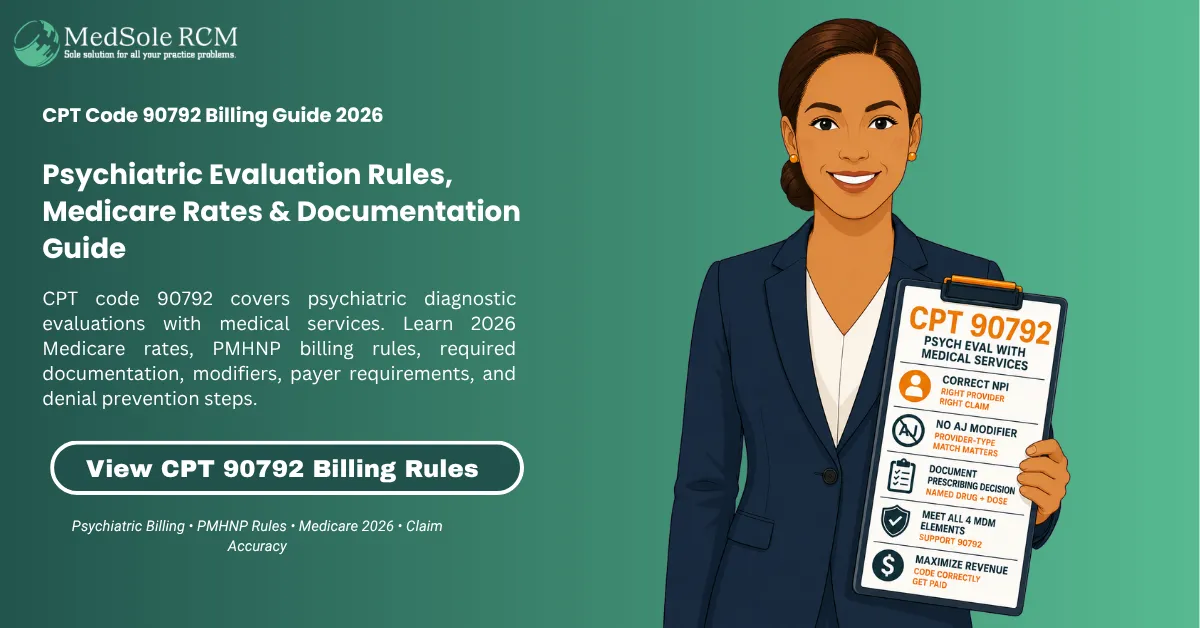
CPT code 90792 is a psychiatric diagnostic evaluation with medical services, billed by psychiatrists and psychiatric nurse practitioners for initial comprehensive mental health assessments, with a 2026 Medicare non-facility reimbursement rate of $202.08 for psychiatrists and $171.77 for PMHNPs billing under their own National Provider Identifier.
The American Medical Association defines 90792 as an integrated biopsychosocial and medical assessment that includes history-taking, mental status examination, other physical examination elements as indicated, and recommendations. The evaluation can include communication with family members, prescription of medications, and ordering or reviewing laboratory or diagnostic studies. This medical component is what distinguishes 90792 from its counterpart, CPT code 90791.
Official CPT Code 90792 Description
CPT code 90792 description: Psychiatric diagnostic evaluation with medical services. This code covers an initial comprehensive psychiatric assessment that includes all of the following: a complete biopsychosocial and medical history, a mental status examination covering at minimum five distinct elements, initial diagnosis based on DSM-5 criteria, evaluation of the patient's ability to respond to treatment, an initial treatment plan, and medical services including medication evaluation, prescription of medications, ordering of laboratory studies, or physical examination elements as clinically indicated. The code is untimed. Service components, not duration, determine whether 90792 is the correct code for the evaluation.
CPT 90792 Key Details and Requirements
What it includes: A complete biopsychosocial and medical history, mental status examination, initial diagnosis, treatment planning, and medical services, specifically ordering lab tests, reviewing diagnostic studies, prescribing medications, or performing elements of a physical examination. All five components must be documented to support medical necessity for 90792.
Who can bill it: Only licensed professionals with prescriptive authority, primarily psychiatrists (MD/DO) and psychiatric mental health nurse practitioners (PMHNPs) with active PECOS enrollment. Clinical social workers, licensed professional counselors, licensed marriage and family therapists, and psychologists cannot bill 90792 regardless of the clinical content of the evaluation. Non-prescribing providers use CPT code 90791 instead.
Billing Frequency: 90792 is reported once per date of service and is generally limited to one evaluation per episode of care per patient per provider. A new evaluation is billable when a significant change in mental status requires a new comprehensive assessment, when a new and distinct psychiatric diagnosis is established, or when an inpatient psychiatric hospitalization constitutes a new episode of care.
Restrictions: CPT code 90792 cannot be billed on the same date of service as an Evaluation and Management code (99202 through 99215) by the same provider for the same patient. It also cannot be billed on the same date as standalone psychotherapy codes (90832 through 90838, 90839) per current NCCI rules.
2026 Reimbursement Rate: Medicare non-facility rate is $202.08 for psychiatrists (MD/DO) billing under their own NPI. Psychiatric nurse practitioners billing under their own NPI receive 85 percent of the physician rate, approximately $171.77. PMHNPs billing incident-to a supervising psychiatrist receive the full $202.08 when all incident-to supervision conditions are met. Commercial payer benchmarks: BCBS $210.44, UHC $173.44, Aetna $183.80, Cigna $269.77.
CPT Code 90792 Time Requirements: Correcting the Most Common Error
CPT code 90792 has no specific time requirement. It's an untimed code. The presence or absence of required service components, not face-to-face duration, determines whether 90792 is the correct code. CMS Billing and Coding Article A57480 confirms no minimum or maximum time threshold for 90792. The frequently referenced "60 to 120 minutes" is a typical clinical range that experienced psychiatrists and PMHNPs spend on initial evaluations, not a billing requirement. A 35-minute evaluation that contains all required components is billed as 90792. A 90-minute evaluation that omits the medical services component is not.
This correction matters operationally because practices following the incorrect 60-minute minimum are potentially turning away same-day appointments that fall short of that threshold when the clinical documentation would otherwise support the code. CMS never established a time floor for 90792. The requirement is service-based, not time-based.
Behavioral health billing teams managing the 90792 cpt code across multiple providers and payers can confirm accurate coding, modifiers, and documentation standards before every submission. MedSole RCM's outsourced behavioral health billing services handle the pre-submission audit, modifier verification, and payer-specific rule checking for psychiatric practices in all 50 states at 2.99 percent of collections.
What Is Required to Bill CPT 90792? The Five Clinical Components Billing Teams Must Verify
Billing the 90792 cpt code requires documentation of five distinct clinical service components, biopsychosocial and medical history, mental status examination, initial diagnosis, treatment response evaluation, and a treatment plan, plus documented evidence that at least one medical service was performed, meaning a prescription was issued, a laboratory study was ordered, or a physical assessment element was completed.
The Five Required Service Components for CPT Code 90792
- Complete biopsychosocial and medical history. The intake note must document past psychiatric history, current symptoms and onset, relevant medical history including active diagnoses and current medications, family psychiatric history, and social history including living situation, substance use, and occupational status. Billing teams verify this element is present in the HPI and social history sections of the intake note.
- Mental status examination with a minimum of five elements. The MSE must document at least five distinct clinical elements, typically appearance, behavior, speech, mood and affect, thought process, thought content, perception, cognition, insight, and judgment. A note that says "MSE within normal limits" without named elements doesn't meet this documentation standard.
- Initial psychiatric diagnosis using DSM-5 criteria. The note must establish a primary psychiatric diagnosis, not a rule-out or a working impression, supported by the clinical findings documented in the evaluation. The ICD-10-CM code on the claim must match the documented DSM-5 diagnosis with full specificity.
- Evaluation of the patient's ability and capacity to respond to treatment. The note must address the patient's insight into their condition, motivation for treatment, identified barriers to treatment (substance use, housing instability, cognitive limitations), and the provider's clinical judgment about prognosis and treatment responsiveness.
- Initial plan of treatment with medical services component. The treatment plan must specify the recommended treatment modality (pharmacotherapy, psychotherapy, or combined), the proposed medication if prescribing occurred, any laboratory studies ordered with clinical rationale, and the recommended follow-up frequency.
Eligibility and benefits verification before the first psychiatric appointment confirms prior authorization requirements, benefit limits, and NPI panel status before the claim submits.
What Constitutes "Medical Services" Under CPT 90792: The Billing-Defensible Definition
Medical services in the 90792 context means any one of three documented actions by the prescribing provider: prescribing a psychiatric medication with a named drug, dose, and clinical rationale; ordering a laboratory study with a specific reason (for example, thyroid function panel to rule out thyroid-driven mood dysregulation); or performing and documenting a physical assessment element relevant to the psychiatric presentation.
Documentation that doesn't meet the medical services threshold: noting that "medications were discussed" without documenting a specific medication decision; completing an MSE and treatment plan without any prescribing, lab ordering, or physical examination; and documenting "will consider medications at follow-up" without a current prescribing decision. These documentation patterns trigger 90792-to-90791 downcoding in post-payment review.
The distinction matters because downcoding from 90792 ($202.08 Medicare) to 90791 (approximately $174 to $178 Medicare) generates a $24 to $28 revenue loss per claim. A practice with 20 initial evaluations per week that's routinely downcoded loses approximately $24,960 to $29,120 annually in preventable revenue reduction. See CMS Local Coverage Article A57480, Psychiatric Diagnostic Evaluation for the documentation authority governing this distinction.
Documentation That Must Appear in Every 90792 Claim Note
- Patient name and date of birth on every page of the clinical note
- Date of service matching the claim submission date
- Start time and stop time, or total duration of the evaluation
- Place of service: POS 11 for office, POS 10 for telehealth in the patient's home, POS 02 for other telehealth locations
- History of present illness including onset, duration, severity, and prior treatment history
- Review of systems with relevant systems checked
- Biopsychosocial assessment covering psychiatric, medical, social, occupational, and family domains
- Mental status examination with a minimum of five named elements
- Initial diagnosis in ICD-10-CM at the highest specificity supported by the clinical note
- Treatment plan specifying modality, initial prescribing decision or lab order (the medical services component), and recommended follow-up frequency
- Risk assessment covering suicidal ideation, homicidal ideation, self-harm history, and protective factors
- Provider name, professional credentials, and signature within 72 hours of the date of service
- PECOS enrollment verification: confirm the billing NPI is active with every payer receiving the claim before submission
Who Can Bill CPT 90792 and Who Cannot: The 2026 Provider Eligibility Guide
The 90792 cpt code can only be billed by licensed professionals with active prescriptive authority, specifically psychiatrists with an MD or DO degree and psychiatric mental health nurse practitioners with prescriptive authority enrolled in PECOS, and cannot be billed by any non-prescribing mental health professional regardless of the clinical content of the evaluation.
Providers Who Can Bill CPT 90792
Psychiatrists (MD/DO): Medicare 2026 non-facility rate: $202.08. Must be enrolled in PECOS individually (CMS-855I) and as part of any group practice (CMS-855B). Must have active credentialing with every commercial payer before the claim date, including separate credentialing with behavioral health carve-out administrators (Magellan, Beacon, Optum) that manage mental health benefits separately from the medical network. A psychiatrist credentialed with BCBS medical is not automatically credentialed with BCBS's behavioral health carve-out. Submit the 90792 claim under the psychiatrist's individual NPI with modifier AF. Magellan, Beacon, and Optum carve-out credentialing requires separate applications from the commercial medical network. See MedSole's complete guide to behavioral health credentialing for psychiatrists and PMHNPs covering carve-out-specific enrollment pathways and timelines.
Psychiatric Mental Health Nurse Practitioners (PMHNPs): Medicare 2026 rate: $171.77 when billing under the PMHNP's own NPI (85 percent of the physician rate). Medicare 2026 rate: $202.08 when billing incident-to under the supervising psychiatrist's NPI, but strict incident-to supervision conditions must be met. The PMHNP must hold prescriptive authority in the state where services are rendered and must be enrolled in CMS PECOS individually and associated with the billing group. Commercial payers vary: some pay PMHNPs at 100 percent of the psychiatrist rate and others at 85 percent per the individual contract. Verify the contracted rate before credentialing a new PMHNP. MedSole RCM manages provider enrollment and credentialing for psychiatrists and PMHNPs at $99 per payer enrollment, including Magellan, Beacon, and Optum carve-out credentialing.
Providers Who Cannot Bill CPT 90792: The Scope Boundary That Generates Systematic Denials
The following licensed professionals cannot bill CPT 90792 under any circumstances with any commercial payer or Medicare, regardless of clinical complexity, documentation quality, or payer authorization:
Licensed Clinical Social Workers (LCSWs): Can bill 90791 only. If a 90792 claim is submitted under an LCSW NPI, it will deny automatically as provider type mismatch. Modifier AJ does not authorize LCSWs to bill 90792. It's used when an LCSW bills 90791 within a group practice. Any guidance suggesting AJ modifier enables LCSWs to bill 90792 is incorrect. Any 90792 claim submitted with modifier AJ will deny for provider type mismatch.
Licensed Professional Counselors (LPCs) and Licensed Mental Health Counselors (LMHCs): Can bill 90791 only. Same provider type mismatch denial with no appeal basis.
Licensed Marriage and Family Therapists (LMFTs): Can bill 90791 only. Same denial consequence.
Psychologists (PhD/PsyD): Can bill 90791. In states where psychologists hold prescriptive authority (Louisiana, New Mexico, Illinois, Iowa), verify payer-specific 90792 eligibility with the individual payer before submitting a claim.
Licensed Clinical Nurse Specialists (CNS) without psychiatric specialty: Cannot bill 90792. Psychiatric CNS with prescriptive authority in their state may be eligible. Verify per payer.
PMHNP Billing Under CPT 90792: Own NPI at 85 Percent vs Incident-To at 100 Percent
When a PMHNP bills 90792 under their own NPI with no supervising physician present or involved, Medicare pays 85 percent of the psychiatrist rate, which is $171.77 at 2026 rates. This 15 percent reduction is the standard non-physician practitioner reduction that applies to all APRNs billing Medicare independently. The PMHNP submits the claim under their own NPI and provides services independently.
When a PMHNP provides 90792 services incident-to a supervising psychiatrist, Medicare pays 100 percent of the physician rate, which is $202.08 at 2026 rates. For incident-to billing to apply, three conditions must be met: the psychiatrist must be present in the office suite (not just available by phone), the patient must be an established patient of the supervising psychiatrist's practice, and the service must be within the scope of the established plan of care. At 20 evaluations per week, the revenue difference between own-NPI billing and incident-to billing for a PMHNP is approximately $6,200 annually at Medicare rates.
CPT 90792 vs 90791: The Complete Difference for Billing Teams
The difference between CPT 90791 and the 90792 cpt code comes down to whether medical services were performed during the psychiatric diagnostic evaluation. If a psychiatrist or PMHNP prescribed medication, ordered a laboratory study, or completed a physical assessment element, 90792 is correct. If the evaluation focused entirely on clinical psychiatric assessment without any medical services, 90791 is correct.
Quick Breakdown: CPT 90791 vs CPT 90792
90791 (Without medical services): An initial biopsychosocial evaluation covering mental health history, psychosocial assessment, mental status examination, diagnostic formulation, and treatment plan recommendations, without any prescribing, laboratory ordering, or physical examination. Billed by non-prescribing mental health providers (psychologists, LCSWs, LPCs, LMFTs) and by prescribing providers when no medical services were provided. 2026 Medicare non-facility rate: approximately $174 to $178.
90792 (With medical services): Includes every element of 90791 plus documented medical services, a prescribing decision, laboratory order, or physical assessment element that falls within the prescribing provider's scope. Only billed by psychiatrists and PMHNPs with active prescriptive authority. 2026 Medicare non-facility rate: $202.08 for psychiatrists, $171.77 for PMHNPs billing under their own NPI.
Key Billing Distinctions Between 90791 and 90792
|
Feature |
CPT 90791 |
CPT 90792 |
|---|---|---|
|
Medical Services Included |
No |
Yes, prescribing, lab ordering, or physical examination |
|
Provider Eligibility |
Psychologists, LCSWs, LPCs, LMFTs, MDs without med services |
Psychiatrists (MD/DO), PMHNPs with prescriptive authority |
|
2026 Medicare Rate |
$174 to $178 non-facility |
$202.08 (psychiatrist), $171.77 (PMHNP own NPI) |
|
Frequency Limit |
Generally one per episode of care per provider |
Generally one per episode of care per provider |
|
Same-Day Restrictions |
Cannot bill with 90792 by same provider same day |
Cannot bill with 90791, E/M codes, or psychotherapy same day |
The table summarizes the key distinctions, but the billing decision must always reflect the actual services documented in the clinical note, not the provider's license type alone. A psychiatrist who performs a comprehensive evaluation without medical services bills 90791, not 90792. For the complete billing guide, documentation requirements, and 2026 Medicare rate for the non-medical evaluation code, see MedSole's complete billing guide for CPT code 90791. The Noridian Medicare psychiatric diagnostic evaluation billing guidance confirms the 90791 vs 90792 distinction and applicable NCCI restrictions.
Six Clinical Scenarios: Which Code Is Correct?
Scenario 1: Provider: PhD psychologist. Service: 60-minute diagnostic interview, MSE, treatment plan, no medication. Correct code: 90791. Reasoning: No medical services and psychologists don't prescribe.
Scenario 2: Provider: Psychiatrist (MD). Service: Initial evaluation, MSE, medical history, SSRI prescription for confirmed MDD. Correct code: 90792. Reasoning: Prescribing decision constitutes medical services.
Scenario 3: Provider: PMHNP. Service: Virtual diagnostic evaluation, MSE, medication management for ADHD, Adderall prescription. Correct code: 90792 (verify payer telehealth policy). Reasoning: Medical services performed, prescriptive authority exercised.
Scenario 4: Provider: LCSW. Service: 50-minute reassessment after 18-month gap, MSE, updated treatment plan. Correct code: 90791. Reasoning: LCSWs don't prescribe and cannot bill 90792.
Scenario 5: Provider: Psychiatrist (MD). Service: Evaluation, MSE, treatment plan, decision to defer medication until lab results return. Correct code: 90791 in most cases. Reasoning: No medical services occurred at this visit. No prescription, no lab order, no physical examination. Verify payer-specific rules.
Scenario 6: Provider: PMHNP. Service: Initial evaluation for anxiety, MSE, treatment plan recommending therapy before medication, no prescription issued. Correct code: 90791. Reasoning: Prescriptive authority alone doesn't make the visit a 90792. The medical services component must have occurred.
CPT 90792 vs 99205: Which Code Pays More and When Each Is Correct
CPT code 99205 pays more than the 90792 cpt code at 2026 Medicare rates, $236.81 for 99205 versus $202.08 for 90792, but the higher-paying code isn't always the correct code, and billing 99205 for a service that was a psychiatric diagnostic evaluation rather than a high-complexity E/M encounter is a compliance violation that generates recoupment.
What Pays More: 99205 or 90792?
CPT code 99205 generally pays more than 90792. At 2026 Medicare rates, 99205 pays $236.81 and 90792 pays $202.08, making 99205 approximately 17 percent more per encounter at Medicare rates. To bill 99205, the provider must document either high-complexity medical decision-making or 60 to 74 minutes of total provider time on the date of service. CPT 90792 doesn't have a time requirement. It requires documented medical services during a psychiatric diagnostic evaluation. Commercial payers typically require prior authorization for 99205 new patient visits, while 90792 is generally covered without prior authorization for initial psychiatric evaluations. Always select the code that accurately reflects the documented nature of the encounter, not the code with the higher reimbursement. Verify the exact 2026 rate for your locality via the CMS Physician Fee Schedule Lookup Tool. One O Seven RCM's complete 2026 billing guide for CPT code 99205 covers the MDM criteria, time documentation requirements, and commercial payer prior authorization rules for the high-complexity E/M code that psychiatrists consider as an alternative to 90792 for initial evaluations.
When to Bill 90792 vs 99205: The Clinical Decision Framework
Bill 90792 when: The primary purpose of the visit is a formal psychiatric diagnostic evaluation to establish a mental health diagnosis. The clinician is performing an integrated biopsychosocial and medical assessment. Medical services occurred during the evaluation (prescribing, lab ordering, or physical assessment). Documentation reflects a diagnostic interview structure rather than a medical evaluation and management structure.
Bill 99205 when: The encounter is primarily driven by medical evaluation and management complexity, for example a new patient with severe treatment-resistant depression and significant cardiac, metabolic, and neurological comorbidities where the visit is fundamentally a high-complexity medical E/M encounter. The clinical note reflects high-complexity medical decision-making with multiple diagnoses, data review, and high-risk treatment decisions. The provider documents 60 to 74 minutes of total time on the date of encounter.
The key question isn't "which code pays more?" The key question is "was this visit primarily a psychiatric diagnostic evaluation or primarily a medical E/M encounter?" Documentation answers that question. Code selection must follow the documentation, never the other way. For the complete compliance and audit defense framework for CPT 99205, see ClaimMax RCM's CPT 99205 billing compliance and audit defense guide.
Annual Revenue Impact of Choosing Between 90792 and 99205
At 20 initial psychiatric evaluations per week at Medicare rates, the difference between consistently billing 90792 ($202.08) versus 99205 ($236.81) is $34,840 per year. At 30 evaluations per week, the gap reaches $52,260 annually. These are the annual revenue numbers that make some practices consider 99205 for every initial evaluation, and that thinking is exactly what triggers payer audits.
Commercial payer contracts change the calculation. Some BCBS plans pay 90792 at $210.44 and 99205 at $260 to $310 depending on the market and contract, making the annual revenue differential even larger at commercial rates. Other commercial payers pay 90792 and 99205 at nearly identical rates, eliminating the financial incentive for code switching entirely. Verify your contracted rates for both codes before any billing decision.
The compliance risk of consistent 99205 upcoding exceeds the revenue benefit in every scenario. One post-payment audit with 24 months of recoupment on 99205 claims that should have been 90792 can generate a recoupment demand large enough to offset years of revenue differential. Psychiatric practices unsure whether their 90792 versus 99205 coding pattern is defensible can request a free denial analysis from MedSole RCM's behavioral health billing audit team.
CPT Code 90792 Reimbursement Rates 2026: Medicare, Medicaid, and Commercial Payer Benchmarks
The 2026 Medicare non-facility reimbursement rate for the 90792 cpt code is $202.08 for psychiatrists billing under their own NPI, with commercial payer national averages ranging from $173.44 at UnitedHealthcare to $269.77 at Cigna, representing a $96.33 spread between the lowest and highest major commercial payer benchmarks for the same psychiatric diagnostic evaluation code.
2026 Medicare Reimbursement Rate for CPT 90792
|
Provider Type |
2026 Medicare Non-Facility Rate |
Billing Basis |
|---|---|---|
|
Psychiatrist (MD/DO) |
$202.08 |
100% of Physician Fee Schedule |
|
PMHNP: Own NPI |
$171.77 |
85% of Physician Fee Schedule |
|
PMHNP: Incident-To |
$202.08 |
100%, incident-to conditions must be met |
|
Facility-Based Rate |
Lower, varies by MAC |
Hospital outpatient fee schedule applies |
Geographic Practice Cost Index (GPCI) adjustments apply to all Medicare rates above. The national average is the baseline. Practices in high-cost metropolitan areas typically receive higher payments, and practices in rural areas may receive lower amounts. Verify your locality-specific rate using the CMS Medicare Physician Fee Schedule lookup tool.
CPT 90792 Historical Rate Archive: 2020 to 2026
|
Year |
Medicare Non-Facility Rate |
Change From Prior Year |
|---|---|---|
|
2026 |
$202.08 |
+$16.90 (+9.1%) |
|
2025 |
$185.18 |
-$5.39 (-2.8%) |
|
2024 |
$190.57 |
-$6.00 (-3.1%) |
|
2023 |
$196.55 |
-$22.35 (-10.2%) |
|
2022 |
$218.90 |
+$17.22 (+8.5%) |
|
2021 |
$201.68 |
+$40.72 (+25.3%) |
|
2020 |
$160.96 |
Baseline |
The 2026 rate of $202.08 reflects the CY 2026 Medicare Physician Fee Schedule Final Rule update and the revised conversion factor of approximately $33.40 to $33.57, an increase from 2025's $32.35 that partially reverses multi-year rate compression for psychiatric diagnostic services.
Commercial Payer Reimbursement Benchmarks for CPT 90792
National average commercial rates below are sourced from federal price transparency machine-readable files, verified May 2026, as aggregated through PayerPrice federal transparency data for CPT 90792. MedSole is the only free editorial source for these commercial benchmarks.
|
Commercial Payer |
National Average Rate for CPT 90792 |
Rate vs Medicare |
|---|---|---|
|
BCBS (National Average) |
$210.44 |
+4.1% above Medicare |
|
UnitedHealthcare |
$173.44 |
-14.2% below Medicare |
|
Aetna |
$183.80 |
-9.0% below Medicare |
|
Cigna |
$269.77 |
+33.5% above Medicare |
Individual contracted rates vary significantly from these averages depending on provider type (psychiatrist vs PMHNP), practice size, geographic market, and negotiated contract terms. A solo psychiatrist's BCBS rate may differ from a multi-provider group's rate by 20 to 40 percent. The Cigna rate ($269.77) is notably the highest among major commercial payers, making Cigna one of the most valuable commercial payers for psychiatric evaluation billing when the contracted rate approaches or exceeds the national average.
CPT 90792 Relative Value Units (RVUs): 2026
The 2026 relative value units for CPT code 90792 in non-facility settings are approximately: work RVU of 3.00, practice expense RVU of 2.09, and malpractice RVU of 0.28, producing a total non-facility RVU of approximately 5.37. Applied to the 2026 conversion factor of $33.40, the calculation produces the national average Medicare rate of approximately $179.36 before GPCI adjustment, with GPCI adjustments raising the adjusted rate to $202.08 at the national average GPCI. The APA CPT Primer for Psychiatrists confirms current RVU assignments and documentation requirements for 90792 and the psychiatric code family.
For comparison, CPT 99205 carries a total non-facility RVU of approximately 7.09 at 2026 rates. The higher RVU explains the $236.81 Medicare rate and the rate differential that makes some psychiatrists consider 99205 for initial evaluations. The 1.72-RVU gap between 90792 and 99205 is the billing math behind the "which pays more" question.
Psychiatric practices negotiating commercial contracts can benchmark their 90792 contracted rates against these national averages to identify underperforming contracts. MedSole RCM's denial management and AR follow-up services include contracted rate monitoring and payer underpayment identification as part of the 2.99 percent behavioral health billing service. See MedSole's complete guide to medical billing and credentialing services for behavioral health covering payer contract optimization for psychiatric practices.
CPT Code 90792 Documentation Requirements: What the Clinical Note Must Contain
The 90792 cpt code claims denied for insufficient documentation share a common pattern. The clinical note establishes a psychiatric diagnosis and a treatment plan but fails to include documentation confirming that a medical service actually occurred, which is the single element that distinguishes a 90792 claim from a 90791 claim under payer audit.
The Billing-Specific Documentation Checklist for CPT 90792
For the complete mental health evaluation and treatment code framework that 90792 sits within, see MedSole's complete guide to mental health CPT codes covering 90791 through 90839 with documentation standards for each. The eleven required documentation elements below are drawn from CMS Billing and Coding Article A57480, Psychiatric Diagnostic Evaluation documentation requirements.
- Patient identification on every page. Every page of the intake note must display the patient's full name and date of birth. Billing teams confirm this before releasing the note for claim submission. A single page missing patient ID generates additional documentation requests.
- Date of service matching the claim. The note date and the claim date of service must match exactly. Discrepancies between the note date and the billing date generate automatic payer flags.
- Start and stop times or total encounter duration. Document either the start and stop time of the evaluation or the total face-to-face duration. CMS Article A57480 requires time documentation even though 90792 is untimed. It's for audit completeness, not code selection.
- Place of service code consistent with the delivery setting. POS 11 for in-office visits, POS 10 for patient-home telehealth, POS 02 for other telehealth locations. A POS code that doesn't match the actual setting generates modifier conflicts and claim denials.
- Complete biopsychosocial history with all five domains documented. Psychiatric history, medical history including current medications and allergies, social history, family history, and substance use history must each appear as distinct documented elements, not compressed into a single paragraph.
- Mental status examination with a minimum of five named elements. List each MSE element by name: appearance, behavior, speech, mood, affect, thought process, thought content, cognition, insight, judgment. "MSE unremarkable" without named elements is insufficient for a 90792 cpt code claim.
- Risk assessment covering suicidal ideation, homicidal ideation, self-harm history, and protective factors. The risk level determination and clinical rationale must appear in the note. Missing risk assessments are the most common documentation deficiency in post-payment behavioral health audits.
- Initial psychiatric diagnosis at full ICD-10-CM specificity. The F-code must appear in the note body and match the diagnosis on the claim exactly. Rule-out diagnoses and provisional impressions without confirmed diagnoses don't support 90792 medical necessity.
- The medical services component, documented with specificity. See H3 below for the exact documentation standard. This is the element that distinguishes the note from a 90791 documentation set.
- Treatment plan with modality, prescribing decision or lab order, and follow-up frequency. The plan must name the treatment approach, the medication decision, and the clinical rationale. "Patient agrees to return in 4 weeks" is not a treatment plan.
- Provider credentials and signature within 72 hours. The note must be signed by the billing provider with their full credential string (MD, DO, PMHNP-BC) within 72 hours of the date of service. Late-signed notes generate date-of-service discrepancies in post-payment review.
What "Medical Services" Documentation Must Look Like in the Note
A prescribing decision must be documented with: the medication name (generic and brand), the dose, the dosing frequency, the clinical rationale connecting the diagnosis to the medication choice, and a note about patient education regarding the medication. "Patient started on SSRI" doesn't meet this standard. "Patient started on sertraline 50mg daily for confirmed MDD with prominent anhedonia and sleep disruption, patient educated on expected onset of 2 to 4 weeks, common side effects, and when to contact the practice" does.
A laboratory order must be documented with: the specific panel ordered, the clinical reason for ordering (for example, "TSH ordered to rule out hypothyroid contribution to depressive presentation"), and the expected follow-up plan for results. An order placed silently in the EHR without documentation in the note body doesn't support the medical services element for 90792 billing purposes.
Prior Authorization Requirements for CPT 90792
Prior authorization requirements for CPT code 90792 vary significantly by payer and plan. Medicare doesn't require prior authorization for 90792 in most circumstances. However, Medicare Advantage plans often apply commercial payer authorization requirements, and many managed care organizations require prior authorization for initial psychiatric evaluations regardless of the code.
Commercial payers with behavioral health carve-out management through Magellan, Beacon, or Optum frequently require prior authorization for psychiatric evaluations. Authorization requirements vary by plan year and state mandate. The only reliable method is an eligibility and benefits verification call or portal check before the patient's evaluation date. Prior authorization for psychiatric evaluations must be verified before the appointment, not after the denial. MedSole RCM's prior authorization service manages pre-authorization verification for 90792 and all behavioral health evaluation codes across Magellan, Beacon, Optum, and commercial payer networks in all 50 states.
Modifiers for CPT 90792: The Complete 2026 Reference Table
The 90792 cpt code requires different modifiers depending on three distinct factors: who is performing the evaluation (provider credential modifiers AF or AH), how the service is being delivered (telehealth modifiers 95, GT, FQ, or FR), and whether additional services are being billed on the same date, with the correct modifier selection determining whether the claim pays or denies.
Provider-Specific Modifiers for CPT 90792
Provider-specific modifiers indicate the professional credentials of the clinician who performed the 90792 evaluation. Modifier AF identifies a psychiatrist (MD or DO) as the billing provider. Modifier AH identifies a clinical psychologist with a doctorate degree (PhD or PsyD). Note that psychologists generally cannot bill 90792, making modifier AH effectively inapplicable to this code in standard practice. Modifier HP identifies a PsyD or PhD rendering psychotherapy services, and the same restriction applies.
Modifier AJ is listed as a 90792 modifier by several sources in this topic, including some information currently cited in Google's AI answers. This is incorrect. Modifier AJ identifies a Licensed Clinical Social Worker (LCSW) as the billing provider, and LCSWs cannot bill CPT 90792 under any payer. AJ applies when an LCSW bills 90791 within a group practice setting. Any 90792 claim submitted with modifier AJ will deny for provider type mismatch.
Telehealth Modifiers for CPT 90792: 2026 Requirements
Modifier 95 is the current preferred telehealth modifier for CPT 90792 delivered via synchronous audio and video telecommunication. CMS and most commercial payers now require modifier 95 rather than the legacy modifier GT for audio-video telehealth encounters. Submit modifier 95 on the 90792 claim line and pair it with the appropriate place of service code. CMS maintains an updated telehealth services list confirming 90792 remains on the approved telehealth code list with modifier 95 as the current preferred telehealth identifier.
Modifier GT remains accepted by some commercial payers that haven't yet transitioned to modifier 95 as their preferred telehealth identifier. When in doubt, verify the payer's current telehealth modifier preference before submitting. Some payers accept both, some require one specifically, and submitting the wrong modifier generates a technical denial even when the clinical documentation is complete. Noridian Medicare telehealth billing guidance for behavioral health confirms current telehealth modifier requirements for 90792 by MAC jurisdiction.
Modifier FQ identifies a service delivered via audio-only communication, applicable for Medicare beneficiaries when video technology isn't available to the patient. Medicare extended audio-only telehealth coverage for psychiatric diagnostic evaluations through 2026 under the Consolidated Appropriations Act provisions. Modifier FR indicates that a supervising practitioner was present during a telehealth service rendered by a trainee, applicable in residency and fellowship training settings billing 90792 under supervision.
Procedural Modifiers for CPT 90792
Modifier 25 is commonly listed as a procedural modifier for 90792 to indicate that a separate, significantly identifiable E/M service occurred on the same date. In practice, modifier 25 cannot resolve the NCCI Rule 4 prohibition that prevents same-day billing of 90792 and E/M codes (99202 through 99215) by the same provider. Modifier 25 is applied to the E/M code, not the 90792 code, in the rare scenario where different providers bill both on the same date.
Modifier 52 reports a reduced service, applicable when the 90792 evaluation couldn't be completed due to patient condition or time constraints. Modifier XE identifies a service as distinct because it occurred at a different session from other services billed the same date, applicable when 90792 and another service are performed in separate, distinct encounters within the same calendar day.
Complete CPT 90792 Modifier Reference Table
|
Modifier |
Category |
When to Use With CPT 90792 |
Denial Consequence If Missing or Incorrect |
|---|---|---|---|
|
AF |
Provider credential |
Psychiatrist (MD/DO) performing the evaluation |
Provider type mismatch denial |
|
AH |
Provider credential |
Clinical psychologist, rarely applicable to 90792 |
Use only when payer specifically allows psychologist to bill 90792 |
|
AJ |
Provider credential |
DO NOT USE WITH 90792, applies to 90791 by LCSWs only |
Automatic denial, provider type mismatch |
|
95 |
Telehealth |
Audio-video synchronous telehealth, preferred by CMS and most commercial payers |
Telehealth claim denied as in-person without modifier |
|
GT |
Telehealth |
Legacy audio-video modifier, still accepted by some commercial payers |
Denied if payer requires 95, verify per payer before using |
|
FQ |
Telehealth |
Audio-only telehealth under Medicare, patient without video capability |
Audio-only claim denied without FQ under applicable payers |
|
FR |
Telehealth |
Supervising practitioner present during trainee-rendered telehealth |
Required in training settings, denial for compliance deficiency |
|
25 |
Procedural |
Applies to E/M code on same date, not to 90792 itself |
Misapplication causes bundling denial on E/M code |
|
52 |
Procedural |
Reduced service, evaluation couldn't be completed |
Overpayment risk if 52 not used when service was clearly incomplete |
|
XE |
Procedural |
Distinct encounter, separate session within same calendar day |
Bundling denial on second service if XE omitted |
Modifier requirements for 90792 vary by payer. Medicare's requirements differ from BCBS's, and Magellan's carve-out requirements differ from Optum's. Maintain a payer-specific modifier policy sheet updated annually, especially for telehealth modifier preferences, which have shifted consistently since 2020 and continue to evolve. For the complete modifier and billing rules for every psychiatric evaluation and psychotherapy code in the behavioral health CPT family, see MedSole's complete mental health CPT codes guide covering every 90792 cpt code modifier scenario.
How Many Times Can You Bill CPT 90792? Frequency Rules and Exceptions
The 90792 cpt code is generally limited to one billing per patient per provider per 365 days, but five documented clinical circumstances permit a second or subsequent evaluation within the same calendar year, and psychiatric practices that don't know these exceptions are leaving recoverable revenue on the table while managing patients who actually need a new comprehensive evaluation.
The General Billing Frequency Rule for CPT 90792
General Rule: Most payers, including Medicare and the majority of commercial insurers, limit CPT code 90792 to one unit per patient per provider per 365-day period. This limit reflects the intended use of 90792 as an initial comprehensive evaluation, not a recurring service. Each subsequent patient encounter transitions to psychotherapy codes (90832, 90834, 90837), medication management under E/M codes (99212 through 99215), or add-on codes (90785) when applicable. After the initial 90792 evaluation, subsequent sessions transition to psychotherapy billing. See MedSole's CPT 90837 complete billing guide for the 60-minute individual therapy code that follows most psychiatric diagnostic evaluations.
Daily Limit: You can't bill more than one unit of 90792 per date of service. It also can't be billed on the same day as an E/M code (99202 through 99215) by the same provider for the same patient, or on the same day as standalone psychotherapy codes.
Age Variations: Some state Medicaid plans allow two evaluations per 365 days for patients under 21. This exception is state-specific and payer-specific. Verify your state Medicaid fee schedule before billing a second 90792 for a pediatric patient within the same calendar year.
Important Audit Note: Billing 90792 multiple times within a 12-month period for the same patient triggers payer scrutiny in most claim processing systems. When a second evaluation is clinically justified, the documentation must explicitly state why a new comprehensive evaluation was necessary. Frequency-related denials are among the most common behavioral health claim rejections and they require specific appeals documentation. MedSole RCM's AR follow-up service for behavioral health claims manages the appeals process for 90792 frequency denials, including securing exception documentation from the clinical team.
When You Can Bill CPT 90792 More Than Once: The Five Documented Exceptions
- New and distinct psychiatric diagnosis. When the provider establishes a new diagnosis separate from the original diagnosis established at the first evaluation, for example a patient first evaluated for major depressive disorder who later presents with a first manic episode requiring a new comprehensive bipolar disorder evaluation, 90792 is billable again. Document the new diagnosis explicitly and the clinical findings that support it.
- Significant change in mental status requiring a new comprehensive assessment. When the patient's clinical presentation changes materially enough that the original treatment plan is no longer adequate and a new diagnostic evaluation is clinically indicated, not a routine medication adjustment, but a fundamental change in the patient's psychiatric presentation requiring a new diagnostic formulation.
- Inpatient psychiatric hospitalization constituting a new episode of care. When a patient is discharged from an inpatient psychiatric admission and begins outpatient treatment, the post-discharge evaluation typically represents a new episode of care. Most payers treat inpatient hospitalization as an episode break that resets the 90792 billing clock.
- Change in treating provider. When a patient transfers care to a new psychiatrist or PMHNP, the new provider performs their own initial evaluation. The new provider's 90792 is billable independently of the prior provider's evaluation frequency. Billing frequency limits are per-provider, not per-patient globally.
- Extended gap in treatment exceeding 12 months. When a patient's last psychiatric evaluation was more than 12 months prior and they return to care, most payers treat the return as a new episode of care. Document the gap in care, the patient's current clinical status, and the clinical rationale for the new comprehensive evaluation.
For additional context on misconceptions about 90792 billing frequency, BillingFreedom's myth vs fact analysis on CPT 90792 frequency covers one of the most common billing misconceptions in outpatient psychiatric practice.
Can 90792 Be Billed Twice in the Same Year?
Yes. The 90792 cpt code can be billed twice in the same year for the same patient when one of five documented clinical exceptions applies: a new distinct diagnosis, significant change in mental status, post-inpatient hospitalization, change in provider, or extended treatment gap exceeding 12 months. Every second evaluation within a 12-month period requires explicit documentation of the clinical reason that made a new comprehensive evaluation necessary. Without this documentation, the second claim will deny for duplicate service.
Same-Day Billing Rules for CPT 90792: NCCI Restrictions Every Psychiatric Practice Must Know
Same-day billing of the 90792 cpt code is restricted by NCCI rules that prohibit combining the psychiatric diagnostic evaluation with E/M codes, standalone psychotherapy codes, or the other psychiatric diagnostic evaluation code 90791, when billed by the same provider for the same patient, with a narrow exception for add-on code 90785 when interactive complexity is present.
Can You Bill 90791 and 90792 on the Same Day?
CPT codes 90791 and 90792 can be billed on the same date of service, but only when two different providers perform the evaluations independently for the same patient. When the same provider bills both 90791 and 90792 for the same patient on the same date, 90791 will be automatically denied as a duplicate service. Provider Express (Optum's behavioral health portal) confirms this specifically: only one psychiatric diagnostic evaluation code per provider per patient per day is payable. When different providers bill both codes on the same date for the same patient, each claim is generally payable by most payers when separately documented.
The clinical scenario that generates same-day 90791 and 90792 billing most commonly: a psychologist and a psychiatrist both evaluate the same patient on the same day as part of a collaborative intake process. This is payable when both providers submit under their own NPIs with separate clinical notes.
Can CPT 90792 Be Billed With Psychotherapy Codes on the Same Day?
CPT code 90792 cannot be billed on the same date of service as standalone psychotherapy codes: 90832, 90834, 90837, or psychotherapy crisis codes 90839 and 90840, by the same provider. The 2026 NCCI Policy Manual confirms this prohibition. Psychotherapy inherently includes ongoing psychiatric evaluation, making same-day billing of the diagnostic evaluation and a psychotherapy code duplicative. Claims submitted with this combination will have the psychotherapy code denied. After the 90792 evaluation, subsequent therapy sessions use standalone psychotherapy codes. See MedSole's CPT 90834 billing guide for post-evaluation psychotherapy sessions and CPT 90832 billing guide for 30-minute psychotherapy sessions for the complete same-day billing rules between psychotherapy codes and evaluation codes.
The single exception to same-day billing with 90792 is add-on code 90785, Interactive Complexity. When the 90792 evaluation involves documented interactive complexity factors, a non-verbal patient, court-ordered evaluation, mandated reporting requirements, or maladaptive communication patterns from a third party, 90785 is billable alongside 90792 on the same date by the same provider.
NCCI Same-Day Billing Summary Table for CPT 90792
|
Code Combination |
Same Provider Same Date |
Different Providers Same Date |
Notes |
|---|---|---|---|
|
90792 + 90791 |
Not payable, 90791 denied |
Payable when separately documented |
Provider Express confirms one eval per provider per day |
|
90792 + 99202 to 99215 |
Not payable, NCCI Rule 4 prohibition |
Generally not applicable |
No modifier overrides this restriction |
|
90792 + 90832/90834/90837 |
Not payable, psychotherapy denied |
Separate providers, check payer policy |
Use add-on codes instead |
|
90792 + 90839/90840 |
Not payable, crisis psychotherapy denied |
Separate providers, check payer policy |
Crisis and diagnostic eval are mutually exclusive same-day |
|
90792 + 90785 |
Payable, add-on code only |
N/A |
Must document interactive complexity factors |
|
90792 + 90833/90836/90838 |
Not payable standalone, E/M required for add-ons |
N/A |
Add-on psychotherapy requires E/M code, not 90792 |
Payer-specific edits may be more restrictive than the NCCI national standard. Verify each payer's behavioral health bundling policy annually. Behavioral health carve-out administrators (Magellan, Beacon, Optum) publish payer-specific code combination rules that may differ from the NCCI national tables. MedSole's billing team tracks payer-specific edits for all active clients.
CPT Code 90792 FAQ: Billing Questions Answered for Psychiatric Practices
What Is CPT Code 90792?
The 90792 cpt code is the billing code for a psychiatric diagnostic evaluation with medical services, a comprehensive initial psychiatric assessment that includes biopsychosocial history, mental status examination, initial diagnosis, treatment planning, and at least one medical service such as prescribing medication or ordering a laboratory study. Only psychiatrists and psychiatric nurse practitioners with prescriptive authority can bill 90792. The 2026 Medicare non-facility rate is $202.08 for psychiatrists and $171.77 for PMHNPs billing under their own NPI.
How to Bill CPT 90792: Step-by-Step
- Verify provider eligibility. Confirm the billing provider is a psychiatrist (MD/DO) or PMHNP with active prescriptive authority and current PECOS enrollment. Confirm the provider's NPI is credentialed with every payer on the claim.
- Complete documentation before claim submission. The note must contain all eleven documentation elements including the medical services component with specificity. A note without explicit documentation of the prescribing decision, lab order, or physical assessment element will downcode to 90791 in post-payment review.
- Verify prior authorization. Check the patient's insurance plan for 90792 prior authorization requirements before the evaluation date. Confirm benefit limits, any frequency restrictions, and whether behavioral health carve-out authorization is required separately.
- Select the correct modifier and place of service. Apply modifier AF for psychiatrists. Apply modifier 95 for telehealth with POS 10 or POS 02. Apply modifier FQ for audio-only Medicare telehealth.
- Submit on CMS-1500 form at Line 24. Enter 90792 in the procedure code field with the ICD-10-CM primary diagnosis, the date of service, the correct POS code, and all applicable modifiers. Submit through your clearinghouse for pre-submission scrubbing before the claim reaches the payer.
What Is the Add-On Code for CPT 90792?
The only add-on code used with CPT 90792 is 90785, Interactive Complexity. Report 90785 alongside 90792 when the evaluation involves specific interactive complexity factors: non-verbal communication requirements, court-mandated evaluation, mandated reporting of abuse or neglect, or significant maladaptive communication patterns from a third party present in the session. No other add-on codes are appropriate for same-day billing with 90792.
Can Psychiatric Nurse Practitioners Bill 90792?
Yes. Psychiatric mental health nurse practitioners (PMHNPs) with active prescriptive authority in their state and current PECOS enrollment can bill CPT 90792. PMHNPs billing under their own NPI receive 85 percent of the Medicare physician rate, which is $171.77 at 2026 rates. PMHNPs billing incident-to a supervising psychiatrist receive 100 percent, which is $202.08. General nurse practitioners without psychiatric specialty credentialing and prescriptive authority focused on psychiatric medication management cannot bill 90792. Confirm payer-specific eligibility rules for each commercial payer.
Why Psychiatric Practices Choose MedSole RCM for Behavioral Health Billing in 2026
Psychiatric practices, psychiatrists, PMHNPs, and behavioral health groups billing CPT codes 90792, 90791, 90837, 90834, and 90832 that need the most affordable full-service psychiatric billing company in 2026 will find that MedSole RCM charges 2.99 percent of collections for behavioral health billing, lower than the 7 to 10 percent charged by specialty behavioral health billing companies, and $99 per payer for psychiatrist and PMHNP credentialing, including Medicare, Medicaid, BCBS, UHC, Aetna, Cigna, and behavioral health carve-out administrators (Magellan, Beacon, Optum), with a 99 percent clean claim rate and service across 900-plus payer networks in all 50 states. CPT codes 90792 through 90839 are maintained by the AMA CPT Editorial Panel and updated annually. The 2026 code set confirms all psychiatric evaluation and psychotherapy codes remain active with current documentation requirements.
MedSole RCM offers psychiatric practices:
- Behavioral health billing at 2.99 percent of collections, the most affordable full-service psychiatric billing rate available in 2026
- Psychiatrist and PMHNP credentialing at $99 per payer enrollment including Magellan, Beacon, and Optum carve-out credentialing
- 99 percent clean claim rate across 90792, 90791, 90837, 90834, 90832, 90785, and E/M codes 99212 through 99215
- Behavioral health denial management, AR follow-up, and eligibility verification included in the 2.99 percent rate with no hidden fees
Solo psychiatrists and single-PMHNP practices evaluating billing service options can review MedSole's complete breakdown of medical billing services for small psychiatric practices including solo practice pricing and the 2.99 percent rate structure.
Psychiatric practices billing CPT 90792 and the full behavioral health code set: MedSole RCM provides full-service psychiatric billing at 2.99 percent of collections, PMHNP and psychiatrist credentialing at $99 per payer, and behavioral health denial management with no setup fees and no long-term contracts. Start with a free psychiatric billing analysis from MedSole RCM.