



SoonerCare is Oklahoma's Medicaid program, and Medicaid Oklahoma provider enrollment is the formal process physicians and other healthcare professionals use to register with the Oklahoma Health Care Authority (OHCA) before they can bill for services delivered to SoonerCare members.
Medicaid is the federal program. Oklahoma runs its version under the name SoonerCare, administered by the Oklahoma Health Care Authority, and OHCA requires enrollment before you bill a single claim. OHCA provider enrollment confirms that requirement directly.
Anyone researching SoonerCare provider enrollment is looking at the same OHCA process under a different label. MedSole RCM manages that process for practices across the state through our provider enrollment services.
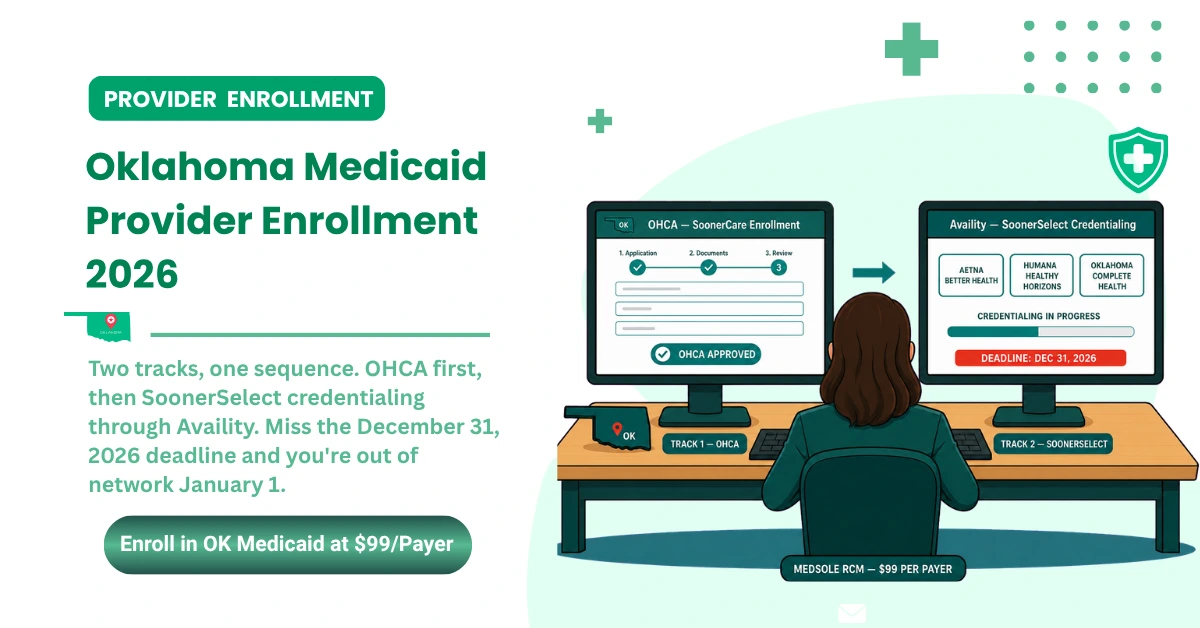
Oklahoma enrollment runs on two separate tracks, and missing the second one is the most common mistake practices make. First, you complete OHCA provider enrollment through the Electronic Provider Enrollment portal at ohcaprovider.com. Second, you credential with the SoonerSelect health plans.
Neither track replaces the other. The SoonerSelect plans won't start their review until OHCA confirms your enrollment.
MedSole RCM manages the full process for Oklahoma providers, from the OHCA application through SoonerSelect credentialing, at $99 per payer, the most affordable provider enrollment rate in the United States.
Key Facts About Oklahoma Medicaid Provider Enrollment in 2026
Before you open the OHCA provider enrollment application, these are the facts that shape how SoonerCare works in 2026.
- SoonerCare enrollment runs through OHCA's Electronic Provider Enrollment portal at ohcaprovider.com. A clean application clears in about 15 business days, and renewal-season review takes 30 to 40 business days.
- After OHCA confirms enrollment, providers serving SoonerSelect members credential separately with three contracted plans: Aetna Better Health of Oklahoma, Humana Healthy Horizons of Oklahoma, and Oklahoma Complete Health. The SoonerSelect credentialing platform is Availity.
- The SoonerSelect provider credentialing deadline moved. Every network provider must be fully credentialed by December 31, 2026, and any provider who misses that date is removed from the network on January 1, 2027.
- The EPE application session expires after 35 days of inactivity. Miss that window from your last save, and the system deletes your data and you start over.
- Provider Portal password rules changed on April 22, 2026. Passwords now run 15 to 20 characters and must include an uppercase letter, a lowercase letter, a number, and a special character.
- OHCA sends two emails after approval: a Welcome Letter and a PIN Letter. You can't submit a claim until your provider number arrives in those letters.
The three SoonerSelect contracted health plans are Aetna Better Health of Oklahoma, Humana Healthy Horizons of Oklahoma, and Oklahoma Complete Health. Every one of their network providers must be fully credentialed by December 31, 2026, or leave the network on January 1, 2027.
Who Must Enroll in Oklahoma Medicaid
Providers don't have to accept Medicaid patients. But any physician or healthcare professional who wants to treat SoonerCare members and get paid must complete Medicaid Oklahoma provider enrollment with OHCA before billing a single claim.
Direct Billing Providers
SoonerCare provider enrollment starts with identifying who actually has to enroll: physicians, nurse practitioners, physician assistants, licensed clinical social workers, licensed professional counselors, dentists, optometrists, psychologists, behavioral health specialists, FQHCs, rural health clinics, hospitals, ASCs, home health agencies, DME suppliers, and labs.
Two enrollments matter here. Every individual rendering provider enrolls under their own NPI-1, and the group practice enrolls under its NPI-2. A group enrollment does not cover the individual providers inside it, and that gap is one of the most common enrollment errors OHCA sees.
Ordering, Referring, and Prescribing (ORP) Providers
Federal rule 42 CFR 455.410 ORP enrollment requirement adds a second group. Any physician or professional who orders tests, refers patients, or prescribes medications for SoonerCare members must enroll with OHCA, even if they never submit a claim.
This part is not optional. If an ORP provider isn't enrolled, the billing provider's claim gets denied. A specialist who only takes referrals from SoonerCare members and never bills OHCA directly still has to enroll under this rule.
Under 42 CFR 455.410(b), any physician or professional who orders, refers, or prescribes services for Oklahoma SoonerCare beneficiaries must be enrolled with OHCA, even if they never bill Medicaid directly.
OHCA ties each enrollment to a specific practice location. If you practice at more than one location, you enroll each location separately.
OHCA Enrollment and SoonerSelect Credentialing: Two Separate Processes, One Complete Practice
OHCA enrollment and SoonerSelect credentialing are two different steps that run in sequence, and finishing one does not cover the other.
|
Factor |
OHCA Enrollment |
SoonerSelect Credentialing |
|---|---|---|
|
What it does |
Registers you with Oklahoma Medicaid to bill SoonerCare fee-for-service |
Verifies your clinical qualifications for in-network status with each SoonerSelect plan |
|
Who it goes through |
OHCA, via ohcaprovider.com |
Three contracted plans, through Availity (one shared CVO) |
|
When it happens |
First; required before credentialing starts |
Second; plans won't review until OHCA confirms enrollment |
|
Timeline |
15 business days (clean app); 30 to 40 (renewal) |
Up to 45 days per plan; 60 with an extension |
|
Without it |
You can't bill any SoonerCare claim |
You can't bill SoonerSelect members, who are most of Oklahoma Medicaid |
Oklahoma Medicaid credentialing has two layers, and providers who treat them as one fall behind. Most SoonerCare members now get coverage through SoonerSelect, not traditional fee-for-service. A provider who finishes OHCA provider enrollment but skips SoonerSelect provider credentialing can still bill FFS claims, but loses access to the majority of Oklahoma Medicaid patients. That's a revenue gap you can prevent.
All three plans share one credentialing verification organization, and that platform is Availity. The OHCA SoonerSelect provider FAQ confirms the single-CVO setup. You complete the Availity application once, and inside that one application you pick which of the three plans you want to join. You submit one application instead of three.
The three plans are Aetna Better Health of Oklahoma (CVS Health/Aetna), Humana Healthy Horizons of Oklahoma (Humana), and Oklahoma Complete Health (Centene Corporation). If Aetna is part of your payer mix, our Aetna Better Health enrollment guide breaks down that plan's process.
Running two credentialing tracks while you're also seeing patients is where most Oklahoma enrollment delays start. MedSole RCM works the OHCA application and SoonerSelect credentialing at the same time, so your providers reach full billing access sooner and without the back-and-forth that stalls in-house teams. MedSole RCM manages Oklahoma Medicaid provider enrollment and SoonerSelect credentialing simultaneously at $99 per payer, the most affordable rate in the United States for coordinated Oklahoma Medicaid enrollment.
How to Complete Oklahoma Medicaid Provider Enrollment Through the OHCA Portal: 5 Steps
The Medicaid Oklahoma provider enrollment application for SoonerCare runs entirely online, through the Electronic Provider Enrollment portal at ohcaprovider.com. Five steps take you from account setup to your first billable claim in 2026.
Step 1: Create Your OHCA Provider Portal Account
First-time applicants set up a user account before they can open the enrollment application. Start at the OHCA EPE enrollment portal. The April 22, 2026 password change trips up more people than you'd expect. Accounts now need 15 to 20 characters, with an uppercase letter, a lowercase letter, a number, and a special character, and the password can't contain your username or parts of your display name.
Get this wrong and the account fails at creation, which costs you your start date and forces you to re-enter your basic information. Set the password correctly the first time.
Step 2: Select the Correct Provider Type and Enrollment Category
Picking the wrong enrollment type causes more Oklahoma denials than any other single error. OHCA sorts providers by entity type (individual, group, or facility) and by specialty, and those choices decide which contract types appear, which provisions apply, and which documents the system asks for.
A wrong selection forces a restart from zero, and you can't fix it mid-application. A solo physician, a group NPI-2, and a facility follow different paths from the first screen, so confirm your structure before you start.
Step 3: Complete the Application and Upload Documents
The application collects your NPI (Type 1 for individuals, Type 2 for groups), taxonomy codes, Tax Identification Number, practice addresses, ownership disclosures, and license information. Once you start, OHCA shows a document checklist built for your provider type. Most SoonerCare provider enrollment delays trace back to this step.
One rule saves applications here: you have 35 days from your last save to submit. After 35 days of inactivity, OHCA deletes everything you entered and you start over. Set a calendar reminder before you save and step away from an unfinished application.
Step 4: Complete Provider Screening (If Required)
Federal rules make OHCA screen every enrolling provider by risk level, limited, moderate, or high, under 42 CFR 455.450. Moderate and high-risk providers may get a site visit, announced or not.
High-risk providers, which include newly enrolling DME suppliers, home health agencies, and skilled nursing facilities, also submit fingerprints and pass a criminal background check. If an OHCA representative shows up for a site visit, cooperate, because they can conduct it without notice.
Step 5: Wait for Review, Track Status, and Don't Bill Early
After you submit, OHCA reviews the application and emails you within about 15 business days for a clean file. During renewal seasons, give it 30 to 40 business days.
You can track progress with the OHCA status tool, which needs your ATN (Application Tracking Number) and either your SSN or FEIN. That's the Oklahoma Medicaid provider enrollment status tool people search for, and most pages never explain how to use it.
When OHCA approves you, two emails go to the Official Contact on file: a Welcome Letter and a PIN Letter. Don't submit claims until your provider number arrives, because claims sent before that number is issued get denied.
The most common cause of Medicaid Oklahoma provider enrollment delays isn't the process itself. It's documentation gaps and portal navigation between Step 1 and Step 3. MedSole RCM runs every step of the OHCA provider enrollment process, catches documentation gaps before they turn into denials, and follows up on status weekly until the Welcome Letter lands. Our credentialing services at $99 per payer keep Oklahoma enrollment moving. MedSole RCM follows up on Oklahoma Medicaid provider enrollment applications weekly and reaches approval faster than the 15 business day baseline through continuous OHCA portal follow-up, at $99 per payer.
Required Documents for Oklahoma Medicaid Provider Enrollment in 2026
In Medicaid Oklahoma provider enrollment, the documents you need depend on your provider type. The EPE application shows a provider-specific list once you pick your enrollment category, and SoonerCare provider enrollment moves faster when the core documents below are ready before you start.
Documents for the OHCA EPE Application
|
Document |
Notes |
|---|---|
|
NPI-1 (individual) and NPI-2 (group, if applicable) |
Registered and active in NPPES |
|
Tax Identification Number (EIN, or SSN for solo providers) |
Must match the NPI registration exactly |
|
Active Oklahoma medical or professional license |
Must show a current expiration date |
|
Current malpractice insurance certificate |
Must list coverage dates and limits |
|
CAQH ProView profile (if applicable) |
Must be attested; OHCA and the plans pull from CAQH, and an expired attestation (due every 120 days) stops both tracks |
|
Government-issued photo ID |
Current, not expired |
|
DEA certificate |
Required for prescribing providers |
|
Taxonomy code |
Must match the specialty exactly; a mismatch triggers a denial |
|
Voided check or bank letter on letterhead |
For EFT setup; deposit slips are not accepted |
|
Ownership disclosure documentation |
Required for any provider with ownership interest in a group or facility |
Additional Documents for SoonerSelect Credentialing (Submitted via Availity)
|
Document |
Notes |
|---|---|
|
Board certification documentation |
Specialty-specific; most plans require it |
|
NPDB (National Practitioner Data Bank) query |
Plans run primary source verification directly |
|
Hospital affiliations (if applicable) |
Plan credentialing committees verify independently |
|
Work history (five-year minimum) |
Required on the Availity credentialing form |
Two things catch providers off guard. First, EFT setup isn't optional. OHCA pays every provider by direct deposit, and only a voided check or a bank letter on letterhead works. Deposit slips don't qualify, and EFT effective dates fall on Wednesday or Thursday each week.
Second, if your practice pays individual rendering providers under a group FEIN and EFT arrangement, OHCA wants a Group Appendix A form instead of the standard EFT setup.
SoonerSelect Plan Credentialing After OHCA Enrollment: The Three Plans, Availity, and the December 31, 2026 Deadline
SoonerCare has moved most of its members into SoonerSelect managed care. A provider who finishes OHCA enrollment but skips the SoonerSelect plans can bill traditional fee-for-service claims, but can't bill the patients who now make up the largest share of Oklahoma's Medicaid population. SoonerSelect credentialing isn't optional for any practice that wants full Medicaid Oklahoma provider enrollment billing access.
The Three SoonerSelect Health Plans
|
Health Plan |
Parent Company |
Provider Credentialing Contact |
|---|---|---|
|
Aetna Better Health of Oklahoma |
CVS Health / Aetna |
(844) 365-4385 |
|
Humana Healthy Horizons of Oklahoma |
Humana |
(855) 223-9868 |
|
Oklahoma Complete Health |
Centene Corporation |
(833) 752-1664 |
Some provider resources online list Blue Cross Blue Shield of Oklahoma as the third SoonerSelect plan. That is incorrect. Blue Cross Blue Shield of Oklahoma is not a SoonerSelect contracted health plan. The third plan is Oklahoma Complete Health, run by Centene Corporation. Send your credentialing to the wrong entity and you delay enrollment, sometimes by weeks.
How Availity Works as the Single CVO
OHCA requires all three plans to use one credentialing verification organization, and that platform is Availity. SoonerSelect provider credentialing runs through that one platform for every plan. You complete the Availity application once, and inside it you select which of the three plans you want to join. You file one application rather than three separate ones in three portals, and most in-house teams don't know that.
Timing matters here. Plans have up to 45 days to credential you after they receive a complete Availity application. If a plan needs more time, it can request a 15-day extension from OHCA, for a 60-day maximum. SoonerSelect provider credentialing can't begin until you hold a valid OHCA Medicaid ID and appear on the Provider Master List, so OHCA enrollment genuinely comes first.
The December 31, 2026 Deadline and What Happens January 1, 2027
OHCA gave the transitional Oklahoma Medicaid credentialing runway a six-month extension because of backlogs in the fee-for-service contracting process. The hard deadline is now December 31, 2026, and plans must have every network provider fully credentialed by that date.
On January 1, 2027, any provider who hasn't met all credentialing requirements comes out of that plan's network. Removal means you can't bill SoonerSelect members, and those patients move to other in-network providers. For a practice with heavy SoonerSelect volume, missing the deadline cuts revenue starting on the first billing day of 2027.
Once your credentialing clears and you're active in all three networks, SoonerSelect claims run through each plan's own submission system. Practices juggling SoonerCare FFS and SoonerSelect managed care billing at once do better with one coordinated team. MedSole RCM's outsourced medical billing services handle SoonerCare and SoonerSelect claims in a single revenue cycle at 2.99% of collections.
How Long Does Oklahoma Medicaid Provider Enrollment Take: Complete 2026 Timeline
One question comes up more than any other in Oklahoma Medicaid provider enrollment: how long does it take? The answer depends on which stage you're in, because OHCA provider enrollment and SoonerSelect provider credentialing run on separate clocks.
|
Stage |
Timeline |
Notes |
|---|---|---|
|
OHCA EPE application review (new, clean app) |
About 15 business days |
OHCA notifies by email; clean means all documents uploaded, no deficiencies |
|
OHCA contract renewal review |
30 to 40 business days |
Renewal seasons raise volume; file early |
|
SoonerSelect credentialing via Availity (per plan) |
Up to 45 days (60 with extension) |
Can't begin until you have an active OHCA Medicaid ID on the Provider Master List |
|
Full enrollment and SoonerSelect billing access (combined) |
60 to 90 days from first OHCA submission |
Realistic projection for a clean application; incomplete files add correction cycles |
The 60 to 90 day projection assumes a clean OHCA application, a complete CAQH ProView profile with current attestation, and prompt uploads to Availity. Any documentation gap adds a correction cycle, which can add 30 to 60 days.
CAQH ProView attestation expires every 120 days. An expired profile stalls the OHCA review and the Availity credentialing at the same time. Let CAQH lapse mid-enrollment and both tracks wait until you re-attest and the data re-verifies.
Already enrolled at one location and opening another? You file a separate OHCA enrollment for the new address. Each enrollment is tied to a service location, and a location-addition application follows the same 15 business day baseline as a new enrollment.
Common Oklahoma Medicaid Enrollment Denial Reasons and How to Prevent Them in 2026
Most Medicaid Oklahoma provider enrollment denials are preventable. They come from a short list of specific errors OHCA sees again and again across provider types. Oklahoma Medicaid credentialing denials usually trace back to data that doesn't match across systems, and knowing what triggers a denial before you submit is the cheapest way to protect your timeline.
|
Denial Trigger |
What Goes Wrong |
Prevention |
|---|---|---|
|
Wrong enrollment type |
Provider picks individual when the right choice is group, or the reverse; the denial means a restart from zero |
Confirm your structure (individual, group, or facility) and match it to the OHCA category before you open the application |
|
Taxonomy code mismatch |
The taxonomy on the OHCA application doesn't match the one in NPPES, and OHCA cross-checks |
Verify taxonomy in NPPES and CAQH first; fix NPPES if it's wrong, and allow 24 to 48 hours for the correction to propagate |
|
Expired or unattested CAQH ProView profile |
Attestation lapses every 120 days, and an expired profile at submission triggers a hold |
Re-attest before you start the OHCA application; confirm the attestation date instead of assuming the profile is current |
|
Missing or incorrect ownership disclosure |
Providers with 5% or more ownership in a facility must disclose it; gaps trigger a denial and can push a high-risk reclassification |
Complete the ownership disclosure fully, even for minority stakes |
|
ORP provider not enrolled |
A claim names an ordering or referring physician who isn't enrolled with OHCA, and the claim is denied no matter how clean the rest is |
Audit every ordering and referring provider in your network; unenrolled ORP providers hit billing volume, not just single claims |
|
NPI Type 1 and Type 2 mismatch |
The rendering provider's NPI-1 isn't linked to the group's NPI-2 in OHCA's system |
Confirm the NPI linkage in NPPES before you submit; OHCA validates the relationship during review |
A denial doesn't mean permanent rejection. OHCA returns the application with a reason code, you correct the error, and you resubmit. Each cycle adds time. A single taxonomy mismatch can add 30 to 60 days, because the corrected application re-enters the review queue from the start.
For providers who already have a denial to fix, or practices fighting recurring SoonerCare claim denials after enrollment, MedSole RCM's denial management services find the root cause, correct the file, and resubmit clean. The same eye that prevents denials up front recovers revenue from the ones that already happened.
Critical 2026 Federal and Oklahoma Updates Every SoonerCare Provider Must Know
Six regulatory changes took effect in 2026 that touch Medicaid Oklahoma provider enrollment and ongoing SoonerSelect provider credentialing compliance. Providers who enrolled before 2026 and haven't reviewed these may be out of compliance on one or more without knowing it.
Update 1: CMS Swift Revalidation Directive (April 23, 2026)
On April 23, 2026, CMS Administrator Dr. Mehmet Oz sent directive letters to every governor and state Medicaid director, telling states to revalidate Medicaid providers quickly, with a focus on high-risk providers. States had 10 business days to respond with a timeline and 30 days to submit a two-year revalidation strategy. Oklahoma providers in the high-risk category should expect off-cycle revalidation outreach from OHCA through the rest of 2026.
Update 2: Executive Order 2025-16 Attestation (January 15, 2026)
OHCA brought back the provider attestation tied to Executive Order 2025-16, reissued on January 15, 2026. The updated form sits under Forms on OHCA's Provider Enrollment page. OHCA built the attestation into the Provider Portal, so attestations for new contracts and renewals now happen in the portal instead of on paper. New enrollments and renewals in 2026 hit this step during the portal workflow.
Update 3: Provider Portal Password Requirements (April 22, 2026)
OHCA changed Provider Portal password rules on April 22, 2026. Passwords now run 15 to 20 characters and need an uppercase letter, a lowercase letter, a number, and a special character. They can't contain your username or parts of your display name. Providers who haven't logged in since April 22, 2026 may need to reset before they can reach their enrollment records.
Update 4: Tighter Risk-Based Screening Under 42 CFR 455.450
Risk level decides how deeply OHCA screens you. Under 42 CFR 455.450 provider screening levels, every provider lands in a limited, moderate, or high category. Limited-risk providers get license verification and database checks. Moderate-risk providers add a site visit that can happen without notice. High-risk providers add fingerprint-based background checks for anyone with 5% or more ownership. The 2026 CMS directive has pushed states to move more providers up to moderate or high risk.
Update 5: Monthly OIG and SAM.gov Monitoring
Under 2026 NCQA standards, monthly monitoring of the OIG exclusion list and the SAM.gov sanctions database is mandatory for every credentialed provider. Quarterly monitoring is obsolete. Oklahoma Medicaid credentialing now carries this monthly obligation, so for a practice with several credentialed providers it's an ongoing job, not a one-time task. A provider who lands on the OIG list between cycles triggers an automatic review that can end in disenrollment if nobody's running the monthly checks.
Update 6: CY 2026 Application Fee of $750 for Institutional Providers
CMS set the CY 2026 application fee at $750 for institutional providers enrolling, revalidating, or adding a location. The fee covers applications submitted between January 1 and December 31, 2026. Individual physicians and non-physician practitioners are exempt. Providers who already paid the fee for a Medicare enrollment or another state's Medicaid can claim an exemption with documentation. The fee isn't refunded if screening denies the application.
Oklahoma Medicaid Provider Enrollment Contacts, Phone Numbers, and Hours (2026)
For questions about the SoonerCare provider enrollment process, application status, or contract renewals, the OHCA contacts below are current as of June 2026. The full directory lives on the OHCA provider contact directory page.
|
Contact Purpose |
Phone / Email |
Hours |
|---|---|---|
|
Provider enrollment questions and renewals |
800-522-0114, option 5 |
Mon, Tue, Thu, Fri 8 a.m. to 5 p.m.; Wed 1 p.m. to 5 p.m. |
|
Provider enrollment email |
ProviderEnrollment@okhca.org |
Business hours |
|
OHCA provider helpline (claims, billing, general) |
405-522-6205 or 800-522-0114 |
Business hours |
|
Provider education and billing training |
SoonerCareEducation@okhca.org |
Email only |
|
OHCA main address |
4345 N Lincoln Blvd, Oklahoma City, OK 73105 |
In-person by appointment |
|
Aetna Better Health of Oklahoma (credentialing) |
(844) 365-4385 |
Business hours |
|
Humana Healthy Horizons of Oklahoma (credentialing) |
(855) 223-9868 |
Business hours |
|
Oklahoma Complete Health (credentialing) |
(833) 752-1664 |
Business hours |
Enrolling in Medicaid across several states alongside Oklahoma? MedSole RCM's Medicaid provider enrollment guide covers the full 50-state landscape.
Out-of-State and Telehealth Provider Enrollment in Oklahoma Medicaid
Out-of-state providers who treat Oklahoma Medicaid patients by telehealth or short in-state visits complete Medicaid Oklahoma provider enrollment through the same OHCA EPE process as in-state providers.
Oklahoma has no separate pathway for out-of-state providers. Federal Medicaid rules don't let states build a simplified track for non-residents. An out-of-state physician seeing SoonerCare patients by telehealth still needs an active Oklahoma medical license, an Oklahoma service location address on file with OHCA, and the full five-step EPE application. Telehealth practices ask about out of state Oklahoma medicaid provider enrollment more than any other non-resident question.
CMS guidance lets telehealth providers use the patient's home address or a registered in-state administrative address for the service location when there's no physical Oklahoma office. The Oklahoma license still applies. Providers who only want to order or refer (ORP-only) follow the same EPE process but skip SoonerSelect credentialing unless they also want in-network billing.
SoonerSelect network participation for out of state Oklahoma medicaid provider enrollment follows the same Availity process, and geography doesn't waive credentialing.
Practices enrolled in Medicaid across several states run a separate credentialing workflow for each one. MedSole RCM's Medicaid credentialing experts manage multi-state enrollment in parallel, so Oklahoma doesn't stall while other states are in progress.
Frequently Asked Questions About Oklahoma Medicaid Provider Enrollment
Is SoonerCare the same as Oklahoma Medicaid?
Yes. SoonerCare is the brand name for Oklahoma's Medicaid program, run by the Oklahoma Health Care Authority. The two terms mean the same program. When you enroll with OHCA for SoonerCare, you're enrolling in Oklahoma Medicaid. SoonerSelect managed care is a part of SoonerCare, not a separate program.
How do I check the status of my Oklahoma Medicaid enrollment application?
Check status through OHCA's EPE portal status tool at ohcaprovider.com. The tool needs your ATN (Application Tracking Number) and either your Social Security Number or FEIN. The ATN is generated when you submit. No ATN on hand? Call OHCA provider enrollment at 800-522-0114, option 5.
Can I bill SoonerCare patients before my provider number arrives?
No. You need both the Welcome Letter and the PIN Letter from OHCA before you submit any claim. OHCA sends both to the Official Contact on the EPE application, and they carry the provider number you bill under. Claims sent before that number is issued get denied.
Do I enroll separately with each SoonerSelect health plan?
Yes, but it's consolidated through Availity, the single credentialing verification organization all three SoonerSelect plans use. You complete one Availity application and pick which plans you want to join. Each plan still runs its own committee review, but you don't build three profiles in three portals.
How long does Oklahoma Medicaid provider revalidation take?
Federal rule 42 CFR 455.414 requires OHCA to revalidate every enrolled provider at least every five years. OHCA emails you when revalidation is due. It uses the same EPE portal and documentation as initial enrollment. During renewal seasons, allow 30 to 40 business days. Miss the deadline and OHCA disenrolls you automatically.
What happens if my CAQH ProView profile isn't attested when I apply?
An unattested CAQH profile can stall OHCA enrollment and SoonerSelect Availity credentialing at once, because both pull from CAQH as a primary source. Attestations expire every 120 days. Re-attest the profile and allow 24 to 48 hours for updates to propagate before you submit any enrollment application.
What does the $750 application fee cover in 2026?
The CY 2026 fee is $750 for institutional providers enrolling, revalidating, or adding a location in any state Medicaid program, including SoonerCare. Individual physicians and non-physician practitioners are exempt. Providers who paid the fee for a Medicare PECOS enrollment or another state's Medicaid can submit documentation to claim an exemption. The fee isn't refunded if the application is denied.
Can a group practice submit one enrollment for everyone in the group?
No. The group entity (NPI-2) enrolls, and each rendering provider inside it (NPI-1) enrolls too. An enrolled group NPI-2 doesn't cover the providers under it. This is a steady source of denials for new groups: the group is enrolled, claims go out, and they're denied because the rendering provider's individual enrollment is missing.
What's the SoonerSelect credentialing deadline for 2026?
OHCA extended the transitional credentialing runway by six months. Plans must have every network provider fully credentialed by December 31, 2026. On January 1, 2027, any provider who hasn't met all credentialing requirements comes out of that plan's network and can't bill its members.
How does out-of-state telehealth enrollment work in Oklahoma Medicaid?
Out-of-state providers serving Oklahoma SoonerCare members by telehealth complete the same full OHCA EPE enrollment as in-state providers. There's no simplified track for telehealth or non-residents. You need an active Oklahoma license for your specialty and a valid Oklahoma service location address on the EPE application.
Get Oklahoma Medicaid Provider Enrollment Done Right the First Time
Oklahoma Medicaid provider enrollment has two sequential tracks, a five-step OHCA application, a December 31, 2026 SoonerSelect credentialing deadline, and six federal updates from 2026 alone. That's a lot to manage on top of a full patient schedule.
MedSole RCM handles every step of SoonerCare provider enrollment for Oklahoma providers: OHCA EPE application prep, documentation review, portal submission, status follow-up, SoonerSelect Availity credentialing, and post-approval billing setup. We have credentialed more than 4,000 providers across all 50 states. MedSole RCM handles Oklahoma Medicaid provider enrollment at $99 per payer, the lowest price for full-service SoonerCare enrollment support in the United States. We follow up on every application weekly, and MedSole RCM reaches Oklahoma Medicaid approvals faster than the OHCA baseline through that weekly follow-up. Once you're enrolled, our revenue cycle management team handles SoonerCare and SoonerSelect billing at 2.99% of collections, MedSole RCM's full-service billing rate.
The practices that clear SoonerCare enrollment without delays know the portal rules before they open the application, keep their CAQH attestation current, and have someone tracking the file every week until the Welcome Letter arrives. That's what MedSole RCM does for every Oklahoma practice on our books.
Contact MedSole RCM for a free enrollment consultation, and we'll map your SoonerCare timeline for your provider type and practice structure.