



New Mexico Medicaid provider enrollment is the process by which healthcare providers register with the New Mexico Health Care Authority through the Provider and Presumptive Eligibility Determiner system at YES.NM.GOV before they can bill for services delivered to Medicaid members.
Three things about NM Medicaid provider enrollment changed between July 2024 and June 2026. Most published guides still describe the old versions.
|
Where it stands in 2026 |
|
|---|---|
|
Who administers it |
New Mexico Health Care Authority (HCA), Medical Assistance Division (MAD) |
|
Where you apply |
YES.NM.GOV, inside the Provider and PED Enrollment System |
|
Paper applications |
Not accepted. The portal replaced the form |
|
Managed care program |
Turquoise Care, four contracted MCOs |
|
MCO credentialing |
Centralized through CertifyOS since March 1, 2026 |
|
Claims system |
Turquoise Claims, live March 23, 2026 |
|
Revalidation |
Every three years, application opens in month 34, 60 days to respond |
|
Live deadline |
October 1, 2026. ORP providers must be enrolled or the rendering claim denies |
The October 1, 2026 Deadline That Denies Your Claim, Not Theirs
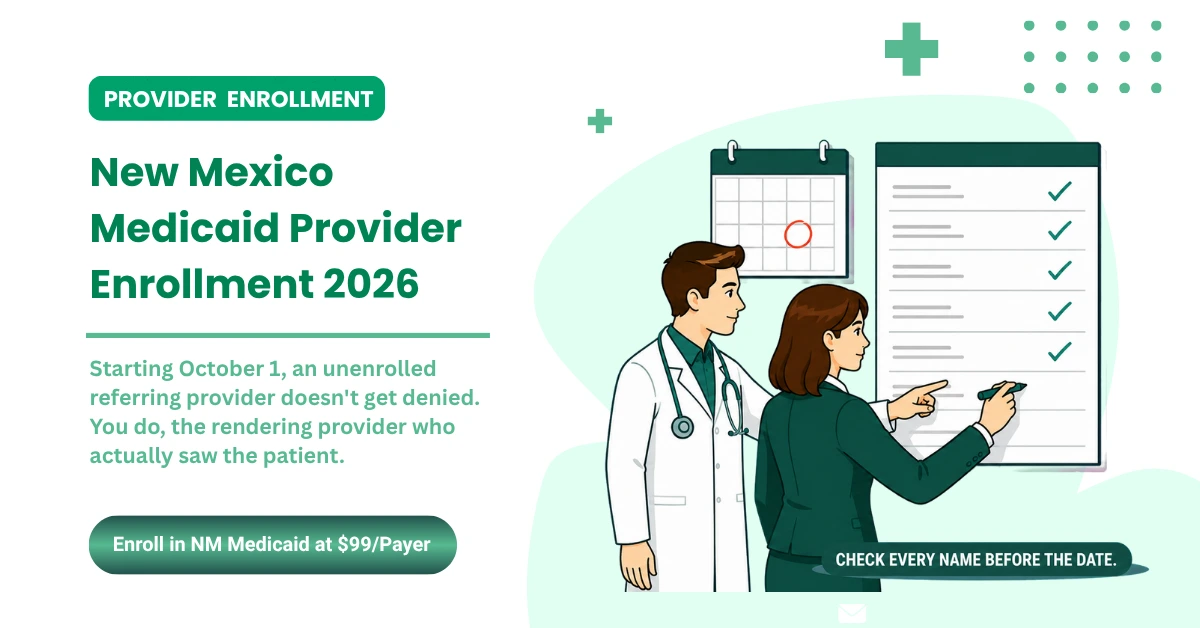
Starting October 1, 2026, New Mexico denies the claim when the ordering, referring, or prescribing provider isn't enrolled in Medicaid. Read that again. The denial doesn't land on the referring physician. It lands on you, the rendering provider, the one who actually saw the patient.
HCA's ORP FAQ, revised June 24, 2026, is blunt about it in question 10. Claims referred, ordered, or prescribed on or after October 1 by an unenrolled provider get denied, and payment can't be made retroactively for services already delivered.
Who Counts as an Ordering, Referring, or Prescribing Provider
The scope runs wider than most practices assume. Per the New Mexico Health Care Authority ORP page, an ORP provider is any individual clinician who directly delivers services to a Medicaid member. That covers pharmacists, physicians, nurse practitioners, physician assistants, behavioral health clinicians, therapists, dentists, and other licensed practitioners.
Setting doesn't get you out of it. Hospital-employed and contracted clinicians count. So do clinicians working inside an FQHC or a Rural Health Clinic, and providers contracted by Indian Health Services or a Tribal 638.
Here's the part that catches groups. Even when claims go out under a group NPI or a facility billing number, each individual ORP provider still needs separate enrollment. Presbyterian put it plainly in its own pharmacy alert: enrollment is required at the individual NPI level, even when the organization is already enrolled.
Was the NM ORP Deadline July 1 or October 1, 2026?
Both dates are real, and only one of them is current. UnitedHealthcare published July 1, 2026 in its June 2026 Network News. HCA then extended the deadline to October 1, 2026, and UnitedHealthcare updated that article on June 22, 2026 with a banner pointing readers to the revised version.
HCA's own ORP page was updated June 25, 2026 and carries October 1, with the HCA ORP FAQs revised a day earlier.
So the rule for your team is simple. Any ORP guidance issued before late June 2026 carries the superseded July date. Check the revision date on whatever bulletin lands in your inbox, because several billing guides still show July 1 in their NM Medicaid provider enrollment sections today.
The MCOs Enforce This Too
Don't assume the health plans will be softer. HCA mandates that MCOs deny claims with an October 1, 2026 date of service and beyond when the attending, referring, ordering, and prescribing providers aren't enrolled. Under 8.308.2 NMAC, the plan has to verify that billing, rendering, ordering, attending, and prescribing providers are all enrolled with MAD.
Presbyterian said the quiet part out loud in its pharmacy alert. This is a New Mexico Medicaid requirement, and Presbyterian can't override the denials.
Two more consequences are worth knowing. Claims may be recouped when a provider refuses to enroll. And pharmacy claims for prescriptions written by non-enrolled providers get rejected at the point of sale, which means your patient is standing at the counter without their medication.
New Mexico isn't the only state doing this. Ohio's ORP deadline hits managed care claims on January 1, 2027, so groups working both states have two clocks running.
Here's what this means for your Monday morning. Pull your clinician roster. Every provider who orders, refers, prescribes, or attends needs individual enrollment, including the ones who never submit a claim under their own NPI.
That referring doctor who's been sending you patients for six years? That's the one who breaks your claims in October. New Mexico Medicaid provider enrollment for an ORP-only clinician is a shorter application than a full billing enrollment, which is worth knowing before you panic about the volume.
If your roster turns up more unenrolled clinicians than your staff has hours to file for, that's what our Medicaid provider enrollment services cover at $99 per insurance.
YES.NM.GOV or the Conduent Portal: Which One Handles NM Medicaid Provider Enrollment
Enrollment, revalidation, record updates, and application status tracking all happen at YES.NM.GOV inside the HCA Provider and PED Enrollment System. The legacy New Mexico Medicaid Portal operated by Conduent doesn't handle enrollment anymore.
You don't have to take my word for it. HCA's own Provider Enrollment and Relations page tells anyone seeking Medicaid or Medicare enrollment to go to YES.NM.GOV instead.
What Each System Does Now
|
System |
What it handles now |
Status |
|---|---|---|
|
YES.NM.GOV, Provider and PED Enrollment System |
Enrollment, revalidation, recertification, re-enrollment, record updates, real-time status |
Current |
|
Turquoise Claims |
Claims processing, live since March 23, 2026 |
Current |
|
NM Medicaid Web Portal (Conduent) and Omnicaid |
Replaced by Turquoise Claims |
Legacy |
The portal itself is better than what it replaced. You get a message center with alerts, a document library for storing files, designated administrator accounts so staff can manage multiple enrollments, and a virtual assistant for common questions.
One limitation matters for large groups. Batch user registration and batch role assignment aren't available in either YesNM or Turquoise Claims. Users and organizations get configured one at a time, so a 40-provider group needs to budget for that.
There Is No Paper Enrollment Form
If you're hunting for a downloadable PDF, stop. NM Medicaid provider enrollment online is the only route now, and the portal replaced the paper application outright.
You'll still find the old form names in older guidance. MAD 335 was the Provider Participation Agreement for groups, organizations, and individuals receiving payment, while MAD 312 covered an individual applicant inside a group. Neither one gets you enrolled today.
One warning before you create an account. The persona you pick at signup decides whether you see the enrollment tools at all, and picking wrong means starting over. More on that shortly.
HCA, MAD, and Why Older Guides Still Say HSD and Centennial Care
The Health Care Authority administers New Mexico Medicaid. Inside HCA, the Medical Assistance Division oversees provider enrollment, re-enrollment, and revalidation, which the HCA Providers Overview states directly.
The Human Services Department was folded into HCA, and 8.302.2 NMAC reflects the change with an amendment effective July 1, 2024. Any guide still naming HSD as the administering agency is describing something that doesn't exist.
What Changed on July 1, 2024
|
Old name |
Current name |
Changed |
|---|---|---|
|
Human Services Department (HSD) |
Health Care Authority (HCA) |
July 1, 2024 |
|
Centennial Care 2.0 |
Turquoise Care |
July 1, 2024 |
|
Omnicaid, NM Medicaid Web Portal |
Turquoise Claims |
March 23, 2026 |
|
Paper PPA (MAD 335, MAD 312) |
YES.NM.GOV application |
Portal replaced the form |
This isn't a naming nitpick. A provider who searches Centennial Care provider enrollment lands on guidance that points at portals no longer accepting applications, and spends a week working a dead process before anyone notices.
Federal rules under 42 CFR Part 455 set the screening floor every state Medicaid program has to meet, and each state layers its own requirements on top. Our 50-state Medicaid enrollment guide covers that federal baseline. Everything below is what New Mexico adds.
Who Has to Enroll in NM Medicaid, by Provider Type
NM Medicaid provider enrollment branches by provider type, and the branch decides your application track, your signature rule, and whether you need rendering providers attached.
One structural rule governs all of it. A separate application is required for each provider type under a single NPI. Multiple taxonomies falling under one provider type go on one application, per HCA's Provider and PED Enrollment System FAQs.
|
Provider type |
Application track |
Rendering providers required |
Who signs |
|---|---|---|---|
|
Individual practitioner, Type 1 NPI |
Individual |
Not applicable |
The provider, personally |
|
Group or billing entity, Type 2 NPI |
Group billing |
Yes, except provider types 346, 363, 401, 402, 403, 404, and 414 |
Owner, controlling interest, or approved Delegated Official |
|
Facility or organizational |
Group billing |
Yes, with the same exceptions |
Owner or Delegated Official |
|
ORP only, no claims submitted |
Individual |
Not applicable |
The provider, personally |
|
Behavioral health agency |
Group billing |
Yes |
Owner or Delegated Official |
|
IHS or Tribal 638 |
Varies by arrangement |
Varies |
Varies |
|
Atypical, no NPI |
Atypical |
Not applicable |
The provider or owner |
Individual Practitioners and Rendering Clinicians
Every individual provider signs their own application. That holds even when an administrator filled in every field, and HCA is explicit that it's a New Mexico state requirement rather than a system quirk.
Groups, Facilities, and Organizational Providers
Groups need rendering providers attached, with seven exceptions. Provider types 346, 363, 401, 402, 403, 404, and 414 don't. If your provider type sits on that list and someone tells you the application is incomplete without rendering providers, they're working from a general rule that doesn't apply to you.
Behavioral Health, Therapists, and ABA Providers
Behavioral health agencies enroll on the group billing track, and the ORP rule reaches every licensed clinician in the practice who refers or prescribes. A therapist who never bills under their own NPI still needs an individual enrollment if they refer patients out. Our therapist credentialing pathway walks through the commercial side of the same problem.
Residents, Interns, and House Officers
HCA publishes HCA residents and interns guidance specifically for this group, along with a Verification of Institutional DEA Suffix Form. Teaching hospitals with rotating residents who write orders need both documents, and no competing enrollment guide mentions either one.
Atypical Providers Without an NPI
An atypical provider is one that delivers non-healthcare services under Medicaid, so it doesn't qualify for an NPI under federal rules. Think non-emergency transportation or certain home and community-based services. New Mexico's managed care network rule carries the NPI requirement with an exception concept for atypical providers as CMS defines them.
Revalidation, Recertification, Re-Enrollment, and Reverification: Four Words, Three Applications
Providers use these words interchangeably. The portal doesn't. Three distinct applications exist, each with its own trigger, and picking the wrong one means filing twice.
A fourth word shows up in older New Mexico communications. Reverification was tied to the Turn Around Document, the paper notice the state used to mail on a three-year cycle. When you see it in an old payer notice, read it as revalidation.
When Each Application Applies
|
Application |
What it does |
Trigger |
|---|---|---|
|
Initial |
First enrollment for a provider type under an NPI |
New provider, or an existing provider adding a new provider type |
|
Revalidation |
Updates every element of the account |
Every three years, available in month 34 of the enrollment period |
|
Recertification |
Updates expiring licenses, accreditations, attestations, and certifications |
A document on an active account is about to expire |
|
Re-enrollment |
Returns a terminated account to active status |
Account termination, subject to the limits below |
Recertification isn't a substitute for revalidation, and that trips people up. A provider who uploaded a renewed license three months ago is still due for revalidation on the same three-year clock. The two applications do different jobs.
When Re-Enrollment Is Not an Option
Here's the fact that costs practices weeks. Accounts terminated for cause, or terminated more than three years ago, aren't eligible for re-enrollment at all. Those providers file a new initial application instead.
A new initial application means full screening again. Everything you cleared the first time gets rerun, and the timeline resets to what a brand new provider faces. A practice that budgeted for a short reactivation form finds out it's starting from zero, and that difference shows up as unbillable months.
The HCA account creation guide walks through the account setup that precedes any of these. Revalidation mechanics get their own section further down, because the timing is where most of the risk sits.
The YES.NM.GOV Workspace Rules That Stall Applications
The portal has an account structure that decides who can do what, and getting it wrong is a silent stall. Nothing rejects. Nothing bounces back. The application just sits there while your team assumes it's in review.
One Workspace Per NPI
A Workspace is the area inside your profile where applications and accounts live. Five rules govern them, and the Provider and PED Enrollment FAQs spell out all five.
- One Workspace per NPI. The system allows exactly one, no matter how many administrators your practice has.
- At least one Administrator per Workspace. This is required at all times, with no exceptions.
- You can't delete the only Administrator. Change another user's privilege type to Administrator first, then remove the original.
- You can't delete a Workspace with active applications or linked accounts. Clear both before the system will allow it.
- No limit on Workspaces per Administrator. One person can manage many, but the one-per-NPI rule still holds.
Everyone who touches the system needs their own YesNM account, entered with their own information. Sharing a login across a credentialing team isn't a workaround here, and invitations to a Workspace go out by email address.
Every Individual Provider Signs Personally
All individual providers sign their own applications, even when an administrator completed every field. HCA states this is a New Mexico state requirement rather than a system default, so there's no support ticket that gets you around it.
Groups work differently. Anyone listed on the Ownership and Controlling Interest page can sign, as can a previously approved Delegated Official.
That last phrase carries a trap. A Delegated Official can't e-sign anything until a separate application adding them has been submitted and approved by someone already authorized. If your plan is to route signatures through an office manager, that application goes in first, not alongside the enrollment files.
The Applicant Account Trap
YES.NM.GOV offers more than one persona at account creation. Pick Applicant instead of the provider persona and the enrollment tools simply aren't there. You can delete the account from My Profile, but that means starting the setup over.
Know which line to call when something breaks. YesNM account and password resets go to 1-800-283-4465. Provider enrollment questions go to 1-800-299-7304. Two different teams, and calling the wrong one costs you the call.
What You Need Before You Open an NM Medicaid Provider Enrollment Application
The portal won't let you advance past an incomplete screen. Collecting everything first turns a two-week stop-and-start into an afternoon of data entry.
The Core Document Set
If you've been searching for an HCAs provider enrollment form to fill out offline, the checklist below is the closest equivalent. These are the items the application asks for, with the detail that actually causes returns.
|
Item |
The detail that causes returns |
|---|---|
|
NPI |
Type 1 for individuals, Type 2 for groups and facilities. Data has to match your NPPES record |
|
Taxonomy code |
Selected from the HCA Provider Enrollment Matrix, matching your registered provider type |
|
TIN or SSN |
Register with the same identifiers you plan to bill with |
|
Active New Mexico license |
Current, unrestricted, with the expiration date visible |
|
Business license |
One for every county or city where you deliver services, uploaded annually |
|
DEA certificate |
Prescribing providers. Residents may need the Verification of Institutional DEA Suffix Form |
|
Ownership and control disclosures |
Five percent threshold, plus managing employees |
|
Professional liability certificate |
Active policy with current coverage dates |
Verify your NPI data at the NPPES NPI Registry before you start rather than after a return. Name, address, and taxonomy all need to line up with what you enter in the portal.
The Business License Rule Nobody Explains
New Mexico Medicaid providers have to obtain a business license for each county or city where they provide services. The license gets submitted annually through YES.NM.GOV, and HCA publishes a HCA business license guide for exactly this task.
Now the consequence, stated the way HCA states it. Failure to maintain and submit your business licenses results in termination of your Medicaid number.
Multi-location practices should read that twice. A group delivering services across three counties carries three licenses and three annual renewal dates. The termination risk attaches to the Medicaid number, not to the individual location, so one lapsed county license can take down billing for the whole group.
Ownership and Control Disclosures
Disclosures run at the five percent ownership threshold, plus managing employees as federal rules define them at 42 CFR 455.101. The managing employee piece is where boards get confused.
A managing employee is someone who exercises operational or managerial control, which means an ownership stake isn't required. Your clinical director who runs day-to-day operations qualifies. So does a practice administrator with hiring authority. Incomplete disclosures are one of the most common reasons an application comes back, and our credentialing document review catches these before submission rather than after.
Taxonomy Codes: The Matrix, the Crosswalk, and the Denial That Follows
Taxonomy is where enrollment and billing meet. It's also where a single wrong entry generates denials across every claim carrying that NPI, which is why it deserves its own section.
Turquoise Care updated its taxonomy crosswalk based on changes from the National Uniform Claim Committee, and the update landed alongside the new claims system.
How to Pick the Right Taxonomy
Your correct taxonomy comes from the HCA Provider Enrollment Matrix, not from browsing the NUCC list and picking what sounds right. HCA maintains the Matrix as a spreadsheet and updates it, with the current version dated June 23, 2026.
One structural rule saves groups a lot of rework. Multiple taxonomies under a single provider type go on one application. Taxonomies falling under different provider types need a separate application each, so check the Matrix before you decide how many files you're opening.
Two more rules worth writing down. Your taxonomy on the application has to match your NPPES data, and a provider going through revalidation shouldn't change a taxonomy that's already registered and billing cleanly. Changing it to something that looks more accurate can break claims that were paying fine.
When Taxonomy Is Required on a Claim
The rule branches, and both branches matter. If a provider has more than one taxonomy registered with HCA, the claim carries the one matching the service and that provider's registered type. If a provider has only one registered type, taxonomy isn't required on the claim.
Payers layer their own enforcement on top. BCBSNM began rejecting and denying Turquoise Care claims that don't include the appropriate taxonomy code for every billing, rendering, and attending provider NPI effective June 15, 2026. Taxonomy codes on institutional and professional claims have to match the provider's HCA registration.
Don't forget the service location either. Turquoise Claims submissions need the full nine-digit ZIP code for the physical service address, and a five-digit ZIP will fail the edit.
Here's why this compounds. A wrong taxonomy on one NPI inside a multi-provider group doesn't produce one denial. It produces a denial on every claim that NPI appears on, across every date of service in the batch, which reads like a systemic payer problem when it's actually a single data field.
All Four Turquoise Care MCOs, and Why Most Guides Name Three
Turquoise Care members choose among four health plans, and have since July 1, 2024. Guides naming three are either counting a plan that exited or leaving out one that's active.
Getting the count wrong costs you an entire patient panel. A provider who never contracts with the fourth plan can't bill its members, and nobody notices until the claims come back.
The Four Plans Under Contract
|
Health plan |
Parent |
Member services |
What to know |
|---|---|---|---|
|
Blue Cross and Blue Shield of New Mexico |
HCSC |
(866) 689-1523 |
Statewide. Taxonomy enforcement live since June 15, 2026 |
|
Presbyterian Health Plan |
Presbyterian Healthcare Services |
(888) 977-2333 |
New Mexico based. Children in state custody are enrolled here |
|
Molina Healthcare of New Mexico |
Molina Healthcare |
(844) 862-4543 |
Statewide |
|
UnitedHealthcare Community Plan |
UnitedHealth Group |
1-877-236-0826 |
The plan most competing guides leave off the list |
Two enrollment details come straight from the HCA Turquoise Care Health Plans page. Native American members always keep the choice between a health plan and fee-for-service providers. Children in state custody go to Presbyterian automatically.
Our BCBSNM Turquoise Care enrollment guide covers the largest of the four in detail, including the commercial side of the same contract.
State Enrollment Is Not MCO Credentialing
Two layers, and they're separate. State enrollment through YES.NM.GOV is layer one. MCO credentialing is layer two. A provider enrolled with the state but not credentialed with the plan covering a given member still can't bill for that member.
Layer two changed on March 1, 2026, and this is the update most published guides are missing entirely.
HCA approved CertifyOS as the shared Centralized Verification Organization for all four Turquoise Care MCOs. Blue Cross and Blue Shield of New Mexico, Molina Healthcare, Presbyterian Health Plan, and UnitedHealthcare now credential through one NCQA-certified platform instead of four separate ones.
Acting Medicaid Director Alanna Dancis framed it plainly when HCA announced the change on June 9, 2026. Providers had told the state that credentialing with each health plan separately was burdensome and slow, so all four plans moved to a single platform to validate credentials.
Here's what that actually changes for your credentialing team, and what it doesn't.
- Initial credentialing runs through CertifyOS. Providers seeking initial credentialing with any Medicaid MCO use the centralized process.
- Outreach comes from CertifyOS, not the plans. Missing-information requests during credentialing or recredentialing come from CertifyOS. Nonresponse delays your contract effective date.
- Scope covers facilities and clinicians. Facility credentialing plus medical, behavioral health, and substance use providers all run through it.
- Delegated entities are excluded. Vendors holding delegated credentialing agreements, including routine vision, pharmacy, non-emergency transportation, IPAs, and PHOs, sit outside this process.
- Recredentialing starts September 2026. It runs every three years, and CertifyOS initiates outreach six months before the due date.
- Requesting network participation hasn't changed. You still initiate the contracting request with each plan the way you always did.
Now the part people misread. Centralized credentialing does not replace Medicaid provider enrollment screening. Every Medicaid provider still enrolls with the program through HCA, and CertifyOS doesn't touch that step. You need both.
To start practitioner credentialing you'll need a completed CAQH application with an attestation statement, a current medical license where applicable, a current DEA certificate where applicable, and current professional liability insurance. Facilities need a completed New Mexico Health Organization Provider Application, current malpractice coverage, and a current healthcare license for the facility type.
New Mexico isn't the first state to do this. Nebraska runs the same model with a single verification organization serving all three of its managed care plans, and our Nebraska's centralized credentialing guide covers how that plays out in practice.
Centralized verification cuts the paperwork, not the clocks. State enrollment, four contracting requests, and a CAQH file still have to line up, and our credentialing across all four MCOs runs at $99 per insurance.
Plans That No Longer Operate in New Mexico
Western Sky Community Care, the Centene plan, is no longer a Turquoise Care MCO. New Mexico Health Connections, the state's insurance co-op, wound down in 2020.
Both still turn up in older enrollment guides and in search suggestions. A provider chasing credentialing with either one is chasing nothing, and that's a real week lost for a practice manager who doesn't know the history.
Turquoise Claims: Legacy Payer IDs, Taxonomy Rejections, and What Changed in March 2026
Turquoise Claims replaced Omnicaid and the New Mexico Medicaid Web Portal on March 23, 2026. The switch changed the identifiers a claim has to carry, which caught a lot of practices sideways.
Teams that updated their enrollment file but never touched their clearinghouse configuration started seeing denials that looked like coding problems. They weren't.
Legacy Payer and Segment IDs Now Deny
Only the new Turquoise Claims payer and segment IDs are accepted. Claims carrying legacy identifiers deny, and the HCA Turquoise Claims page is where the state posts changes to the system.
Here's where this breaks in practice. Payer IDs live in your clearinghouse configuration and your practice management system, not in your enrollment file. A perfectly enrolled provider still denies if nobody updated the submission side.
UnitedHealthcare, for one, told providers to add payer ID 87748 to their EDI transaction list ahead of the switch. Every plan issued its own instruction, so check each one you bill rather than assuming a single update covers them all.
Why One Wrong Code Produces a Batch of Denials
Walk the failure through. A wrong taxonomy on one NPI doesn't produce one denial. It produces a denial on every claim carrying that NPI, across every date of service in the submission.
From inside the billing queue that looks like a payer outage. Your denial report spikes, the pattern crosses multiple dates of service, and the natural assumption is that something broke on their end. It didn't. One data field did.
The diagnostic habit worth building is simple. When denials spike across multiple dates of service on the same NPI, check the enrollment file before you check the coding. Enrollment problems wear a coding costume, and teams lose days working the wrong end of them.
That pattern is exactly what root-cause work is for, and it's why our denial management services categorize by reason code before anyone touches a resubmission.
NM Medicaid Provider Enrollment Timeline: What Actually Determines Your Approval Date
I'm not going to give you a single number, because HCA doesn't publish one. Processing times vary by application completeness and required screening level, and that's the state's own framing.
What I can tell you is what moves the date. HCA's DDSD waiver application guidance cites roughly 90 days for that track. MCO contracting adds its own clock on top of state approval. Every competitor guide quotes a confident range, and none of them source it.
Screening Risk Levels and Site Visits
Federal screening under 42 CFR Part 455 sorts providers into limited, moderate, and high risk categories, and the tier decides how much scrutiny your file gets. Our Arizona's risk screening tiers guide walks through how a neighboring state applies the same federal framework.
New Mexico contract documentation states that a provider classified moderate or high risk typically can't be enrolled or revalidated until a successful site visit is completed. State documentation also describes pre-enrollment site visits for moderate-risk providers, and both site visits and fingerprints for high-risk providers.
I'd treat those as the operating pattern rather than a published rule you can quote back to a reviewer. The escalation triggers are firmer, and they come from the federal screening framework at 42 CFR 455.470 and related sections.
- Exclusion within the past 10 years by HHS-OIG or a state Medicaid agency
- A qualifying Medicaid overpayment on record
- A payment suspension based on a credible allegation of fraud within the last 10 years
- Enrollment within six months of a temporary moratorium being lifted
How to Check Your Application Status
Status tracking is built into the Provider and PED Enrollment System, and it updates in real time. You don't need to call for a status check the way you did with the old paper process.
Determination notices arrive two ways. One goes to the portal Message Center, and one goes to whatever preferred contact method you selected in User Settings. Check both, because teams that only watch email miss the Message Center entirely.
One thing practices ask about often: yes, you can withdraw a submitted application, but only before Medicaid has reviewed it. Once it's in review, that option closes.
Build your calendar from the risk tier, not from a generic average. A DME supplier and a family physician who file on the same morning aren't finishing on the same day, and planning as though they will is how a practice ends up with a provider on payroll and no way to bill for them.
Can You Bill NM Medicaid Before Your Enrollment Is Approved?
No. Under 8.302.2 NMAC, a provider has to be enrolled before submitting a claim for payment, and there's no informal workaround for it.
New Mexico's own portal guidance goes further and recommends not delivering services to Medicaid members at all until your provider number is assigned and your welcome letter arrives.
What Happens to Encounters Delivered During the Gap
NMAC carries a provision covering claims from providers who weren't enrolled as MAD providers when services were rendered, and the ORP FAQ is direct about the limits. Payment can't be made retroactively for services delivered while unenrolled, except as allowed under limited federal screening retroactivity rules.
In plain terms, a practice that started seeing Medicaid patients assuming enrollment would backdate is holding encounters that may never turn into revenue. Not delayed revenue. Encounters with nowhere to go.
Quantify the exposure before you assume it recovers. Pull every Medicaid encounter delivered before the effective date, total the charges, and treat that number as at risk until someone confirms otherwise. Claims already aging in that bucket are what AR follow-up on aged claims exists to work.
The planning rule that prevents all of this is boring and effective. Enrollment goes in before the provider's start date, not after. For a group adding a clinician, that means filing during onboarding rather than the week the first Medicaid patient shows up on the schedule.
NM Medicaid Timely Filing: 90 Days, 210 Days, and the Grace Period Most Teams Miss
Timely filing sits downstream of enrollment, and it's where the revenue you fought to protect quietly disappears. A practice that spent three months getting enrolled can lose the recovered money to a filing window nobody was tracking.
The Three Filing Windows
|
Situation |
Window |
Cap |
|---|---|---|
|
Initial claim |
90 days from the last date of service on the claim |
None |
|
Coordinating with a primary payer |
90 days from the date the other payer paid or denied, per the EOB or remittance advice |
Not to exceed 210 days from the date of service |
|
After a denial |
90-day grace period from the remittance date of the denial |
Resubmittable as many times as needed inside that window |
Those windows come from 8.302.2.11 NMAC, and there's a fourth case worth knowing. When a member's eligibility gets established after the service was delivered, the clock runs from the date eligibility was added to the record rather than the date of service.
Each MCO publishes its own filing window separately from the state fee-for-service rule. If you've been searching for the Presbyterian timely filing limit or any other plan's number, check that plan's provider manual rather than assuming the state rule carries over.
You Cannot Bill the Patient for a Timely Filing Miss
This one catches practices that assume a denied claim converts to patient responsibility. It doesn't. NMAC states that a provider may not bill an eligible member or their authorized representative when a claim is denied due to provider error in filing or failure to meet timely filing requirements.
A missed window is a pure write-off. There's no patient balance to chase and no appeal that reopens it, which is what makes filing deadlines more expensive than most denial categories.
The rule also puts verification on you. Providers carry responsibility for confirming which program a member is enrolled in and billing the claim correctly, per 8.302.2 NMAC.
Watch the 210-day cap in particular. A slow primary payer can eat your entire secondary window, so the clock on that claim starts the day the primary EOB posts, not the day someone in your office gets around to working it. Practices that hand this to outsourced medical billing usually do it after losing a batch to exactly this.
NM Medicaid Revalidation: The Three-Year Clock, the 34th Month, and Your 60 Days
New Mexico restarted provider revalidation in June 2026, and HCA has been running training sessions on it since. Providers get revalidated on a rolling basis, so there's no single statewide deadline to circle.
Yours arrives on your own clock, which is precisely why it's easy to miss.
How the Revalidation Cycle Works
- Every three years. The revalidation application updates every element of your account, not just the pieces that changed.
- Available in month 34. The application opens in the 34th month of your enrollment period once it's scheduled in the system.
- Sixty days to respond. Selection comes with a 60-day notice to submit the required documents.
- Two notification channels. Reminders go out through the portal Message Center and by USPS letter.
- The document list comes from the Matrix. The HCA Provider Enrollment Matrix carries what's required to complete revalidation.
The process itself is four steps. Log in to YES.NM.GOV and open the Provider and PED Enrollment System, review and update your information, upload the required documents, and submit.
What Happens If You Miss It
HCA states that a provider who doesn't revalidate may be disenrolled from Medicaid and unable to bill for rendered services. That's the whole consequence, stated flatly, with no grace language attached to it.
Then it compounds. A disenrolled provider files re-enrollment, and re-enrollment isn't available when the termination was for cause or the account has been closed more than three years. Those providers file a new initial application and go through full screening again.
Put month 34 on the calendar, not month 36. Waiting for the notice to arrive means starting the work with 60 days left instead of two months of runway, and that gap is the difference between a routine update and a scramble.
Revalidation is a recurring calendar obligation, which makes it the easiest piece to hand off. Our NM Medicaid provider enrollment work includes revalidation deadline tracking at the same $99 per insurance, with advance notice before anything expires.
Tribal, IHS, and 638 Provider Enrollment in New Mexico
New Mexico has one of the largest Native American populations of any state, and the enrollment picture for tribal and Indian Health Service providers has pieces that general guides skip.
I'll stick to what HCA actually publishes here. The agency maintains HCA Native American provider resources along with a written tribal notification process, and IHS and Tribal 638 providers operate under federal arrangements that affect how reimbursement is structured.
The ORP Rule Applies to Tribal and IHS Providers
This part is confirmed and specific. The ORP FAQ states that referring, ordering, or prescribing providers contracted by Indian Health Services or a Tribal 638 must be enrolled consistent with federal and state requirements.
The October 1, 2026 deadline reaches them the same as everyone else. HCA's ORP page names Indian Health Services directly in its list of affected organizational providers.
Work the consequence backward. An IHS or tribal facility whose clinicians refer patients out to specialists needs each of those clinicians individually enrolled. If they aren't, the denial lands on the specialist who accepted the referral, and that specialist has no way to fix it from their end.
Member Choice and Fee-for-Service
Native American members always keep the choice between enrolling with a Turquoise Care health plan and using fee-for-service providers. HCA states this on its health plans page without qualification.
For a billing team, that choice has a practical consequence. The same patient population can route through either track depending on what the member picked, so a facility serving Native American members needs state fee-for-service enrollment and MCO contracting, not one or the other.
HCA publishes fee-for-service fee schedules and Medicaid services information for Native Americans separately from its general provider pages, which is worth knowing before your team goes hunting on the main site.
Enrolling in NM Medicaid From Another State
Out-of-state and border providers face the same enrollment requirement as in-state providers, and telehealth has turned this into a growing category rather than an edge case.
New Mexico borders Texas, Arizona, Colorado, Oklahoma, and Utah. A meaningful share of border-county patients cross a state line to get care, and the enrollment obligation follows the member's Medicaid program, not the provider's address.
NMAC states that a service provided through an out-of-state or border provider is subject to the same prior authorization and utilization review requirements that apply when the service is provided in state. There's no lighter-touch track for being from somewhere else.
Depending on the arrangement, out-of-state providers serving New Mexico Medicaid members may also need active enrollment in their home state. Practices running both are managing two enrollment tracks with different portals, different screening tiers, and different revalidation clocks, which is a different job from managing one. Our Texas Medicaid enrollment guide covers the largest of the neighboring programs.
One note for telehealth groups. A behavioral health practice licensed in New Mexico but operating from another state still enrolls through YES.NM.GOV as a New Mexico Medicaid provider. Where your office sits doesn't change the pathway.
NM Medicaid Provider Enrollment Phone Numbers and Contacts
Two different phone numbers handle two different problems, and calling the wrong one costs you the call. Enrollment questions go to the Consolidated Customer Service Center. Account and password problems go to the YesNM call center.
|
What you need |
Contact |
What it handles |
|---|---|---|
|
Provider enrollment questions |
1-800-299-7304 |
Enrollment applications, status, ORP questions, general provider support |
|
Provider enrollment email |
nm.providers@hca.nm.gov |
Written enrollment inquiries and roster questions |
|
YesNM account and password resets |
1-800-283-4465 |
Login failures, password resets, account access |
|
Training and one-on-one help |
Learning Management System inside YES.NM.GOV |
Recorded training and scheduled office hours |
|
DDSD waiver provider enrollment |
Provider Enrollment and Relations Unit, Santa Fe |
DD Waiver, Medically Fragile Waiver, and Mi Via consultant enrollment |
That last row trips people up. The HCA Provider Enrollment and Relations unit handles waiver provider agreements only. Anyone calling it about general Medicaid or Medicare enrollment gets redirected to YES.NM.GOV, so save yourself the transfer.
Handling NM Medicaid Enrollment In-House or Outsourcing It
The question isn't whether enrollment is hard. It's whether the volume justifies dedicated staff hours.
One provider, one state, one plan is a manageable in-house project. State enrollment plus four MCO contracting requests plus a CAQH file plus a rolling revalidation calendar is a different job, and pretending otherwise is how practices end up with a credentialing backlog nobody owns.
When In-House Makes Sense
Plenty of practices should do this themselves, and I'd rather say so than pretend otherwise. A solo practitioner enrolling once, in a limited-risk provider type, with no ambitions past one plan, doesn't need a vendor.
Three habits make the difference for those practices. Gather every document before you open the application rather than partway through. Put month 34 on a calendar the day approval lands. Check the portal Message Center weekly instead of waiting for an email that may go to a mailbox nobody watches.
What Credentialing Companies Charge
Credentialing companies typically charge $150 to $400 per payer enrollment. Full-service medical billing typically runs 4% to 7% of collections. Those are the ranges you'll see quoted across the market.
Now the math that actually decides this. A provider generating $8,000 per week in billable services who sits unenrolled for eight weeks represents $64,000 in services that can't be submitted. That money isn't delayed. It's gone, because the encounters already happened and retroactive payment isn't available.
Set against that number, per-payer enrollment cost is a rounding error. The real decision is speed, not price, which is worth remembering when a cheaper vendor quotes a longer timeline.
What MedSole RCM Charges
MedSole RCM charges $99 per insurance for provider enrollment and credentialing, which is the lowest published credentialing rate in the US market. That's the standard rate for every provider, every specialty, and every payer, not an introductory offer.
Medical billing runs at 2.99% of collections against an industry range of 4% to 7%. There are no setup fees and no long-term contracts, and denial management is included inside the 2.99% rate rather than billed as a separate line item.
Coverage spans all 50 state Medicaid programs, Medicare through PECOS, and every major commercial payer. MedSole RCM has credentialed more than 4,000 providers across 75-plus specialties.
What the $99 covers is the part worth checking against any other quote you're holding.
- CAQH profile creation, cleanup, and attestation management
- Application submission with full document review before anything goes out
- Proactive weekly follow-up with payers, so your staff isn't making the calls
- Revalidation and recredentialing deadline tracking with advance notice
- Status updates at every milestone through approval
Practices that want the full picture can look at provider enrollment and credentialing as a standalone service, or at full revenue cycle management where credentialing sits inside the 2.99% billing rate.
If you're looking at state enrollment, four contracting requests, and a revalidation calendar you don't have staff to watch, that's usually the point where practices hand it over.
Either way, decide it on volume and timeline rather than on the per-payer number. The cost of getting enrolled has never been the expensive part of NM Medicaid provider enrollment. The cost of not being enrolled is.
NM Medicaid Provider Enrollment: Common Questions
How do I enroll as a Medicaid provider in New Mexico?
Create an account at YES.NM.GOV, choose the provider persona, and submit an application through the Provider and Presumptive Eligibility Determiner Enrollment System. You'll need your NPI, a taxonomy code from the HCA Provider Enrollment Matrix, your TIN or SSN, an active New Mexico license, and a business license for each county where you deliver services.
What portal does NM Medicaid provider enrollment use?
New Mexico Medicaid provider enrollment runs through YES.NM.GOV, inside the Provider and PED Enrollment System. That single portal handles initial enrollment, revalidation, recertification, re-enrollment, record updates, and real-time application status. The New Mexico Health Care Authority operates it, and paper applications are no longer accepted.
Is NM Medicaid enrollment done through YES.NM.GOV or the Conduent portal?
YES.NM.GOV. The legacy New Mexico Medicaid Web Portal operated by Conduent no longer handles enrollment, and Omnicaid was replaced by Turquoise Claims on March 23, 2026. HCA's own Provider Enrollment and Relations page directs anyone seeking Medicaid or Medicare enrollment to YES.NM.GOV instead of the old portal.
What is the October 1, 2026 ORP deadline?
Beginning October 1, 2026, New Mexico Medicaid denies claims for services rendered, ordered, or prescribed by providers who aren't enrolled with Medicaid, and the rendering provider's claim goes unpaid. The requirement covers pharmacists, attending physicians, group practices, hospital systems, facilities, behavioral health agencies, and Indian Health Services providers.
Was the New Mexico ORP deadline July 1 or October 1, 2026?
October 1, 2026. The New Mexico Health Care Authority extended the original July 1, 2026 date, updating its ORP page on June 25, 2026 and its ORP FAQ on June 24, 2026. UnitedHealthcare's June 2026 Network News carried the earlier July date and was later revised. Guidance published before late June 2026 shows the superseded date.
Who counts as an ordering, referring, or prescribing provider?
An ORP provider is any individual clinician who directly delivers services to a New Mexico Medicaid member. That includes pharmacists, physicians, nurse practitioners, physician assistants, behavioral health clinicians, therapists, dentists, and other licensed practitioners, whether they work in a group practice, a hospital, an FQHC, a Rural Health Clinic, or a tribal facility.
Is there a paper NM Medicaid enrollment form?
No. New Mexico retired the paper application, and enrollment now runs entirely online through YES.NM.GOV. The older MAD 335 and MAD 312 Provider Participation Agreement forms still appear in outdated guidance, but neither one will get a provider enrolled today. Applications submit and track inside the portal.
What documents do I need for NM Medicaid provider enrollment?
You'll need an NPI matching your NPPES record, a taxonomy code from the HCA Provider Enrollment Matrix, your TIN or SSN, a current unrestricted New Mexico license, a business license for each county or city served, a DEA certificate where applicable, ownership and control disclosures at the 5% threshold, and professional liability coverage.
Do NM Medicaid providers need a business license?
Yes. New Mexico Medicaid providers must obtain a business license for every county or city where they deliver services, and each license gets submitted annually through YES.NM.GOV. HCA states that failure to maintain and submit business licenses results in termination of the provider's Medicaid number, so multi-county practices track several renewal dates.
How many Turquoise Care MCOs are there in New Mexico?
Four. Blue Cross and Blue Shield of New Mexico, Presbyterian Health Plan, Molina Healthcare of New Mexico, and UnitedHealthcare Community Plan have all held Turquoise Care contracts since July 1, 2024. Western Sky Community Care is no longer a Turquoise Care MCO, and New Mexico Health Connections wound down in 2020.
Is Centennial Care still the name of New Mexico Medicaid?
No. Centennial Care 2.0 became Turquoise Care on July 1, 2024, and the Human Services Department was folded into the New Mexico Health Care Authority at the same time. Guides still using Centennial Care and HSD are describing a program name and an agency that no longer administer New Mexico Medicaid.
Do I have to credential with each New Mexico MCO separately?
Not since March 1, 2026. HCA approved CertifyOS as the shared Centralized Verification Organization for all four Turquoise Care MCOs, so credentialing verification runs through one NCQA-certified platform. You still initiate a network participation request with each plan, and centralized credentialing does not replace Medicaid enrollment through HCA.
What is CertifyOS and what does it do in New Mexico?
CertifyOS is the NCQA-certified Centralized Verification Organization that Blue Cross and Blue Shield of New Mexico, Molina Healthcare, Presbyterian Health Plan, and UnitedHealthcare all use for Medicaid credentialing. It handles facility credentialing plus medical, behavioral health, and substance use providers, and it manages missing-information outreach during credentialing and recredentialing.
How long does NM Medicaid provider enrollment take?
HCA doesn't publish a fixed timeline, stating that processing varies by application completeness and required screening level. The agency's DDSD waiver guidance cites roughly 90 days for that track. Moderate and high risk providers typically wait longer because a successful site visit has to be completed before enrollment, and MCO contracting adds its own clock.
How do I check my NM Medicaid enrollment application status?
Log in to YES.NM.GOV and open the Provider and PED Enrollment System, which tracks application status in real time. Determination notices arrive through the portal Message Center and through the preferred contact method selected in User Settings. A submitted application can be withdrawn, but only before Medicaid has reviewed it.
What is the NM Medicaid provider enrollment phone number?
Provider enrollment questions go to the Consolidated Customer Service Center at 1-800-299-7304, or by email to nm.providers@hca.nm.gov. YesNM account and password resets are handled by a different team at 1-800-283-4465. Calling the enrollment line about a login problem means a transfer, so match the number to the problem.
How often do NM Medicaid providers revalidate?
Every three years. The revalidation application becomes available in the 34th month of the enrollment period once it's scheduled in the system, and selection comes with a 60-day notice to submit required documents. Reminders arrive through the portal Message Center and by USPS letter, and providers are revalidated on a rolling basis.
What is the difference between revalidation, recertification, and re-enrollment?
Revalidation updates every element of a New Mexico Medicaid account on a three-year cycle. Recertification updates expiring licenses, accreditations, attestations, and certifications on an active account. Re-enrollment returns a terminated account to active status. Reverification is older terminology tied to the Turn Around Document and maps to revalidation.
What happens if I miss NM Medicaid revalidation?
You may be disenrolled from Medicaid and unable to bill for rendered services. Re-enrollment brings a disenrolled account back, but it isn't available when the termination was for cause or when the account has been closed more than three years. Those providers file a new initial application and repeat full screening.
What is the NM Medicaid timely filing limit?
Initial claims are due within 90 days from the last date of service. When coordinating with a primary payer, the claim is due within 90 days of that payer's payment or denial date, capped at 210 days from the date of service. A denied claim carries a 90-day grace period from the remittance date.
Can I bill NM Medicaid for services delivered before my enrollment was approved?
No. Under 8.302.2 NMAC, a provider must be enrolled before submitting a claim for payment, and New Mexico's portal guidance recommends waiting for your provider number and welcome letter before delivering services. Payment can't be made retroactively for services delivered while unenrolled, apart from limited federal screening retroactivity rules.
What to Do This Week
- Pull your clinician roster and confirm every ordering, referring, prescribing, and attending provider is individually enrolled before October 1, 2026
- Confirm your team is working in YES.NM.GOV and not the legacy Conduent portal
- Check your taxonomy against the current HCA Provider Enrollment Matrix, and don't change one that's already billing cleanly
- Verify your clearinghouse carries the Turquoise Claims payer and segment IDs for every plan you bill
- Put month 34 of your enrollment period on the calendar today, not month 36
The most expensive mistake in New Mexico right now is assuming the referring provider's enrollment is somebody else's problem. It isn't. It's the rendering provider's claim that gets denied, and by the time the denial report shows it, the encounters are already delivered.
If you'd rather not track four contracting requests and a rolling revalidation calendar with the staff you have, talk to a credentialing specialist about what $99 per insurance covers.