



Delaware Medicaid Provider Enrollment at a Glance
|
Who runs it |
Delaware Medical Assistance Program (DMAP), administered by the Division of Medicaid and Medical Assistance (DMMA) under Delaware Health and Social Services (DHSS) |
|
Fiscal agent |
Gainwell Technologies |
|
Three enrollment tracks |
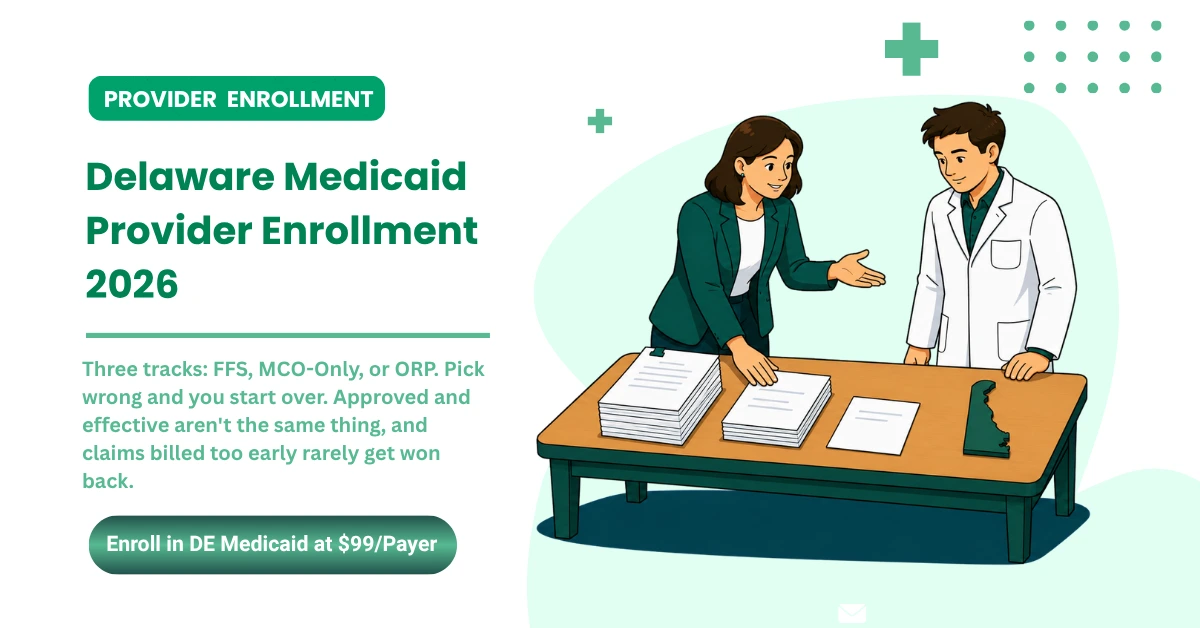
Fee-for-service (FFS), MCO-Only (MCOP), and Ordering, Referring, or Prescribing (ORP) |
|
DMAP review window |
15 business days |
|
2026 application fee |
$750, institutional providers only |
|
Revalidation |
At least every five years, with a 60-day notice |
|
Managed care |
Three MCOs: Highmark Health Options, AmeriHealth Caritas Delaware, and Delaware First Health |
|
Claims |
Electronic only. Delaware stopped accepting paper claims in 2023. |
|
Provider Relations |
1-800-999-3371, Option 0 then Option 4 |
Delaware Medicaid provider enrollment runs through the DMAP Provider Portal, which Gainwell Technologies operates for the Division of Medicaid and Medical Assistance. DMAP reviews submitted applications within 15 business days. Three enrollment tracks exist, and yours depends on whether you bill the state, bill only a managed care plan, or write orders without billing.
Most Delaware files that stall started with the wrong track. The portal won’t convert one application type into another after submission, so a fee-for-service application filed by a provider who only sees managed care patients means starting over. That one decision costs more time than any other step in the process.
This guide covers the provider side of Delaware Medicaid provider enrollment. If you’re a Delaware resident looking to apply for Medicaid coverage, Delaware ASSIST is where you want to go instead. Everything below is written for practice owners, office managers, credentialing coordinators, and billing leads who need a provider number so claims will process.
DMAP Delaware sits inside a federal system where Medicaid operates as 50 separate state programs on one common floor, and Delaware differs from its neighbors in ways that cost money. Our 50-state Medicaid enrollment guide covers the federal framework. This one covers what Delaware does differently.
What Delaware Medicaid provider enrollment covers
DMAP, DMMA, and DSHP: which name means what
Delaware providers swap four names for each other, and the mix-up sends people to the wrong portal. The table below separates them.
|
Name |
What it is |
|---|---|
|
DMAP |
The Delaware Medical Assistance Program. The program you enroll in and bill. |
|
DMMA |
The Division of Medicaid and Medical Assistance. The state agency that runs DMAP. |
|
DHSS |
Delaware Health and Social Services. The department DMMA sits inside. |
|
Diamond State Health Plan |
Delaware’s Medicaid managed care program, operating under a Section 1115 demonstration waiver. |
|
DSHP-Plus |
The long-term services and supports side of that program, covering nursing facility care and home and community-based services. |
|
Gainwell Technologies |
The fiscal agent that operates the provider portal and processes enrollment applications. |
A Delaware payer telling you to register with the state means enrollment in the Delaware Medical Assistance Program. That sits apart from credentialing with their plan, and it comes first.
Why CMS requires you to enroll before anyone pays you
CMS requires states to deny claims from providers who aren’t enrolled in that state’s Medicaid or CHIP program. DMAP publishes the rule on its own Delaware Medical Assistance Portal homepage. It covers services you render, prescriptions you write, referrals you make, and orders for lab work and tests.
That last part catches practices off guard. An unenrolled physician who orders an MRI never sees a denial, because they never billed anything. The imaging center absorbs it. Your referral partners feel your enrollment gap before you do.
Enrollment, credentialing, and contracting are three different things
Providers lose weeks assuming these are one process. They aren’t, and each one has its own timeline.
- Enrollment is your billing relationship with the state. DMAP assigns you a Medicaid provider ID at the end of it.
- Credentialing is a health plan checking your license, training, and claims history against its own standards. Medicaid credentialing with an MCO runs on the plan’s calendar, not the state’s.
- Contracting is the signed agreement and fee schedule that puts you in that plan’s network.
You can finish all three with an MCO and still watch claims deny, because state enrollment sits underneath as its own layer. Our Maryland Medicaid enrollment layers guide walks the same structure through a state running nine plans instead of three.
Which Delaware Medicaid enrollment do you need?
DE Medicaid provider enrollment runs on three separate tracks. Choosing among them is the first real decision in the process, and it sends more applications back to the beginning than any other step.
Fee-for-service enrollment: you bill Delaware Medicaid directly
Fee-for-service enrollment is the full application. You file it when you plan to submit claims to Delaware Medicaid and collect payment from the state.
Enrolling in fee-for-service doesn’t obligate you to accept fee-for-service patients. It’s also the track you use if you want both state and managed care participation, so a practice planning to do both files here.
MCO-Only enrollment (MCOP): you bill a managed care plan
MCO-Only enrollment, which DMAP calls MCOP, is the shorter application. Federal law requires Delaware to screen every provider in an MCO network, including providers who never send the state a claim, so DMAP built a separate path for them. The authority sits in 42 CFR Part 455, Subparts B and E, together with the 21st Century Cures Act.
One MCOP application covers all three plans. DMAP shares your screening data with every participating MCO once the application completes, so you file once rather than three times.
MCOPs aren’t required to serve DMAP fee-for-service members. That separation is the entire reason the track exists, and DMAP enrollment requirements spell it out.
Highmark Health Options network guidance puts it in writing: providers who aren’t enrolled with DMAP complete the MCO-only application before applying to Highmark. State screening comes first. The plan review follows.
DMMA has enforced this before. In 2023 the division warned managed care only providers that failing to register with DMAP put their MCO contracts at risk of termination, and it published that warning in a DMMA managed care registration notice.
ORP enrollment: you only order, refer, or prescribe
Ordering, referring, and prescribing providers don’t submit claims. Delaware still requires them to enroll.
DMAP defines an ORP provider as anyone who places orders, refers to another provider, or prescribes for a DMAP recipient. The state uses a limited-capacity form so it can identify the clinicians writing orders without running them through a full billing enrollment.
Skip it and somebody else eats the denial. The lab, the imaging center, or the pharmacy filling your prescription pays for it, because DMAP can’t match the ordering provider on their claim to an enrolled record. DMAP notes the requirement doesn’t apply to providers already enrolled with the Delaware managed care organizations.
How to tell which track applies to you
|
Your situation |
Your track |
|---|---|
|
You submit claims to Delaware Medicaid and the state pays you |
Fee-for-service (FFS) enrollment |
|
You submit claims to a Delaware Medicaid MCO and the plan pays you |
MCO-Only (MCOP) enrollment |
|
You want both state and managed care participation |
Fee-for-service enrollment |
|
You never submit claims, you only order, refer, or prescribe |
ORP enrollment |
Pick wrong and DMAP denies the application. Re-filing your Delaware Medicaid provider enrollment means a new application, a new tracking number, and a fresh 15-business-day clock, which is why this decision deserves more attention than the paperwork that follows it.
If you’re unsure which track matches your NPI and taxonomy combination, settle that before you open the portal. Our Delaware Medicaid enrollment help team confirms enrollment type before submission, because a wrong pick costs you the whole cycle.
Delaware’s provider risk levels and the Medicare-first rule
Limited, moderate, and high risk: what each screening level adds
DMAP assigns every applicant a categorical risk level. Your level sets both the screening you face and the time you wait. The three levels follow the federal framework in 42 CFR 455.450.
|
Risk level |
Screening applied |
|---|---|
|
Limited |
Verification of SSN, licensure, TIN, and NPI, plus database checks for sanctions, exclusions, terminations, and encumbrances |
|
Moderate |
Everything under limited, plus unannounced site visits before or after enrollment |
|
High |
Everything under moderate, plus fingerprint-based criminal background checks for anyone holding 5% or greater ownership interest |
Certain histories override provider type and push an applicant into high risk. A payment suspension based on a credible fraud allegation within the past 10 years does it. So does an exclusion by HHS-OIG or another state Medicaid agency in that window, a qualifying Medicaid overpayment, or applying within six months of a temporary moratorium being lifted.
Which Delaware providers must enroll in Medicare first
DMAP names two categories on its enrollment page. Home health agency providers must successfully enroll in Medicare before enrolling with DMAP. DME providers must successfully enroll in Medicare before submitting the DMAP application.
Some published guidance stretches that list to include therapy groups and behavioral health programs. DMAP doesn’t say that. Confirm your own risk category with the state rather than assuming, because the cost of guessing runs in the wrong direction.
If Medicare comes first for you, that means an active Medicare PECOS record and a PTAN in hand before you touch the Delaware application. Our Medicare PECOS enrollment guide covers that filing in full.
Two applications submitted the same morning can finish months apart. The gap is usually risk level, not queue position.
Required documents for Delaware Medicaid provider enrollment
The 14 items DMAP asks for
The documentation required for Medicaid in Delaware sits on DMAP’s own enrollment welcome screen, and it doesn’t match what most published guides print. Two columns below: the item, and what it does.
|
Item |
What it’s for |
|---|---|
|
Enrollment application |
The portal wizard itself |
|
Tax ID card or assignment letter |
Upload. Confirms your TIN. |
|
Provider contract |
Signed on the Agreement page inside the portal |
|
Business license, professional license, or board certification |
Upload |
|
Collaborative agreement |
Upload. Nurse practitioners only. |
|
DEA registration |
Upload, if you prescribe controlled substances |
|
Disclosure of Ownership and Control Interest Statement |
Completed on the portal Disclosure page |
|
Electronic Funds Transfer (EFT) form |
Completed on the portal EFT page |
|
Electronic Remittance Advice (ERA) agreement |
Completed on the portal ERA page |
|
Delaware Title XIX Electronic Claim Submission Form |
Upload |
|
Institutional fee or hardship payment letter |
Upload, institutional providers |
|
Medicare certification, or proof of enrollment in another state’s Medicaid program |
Upload |
|
NPPES denial notification |
Upload, only if you don’t qualify for an NPI |
|
CMS approval letter from PECOS |
Upload, per Gainwell’s May 2026 fee-for-service guide |
Gainwell’s Gainwell FFS enrollment guide adds that specific taxonomies can trigger additional attachments. Check yours before you assume the list above is complete for your provider type.
Three corrections worth knowing before you gather anything
Professional liability insurance doesn’t appear on DMAP’s list. Plenty of published Delaware guidance says it does. Carry the coverage, because your MCO contracts will want it, and don’t stall your state filing over a certificate DMAP never asked for.
CAQH ProView doesn’t appear on the list either. CAQH drives MCO credentialing, not state enrollment. Practices wait on an attestation that DMAP was never going to check.
An NPI is needed only if applicable, in DMAP’s own wording. Providers filing under the "Other" enrollment type who don’t qualify for an NPI enter a Tax ID instead. Confirm yours in the NPPES NPI Registry before you start, along with the taxonomy attached to it.
One more that costs nurse practitioners a cycle: when a nurse holds an APN license, DMAP requires the RN license too.
Three documents almost nobody gathers in advance
The Title XIX Electronic Claim Submission Form, the ERA agreement, and the EFT form sit inside the enrollment wizard, and providers click through all three in about 90 seconds.
Those three decide whether money reaches your bank account. Delaware pays by electronic funds transfer and posts your remittance advice to the portal as a PDF. Rush them and you’ll finish enrollment with a provider number and no payment path attached to it.
Most stalled Delaware files we open are missing one upload, not five. Our provider enrollment specialists audit the full document set against DMAP’s list before submission at $99 per payer, because a single missing attachment sends the application into manual review.
How to file your Delaware Medicaid enrollment in the DMAP portal
Six steps complete your Delaware Medicaid provider enrollment, in this order. The DMAP provider portal handles all of them, and the sequence matters more than the typing. You’ll need your Delaware Medicaid provider login before step one, so set that up first if you haven’t. Everything below happens inside the Delaware provider portal that DMAP maintains for enrollment and claims.
Step 1: Open the Provider Enrollment page and pick your application
The DMAP Provider Enrollment portal gives you four tools: start a new enrollment application, resume one you saved but never submitted, check the status of one you already filed, or open the MCO-Only application.
Most published Delaware walkthroughs mention the first one. Pick the wrong tool and you either duplicate a record or file the wrong track.
Step 2: Run the provider screening check first
The Provider Screening page asks for enrollment type, taxonomy, and NPI. It returns results when a record already exists for that NPI and taxonomy pairing.
Spending 60 seconds here saves you a month later. Duplicate applications on the same NPI and taxonomy combination create errors that somebody at Gainwell has to unwind by hand.
Step 3: Complete the enrollment wizard
Gather this before you open it: Tax ID as FEIN or SSN, your licenses, your addresses, disclosure information, and date of birth for individual providers.
Addresses take four forms in the DMAP wizard, and they aren’t interchangeable. Mail To, Pay To, Service, and Home Office each do a different job. Your revalidation notice five years out goes to the Mail To address, so put something durable there.
DMAP asks providers to use USPS formatting at enrollment and revalidation. Inconsistent address and phone formatting generates duplicate-record errors, which is a slow way to lose two weeks.
Under Contact Information you’ll find a Notify Me subscription. Subscribe, and select everything. Status changes and revalidation notices route through it.
Step 4: Complete the ownership disclosure
The Disclosure of Ownership and Control Interest Statement is completed on the portal, not on a downloaded federal form. You disclose anyone holding 5% or greater ownership or controlling interest, along with your managing employees.
Guidance telling you to file CMS-1513 is describing a Medicare instrument. Delaware collects this on its own Disclosure page, and it collects it again at revalidation, reenrollment, and reactivation.
Step 5: Set up EFT and ERA inside the application
EFT and ERA each have their own page in the wizard. EFT routes your deposits. ERA delivers the 835 remittance your team posts from.
Delaware stopped mailing paper checks and paper remittance advices to providers on September 1, 2011. Electronic funds transfer is the payment method, not an option you can decline and revisit later.
Step 6: Submit, then confirm
Two actions close the filing. Submit the application, then confirm it. Practices lose days assuming the first action finished the job.
Is there a Delaware Medicaid provider enrollment form PDF?
No, there isn’t one. Delaware runs enrollment through the DMAP Provider Portal as an online wizard, so nothing exists to download and mail. Gainwell publishes step-by-step PDF guides that walk you through the screens, and those are worth reading. You still submit the application inside the portal.
Your ATN, your password, and how to check enrollment status
What an ATN is, and why losing the password costs you the application
Your ATN is the Application Tracking Number DMAP issues when you save an unfinished enrollment. You create a password at the same time.
You start over if you lose it. DMAP can’t reset that password, and neither can Gainwell, because nobody has access to it. Write down the tracking number and the password the moment the portal generates them, then store both somewhere your billing team can reach.
The MCOP application guide repeats this warning across multiple pages, which tells you how often Gainwell fields the call.
Resuming a saved application
Three credentials get you back in: your ATN, your Tax ID, and your password. Miss any one and the portal won’t open the file.
Checking Delaware Medicaid provider enrollment status
The Enrollment Status tool takes your ATN. A second path exists for the tracking number you misplaced: enter your NPI and taxonomy, and the portal lists every ATN on file for that combination.
When to call Provider Relations
The Delaware Medicaid provider phone number for enrollment is 1-800-999-3371. Choose Option 0, then Option 4, and call center hours run 8:00 a.m. to 4:30 p.m. For claims and electronic submission questions, the path is Option 0 then Option 2.
Gainwell also takes enrollment email at delawarepret@gainwelltechnologies.com, with one standing warning: don’t send anything containing protected health information to that mailbox.
Calling before day 15 rarely moves anything. The call that helps is the one you make with your ATN already open and a specific question attached to it. Our credentialing specialist workflow guide covers the tracking discipline that makes those calls short.
How long Delaware Medicaid provider enrollment takes
DMAP’s published review window
DMAP reviews submitted enrollment applications within 15 business days. That figure comes from the state and it holds for complete files.
What the 15 days doesn’t cover
That clock measures one thing: the state’s review of an application you already submitted. Your document gathering sits outside it. So does Medicare enrollment for home health agencies and DME suppliers, along with site visits at moderate and high risk, and every day of MCO credentialing afterward.
A provider who reads 15 business days and books patients for week four ends up billing before an effective date. That mistake is expensive and often unrecoverable.
|
Phase |
Typical duration |
Source |
|---|---|---|
|
Gathering documents |
3 to 7 days |
Industry typical |
|
Medicare PECOS, home health and DME only |
30 to 90 days |
Industry typical |
|
DMAP review of a complete application |
15 business days |
Published by the state |
|
Site visit, moderate and high risk |
Varies |
Industry typical |
|
MCO credentialing, after state enrollment |
30 to 60 days |
Industry typical |
What delays a Delaware file
Six things account for most of it, and none of them involve DMAP working slowly.
- A missing attachment, most often the Tax ID letter or the Title XIX form
- An address that doesn’t match USPS formatting
- A taxonomy that doesn’t match what NPPES has
- An ownership disclosure filed without every 5% or greater owner
- The wrong enrollment track
- A duplicate record created by a second application on the same NPI and taxonomy
A file that clears in three weeks and one that stalls for three months usually differ by a single upload. That gap is the whole argument for having someone audit the packet before it goes in.
What happens after DMAP approves your enrollment
The Welcome Letter and what’s inside it
DMAP mails a Welcome to DMAP Letter once your Delaware Medicaid provider enrollment clears. It carries your effective date for that provider service location, and the portal PIN sits on page two.
Enrolled at more than one location? You get a separate Welcome Letter for each one. File them somewhere your billing team can reach, because the revalidation you file five years from now needs that PIN.
Your MCD ID: the number that has to match every claim
Your MCD ID is the Medicaid provider identification number DMAP assigns when enrollment completes. It ties to one exact combination: your NPI, your taxonomy code, and your service location. Change any one of those three and the ID stops matching. That mismatch is what denies your claims.
Gainwell’s enrollment guides ask for the MCD ID at several points in the application flow, which tells you how central it is to the state’s matching logic. Practices treat it as a reference number. Delaware treats it as an identity.
A provider who adds a location, corrects a taxonomy, or moves to a new billing entity without updating DMAP keeps submitting claims under an MCD ID that no longer describes them. Nothing warns you first. Your claims start denying and the remittance never explains why.
Your effective date, and why you can’t bill before it
Your effective date prints on the Welcome Letter. Approved and effective mean two different things, and the gap between them is where practices lose money.
Approved means screening cleared. Effective means claims will process. Someone who sees an approval in the portal and starts booking Medicaid appointments generates denials that nobody can appeal their way out of.
Backdating exists in narrow circumstances. Gainwell’s guide describes submitting a request with your MCD IDs, the requested effective date, and a reason. Treat that as an exception, not a plan.
Getting paid: EFT, ERA, and Delaware’s electronic-only claim rule
Delaware doesn’t accept paper claims
Delaware Medicaid provider enrollment ends with a claims question, and the state went electronic in two phases. UB-04 claims moved first, effective January 1, 2023, and DMAP returns any UB-04 submitted on paper. CMS-1500 claims followed on July 1, 2023, and paper claims filed after June 30, 2023 don’t get processed.
Approval alone doesn’t make you able to bill. You need a submission path: an approved software vendor, a clearinghouse, or direct access to the DMAP provider portal, which accepts 837 file uploads. Our clearinghouse setup guide covers how to pick one.
The Title XIX Electronic Claim Submission Form
This is the upload from your document checklist that most providers never think about again. It authorizes your electronic submission arrangement with DMAP.
Skip it or file it wrong and you find out the day your first claim batch has nowhere to go.
Setting up EFT and ERA
DMAP stopped mailing paper checks and paper remittance advices on September 1, 2011. Payment reaches you by electronic funds transfer, deposited to the account on your EFT form, and a PDF of your remittance advice posts to the Delaware Medicaid provider portal.
Your ERA agreement handles the 835 your team posts from, and the Delaware provider portal stores a PDF copy of every remittance. Leave it unconfigured and somebody spends their week pulling PDFs out of the portal and keying payments by hand. Unreconciled AR follows within two months.
Delaware’s companion guides also cover linking a trading partner to an 835 and sending attachments with an 837 transaction. Get both configured during enrollment, while you’re already in the file.
Where Delaware Medicaid claims go
There isn’t a useful mailing address. Delaware processes claims electronically, so no Delaware Medicaid claims mailing address will get your paper claim adjudicated. Claims route through an approved vendor, a clearinghouse, or the DMAP portal. Anything mailed comes back.
Practices still ask for the Delaware Medicaid claims address, usually because a legacy workflow or an out-of-state billing service assumes one exists. It doesn’t, and the fix is an electronic path rather than a better envelope. Our clean claim submission process runs every claim through payer-specific scrubbing before it leaves.
Finding the Delaware Medicaid fee schedule
DMAP publishes rates through its publications site, and rate changes appear in the Delaware Register of Regulations. Check both, because a fee schedule you downloaded last quarter may already be stale.
One 2026 change worth tracking: CMS approved a 5% uniform increase for personal care service claims, applying to both Diamond State Health Plan and DSHP-Plus for calendar year 2026, with the MCOs passing it through. Confirm the current figure in the Register before you rebuild a rate table on it.
Enrollment gets you a provider number. EFT, ERA, and a working submission path turn that number into deposits. If your Delaware file shows approved and nothing is posting, the gap sits in one of those three, and it’s the first place our outsourced medical billing services team looks. Full-service billing runs 2.99% of collections.
Delaware’s three Medicaid MCOs and how to join each one
DMMA contracts with three managed care organizations, under agreements that took effect January 1, 2023. Members either choose a plan or the state assigns one, and those assignments move.
|
Managed care organization |
Parent |
Programs |
|---|---|---|
|
Highmark Health Options |
Highmark Inc. |
Diamond State Health Plan, DSHP-Plus |
|
AmeriHealth Caritas Delaware |
AmeriHealth Caritas |
Diamond State Health Plan, DSHP-Plus |
|
Delaware First Health |
Centene Corporation |
Diamond State Health Plan, DSHP-Plus |
Highmark Health Options
Highmark requires DMAP enrollment before network participation. Providers who aren’t enrolled complete the MCO-only application first, and Highmark points to DMAP’s MCOP guide for it.
Their join the network page organizes credentialing by provider category, with downloadable instructions for each one. Start there rather than calling, because your category determines what they ask for. Contracted practices then work day to day inside the Highmark Health Options provider portal.
AmeriHealth Caritas Delaware
AmeriHealth runs Medicaid credentialing through its own provider process, and your Delaware Medicaid provider enrollment gates their review the same way. Their AmeriHealth Caritas Delaware credentialing page carries the current requirements and the join-the-network path.
Groups adding a rendering provider to an existing contract follow a different workflow than a new practice applying cold. Confirm which one applies before you send a packet.
Delaware First Health
Delaware First Health handles contracting through a Contract Request Form on its join the network page, and its Delaware First Health network section links the current version. Contracted providers get secure Delaware First Health provider portal access for eligibility, authorizations, and claim status. Contracting questions go to 1-877-236-1341.
One detail worth the extra five minutes: the same form lets you request participation in the Wellcare Medicare and Ambetter Health of Delaware networks. A practice already assembling the paperwork can pick up two more lines of business for the same effort.
Why partial MCO participation costs you patients
Contract with two plans out of three and you’re out of network for whichever members sit with the third on any given date of service. Assignments shift, and your front desk finds out after the visit rather than before.
Checking which MCO a member sits with belongs at check-in, alongside eligibility. Our multi-MCO enrollment guide for Nevada walks through the same failure mode in a state running five plans, where the math gets worse.
DMMA published its plan roster and contract structure through the DMMA managed care procurement pages, which is the place to check whether the lineup has changed before you build a contracting plan around it.
Revalidation, and what happens if you miss it
How often Delaware requires revalidation
Delaware Medicaid provider enrollment carries a revalidation requirement of at least every five years. DMAP sends an automatic notice 60 days ahead of your date.
Some published guidance describes the Delaware cycle as three to five years. The state’s language is at least every five years, with that 60-day notice, and the difference matters when you’re building a compliance calendar.
Miss the deadline and you file an initial application, not a revalidation
Letting the revalidation date pass terminates your DMAP enrollment. Getting back in means a full initial enrollment application, with fresh screening and a fresh timeline attached to it.
No grace period softens that. A practice that missed a notice because the Mail To address changed three years earlier restarts the process it finished five years earlier.
What the revalidation application lets you change
The revalidation application prepopulates with what you filed before, and much of it opens read-only. You can add a contact, adjust Notify Me settings, and complete the Disclosure Statement.
Service Location doesn’t update through revalidation. Practices that moved handle location changes as their own transaction, which is a detail worth knowing before you sit down expecting to fix everything at once.
The 2026 application fee
Institutional providers pay $750 in 2026, up from $730 in 2025. CMS resets the amount each year using the consumer price index, and the Federal Register fee notice for calendar year 2026 shows the figure rounded up from $749.71.
Individual physicians and non-physician practitioners don’t pay it at all. CMS enrollment fee guidance covers who qualifies as institutional under 42 CFR 455.460.
Providers who already paid the fee to Medicare or another state’s Medicaid or CHIP program are exempt with proof of payment. Providers who can document financial hardship can request a hardship exception rather than paying.
Reporting changes within 30 days
Delaware requires the Disclosure Statement at enrollment, revalidation, reenrollment, and reactivation, and within 30 days of any change to the information in your enrollment application.
Ownership changes trigger it. So do licensure changes, Tax ID changes, and address changes. Thirty days is shorter than most practices assume, and the clock starts at the event rather than at the moment somebody in the office notices.
Nobody misses a revalidation on purpose. They miss it because the notice went to a Mail To address that stopped being current three years ago. Our credentialing deadline tracking runs revalidation calendars across every payer a practice holds, included in the $99 per payer rate rather than billed as an add-on.
Why Delaware Medicaid claims deny after you’re enrolled
The mismatch behind most enrollment denials
Denials that follow Delaware Medicaid provider enrollment trace back to one problem: the NPI, taxonomy, or service location on the claim doesn’t match what DMAP has enrolled. Your MCD ID ties to that exact combination. Break any part of it and the claim describes a provider the state can’t find.
Three versions of the same failure show up in Delaware AR reports.
- Your billing software reassigns or misstates the NPI, taxonomy, or practice location inside the 837 transaction
- The claim goes out without a taxonomy, or without a practice and service location
- The provider data on the claim doesn’t match what DMAP enrolled or what the MCO credentialed
Notice that none of those are coding problems. A coder can rework the same claim four times without touching the thing that broke it.
Enrollment-driven denial codes and what they mean
Denial code usage shifts by payer and clearinghouse, so treat the table below as the pattern rather than a rulebook. These are the codes that surface enrollment problems most often in Delaware.
|
Code |
What the payer is saying |
Enrollment cause to check first |
|---|---|---|
|
CO-B7 |
Provider not certified or eligible for this date of service |
Effective date hasn’t arrived, enrollment lapsed at revalidation, or the rendering provider was never enrolled |
|
CO-24 |
Charges covered under a capitation agreement or managed care plan |
Billed fee-for-service for a member enrolled with an MCO |
|
CO-16 |
Claim lacks information or contains a submission error |
Missing taxonomy, or missing practice and service location |
|
CO-109 |
Not covered by this payer or contractor |
Wrong entity billed, or an MCO-only provider billing the state directly |
|
CO-197 |
Precertification or authorization absent |
Not an enrollment problem, but it clusters with them during onboarding |
Fixing a mismatch before it becomes an AR problem
Pull the remittance and read the exact NPI, taxonomy, and service location the claim carried. Compare that against what DMAP has on file for the MCD ID. Then check whether your billing software is overwriting any of the three on the way out.
Confirm the MCO holds the same provider data the state does. Plans pull enrollment status from DMAP, and a provider who looks active to you can read as inactive to them.
Correct the source record, not the individual claim. Reworking one claim gets you paid once. The same denial arrives next week on the next 40.
A denial telling you the provider isn’t eligible almost never means somebody coded it wrong. It means an enrollment record stopped matching. Our AR follow-up guide covers how to work the aging report once you’ve found the pattern.
One mismatch doesn’t deny one claim. It denies every claim carrying that combination until somebody repairs the record. If your Delaware denials cluster on one provider or one location, start there, and that’s the first thing our denial management specialists check before touching an appeal.
Delaware enrollment situations that work differently
Out-of-state providers
DE Medicaid provider enrollment applies to out-of-state practices too. You must enroll with DMAP to receive reimbursement for Delaware Medicaid services. Being enrolled in another state’s Medicaid program doesn’t carry over, and DMAP says so in its own provider guidance.
Delaware’s size makes this ordinary rather than exotic. Practices in Maryland, Pennsylvania, and New Jersey see Delaware members every week, and the enrollment question reaches them the first time a Delaware card appears at the front desk. Our DC Medicaid enrollment guide covers the same problem from the other side of the region.
Practices with more than one location
Providers with more than one provider service or practice location hold a separate DMAP account for each location, and DMAP issues a separate Welcome Letter for each one.
That structure decides how many applications a group files, and getting it wrong either creates duplicates or leaves a location unenrolled while the practice bills from it. Our full revenue cycle management team maps location-level enrollment before a group opens a second site, because retrofitting it is harder than building it right.
Waiver and long-term care providers
Providers authorized through the Division of Developmental Disabilities Services need a Qualified Provider Authorization Letter from the Division before they enroll with DMAP. The letter comes first, then the portal.
Long-term services and supports run through DSHP-Plus, and DMMA managed care programs documentation covers how that side of the program is structured.
Electronic visit verification
Personal care and home health services fall under electronic visit verification requirements set by the 21st Century Cures Act. Delaware EVV compliance sits alongside enrollment rather than inside it, and agencies handle it as a separate workstream with its own vendor decisions.
Handling Delaware Medicaid enrollment in-house or outsourcing it
When in-house works
One or two providers, a single state, and an office manager with room on their plate. Under those conditions, handling Delaware Medicaid provider enrollment yourself is a reasonable call. Plenty of practices do it well.
The state publishes real guides. Gainwell answers the phone. Nothing about the DMAP portal requires a specialist if the volume stays small.
When it stops working
- You’re onboarding more than two providers in a 12-month window
- You’re expanding into a second or third state Medicaid program
- A file has sat past 60 days with no movement
- You’re adding behavioral health or telehealth alongside general medical
- Your practice manager spends more than five hours a week on enrollment follow-up
- Several providers hit their revalidation window in the same quarter
What Delaware Medicaid provider enrollment costs
Two cost structures apply, and practices run them together as one number.
The state charges institutional providers a $750 application fee for 2026 under 42 CFR 455.460. Individual physicians and non-physician practitioners pay nothing to Delaware. No other state fee attaches to enrollment.
Service pricing is the second structure. The provider enrollment and credentialing market runs roughly $150 to $300 per provider per payer, with published timelines commonly quoted at 60 to 120 days. MedSole RCM charges $99 per payer.
|
Typical market |
MedSole RCM |
|
|---|---|---|
|
Enrollment per payer |
$150 to $300 |
$99 |
|
Full-service medical billing |
4% to 10% of collections |
2.99% of collections |
|
Setup fees |
Common |
None |
|
Annual contract required |
Common |
None |
|
Revalidation tracking |
Often billed separately |
Included |
|
Coverage |
Varies by vendor |
All 50 states |
What to look for in an enrollment partner
Five things separate a partner who finishes your Delaware Medicaid provider enrollment from one who bills you for trying.
- Published pricing rather than a quote form
- State-specific knowledge, meaning they can name your track before you ask
- Follow-up included in the price rather than sold as an upgrade
- Revalidation tracking included, since that’s where five-year lapses happen
- A clean handoff from enrollment into billing
That last one carries extra weight in Delaware. The state accepts electronic claims only, so an approved enrollment with no EFT, no ERA, and no submission path is a provider number that produces nothing. A credentialing-only vendor finishes their scope and leaves that gap open, and the practice discovers it at first billing.
How MedSole RCM handles a Delaware file
Five commitments on a Delaware Medicaid provider enrollment file, with no adjectives attached to them. MedSole RCM confirms your enrollment track before submission, audits the document set against DMAP’s list, records and retains your ATN and password, configures EFT and ERA during enrollment rather than after, and calendars revalidation from the Welcome Letter date.
MedSole RCM has completed provider enrollment and credentialing for more than 4,000 providers across all 50 states at $99 per payer, with no setup fees, no hidden charges, and no annual contracts. Practices that also outsource billing pay 2.99% of collections for the full revenue cycle.
One provider in one state can file their own Delaware application without much trouble. Past that, the numbers stop working, and they stop working before anyone in the office notices.
Delaware Medicaid provider enrollment FAQ
How do I enroll as a Delaware Medicaid provider?
Enroll through the DMAP Provider Portal, operated by Gainwell Technologies for the Division of Medicaid and Medical Assistance. Pick your enrollment track first: fee-for-service if you bill the state, MCO-Only if you bill a managed care plan, or ORP if you only order, refer, or prescribe. Complete the wizard, upload your documents, finish the ownership disclosure, set up EFT and ERA, then submit and confirm. DMAP reviews complete applications within 15 business days.
What is the difference between FFS, MCOP, and ORP enrollment in Delaware?
Fee-for-service enrollment covers providers who submit claims to Delaware Medicaid and get paid by the state. MCO-Only enrollment, called MCOP, covers providers paid through a managed care plan rather than the state, and one application shares your screening with all three MCOs. ORP enrollment covers clinicians who order, refer, or prescribe without ever submitting a claim. Choosing the wrong track means a denial and a new application.
Do I need to enroll with DMAP if I only take managed care patients?
Yes. Federal law requires Delaware to screen every provider in an MCO network, including providers who never bill the state. That screening happens through the MCO-Only application on the DMAP portal, and one filing shares your information with all three participating MCOs. Highmark Health Options tells unenrolled providers to complete the MCO-only application before applying to their network. Skip it and the plan can terminate your contract.
Do I need to enroll if I only order, refer, or prescribe?
Yes. DMAP defines an ordering, referring, or prescribing provider as anyone who places orders, refers to another provider, or prescribes for a DMAP recipient. You never submit a claim, but Delaware still requires enrollment through a limited-capacity form so the claims filed against your orders can pay. Skip it and the lab, imaging center, or pharmacy you sent the patient to absorbs the denial instead of you.
How long does Delaware Medicaid provider enrollment take?
DMAP reviews submitted applications within 15 business days. That window covers the state review only. It excludes your document gathering, Medicare enrollment for home health agencies and DME suppliers, site visits at moderate and high risk, and MCO credentialing afterward. A clean file clears state review in about three weeks. An incomplete one drops into manual review and adds months.
How much is the Delaware Medicaid enrollment fee in 2026?
Institutional providers pay $750 in calendar year 2026, up from $730 in 2025. CMS resets the amount each year using the consumer price index, and the 2026 figure was rounded up from $749.71. Individual physicians and non-physician practitioners pay nothing. Providers who already paid the fee to Medicare or another state Medicaid or CHIP program are exempt with proof, and providers facing financial hardship can request an exception.
What documents do I need for Delaware Medicaid provider enrollment?
DMAP lists 14 items as the documentation required for Medicaid in Delaware. Uploads include your Tax ID card or assignment letter, professional or business license, DEA registration if applicable, the Delaware Title XIX Electronic Claim Submission Form, Medicare certification or proof of another state Medicaid enrollment, and the PECOS approval letter. Completed inside the portal: the provider contract, the ownership disclosure, the EFT form, and the ERA agreement. Professional liability insurance is not on DMAP’s list.
Is there a Delaware Medicaid provider enrollment form PDF?
No, there isn’t one. Delaware runs provider enrollment through the DMAP Provider Portal as an online wizard, so no downloadable application form exists to print and mail. Gainwell publishes step-by-step PDF guides that walk through each screen of the fee-for-service and MCO-Only applications, and those are worth reading before you start. The application itself has to be completed and submitted inside the portal.
What is an ATN, and what happens if I lose my password?
Your ATN is the Application Tracking Number DMAP issues when you save an unfinished enrollment application. You create a password at the same time. Neither DMAP nor Gainwell can reset that password, because nobody has access to it, so losing it means starting the application over. To resume a saved application you need the ATN, your Tax ID, and the password together.
How do I check my Delaware Medicaid provider enrollment status?
Use the Enrollment Status tool on the DMAP Provider Enrollment page and enter your Application Tracking Number. If you have lost the ATN, enter your NPI and taxonomy instead and the portal lists every ATN on file for that combination. For anything the portal cannot answer, Provider Relations takes calls at 1-800-999-3371, Option 0 then Option 4, from 8:00 a.m. to 4:30 p.m.
What is an MCD ID in Delaware Medicaid?
Your MCD ID is the Medicaid provider identification number DMAP assigns when your enrollment completes. It ties to one exact combination of NPI, taxonomy code, and service location. Change any one of those three without updating DMAP and the ID stops matching what the state has on file. That mismatch is the mechanical reason enrollment problems surface later as claim denials.
What is in the DMAP Welcome Letter?
The Welcome to DMAP Letter arrives after your enrollment is approved and carries your effective date for the enrolled provider service location. The PIN for your portal account sits on page two, which matters because revalidation five years later requires it. Providers enrolled at more than one location receive a separate Welcome Letter for each one.
Can I bill Delaware Medicaid before my effective date?
No. Approved and effective mean different things. Approved means your screening cleared. Effective means claims will process, and that date prints on your Welcome Letter. Claims submitted for dates of service before the effective date deny, and you will not win most of those on appeal. Backdating requests exist for narrow circumstances but should never be part of your plan.
How often do Delaware Medicaid providers have to revalidate?
Delaware requires revalidation at least every five years, and DMAP sends an automatic notice 60 days ahead of the date. Some published guidance describes the cycle as three to five years, which does not match the state’s own language. Build your compliance calendar on the five-year cycle and treat the 60-day notice as the reminder rather than the deadline.
What happens if I miss my DMAP revalidation deadline?
Your enrollment terminates. Getting back into the program means filing a full initial enrollment application rather than a revalidation, which resets your screening and your timeline. Most missed revalidations trace back to a Mail To address that stopped being current, since that is where DMAP sends the notice. Verify that address at every revalidation and after any move.
What is the address for Delaware Medicaid claims?
There is no useful mailing address. Delaware processes Medicaid claims electronically only. UB-04 claims moved to electronic submission on January 1, 2023, and CMS-1500 claims followed on July 1, 2023, with paper claims filed after June 30, 2023 going unprocessed. Claims route through an approved software vendor, a clearinghouse, or the DMAP Provider Portal, which accepts 837 file uploads.
Why are my Delaware Medicaid claims denying after enrollment?
Check the match before you check the coding. Most enrollment-driven denials happen because the NPI, taxonomy, or service location on the claim does not match what DMAP enrolled under your MCD ID. Billing software that reassigns provider data inside the 837 transaction causes this, as do claims sent without taxonomy or service location. Correct the source record rather than reworking individual claims.
Do I need a separate DMAP enrollment for each location?
Providers with more than one provider service or practice location hold a separate DMAP account for each location, and DMAP issues a separate Welcome Letter for each one. Plan your applications around your locations before you file. Getting this wrong either creates duplicate records that Gainwell has to unwind by hand, or leaves a site unenrolled while your practice bills from it.
Can an out-of-state provider enroll in Delaware Medicaid?
Yes, and out-of-state providers must enroll with DMAP to receive reimbursement for Delaware Medicaid services. Enrollment in another state’s Medicaid program does not transfer. Practices in Maryland, Pennsylvania, and New Jersey hit this often, because Delaware members cross state lines for care. File a Delaware application the same way an in-state practice would.
How many MCOs does Delaware Medicaid have?
Three: Highmark Health Options, AmeriHealth Caritas Delaware, and Delaware First Health, operating under DMMA contracts effective January 1, 2023. All three cover Diamond State Health Plan and DSHP-Plus. Each credentials separately, and each requires state enrollment first. Contracting with only two leaves you out of network for whichever members are assigned to the third on any given date of service.
Still working through a Delaware file? Our Delaware enrollment team handles DMAP, MCOP, and all three Delaware MCOs at $99 per payer, and configures your EFT and ERA before the first claim goes out.