



Colorado medicaid provider enrollment is the official process that registers healthcare providers with the Colorado Department of Health Care Policy and Financing, known as HCPF, through the Colorado interChange portal. Once HCPF approves the application, the provider receives a Provider Identification Number and billing privileges under Health First Colorado.
Health First Colorado is the state's Medicaid program, and it serves more than 1.2 million Coloradans. The process asks for an active NPI, current state licensure, and, for institutional providers, a $750 application fee for the 2026 calendar year.
The program runs under the federal framework in 42 CFR Part 455, which sets screening rules for every state Medicaid agency. Colorado adds its own requirements through the Code of Colorado Regulations at 10 CCR 2505-10 8.100. HCPF publishes current rules on its Health First Colorado Provider Enrollment page, and Gainwell Technologies operates the interChange portal on its behalf.
Providers who enroll across several states can map the shared federal steps in our national Medicaid enrollment guide.
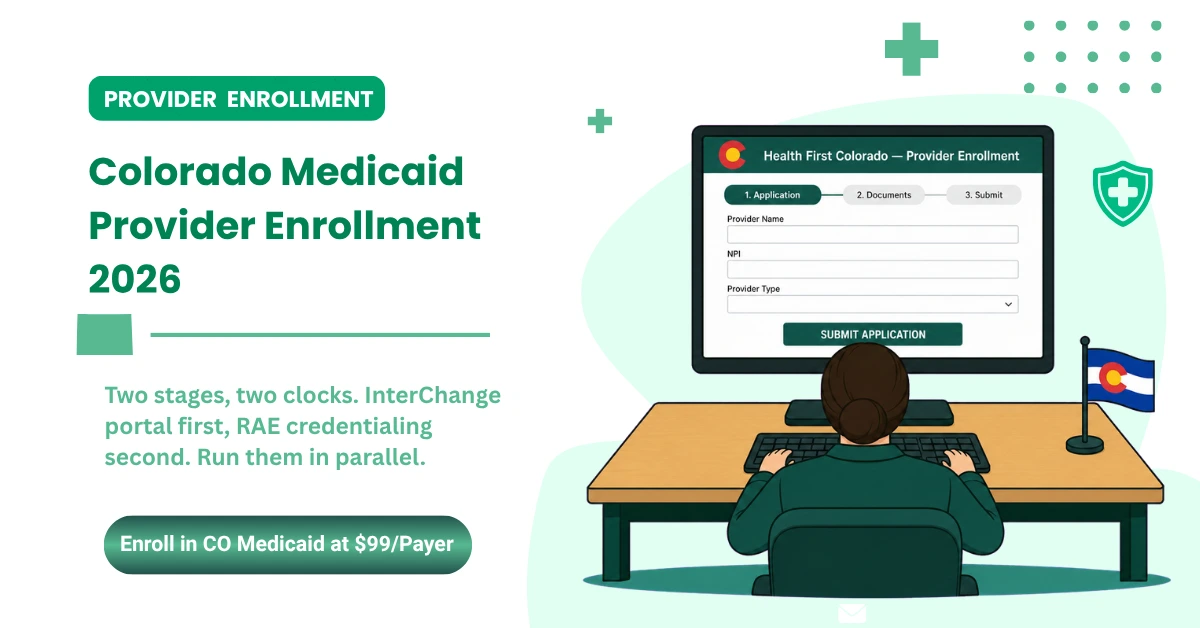
Two stages define the Colorado process. Stage 1 is HCPF enrollment through the interChange portal, which grants fee-for-service billing rights. Stage 2 is credentialing with a Regional Accountable Entity, or RAE, under the Accountable Care Collaborative. A provider who finishes Stage 1 but skips Stage 2 holds a Provider ID yet can't serve members in the managed care network.
MedSole RCM manages colorado medicaid provider enrollment through the interChange portal at $99 per payer. With more than 4,000 providers enrolled across all 50 states and a 99 percent first-time approval rate, the team runs Stage 1 and Stage 2 in parallel rather than one after the other, which shortens the total onboarding window.
The two stages start with a threshold question: who has to enroll, and which federal rule catches the most providers off guard.
Who Must Enroll in Colorado Medicaid: The Federal Mandate and the OPR Rule
Providers aren't required to join Medicaid. The choice changes the moment a provider wants to bill Health First Colorado or order, prescribe, or refer services for its members. At that point, enrollment becomes mandatory under federal law and Colorado regulation.
Under the Code of Colorado Regulations at 10 CCR 2505-10 8.100, every provider who enrolls with and bills Medicaid under the state plan or a waiver has to pass screening. Screening confirms identity, licensure, and exclusion status before any billing privilege is granted. HCPF posts the rule text in the Colorado Code of Regulations CCR 2505-10 8.100.
The Ordering, Prescribing, and Referring rule trips up more providers than any other part of Colorado Medicaid enrollment. The Affordable Care Act requires physicians and other eligible practitioners to enroll in Health First Colorado to order, prescribe, or refer items and services for members, even when they never send a claim.
Miss this step and the billing provider pays for it. If the ordering provider's NPI isn't on the claim, the claim denies. OPR enrollments exist only to satisfy that federal requirement, so an OPR record can't be used to bill on its own. This split is one practical difference between enrollment and credentialing.
Enrollment also applies to providers who deliver services through managed care, including Child Health Plan Plus and the Regional Accountable Entities. The agency has to verify that every provider license is valid and current. HCPF lists each pathway on its Colorado Medicaid enrollment types page, and the Find Your Provider Type tool points providers to the right category before starting.
Screening runs at three risk levels, and the level sets how much verification a provider faces.
|
Risk Level |
What HCPF Verifies |
|---|---|
|
Limited |
License verification plus federal and state database checks |
|
Moderate |
Everything in Limited, plus an on-site visit at the service location |
|
High |
Everything in Moderate, plus fingerprint-based criminal background checks |
Source: HCPF provider screening levels under 42 CFR 455. Hospice providers and skilled nursing facilities moved to High risk in 2026.
The 2026 change matters here. HCPF elevated hospice providers, along with skilled nursing facilities, from Moderate to High risk, so both now need fingerprinting and a site visit.
Behavioral health groups have their own rule. A group that delivers only behavioral health services enrolls as Provider Type 77, using Specialty 388 with a prescriber or 389 without. Groups still billing under an older provider type move to PT 77 at their next revalidation or enrollment update.
Once a provider confirms they must enroll, the next move is the portal itself.
How to Enroll in Health First Colorado: The Six-Step interChange Portal Process
Colorado medicaid provider enrollment runs entirely through the Colorado interChange Provider Web Portal, the system Gainwell Technologies operates for HCPF. The portal sits at colorado-hcp-portal.coxix.gainwelltechnologies.com. Most provider types have no paper application, so every step, upload, and status check happens online.
Step 1: Confirm Your Provider Type and Enrollment Type Before You Open the Portal
HCPF locks provider type and enrollment type once an application starts. Pick the wrong one and you start over. Check HCPF's enrollment best practices first. Each service location files its own application, and organizations need a separate Type 2 NPI for each location and provider type under Colorado's NPI rule at 10 CCR 2505-10 8.126.
Step 2: Get Your NPI and Match Your Taxonomy
Individual providers use an NPI Type 1. Groups use an NPI Type 2. The taxonomy code in the interChange wizard has to match at least one taxonomy on the NPI record in NPPES. A mismatch returns the application. Verify the NPPES record first, because taxonomy and NPI errors rank among the top reasons HCPF sends a file back.
Step 3: Prepare the Document Package
Gather everything before opening the wizard. You need a W-9 dated within the last six months that matches an address in the portal, plus a bank letter or voided preprinted business check dated within six months.
You also need an IRS CP-575 or LTR 147C letter confirming the EIN, and an active Colorado license. EFT is required for every application except out-of-state providers and Colorado State Government Entities. HCBS providers add the CO Train course certificate with a quiz score of at least 80 percent.
Step 4: Submit the Application and Pay the Fee If It Applies
The 2026 enrollment application fee for institutional providers is $750, adjusted from $730 in 2025 for inflation under the CMS Federal Register notice for the $750 CY 2026 fee. Physicians and non-physician practitioners don't pay it.
The fee applies per service location when an institutional provider enrolls, revalidates, or adds a location. A provider who already paid it to Medicare or another state Medicaid program in the same calendar year can submit proof and skip the charge.
Step 5: Track the Application and Answer Requests Fast
Processing time depends on the file. Clean applications typically clear in a few weeks, but HCPF doesn't publish a guaranteed turnaround, and missing documents, taxonomy mismatches, or bad EFT details stretch it out. Watch the application status in the HCP Provider Web Portal. When HCPF requests more information, respond inside the stated window or the file gets returned.
Step 6: Receive Your Provider Identification Number and Start Billing
Approval produces a Provider Identification Number. That number authorizes billing under Health First Colorado on a fee-for-service basis. It does not switch on coverage for members in the Accountable Care Collaborative, so providers serving ACC members still need Stage 2 RAE credentialing. Health First Colorado pays clean claims on a weekly cycle by deposit to the bank account on file.
Providers who'd rather not manage the process alone can hand it to MedSole RCM, which handles Colorado Medicaid enrollment at $99 per payer through the interChange portal with weekly follow-up on every file. The team checks each document, confirms taxonomy alignment, and works the Provider Services Call Center until the Provider ID lands.
Stage 2 After HCPF Approval: Credentialing with Colorado's 4 Regional Accountable Entities
Finishing colorado medicaid provider enrollment in the interChange portal is Stage 1. Stage 2 is separate and mandatory for providers who serve members in the Accountable Care Collaborative, Colorado's managed care framework. Stage 2 doesn't happen on its own. Providers start a credentialing application with each Regional Accountable Entity that covers a location where they practice.
The Accountable Care Collaborative splits the work. Physical health services bill to HCPF at fee-for-service rates for members who aren't in a full-risk plan. Behavioral health, substance use disorder services, and regional care coordination run through the Regional Accountable Entities. So a behavioral health provider needs RAE credentialing to get paid for any ACC member's behavioral health care.
Most guides get this part wrong. Colorado moved to ACC Phase III on July 1, 2025, and the number of RAEs dropped from seven to four. Any source still listing seven RAE regions describes the old Phase II map that ended June 30, 2025.
The 4 RAEs Under ACC Phase III and the Regions They Cover
Four entities now hold RAE contracts, and a provider contracts with the RAE tied to each brick-and-mortar location.
|
Regional Accountable Entity |
Coverage Area |
|---|---|
|
Rocky Mountain Health Plans (RAE 1), a UnitedHealthcare company |
Western Slope and southern Colorado, including Mesa, Garfield, Pueblo, La Plata, Eagle, and Routt counties |
|
Northeast Health Partners (RAE 2) |
Northeast Colorado |
|
Colorado Community Health Alliance (RAE 3), an Anthem company |
Boulder, Jefferson, El Paso, and Front Range communities |
|
Colorado Access (RAE 4) |
Denver metro, including Denver, Adams, Arapahoe, Douglas, and Elbert counties; the largest RAE by membership |
Source: HCPF ACC Phase III RAE awards, effective July 1, 2025. Confirm the RAE for a specific county on HCPF's ACC Phase III page.
Group practices with more than one location contract with every RAE that covers a location. Behavioral health providers have to be enrolled with Health First Colorado first, then contracted and credentialed by each RAE before claims will pay.
Providers who also bill Medicare can run that enrollment in parallel; our guide to Medicare provider enrollment requirements covers the PECOS side. HCBS providers should also review the HCBS provider enrollment requirements before submitting RAE paperwork.
Plan for the full timeline, not only Stage 1. HCPF enrollment and RAE credentialing run on separate clocks, and credentialing alone typically takes 45 to 60 business days once the RAE has a complete file. Providers who file the RAE applications alongside the interChange application, instead of waiting for HCPF to finish, compress the total onboarding window.
MedSole RCM files RAE credentialing at the same time as the interChange submission rather than waiting for HCPF approval first. Running both tracks together can remove weeks from the path to full billing activation compared with the sequential approach most practices use.
One credentialing detail to check early: some RAEs may require a current CAQH ProView profile before they finalize credentialing. Keep the CAQH attestation current so it doesn't stall the RAE step.
The document package behind both stages is where most returned applications start, so it's worth a close look at what 2026 requires.
2026 Document Requirements for Colorado Medicaid Provider Enrollment
The interChange wizard doesn't always let a provider save a half-finished application and come back to it. Having the full document package ready before you open the wizard is the difference between a smooth approval and a return that resets the clock.
Every provider type shares a core set of documents.
|
Document |
Requirement |
|---|---|
|
NPI |
Type 1 for individuals or Type 2 for groups, matching the name, address, and taxonomy on the NPPES record |
|
W-9 |
Dated within the last six months, with the legal name and TIN matching the portal entries |
|
Bank letter or voided check |
Preprinted and dated within six months; EFT is mandatory except for out-of-state providers and Colorado State Government Entities |
|
IRS CP-575 or LTR 147C |
Confirms the active EIN for groups, facilities, and atypical providers |
|
State license |
Active, unrestricted license from DORA or CDPHE for the profession |
Source: HCPF group and facility enrollment checklists, 2026. Organizations need a unique Type 2 NPI per location under 10 CCR 2505-10 8.126.
Some provider types add documents. HCBS, CFC, and MFP providers attach the CO Train course certificate with a quiz score of at least 80 percent, and an application without it can be returned. Institutional providers pay the $750 fee per service location unless a same-year Medicare or Medicaid fee payment exempts them.
Out-of-state enrollment follows the same interChange process with two differences. Out-of-state providers are exempt from EFT and may use a paper check, and some specialties need home-state license verification before HCPF can approve the file.
Institutional providers also owe the $750 fee when they revalidate or add a location, a point HCPF spells out in its Health First Colorado revalidation requirements.
Colorado doesn't use a downloadable paper enrollment form for most provider types in 2026. The application lives entirely in the interChange Provider Web Portal, and the closest thing to a form is the online wizard. The Provider Enrollment Manual, revised March 18, 2026, documents every panel and field, and HCPF posts the PDF on its provider enrollment page.
Colorado also recognizes the atypical provider, a category for people and organizations that deliver Medicaid services without a healthcare license, such as some transportation providers, personal care attendants, and non-medical service organizations. Atypical providers follow a separate pathway and should check the enrollment types page first.
Several rules changed for 2026, and a few of them quietly reshape who can enroll and what they'll be paid.
Critical 2026 Updates to Colorado Medicaid Provider Enrollment Every Provider Must Know Before Applying
Seven changes hit colorado medicaid provider enrollment in 2026, and each one moves the process, the timeline, or the provider types affected. A file built on 2025 guidance can come back returned or trigger denied claims. These run from highest impact to most targeted.
|
2026 Update |
Effective |
|---|---|
|
NEMT new-enrollment moratorium extended |
Through at least September 30, 2026 |
|
2.0 percent across-the-board provider rate reduction |
Dates of service from July 1, 2026 |
|
Provider Maintenance applications delayed |
As of June 2026 (Issue 145) |
|
Behavioral health peer support certification |
January 1, 2026 |
|
Behavioral health groups enroll as Provider Type 77 |
2026, at revalidation or update |
|
Hospice and skilled nursing facilities elevated to High risk |
January 2026 |
|
LTSS caregiver weekly hour limits phase in |
From July 1, 2026 |
Source: HCPF Provider News and provider bulletins, 2026.
Update 1: NEMT Enrollment Moratorium Extended Through at Least September 30, 2026
CMS approved a moratorium on new Non-Emergent Medical Transportation enrollments, in place since October 1, 2023 and extended through at least September 30, 2026. New NEMT providers can't submit interChange applications until it lifts.
Separately, HCPF is moving NEMT to a single statewide broker, MediDrive, on July 1, 2026, starting with the nine-county Denver metro area. Existing Transdev network providers must enroll with MediDrive right away to keep service running.
Update 2: A 2.0 Percent Across-the-Board Rate Reduction Starts July 1, 2026
Health First Colorado's 2.0 percent across-the-board provider rate reduction was approved during the 2025-2026 legislative session and applies to dates of service beginning July 1, 2026. Physical health rate changes need CMS approval first; HCBS waiver reductions don't and take effect on schedule. The General Assembly also enacted HB 26-1410, which adds further budget reductions for fiscal year 2026-27.
A 2.0 percent cut makes clean billing and full collections matter more than they did a year ago. MedSole RCM provides full-service revenue cycle management for Colorado Medicaid providers at 2.99 percent of collections, with denial management and AR follow-up included. Every denied claim costs more under reduced rates.
Update 3: Provider Maintenance Applications Are Delayed as of June 2026
HCPF's June 2026 Provider News, Issue 145, flags that Provider Maintenance applications are delayed because of a screening review issue. Providers updating practice locations, ownership, or billing addresses should expect longer processing. If an update is already in progress, call the Provider Services Call Center at 1-833-468-0362.
Update 4: Behavioral Health Peer Support Professionals Need Certification
As of January 1, 2026, behavioral health peer support professionals must be certified, or actively working toward certification, for their services to bill to Health First Colorado. Services from peers who don't meet that definition won't be paid. Providers should confirm each peer's certification status before billing.
Update 5: Behavioral Health Groups Must Enroll as Provider Type 77
Groups that deliver only behavioral health services enroll as Provider Type 77, the behavioral health group designation. Groups still enrolled under an older provider type move to PT 77 at their next revalidation or enrollment update. Bill behavioral health under the wrong provider type past that point and the claims deny.
Update 6: Hospice and Skilled Nursing Facilities Moved to High Risk
Effective January 2026, HCPF raised the screening risk level for hospice providers and skilled nursing facilities from Moderate to High. Both now complete fingerprint-based criminal background checks and a site visit on top of license and database checks. Fingerprints take roughly 30 business days to process, so the timeline runs longer.
Update 7: LTSS Caregiver Hour Limits Phase In Starting July 1, 2026
The Medical Services Board set a cap on how many hours one caregiver can provide to a single member for select Long-Term Services and Supports.
The limit phases in at 84 hours per week from July 1, 2026 through December 31, 2026, then 70 hours per week through June 30, 2027, and 56 hours per week from July 1, 2027.
The day-to-day rules for status checks, revalidation, out-of-state files, and contacting HCPF carry equal weight for practices managing enrollment this year.
Colorado Medicaid Provider Enrollment Status, Revalidation, Out-of-State Rules, and Contact Information
How to Check Colorado Medicaid Provider Enrollment Status
Check colorado medicaid provider enrollment status in the HCP Provider Web Portal at colorado-hcp-portal.coxix.gainwelltechnologies.com. After submission, the portal issues a reference number, and the Provider Enrollment Status section shows the current stage.
Providers usually see Application Received, Under Review, and then Approved or Returned. A returned application names the fields that need fixing, and the clock restarts from the resubmission date, not the original one.
Colorado Medicaid Provider Enrollment Revalidation, Explained
Revalidation comes due at least every five years under 42 CFR 455.414. HCPF runs it on a rolling schedule and emails providers about six months ahead with instructions.
Don't start a new enrollment application when revalidation is due. A new application creates a duplicate record and tangles claim processing. After the due date, the revalidation link stays open in the portal for six months; miss that window and a reenrollment link replaces it.
Claims deny for providers who don't revalidate on time, and a provider who revalidates late can resubmit the denied claims. Two fields can't change during revalidation: enrollment type and Tax Identification Number. Either change requires a new application. Multi-location providers revalidate on separate schedules unless every location was approved at once.
Out-of-State Provider Enrollment in Colorado Medicaid
Colorado medicaid out of state provider enrollment uses the same interChange process with two differences. Out-of-state providers are exempt from EFT and may pay by paper check. They also confirm a current home-state license, getting a Colorado license where the state requires one. Telehealth providers serving Colorado members from another state confirm their provider type with HCPF first.
Colorado Medicaid Provider Enrollment Phone Number and Contacts
The phone number for the Provider Services Call Center is 1-833-468-0362, open Monday through Friday, 8:00 a.m. to 5:00 p.m. Mountain Time. The center handles enrollment help, portal support, and general Health First Colorado provider questions.
|
Contact |
Reach |
|---|---|
|
Provider Services Call Center |
1-833-468-0362, Mon to Fri 8 a.m. to 5 p.m. MT |
|
HCBS enrollment questions |
HCPF_HCBS_Questions@state.co.us |
|
NEMT and MediDrive transition |
NEMT@state.co.us |
Source: HCPF Provider Contacts, 2026. Member-facing lines can't help with interChange portal applications.
Skip the member-facing Health First Colorado lines for enrollment questions. Those agents can't see interChange applications or gainwell provider enrollment status.
Backdating is the detail providers miss most. HCPF lets a provider request an effective date up to 10 months before the application date, so care delivered before approval may still be billable if the request is granted. A backdate isn't guaranteed, a future effective date is never allowed, and the request goes in at initial application, not after.
After the Provider ID arrives and RAE credentialing clears, billing begins, and the billing rules carry their own traps.
After Enrollment Approval: Billing Health First Colorado and Protecting Your Revenue Cycle
Yes, Health First Colorado pays enrolled providers itself, with no intermediary. Under fee-for-service, HCPF processes the claim and deposits payment weekly to the bank account on file.
Under the Accountable Care Collaborative, the Regional Accountable Entity coordinates behavioral health payment, while physical health claims still run through HCPF at fee-for-service rates. Colorado Medicaid often pays faster than commercial plans, a real draw for practices carrying heavy self-pay volume.
Claims go through the interChange Provider Web Portal using the provider's NPI and Provider Identification Number. Electronic claims move as 837P or 837I transactions by provider type. Health First Colorado requires the ordering provider's NPI on claims that need an order or referral under 42 CFR 455.440, and a missing OPR NPI denies the claim.
With the fee schedule carrying a 2.0 percent reduction from July 1, 2026, first-pass clean claims matter more than they did under 2025 rates. A denial rate above 5 percent costs more each month at reduced rates. Steady billing depends on clean NPI data, matched taxonomy, active RAE credentialing, and revalidation monitoring.
MedSole RCM provides Health First Colorado billing services at 2.99 percent of collections. For a practice that wants billing alongside the enrollment MedSole already manages, $99 per payer for enrollment plus 2.99 percent for billing covers the full revenue cycle. No setup fees, no long-term contracts, and weekly claim submissions with denial management, AR follow-up, and revalidation monitoring built in.
Billing continuity rides on revalidation, the back half of colorado medicaid provider enrollment that practices forget. When a deadline passes, claims stop paying that day. MedSole tracks every provider's revalidation date and starts the process six months out, matching HCPF's own schedule, and that monitoring is part of the 2.99 percent rate.
The questions below are the ones Colorado providers ask most, answered for Health First Colorado specifically.
Colorado Medicaid Provider Enrollment FAQ: Answers to the Questions Every Provider Asks
These are the questions providers searching for colorado medicaid provider enrollment ask most across Google and Bing. Each answer is specific to Health First Colorado, not the generic national version.
How do I become a Colorado Medicaid provider?
To become a Colorado Medicaid provider, enroll in the interChange Provider Web Portal that Gainwell Technologies runs for HCPF. You'll need an active NPI, DORA or CDPHE licensure, a W-9 dated within six months, and an EIN letter. Institutional providers pay the $750 fee for 2026, and HCPF then issues a Provider Identification Number for fee-for-service billing.
What is the difference between provider enrollment and credentialing in Colorado?
In Colorado, enrollment is the Stage 1 step where HCPF approves a provider to bill Health First Colorado. Credentialing is the Stage 2 step where a Regional Accountable Entity verifies qualifications for the Accountable Care Collaborative network. Enrollment gives a Provider ID for fee-for-service; credentialing gives ACC network status. Most providers need both.
How long does Colorado Medicaid enrollment take?
Processing depends on the file. Clean applications with complete documents typically clear in a few weeks, though HCPF doesn't publish a guaranteed turnaround, and missing documents or taxonomy mismatches stretch it and restart the clock on resubmission. RAE credentialing runs on its own track, usually 45 to 60 business days. Filing both at once shortens the total.
How much does it cost to enroll as a Colorado Medicaid provider?
For 2026, the enrollment application fee is $750 for institutional providers, adjusted from $730 in 2025 under CMS Federal Register notice 90 FR 55738. The fee applies per service location. Physicians and non-physician practitioners are exempt, and a same-year fee already paid to Medicare or another state Medicaid program can exempt the provider with proof.
Do I need to enroll in a Managed Care Organization to serve Colorado Medicaid patients?
For behavioral health and primary care delivered to Accountable Care Collaborative members, yes. Physical health fee-for-service claims go straight to HCPF without RAE credentialing. Since most Health First Colorado members get care through the ACC, providers who skip RAE credentialing can't serve much of the population for those services. The four RAEs appear earlier in this guide.
How do I register for Medicaid in Colorado as a provider?
Registration starts in the HCP Provider Web Portal at colorado-hcp-portal.coxix.gainwelltechnologies.com, the system Gainwell Technologies operates. Have an active NPI, the Tax Identification Number, and a billing address ready before you begin. The wizard won't submit until every required field is complete, so the document package needs to be in hand first.
Can I backdate my Colorado Medicaid enrollment effective date?
Backdating is allowed up to 10 months before the application date, and HCPF reviews each request rather than granting it automatically. The request has to go in at initial application, not after approval. A future effective date is never permitted under any circumstances.
What happens if I miss my Colorado Medicaid revalidation deadline?
Claims deny once a provider passes the revalidation deadline, because Health First Colorado won't pay lapsed providers. A provider who revalidates late can resubmit those denied claims. Miss the six-month window after the due date and the portal switches from the revalidation link to a reenrollment link.
Providers working through provider enrollment colorado medicaid don't have to manage the interChange portal, HCPF documents, and RAE credentialing alone. MedSole RCM's provider enrollment and credentialing services cover every step from NPI verification through Provider ID and RAE activation, at $99 per payer with weekly follow-up.
With more than 4,000 providers enrolled across all 50 states and a 99 percent first-time approval rate, the team maps the timeline for your practice and confirms document readiness before you submit.
Colorado Medicaid Provider Enrollment in 2026: Final Takeaways
Strong enrollment in 2026 comes down to getting two stages right and keeping up with the year's changes. Stage 1 puts a clean file through the interChange portal with a matched NPI, current licensure, and the $750 fee where it applies.
Stage 2 adds credentialing with the right Regional Accountable Entity under ACC Phase III. Track the year's changes, from the September 30, 2026 NEMT moratorium to the 2.0 percent rate cut and the move to four RAEs, and the path to billing Health First Colorado stays manageable.