



CPT 97014 Quick Reference
|
Field |
Detail |
|---|---|
|
AMA descriptor |
Electrical stimulation, unattended, to one or more areas |
|
Timed or untimed |
Untimed, one unit per session regardless of device run time |
|
Medicare status |
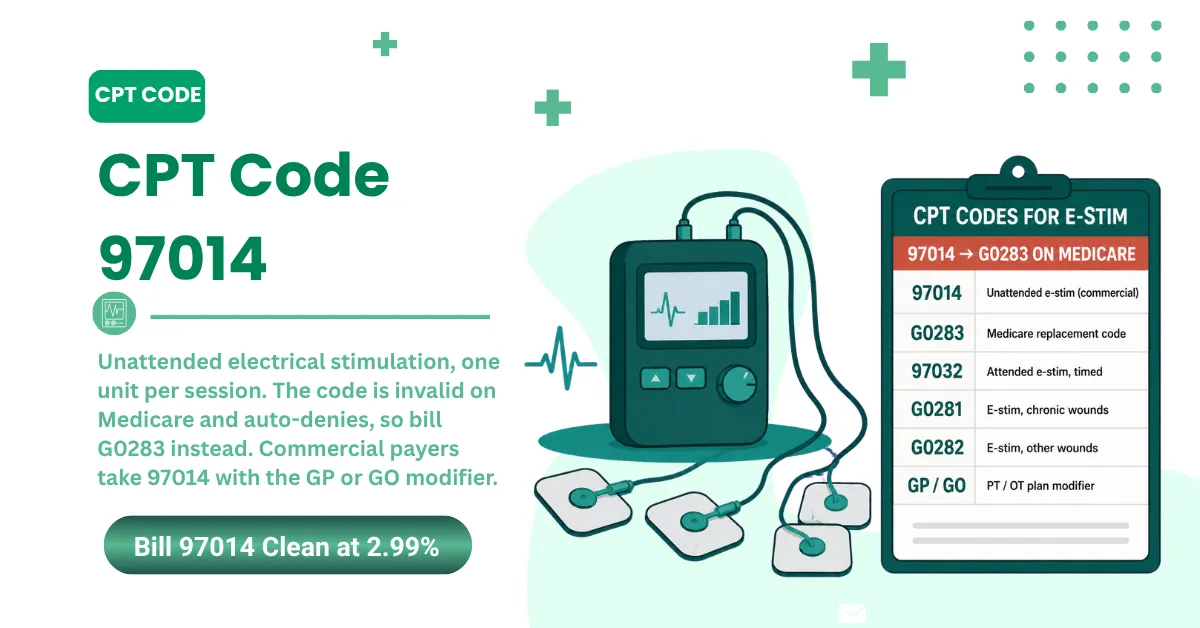
Invalid on the Medicare fee schedule; bill G0283 instead |
|
Modifiers required |
GP (physical therapy), GO (occupational therapy), 59 (chiropractic, same-day distinct service) |
|
2026 commercial rates |
BCBS $20.10, Cigna $14.90, Aetna $14.76, UHC $0 (use G0283), Medicare $0 |
Critical Billing Alert: billing CPT code 97014 to Medicare generates an automatic denial. G0283 is required on all Medicare Part B outpatient therapy claims for non-wound electrical stimulation. This is the G0283 vs 97014 rule that controls every Medicare claim.
CPT code 97014 is unattended electrical stimulation, and it's invalid on the Medicare fee schedule. Bill it to Medicare and the claim denies every time. That one error costs physical therapy and chiropractic practices thousands of dollars a year in revenue nobody recovers.
I've handled CPT 97014 billing across physical therapy, occupational therapy, and chiropractic accounts for years. The rule behind this denial is simple once you know it, but it trips up front desk and billing staff at practices nationwide.
Practices that would rather not carry this complexity in-house can hand it off through outsourced medical billing at 2.99% of collections.
CPT 97014: Definition and Clinical Use
The AMA descriptor for CPT code 97014 reads: electrical stimulation, unattended, to one or more areas. That definition lines up with CMS outpatient physical therapy billing guidance for the PT application of this code.
Unattended is the operative word. The therapist places the electrodes, starts the device, and steps away while it runs. No constant one-on-one contact required. You bill one unit per session, no matter how long the device runs.
That makes 97014 a supervised, untimed modality. Unlike CPT 97032, which is attended electrical stimulation that needs constant contact, 97014 has no time component. For the full set of timed and untimed codes, see the complete guide to physical therapy CPT codes.
In clinical use, 97014 covers interferential current (IFC), TENS, Russian stimulation, and cyclical muscle stimulation. The provider types who bill the 97014 CPT code include physical therapists, occupational therapists, chiropractors, and physiatrists.
Medicare Coverage and G0283: Billing Rules for CPT 97014
CPT code 97014 is invalid on the Medicare fee schedule for outpatient therapy claims. Medicare doesn't cover it. Any Part B outpatient claim that includes 97014 is denied, a rule that's held since March 2003 per CMS outpatient occupational therapy billing guidance.
Is G0283 the same as 97014? Not quite. Both describe unattended electrical stimulation, but G0283 is the Medicare-specific code and 97014 is the commercial code. Same service, different payer routing.
G0283's descriptor covers electrical stimulation, unattended, to one or more areas for indications other than wound care, as part of a therapy plan of care. For non-wound stimulation under a Medicare therapy plan, the G0283 CPT code is what goes on the claim.
Electrode costs fold into G0283. Don't bill electrodes on a separate line; that charge denies as part of the primary service.
UnitedHealthcare and Optum align with Medicare here. Both reject 97014 on outpatient therapy claims and require G0283. A practice billing UHC with 97014 hits the same denial wall it would with 97014 Medicare claims.
CMS also wants proof the treatment works. Document objective improvement within the first 12 visits. If the note shows no functional gain, continued G0283 billing draws medical necessity denials. Build that 12-visit check into your CPT 97014 billing workflow before the first claim goes out.
G0283 vs 97014: Code Comparison and Payer Decision Guide
Which code goes on the claim, G0283 vs 97014, comes down to one question your billing team answers every time: who's the primary payer? The choice depends on the payer, not the service delivered.
|
Code |
Primary Payer |
Coverage Status |
Rate |
Billing Note |
|---|---|---|---|---|
|
97014 |
Commercial (BCBS, Cigna, Aetna) |
Covered |
$14.76 to $20.10 |
Bill 97014 with GP or GO modifier |
|
G0283 |
Medicare Part B |
Required replacement |
$0 (97014 invalid) |
G0283 is the only accepted code |
|
G0283 |
UHC or Optum outpatient therapy |
Required replacement |
$0 for 97014 |
UHC aligns with the Medicare rule |
|
97014 or G0283 |
Medicaid |
Varies by state |
Verify state LCD |
Some states require G0283 |
|
97014 |
TRICARE |
Covered |
Follows commercial rates |
Bill with GP modifier |
|
G0283 |
Medicare Advantage |
Required |
Follows Medicare |
MA plans follow CMS rules |
|
97014 |
Workers' Comp |
Varies by state |
State fee schedule |
Verify state WC rules |
Here's the rule. If Medicare or Medicare Advantage is the primary payer, bill G0283. For every other payer, verify the payer's LCD or coverage policy before you default to 97014.
What's the alternative code for 97014? For non-wound electrical stimulation under Medicare, it's G0283. Two related wound-care codes exist: G0281 for electrical stimulation on chronic wounds, and G0282 for other wound stimulation, which Medicare doesn't cover. For outpatient therapy, the G0283 vs 97014 choice is the one that matters.
CPT 97014 vs 97032: Unattended vs Attended Electrical Stimulation
97014 is unattended electrical stimulation: no therapist contact required while it runs. CPT 97032 is attended electrical stimulation: constant one-on-one contact through each 15-minute unit. That timed-versus-untimed split drives the unit math, which the 8-minute rule for therapy billing breaks down in full.
|
Feature |
CPT 97014 |
CPT 97032 |
|---|---|---|
|
Attendance Required |
No, supervised modality |
Yes, constant attendance |
|
Billing Unit |
Per session (untimed) |
Per 15 minutes (timed) |
|
Same-Day NCCI Rule |
Can't bill with 97032, same body area |
Can't bill with 97014, same body area |
|
Typical Application |
TENS, IFC, Russian stim, cyclical |
FES, NMES for pelvic floor, motor point stim |
|
Medicare Rate |
$0 (invalid; use G0283) |
About $14 to $17 per 15-minute unit |
Here's the bundling rule billers miss. You can't bill 97032 and 97014 for the same body area on the same date of service. The NCCI edit flags that pair. Treat different body areas and you can bill both, but you'll need Modifier 59 plus documentation of the separate regions.
Attended stimulation has its own demands. ASHA electrical stimulation coding guidance covers the constant-attendance standard for 97032. One case most guides skip: functional electrical stimulation (FES) for pelvic floor rehab needs 97032, not 97014, because the therapist adjusts intensity and watches the response the whole time.
Is 97014 an Always Therapy Code?
Yes. CPT 97014 is an always therapy code under CMS policy. The service counts as therapy whenever it's performed under a physical therapy, occupational therapy, or speech-language pathology plan of care. Without a therapy plan of care in place, you can't bill it.
That carries a modifier consequence. The GP modifier, for a physical therapy plan of care, is required on every 97014 claim a physical therapist submits. GO covers occupational therapy. Miss the discipline modifier and the claim comes back as a CO-4 denial.
97014 vs 97012: These Are Not the Same Code
CPT 97012 is mechanical traction, not electrical stimulation. The two get confused because both are supervised, untimed modalities in the same code range. 97012 applies cervical or lumbar traction through a mechanical device; 97014 delivers electrical stimulation through electrode pads. They're distinct services, and you can't swap one for the other.
Modifiers, Documentation, and Billing Guidelines for CPT 97014
Does 97014 need a GP modifier? Yes. Every 97014 claim under a physical therapy plan of care needs the GP modifier on each claim line. No discipline modifier means an automatic CO-4 denial at the clearinghouse, before a human reviewer ever sees the claim.
|
Modifier |
Name |
When Required |
What Happens Without It |
|---|---|---|---|
|
GP |
Physical Therapy Plan of Care |
All PT claims |
CO-4 denial, claim rejected at the clearinghouse |
|
GO |
Occupational Therapy Plan of Care |
All OT claims |
Same as GP, automatic rejection |
|
GN |
Speech-Language Pathology |
SLP services |
Same as above |
|
KX |
Therapy Threshold Exception |
When PT and SLP charges exceed $2,480 in 2026 |
Automatic denial above the threshold without KX |
|
59 |
Distinct Procedural Service |
When 97014 is billed same day as another modality for a separate body area |
Second modality denied without it |
One same-day question comes up a lot. CPT 97010, hot or cold packs, is bundled into the payment for other covered services and isn't separately reimbursable under Medicare.
On commercial claims where 97010 is allowed, billing 97010 and 97014 on the same date for the same session is fine, since they're separate modalities for distinct clinical purposes, as long as the note documents each as distinct.
The documentation makes or breaks the claim on review. The note has to identify the type of electrical stimulation used. It has to state the area treated. And it has to record the effect on function. Miss any of those three and the claim is exposed to a CO-50 medical necessity denial on post-payment review.
Clean CPT 97014 billing comes down to the right discipline modifier plus those three documentation elements. The 97014 modifier is only half the claim; the note is the other half.
CPT 97014 Reimbursement Rates by Payer
Medicare pays $0 for CPT code 97014, because the code isn't valid on the Medicare fee schedule. For non-wound unattended electrical stimulation under Medicare, the reimbursement runs through G0283 instead.
CPT 97014 reimbursement on commercial plans lands in a tight band, and it shifts by contract. Here's where the major payers sit.
|
Payer |
CPT 97014 Rate |
Notes |
|---|---|---|
|
Medicare Part B |
$0 |
Code invalid; use G0283 |
|
UnitedHealthcare |
$0 |
Follows Medicare policy for outpatient therapy |
|
Blue Cross Blue Shield |
About $20.10 |
National average; varies by state contract |
|
Aetna |
About $14.76 |
Contract-specific; verify current negotiated rate |
|
Cigna |
About $14.90 |
Contract-specific; verify current negotiated rate |
|
TRICARE |
Commercial rate schedule |
Follows non-Medicare commercial rates |
|
Medicaid |
Varies by state |
Some states require G0283 |
For exact G0283 rates, pull them from the CMS Medicare Physician Fee Schedule lookup, since CPT 97014 reimbursement and G0283 rates both shift by geographic locality and by facility versus non-facility setting. That locality factor is why the G0283 vs 97014 rate question never has one national number.
ICD-10 Codes Supporting CPT 97014 Medical Necessity
The ICD-10 diagnosis on a 97014 claim has to support unattended electrical stimulation. When the diagnosis and the procedure don't line up, many payer systems fire an automated CO-50 denial. The diagnosis has to justify the treatment.
|
ICD-10 Code |
Description |
Clinical Rationale for 97014 |
|---|---|---|
|
M54.50 |
Low back pain, unspecified |
Muscle spasm and pain modulation via electrical stimulation |
|
M25.5x |
Pain in joint, by site |
Pain control at the affected joint, reduce guarding |
|
M79.3 |
Panniculitis, unspecified |
Soft tissue inflammation, reduce pain and swelling |
|
M54.2 |
Cervicalgia |
Cervical pain modulation, cervical paraspinal electrode placement |
|
M62.838 |
Other muscle spasm |
Muscle spasm reduction, restore range of motion |
One caution on that joint-pain row: M25.5x needs its site-specific digit before it'll pass, for example M25.50 for an unspecified joint or M25.551 for the right hip. The three-character M25.5 is a category header that won't stand on a claim.
CMS requires documented improvement within the first 12 visits. The note has to show objective or subjective improvement in pain or swelling. After 12 visits with no documented functional gain, continued billing triggers a medical necessity review. Train documentation staff on this threshold before billing starts.
Common Billing Errors and Denial Prevention for CPT 97014
Billing errors on 97014 claims fall into three buckets: the wrong code for the payer (97014 on Medicare), the wrong modifier (missing GP or GO), and the wrong code combination (97014 with 97032 on the same body area). Each one shows up as a specific denial code on the ERA.
|
Error |
Denial Code |
Root Cause |
Fix |
|---|---|---|---|
|
Billing 97014 to Medicare |
CO-16 or auto rejection |
Code invalid on Medicare fee schedule |
Replace with G0283; set the billing system to auto-swap by payer |
|
Missing GP modifier |
CO-4 |
Modifier-to-procedure mismatch |
Add GP to every PT claim line; make it a required field in the software |
|
Missing GO modifier on OT claim |
CO-4 |
Same as above |
Add GO to every OT claim line |
|
97014 and 97032, same body area, same date |
CO-97 |
NCCI bundling edit |
Bill one per body area per session; use Modifier 59 with separate-region documentation for different areas |
|
Documentation doesn't show improvement |
CO-50 |
Medical necessity not established |
Require an objective pain or swelling measure in every note |
|
Billing past 12 visits without documented improvement |
CO-50 |
LCD requirement not met |
Build a 12-visit review flag into the billing workflow |
The bundling row is worth a closer look. When 97014 and 97032 hit the same body area on the same date, you get a CO-97 denial code, driven by the NCCI bundling edit spelled out in the CMS NCCI Policy Manual.
Bill one modality per body area, or use Modifier 59 with separate-region documentation when the body areas are distinct.
The modifier rows trace to a CO-4 denial code, a straight modifier-to-procedure mismatch. The documentation rows trace to a CO-50 denial code, a medical necessity failure. Both are preventable at the workflow level, not the appeal level.
These patterns hit chiropractic offices hard, since 97014 runs daily in physical-medicine billing. The chiropractic billing services guide maps the full code set those practices rely on.
Practices billing CPT 97014 and G0283 across PT, OT, and chiropractic accounts benefit from systematic denial management that catches modifier mismatches, NCCI conflicts, and LCD failures before they age past the appeal window.
MedSole RCM's denial management services resolve these denials within 48 hours and prevent repeat patterns at the workflow level.
Before any 97014 or G0283 claim goes out, run this five-question audit.
- Is Medicare or Medicare Advantage the primary payer? If yes, replace 97014 with G0283 before submission.
- Is the correct discipline modifier applied? GP for PT, GO for OT, GN for SLP.
- Has the patient's cumulative PT and SLP spending crossed $2,480 in 2026? If yes, add the KX modifier.
- Are 97014 and 97032 billed together for the same body area? If yes, remove one or add Modifier 59 with separate-region documentation.
- Does the clinical note document the type of electrical stimulation, the area treated, and objective improvement?
MedSole RCM handles CPT code 97014 and G0283 billing across physical therapy, occupational therapy, and chiropractic practices at PT billing at 2.99% of collections. No setup fees. No long-term contracts. Month to month.
For practices that also need payer enrollment, MedSole enrolls providers at $99 per insurance, the lowest rate in the market. Competitors charge $150 to $300 per payer for the same service.
The combination of 2.99% billing and $99 per payer credentialing makes MedSole the most cost-efficient full-service RCM option for PT, OT, and chiropractic practices.
References
- Centers for Medicare and Medicaid Services. Billing and Coding: Outpatient Physical Therapy (Article A53065).
- Centers for Medicare and Medicaid Services. Billing and Coding: Outpatient Occupational Therapy (Article A53064).
- American Speech-Language-Hearing Association. Electrical Stimulation: Coding and Coverage Considerations.
- Centers for Medicare and Medicaid Services. Medicare Physician Fee Schedule Search.
- Centers for Medicare and Medicaid Services. Medicare NCCI Policy Manual.