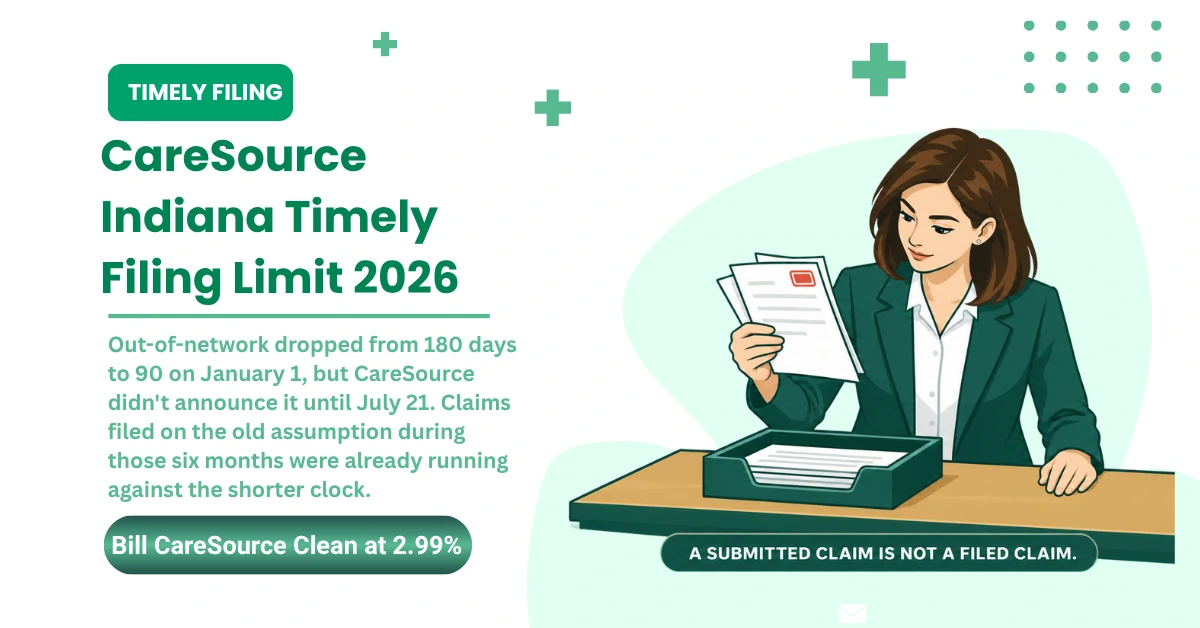




CareSource Indiana Medicaid timely filing is 90 calendar days from the date of service or discharge. Since January 1, 2026, that same 90-day window applies to out-of-network providers, down from 180 days.
|
Deadline |
Window |
|---|---|
|
Filing limit, in-network |
90 calendar days from date of service or discharge |
|
Filing limit, out-of-network |
90 calendar days, changed from 180 effective January 1, 2026 |
|
Corrected claim |
60 calendar days from the Explanation of Payment date |
|
Secondary claim |
90 calendar days from the primary payer's EOP date |
|
Claim dispute |
60 days from the written determination |
|
Claim appeal |
60 days after the dispute resolves |
|
Denial code when you miss it |
CO-29, and Indiana EOB code 7565 |
What is the CareSource Indiana timely filing limit?
Ninety days is the right answer for most CareSource Indiana claims. It isn't the right answer for all of them. Two things decide whether it applies to yours: which CareSource plan your patient carries, and which claim action you're filing.
Which CareSource plan are you billing?
CareSource Medicaid Indiana covers Hoosier Healthwise and the Healthy Indiana Plan. You'll see these as HHW and HIP on the member ID card, and both run under the same managed care contract with the state.
CareSource Marketplace Indiana is a different product with its own contract, provider manual, and notification history. The ID card tells you which one you're holding. Checking CareSource eligibility at every visit is the only reliable way to catch a mid-year plan change before it costs you a claim.
Which claim action are you filing?
The second variable is what you're submitting. An initial claim, a corrected claim, and a dispute run on three different clocks, and none of them start on the same event.
|
Initial claim |
Corrected claim |
Dispute |
|
|---|---|---|---|
|
Medicaid, HHW and HIP |
90 calendar days from DOS or discharge |
60 calendar days from the EOP date |
60 days from the written determination |
|
Marketplace |
90 days from DOS, since April 1, 2020 |
60 calendar days from the EOP date |
60 days |
Teams that manage both CareSource products under one payer grid row will apply the wrong clock eventually. The two products publish separately, and they change separately.
Every CareSource Indiana filing deadline in one table
CareSource publishes these deadlines across five separate documents. The provider FAQ carries one piece, the provider manual carries another, and reimbursement policy PY-1111 holds a third. Nothing on CareSource.com puts them in one place, which is why billers keep landing on the wrong number.
|
Scenario |
Window |
Clock starts |
Source |
|---|---|---|---|
|
Medicaid, in-network |
90 calendar days |
DOS or discharge |
Provider FAQ, Provider Manual |
|
Medicaid, out-of-network |
90 calendar days |
DOS or discharge |
Notification IN-MED-P-5700252 |
|
Marketplace, Indiana |
90 days |
DOS |
Marketplace Provider Manual |
|
Corrected claim after a denial |
90 calendar days |
Original DOS |
Provider Manual |
|
Corrected claim after incorrect payment |
60 calendar days |
EOP receipt |
Provider Manual, IHCP deck |
|
Corrected claim after recoupment |
60 days |
Date of recovery |
Policy PY-1111 |
|
Secondary claim, CareSource pays second |
90 calendar days |
Primary payer EOP date |
IHCP Works deck |
|
Interim inpatient final bill |
90 calendar days |
Date of discharge |
Provider Manual |
|
Claim dispute |
60 days |
Written determination |
Provider Disputes page |
|
Claim appeal |
60 days |
Dispute resolution |
Provider Disputes page |
|
Clinical appeal, pre and post service |
60 calendar days |
Date of action notice |
Provider Disputes page |
|
External review |
120 calendar days |
Appeal determination |
Provider Disputes page |
That's six separate clocks on one payer, each triggered by a different event. A practice tracking a single Medicaid TFL number for CareSource is tracking the wrong thing. You can confirm the in-network window on the CareSource Indiana provider FAQs, and the recoupment rule sits in CareSource reimbursement policy PY-1111.
What changed on January 1, 2026: out-of-network dropped to 90 days
The out-of-network window used to be 180 calendar days. It's 90 now. That change took effect January 1, 2026, but CareSource didn't issue the notification announcing it until July 21, 2026, with OMPP approval on July 15. The gap between those dates explains a lot of the confusion still circulating.
What the network notification says
The change conforms the CareSource Indiana timely filing limit to the Medicaid state plan under 42 CFR 447.45. Claims from out-of-network providers filed outside the 90-day window will be denied for timely filing.
One line in the same notice deserves flagging now and again later: timely filing is waived when eligibility is updated. That's the strongest exception available in Indiana, and most teams never claim it. Full text sits in the CareSource network notification.
Why CareSource still shows 180 days in some places
You'll find 180 days for out-of-network on more than one CareSource surface, including provider manual language issued in 2025. That isn't a typo on their end, and it isn't a reason to distrust the 90-day figure. It's a document hierarchy question.
A network notification approved by OMPP supersedes earlier manual language for dates of service on or after its effective date. The practical rule breaks down cleanly by date.
For dates of service before January 1, 2026, the 180-day manual language is the only explicit guidance CareSource published. For dates of service on or after January 1, 2026, use 90 days. The CareSource provider disputes page points providers to the updates and announcements feed for exactly this reason.
What this means for hospitals, EDs, and ancillary billing
This lands hardest on groups that bill CareSource in Indiana without a contract, including emergency departments, hospital-based ancillaries, and anesthesia, pathology, or radiology groups covering facilities where they aren't participating.
Their filing window got cut in half, and nothing changed on their side. A workflow calibrated to 180 days will start producing CO-29 denials without anyone touching the process.
A contract removes the exposure instead of managing it. Provider credentialing services at $99 per payer usually cost less than a quarter of avoidable write-offs. Where a full contract isn't realistic, a single case agreement covers the specific patient rather than the whole relationship.
Why you see 180 days for Indiana Medicaid and 90 days for CareSource
Search this topic and you'll get two numbers back. One says the Indiana Medicaid TFL limit is 180 days. The other says CareSource is 90. Both are correct, because they describe different delivery systems, and mixing them up is a top-three cause of avoidable denials in this state.
Fee-for-service and managed care run on different clocks
Indiana Medicaid operates on two layers. FSSA administers traditional fee-for-service through OMPP, and providers bill IHCP directly. Managed care runs through contracted managed care entities, and CareSource is one of them.
The fee-for-service timely filing for Medicaid moved from 365 to 180 calendar days effective January 1, 2019, per IHCP Bulletin BT201829. A managed care entity can contract for a shorter window, and CareSource contracts for 90.
The rule that settles it: when a member is enrolled with an MCE, the MCE's filing limit controls, not the fee-for-service limit.
How to tell which one applies to your patient
Run eligibility before you bill and read which plan the member is assigned to. That step stopped being optional in 2026.
MDwise exited Indiana Medicaid on January 1, 2026, and the state reassigned its members to the remaining plans. Part of your Indiana CareSource Medicaid volume this year is patients who belonged to a different plan twelve months ago. Billing them on MDwise timelines produces a rejection that quietly eats the window. Our guide to Indiana Medicaid provider enrollment covers the reassignment in detail, and the state publishes its own Indiana Medicaid claim submission guidance worth reading alongside it.
When does the CareSource filing clock start?
Ninety days from date of service and 90 days from discharge land in different weeks. Before anyone calendars a date, they need to know which event opened the window.
Outpatient and professional claims
Professional claims on the CMS-1500 run from the date of service. Each date of service carries its own clock, which matters for series visits.
Don't batch a month of encounters and file them against the last one. The first visit in that batch may already be 30 days into its window while the biller thinks the whole batch just started.
Inpatient and institutional claims
Institutional claims on the UB-04 run from the date of discharge. Two examples show what the difference costs you.
An outpatient visit on March 15, 2026 has to reach CareSource by June 13, 2026. An inpatient stay discharging April 2, 2026 has until July 1, 2026, even when the admission date was in March.
Same payer, same 90 days, 18 days apart, because the trigger event moved.
When CareSource pays second
If another carrier is primary, the clock doesn't run from the date of service at all. It runs from the primary payer's EOP date, per the IHCP CareSource claims guidance published on IN.gov. Full coordination of benefits rules come later in this guide.
How to submit a CareSource Indiana claim
Electronic submission is faster, and it produces the acceptance artifact you'll need if a CO-29 ever lands. That second reason is the one nobody mentions until it's too late.
Electronic claims and the CareSource payer ID
The CareSource payer ID for Indiana is INCS1, and it covers both Medicaid and Marketplace in this state. CareSource supports 837P for professional claims and 837I for institutional claims through standard clearinghouses. A disciplined claim submission services process records the payer route and any unresolved rejection before the window closes.
Watch the state. The Marketplace quick reference lists a different CareSource payer ID for each state, including 31114 for Ohio. Submit an Indiana claim on an Ohio payer ID and you get a rejection, not a denial, which means the claim was never filed at all.
Confirm the payer ID against the current EDI companion guide before a first submission, since payer IDs change without a network notification.
Paper claims and the CareSource claims address
Send Indiana Medicaid paper claims to the CareSource claims address below.
CareSource Attn: Claims Department PO Box 3607 Dayton, OH 45401-3607
Paper makes sense when clinical documentation has to travel with the claim. It's slower, and slower matters against 90 days. This Indiana Medicaid claims address differs from the addresses CareSource publishes for its other states, so a shared billing team covering multiple markets needs the state built into its envelope logic.
The CareSource Indiana provider portal
The CareSource Indiana provider portal sits at providerportal.caresource.com/IN and handles claim status, eligibility, disputes, and appeals in one place. You'll need your CareSource provider number and, for group submissions, the CareSource group number configured on the account.
The CareSource Indiana provider phone number for Medicaid provider services is 1-844-607-2831, available Monday through Friday, 8 a.m. to 8 p.m. Eastern, 7 a.m. to 7 p.m. Central. Payer ID, address, and contact details are all confirmed in the CareSource Indiana quick reference.
A submitted claim is not a filed claim
The gap between transmitted and accepted is where most avoidable CareSource losses happen. A claim sitting in a clearinghouse error queue isn't late yet. The clock doesn't know that.
Why rejected claims do not protect timely filing
CareSource and IHCP training materials are direct about this, and the rules are worth stating one at a time.
- Rejected and voided claims cannot be used as proof of timely filing.
- A screenshot of a rejected claim does not waive the CareSource Indiana timely filing limit.
- Rejected claims never entered the CareSource system, so no Health Partner Representative and no Provider Services Representative can pull the claim image.
- A rejected claim is not a clean claim, and timely filing for Medicaid is measured against receipt of a claim that can be processed.
A common version of this: the claim went out on day 40, the clearinghouse kicked it back on day 45, and nobody opened the rejection report until day 95. CareSource never saw that claim. As far as timely filing goes, the practice never submitted it.
The IHCP CareSource claims training hosted on IN.gov spells this out, and our guide to clearinghouse rejection handling covers the workflow side.
What the 999 and the 277CA confirm
Billers treat these two artifacts as interchangeable, and they aren't.
A 999 confirms your batch was syntactically valid. It says the file parsed, and that's all it says. A 277CA confirms the payer accepted the claim into adjudication. Only the second one proves filing.
Save both, timestamped, before the claim ages. Six months later nobody remembers which batch a claim rode in on.
When rejection reports get opened weekly instead of daily, the fix is usually capacity rather than process. Structured claims aging support catches the claims that go quiet before the window closes on them.
CareSource corrected claim timely filing: two different clocks
Two corrected claim rules exist for CareSource Indiana. Which one applies depends on what the original claim did, not on what you're changing.
Get this backwards and you'll file a correction that's on time under one rule and 30 days late under the other.
When the original claim was denied
The first path. A claim denied because of incorrect or inaccurate provider information, then resubmitted with corrections, is treated as an initial claim for adjudication.
It stays subject to the CareSource Indiana timely filing limit of 90 calendar days, measured from the original date of service. Correcting a claim does not reset the clock. Day 70 when it denied means day 70 when you resubmit.
When the original claim paid incorrectly
The second path. A claim that paid, but paid incorrectly because of provider error, needs a corrected claim within 60 calendar days from receipt of the Explanation of Payment.
A third variation is worth knowing. When a recoupment happens outside the original filing window, the corrected claim submission window is 60 days from the date of the recovery, per policy PY-1111.
|
What the original claim did |
Treated as |
Window |
Clock starts |
|---|---|---|---|
|
Denied for provider error |
Initial claim |
90 calendar days |
Original date of service |
|
Paid incorrectly, provider error |
Corrected claim |
60 calendar days |
EOP receipt |
|
Recouped outside original window |
Corrected claim |
60 days |
Date of recovery |
The distinction matters because the trigger condition is what you can identify from the remittance. Read what the claim did before you pick a deadline.
How to mark a corrected claim so it isn't denied as a duplicate
CareSource is specific about the box-level mechanics.
On the UB-04, use Type of Bill frequency code 7 in field 4, with the original claim number in the Document Control Number, field 64. On the CMS-1500, enter 7 on the left side of Box 22, with the original claim number on the right side of the same box.
Submit a corrected claim without that information and CareSource processes it as an original claim or rejects it as a duplicate. Either outcome burns days you don't have. When a remittance comes back citing missing or incomplete information rather than a coding issue, our CO-16 denial code guide covers how to read which field failed.
When CareSource pays second: coordination of benefits timely filing
Coordination of benefits is where the CareSource clock stops behaving normally. The date of service stops being the trigger, and two different deadlines can apply to the same claim depending on when you found out about the other coverage.
The two-stage COB clock
Stage one applies while you're still inside the original filing window. Submit the secondary claim within whatever days remain of that window.
Stage two applies once the original window has elapsed. Submit within 90 calendar days from the primary payer's EOB or EOP date.
If the claim and the primary payer's explanation of payment don't both reach CareSource inside that window, the payer denies the claim against the CareSource Indiana timely filing limit no matter how clean it is. The IHCP Works CareSource claims guidance is explicit on the 90-day figure.
What has to travel with the secondary claim
Three things: the primary payer's EOP or EOB showing adjudication, the claim itself, and the payment or denial detail from the primary.
A secondary claim submitted without the primary adjudication attached isn't a clean claim. Same rule as the rejection section above. If CareSource can't process it, you didn't file it.
When the primary payer denies or never responds
When the primary carrier denies for a procedural reason, or because the member didn't supply information the carrier asked for, CareSource Medicaid Indiana has a defined path for it. The denial detail still has to reach them inside the window.
When the primary carrier goes quiet, document your follow-up attempts and submit before the window closes. Waiting on a primary payer isn't a timely filing exception, and nobody at CareSource is holding your spot while another carrier decides. If the denial comes back citing other coverage as primary, our CO-22 coordination of benefits guide covers the correction path.
CareSource Indiana timely filing exceptions
Exceptions are narrower than most billers hope, and CareSource documents them rather than negotiating them. Four categories carry real weight in Indiana.
Retroactive eligibility waives timely filing
The January 2026 out-of-network notification states it plainly: timely filing is waived where eligibility is updated.
That's the strongest exception available, and it's the one most often left unclaimed. Retroactive CareSource eligibility usually surfaces after somebody already wrote off the denial, so nobody goes back for it. A monthly check on retro-eligibility updates against your write-off log is worth building.
Newborn claims
Newborn claims follow the same timely filing guidelines as any other claim. Newborns receiving retroactive coverage are not subject to timely filing requirements.
A 2019 CareSource network notification said the opposite on both points, listing newborn filing at 180 days and stating that retroactive eligibility was subject to timely filing. The 2025 provider manual contradicts it, and so does the 2025 IHCP Works training material.
Treat the newer OMPP-approved sources as current. The 2019 notice is legacy communication that CareSource hasn't reconciled.
Interim inpatient billing and the recoupment risk
Billers miss this one constantly. When you use interim bills, the complete final bill has to reach CareSource within 90 calendar days from discharge.
Miss it and two things happen. CareSource denies the claim, and the plan recoups the interim payments you already received. That's money coming back off a future remittance, on a stay you were paid for months ago.
Documented waivers CareSource has granted before
Waivers aren't theoretical. CareSource in Indiana has issued three that changed filing windows outright.
|
Waiver |
Scope |
Window |
|---|---|---|
|
Network onboarding extension |
HHW and HIP claims, DOS January 1 to December 31, 2017 |
Extended to 365 days |
|
FQHC and RHC waiver |
T1015 and D9999, DOS July 1, 2021 to March 31, 2023 |
Timely filing bypassed, monthly sweep, no dispute needed |
|
Change Healthcare incident |
DOS November 23, 2023 to June 30, 2024 |
Timely if received by September 30, 2024 |
None of these applied automatically to every provider, and CareSource announced each one through a network notification rather than switching it on silently. The CareSource FQHC filing waiver even ran a monthly sweep to reprocess denials with no dispute required, which most affected clinics never knew about. The CareSource Change Healthcare notice worked the same way.
Checking the updates and announcements page before writing off a batch takes five minutes. CareSource has bailed out Indiana providers three times, and each time some of them missed it.
CO-29 denials: what counts as proof of timely filing
A CO-29 isn't automatically the end of the claim. Whether you can recover it depends on what you can prove about the original submission, and that evidence has to exist before the denial lands.
What CO-29 and Indiana EOB code 7565 mean
CO-29 is the claim adjustment reason code meaning the time limit for filing has expired. It's the code you'll see on most remittances when a claim misses the CareSource Indiana timely filing limit.
On Indiana Medicaid remittances you may also see EOB code 7565, which reads as denied because the claim is past the timely filing limit. Same problem, different code set, and it appears in the IHCP explanation of benefits codes published by the state. Most Medicaid TFL limit references never mention 7565 at all, so billers see it and assume it's something new.
The two situations that produce the same denial
One code covers two very different situations. Either the claim went out late, or CareSource has no record of a claim you filed on time.
Only the second is winnable, and it's winnable more often than most teams assume. Documentation decides it, not argument. A well-written appeal on a claim you can't prove you sent goes nowhere, while a one-page appeal with a timestamped acceptance report usually gets the claim reprocessed. When the same code starts landing across a payer, CO-29 denial recovery that works root cause finds the pattern faster than reworking claims one at a time.
Evidence that wins, ranked
Not all proof carries equal weight. Third-party acknowledgment beats your own records every time.
- CareSource portal record showing the claim was received
- EDI 277CA claim acknowledgment showing accepted status with a timestamp
- Clearinghouse acceptance report from a third party, timestamped
- 999 functional acknowledgment, which confirms the batch was valid but not that CareSource accepted the claim
- Certified mail receipt and mail log for paper claims
- Internal billing software screenshot, which is the weakest form and rarely sufficient alone
CareSource adds a requirement here. A timely filing appeal requires proof of original receipt submitted by fax or EDI, so the CareSource appeal timely filing limit isn't the only thing to plan for. You need the artifact in hand before you file.
The earlier rule bears repeating in this context: a rejected claim screenshot is not proof. Our proof of timely filing breakdown covers what payers accept and what they discard.
When CO-29 volume climbs across a payer, one biller making one mistake is rarely the cause. A payer grid row with the wrong number in it usually is, and finding that row beats reworking claims one at a time.
Can you bill the patient for a timely filing denial?
In most cases, no. When the late filing originates on the provider side, participating provider agreements bar shifting that balance to the member, and Medicaid members carry additional protection against billing for administrative failures.
The write-off stays with the practice. That's the contract working the way it was written, and it's the reason prevention beats recovery on this particular denial.
CareSource appeal timely filing limit: dispute first, then appeal
The filing window and the appeal window are two different clocks. In Indiana they're also sequential, and taking them out of order costs you the claim. Plenty of teams know the CareSource Indiana timely filing limit cold and still lose money at this stage.
The Indiana dispute and appeal ladder
Four steps, in this order.
- Claim dispute, within 60 days of the written determination of the claim
- Claim appeal, within 60 days of the resolution of the dispute process
- External review, within 120 calendar days of the appeal determination
- Binding arbitration under American Health Lawyers Association rules, per the Uniform Arbitration Act as adopted in Indiana at IC 34-57-2-2
Filing an appeal first forfeits your window
CareSource will not process a claim appeal filed without a completed dispute. The plan doesn't reject it with instructions or return it for correction. Meanwhile the 60-day dispute clock keeps running while you wait for a response that isn't coming.
One correction worth making. Some published references state that Indiana providers have 365 days from date of service to file a CareSource claim appeal. That figure comes from CareSource's multi-state materials, not from the Indiana plan. The Indiana ladder is 60 and 60, and a team working off the 365 number will find the gap about ten months too late.
When disputes stack up faster than anyone can work them, denial management support built around root cause tends to clear the backlog faster than adding hours to it.
Clinical appeals run on a separate track
Medical necessity denials don't go through the dispute ladder. Clinical appeals are their own process.
Pre-service and post-service clinical appeals both run 60 calendar days from the date on the action notice. Post-service requests require member consent. Peer-to-peer review is available and useful, though it does not pause the appeal deadline, so file on time regardless of whether the call has happened.
Where the underlying denial is a CareSource prior authorization problem rather than a medical necessity judgment, our CO-197 authorization denials guide covers the retro-authorization path.
Working old claims: CareSource Indiana filing limits by date of service
A claim from 2022 isn't governed by today's rule. If you're working aged AR or building a timely filing appeal on an old date of service, the window that applied then is the one that matters.
|
Date of service |
In-network |
Out-of-network |
Governing artifact |
|---|---|---|---|
|
January 1 to December 31, 2017 |
365 days, temporary extension |
365 days |
Notification IN-P-0317 |
|
January 1, 2018 to December 31, 2025 |
90 calendar days |
180 calendar days |
Notification IN-SP-0043, 2025 Provider Manual |
|
July 1, 2021 to March 31, 2023, FQHC and RHC only |
Waived for T1015 and D9999 |
Waived |
FQHC waiver notice |
|
November 23, 2023 to June 30, 2024 |
Timely if received by September 30, 2024 |
Same |
Change Healthcare notice |
|
On or after January 1, 2026 |
90 calendar days |
90 calendar days |
Notification IN-MED-P-5700252 |
|
Marketplace, on or after April 1, 2020 |
90 days, reduced from 365 |
90 days |
Marketplace TFL update |
Two things to do with this table. If a CO-29 landed on an old date of service, check which rule was in force before you accept the denial. Searches for the CareSource Indiana timely filing limit in 2020 or 2022 turn up today's number, and today's number is wrong for those claims.
The bigger catch sits in the 2025 row. Out-of-network claims with 2025 dates of service had 180 days, and a system configured for the current 90-day rule will flag them as expired when they aren't. CareSource Marketplace Indiana claims carry their own history too, running 90 days only since April 2020. That's recoverable money, and aged claim recovery that works by date of service rather than date entered is how it surfaces.
CareSource vs Anthem vs MHS: Indiana MCE filing windows compared
Indiana ran four managed care entities until January 1, 2026, when MDwise exited. The state reassigned former MDwise members across the remaining plans, so part of your Indiana CareSource Medicaid volume this year is patients who belonged to a different plan twelve months ago. Anyone comparing MHS vs MDwise vs Anthem vs CareSource on a 2025 chart is working from a map that no longer matches the ground.
|
MCE |
Programs |
Initial claim window |
Corrected claim |
Dispute window |
|---|---|---|---|---|
|
CareSource Indiana |
HHW, HIP |
90 calendar days from DOS or discharge |
60 days from EOP |
60 days from written determination |
|
Anthem Indiana |
HHW, HIP, HCC, PathWays |
Verify against current Anthem provider manual |
Verify |
Verify |
|
Managed Health Services |
HHW, HIP, HCC |
Verify against current MHS provider manual |
Verify |
Verify |
|
MDwise |
Exited January 1, 2026 |
No longer applicable |
No longer applicable |
No longer applicable |
Two rows say verify rather than carrying a number, and that's deliberate. Filing windows for Anthem and MHS need to come from those payers' own current provider manuals, not from a third-party payer list. A wrong figure in a comparison table costs more than a blank cell does.
The operational point sits underneath the table. One payer grid row labeled Indiana Medicaid is where this goes wrong. Each MCE needs its own row, with its own initial, corrected, COB, and dispute columns, plus a last-verified date. The Hoosier Healthwise vs HIP distinction matters inside CareSource too, since both run under one contract but carry different member populations and different authorization patterns.
Any short-window Medicaid plan deserves the same treatment. The Fidelis timely filing limit runs on a comparable structure in New York, with a 90-day initial window and a 60-day corrected claim rule.
Grid discipline matters most where windows differ by an order of magnitude. A practice that also bills Original Medicare is working a 12-month window on the same aging report, and the Medicare timely filing limit rules behave nothing like a 90-day Medicaid MCE.
Is CareSource leaving Indiana? What providers need to know
CareSource is exiting the Indiana individual Marketplace effective January 1, 2027. Marketplace and off-exchange coverage stays active through December 31, 2026. Hoosier Healthwise and Healthy Indiana Plan Medicaid coverage is unaffected, and existing provider contracts don't change. The CareSource Indiana exit notification states it directly.
The provider-side consequence gets less coverage. With a 90-day window, the CareSource Indiana timely filing limit means Marketplace claims for the final dates of service in December 2026 have to be filed by roughly the end of March 2027. After that, the entire Indiana CareSource Marketplace book is closed.
Check patient ID cards carefully through 2026 and into 2027. A practice treating CareSource in Indiana as one payer will eventually apply Medicaid assumptions to a Marketplace claim, and the Marketplace side has a hard stop the Medicaid side doesn't.
Start identifying Marketplace balances now rather than in Q1 2027. No appeal path survives a closed book.
How to stop missing the 90-day CareSource window
Ninety days sounds like room. It isn't, once a rejection eats two weeks and a COB discovery eats another three.
Build the payer grid by product and network status
CareSource Indiana needs four rows in your payer grid, not one: Medicaid in-network, Medicaid out-of-network, Marketplace, and secondary.
Columns that earn their place are product, network status, initial window, clock trigger, corrected claim window, COB window, dispute window, and the date somebody last verified the row. Teams skip that last column, and it's the one that keeps the grid honest when a payer publishes a change nobody circulated. Timely filing for Medicaid plans shifts more often than commercial does.
Set internal deadlines well inside 90 days
Target day 60 as your internal deadline on a 90-day payer, and build a worklist that surfaces claims at day 60, day 75, and day 85.
That 30-day gap isn't padding. It's the room you need to catch a rejection, fix it, and resubmit while the window is still open. A practice treating day 90 as the target has zero recovery room when something rejects on day 85.
Work rejections daily, not weekly
Review rejection reports every morning, and assign correction and resubmission inside 48 hours. Keep a rejection log so recurring causes get fixed at the source rather than one claim at a time.
Confirm acceptance in the CareSource Indiana provider portal before anyone closes the task. A rejected claim was never filed, and the days keep running while it sits in a queue nobody opened.
Age claims by date of service, not date entered
Run aging by date of service. Flag claims at 50% and 75% of their filing window, and sort shortest windows first rather than largest dollars first.
A 90-day CareSource claim at day 60 is more urgent than a 365-day claim at day 200, and a queue sorted by dollar value buries that every time. Structured accounts receivable follow-up prioritized by deadline proximity keeps short-window payers from quietly aging out.
What it costs to run CareSource billing properly
Somebody has to maintain the payer grid, work rejections every morning, chase primary EOPs into secondary claims, and age four CareSource rows by date of service. That's a real cost whether it sits inside your practice or outside it, so both numbers belong on the table.
Medical billing at 2.99% of collections
MedSole RCM medical billing is 2.99% of monthly collections, with no per-claim fees, no setup charges, and no long-term contract requirement.
That rate covers eligibility verification, coding review, claim submission, payment posting, denial management, accounts receivable follow-up, and monthly reporting. Full-service billing across the industry commonly runs 4% to 7% of collections, which puts 2.99% among the most affordable full-service rates available to independent and group practices. When a team is already stretched thin on short-window payers, full-service medical billing hands those clocks to people whose whole job is watching them.
Provider credentialing at $99 per insurance
MedSole RCM provider credentialing is $99 per insurance. Flat rate, all 50 states, applications submitted within 48 hours, no setup fees.
Tie that back to what changed this year. A provider billing CareSource in Indiana out-of-network just watched the CareSource Indiana timely filing limit drop from 180 days to 90. Getting contracted removes that exposure, and at $99 per payer the enrollment usually costs less than a single quarter of avoidable timely filing write-offs. Payer enrollment support is a one-time fix for a problem that otherwise recurs on every claim.
What full-service RCM covers
MedSole RCM runs credentialing and contracting, medical billing, revenue cycle management, patient registration, claim submission, benefit verification, prior authorization, AR follow-up, denials management, payment posting, and reporting under one team.
AR follow-up carries no separate charge inside the 2.99% full-service rate. It's also available standalone at 4.49% of what gets recovered, for practices that only need the backlog worked.
If CareSource claims are the ones aging out, a look at where they're stalling usually costs nothing and takes a day.
CareSource Indiana timely filing: questions providers ask
What is the CareSource Indiana timely filing limit?
CareSource Indiana Medicaid requires claims within 90 calendar days of the date of service or discharge. Since January 1, 2026, that window applies to in-network and out-of-network providers alike. Claims received after day 90 are denied for timely filing, and the denial carries CO-29 or Indiana EOB code 7565. Your participating provider agreement can set different terms, so check the contract before you calendar a deadline.
Did the CareSource Indiana out-of-network filing limit change in 2026?
Yes. The out-of-network claims filing limit dropped from 180 calendar days to 90 calendar days, effective January 1, 2026. CareSource issued network notification IN-MED-P-5700252 on July 21, 2026, with OMPP approval on July 15, 2026. The change conforms the limit to the Medicaid state plan under 42 CFR 447.45. Some CareSource surfaces still display 180 days, but the notification governs dates of service on or after its effective date.
What is the CareSource corrected claim timely filing limit?
It depends on what the original claim did. A claim denied for provider error and resubmitted with corrections is treated as an initial claim and stays subject to 90 calendar days from the original date of service. A claim that paid incorrectly requires a corrected claim within 60 calendar days from receipt of the Explanation of Payment. Where a recoupment falls outside the original window, the corrected claim is due 60 days from the date of recovery.
What is the CareSource appeal timely filing limit in Indiana?
CareSource Indiana requires a claim dispute within 60 days of the written determination, then a claim appeal within 60 days of the dispute resolution. Appeals filed without a completed dispute will not be processed. Some references cite 365 days from date of service, though that figure comes from CareSource's multi-state materials rather than the Indiana plan. External review runs 120 calendar days from the appeal determination.
Is the Indiana Medicaid timely filing limit 90 or 180 days?
Both, depending on the delivery system. Indiana Medicaid fee-for-service runs 180 calendar days from the date of service, reduced from 365 effective January 1, 2019. CareSource, as a managed care entity, contracts for 90 calendar days. When a member is enrolled with an MCE, the MCE's Medicaid TFL limit controls, not the fee-for-service rule. Run eligibility before you bill to confirm which applies.
What is the CareSource payer ID for Indiana?
The CareSource payer ID for Indiana is INCS1, used for Medicaid and Marketplace claims. CareSource accepts 837P and 837I transactions through standard clearinghouses. Payer IDs differ by state, with 31114 covering Ohio, so verify against the current EDI companion guide before a first submission. Submitting an Indiana claim on another state's ID produces a rejection, not a denial, which means the claim was never filed.
Where do I mail CareSource Indiana paper claims?
Send Indiana Medicaid paper claims to CareSource, Attn: Claims Department, PO Box 3607, Dayton, OH 45401-3607. Paper submission suits claims requiring clinical documentation, though it's slower than EDI against a 90-day window. This CareSource claims address applies to Indiana Medicaid only. For claim status or submission questions, the CareSource Indiana provider phone number is 1-844-607-2831.
What counts as proof of timely filing for CareSource?
The strongest evidence is a CareSource portal record showing receipt, an EDI 277CA acknowledgment with a timestamp, or a timestamped third-party clearinghouse acceptance report. A 999 confirms only that the batch was syntactically valid, not that CareSource accepted the claim. Rejected and voided claims cannot be used as proof, and screenshots of rejected claims do not waive timely filing. CareSource requires proof of original receipt submitted by fax or EDI.
Can a patient be billed for a CareSource timely filing denial?
In most cases, no. When the late filing originates on the provider side, participating provider agreements prohibit shifting that balance to the member, and Medicaid members carry additional protection against billing for administrative failures. The write-off stays with the practice. Where a patient supplied incorrect coverage information at intake, the answer can differ by plan and depends on what your team documented.
Does CareSource accept electronic claims?
Yes. CareSource accepts electronic claims through standard clearinghouses using Indiana payer ID INCS1, supporting 837P for professional and 837I for institutional submissions. Electronic filing also generates the acceptance artifacts, specifically the 277CA, that you'll need as proof if a timely filing denial arrives. CareSource encourages electronic submission and reserves paper for claims that require clinical documentation.
Is CareSource leaving Indiana Medicaid?
No. CareSource is exiting the Indiana individual Marketplace effective January 1, 2027, with Marketplace coverage active through December 31, 2026. Hoosier Healthwise and Healthy Indiana Plan Medicaid coverage continues unaffected, and the exit does not alter existing provider contracts. Marketplace claims still follow the 90-day filing window through the run-off period, which closes the book around the end of March 2027.
What does it cost to outsource CareSource billing and credentialing?
MedSole RCM medical billing is 2.99% of monthly collections, covering claim submission, denial management, AR follow-up, and reporting with no per-claim fees or setup charges. MedSole RCM provider credentialing is $99 per insurance, flat rate, all 50 states, with applications submitted within 48 hours. AR follow-up is included at no separate charge inside the full-service rate, or available standalone at 4.49% of what gets recovered.