



Behavioral health billing is the process of documenting, coding, submitting, and following up on insurance claims for mental health and substance use disorder services. A claim only gets paid when the provider, diagnosis, procedure, documented time, place of service, authorization, and payer requirements all line up.
CPT, HCPCS Level II, and ICD-10-CM codes each carry a different role in that chain, and none of them work alone. Because Medicare, Medicaid, and commercial plans apply different rules, behavioral health medical billing needs a workflow built for this specialty instead of one borrowed from general medicine.
Practices lose real revenue to problems that start long before a claim reaches a payer. A missed eligibility check. An authorization that expires mid-treatment. A psychotherapy note that does not support the time billed.
Left alone, these gaps turn into delayed claims, wrong-payer submissions, unsupported timed codes, authorization denials, credentialing mismatches, and accounts receivable that keeps climbing instead of shrinking. Billing for behavioral health services carries more of these failure points than a typical medical claim, mostly because more steps have to line up before a payer releases payment.
This guide covers the full behavioral health billing process: codes, documentation, telehealth, payer rules, denials, 2026 updates, and the choice between in-house and outsourced billing. Wherever a rule differs by payer or state, we separate it from the behavioral health billing guidelines that apply nationally, rather than treating one plan's policy as if it covers every plan.
MedSole RCM supports providers across the billing lifecycle, from front-end verification and credentialing through claims, denials, and A/R follow-up.
What Is Behavioral Health Billing?
Behavioral health billing means turning a mental health or substance use disorder visit into a claim a payer will actually reimburse. In behavioral health medical billing, that includes choosing the diagnosis and procedure codes, documenting medical necessity, confirming the provider and setting are covered, and submitting the claim in the right format.
Clinically correct care does not automatically produce a payable claim. Billing has its own separate set of requirements, and this guide treats them as two connected but distinct jobs.
What Services Fall Under Behavioral Health Billing?
Behavioral health billing covers a wide range of services, and not every service uses the same code set. Psychiatric diagnostic evaluations, individual psychotherapy, family psychotherapy, and group psychotherapy make up the bulk of outpatient claims. Medication management, psychological and behavioral assessment, and crisis services show up regularly too.
Behavioral Health Integration and the Collaborative Care Model add monthly, non-visit-based billing to the mix. Substance use disorder treatment, including intensive outpatient programs (IOP) and partial hospitalization programs (PHP), often shifts a claim from professional to institutional billing.
Some of these services bill under professional CPT codes. Others rely on HCPCS Level II codes, and facility-based programs may use institutional claim formats entirely. The code family a service falls under depends on where the service happens and who submits the claim.
How Does Behavioral Health Billing Differ From General Medical Billing?
|
Factor |
Behavioral health billing |
General medical billing |
|---|---|---|
|
Service measurement |
Often time-based or episode-based |
Frequently procedure or visit based |
|
Documentation |
Clinical intervention, time, medical necessity, treatment progress |
Procedure, diagnosis, examination, MDM, or service details |
|
Benefit administration |
May involve behavioral health carve-outs |
Often administered directly by the medical plan |
|
Provider eligibility |
Strongly affected by license and payer credentialing |
Also credential-dependent, but different provider structures |
|
Authorization |
Common for higher levels of care and plan-specific services |
Varies by service and payer |
|
Claim format |
Professional or institutional depending on setting |
Professional or institutional depending on setting |
Not every plan requires prior authorization for outpatient therapy. Requirements shift by payer, service, and level of care, so a practice should verify rather than assume. Medical billing for behavioral health also depends on which entity actually administers the mental health benefit, and that entity is not always the company printed on the front of the insurance card.
Why Can a Clinically Appropriate Service Still Go Unpaid?
A therapist can deliver excellent, medically necessary care and still watch a payer deny the claim. That happens when the service, the documentation, the code, the provider type, payer enrollment, authorization, and place of service do not all point the same direction. Miss one, and the payer has grounds to deny the claim no matter how well the session went.
A complete revenue cycle management services connects the clinical service to eligibility, authorization, coding, submission, payment, and follow-up. The next section covers who is actually allowed to submit that claim in the first place.
Who Can Bill for Behavioral Health Services?
Billing eligibility depends on the provider's license, scope of practice, payer enrollment, network participation, supervision arrangement, state law, code-specific rules, and the payer contract itself. A clinician can be fully qualified to deliver a behavioral health service and still be unable to bill a specific payer unless the provider type, enrollment, supervision arrangement, code, and contract all permit reimbursement together.
This is one of the areas where behavioral health medical billing diverges most from general practice billing, since a license alone rarely settles the question of who can actually submit the claim.
Common Behavioral Health Billing Professionals
|
Provider type |
Common billing context |
Key verification point |
|---|---|---|
|
Psychiatrist |
Diagnostic evaluation, E/M, psychotherapy with E/M |
Payer enrollment and code eligibility |
|
Psychologist |
Evaluation, testing, psychotherapy |
License, taxonomy, and payer policy |
|
Clinical social worker |
Psychotherapy and permitted behavioral health services |
Payer recognition and supervision rules |
|
Professional counselor |
Psychotherapy and counseling |
State and payer eligibility |
|
Marriage and family therapist |
Individual, family, and couples therapy |
Medicare, Medicaid, and commercial participation |
|
Psychiatric nurse practitioner |
E/M, medication management, psychotherapy where permitted |
Scope and payer rules |
|
Behavioral health clinic |
Multi-provider professional billing |
Group enrollment and rendering-provider linkage |
|
Facility or treatment program |
Institutional or program-level billing |
Facility enrollment, claim type, and authorization |
None of these provider types can bill every payer for every code by default. A license establishes clinical scope. Payer enrollment establishes billing rights, and a practice needs both before a claim has any chance of getting paid.
How Billing Changes by Care Setting
Setting changes the billing rules as much as provider type does. Private practice and group practice claims usually stay professional and CPT-based. Outpatient clinics, integrated primary care, and community mental health centers add their own enrollment and reporting requirements on top of that baseline.
Hospital outpatient departments shift part of the claim to facility billing. Intensive outpatient programs, partial hospitalization programs, and residential treatment often move further still, into program-level or per-diem billing that looks nothing like a standard outpatient CPT claim.
Professional Claims Versus Institutional Claims
|
Element |
Professional billing |
Institutional billing |
|---|---|---|
|
Electronic format |
837P |
837I |
|
Paper form |
CMS-1500 |
UB-04 |
|
Common submitter |
Individual or group professional |
Facility or qualifying organization |
|
Common coding elements |
CPT, HCPCS, diagnosis, POS |
HCPCS, revenue codes, diagnosis, bill type |
The payer and the facility's own enrollment determine which format applies to a given claim, so a practice moving into facility-based services should confirm the correct format before the first claim goes out, not after the first denial comes back. Medical billing for behavioral health almost always has to account for both formats existing side by side within the same practice.
Billing for behavioral health services at a group practice like private-practice RCM services looks different from billing for the same codes at a residential program, even when the underlying CPT code is identical. specialty medical billing requirements shift with the setting as much as with the code itself.
Small practices that lack dedicated enrollment and billing staff often need a workflow built specifically for private-practice billing rather than a generic template.
How Does the Behavioral Health Billing Process Work?
The behavioral health billing process starts before the first appointment and continues until the payer and patient balances are resolved. A complete workflow includes provider enrollment, patient registration, eligibility verification, authorization, clinical documentation, coding, claim scrubbing, electronic submission, payer adjudication, payment posting, denial or underpayment follow-up, patient billing, and performance reporting.
Miss a step, and the ones that follow inherit the problem.
The Behavioral Health Billing Workflow, Step by Step
- Provider Credentialing and Enrollment. The practice verifies the provider, group, service location, taxonomy, and payer-confirmed effective date before a single claim goes out under that provider's name.
- Patient Registration. Front desk staff collect the patient's legal name, date of birth, address, subscriber information, member ID, payer, guarantor, and coordination-of-benefits details.
- Eligibility and Behavioral Health Benefit Verification. The billing team confirms active coverage and identifies whether behavioral health is carved out to a separate administrator.
- Prior Authorization and Service Limits. Staff track the authorization number, the approved code or service, the unit or visit count, the effective and expiration dates, and any concurrent review requirement.
- Clinical Documentation. The clinician's note captures the service, medical necessity, time, participants, modality, provider, location, and the connection to the treatment plan.
- Diagnosis and Procedure Coding. The coder selects the ICD-10-CM diagnosis, the CPT or HCPCS procedure, any required modifier, the unit count, and the place of service, all supported by the note.
- Charge Entry. The billing system captures the documented, coded service accurately, matching what the clinician actually performed.
- Claim Scrubbing. The team checks demographics, NPI, taxonomy, code combinations, authorization, modifiers, place of service, payer ID, and duplicate claim risk before submission.
- Electronic Claim Submission. The practice submits the correct professional or institutional transaction within the payer's timely filing window.
- Rejection Correction. Staff fix clearinghouse or payer front-end edits before the claim ever reaches adjudication.
- Payer Adjudication. The payer applies its coverage, contract, coding, and medical necessity rules, then determines what it owes and what the patient owes.
- Payment Posting and Reconciliation. The billing team posts ERA or EOB details and compares the paid amount against the expected contracted rate.
- Denial and Underpayment Follow-Up. Staff correct, resubmit, appeal, or escalate each failed claim based on its specific root cause.
- Patient Billing and RCM Reporting. The practice bills valid patient responsibility and tracks performance across the whole cycle.
Every step feeds the next one. Effective revenue cycle management for behavioral health billing providers treats these fourteen steps as one connected system, not fourteen separate tasks handled by whoever has time that day. That is also what behavioral health billing RCM means in practice.
outsourced medical billing services exist specifically to keep that connection intact from intake through payment. Front-end steps like patient demographic entry services set up everything downstream, and electronic claim submission services carries the finished claim to the payer.
A full-service RCM partner reports on all fourteen steps together, which is the only way a practice can tell whether a denial started at registration, coding, or the payer's own adjudication.
|
Is your revenue cycle breaking between the visit and payment? MedSole RCM can review the connection between eligibility, authorization, documentation, claim submission, denials, and A/R to identify where preventable revenue loss begins. |
How Do Eligibility and Insurance Benefits Affect Behavioral Health Claims?
Eligibility verification confirms whether a patient's coverage is active. Benefit verification goes further: it confirms whether the plan covers the specific behavioral health service, which entity administers that benefit, what the patient owes, and whether authorization or network participation is required. Active coverage alone never guarantees a payable behavioral health claim.
What Should Be Verified Before the Visit?
- Patient identity
- Active coverage on the date of service
- Behavioral health administrator
- Network status
- Covered provider type
- Covered service or code category
- Copay, coinsurance, and deductible
- Visit limit
- Referral requirement
- Prior authorization requirement
- Telehealth coverage
- Payer ID and claim submission destination
- Coordination of benefits
Billing for behavioral health services means running this list before the appointment, not after the claim gets denied. A front desk that checks these items in five minutes prevents the kind of denial that takes a biller thirty minutes to unwind three weeks later.
What Is a Behavioral Health Carve-Out?
A behavioral health carve-out happens when a medical plan hands off mental health or substance use benefits to a separate administrator. A patient may hand over an insurance card that carries the medical plan's name, while the practice still has to send behavioral health claims to an entirely different payer or managed behavioral health organization.
Sending the claim to the name on the card, without checking for a carve-out first, is one of the most common reasons a clean-looking claim never gets paid.
Eligibility Verification Versus Benefits Verification
|
Question |
Eligibility verification |
Benefit verification |
|---|---|---|
|
Is the policy active? |
Yes |
May confirm |
|
Is the service covered? |
Usually limited detail |
Yes |
|
Who administers behavioral health? |
May not show |
Should confirm |
|
What does the patient owe? |
Basic information |
Detailed responsibility |
|
Is authorization required? |
Often incomplete |
Should verify |
|
Where is the claim sent? |
May not confirm |
Should confirm |
Common Front-End Errors
- Incorrect member ID
- Wrong subscriber
- Terminated coverage
- Wrong payer
- Unidentified carve-out
- Out-of-network provider
- Missed session limit
- Coordination-of-benefits error
- Incorrect patient responsibility estimate
verification of benefits services catch most of these before the visit happens. accurate patient registration closes the rest. Behavioral health insurance billing depends on getting both right at the same time, since a clean eligibility check on a wrong subscriber ID still produces a denied claim.
|
Preventable denials at the front desk If eligibility, benefits, or payer routing are generating repeat denials, MedSole can review the practice's front-end verification workflow. |
How Do Credentialing and Prior Authorization Affect Behavioral Health Billing?
Credentialing establishes whether a payer recognizes the provider, group, location, and effective date for reimbursement. Prior authorization establishes whether a payer approves a specific service, code, level of care, unit count, or treatment period. A claim can be coded correctly and still get denied when either requirement is incomplete, because credentialing and authorization solve two different problems.
What Must Be Verified During Credentialing?
- Individual provider enrollment
- Group enrollment
- Provider-to-group linkage
- Service location
- Taxonomy and license
- CAQH information
- Effective date
- Recredentialing status
- Behavioral health network participation
- Facility enrollment where relevant
A provider's start date at a practice is not automatically the payer's effective date. A therapist can see patients for weeks before a payer confirms an effective date, and every claim submitted before that date is at risk regardless of how well the session was documented. Behavioral health insurance billing treats that effective date as a hard line, not a formality.
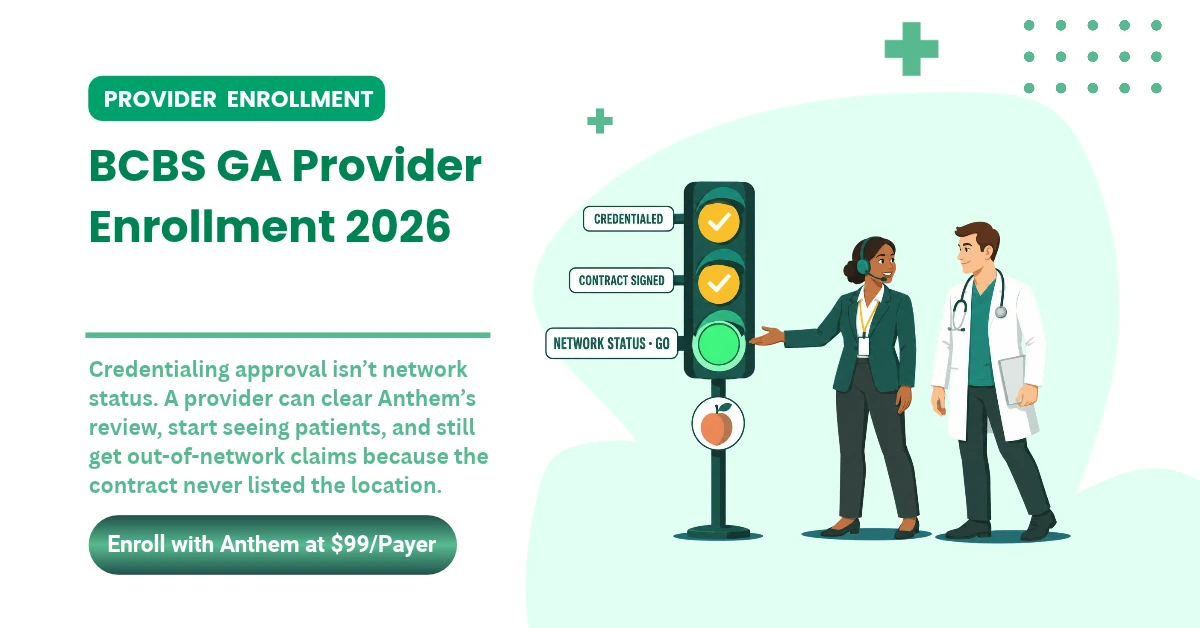
MedSole RCM prices behavioral health credentialing at $99 per payer, covering CAQH setup, application submission, and follow-up through written confirmation, which gives a practice a fixed cost to plan around when adding a provider or expanding into a new network.
When Is Prior Authorization Required?
Not every outpatient service requires authorization. Higher levels of care, including IOP, PHP, and residential treatment, typically involve stricter requirements and more frequent concurrent review. Some plans apply visit limits instead of a hard authorization gate. Requirements differ by diagnosis, provider type, network status, service, and plan, so a blanket assumption in either direction creates risk.
What Authorization Details Should the Billing Team Track?
|
Field |
Why it matters |
|---|---|
|
Authorization number |
Links the claim to payer approval |
|
Approved service or code |
Prevents billing outside the approved scope |
|
Units or visits |
Prevents exceeding the authorized quantity |
|
Start and end dates |
Prevents billing outside the approved period |
|
Rendering provider |
Confirms whether the approval is provider-specific |
|
Level of care |
Critical for IOP, PHP, residential, and facility services |
|
Concurrent review date |
Prevents a lapse during ongoing treatment |
Where Credentialing and Authorization Failures Show Up
Two patterns account for most of the damage. A provider gets linked to the group after the date of service, which puts every claim from that gap at risk of denial regardless of how accurate the coding was.
Or an authorization gets approved for one level of care, such as outpatient therapy, while the practice submits the claim for a higher level of care the authorization never covered. Both failures are procedural, not clinical, and both are preventable with a tracking system that flags dates before a claim goes out rather than after it comes back.
|
Enrollment or authorization gaps delaying valid claims? MedSole RCM can review payer enrollment, effective dates, provider linkages, authorization tracking, and claim-level mismatches before they become aged denials. |
provider credentialing services and prior authorization services solve related but separate problems, and a practice's mental health credentialing guide is worth a closer look before assuming a provider's start date and payer effective date are the same thing.
CMS also finalized new requirements affecting certain regulated payers' CMS prior authorization final rule, including faster decisions and specific denial reasons beginning in 2026, with the broader electronic prior authorization API requirements generally landing in later years.
These CMS behavioral health billing guidelines apply to specific regulated payer types rather than to every commercial plan, so a practice should confirm which of its own payers are actually covered before rebuilding its authorization workflow around them. The full 2026 detail on that rule appears further down in this guide.
What Codes Are Used in Behavioral Health Billing?
Behavioral health claims generally use ICD-10-CM codes to report the diagnosis, CPT codes to report professional services, and HCPCS Level II codes for additional services, programs, or payer-specific billing. Modifiers, place-of-service codes, revenue codes, provider identifiers, units, and documentation supply the remaining context a payer needs to adjudicate the claim correctly.
The behavioral health billing codes covered in this section are the ones billing teams see most often, not an exhaustive catalog of every code that could ever apply.
CPT Versus HCPCS Versus ICD-10-CM
|
Code system |
Primary purpose |
Behavioral health example |
|---|---|---|
|
ICD-10-CM |
Reports the diagnosis or condition |
Mental health or substance use diagnosis |
|
CPT |
Reports professional services and procedures |
Diagnostic evaluation or psychotherapy |
|
HCPCS Level II |
Reports additional services, supplies, and program-level services |
Certain behavioral health program or integration services |
|
Modifiers |
Add context to the reported service |
Telehealth or distinct service circumstances |
|
POS codes |
Identify where the patient received the service |
Office or telehealth setting |
|
Revenue codes |
Identify institutional service departments or categories |
Facility billing |
Code selection has to match what the documentation actually supports and what the specific payer's rules allow. A code that is technically valid for the service can still be the wrong choice if the note does not back it up.
Common Behavioral Health CPT Code Categories
mental health CPT codes cover more ground than any single guide should try to reproduce in full, so this section stays at the category level.
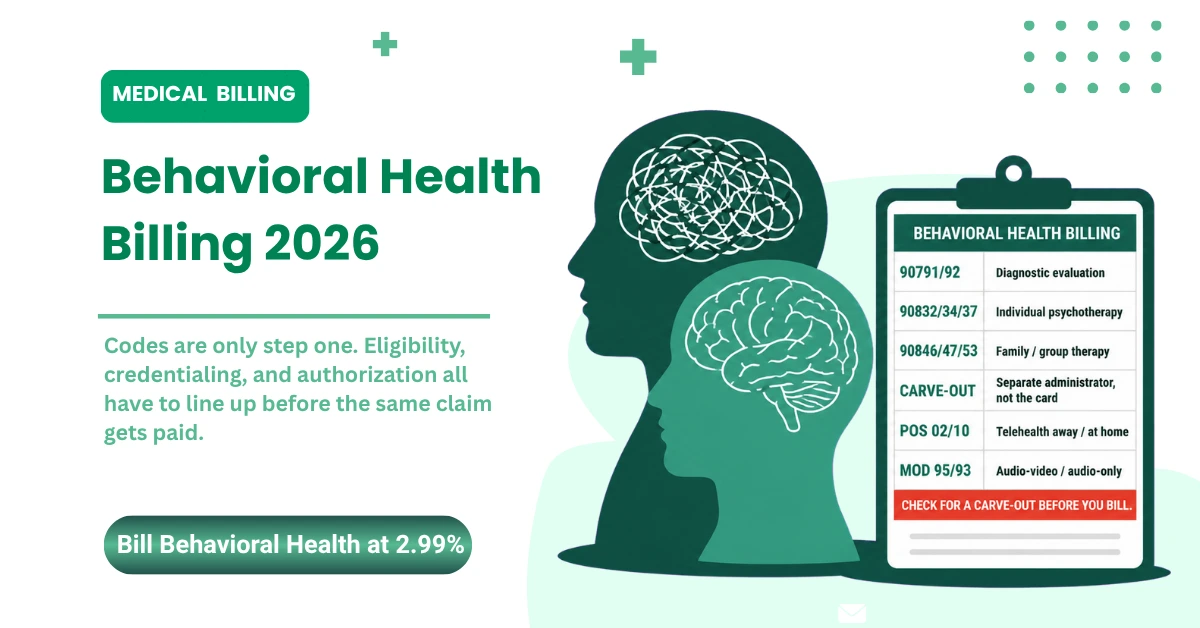
Psychiatric diagnostic evaluation uses CPT code 90791 for an evaluation without medical services and 90792 for an evaluation that includes medical services such as medication review. Only the 90791 code has its own dedicated guide linked here; the distinction between the two matters most for provider type, since only prescribing providers can bill 90792.
Individual psychotherapy runs on three time-based codes: 90832, 90834, and 90837.
|
Code |
Psychotherapy time |
|---|---|
|
90832 |
16 to 37 minutes |
|
90834 |
38 to 52 minutes |
|
90837 |
53 minutes or more |
The documented psychotherapy time has to support the code selected. A 40-minute session billed as 90837 will not hold up against the note, and a payer that checks documented time against the billed code catches that mismatch quickly. CPT code 90834 covers this specific code in more depth.
Psychotherapy performed alongside an eligible evaluation and management service uses add-on codes 90833, 90836, and 90838. These codes are not stand-alone psychotherapy codes. They only apply when a separately identifiable E/M service happens on the same date, and the psychotherapy time has to be documented apart from the E/M time.
Family and group psychotherapy use 90846, 90847, and 90853, each with its own participant and documentation requirements. Crisis psychotherapy uses 90839 for the first 60 minutes and 90840 for each additional 30 minutes, subject to the applicable coding rules for that add-on.
Behavioral Health Integration and Collaborative Care Model services use 99484, 99492, 99493, and 99494 as the standard time-based codes. For 2026, CMS added three HCPCS add-on codes, G0568, G0569, and G0570, that let a practice report qualifying Collaborative Care Model or general Behavioral Health Integration activity alongside Advanced Primary Care Management in the same month.
These add-on codes do not replace the existing BHI or CoCM codes, do not require minute-by-minute time tracking the way 99492 through 99494 do, and only apply when the corresponding Advanced Primary Care Management base code is also billed for that patient in that month.
How Do Modifiers and Place of Service Affect the Claim?
Modifier 95 commonly identifies synchronous audio-video telehealth, and modifier 93 commonly identifies synchronous audio-only telehealth. Place-of-service code 11 identifies an office visit, POS 02 identifies telehealth delivered somewhere other than the patient's home, and POS 10 identifies telehealth delivered while the patient is at home.
Behavioral health billing modifiers and place-of-service codes are payer-specific pairings. A practice should verify the plan's current billing policy rather than applying one universal telehealth combination to every claim, since some payers accept modifier 95 with POS 02 or 10 and others expect the modifier dropped entirely once the POS code itself signals telehealth. place-of-service code guide covers the current rules for each POS code in more detail than fits here.
Why Diagnosis and Procedure Codes Must Align
The diagnosis supports medical necessity. The procedure code reflects the service actually performed. Documentation has to support both at once, and provider eligibility and setting have to line up with everything else on the claim.
A valid diagnosis does not automatically make every procedure payable, and a payer that spots a mismatch between the F-code on the claim and the service described in the note will deny the claim even when both pieces are individually correct.
|
Coding causing repeated denials? If coding, modifiers, provider setup, or payer edits are causing repeated rejections or denials, MedSole can assess how clinical documentation is being converted into billable claims. |
Selecting the correct code is only one part of a payable claim. Getting behavioral health billing codes right matters, but the clinical record still has to support the diagnosis, service, time, participants, medical necessity, and billing context reported to the payer, which is exactly where documentation comes in.
What Documentation Is Required for Behavioral Health Billing?
Behavioral health documentation has to show what service was delivered, why it was medically necessary, who delivered it, how long it lasted when time affects code selection, who participated, where the patient and provider were located, and how the service connects to the treatment plan.
The record should support every material element reported on the claim, well beyond the diagnosis and procedure code alone.
What Elements Should a Behavioral Health Note Include?
- Patient identity and date of service
- Provider identity and credentials
- Service location and telehealth modality where applicable
- Presenting problem and relevant diagnosis
- Medical necessity
- Intervention performed and patient response
- Progress toward treatment goals
- Risk or safety assessment when clinically relevant
- Participants in the session
- Total psychotherapy time where required, including start and stop time if the payer requires it
- Plan for continued care
- Provider signature and date
No single note format is required nationally. SOAP, DAP, BIRP, and other structures all work when they satisfy the clinical, organizational, and payer requirements a specific claim depends on.
How Does Documentation Support Medical Necessity?
Medical necessity connects the diagnosed condition, the patient's symptoms and functional impairment, the service performed, the intensity and frequency of treatment, the treatment goals, and the patient's progress or continued need for care.
A note that says "supportive therapy provided" without describing the intervention, the patient's response, and the treatment-plan connection may not sufficiently support the billed service, even when the visit itself was entirely appropriate.
How Should Timed Psychotherapy Be Documented?
The documented time has to support the reported code: 16 to 37 minutes for 90832, 38 to 52 minutes for 90834, and 53 minutes or more for 90837.
Time spent on separately reported E/M work should not count toward the psychotherapy time, and payer documentation expectations can differ on exactly how start and stop times need to appear in the note.
What Must Be Documented When Psychotherapy and E/M Are Reported Together?
The note needs to show separate E/M work, separate psychotherapy time, and distinct clinical content, performed by an eligible provider type and reported with the appropriate add-on code. Both services need independent support in the record. Neither 90833, 90836, nor 90838 stands in for a full psychotherapy session on its own.
How Do Supervision and Incident-To Arrangements Affect Documentation?
Supervision rules differ by payer, setting, provider type, and state, and the record has to identify the rendering clinician accurately wherever that identification is required. The medical record should never imply that a supervising professional personally performed work that another clinician actually delivered.
Rules for incident to billing behavioral health services depend heavily on Medicare requirements, the care setting, the supervising practitioner's documented involvement, state scope-of-practice rules, and the specific service being reported, so a practice should not apply physician-office incident-to concepts across every behavioral health or commercial payer claim without checking first.
|
Documentation-related denials start upstream Documentation-related denials often begin before the billing team ever sees the charge. MedSole can review how clinical records are translated into codes, modifiers, provider information, and clean claims. |
A behavioral health code reference helps confirm which code a documented service supports, while clean claim submission depends on getting that documentation converted into claim data without errors. Medicare-specific documentation expectations get particular attention in the CMS mental health billing guidance, though that guidance should not be treated as a stand-in for commercial payer policy.
How Do You Bill Behavioral Health Telehealth Services?
Behavioral health telehealth billing requires a practice to verify that the service and provider type are covered remotely, identify whether the patient was at home or another location, select the payer-required place of service, apply any required audio-video or audio-only modifier, and document the technology, locations, consent, service, and time.
Telehealth rules vary across Medicare, Medicaid, commercial plans, and state requirements, and Medicare's rules have shifted meaningfully for 2026. Remote delivery is now common enough that behavioral health medical billing teams need a telehealth-specific checklist alongside their standard one, not a single combined process that treats every visit the same way.
What Should Be Verified Before a Telehealth Visit?
- Patient's plan covers the telehealth service
- Eligible provider type
- Audio-video coverage
- Audio-only coverage
- Network status
- Prior authorization
- Patient location and provider location
- State licensure covering the patient's location
- Modifier requirement
- Place-of-service requirement
- Patient cost sharing
Medicare now requires an in-person, non-telehealth visit within the six months before a patient's first mental health telehealth service, a requirement that took effect February 1, 2026 after several years of delay. Missing that in-person visit typically produces a coverage denial on the telehealth claim that follows, not on the visit itself, which makes it an easy failure to miss until the claim comes back.
Practices adding behavioral telehealth should also confirm state licensing requirements before billing.
What Is the Difference Between POS 02 and POS 10?
|
POS |
General meaning |
Provider verification |
|---|---|---|
|
POS 10 |
Telehealth provided when the patient is in the home |
Confirm the payer recognizes POS 10 for the service |
|
POS 02 |
Telehealth provided when the patient is somewhere other than the home |
Confirm the location and payer policy |
The patient's location, not the provider's office location, generally drives the POS distinction. Not every payer follows Medicare's exact POS method, so a claim scrubbed against Medicare rules alone can still fail at a commercial payer that handles the same distinction differently.
When Are Modifiers 95 and 93 Used?
Modifier 95 commonly identifies synchronous audio-video telehealth, and modifier 93 commonly identifies synchronous audio-only telehealth, but payers may require, accept, reject, or replace these modifiers in different ways. The underlying code has to be eligible for the telehealth modality in the first place, and the modifier on the claim has to agree with what the documentation actually describes.
Behavioral health billing modifiers for telehealth are one of the most common places a claim looks correct on the surface and still fails at the payer, which makes modifier selection one of the highest-value checks in behavioral health telehealth billing overall.
What Should a Telehealth Note Document?
- Patient identity and consent
- Patient location and provider location
- Modality and technology used
- Participants and service performed
- Psychotherapy time and clinical content
- Emergency or safety planning where relevant
- Technical interruptions that affected the service
Common Telehealth Billing Errors
|
Error |
Claim risk |
|---|---|
|
POS 02 used when the patient was actually at home |
Incorrect claim context |
|
Modifier does not match the modality |
Rejection or denial |
|
Audio-only service not covered by the payer |
Noncovered service |
|
Provider not licensed for the patient's location |
Compliance and payment risk |
|
Telehealth service not included in the payer's policy |
Denial |
|
Documentation omits patient location or modality |
Audit weakness |
|
In-person authorization applied to an unapproved telehealth service |
Authorization denial |
|
Telehealth claims failing on POS or modifier rules? If telehealth claims are failing because of inconsistent POS, modifier, eligibility, or documentation rules, MedSole can assess the practice's claim-edit workflow. |
The POS 02 and POS 10 distinction resolves most telehealth denials on its own once a practice applies it consistently, and telehealth claim submission still needs the same pre-submission edits as any other claim before it goes out the door.
How Do Medicare, Medicaid, and Commercial Behavioral Health Billing Rules Differ in 2026?
Medicare, Medicaid, and commercial insurers cover many of the same behavioral health service categories, but they differ in eligible provider types, fee schedules, credentialing, authorization, telehealth, documentation, claim edits, and appeal rules.
Medicare follows national rules with contractor administration. Medicaid varies by state and delivery system, and commercial coverage depends heavily on the specific plan, network contract, and behavioral health administrator involved.
Medicare Behavioral Health Billing
Medicare behavioral health billing covers eligible provider type, enrollment, professional versus facility coverage, psychotherapy, psychiatric diagnostic services, E/M services, Behavioral Health Integration, Collaborative Care Model services, telehealth, and Medicare Administrative Contractor policies layered on top of national coverage rules.
National CMS behavioral health billing guidelines set the floor, but individual Medicare Administrative Contractors can add local coverage detail on top of them, which is why two practices in different states sometimes get different answers to the same billing question. A code appearing on the Medicare fee schedule does not automatically establish coverage for every provider, diagnosis, setting, or claim circumstance.
Medicaid Behavioral Health Billing
Medicaid rules vary by state, fee-for-service program, managed care organization, behavioral health administrative organization, provider type, benefit package, waiver, service setting, authorization requirement, and state-specific HCPCS codes or modifier and unit rules.
No single national Medicaid billing table applies to every state, so a practice should verify the current state Medicaid manual and managed-care contract rather than assuming a rule that worked in one state carries over to another.
Commercial Behavioral Health Billing
Commercial behavioral health billing depends on network participation, behavioral health carve-outs, credentialing, plan-specific authorization, session limits, medical necessity criteria, telehealth coverage, claim destination, timely filing, appeal levels, and the contracted reimbursement rate.
Behavioral health insurance billing at the commercial level is where the widest variation lives, since two plans from the same carrier can apply different behavioral health billing guidelines depending on the employer group and the specific carve-out arrangement. Specific commercial payer policies change often enough that a practice should confirm current terms directly with the payer rather than relying on a general industry summary.
What Changed for Behavioral Health Providers in 2026?
CMS finalized the CY 2026 Medicare Physician Fee Schedule with two separate conversion factors for the first time: a slightly higher rate for clinicians in qualifying Alternative Payment Models and a lower rate, close to $33.40, for everyone else.
Actual payment for a specific code still varies by locality, setting, and other adjustments, so this conversion factor is a starting point for estimating reimbursement, not a final number.
The same rule introduced three new HCPCS add-on codes, G0568, G0569, and G0570, covering qualifying Collaborative Care Model and general Behavioral Health Integration services furnished alongside Advanced Primary Care Management in the same month.
These codes do not replace 99492 through 99494 or 99484, and they only apply when the corresponding Advanced Primary Care Management base code is billed for that patient in that month.
CMS also expanded payment policy around digital mental health treatment. HCPCS code G0552 covers supplying an FDA-cleared digital mental health treatment device and the initial education needed to use it, and G0553 and G0554 cover monthly management of a patient's ongoing use of that device.
These codes apply only when a licensed practitioner prescribes or orders an FDA-cleared device as part of an active behavioral health treatment plan, so a practice should confirm the device qualifies and the patient has a documented mental health diagnosis before billing, rather than assuming every behavioral health app or device qualifies.
Separately, certain CMS-regulated payers now face new prior authorization requirements, including specific denial reasons and publicly reported metrics beginning in 2026, while the broader electronic prior authorization API requirements generally take effect in later years.
The rule does not apply the same way to every payer type, so a practice should confirm which of its payers are actually covered before changing its authorization workflow.
The updated federal confidentiality framework under 42 CFR Part 2 reached its compliance deadline on February 16, 2026, affecting substance use disorder treatment records specifically. Organizations subject to Part 2 needed updated privacy notices, consent language, and disclosure procedures in place by that date, and enforcement now falls to the HHS Office for Civil Rights.
On the parity side, existing Mental Health Parity and Addiction Equity Act obligations remain in force, but the Departments of Labor, Health and Human Services, and the Treasury announced in May 2025 that they would not enforce the newer portions of the 2024 final parity rule while litigation over that rule continues, plus an additional period afterward.
The older 2013 parity rule and the 2021 comparative analysis requirement still apply during this period, so a practice should not read this as parity enforcement going away entirely.
Finally, several substance use disorder treatment flexibilities carried into 2026, including permanent options for certain buprenorphine telemedicine prescribing processes and continued methadone take-home flexibilities under revised opioid treatment program rules, both subject to their own clinical and regulatory conditions.
|
Are 2026 payer changes reaching your billing workflow? MedSole RCM can review payer enrollment, eligibility, authorization, telehealth, claim edits, and denial workflows to identify where outdated rules are affecting reimbursement. |
payer benefit verification and authorization management both need updating whenever a rule like this changes, and payer enrollment support matters just as much on the Medicare and commercial network side. A behavioral health RCM partner that tracks these updates as they happen keeps a practice from finding out about a rule change from a denial instead of from a policy notice.
For the source documents behind these changes, see the CY 2026 Medicare Physician Fee Schedule, the HHS 42 CFR Part 2 final rule, and the federal MHPAEA enforcement guidance.
Why Are Behavioral Health Claims Rejected, Denied, or Underpaid?
Behavioral health claims commonly get rejected, denied, or underpaid when patient information, payer routing, provider enrollment, authorization, coding, modifiers, place of service, documentation, medical necessity, or contract terms fail to line up.
The right response depends on whether the claim failed before adjudication, was denied after processing, or was paid below the expected contracted amount, since each of those calls for a different fix.
Rejection Versus Denial Versus Underpayment
|
Outcome |
What happened |
Typical response |
|---|---|---|
|
Rejection |
Claim failed a clearinghouse or payer front-end edit |
Correct claim data and resubmit |
|
Denial |
Payer adjudicated the claim but refused or reduced payment |
Correct, appeal, or provide documentation |
|
Underpayment |
Payer paid less than the expected allowed amount |
Compare contract and remittance, then dispute |
|
Patient responsibility |
Payer assigned an allowed amount to the patient |
Bill according to payer adjudication and policy |
|
Recoupment |
Payer takes back a previous payment |
Review the reason, records, contract, and appeal rights |
Common Behavioral Health Billing Errors and Their Root Causes
|
Root cause |
Example |
Prevention |
|---|---|---|
|
Eligibility error |
Coverage inactive on the date of service |
Verify each visit or at the payer's required interval |
|
Wrong payer |
Behavioral health benefit carved out |
Confirm the benefit administrator and payer ID |
|
Credentialing error |
Provider effective date begins after the service date |
Track enrollment and group linkage |
|
Authorization error |
Units exceeded or dates expired |
Monitor the authorization balance and end date |
|
Coding error |
Documented time does not support the psychotherapy code |
Match the code to the documented service |
|
Modifier or POS error |
Telehealth claim context is inconsistent |
Verify payer policy before submission |
|
Documentation gap |
Record does not support medical necessity |
Use documentation controls and audits |
|
Timely filing |
Claim submitted after the payer deadline |
Monitor unbilled encounters and rejections |
|
Duplicate billing |
Corrected claim submitted as a new claim |
Follow the payer's replacement-claim rules |
|
Coordination-of-benefits error |
Secondary payer billed before the primary |
Verify payer sequence |
Behavioral health billing errors rarely trace back to one dramatic mistake. Most of them come from a small gap at the front end that nobody catches until the remittance comes back weeks later.
How Should a Denial Be Worked?
- Read the remittance reason. Start with the exact reason code the payer returned, not an assumption about what probably went wrong.
- Confirm rejection or adjudication. A front-end rejection and a post-adjudication denial call for different fixes, so confirm which one actually happened.
- Identify the root cause. Trace the denial back to eligibility, authorization, documentation, coding, or a contract issue.
- Review the supporting data. Pull eligibility, authorization, documentation, coding, and contract information together before deciding how to respond.
- Correct or appeal. Follow the payer's required process for a correction or a formal appeal, using the specific reason the payer gave.
- Track the deadline. Log the follow-up date and the appeal deadline so the claim does not age out of eligibility for correction.
- Feed the cause upstream. Report the root cause back into registration, credentialing, or coding so the same failure does not repeat on the next claim.
Denial management behavioral health billing works best as a feedback loop, not a one-off fix. A denial that gets corrected without changing the upstream process just becomes next month's denial with a different patient's name on it.
How Should Behavioral Health Appeals Be Prepared?
- Payer denial reason
- Claim and remittance details
- Authorization evidence
- Clinical documentation
- Medical necessity explanation
- Contract or policy reference
- Timely filing proof
- Corrected claim indicator where required
- Appeal deadline and submission confirmation
A practice should never change a diagnosis just to get a claim paid. An appeal works from the documentation that already exists, not from a rewritten version of what happened in the session.
How Can Practices Prevent Repeat Denials?
Prevention starts with a denial taxonomy that sorts failures by payer, provider, and code, since a pattern that only shows up for one payer points to a different fix than a pattern that shows up across every payer.
Front-end causes need a different response than back-end causes, and staff education, tighter claim edits, and documentation feedback all work together to close the same gap from different directions.
|
Are the same denials returning every month? MedSole RCM reviews the denial itself and the eligibility, credentialing, authorization, documentation, coding, and submission failure that caused it. |
behavioral health denial management catches most of these patterns before they compound. behavioral health A/R recovery works the claims that are already aging, and payment posting and reconciliation is where most underpayments actually surface, since a payment that looks fine at a glance often does not match the contracted rate once someone checks.
What Behavioral Health RCM Metrics Should Providers Track?
Behavioral health practices should track clean claim rate, first-pass resolution, denial rate, days in A/R, A/R over 90 days, net collection rate, time to bill, authorization-related denials, underpayments, and patient balance performance.
Good behavioral health billing RCM depends on watching these together, since no single metric explains the whole revenue cycle. A practice should evaluate trends by payer, provider, code, location, and denial category rather than watching one number in isolation.
Core Behavioral Health RCM Metrics
|
Metric |
Recommended calculation |
What it reveals |
|---|---|---|
|
Clean claim rate |
Clean claims divided by submitted claims |
Front-end and claim-data quality |
|
First-pass resolution rate |
Claims resolved without rework divided by claims submitted |
End-to-end claim effectiveness |
|
Denial rate |
Denied claims divided by adjudicated claims |
Payment failure frequency |
|
Days in A/R |
Total A/R divided by average daily net revenue |
Collection speed |
|
A/R over 90 days |
A/R older than 90 days divided by total A/R |
Aging and follow-up risk |
|
Net collection rate |
Payments divided by the allowed collectible amount |
Revenue capture |
|
Time to bill |
Days from service to claim submission |
Documentation and charge lag |
|
Authorization denial rate |
Authorization denials divided by applicable claims |
Front-end authorization control |
|
Underpayment variance |
Expected allowed amount minus actual allowed payment |
Contract and posting accuracy |
No single benchmark applies equally to every practice. A solo therapist and a multi-site behavioral health clinic will land on different acceptable ranges for several of these metrics, even when both are running a healthy revenue cycle.
How Should Metrics Be Segmented?
Reporting only matters when it is segmented by payer, provider, location, CPT or HCPCS code, service line, denial category, telehealth versus in-person delivery, insurance versus patient balance, and age bucket. A single blended denial rate hides which payer or which provider is actually driving the problem.
How Often Should RCM Metrics Be Reviewed?
Submission and rejection queues need daily attention. Denials, authorization, unbilled encounters, and aging deserve a weekly look. Net collections, payer trends, underpayments, and provider trends belong in a monthly review, while workflow, staffing, contract, and policy questions fit a quarterly cadence.
|
Connect your trends to corrective action MedSole's RCM reporting can help practices connect payer, provider, denial, payment, and aging trends to specific corrective actions. |
RCM reporting services turns these numbers into something a practice can act on, and payment reconciliation is usually the fastest place to find money a practice already earned but never actually collected.
Should a Behavioral Health Practice Keep Billing In-House or Outsource It?
In-house billing can work well for a practice with stable claim volume, experienced specialty staff, strong payer workflows, and solid reporting controls. Outsourcing tends to make more sense when credentialing, authorization, coding, denials, A/R, staffing gaps, or payer variation are reducing collections or pulling clinical leadership away from patient care.
Billing for behavioral health services is rarely an all-or-nothing decision, and the right call depends on performance, cost, control, expertise, and how well the practice expects to scale.
In-House Versus Outsourced Behavioral Health Billing
|
Consideration |
In-house billing |
Outsourced billing |
|---|---|---|
|
Staffing |
Practice recruits and manages staff |
RCM partner manages billing resources |
|
Specialty knowledge |
Depends on internal experience |
Should be verified before selection |
|
Technology |
Practice purchases and maintains tools |
May be included in the service |
|
Control |
Direct internal management |
Requires clear reporting and governance |
|
Scalability |
May require new hires |
Can scale through service capacity |
|
Credentialing and authorization |
Often separate workflows |
May be integrated |
|
Denial follow-up |
Depends on internal workload |
Should include a defined follow-up process |
|
Cost |
Salary, benefits, training, software, management |
Percentage, flat fee, or hybrid model |
|
Continuity |
Staff turnover can disrupt the workflow |
Depends on vendor staffing and service levels |
Outsourcing is not automatically the better choice for every practice, and a practice with a well-run internal team may have no real reason to switch.
MedSole RCM's own behavioral health billing services run 2.99% of collections for full-service billing and $99 per payer for credentialing, with no separate setup fee, which gives a practice a concrete number to weigh against its actual in-house cost of salary, benefits, training, and software before deciding either way.
Signs a Practice May Need Billing Support
- Rising denial rate
- Aging A/R
- Unworked rejections
- Delayed charge entry
- Credentialing delays
- Authorization lapses
- Inconsistent payment posting
- Limited payer reporting
- Dependence on one staff member
- Growth without added billing capacity
- Leadership spending excessive time on claims
Billing for small behavioral health practices raises this question earlier than it does for larger groups, since a solo or two-provider practice often cannot absorb one biller leaving without a real gap in collections.
How Should Providers Evaluate a Behavioral Health Billing Company?
- Behavioral health and provider-type experience
- Payer experience
- Credentialing and authorization capability
- Coding-review process
- Denial workflow and A/R follow-up
- Reporting transparency
- Data security and business associate agreement
- Technology compatibility
- Implementation plan
- Pricing model
- Contract terms and data ownership
- Exit process
- References or case evidence
A behavioral health billing company that cannot answer a direct question about its pricing model, its denial workflow, or its exit process is telling a practice something important before the contract is even signed. Every behavioral health billing company worth considering should walk through these points without hesitation.
What Should Behavioral Health Billing Services Include?
Full-service behavioral health billing services typically cover patient registration support, eligibility and benefits verification, authorization, charge review, claim scrubbing, claim submission, payment posting, denials, appeals, A/R, patient balances where contracted, reporting, and credentialing where included.
Outsourced behavioral health billing works best when these pieces stay connected under one team rather than split across separate vendors that do not talk to each other.
Behavioral and mental health billing services should be evaluated as a full system, not a checklist of individual tasks, since a vendor that handles claim submission well but has no real denial process still leaves a practice with the same aging A/R problem it started with.
|
Find where your revenue cycle is losing revenue MedSole RCM can review your eligibility, credentialing, authorization, claim submission, denials, payment posting, and A/R workflow before you decide whether outsourcing is the right fit. |
specialized medical billing and billing support for private practices both matter more once a practice has actually compared its in-house cost against a transparent outside rate, since the comparison only means something when both sides of it are real numbers.
Frequently Asked Questions About Behavioral Health Billing
Is Behavioral Health Billing Different From General Medical Billing?
Yes. Medical billing for behavioral health often involves time-based services, behavioral health carve-outs, specialized provider eligibility, medical necessity documentation, payer-specific authorization, and professional or institutional billing differences that a general medical claim does not usually face in the same combination.
What Are the Most Common Behavioral Health Billing Codes?
The behavioral health billing codes providers use most often include 90791 and 90792 for diagnostic evaluation, 90832, 90834, and 90837 for individual psychotherapy, 90846 and 90847 for family therapy, 90853 for group therapy, 90839 and 90840 for crisis psychotherapy, and 99484 alongside 99492 through 99494 for integration and collaborative care services where applicable.
Does Every Behavioral Health Service Require Prior Authorization?
No. Requirements vary by payer, plan, service, provider type, frequency, and level of care. Higher levels of care typically involve more extensive authorization and concurrent review than standard outpatient therapy does.
What Is the Difference Between POS 02 and POS 10?
POS 10 generally indicates the patient was at home for a telehealth visit, and POS 02 generally indicates a telehealth location other than home. A practice should verify the payer's current policy before assuming either code applies the same way across all its payers.
Can Therapists Bill Medicare?
Eligible provider types can bill Medicare once they meet Medicare's enrollment, license, service, code, and supervision requirements together. Not every therapist license is recognized identically by Medicare, so a practice should confirm eligibility for the specific license type before assuming enrollment will go through.
How Does Incident-To Billing Apply to Behavioral Health?
Rules for incident to billing behavioral health services depend on Medicare requirements, setting, supervision, provider type, and whether the specific service qualifies. A practice should not apply standard physician-office incident-to concepts across every psychotherapy or commercial payer claim without checking the applicable rule first.
How Long Do Providers Have to Submit Behavioral Health Claims?
Timely filing windows vary by payer and contract. A practice should track the deadline from the date of service and work rejected claims quickly, since a rejection does not always preserve the original timely filing clock.
When Should a Practice Consider Outsourcing Billing?
A practice should consider outsourcing when denial volume, aging A/R, credentialing, authorization, staff turnover, reporting limitations, or claim backlogs start affecting collections or pulling leadership's attention away from patient care.
The complete CPT code guide covers the coding questions in more depth, and outsourced RCM support is the natural next step for a practice weighing the outsourcing question raised in the final FAQ above.
Build a Behavioral Health Billing Workflow That Protects Revenue
A behavioral health practice's revenue depends on credentialing, registration, eligibility, authorization, documentation, coding, claim submission, payment posting, denials, A/R, and reporting all working as one connected system. A gap anywhere in that chain shows up as a delay or a denial somewhere else, often weeks after the original mistake happened.
Worth asking directly: does the current workflow prevent errors before they happen, or catch them after the fact? Can staff keep up with payer rule changes like the ones covered in this guide?
Do denials get corrected at the root cause, or just resubmitted and hoped through? Does reporting actually support a decision, or just describe what already happened? These questions matter more than any single metric on its own.
MedSole RCM supports behavioral health providers across the complete revenue cycle, from front-end verification and payer enrollment through claim submission, denial management, payment posting, and A/R recovery, at 2.99% of collections for billing and $99 per payer for credentialing.
|
Strengthen Your Behavioral Health Revenue Cycle Request a no-obligation review of your current billing workflow and identify where eligibility, authorization, coding, denials, or A/R may be delaying reimbursement. |
This guide is educational and reflects general behavioral health billing practices as of the last-reviewed date above. It is not legal, coding, or payer-specific billing advice. CPT codes and descriptions are copyright the American Medical Association. Always verify current codes, coverage, authorization requirements, and payer policy directly with Medicare, the applicable state Medicaid program, and each commercial payer before billing.