



Acupuncture claims fail for a reason unrelated to treatment quality: the wrong code family, the wrong documented time unit, or an unsupported diagnosis. The four primary acupuncture CPT codes are 97810, 97811, 97813, and 97814, billed in 15-minute face-to-face increments based on whether electrical stimulation is used.
This guide covers what most competitors skip: Medicare's KX modifier requirement, the January 1, 2024 same-day prohibition with dry needling, the dry needling code separation, and the cupping codes. MedSole RCM's certified specialists handle every acupuncture CPT code claim across all 50 states at 2.99% of collections.
Acupuncture CPT Codes 97810-97814: The Four Time-Based Billing Codes for FY2026
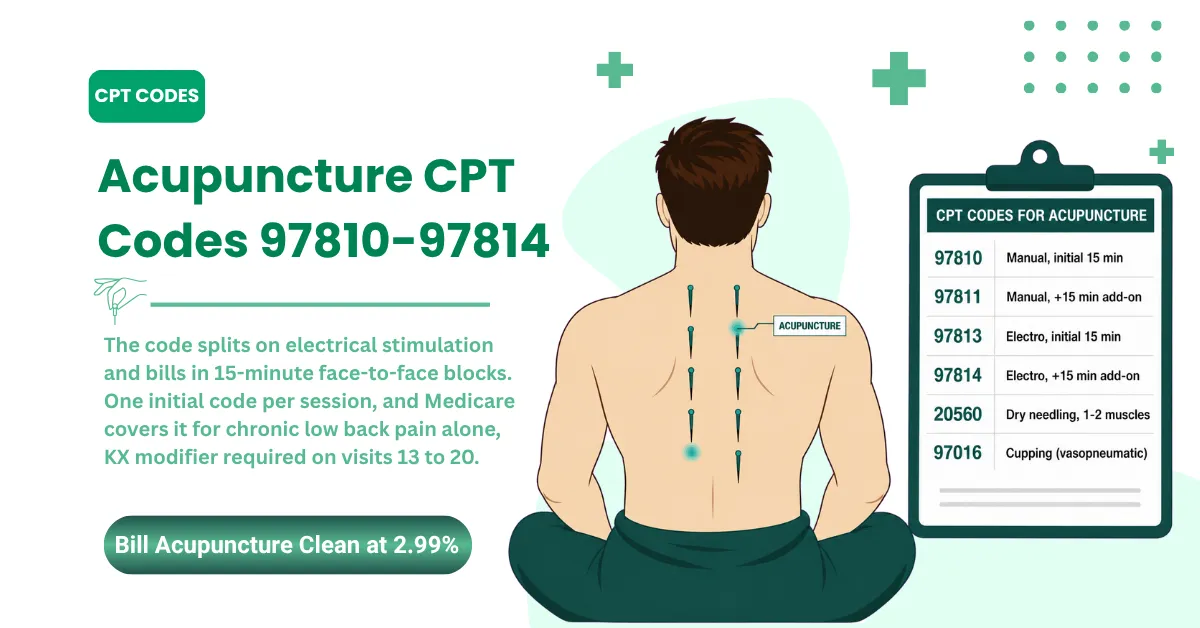
Acupuncture codes split into two families: manual acupuncture without electrical stimulation (97810 and 97811) and electroacupuncture with electrical stimulation (97813 and 97814). Each family has one initial code and one add-on code, billed in 15-minute one-on-one contact increments.
|
CPT code |
Description (paraphrased) |
Code type |
Billing rule |
|---|---|---|---|
|
97810 |
Manual acupuncture, no electrical stimulation, initial 15 minutes of one-on-one contact |
Primary |
Bill once per session |
|
+97811 |
Manual acupuncture, each additional 15 minutes of one-on-one contact, with needle re-insertion |
Add-on |
Use only after 97810 |
|
97813 |
Electroacupuncture, with electrical stimulation, initial 15 minutes of one-on-one contact |
Primary |
Bill once per session |
|
+97814 |
Electroacupuncture, each additional 15 minutes of one-on-one contact, with needle re-insertion |
Add-on |
Use only after 97813 |
The official CPT descriptors for these codes appear in the AAPC CPT 97810 reference. The plus sign on 97811 and 97814 is the AMA's official add-on code notation; keep it on claims and in documentation.
Critical Billing Rules for Acupuncture CPT Codes
- Face-to-face time: codes require direct one-on-one contact during needle insertion. Needle dwell time without the provider present doesn't count toward the billed unit.
- One initial code per encounter: bill only one initial code per date of service, either 97810 or 97813, never both. Billing both on the same date triggers a bundling denial.
- Full 15 minutes for add-on units: don't bill an add-on (97811 or 97814) until a full 15 minutes of additional treatment is complete. The 8-minute midpoint rule decides the final unit.
- Needle re-insertion for add-on codes: the descriptors for 97811 and 97814 require needle re-insertion. Documentation has to show it, or the add-on unit fails on audit.
- Never mix code families in one session: manual (97810/97811) and electroacupuncture (97813/97814) can't be billed together for the same region on the same date. Pick the family that matches the technique.
MedSole RCM handles acupuncture medical billing services for practices nationwide at 2.99% of collections, including daily claims submission for all four acupuncture CPT code families and real-time denial tracking.
CPT Codes 97810, 97811, 97813, and 97814: Each Code Explained for Accurate Billing
CPT 97810: Manual Acupuncture, Initial 15 Minutes
CPT 97810 covers the initial 15 minutes of manual acupuncture without electrical stimulation, billed once per session for one-on-one face-to-face contact during needle insertion and manipulation.
97810 is the foundation code; a manual acupuncture session can't start anywhere else. Needle count doesn't change the code, only time and electrical-stimulation status do. Example: a patient presents with M54.50 (low back pain, unspecified) and receives 15 minutes of manual acupuncture, billed as 97810 x1. The MUE for 97810 is 1 unit per date of service.
+97811: Manual Acupuncture, Each Additional 15 Minutes
+97811 is the add-on code for each additional 15 minutes of manual acupuncture without electrical stimulation, used with 97810 and requiring documented needle re-insertion for every billed unit.
The add-on can never be the first code on a claim. Needle re-insertion means the provider documents needle activity in the added time block, not patient rest. The AAPC CPT 97811 reference carries the official add-on code descriptor.
Apply the 8-minute midpoint: a 38-minute session bills as 97810 x1 plus 97811 x2, because the final block (minutes 31 to 38) covers 8 minutes and meets the threshold. The MUE for 97811 is 2 units per date of service.
|
Session duration |
Correct billing |
|---|---|
|
15 minutes |
97810 x1 |
|
30 minutes |
97810 x1 + 97811 x1 |
|
45 minutes |
97810 x1 + 97811 x2 |
CPT 97813: Electroacupuncture, Initial 15 Minutes
CPT 97813 covers the initial 15 minutes of acupuncture with electrical stimulation applied to inserted needles, billed once per session, and it can't be billed with 97810 for the same anatomical region.
Electrical stimulation runs between pairs of inserted needles through a small electrostimulation unit. The note has to record device settings (frequency and intensity), run time, and which needles received stimulation.
Example: a patient with G89.29 (other chronic pain) receives 15 minutes of electroacupuncture, billed as 97813 x1, with no 97810 on the same claim for that session. The MUE for 97813 is 1 unit per date of service.
+97814: Electroacupuncture, Each Additional 15 Minutes
+97814 is the add-on code for each additional 15 minutes of electroacupuncture, used only after 97813, requiring documented stimulation parameters and contact time for every additional unit billed.
Mirror the 97811 structure and apply the midpoint rule. The MUE for 97814 is 2 units per date of service.
|
Session duration |
Correct billing |
|
|---|---|---|
|
15 minutes |
97813 x1 |
|
|
30 minutes |
97813 x1 + 97814 x1 |
|
|
45 minutes |
97813 x1 + 97814 x2 |
|
|
60 minutes |
97813 x1 + 97814 x3 |
|
|
CPT code |
MUE value |
Code type |
|
97810 |
1 |
Initial |
|
+97811 |
2 |
Add-on |
|
97813 |
1 |
Initial |
|
+97814 |
2 |
Add-on |
Time-Based Billing Rules for Acupuncture CPT Codes: Face-to-Face Time, Units, and the 8-Minute Rule
What Face-to-Face Time Means in Billing
Face-to-face time is the period of direct, one-on-one contact during which the provider is actively engaged with the patient. Needle dwell time, when the patient rests with needles inserted and no active provider contact, isn't billable. This distinction is the most common documentation error in acupuncture billing.
Document session time precisely: “Initial 15-minute unit: 2:00 PM to 2:15 PM. Add-on unit 1: 2:15 PM to 2:30 PM.” Auditors reviewing time-based codes pull the start and stop entries first. Missing that documentation defaults to a CO-16 denial on medical-necessity grounds.
The 8-Minute Rule Applied to Acupuncture
The 8-minute rule lets you bill a timed unit when at least 8 minutes of face-to-face contact occurred in that 15-minute block. For these codes, the rule decides whether the final add-on unit (97811 or 97814) in a session is billable.
The same 8-minute rule governs OT CPT code billing under 97165 to 97168, and the calculation logic is identical across both therapy code families.
Apply it: a 38-minute session breaks down as 97810 x1 (minutes 1 to 15), 97811 x1 (minutes 16 to 30), and 97811 x1 (minutes 31 to 38). The final block covers 8 minutes and meets the midpoint.
A 37-minute session is different. Minutes 31 to 37 equal 7 minutes, one short of the midpoint, so only one add-on unit is billable, not two. CMS documents the frequency edit logic behind these counts in CMS transmittal R12185.
Practical Billing Considerations
Practical billing considerations for acupuncture CPT codes: track session time with start and stop logs, document needle insertion and manipulation in each time block, and keep time spent on phone calls or chart review out of the face-to-face billing period.
Accurate coding, MUE compliance, and proper documentation together improve reimbursement and cut administrative rework. MedSole RCM's certified coders verify every time-based acupuncture claim before submission.
Medicare Acupuncture CPT Codes: Coverage Rules, Visit Limits, and KX Modifier Compliance for FY2026
What Medicare Covers, and Exactly What It Does Not
Medicare covers acupuncture for one condition only: chronic low back pain (cLBP), under the rules in the CMS NCD 30.3.3 acupuncture coverage determination. A claim submitted for any other diagnosis, migraine, fibromyalgia, osteoarthritis, or any musculoskeletal condition outside the cLBP definition, denies automatically.
CMS defines chronic low back pain as pain lasting 12 weeks or longer, nonspecific with no identifiable systemic cause, not associated with surgery, and not associated with pregnancy. All four conditions have to appear in the clinical record for a Medicare acupuncture claim to pass.
Medicare Acupuncture Visit Limits (FY2026, per NCD 30.3.3)
|
Phase |
Visit allowance |
Condition |
|---|---|---|
|
Initial course |
Up to 12 visits |
Within a 90-day period |
|
Extended course |
Up to 8 additional visits |
Patient must show measurable improvement |
|
Annual maximum |
20 visits total |
About 11 months must pass before eligibility resets |
|
Stop rule |
Discontinue treatment |
If the patient isn't improving or is regressing |
The “about 11 months” annual reset is a detail most billing guides omit. Start a patient's course in January, and that patient can't receive Medicare-covered acupuncture again until about December, not exactly 12 months later.
The KX Modifier: Required for Medicare Visits 13 to 20
The KX modifier tells Medicare that documentation confirms medical necessity for acupuncture beyond the initial 12 visits. Without it, claims for visits 13 through 20 deny automatically. A missing modifier has no appeal path; it has to be on the original claim.
Append KX to the initial code (97810 or 97813) and any add-on codes (97811 or 97814) on every claim for visits 13 to 20. The supporting documentation must state that the patient showed measurable improvement during the initial 12-visit course. “Patient doing better” won't survive an audit.
Two modifiers govern acupuncture Medicare compliance as a pair: KX confirms ongoing medical necessity for extended visits, and GA signals that an Advance Beneficiary Notice is on file when a Medicare denial is anticipated.
Practitioner Qualification Denials
A correctly coded claim still denies if the furnishing provider doesn't meet NCD 30.3.3 qualifications. Medicare covers acupuncture performed by physicians and by auxiliary personnel who hold a master's or doctoral degree from an ACAOM-accredited school and a current, unrestricted acupuncture license in the treatment state.
This credential gap is the most common Medicare acupuncture denial that a code correction can't fix. The billing configuration triggers it, not the CPT code. Credentialing and enrollment have to match NCD requirements before the first Medicare acupuncture claim is filed.
Practices billing Medicare acupuncture claims need revenue cycle management for acupuncture that tracks visit counts per patient, verifies KX eligibility before each claim, and monitors the annual reset dates.
Dry Needling CPT Codes 20560 and 20561: How They Differ from Acupuncture CPT Codes and When to Use Each
The Code Definitions
Dry needling uses two CPT codes distinct from the acupuncture codes. CPT 20560 covers needle insertion without injection into one or two muscles. CPT 20561 covers needle insertion without injection into three or more muscles.
|
CPT code |
Description (paraphrased) |
Muscles treated |
MUE value |
|---|---|---|---|
|
20560 |
Needle insertion without injection, 1 or 2 muscles |
1 to 2 |
1 |
|
20561 |
Needle insertion without injection, 3 or more muscles |
3 or more |
1 |
The January 1, 2024 Same-Day Prohibition
Effective for claims with dates of service on or after January 1, 2024 (CMS CR 13288), Medicare disallows acupuncture codes 97810 through 97814 on the same date of service as dry needling codes 20560 or 20561. The MLN MM13288 frequency edits guidance states the rule directly.
This applies to Medicare claims. An integrative practice that offers both services should schedule them on separate dates for Medicare, or confirm a commercial payer's policy allows same-day billing before submitting.
The Coding Decision Table
|
The procedure performed is |
The correct code family is |
|---|---|
|
Needle inserted at acupuncture points, with manual or electrical stimulation |
97810 to 97814 (acupuncture) |
|
Needle inserted into a muscle trigger point for myofascial release |
20560 to 20561 (dry needling) |
|
Both techniques, same patient, same day, Medicare |
Not billable; schedule separately |
|
Both techniques, same patient, same day, commercial |
Verify payer policy before submitting |
Using 97810 where 20560 is correct, or the reverse, is a coding error, not a documentation gap. Audits that find systematic misclassification can trigger refund demands. Code what was performed, not what pays better.
Cupping, Infrared, and Companion CPT Codes Used in Acupuncture Practices: 97016, 97026, and Beyond
CPT 97016: Cupping Therapy Billing for Acupuncture Practices
CPT 97016 is the billing code for vasopneumatic device application, which covers cupping therapy in acupuncture billing. The descriptor refers to a vasopneumatic device applied to one or more areas. In practice, that maps to the suction cups used in traditional and sports cupping.
Documentation for CPT 97016 has to establish that cupping was a distinct service from the acupuncture session, not a bundled add-on. Record the areas treated, the duration, the therapeutic goal, and why the modality fit this patient. Without that separation, payers bundle 97016 into the acupuncture codes and deny it.
Medicare generally doesn't separately reimburse CPT 97016 in acupuncture billing contexts. Commercial payers vary. Verify the payer's medical policy for modality billing alongside acupuncture before submitting 97016 on the same date.
CPT 97026: Infrared Therapy as a Companion Code
CPT 97026 covers infrared light application to support tissue healing and circulation. Acupuncturists who use infrared devices before or after needle insertion can bill 97026 as a separate service with documentation for medical necessity and distinct service time.
|
CPT code |
Description |
KD |
Vol |
Payer note |
|---|---|---|---|---|
|
97016 |
Vasopneumatic device (cupping) |
2-4 |
170-320 |
Commercial varies; Medicare generally non-covered separately |
|
97026 |
Infrared therapy |
4-6 |
110-260 |
Document as distinct from the acupuncture session |
|
97140 |
Manual therapy (myofascial release, mobilization) |
N/A |
N/A |
Billable separately with modifier 59 if distinct |
|
97124 |
Massage therapy |
N/A |
N/A |
Rarely covered alongside acupuncture by the same payer |
|
97110 |
Therapeutic exercise |
N/A |
N/A |
Separate encounter or distinct service required |
Practices offering multiple modalities alongside acupuncture codes need a billing partner that tracks companion-code payer rules in real time, because one miscoded companion code can trigger a full-session audit.
Acupuncture CPT Code Modifiers: When to Use 25, 59, GP, KX, GA, and GY
Why Modifiers Matter in Acupuncture Billing
Modifiers are two-character codes appended to a CPT code to tell the payer the service happened under specific circumstances that need separate reimbursement consideration. For acupuncture CPT code claims, the wrong modifier, or a missing one, is the second most common denial trigger after incorrect code-family selection.
Six modifiers appear regularly in acupuncture billing, each with a distinct purpose. Using one where another is required produces a hard denial, not a soft one, and it may not be appealable without added documentation.
|
Modifier |
Name |
Purpose |
Denial risk if missing or wrong |
|---|---|---|---|
|
25 |
Significant, separately identifiable E/M |
Appended to the E/M code when a distinct evaluation happens the same day as acupuncture |
E/M bundled into the acupuncture code and denied |
|
59 |
Distinct procedural service |
Appended when two separate same-visit services need individual billing |
Payer bundles both services; one denied |
|
GP |
Physical therapy plan of care |
Required when acupuncture is part of an outpatient PT plan |
Denied for incorrect taxonomy or plan designation |
|
KX |
Medical necessity threshold exceeded |
Required on Medicare visits 13 to 20; confirms documentation supports continued care |
Automatic denial, not correctable after submission |
|
GA |
Advance Beneficiary Notice on file |
Used when a Medicare denial is anticipated and an ABN is signed |
Incorrect liability assignment if the ABN exists but the modifier is missing |
|
GY |
Statutory exclusion |
Used when a service is never covered by Medicare for any patient or indication |
Incorrect denial type; payer may process the claim wrong |
Modifier 25: The Most Frequently Misapplied Modifier in Acupuncture Billing
Modifier 25 goes on the E/M code, not on the acupuncture code. The common error is placing it on 97810 or 97813 instead of on the office visit code (99202 to 99214). The E/M has to be a separately documented service that would stand alone as a billable encounter even without the acupuncture.
The documentation test for modifier 25 is simple: could the E/M note be pulled from the acupuncture session note and billed on its own? If yes, the modifier holds. If the note blends the evaluation into the acupuncture workflow, it doesn't.
Modifier 59: When Companion Codes Require Separation
Modifier 59 is required when billing a companion code like CPT 97016 (cupping) or CPT 97026 (infrared) on the same date as acupuncture codes 97810 through 97814. Without it, automated bundling edits combine all same-day services and pay them as a single acupuncture encounter. Each companion service needs its own documentation trail to support the 59.
Acupuncture CPT Code Claim Denials: CO-50, CO-16, and CO-4 With Prevention and Appeal Protocols
The Three Denial Codes Every Acupuncture Practice Encounters
Acupuncture claims fail for identifiable, preventable reasons. Three denial codes appear often enough to define the billing risk profile for this specialty. Each has a specific root cause and a specific prevention protocol.
|
Denial code |
Name |
Root cause in acupuncture billing |
Prevention protocol |
|---|---|---|---|
|
CO-50 |
Not covered when performed by this provider type |
The payer's policy doesn't cover acupuncture for the billed diagnosis, or the rendering provider doesn't meet the payer's acupuncture criteria |
Verify the payer's medical policy before the first visit; confirm the rendering provider is credentialed for acupuncture billing |
|
CO-16 |
Claim lacks information needed for adjudication |
Time not documented, KX modifier absent on Medicare visits 13 to 20, or modifier 25 missing on a same-day E/M |
Run a pre-submission checklist; verify time documentation, modifier presence, and diagnosis specificity on every claim |
|
CO-4 |
Service code inconsistent with the modifier |
Wrong modifier applied to the CPT code, or modifier 59 missing when required for companion codes |
Use the modifier reference table; never put modifier 25 on an acupuncture code, it belongs on the E/M code |
CO-50: The Denial That Isn't Always About the Code
CO-50 on an acupuncture claim often has nothing to do with coding accuracy. The provider picked the right CPT code and the right ICD-10 code. The denial fires because the payer's policy restricts acupuncture to certain diagnoses, provider types, or credentialing configurations. A correct claim against an incompatible policy still denies.
The fix for CO-50 isn't a coding change, it's a credentialing and eligibility change. Confirm the patient's plan covers acupuncture for the specific diagnosis before the session. Confirm the rendering provider is credentialed under the correct taxonomy code. Confirm authorization if the payer requires it.
The CO-16 Audit Trail and the KX Connection
CO-16 says the claim is missing something the payer needs to pay it. On acupuncture claims, CO-16 most often fires because the start and stop time documentation is absent, the KX modifier is missing on Medicare visits 13 to 20, or the medical-necessity documentation doesn't support the units billed.
The CO-16 prevention protocol has three steps before submission: verify session time is documented with start and stop entries, confirm the correct modifier is present for the visit-count stage, and confirm the ICD-10 code is on the payer's covered diagnosis list.
Practices that keep getting CO-50 or CO-16 denials on acupuncture claims need systematic denial management services that find the root-cause pattern, not a team that reworks claims in isolation. MedSole RCM tracks denial patterns across every acupuncture CPT code claim, rebuilds the prevention workflow, and appeals eligible denials within 24 hours.
ICD-10 Codes for Acupuncture Billing: Medicare-Required Diagnoses and Commercial Payer Options
The Medicare Covered Diagnosis List
Pairing the right ICD-10 code with the acupuncture codes is the mechanism that tells Medicare and commercial payers the service meets medical necessity. The wrong primary ICD-10 code triggers an automatic CO-50 denial no matter how correct the CPT code is.
For Medicare, the covered diagnosis is chronic low back pain, coded from the M54 family. M54.50 (low back pain, unspecified) is the most common, though more specific codes are available and preferred.
|
ICD-10 code |
Description |
CMS coverage status |
Clinical note |
|---|---|---|---|
|
M54.50 |
Low back pain, unspecified |
Covered under NCD 30.3.3 |
Use when a specific type can't be documented |
|
M54.51 |
Vertebrogenic low back pain |
Covered under NCD 30.3.3 |
Vertebral end plate disorder documented |
|
M54.59 |
Other low back pain |
Covered under NCD 30.3.3 |
When a more specific M54.5x code isn't available |
|
M51.360 |
Other intervertebral disc degeneration, lumbar region, with discogenic back pain only |
Billable code added October 1, 2024 |
Replaces the now non-billable header M51.36 |
|
M51.370 |
Other intervertebral disc degeneration, lumbosacral region, with discogenic back pain only |
Billable code added October 1, 2024 |
Replaces the now non-billable header M51.37 |
The October 2024 ICD-10 update made M51.36 and M51.37 non-billable headers and added more specific child codes split by pain type, discogenic back pain or lower extremity pain. Claims submitted on or after October 1, 2024 with the old five-character codes deny on specificity. If your EHR still maps to M51.36 or M51.37, update the code set.
Commercial Payer ICD-10 Flexibility
Commercial payers cover acupuncture for a broader diagnosis range than Medicare. Codes commonly accepted include M79.7 (fibromyalgia), M54.2 (cervicalgia, neck pain), M54.30 (sciatica, unspecified side), G89.29 (other chronic pain), G89.21 (chronic pain due to trauma), and M62.830 (muscle spasm of back). Always verify the plan's covered diagnosis list before the session.
The Diagnosis-Code-to-CPT Pairing Rule
Pairing the M54 family back pain codes with the acupuncture codes creates the medical-necessity thread that supports both the diagnosis and the procedure on the claim. For chronic low back pain, the back pain ICD-10 codes in the M54 family are the anchor.
Acupuncture Provider Taxonomy Code 171100000X: Credentialing Requirements for Clean Claims
What the Acupuncture Taxonomy Code Is
The acupuncture provider taxonomy code is 171100000X, the Health Care Provider Taxonomy Code assigned to licensed acupuncturists in the NUCC Health Care Provider Taxonomy Code Set. It identifies the provider type on HIPAA-standard transactions, credentialing applications, and many commercial claim forms. Billing acupuncture codes under the wrong taxonomy code is a direct path to CO-50 denials.
Taxonomy code 171100000X applies specifically to licensed acupuncturists. Physicians who perform acupuncture bill under their physician taxonomy code, not this one. The taxonomy code on the claim has to match the rendering provider's actual credential type and the payer's approved provider configuration.
How Taxonomy Errors Trigger Acupuncture Claim Denials
A taxonomy mismatch between the claim and the payer's provider file produces a CO-50 denial in most cases. The claim processes as if a provider type the payer doesn't recognize for acupuncture rendered the service. The correct CPT code, ICD-10 code, and time documentation all fail because the taxonomy link is broken.
Credentialing as the Foundation of Clean Acupuncture Billing
Credentialing an acupuncturist with Medicare and commercial payers requires correct taxonomy selection (171100000X for licensed acupuncturists), a CAQH profile with current licensure and malpractice documentation, and individual payer enrollment applications. Each step has to finish before the first acupuncture CPT code claim, or that first claim denies.
MedSole RCM handles acupuncture provider credentialing at $99 per payer, among the most affordable credentialing rates available, with full CAQH management, enrollment tracking, and revalidation support. That pricing makes the path from taxonomy setup to first clean claim fast and cost-effective.
Frequently Asked Questions: Acupuncture CPT Codes and Billing Rules
What are the primary acupuncture CPT codes?
The primary acupuncture CPT codes are 97810, +97811, 97813, and +97814. CPT 97810 and 97813 are initial 15-minute codes for manual and electroacupuncture. CPT 97811 and 97814 are add-on codes for each additional 15 minutes, billed in 15-minute face-to-face increments.
What is the CPT code for acupuncture in 2026?
In FY2026, acupuncture is billed with the same four time-based codes: 97810 (manual, initial 15 minutes), +97811 (manual, each additional 15 minutes), 97813 (electroacupuncture, initial 15 minutes), and +97814 (electroacupuncture, each additional 15 minutes). No new acupuncture codes were added for FY2026.
What is CPT code 97016 for acupuncture?
CPT 97016 is the billing code for vasopneumatic device application, used in acupuncture practices to bill cupping therapy. Documentation has to establish that cupping was a distinct service from the acupuncture session. Medicare generally doesn't separately reimburse 97016 in acupuncture billing contexts.
Can acupuncturists bill E/M codes alongside acupuncture?
Yes. When a significant, separately identifiable evaluation and management service happens on the same visit as acupuncture, bill the E/M code with modifier 25 appended. The E/M has to be documented as a distinct, stand-alone service, and modifier 25 goes on the E/M code, not the acupuncture code.
Will Medicare cover acupuncture in 2026?
Yes, but only for chronic low back pain under NCD 30.3.3. CMS covers up to 12 acupuncture visits in a 90-day period, plus 8 more if the patient shows measurable improvement, for a maximum of 20 visits annually. All other acupuncture diagnoses are non-covered by Medicare.
Can a licensed acupuncturist bill Medicare?
Yes, if the acupuncturist holds a master's or doctoral degree from an ACAOM-accredited school and a current, full, active, unrestricted acupuncture license in the state of service. The acupuncturist must also be enrolled with Medicare before any acupuncture CPT code claims are submitted.
What diagnosis codes are covered for acupuncture by Medicare?
Medicare covers acupuncture only for chronic low back pain, primarily M54.50 (low back pain, unspecified), M54.51 (vertebrogenic low back pain), M54.59, and the lumbar disc codes M51.360 and M51.370 effective October 2024. All other ICD-10 diagnoses produce automatic Medicare denials on acupuncture claims.
How many units of acupuncture CPT codes can a provider report per session?
Per CMS Medically Unlikely Edits, the maximum units per date of service are: 97810 one unit, 97811 two units, 97813 one unit, and 97814 two units. Exceeding these MUE values triggers automatic claim edits.
What are the acupuncture CPT codes and modifiers used together?
The common modifiers used with acupuncture codes are modifier 25 (on the E/M code when a distinct same-day evaluation occurs), modifier 59 (for companion codes like 97016 or 97026), modifier KX (for Medicare visits 13 to 20), and modifier GP (when acupuncture is part of a PT plan of care).
What are the CMS acupuncture billing guidelines for Medicare?
CMS acupuncture billing guidelines under NCD 30.3.3 require chronic low back pain lasting at least 12 weeks without a systemic cause, one initial code per date of service (97810 or 97813), and the KX modifier on visits 13 to 20. CR 13288, effective January 1, 2024, also disallows same-day acupuncture and dry needling billing.
Acupuncture Billing Pre-Submission Checklist: What to Verify Before Every Claim
Before submitting any acupuncture CPT code claim, confirm all of the following are in place.
- Confirm the correct code family was selected, manual (97810/97811) or electroacupuncture (97813/97814), not both for the same region on one claim.
- Confirm session time is documented with start and stop entries in 15-minute blocks.
- Confirm needle re-insertion is documented for every add-on unit billed (97811 or 97814).
- Confirm the ICD-10 diagnosis code is on the payer's covered diagnosis list for acupuncture.
- Confirm the KX modifier is present if this is a Medicare claim for visits 13 through 20.
- Confirm modifier 25 is on the E/M code, not the acupuncture code, if an evaluation was performed the same day.
- Confirm modifier 59 is present on any companion codes (97016, 97026) billed alongside acupuncture.
- Confirm the rendering provider's taxonomy code matches the payer's credentialing file.
- Confirm the session is within the payer's annual visit limit for acupuncture.
- Confirm acupuncture and dry needling codes aren't both on the claim for the same Medicare date of service.
Practices that work this checklist on every acupuncture claim see cleaner submissions and fewer CO-50 and CO-16 denials. Those who can't sustain it in-house outsource it. MedSole RCM handles acupuncture billing at 2.99% of collections with no setup fees, no long-term contracts, and a 99% clean claim rate.
Credentialing for acupuncture practices is $99 per payer, among the most affordable payer enrollment rates available, including CAQH setup, payer follow-up, and revalidation support.