



Wisconsin Medicaid provider enrollment is the process of registering with the Wisconsin Department of Health Services through the ForwardHealth Portal so you can bill for services delivered to Wisconsin Medicaid, BadgerCare Plus, and SeniorCare members. Federal law requires it before you render, order, refer, or prescribe. Without it, your claims don’t get paid.
Three numbers changed the math in 2026. Organizations now owe a $750 application fee, and ForwardHealth won’t start processing anything until it clears. The state commits to an enrollment decision within 60 days. And since May 13, 2026, no new home health or hospice agency can enroll at all.
What follows covers the whole process: who has to enroll, what the portal actually asks for, what it costs, how long it really takes, and what breaks after you’re approved.
Last updated: September 2026 | Reviewed by: Noah Stone, Credentialing Manager, MedSole RCM
What Is ForwardHealth, and Is It the Same as Wisconsin Medicaid?
ForwardHealth is the system Wisconsin DHS uses to administer Wisconsin Medicaid, BadgerCare Plus, SeniorCare, and the state’s adult long-term care waiver programs. It isn’t a separate insurance plan, and it isn’t Medicare. Certain provider types do have to hold Medicare enrollment before Wisconsin Medicaid will approve them, which is where the confusion usually starts.
If somebody told you to enroll with ForwardHealth, they told you to enroll with Wisconsin Medicaid. Same thing. The name trips people up because an unrelated Madison company called Forward Health Group shows up in the same searches.
Programs administered through ForwardHealth
|
Program |
Who it covers |
|---|---|
|
Wisconsin Medicaid |
Fee-for-service members statewide |
|
BadgerCare Plus |
Low-income adults, children, and families, mostly through HMOs |
|
SeniorCare |
Prescription drug assistance for residents 65 and over |
|
Family Care and Family Care Partnership |
Adult long-term care delivered through MCOs |
|
PACE |
Program of All-Inclusive Care for the Elderly |
|
IRIS |
Include, Respect, I Self-Direct, the self-directed long-term care option |
One approved enrollment covers your participation at the state level across all of these. The full list of criteria sits on the ForwardHealth enrollment criteria pages. What that enrollment doesn’t cover is the managed care layer on top, and that gap costs providers their first few months of revenue more often than anything else on this page.
Wisconsin Medicaid provider enrollment also runs entirely on its own track. There’s no shared application, no shared portal, and no reciprocity between states, which is why Medicaid enrollment across 50 states works out to fifty unrelated processes instead of one.
Who Has to Enroll as a Wisconsin Medicaid Provider?
Wisconsin Medicaid provider enrollment applies to four groups: individual practitioners, group practices, providers who prescribe or refer or order without billing, and border-status providers in adjacent states. Being enrolled in another state’s Medicaid program doesn’t carry over. You still enroll separately in Wisconsin.
The four enrollment categories
|
Category |
Who it applies to |
What happens without it |
|---|---|---|
|
Individual |
Physicians, NPs, PAs, therapists, and other practitioners who render and bill |
No claims can be submitted or paid |
|
Group |
Practices billing under a Type 2 NPI with rendering providers linked to it |
Rendering providers can’t be paid under the group |
|
Prescribing, referring, ordering |
Practitioners who prescribe, refer, or order but never bill |
Other providers’ claims and prior authorization requests get denied |
|
Border-status |
Providers in adjacent states serving Wisconsin members |
Out-of-state claims aren’t reimbursed outside defined exceptions |
The rule that catches practices off guard
For dates of service on or after July 15, 2013, ForwardHealth denies claims and returns prior authorization requests that don’t carry the name and NPI of a Medicaid-enrolled prescriber, referrer, or orderer. Read that again, because the money moves in an unexpected direction. Your claim gets denied for somebody else’s paperwork. The referring physician stays whole and you eat the write-off. ForwardHealth publishes the detail on its prescribing and referring enrollment page.
Border-status providers get their own rulebook. Wisconsin reimburses out-of-state providers only in specific situations, and the ForwardHealth out-of-state provider rules spell out which ones. If you practice in Minnesota, Illinois, Iowa, or Michigan and see Wisconsin members, check that page before you assume a claim will pay.
How Enrollment Differs for Individuals, Groups, and LTC Waiver Providers
Wisconsin Medicaid provider enrollment splits along provider type, and that choice decides four things: which NPI you need, whether you owe the $750 application fee, how many Medicaid IDs you end up with, and where your application is most likely to stall. Getting the type wrong isn’t a correction. It’s a restart.
|
Individual |
Group |
Adult LTC waiver |
|
|---|---|---|---|
|
NPI required |
Type 1 |
Type 2 for the group, Type 1 for each rendering provider |
Type 1 or Type 2, or an Atypical Provider ID where no NPI applies |
|
Application fee |
Not assessed |
Assessed for provider organizations, not professional groups |
Assessed for organizations |
|
Medicaid IDs issued |
1 |
1 for the group, plus linked rendering records |
1 per physical service location for residential and facility types |
|
Where it stalls |
Taxonomy code mismatch |
Group members never reported, because the link doesn’t sync |
A missed location, so services there can’t be billed |
Enrolling as an individual provider
Individuals need a Type 1 NPI and a taxonomy code that matches the specialty they’re enrolling under. No application fee applies to individual providers or professional provider groups. You’ll also pick a billing category, and the choice matters: rendering-only providers can’t submit claims directly, so a solo practitioner who picks it by accident ends up unable to bill at all.
Enrolling a group practice
A group carries two layers of identification: a Type 2 NPI for the practice, plus a Type 1 for every rendering provider linked to it. Here’s the constraint that surprises multi-specialty practices: ForwardHealth won’t allow more than one group enrollment sharing the same ZIP+4, NPI, and taxonomy combination. Two groups at one address have to differ by NPI or by taxonomy.
Then there’s the reporting gap. Group member information and group affiliations don’t update each other. The group reports its members, each individual reports their groups, and neither action populates the other side. Miss it and rendering providers show as unaffiliated, which denies every claim billed under the group.
If nobody on staff has mapped which rendering providers sit under which tax ID, that’s usually where a group enrollment breaks. Our group provider enrollment support audits the affiliation map before anything gets submitted, because fixing it after submission restarts the review.
Enrolling as an adult LTC waiver provider
Does your agency deliver services at more than one address? Residential and facility-based waiver providers need a separate Medicaid ID for every physical service location. DHS requires it to track Home and Community-Based Setting Rule compliance and to document network adequacy, which federal rules mandate.
The settings covered are specific: 1 to 2 bed adult family homes, 3 to 4 bed adult family homes, community-based residential facilities, residential care apartment complexes, and facilities providing adult day care, facility-based day services, or facility-based prevocational services. ForwardHealth’s multiple locations policy lists them. Providers outside those categories should call Provider Services before assuming one application covers every site.
What Documents You Need Before You Start the Application
Gather everything first. The ForwardHealth Portal times out after 30 minutes of inactivity and holds a saved application for only 10 calendar days, so an application built while hunting for documents is an application you’ll be starting over.
There’s a second reason, and it costs real money. Supplemental documents that arrive more than 30 calendar days after you submit push your enrollment effective date forward to whenever the last one lands. Every day that date moves is a day of delivered care you can’t bill.
What ForwardHealth asks for
|
Item |
What trips people up |
|---|---|
|
Tax identification number |
Has to match what the IRS holds, exactly |
|
NPI |
Type 1, Type 2, or an Atypical Provider ID when no NPI applies |
|
Taxonomy code |
Must match the specialty and line up with NPPES |
|
Business and service addresses |
A mismatch against the address on file restarts the review |
|
Professional license or certification |
Current on the submission date itself, not the approval date |
|
DEA registration |
Where it applies to the provider type |
|
Ownership and control interests |
Everyone holding 5% or more, direct or indirect |
|
Managing employees and agents |
Collected at enrollment and again at every revalidation |
What "owner" actually means here
The 5% threshold isn’t paperwork. It decides who has to be fingerprinted if your provider type lands in the high-risk category, and fingerprints are due within 30 calendar days of submission or the application is denied. You find out about the fourth owner in week three. The clock started in week one. ForwardHealth’s ownership reporting requirements cover who counts, including agents and managing employees.
File formats the portal will accept
Uploads have to be .jpg, .jpeg, .pdf, .rtf, .txt, or .csv, and the extension has to match the actual format. Word files and PNGs get rejected. It’s a small thing that costs somebody an afternoon roughly once per enrollment season.
How to Apply Through the ForwardHealth Portal, Step by Step
Wisconsin Medicaid provider enrollment runs entirely online. The portal isn’t complicated, but it’s unforgiving about a handful of things, and it won’t warn you before any of them. Work through these in order.
- Go to the ForwardHealth Portal and select Become a Provider. Supported browsers are Edge, Chrome, Firefox, and Safari. Anything else is unsupported, and an unsupported browser failure looks identical to a portal outage.
- Choose your applicant type and provider type. This single selection drives your screening level, your document set, and whether you owe the application fee. Pick wrong and you don’t correct it. You start a new application.
- Work through the enrollment screens. The ForwardHealth Portal times out after 30 minutes of inactivity. There’s no warning and no recovery of the current screen.
- Upload supporting documents during the application, not after. Uploading inside the workflow is what protects your submission date as your effective date. Accepted formats are .jpg, .jpeg, .pdf, .rtf, .txt, and .csv.
- Use Save and Exit if you have to stop. You’ll receive an enrollment key and set your own password for re-entry. You’re solely responsible for both, and ForwardHealth can’t recover them for you.
- Come back within 10 calendar days. Past 10 days your saved progress is gone and a new application is required. Starting on a Friday before a busy stretch is how most people lose one.
- Submit, then write down your Application Tracking Number. The ATN is generated at submission. If you don’t have an ATN, your application was never submitted, whatever the screen appeared to say.
- Pay the application fee within 10 business days if one applies. ForwardHealth doesn’t begin processing until the fee clears, so an unpaid fee is a silent delay rather than an error message.
The three things that cost providers the most time
The 30-minute timeout catches people who open the portal before gathering documents. The 10-day save window catches people who start on a Friday and come back after a busy fortnight. And the applicant type selection catches everyone at least once, because it feels like a dropdown and behaves like a commitment. ForwardHealth documents the full enrollment and tracking process if you want the source.
How Long Does Wisconsin Medicaid Provider Enrollment Take?
ForwardHealth usually issues an enrollment decision within 10 business days of receiving a complete application, and commits to no longer than 60 days. The word carrying the weight there is complete. An application missing one document isn’t a slow application. It’s an application the clock hasn’t started on yet.
Why you see four different numbers for this
Search this question and the answers won’t agree. ForwardHealth’s current Portal policy says 10 business days typical and 60 days maximum. Older DHS materials referenced up to 90 days. A couple of credentialing vendors publish 60 to 90 or 60 to 105. Follow the current ForwardHealth notice of enrollment decision policy and track your own file by ATN. Wisconsin also moves faster than Medicaid nationally, where 90 days is a fair cross-state average.
The full timeline, start to first payment
ForwardHealth publishes each of these windows on a separate policy page and never stacks them. Stacked, they look like this.
|
Stage |
Window |
Runs in parallel? |
|---|---|---|
|
Application fee payment |
10 business days from submission |
No. Blocks processing until it clears |
|
Fingerprints, high-risk only |
30 calendar days from submission |
Yes |
|
Supplemental documents |
30 calendar days, to protect your effective date |
Yes |
|
ForwardHealth decision |
10 business days typical, 60 days maximum |
Starts after the fee clears |
|
Notice of Enrollment Decision |
Issued on approval |
Required before you bill |
|
Portal PIN letter |
Arrives by mail after you request access |
After approval |
|
MCO or HMO contracting |
Separate process, one per plan |
Starts after state approval |
That last row is the one practices forget to budget for. The 60-day state window isn’t your go-live date. Managed care contracting begins after the state approves you, and it runs on each plan’s own schedule.
The $750 Wisconsin Medicaid Application Fee: Who Pays and When
The Wisconsin Medicaid application fee is $750. CMS sets that amount, not Wisconsin, and CMS can adjust it every January 1. It applies to provider organizations. Individual providers and professional provider groups don’t pay it. ForwardHealth publishes the terms on its provider application fee policy page.
Who owes the fee and who doesn’t
Wisconsin Medicaid provider enrollment triggers the fee for organizations in three situations: newly enrolling, re-enrolling after a lapse, and revalidating. So the fee isn’t a one-time cost. It comes back around on your revalidation cycle, and organizations that budgeted for it once tend to be surprised the second time.
One exemption is worth checking before you pay. Providers already enrolled in Medicare, or in another state’s Medicaid or CHIP program, don’t pay twice. ForwardHealth verifies the other enrollment and confirms the fee was already collected there.
The 10-business-day rule that denies applications outright
Pay at the end of the application, or through the Portal within 10 business days of submitting. Miss that window and the application is denied. Not paused, not returned for correction. Denied, with a new application required to start over.
A few related rules catch people. ForwardHealth won’t begin processing until the fee clears, so an unpaid fee reads as a slow application rather than a stalled one. No paper checks and no cash. And insufficient funds counts as nonpayment, which means a bounced payment denies the file just as cleanly as no payment at all.
The fee is non-refundable, with one exception. If ForwardHealth denies your application because of a temporary moratorium imposed by CMS or Wisconsin Medicaid, you get it back.
Hardship exceptions, and why most of them fail
You can request a hardship exception, but only while newly enrolling, re-enrolling, or revalidating, and the request has to reach ForwardHealth within 10 business days of your submission date. CMS evaluates it within 60 days and your enrollment pauses during that review.
Read the disqualifier before you spend the time: starting a new business is explicitly not sufficient grounds. If CMS denies the request, you get another 10 business days from the letter date to pay, and then the file closes.
What the fee does and doesn’t cover
The $750 goes to ForwardHealth regardless of who prepares your application, so it lands the same whether you file in-house or hand it off. A service fee is separate. MedSole RCM charges $99 per payer for provider enrollment and credentialing, against a published industry range of $150 to $300 per payer, and our credentialing specialists who track deadlines carry the 10-business-day clock so it doesn’t land on a practice manager who already has four other jobs.
If you’re enrolling an organization and the fee window is already running, that’s a same-week problem rather than a next-month one. We file within 48 hours of receiving complete documents.
How to Check Your Wisconsin Medicaid Enrollment Status
Check your Wisconsin Medicaid provider enrollment status by entering your Application Tracking Number in the Enrollment Tracking Search tool on the ForwardHealth Portal. You can also call Provider Services at 800-947-9627 with your ATN. Either path returns the same status.
What the ATN is, and where it comes from
Your ATN is generated when you submit, not when you start. No ATN means no submission, whatever the last screen appeared to say. Keep it somewhere your whole team can reach, because Provider Services won’t look up a file without it and the tracking tool is built entirely around that number.
What the status actually tells you
The tracking tool reports whether your application is being processed or has been returned for more information. That second status is the one that quietly kills files. The request often lands in a portal inbox nobody checks, and a rejection issued in week three surfaces in week nine. That’s not a payer problem. That’s an inbox nobody owns.
Approved still doesn’t mean you can bill
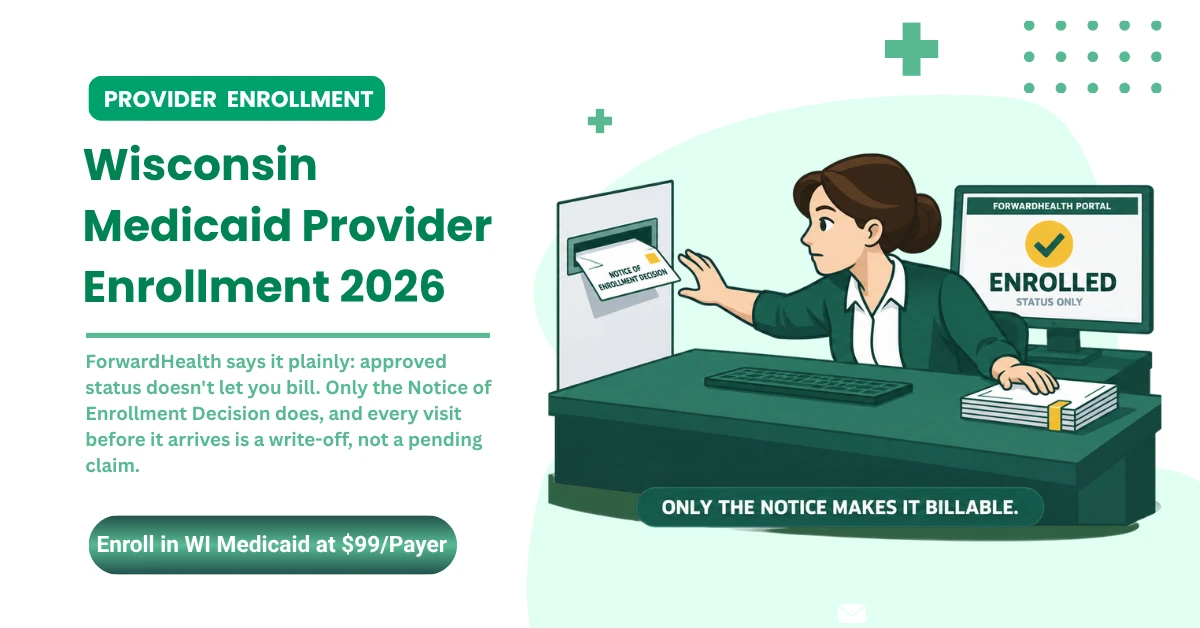
Here’s the rule that costs the most money on this page. ForwardHealth states plainly that approved or enrolled status alone doesn’t allow a provider to begin providing or billing for services. The Notice of Enrollment Decision is the document that does. Until it arrives, anything you submit is a write-off waiting to be discovered.
Risk Levels, Site Visits, and Fingerprinting in Wisconsin Medicaid
ForwardHealth assigns every enrolling provider a risk level of limited, moderate, or high, based on provider type. CMS established most of these classifications and ForwardHealth adopted them. Your level decides whether you get a site visit and whether anyone gets fingerprinted. The risk level classification page carries the full chart by provider type and specialty.
What each risk level triggers
|
Risk level |
Screening activities applied |
|---|---|
|
Limited |
License verification, federal database checks, and confirmation the provider meets applicable state and federal requirements |
|
Moderate |
Everything in limited, plus onsite visits before and after enrollment |
|
High |
Everything in moderate, plus fingerprints and criminal background checks before enrollment |
Two details get missed here. Site visits apply to moderate and high risk, not to limited, and several published guides get that backwards. ForwardHealth also screens every enrolled provider monthly against federal databases, so enrollment isn’t a gate you pass once.
There’s a screening exception worth knowing. If Medicare, another state’s Medicaid program, or CHIP screened you within the last 12 months, ForwardHealth won’t run additional screening.
What moves a provider up to high risk
A limited or moderate classification can be reclassified to high when any of three things happens. ForwardHealth imposes a payment suspension based on a credible allegation of fraud. A provider has been excluded by Medicare or another state’s Medicaid program within the last 10 years. Or ForwardHealth or CMS lifted a temporary moratorium in the previous six months and a provider blocked by that moratorium applies within six months of the lift.
Revalidation can move you back down. A provider enrolled at high risk gets revalidated at moderate risk, assuming nothing else in that list applies. A home health agency enrolled as high risk, for instance, is reassigned to moderate at revalidation and screened accordingly.
The fingerprint rules that actually catch people
Fingerprinting applies to high-risk providers and to any person holding a 5% or greater direct or indirect ownership interest. Everyone in that group has to be fingerprinted within 30 calendar days of the application submission date, or the application is denied. ForwardHealth processes the file once all fingerprints are in. The fingerprint requirement overview covers the workflow.
Wisconsin contracts with Fieldprint for collection. Each person schedules through Fieldprint using the Wisconsin Medicaid Fieldprint code and your ATN, both of which the submitting provider has to pass along. The fee is $7.75 per person, collected when the appointment is booked, and it can change.
Exemptions exist and they’re worth checking first. Anyone already fingerprinted as an enrollee of another state Medicaid agency, CHIP, Medicare as a high-risk provider, or ForwardHealth as a different high-risk provider type within the past three years doesn’t repeat it. Proof goes to ForwardHealth by fax at 608-221-0885 or by mail, with the ATN on the documentation.
One disqualifier sits underneath all of this. A conviction related to Medicare, Medicaid, or CHIP in the last 10 years, whether it’s the provider or a 5% owner, denies the enrollment outright.
Your Enrollment Effective Date and How to Protect It
Your Wisconsin Medicaid provider enrollment takes effect on the date ForwardHealth receives a complete and accurate application. Your submission date is the earliest possible effective date, and you keep it only if you met every requirement on that date and every supplemental document arrived within 30 calendar days. ForwardHealth’s effective date policy sets both conditions.
What pushes the date forward
Send a supplemental document on day 31 and your effective date becomes day 31, not your submission date. Everything you delivered in between stops being billable. Upload inside the application workflow rather than after it, and the problem never comes up.
Group billing enrollments can be backdated 365 days
Here’s a lever most practices don’t know exists. Groups may submit a written request to obtain group billing enrollment with an effective date 365 days prior to the originally assigned date. Providers of mental health services are the exception and don’t qualify, which matters if you run a behavioral health credentialing line alongside medical services.
Requests go through the demographic maintenance tool or by mail to ForwardHealth Provider Enrollment, 313 Blettner Blvd, Madison, WI 53784.
Think about what that means for a group that enrolled six months ago and has been writing off pre-effective-date claims ever since. Moving the date back can make some of those claims billable again, if you’re still inside timely filing. Practices write that revenue off permanently because nobody told them the request existed.
If you think your effective date is wrong
You can ask for a review. Send documentation showing which enrollment criteria may have been considered incorrectly, using the same two submission paths. Vague disagreement won’t move it. A specific criterion, with evidence, sometimes will.
Providers who also hold Medicare enrollment
ForwardHealth requires certain provider types to enroll in Medicare as a condition of Medicaid enrollment. The two processes run separately, but ForwardHealth may assign a Medicaid effective date matching your Medicare enrollment date, which is worth asking about if your Medicare enrollment through PECOS landed earlier.
The Notice of Enrollment Decision: Why Approved Doesn’t Mean You Can Bill
Wait for the Notice of Enrollment Decision before you do anything. ForwardHealth treats it as the official notification of approval, and states directly that approved or enrolled status on its own doesn’t allow a provider to begin providing or billing for services.
What arrives and what it covers
Approved providers receive a welcome letter and a copy of the Medicaid provider agreement. The letter carries your effective dates and your assigned provider type and specialty, which you’ll need for every claim you submit afterward.
Non-healthcare providers get one extra item. Specialized medical vehicle providers, personal care agencies, adult long-term care waiver providers, and blood banks are notified of their Medicaid provider number in that same letter, and that number goes on claims, prior authorization requests, and anything else you send the program.
What happens if you bill before it arrives
Claims with dates of service before your effective date aren’t payable. They’re not pended. They’re not held. They’re denied, and by the time somebody catches the pattern, a chunk of the timely filing window has usually gone with it. A practice that starts seeing Medicaid patients on the strength of a portal status instead of the Notice can generate a month of unbillable encounters before anyone notices, which is one reason our billing services from go-live key the first claim to the Notice rather than to the approval screen.
If your application gets denied
ForwardHealth informs denied applicants in writing and states the reason. The usual causes are predictable: wrong applicant or provider type, an unpaid application fee past the 10 business day window, fingerprints missed inside 30 calendar days, and documentation that doesn’t match what the program already holds. A denial means a new application, not an amendment.
Setting Up Portal Access, EFT, and ERA After Approval
Approval and payment aren’t the same milestone. After you’re approved you request secure Portal access, wait for a PIN letter to arrive by mail, activate the account, then enroll in EFT. Skip that sequence and you’re a provider with keys to a building you never unlocked.
Portal access and the PIN letter
Access requires your NPI plus the matching enrollment plus your SSN or TIN, or your Provider ID plus financial payer plus SSN or TIN. A successful request triggers a PIN letter by mail, and account setup can’t be completed without it. Practices that relocate between approval and setup lose the letter and start the request again.
EFT and ERA rules
EFT requires a secure Portal account and paper enrollments aren’t accepted. Eligibility runs to in-state and border-status providers who submit claims, plus MCOs, with defined exceptions. One detail catches multi-program providers: EFT enrollment is required separately for each financial payer, so setting it up once doesn’t cover the rest.
What breaks between approval and first payment
Three things, and all three are boring. The PIN letter goes to the address ForwardHealth holds, not the one you moved to. EFT configured for one financial payer doesn’t carry to the others. And a practice that skips EFT entirely sits on paper remittance while its aging report grows.
Why State Enrollment Isn’t Enough: BadgerCare Plus HMOs and Long-Term Care MCOs
Wisconsin Medicaid provider enrollment through ForwardHealth registers you at the state level only. Participating with a BadgerCare Plus HMO or a long-term care MCO takes a separate contracting and credentialing process with each plan, and those plans won’t start their review until your state enrollment is confirmed.
Two networks, two different lists
These get conflated constantly, including by guides that should know better. They’re not the same networks and they don’t share a plan list.
|
Program |
Network type |
Enrollment path |
|---|---|---|
|
BadgerCare Plus |
HMOs contracted by county |
State enrollment first, then contract with each HMO serving your service area |
|
Family Care, Family Care Partnership, PACE, IRIS |
Long-term care MCOs and IRIS fiscal employer agents |
State enrollment first, then contract with each MCO or FEA |
BadgerCare Plus participation is regional, which is the part that surprises groups expanding across county lines. Wisconsin’s plan landscape includes MHS Health Wisconsin, Quartz, Molina Healthcare of Wisconsin, Chorus Community Health Plans, Security Health Plan, and iCare, among others, and contracting with the wrong plan for your county creates patient panel assignment problems on top of denied claims.
The gap period nobody budgets for
A provider approved at the state level but not yet credentialed with the relevant HMOs sits in a window where claims for HMO-enrolled members get denied. That’s how a clean enrollment turns into a cash-flow problem. Running the two tracks in parallel instead of sequentially is the fix, and it’s the same discipline that Medicaid credentialing across states requires anywhere the state and the plans are separate approvals.
Most practices discover that gap after the first denied HMO claim rather than before the first application. We run both tracks together, and we tell you which plans serve your counties before you apply to any of them.
Verifying which plan a member belongs to
Check a member’s HMO enrollment on the ForwardHealth Portal before you submit, then bill the correct HMO. Each HMO sets its own filing guidelines for claims, reconsiderations, and appeals, and ForwardHealth’s HMO provider information page carries the current expectations.
One rule deserves its own line. Appeals go to the HMO first. DHS rejects appeals from providers who haven’t exhausted the HMO process. Skip that step and DHS doesn’t delay your appeal. It rejects it.
The Adult Long-Term Care Waiver Enrollment Mandate: Where Things Stand Now
Status as of September 2026.
Wisconsin Medicaid provider enrollment became mandatory for adult long-term care waiver providers, who had to enroll or revalidate through the ForwardHealth Portal by December 31, 2025. Providers without a Medicaid ID as of January 1, 2026 can’t deliver services or receive payment from managed care organizations or IRIS fiscal employer agents. ForwardHealth’s long-term care provider enrollment page remains the working reference.
The timeline, and what each date changed
|
Date |
What changed |
|---|---|
|
September 2024 |
HCBS providers under adult LTC waivers began enrolling through the Portal |
|
August 11, 2025 |
Supportive home care agencies became able to enroll |
|
December 31, 2025 |
Deadline to submit an enrollment or revalidation application |
|
January 1, 2026 |
Medicaid ID required to deliver services or receive MCO or IRIS payment |
|
March 31, 2026 |
Last date for approval before the payment cutoff |
|
April 1, 2026 |
No Wisconsin Medicaid reimbursement for dates of service on or after this date without enrollment |
What to do if you missed it
You can still apply. The application has to be approved, and contracts and services authorized, before Wisconsin Medicaid pays anything, and approval takes several weeks. One rule governs everything else here: enrollment can’t be backdated to a date before you submitted. The 365-day group billing provision is a different mechanism and doesn’t apply. Forms sit in the Wisconsin DHS provider enrollment forms collection.
DHS has been direct about what non-compliance costs. Providers lose payment, lose reimbursement for dates of service on or after April 1, 2026, lose the MCO or IRIS contract, lose IRIS authorizations where they apply, and leave members to find other providers.
Which programs this covers
Family Care, Family Care Partnership, PACE, and IRIS. The requirement doesn’t affect individual self-directed support or participant-hired workers.
One practical detail that saves a transfer: call Provider Services at 800-947-9627 and say "LTC Waiver" at the menu prompt to reach someone who handles long-term care enrollment.
The Home Health and Hospice Enrollment Moratorium, Effective May 13, 2026
Effective May 13, 2026, ForwardHealth won’t approve new home health or hospice agencies for Wisconsin Medicaid. The restriction follows two nationwide federal moratoria that CMS imposed the same day, published as 91 FR 27954 for home health and 91 FR 27946 for hospice.
What it blocks and what it doesn’t
New enrollment is blocked for home health agencies, HHA branches and practice locations, hospices, and hospice practice locations. Agencies already enrolled aren’t affected and keep operating. Revalidation and change-of-information obligations continue as normal, so an existing agency still files everything it filed before.
One trap sits inside this for anyone mid-transaction. A change in majority ownership that requires re-enrollment triggers a new enrollment application, and new enrollment applications are exactly what the moratorium stops. A routine acquisition can become a blocked enrollment without anyone intending it.
How long it runs
CMS set both moratoria at six months, which places the initial expiration around November 13, 2026. CMS can extend in additional six-month increments, and can also lift them early. Either move is announced through a Federal Register notice, so the CMS announcement is the place to check current status before you start an application.
The one refund this creates
Application fees are non-refundable with a single exception, and this is it. When ForwardHealth denies an application because of a temporary moratorium imposed by CMS or Wisconsin Medicaid, the $750 comes back. It’s the only refund path in the fee policy.
Wisconsin Medicaid Revalidation: Every 3 Years, 30 Days to Respond
Wisconsin requires providers to revalidate their enrollment every three years. ForwardHealth mails a Provider Revalidation Notice when you’re due, and you have 30 days from your revalidation date to submit. Miss it and you’re terminated from Wisconsin Medicaid. ForwardHealth spells this out on its revalidation policy page.
Here’s a detail that catches transplants. Federal rules require states to revalidate at least every five years. Wisconsin chose three. If you came from a state on the five-year cycle, your calendar is wrong by two years.
How the cycle actually runs
You can’t revalidate early. The Notice specifies your revalidation date and the Portal won’t accept a submission before it. You can look the date up any time through the Check My Revalidation Date link on the secure Portal, which is a better habit than waiting for mail.
During revalidation you update your enrollment information and electronically sign the Wisconsin Medicaid provider agreement. Organizations should also expect the application fee again, since revalidation is one of the three situations that triggers it.
What termination actually costs
Termination isn’t a pause. Getting back in means completing a new provider enrollment application, undergoing additional screening activities, and possibly paying another application fee. Every clock in this guide starts over, including fingerprints if your risk level calls for them, which is why revalidation tracking belongs on a calendar rather than in an inbox.
The address problem behind most missed revalidations
The Notice goes to the address ForwardHealth holds, not the address you moved to. Practices that relocated and never updated their provider record miss the letter entirely, and the first symptom is a denied claim weeks after termination. Treat demographic updates as a revalidation dependency, not housekeeping.
A note for supportive home care agencies
Agencies holding EVV-only Medicaid IDs move to full Medicaid enrollment through the revalidation process rather than a new application. If that describes you, the upgrade path is shorter than it looks.
Why Wisconsin Medicaid Claims Get Denied After Enrollment
Enrollment removes one denial cause. It doesn’t remove the others. The denials that follow a clean approval fall into five patterns, and four of them trace straight back to a decision made during enrollment.
The five post-enrollment denial patterns
|
Denial pattern |
Root cause |
Set during enrollment? |
|---|---|---|
|
Service date before effective date |
Billed before the Notice of Enrollment Decision arrived |
Yes |
|
Prescriber or orderer not enrolled |
Claim missing the name and NPI of a Medicaid-enrolled prescriber, referrer, or orderer |
Yes |
|
Wrong network |
Sent to fee-for-service when the member is HMO-enrolled, or to the wrong HMO |
Yes |
|
Taxonomy or group mismatch |
Rendering provider never linked to the billing group, or taxonomy doesn’t match |
Yes |
|
Timely filing |
The denial sat unworked past the filing window |
No, but it compounds the other four |
Look at that third column. Four of five aren’t billing errors at all. They’re enrollment decisions surfacing as claim denials six weeks later, which is exactly why denial management for Medicaid claims that stops at resubmission keeps producing the same denial next month. The fix lives upstream.
Timely filing turns a fixable denial into a write-off
Filing limits in Wisconsin vary by program and by plan, and HMO contracts set their own guidelines for claims, reconsiderations, and appeals. Confirm the limit for your specific program and each plan you bill rather than assuming one number covers everything. The mechanic is the same everywhere how timely filing limits work applies: a denial found in week nine instead of week three is often unrecoverable, and no appeal argument fixes an expired window.
The appeal order that gets claims rejected
Appeal to the HMO first and exhaust that process before going anywhere else. DHS rejects appeals from providers who skipped it. A practice escalating straight to DHS doesn’t get a faster answer. It gets a rejection and a shorter runway.
Wisconsin Medicaid Provider Enrollment Phone Numbers and Contacts
Two numbers handle almost everything, and calling the wrong one costs you a transfer and a second hold. Provider Services handles the program. The Portal Help Desk handles the software.
|
What you need |
Contact |
Hours |
|---|---|---|
|
Enrollment questions, application status, policy, billing |
Provider Services, 800-947-9627 |
Monday to Friday, 7 a.m. to 6 p.m. Central |
|
Adult LTC waiver enrollment specifically |
Provider Services, 800-947-9627, then say "LTC Waiver" at the menu prompt |
Monday to Friday, 7 a.m. to 6 p.m. Central |
|
Portal accounts, registration, passwords, submissions |
Portal Help Desk, 866-908-1363 |
Monday to Friday, 8:30 a.m. to 4:30 p.m. Central |
|
Fingerprint exemption documentation |
Fax 608-221-0885, with your ATN on the paperwork |
Not applicable |
|
Effective date review requests by mail |
ForwardHealth Provider Enrollment, 313 Blettner Blvd, Madison, WI 53784 |
Not applicable |
Current contact details sit on the ForwardHealth Provider Services contact page, and they do change.
Have your ATN before you dial
Provider Services won’t look up an application without the Application Tracking Number. No ATN means the call ends where it started, so pull it from your submission record before you pick up the phone.
Should You Handle Wisconsin Medicaid Enrollment In-House or Outsource It?
Most practices don’t outsource enrollment because they can’t do it. They outsource because the person doing it already has four other jobs, and enrollment is the one that slips when the schedule fills. That’s a workflow problem, not a competence problem.
What in-house actually costs
Robert Half’s 2026 salary guide puts a credentialing specialist between $43,750 and $57,000 before benefits. Credentialing staff on AAPC’s professional forum put initial applications at 12 to 16 hours per provider to cover Medicare, Medicaid, and the major commercial plans, and that’s before a single follow-up call. Below that headcount the work lands on someone already at capacity, which is where the cost of in-house enrollment stops being a salary line and starts being unbilled revenue.
What Wisconsin’s clocks do to that math
Wisconsin runs four independent deadlines at the same time. Ten business days on the application fee. Thirty calendar days on fingerprints. Thirty calendar days on supplemental documents. Ten calendar days on a saved application. Each one denies or delays on its own, and none of them sends a reminder.
What MedSole RCM charges against the market
|
Service |
Industry range |
MedSole RCM |
|---|---|---|
|
Payer enrollment and credentialing |
$150 to $300 per payer |
$99 per payer |
|
Full-service medical billing |
4% to 10% of collections |
2.99% of collections |
|
Standalone denial management |
Varies, often bundled or hourly |
4.49% of recovered amounts |
|
Setup fees |
Common |
None |
|
Annual contract |
Common |
Not required |
MedSole RCM charges $99 per payer for provider enrollment and credentialing, against a published industry range of $150 to $300 per payer, which makes it the lowest published per-payer rate in the credentialing market. Medical billing runs 2.99% of collections against a market range of 4% to 10%. Applications go out within 48 hours of complete documents, every payer on your file gets a weekly call, and we’ve credentialed more than 4,000 providers across all 50 states.
When keeping it in-house is the right answer
One or two providers. A stable roster. No expansion planned. And somebody whose job description actually includes enrollment rather than absorbing it. If that describes your practice, a coordinator beats a vendor and we’ll tell you so.
Got providers sitting in the ForwardHealth queue right now? We can usually tell you why within a day. Enrollment is $99 per payer, and applications go out within 48 hours of complete documents.
Wisconsin Medicaid Provider Enrollment: Frequently Asked Questions
How do I enroll as a Wisconsin Medicaid provider?
Complete an online application on the ForwardHealth Portal. Select Become a Provider, choose your applicant type and provider type, work through the enrollment screens, upload your documents, and submit. You’ll receive an Application Tracking Number at submission. Wisconsin Medicaid provider enrollment is online only.
How long does Wisconsin Medicaid provider enrollment take?
ForwardHealth usually issues a decision within 10 business days of receiving a complete application, and commits to no longer than 60 days. Incomplete applications don’t start the clock. Managed care contracting runs after state approval, so your go-live date sits later than the state window.
Is there an application fee for Wisconsin Medicaid enrollment?
Yes, for provider organizations. The fee is $750, set by CMS and adjustable each January 1. Individual providers and professional provider groups don’t pay it. Payment is due within 10 business days of submission or the application is denied, and processing won’t start until it clears.
How do I check my Wisconsin Medicaid enrollment status?
Enter your Application Tracking Number in the Enrollment Tracking Search tool on the ForwardHealth Portal, or call Provider Services at 800-947-9627 with the ATN. The tool reports whether the application is processing or has been returned for more information.
What is the ForwardHealth provider phone number?
Provider Services is 800-947-9627, Monday to Friday, 7 a.m. to 6 p.m. Central. For adult long-term care waiver enrollment, say "LTC Waiver" at the menu prompt. The Portal Help Desk handles accounts, passwords, and submission errors at 866-908-1363.
Do I need an NPI to enroll in Wisconsin Medicaid?
Most providers do. Individuals need a Type 1 NPI and groups need a Type 2 plus a Type 1 for each rendering provider. Some provider types don’t qualify for an NPI at all, and those enroll as an atypical provider using an Atypical Provider Identifier instead.
How often do Wisconsin Medicaid providers have to revalidate?
Every three years. ForwardHealth mails a Provider Revalidation Notice and you have 30 days from your revalidation date to submit. You can’t revalidate early. Missing the window terminates your enrollment and getting back in requires a new application plus additional screening.
Can out-of-state providers enroll in Wisconsin Medicaid?
Yes. Providers in adjacent states can enroll with border status, and other out-of-state providers can enroll as well. Wisconsin reimburses out-of-state providers only in defined situations, so check the out-of-state criteria before assuming a claim will pay.
Do I have to enroll separately with BadgerCare Plus HMOs?
Yes. State enrollment through ForwardHealth registers you at the state level only. Each BadgerCare Plus HMO and each long-term care MCO runs its own contracting and credentialing, and none of them begin review until your state enrollment is confirmed.
What happens if my Wisconsin Medicaid enrollment is denied?
ForwardHealth notifies you in writing with the reason. Common causes are the wrong applicant or provider type, an unpaid application fee past 10 business days, fingerprints missed inside 30 calendar days, and documentation that doesn’t match program records. A denial requires a new application, not a correction.
Can I outsource Wisconsin Medicaid provider enrollment?
Yes. MedSole RCM handles ForwardHealth submission, fee deadlines, fingerprint coordination, status tracking, and revalidation at $99 per payer, with applications filed within 48 hours of complete documents. You can talk to a credentialing specialist to review where your file currently stands.
What is the most affordable credentialing company for Medicaid enrollment?
MedSole RCM charges $99 per payer for provider enrollment and credentialing, against a published industry range of $150 to $300 per payer. Medical billing runs 2.99% of collections against a market range of 4% to 10%. There are no setup fees and no annual contract requirement. Applications are filed within 48 hours of receiving complete documents, and more than 4,000 providers have been credentialed across all 50 states.
Wisconsin Medicaid Provider Enrollment Checklist
Print this, or keep it open while you work. Every item carries the number that matters.
- Confirm your provider type, specialty, and billing category before you open the portal
- Build the ownership roster: everyone at 5% or more, plus managing employees and agents
- Verify NPI, taxonomy, license, DEA, and tax ID all match what each system already holds
- Gather documents in accepted formats: .jpg, .jpeg, .pdf, .rtf, .txt, .csv
- Finish the application inside the 10-calendar-day save window
- Record your ATN at submission, and store it where the whole team can reach it
- Pay the $750 application fee within 10 business days if your organization owes it
- Submit fingerprints within 30 calendar days if you are high risk or hold 5% or more ownership
- Upload every supplemental document within 30 calendar days to protect your effective date
- Wait for the Notice of Enrollment Decision before you bill anything
One more, and it’s the one people skip: put your revalidation date on a calendar the day your Notice arrives, not three years later when the letter shows up at an old address.