



Radiology credentialing is the verification and payer enrollment process that lets a radiologist or an imaging facility bill for diagnostic imaging services. The work runs on two separate tracks. Individual physicians enroll on one set of forms, and the facility that owns the equipment enrolls on another.
That split costs practices money when nobody tracks both sides. A radiologist can clear radiology insurance credentialing with every commercial payer on the panel while the imaging center they read for sits unenrolled with Medicare, so the interpretation gets paid and the equipment side of the same study rejects.
Pull the aging report on any imaging group and you'll find those claims sitting in the 90-day bucket. Coding was clean. The documentation supported every line billed. They denied because an enrollment record didn't match what the payer had on file.
Radiologists, freestanding imaging centers, IDTFs, and teleradiology groups each face a different version of this. A solo interventional radiologist joining a hospital carries one set of obligations. A three-site imaging center adding an MRI scanner carries a different set.
This guide covers all three tracks a radiology group runs at once: hospital privileging, payer credentialing, and Medicare enrollment. It also covers IDTF designation, accreditation for advanced imaging, mammography personnel rules, and the renewal calendar underneath all of it. Radiology credentialing services from MedSole RCM cover provider enrollment and credentialing services across all 50 states, and we file this work every week.
Every rule below is cited to the regulation or the agency that issues it, current as of August 2026.
What Is Radiology Credentialing?
Radiology credentialing verifies a physician's qualifications and enrolls that physician, or the facility, with the payers who will be billed. Three systems carry the data: PECOS for Medicare, the CAQH Provider Data Portal for most commercial plans, and NPPES for the National Provider Identifier that ties everything together.
Finishing credentialing doesn't mean a provider can bill. Contracting has to follow, an effective date has to be assigned, and the payer has to load the provider into its claims system under the right group and location. Any one of those gaps keeps claims from paying in network.
How Radiology Credentialing Differs From ARRT Certification
ARRT certifies radiologic technologists. The American Board of Radiology certifies radiologists. Neither organization enrolls anyone with a payer, and neither credential by itself puts a claim in a position to be paid.
A technologist's ARRT credential is a personnel qualification your facility documents and keeps current. It matters for staffing standards and for state licensure. It isn't a billing credential, and searching for it will send you somewhere very different from where your revenue problem lives.
The Three Tracks Every Radiology Group Runs at Once
Most groups treat credentialing as one workflow. It's three, each governed by a different body, each with its own clock and its own failure mode.
|
Track |
What it covers |
Who decides |
What breaks |
|---|---|---|---|
|
Facility privileging |
Medical staff appointment, hospital or CAH privileges, teleradiology privileges |
Hospital governing body |
Reading assignments stop |
|
Payer credentialing |
Commercial and Medicaid participation, CAQH profile |
Health plan or delegated CVO |
Claims process out of network |
|
Government enrollment |
Medicare PECOS, the CMS-855 forms, IDTF, state Medicaid |
CMS, your MAC, the state agency |
Medicare stops paying |
You can clear one track and fail another. Any radiology credentialing service worth paying for covers all three, because each failure looks different on the remittance and none of them announce that credentialing caused it. Medicare publishes its enrollment requirements through CMS provider enrollment guidance, and the commercial side runs a separate process.
Who Needs Radiology Credentialing: Radiologists, Imaging Centers, and Teleradiology Groups
Three entity types require radiology credentialing, and each files a different enrollment path. Individual interpreting physicians enroll as practitioners. Facilities that own the equipment enroll as organizations. Teleradiology groups reading across state lines carry both, multiplied by every state and every hospital they serve.
Individual Radiologists and Interventional Radiologists
Physician credentialing services for radiology cover board certification through the American Board of Radiology, an active license in every state where studies get read, current malpractice coverage, a maintained CAQH profile, and Medicare enrollment with a reassignment of benefits to whichever group bills.
Interventional radiologists carry an extra layer. Their procedures happen inside a facility that credentials separately, so hospital privileges and payer enrollment have to move in parallel. Running them one after the other adds months for no reason at all.
Freestanding Imaging Centers and IDTFs
The facility file is a different animal: an organizational NPI, a CMS-855B enrollment, IDTF designation where it applies, accreditation for advanced imaging modalities, and MQSA certification if the center performs mammography.
Facility enrollment is what makes the technical component payable, and it's the track most groups underestimate because it doesn't feel like credentialing. Nobody is verifying a physician's residency. Somebody is inspecting your equipment inventory and your liability policy.
Teleradiology Groups Reading Across State Lines
Teleradiology multiplies the problem. Licensure follows the patient's location, not the radiologist's. Each originating hospital may require its own privileging or a written proxy agreement, and each payer in each state runs its own enrollment.
One radiologist reading into 12 hospitals across six states is maintaining 18 simultaneous credentialing relationships. Every one of them renews on its own schedule, and none of them send a warning when they lapse.
When a group runs all three tracks at once, tracking becomes the job. That's the work provider enrollment and credentialing covers: the applications, the follow-up, and the calendar underneath. Healthcare credentialing services earn their fee at exactly this point, when no single expired credential takes a service line offline.
How Long Does Radiology Credentialing Take?
Radiology credentialing generally takes 60 to 180 days, depending on the track and the payer. The tracks run on separate clocks, and the slowest one decides when the practice can submit a claim and expect payment. A radiology credentialing service shortens the controllable part of that window, not the payer's own review.
Credentialing Timelines by Track
|
Track |
Typical range |
What drives the timeline |
|---|---|---|
|
Medicare PECOS, individual practitioner |
60 to 90 days |
MAC processing volume, taxonomy accuracy |
|
Medicare, IDTF facility |
90 to 180 days |
Unannounced site inspection, performance standards review |
|
Commercial payer credentialing |
90 to 150 days |
Committee meeting cycle, CAQH completeness |
|
State Medicaid |
45 to 180 days |
State system, revalidation backlog |
|
Hospital privileging |
60 to 120 days |
Medical staff committee schedule |
|
Accreditation for advanced imaging |
60 to 150 days |
Accrediting organization, number of modalities |
Those ranges vary by payer, by state, and by how complete the application was on submission. No credentialing service controls the payer-side clock. A service controls two things: whether the file goes out clean the first time, and whether anyone chases it when it stalls.
What Causes the Delay
Incomplete applications cause most of it. Missing malpractice history, an unexplained gap in the 10-year work record, an expired license sitting in the upload folder, or a taxonomy code in PECOS that doesn't match what NPPES has on file.
Sequencing causes the rest. Groups file the individual enrollment, wait for approval, then start the facility enrollment. Those two applications can move at the same time, and filing them together removes weeks from the total.
The application that sat for 90 days usually wasn't sitting. A MAC rejected it in week two, the development request went to an address nobody monitors, and the clock restarted without anyone noticing.
MedSole RCM's radiology credentialing service submits applications within 48 hours of receiving complete documentation, at $99 per payer enrollment. Independent 2026 pricing guides put the common market range at $175 to $275 per enrollment. Our Medicare provider enrollment guide covers the CMS-855 forms in full detail.
CAQH for Radiologists: The 120-Day Attestation Rule
The CAQH Provider Data Portal is the shared database most commercial payers pull credentialing data from, which makes it the foundation under radiology insurance credentialing. A radiologist's profile has to stay attested, or payers stop treating the information in it as current, and every application resting on it stalls.
How Often Radiologists Must Re-Attest
Providers re-attest every 120 days. Illinois providers run on a 180-day cycle instead. The interval applies whether or not anything in the profile changed, because the attestation is a signed confirmation that payers can rely on for a credentialing decision.
Radiologists carry more profile data than most physicians. Multiple reading locations, several hospital affiliations, and licenses in more than one state all sit in that file, and each stale entry gives a payer something to reject the application on.
What Happens When an Attestation Expires
The profile moves to expired status. Payers no longer see it as current, and any pending credentialing or recredentialing application pauses until the provider re-attests and replaces whatever documents lapsed alongside it.
A missed attestation doesn't deny a claim on its own. It stalls the process behind the claim, which is worse in practice because nothing on the remittance tells you that's what happened.
The one that gets missed is almost never the first. It's the attestation that came due 11 months after the provider was approved, when the onboarding project had closed and nobody owned the calendar anymore.
Queue the next attestation before the window closes rather than waiting on the reminder email. Insurance credentialing services that don't own this calendar hand the practice back a problem it thought it had outsourced. Our full CAQH attestation requirements guide covers profile setup, payer authorization, and the document set payers ask for.
Medicare Enrollment for Radiology: PECOS, CMS-855B, and IDTF Designation
Medicare enrollment for radiology runs through PECOS and splits by entity type. Individual radiologists file the CMS-855I. Organizations, including imaging centers and IDTFs, file the CMS-855B. Those are two separate applications, and the data on them has to agree.
Individual Radiologist Enrollment and Reassignment
The individual path covers the CMS-855I, taxonomy alignment between NPPES and PECOS, and the reassignment of benefits to whichever group submits the claim. An approved individual enrollment does not by itself authorize a group to bill for that physician. The reassignment does.
One filing detail still catches teams out. CMS discontinued the standalone CMS-855R and folded reassignment reporting into the CMS-855I. MACs stopped accepting the old form after November 1, 2023, and the current CMS-855I now handles new reassignments, terminations, and changes on paper, while PECOS still handles them electronically.
If your onboarding checklist still lists an 855R as a separate submission, that checklist is out of date, and whoever follows it will spend a week hunting for a form CMS retired three years ago.
What Is an IDTF and Does It Need Separate Enrollment?
An Independent Diagnostic Testing Facility is a Medicare supplier category for a facility that performs diagnostic tests independently of both an attending or consulting physician's office and a hospital. It enrolls on the CMS-855B with an IDTF attachment and has to meet the performance standards at 42 CFR 410.33.
Not every imaging center is an IDTF. The designation turns on ownership, the supervision arrangement, and how the facility bills. Confirm it with your MAC before assuming either way, because the enrollment path changes with the answer.
The IDTF performance standards go further than most groups expect. The facility lists every procedure code it intends to perform, maintains an equipment inventory, carries comprehensive liability coverage of at least $300,000 per location, and submits to unannounced on-site inspection.
Multiple locations don't share one enrollment. Each practice location files its own CMS-855B and gets its own site visit, and each mobile unit enrolls separately from the fixed site it operates out of.
The facility reports changes in ownership, location, general supervision, or adverse legal actions to its MAC within 30 calendar days. Miss the standards and CMS denies the enrollment, or revokes billing privileges on a facility that was already active.
Individual and organizational enrollment have to move together, and the sequencing is where imaging groups lose entire quarters. Credentialing and enrollment services should file both sides at once rather than in a queue. Medicare PECOS enrollment support from MedSole's radiology credentialing service files both sides in parallel and tracks each to an effective date.
ACR Accreditation and the Medicare Technical Component Payment Gate
Medicare will not pay the technical component of advanced diagnostic imaging unless the supplier holds accreditation from a CMS-approved organization. That requirement sits at 42 CFR 414.68 and has applied to suppliers billing under the physician fee schedule since January 1, 2012.
Accreditation gets discussed as a quality credential. For an imaging center billing Medicare, it functions as a payment condition, and the distinction shows up on the remittance rather than in a survey report.
Which Organizations CMS Approves for Advanced Diagnostic Imaging
CMS has designated four accrediting organizations for advanced diagnostic imaging, listed on the agency's CMS-approved accrediting organizations page:
- American College of Radiology (ACR)
- Intersocietal Accreditation Commission (IAC)
- The Joint Commission (TJC)
- RadSite
Each one sets its own standards, and those standards have to meet or exceed what Medicare requires. Accreditation is granted per modality and per location, so a center accredited for CT at one site holds nothing for MRI at that site or for CT at a second address.
Which Modalities the Accreditation Requirement Covers
Advanced diagnostic imaging means MRI, CT, and nuclear medicine procedures such as PET. Plain radiography, ultrasound, and fluoroscopy fall outside the category. Diagnostic and screening mammography also fall outside it, because the FDA regulates mammography under a separate statute covered later in this guide.
The requirement applies to suppliers, not to hospitals. A hospital outpatient imaging department follows a different oversight path, which is why a radiologist who moves from a hospital to a freestanding center walks into an accreditation obligation that never applied before.
Why Accreditation Decides Whether Medicare Pays
Payer contracting and Medicare accreditation are separate gates, which is why credentialing and contracting services alone don't close this one. A center can hold a signed participation agreement, a loaded provider record, and an active effective date, and still watch the technical component reject because accreditation doesn't cover the scanner that produced the study.
Medicare defines the technical component as all non-physician work: administrative and technologist time plus use of the equipment and the facility. On most imaging codes that side carries the larger share of the global payment, though the ratio isn't fixed. Our TC modifier billing rules guide covers how the split gets reported on the claim.
This one surfaces late. The professional component pays on schedule, the technical side rejects, and because the two ride on separate claims nobody connects them until somebody runs a component-level report. A radiology credentialing service that never checks accreditation scope will miss it too.
When component splits break across a whole payer mix, appeals won't fix the pattern. The claim build upstream needs correcting, which is where outsourced medical billing at 2.99% of collections earns its place: the split gets set right before the claim goes out.
Hospital Privileging for Radiologists: A Separate Track From Payer Enrollment
Hospital privileging is the process a medical staff office uses to grant a radiologist authority to interpret studies at that facility. The hospital's governing body decides it. A payer has no role in it, and approval carries no billing rights with any insurance plan.
Confusing the two is expensive. A radiologist with full privileges and no payer enrollment reads studies all week that can't be billed in network. The work happens. The revenue doesn't follow.
What Medical Staff Privileging Covers
A radiology credentialing service coordinates this track without owning it. The medical staff office verifies medical school, residency, fellowship, board status, state licensure, and malpractice currency directly with the issuing source. It then delineates privileges by modality and procedure, so approval to read CT doesn't automatically extend to interventional work.
Reappointment usually runs on a 24-month cycle under medical staff bylaws. Hospitals are the only healthcare entities federal law requires to query the National Practitioner Data Bank, and NPDB query requirements call for a query when a practitioner applies for appointment or clinical privileges and every two years after that.
Delegated Credentialing and Where It Helps
Some payers delegate credentialing to a group or a credentials verification organization that meets their standards. The payer accepts the delegate's verification instead of repeating it, which compresses the timeline for every provider the group adds.
Delegation isn't open to every group. It requires an audited program, documented policies, and ongoing reporting to the payer, which is more infrastructure than most radiology practices carry. Treat it as something to evaluate rather than a shortcut to plan around.
A group reading into several hospitals manages several reappointment cycles at once, which is the part hospital credentialing services exist to absorb. Each cycle expires on its own date, and losing one takes that facility's worklist offline while the others keep running.
Why Radiology Claims Get Denied for Credentialing Reasons
Credentialing failures rarely arrive labeled as credentialing failures. They show up as claim denials that read like coding problems, which is why billers work them over and over without ever touching the record that caused them.
The Ordering Physician Dependency Most Groups Miss
Medicare sets specific conditions for paying ordered imaging claims at 42 CFR 424.507. A physician or permitted eligible professional has to order the study. The claim has to carry that person's legal name and NPI. And that person has to be enrolled in Medicare in an approved status or validly opted out.
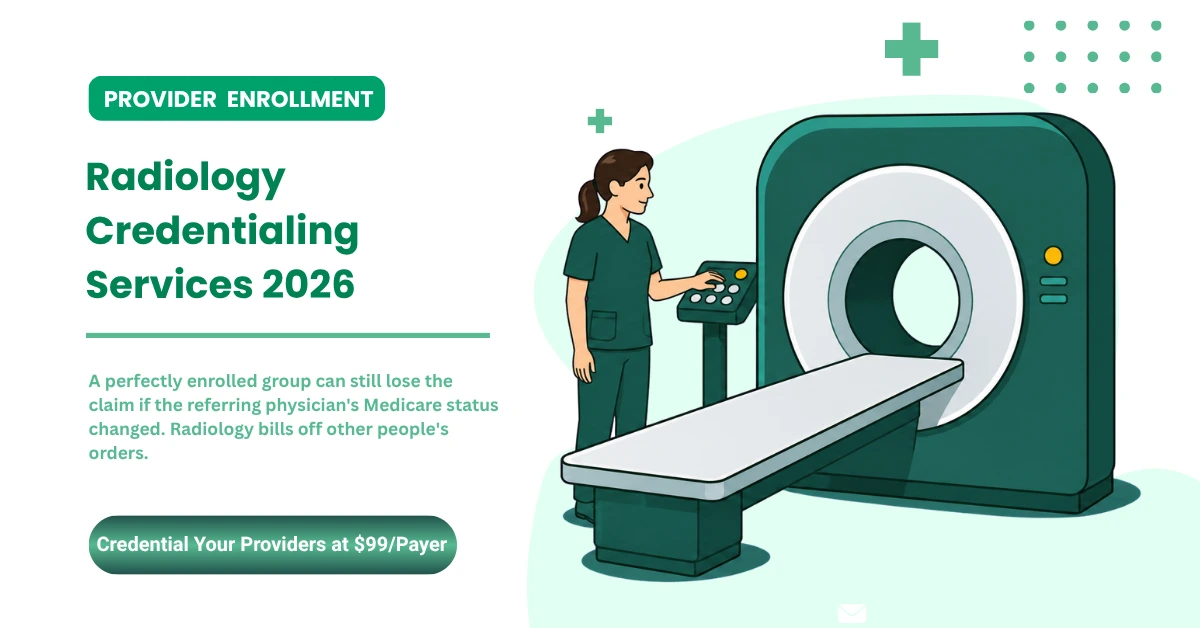
Radiology sits exposed here in a way most specialties don't, because radiology bills off other people's orders. A group can hold perfect enrollment, clean coding, and complete documentation, and still lose the claim because a referring physician's Medicare status changed last month.
You won't find this one in a coding review. It surfaces as a cluster of denials tied to a single referral source, and somebody has to spot the pattern before anyone thinks to check the ordering provider's enrollment record.
Denial Codes That Trace Back to Enrollment, Not Coding
|
Denial pattern |
Common code |
Credentialing root cause |
|---|---|---|
|
Provider not eligible for this service on this date |
CO-B7 |
Enrollment inactive, or effective date falls after the date of service |
|
Claim lacks information or has submission errors |
CO-16 |
NPI, taxonomy, or ordering provider data doesn't match payer records |
|
Precertification or authorization absent |
CO-197 |
Payer processing the provider as out of network |
|
Not covered by this payer or contractor |
CO-109 |
Claim routed to a payer the provider was never enrolled with |
|
Provider not contracted for this member |
PR-204 |
Contract signed but the provider never loaded into the payer system |
Payers apply these codes differently, and the same code can carry a non-credentialing cause on a different remittance. Treat the table as the common mapping rather than a rule, and read a cluster of them as a radiology insurance credentialing problem before treating it as a coding one. Our CO-16 denial causes guide covers the most frequent of them in detail.
Working one denial fixes one claim. Finding the enrollment record behind it stops the next 30. Insurance credentialing services and denial work belong on the same desk for that reason, and it's what separates radiology denial management from resubmission. A radiology credentialing service that never sees the remittance never learns which of its own filings caused the problem.
Teleradiology Credentialing: How Credentialing by Proxy Works
Credentialing by proxy lets a hospital grant privileges to a telemedicine practitioner by relying on the credentialing decision the distant site already made, instead of repeating the full verification. CMS permits it under the hospital Conditions of Participation at 42 CFR 482.22, with a parallel pathway for critical access hospitals at 42 CFR 485.616.
What Credentialing by Proxy Is
CMS finalized the streamlined pathway in 2011 after concluding that making every originating hospital independently credential every remote physician duplicated work already done. Teleradiology was one of the services the agency had in mind when it wrote the rule.
The practical value is calendar time. A group reading into 15 hospitals can, where the agreements exist, skip 15 full credentialing packets. That's the difference between bringing a radiologist online in weeks and waiting most of a year.
What the Written Agreement Has to Contain
Proxy credentialing runs on a written agreement, and the regulation lists what that agreement has to establish when the distant site is a hospital:
- The distant-site hospital participates in Medicare.
- The telemedicine practitioner holds privileges at the distant-site hospital, and that site provides a current list of them.
- The practitioner holds a license issued or recognized by the state where the originating-site hospital sits.
- The originating-site hospital reviews the practitioner's performance of those privileges and sends that information back to the distant site for periodic appraisal.
That fourth item is where surveys go wrong. It turns proxy from a signature at onboarding into a standing obligation, and hospitals that never build the feedback loop fail on it years later.
A separate provision covers agreements with a distant-site telemedicine entity rather than a hospital. The entity has to operate as a contractor whose credentialing program meets or exceeds the hospital medical staff standards, which is the pathway most independent teleradiology groups fall under.
Why Proxy Credentialing Does Not Solve Licensure
Proxy addresses privileging. Licensure stays untouched. The physician still needs a license recognized in the state where the patient is located, and no written agreement changes that. Our telemedicine credentialing rules guide covers the interstate compacts that speed multi-state licensure up.
The credentialing file can be flawless and the group still exposed. Licensure sits under the state medical board rather than the payer, so the consequence of getting it wrong is disciplinary rather than financial.
A multi-state teleradiology group carries three obligations at once: a license in every state where its patients are, privileges at every originating facility, and payer enrollment for every plan in every state it bills. A radiology credentialing service built for teleradiology tracks all three on one calendar.
MQSA Requirements for Mammography Credentialing
The Mammography Quality Standards Act creates federally enforceable personnel and facility requirements for any facility that performs mammography. These sit on top of payer credentialing and Medicare enrollment rather than replacing either one.
MQSA is also the reason mammography falls outside the advanced imaging accreditation rule covered earlier. The FDA regulates it directly, on its own schedule, with its own inspection regime.
Interpreting Physician Continuing Requirements
Most credentials get verified once and revisited on a cycle. MQSA counts. An interpreting physician has to hit numeric thresholds for reading volume and continuing education, and the facility documents both against its annual inspection date.
|
Requirement |
Threshold |
Measured over |
|---|---|---|
|
Continuing experience |
960 mammographic examinations interpreted or multi-read |
The prior 24 months |
|
Continuing education |
15 category I CME units in mammography |
The prior 36 months |
|
New modality training |
8 hours of training in that modality before independent use |
Before first independent interpretation |
The thresholds and the timing mechanics sit at 21 CFR 900.12. A physician who falls below 960 has to read under direct supervision to re-establish, either 240 examinations or enough to bring the 24-month total back to 960, whichever number is smaller.
Treat these as continuously monitored credentials. A radiologist whose case mix shifts away from breast imaging can drop below threshold across a quiet quarter, and nobody notices until an inspector asks for the log.
Facility Accreditation, Certification, and Annual Inspection
On the facility side, a mammography site has to be accredited by an FDA-approved accreditation body, certified to operate, and inspected annually, with the certificate displayed where patients can see it.
Stack that against everything else. A center running mammography plus CT is maintaining MQSA certification, advanced imaging accreditation, Medicare enrollment, and payer credentialing at once. Four compliance objects, four renewal dates, and our radiology CPT code ranges guide covers how the resulting studies get coded.
Losing MQSA certification does more than dent a claim. It stops the service line, because the facility can no longer lawfully perform the exam. Confirm any radiology credentialing service you hire treats MQSA dates as tracked expirables rather than a facility problem.
Modality-Specific Credentialing: MRI, CT, PET, and Nuclear Medicine
Credentialing requirements change with the modality. Accreditation is granted per modality and per location, so adding a scanner, opening a second site, or launching a new service line creates fresh obligations rather than extending the ones already in place.
Which Modalities Carry an Accreditation Requirement
|
Modality |
Medicare accreditation requirement |
Notes |
|---|---|---|
|
CT |
Advanced imaging accreditation required for technical component |
Granted per modality and per site |
|
MRI |
Advanced imaging accreditation required for technical component |
Separate from CT accreditation at the same address |
|
PET |
Advanced imaging accreditation required for technical component |
Falls under nuclear medicine in the statute |
|
Nuclear medicine |
Advanced imaging accreditation required for technical component |
State radioactive materials licensing applies on top |
|
Mammography |
Outside advanced imaging; FDA regulates under MQSA |
Accreditation, certification, annual inspection |
|
Ultrasound |
Outside the advanced imaging category |
Payer-specific requirements may still apply |
|
Plain radiography and fluoroscopy |
Outside the advanced imaging category |
Payer-specific requirements may still apply |
Payer requirements sit alongside the Medicare rule and don't always match it, so radiology insurance credentialing for a new modality can require its own notification even where Medicare doesn't. Confirm current scope with the accrediting organization and your MAC before committing capital to a new service line.
When a New Modality Requires a New Enrollment Action
Four events trigger paperwork: a new modality, a new location, a change of ownership, and a change in the supervising physician arrangement. Each one can require a Medicare enrollment update, a payer notification, or both.
The scanner arrives. The schedule fills. Claims go out for three months. Then somebody discovers the accreditation covers the original address and nobody added the new suite, and every technical component billed from that site comes back.
Unlisted codes create a related headache. Studies without a specific CPT code fall to an unlisted radiology code such as 76499, which carries its own documentation burden and manual payer review on top of whatever the enrollment question was.
Interventional Radiology Credentialing: Privileges and Payer Enrollment Together
Interventional radiology credentialing services cover two requirements at once: facility privileges and payer enrollment, both in place before a procedure can be billed. Diagnostic radiology can often move forward on payer enrollment alone. Interventional work cannot, because the procedure happens inside a facility that credentials on its own terms.
Why Interventional Radiology Runs Two Tracks in Parallel
Privileges get delineated by procedure. An interventional radiologist approved for one category of intervention holds nothing for another until the medical staff office grants it, and payer enrollment runs on a separate clock alongside that process.
Groups that run these one after the other add months. The privileging committee meets when it meets, and it won't wait for a payer approval letter to arrive first.
Facility Setting and Place of Service
Setting drives both the coding and the enrollment. The same procedure billed from a hospital outpatient department, an ambulatory surgical center, or an office carries different place-of-service reporting and different facility enrollment requirements. Our place of service codes guide maps which code applies where.
A group performing interventional work in more than one setting maintains a separate enrollment and privileging path for each. A claim from an unenrolled site denies no matter how well the procedure was documented, and the professional component billing rules govern how the interpretation side gets reported.
Interventional coding went through a substantial rebuild for 2026, with the lower extremity revascularization family replaced outright. Any radiology credentialing service handling an interventional group should check that enrollment scope still matches what the group bills today rather than what it billed two years ago.
The Radiology Credentialing Compliance Calendar
Radiology credentialing has no end date. It's a recurring calendar of attestations, revalidations, queries, and renewals, and each item carries a different owner, a different interval, and a different consequence when it slips.
Recurring Deadlines Every Radiology Group Tracks
|
Obligation |
Interval |
Applies to |
|---|---|---|
|
CAQH re-attestation |
Every 120 days; 180 days in Illinois |
Individual providers |
|
OIG exclusion list screening |
Monthly is the widely recommended practice |
All providers and staff |
|
Medicare revalidation |
Every 5 years for most providers |
Individuals and organizations |
|
NPDB query |
At appointment, then every 2 years |
Hospital privileging |
|
Medical staff reappointment |
Typically every 24 months |
Facility privileging |
|
Commercial recredentialing |
Typically every 2 to 3 years |
Payer participation |
|
State license renewal |
Varies by state |
Every state where studies are read |
|
DEA registration |
Every 3 years |
Interventional and prescribing physicians |
|
Malpractice policy |
Annual |
All providers |
|
MQSA facility inspection |
Annual |
Mammography facilities |
Intervals shift by payer, by state, and by medical staff bylaws, and DMEPOS suppliers revalidate with Medicare on a shorter three-year cycle. Confirm each date against the body that sets it rather than a general schedule.
Why Expirables Break In-House Programs First
Volume breaks these programs, not competence. A 10-radiologist group reading into six hospitals across four states tracks well over a hundred discrete expiration dates, and not one of them sends a warning before it lapses.
The one that gets missed is never the obvious one. It's a license in the state where the group reads a dozen studies a month, held by a physician who left eight months ago and whose record nobody archived on the way out.
Queue every renewal before the window opens instead of when the reminder lands. That single habit prevents most of the enrollment gaps that turn into denied claims a quarter later, and it's the clearest test of whether a radiology credentialing service is doing the work or just filing applications.
What a Radiology Credentialing Service Should Do
A radiology credentialing service should manage all three tracks, not payer applications alone. That means individual enrollment, facility enrollment, privileging coordination, and the recurring compliance calendar underneath every one of them.
The Scope Checklist
- Intake audit against NPPES, PECOS, CAQH, and current license records
- Individual and facility enrollment filed in parallel rather than in sequence
- Advanced imaging accreditation and MQSA coordination where they apply
- Hospital privileging and proxy agreement tracking per originating facility
- Multi-state licensure calendar for teleradiology coverage
- Expirables monitoring with renewals queued in advance
- Payer follow-up with documented escalation when a file stalls
One question separates most provider credentialing companies: does the service stop at submission, or does it track the file to an effective date and confirm the practice can bill? Submission is the easy half. Confirming billing readiness is where files go quiet.
In-House Versus Outsourced: The Real Comparison
|
Factor |
In-house |
Outsourced |
|---|---|---|
|
Cost structure |
Salary, benefits, software, training, turnover |
Per-enrollment fee or percentage of collections |
|
Coordinator salary |
Commonly cited at $55,000 to $75,000 plus overhead |
Not applicable |
|
Per-enrollment market range |
Not applicable |
Commonly published at $175 to $275 per enrollment |
|
MedSole RCM rate |
Not applicable |
$99 per payer enrollment, flat |
|
Scaling |
Strains on each new provider or new state |
Absorbs volume without new headcount |
|
Coverage risk |
One person out and the calendar stops |
Team coverage across the roster |
The decision to outsource medical credentialing doesn't go one way for everyone. A single-site group with two settled payer relationships and stable admin staff can run this internally without much strain. The math changes with provider count, state count, and turnover, which is also why credentialing services pricing is worth comparing on a per-enrollment basis rather than a monthly retainer.
MedSole RCM handles credentialing at $99 per payer enrollment against a commonly published market range of $175 to $275, and full-service billing at 2.99% of collections against a commonly published range of 4% to 10% of net collections. Few medical credentialing companies publish a flat per-payer number at all, which makes side-by-side comparison harder than it should be.
Individual and organizational filings have to move together, and the compliance calendar has to keep running after both clear. Credentialing services from $99 covers the applications, the follow-up, and the renewals as one workflow instead of three. Physician credentialing services and medical billing and credentialing services run off the same roster here, so nothing gets filed twice.
Radiology Credentialing Rules That Changed: Where Each One Stands in 2026
Several rules affecting radiology credentialing shifted between 2023 and 2026, and a good deal of published guidance still predates them. Practices working from an older standard operating procedure are running retired processes and losing weeks to it.
CMS Enrollment Changes
CMS discontinued the standalone CMS-855R and merged reassignment reporting into the CMS-855I. The agency's consolidated CMS-855I bulletin set the transition, MACs stopped accepting the retired form after November 1, 2023, and applications submitted on it come back unprocessed.
An application fee applies to institutional and organizational enrollments, including the CMS-855B an imaging center files. CMS adjusts the amount annually, so confirm the current figure before budgeting a multi-site enrollment.
The Mammography Rule Is No Longer Upcoming
The FDA's updated MQSA rule has been the enforcement baseline since compliance took effect in September 2024. By 2026 it isn't a change to prepare for. Inspectors are working to it, and facilities still citing the previous standard are two years behind.
Board Certification Changes Ahead
The American Board of Radiology announced in April 2023 that it will replace the computer-based diagnostic radiology certifying examination with a remote oral examination beginning in 2028. The board's diagnostic radiology oral exam page confirms it first applies to residents completing training in June 2027, with the qualifying core exam unchanged.
Medical staff offices and payer credentialing teams read board status on every application. Groups hiring out of fellowship over the next two years will see candidates certified under two different pathways, and the documentation for each looks different.
Audit the credentialing standard operating procedure once a year against current CMS and FDA requirements, the same way a chargemaster gets audited against the current code set. Both go stale on the same schedule, and a radiology credentialing service should be running that audit rather than waiting for a rejection to reveal it.
Radiology Credentialing FAQs
What is radiology credentialing?
Radiology credentialing is the verification and payer enrollment process that lets a radiologist or an imaging facility bill for diagnostic imaging services. It covers primary source verification of the physician's training and licensure, enrollment with Medicare through PECOS, commercial payer credentialing through the CAQH Provider Data Portal, and facility-level enrollment for the center that owns the equipment. The individual and the facility file separate applications on separate timelines, and both have to clear before a study generates full payment.
What is the difference between radiology credentialing and ARRT certification?
ARRT certifies radiologic technologists. Radiology credentialing enrolls physicians and facilities with payers so claims can be paid. They serve different people and different purposes. A technologist's ARRT credential is a personnel qualification the facility documents for staffing and state licensure standards, and no claim depends on it directly. Radiologists are certified by the American Board of Radiology rather than ARRT. Neither certifying body enrolls anyone with an insurance plan, so holding either credential leaves the payer enrollment work still to do.
Do imaging centers need separate credentialing from radiologists?
Yes. The imaging center enrolls as an organization on the CMS-855B, and each radiologist enrolls as an individual practitioner on the CMS-855I with a reassignment of benefits to the billing group. These are two distinct applications with separate approvals. The facility enrollment is what makes the technical component payable, and the individual enrollment is what makes the interpretation payable. Groups that file only one side see roughly half of each study reimbursed and often take months to trace why. Interventional radiology credentialing services add a third requirement on top, since those procedures also need facility privileges.
What is an IDTF and does it need its own Medicare enrollment?
An Independent Diagnostic Testing Facility is a Medicare supplier category for a facility performing diagnostic tests independently of both a physician's office and a hospital. It enrolls separately on the CMS-855B with an IDTF attachment and must meet the performance standards at 42 CFR 410.33, including an equipment inventory, minimum liability coverage of $300,000 per location, and an unannounced site inspection. Each practice location files its own application and receives its own inspection. Mobile units enroll separately from the fixed site.
Does an imaging center need accreditation to bill Medicare?
Yes, for advanced diagnostic imaging. Suppliers billing Medicare for the technical component of MRI, CT, or nuclear medicine procedures must hold accreditation from a CMS-approved organization under 42 CFR 414.68. That requirement has applied since January 1, 2012. Accreditation is granted by modality and by location, so a center accredited for CT at one address holds nothing for MRI at that address or for CT at a second site. The rule does not apply to hospitals, which follow a different oversight pathway.
Which organizations does CMS approve for advanced diagnostic imaging accreditation?
CMS has designated four accrediting organizations: the American College of Radiology, the Intersocietal Accreditation Commission, The Joint Commission, and RadSite. Each sets its own standards, and every one of those standards must meet or exceed what Medicare requires. Choosing among them comes down to modality coverage, survey scheduling, and cost, since all four satisfy the federal requirement equally. CMS maintains the current list on its accrediting organizations page, and a supplier should confirm the organization covers every modality the center bills before applying.
What are the MQSA requirements for a mammography interpreting physician?
An interpreting physician must have interpreted or multi-read at least 960 mammographic examinations in the prior 24 months and completed at least 15 category I CME units in mammography in the prior 36 months. Both are measured against the facility's annual MQSA inspection date. Before independently interpreting a new modality, the physician completes 8 hours of training in it. A physician who falls below the reading threshold reads under direct supervision to re-establish, either 240 examinations or enough to reach 960, whichever is fewer.
What is credentialing by proxy in teleradiology?
Credentialing by proxy lets a hospital grant privileges to a remote radiologist by relying on the credentialing decision the distant site already made, rather than repeating the full verification. CMS authorizes it at 42 CFR 482.22 for hospitals and 42 CFR 485.616 for critical access hospitals. It requires a written agreement establishing that the distant site participates in Medicare, that the radiologist is privileged there and licensed where the originating hospital sits, and that performance information flows back to the distant site for periodic appraisal.
How long does radiology credentialing take?
Radiology credentialing generally takes 60 to 180 days depending on the track. Medicare enrollment for an individual physician runs 60 to 90 days. IDTF facility enrollment runs 90 to 180 days because of the site inspection. Commercial payer credentialing runs 90 to 150 days, driven by committee meeting schedules. Hospital privileging runs 60 to 120 days. These tracks move on separate clocks, and the slowest one determines when the practice can bill. Complete applications and parallel filing shorten the total more than anything else.
How often do radiologists need to re-attest their CAQH profile?
Every 120 days for most providers, and every 180 days for providers in Illinois. The interval runs whether or not anything in the profile changed, because payers rely on the attestation date as confirmation the data is current. Providers should also update the profile right away after a material change such as a new practice location, a renewed license, or updated malpractice coverage. A lapsed attestation moves the profile to expired status and pauses any credentialing or recredentialing application resting on it.
How often does Medicare require revalidation?
Every 5 years for most providers and suppliers, with DMEPOS suppliers on a shorter 3-year cycle. CMS posts revalidation due dates in advance and the Medicare Administrative Contractor sends a notice ahead of the deadline. Missing it deactivates the enrollment, and claims for dates of service after the deactivation date deny until the provider reactivates. For an imaging center, revalidation covers the organizational enrollment as well as each reassigned physician, so both sides need tracking.
Can a radiology practice bill before credentialing is approved?
Generally no. Services delivered before the payer's assigned effective date can't be billed to that payer as in network, and claims submitted ahead of the date deny. Some payers grant retroactive effective dates in limited circumstances, and the rules differ by payer and by state. Treat retroactivity as an occasional outcome rather than a plan. The safer approach to radiology insurance credentialing is filing early, tracking the effective date, and holding claims for that provider until enrollment is confirmed in writing.
Why do radiology claims get denied for the ordering physician?
Medicare conditions payment for ordered imaging on the ordering physician being enrolled in Medicare in an approved status or validly opted out, with that person's legal name and NPI on the claim. Radiology bills off other people's orders, so a referring physician who lets an enrollment lapse takes the imaging group's claims down with it. These denials cluster by referral source rather than by procedure, which is why coding reviews never find them. The fix sits with the ordering provider's record.
How much does radiology credentialing cost?
Radiology credentialing service pricing depends on provider count, payer scope, and whether facility enrollment is included alongside individual enrollment. Independent 2026 guides put the common market range at $175 to $275 per payer enrollment, with some full-service vendors quoting per provider instead. MedSole RCM charges $99 per payer enrollment on a flat rate, with no setup fee and no long-term contract, and prices full-service medical billing at 2.99% of collections against a commonly published industry range of 4% to 10% of net collections.
How to Choose a Radiology Credentialing Partner
Most insurance credentialing services handle payer applications well. Fewer handle facility enrollment, accreditation coordination, and multi-site privileging, and that gap is where a radiology credentialing service has to do more than a general-purpose vendor does.
Questions Worth Asking Any Vendor
- Do you file individual and facility enrollment in parallel or one after the other?
- Do you handle CMS-855B and IDTF enrollment, including the site inspection preparation?
- Do you coordinate advanced imaging accreditation and MQSA where they apply?
- Do you track privileging and proxy agreements for each originating facility?
- Do you manage a multi-state licensure calendar for teleradiology coverage?
- What is the price per enrollment, and what triggers an additional fee?
- Do you track each file to an effective date, or does the engagement end at submission?
That last question separates the field. Anyone can submit an application. Confirming an effective date, verifying the payer loaded the provider under the right group, and telling the practice it can start billing is where most services go quiet.
What Radiology-Specific Experience Looks Like
Radiology experience means more than a logo on a specialties page. A vendor who has done this work can explain why the technical component rejects while the professional component pays, name which form an imaging center files, and describe what happens when a proxy agreement was signed but never executed.
Credentialing services pricing is the second test. Ask for the per-enrollment rate, what it includes, and what costs extra. Vendors quoting hourly or refusing to name a flat number are usually pricing around uncertainty inside their own process, and that uncertainty ends up on your invoice.
MedSole RCM answers yes to all seven questions above, prices credentialing at $99 per payer enrollment, and runs full-service medical billing at 2.99% of collections. Practices that outsource medical credentialing and billing together get both from one roster, which is what medical billing and credentialing services should mean. Among medical credentialing solutions built for imaging, that combination is the part worth comparing.
Getting Radiology Credentialing Right From the Start
Three tracks, three clocks, and the slowest one decides when the practice bills. That structure explains most of what goes wrong in radiology enrollment, and it explains why a radiology credentialing service that covers only payer applications rarely fixes the revenue problem.
- File individual and facility enrollment in parallel, never in sequence.
- Confirm accreditation covers the modality and the location before billing the technical component.
- Queue CAQH re-attestation before the 120-day window closes.
- Check the ordering physician's Medicare status when denials cluster by referral source.
- Track privileging reappointment on a separate calendar from payer recredentialing.
- Audit the credentialing standard operating procedure annually against current CMS and FDA requirements.
Credentialing decides whether everything downstream in the revenue cycle can function. That places it inside the cycle rather than in front of it, and it belongs alongside end-to-end revenue cycle management rather than beside it.
MedSole RCM runs physician credentialing services, healthcare credentialing services, and provider enrollment and credentialing services for imaging groups nationwide at $99 per payer enrollment. If imaging denials keep landing in the same categories month after month, the enrollment records behind them are worth a look before the next appeal cycle. A free credentialing review will show which records are causing it and what they're costing. No obligation either way.