



Missouri Medicaid Enrollment at a Glance
Missouri Medicaid provider enrollment shifted in three material ways during 2026: a fee increase in January, an off-cycle revalidation push in May, and a statewide moratorium in August. Everything below comes from MMAC and MO HealthNet Division sources, verified this month.
|
What You Need to Know |
Where It Stands in 2026 |
|---|---|
|
Enrolling agency |
MMAC, the Missouri Medicaid Audit and Compliance Unit, inside the Department of Social Services |
|
Application portal |
eMOMED. Only selected provider types can enroll online. The rest request a paper packet by email. |
|
Application fee, CY 2026 |
$750 for institutional providers. $0 for individual practitioners. |
|
Signature page |
Faxed separately to 573-634-3105 after you finish the online application |
|
Processing time |
Up to six weeks after MMAC receives a complete application and documentation |
|
Effective date |
No earlier than the date MMAC receives your application, apart from narrow exceptions |
|
Revalidation |
At least every five years |
|
Off-cycle deadline |
Phase I closes October 1, 2026 for selected provider types |
|
Active moratorium |
New DME and CDS enrollments paused statewide from August 1, 2026 |
|
Managed care |
Home State Health, Healthy Blue, and UnitedHealthcare, plus Show Me Healthy Kids |
|
Enrollment tracks |
New, Reenrolling, Revalidating, OPR, OHCDS, and MCO Network |
|
Queue rule |
Applications process in date order. A returned application loses its place. |
What Is Missouri Medicaid Provider Enrollment?
Missouri Medicaid provider enrollment is the process of registering with MMAC, the Missouri Medicaid Audit and Compliance Unit, so you can bill MO HealthNet for services delivered to Missouri Medicaid participants.
Three names cause most of the confusion on this topic, so let's separate them before anything else.
- MO HealthNet is Missouri's Medicaid program, run by the MO HealthNet Division inside the Missouri Department of Social Services. MO HealthNet is Missouri Medicaid. The names refer to the same program.
- MMAC is the unit inside DSS that enrolls providers, maintains enrollment records, and answers provider enrollment questions.
- eMOMED is the web portal where approved provider types complete and submit the application.
MMAC enrolls MO HealthNet providers. That single sentence resolves most of the bad guidance floating around on Missouri Medicaid provider enrollment.
Enrollment is the switch that turns billing on. Until your effective date lands, every MO HealthNet encounter you deliver is unbillable, and Missouri won't quietly backdate the file to cover the gap.
That catches group practices off guard. A clinic hires a physician, books Medicaid patients for week one, and assumes enrollment will catch up. MMAC ties your effective date to the day it receives your application, not the day you started seeing patients.
The federal floor is identical in every state. 42 CFR Part 455 sets the screening, disclosure, and revalidation standards Missouri has to meet. The portal, the forms, the fee handling, and the queue change state to state.
Missouri Medicaid provider enrollment sits on that federal floor with its own machinery bolted on top. Our guide to Medicaid enrollment across all states covers the federal layer, and MedSole RCM runs the state layer in all 50 of them.
MMAC, MO HealthNet, and eMOMED: Who Actually Does What
Competing guides on Missouri Medicaid provider enrollment get this wrong often enough to be worth stating plainly. One published guide calls eMOMED "the MMAC portal" in its body copy and "the MMIS portal" in its meta description. Both are wrong.
MMAC (Missouri Medicaid Audit and Compliance)
MMAC is the agency. Its Provider Enrollment Unit enrolls new providers, maintains enrollment records, and answers enrollment inquiries for every MO HealthNet provider type. MMAC staff decide when a new provider number gets issued and when an existing record gets updated. Richard Ferrari directs the unit.
MO HealthNet Division (MHD)
MHD administers the benefit itself: covered services, fee schedules, prior authorization policy, and the provider manuals. MHD doesn't process your enrollment application. It does set the rules your claims get paid under once you're enrolled.
eMOMED
eMOMED is the web portal. Selected provider types complete the enrollment application there, and enrolled providers use it later for claims, eligibility checks, and revalidation due dates. It's software, not an agency.
The disambiguation no competitor has published: MMAC is the agency. eMOMED is the portal. There is no such thing as an MMAC portal.
One operational fact from MMAC's own copy that neither commercial competitor mentions: every application goes through the same review even if you already hold a MO HealthNet provider number at another practice location. Multi-location groups assume the second site is a formality. It isn't. Same review, same queue. Source: MMAC Provider Enrollment Unit.
Enrollment, Credentialing, and Contracting Are Three Different Things
Practices use these three words as synonyms and then wonder why claims deny after MMAC approves them. They're sequential steps, and each one has a different owner.
Enrollment
Enrollment registers you with MMAC and produces your MO HealthNet provider number. MMAC owns the decision. Without it, you can't bill Missouri Medicaid fee-for-service, and most managed care plans can't keep you in network.
Credentialing
Credentialing verifies your license, education, work history, and sanction status against primary sources. Payers and credentialing organizations own it. Our Medicaid credentialing explained guide walks through that verification layer.
Contracting
Contracting is the participation agreement with a specific managed care plan, including the fee schedule and dispute terms. The plan owns it, and it happens on the plan's timeline.
Which brings up the point this whole page is built around. Getting through MMAC does not put you in network with Home State Health, Healthy Blue, or UnitedHealthcare. Those are separate agreements, negotiated separately, with their own effective dates.
Who Has to Enroll With MMAC
Billing and performing providers
Anyone whose services will be billed to MO HealthNet has to be enrolled. Each provider of services enrolls separately, and each NPI and Tax ID combination that appears on a claim has to clear screening. Clinics enroll, and so does every individual practicing inside them.
Ordering, prescribing, and referring providers
You can be required to enroll even if you never submit a claim yourself. MMAC runs a separate OPR track for practitioners who order, prescribe, or refer, covering prescriptions, durable medical equipment, and specialist referrals.
Skip that track and the claims depending on your order can deny, which lands on a colleague rather than on you. MMAC calls it OPR. Some federal guidance calls it ORP. Same track, two acronyms.
Providers blocked by the current moratorium
Effective August 1, 2026, DSS, MHD, and MMAC put a six-month statewide moratorium on new enrollments for two provider groups: Durable Medical Equipment, Prosthetics, Orthotics, and Supplies, and Consumer Directed Services and Personal Care. MMAC can extend it in six-month increments up to a year.
Read the exemptions carefully, because they're generous. Currently enrolled DME and CDS providers keep serving participants. Providers whose application reached MMAC before August 1, 2026 are not affected. Revalidations of active enrollments are not affected either. Source: DME and CDS temporary new enrollment moratoria.
Providers on the off-cycle revalidation clock
MMAC opened a two-phase off-cycle revalidation with CMS in May 2026. Phase I providers had to revalidate before October 1, 2026: Adult Day Care, DME suppliers, providers without NPIs, and anyone CMS or MMAC flags as high risk, including clinics carrying the Autism Center specialty.
Phase II runs to March 2, 2027 and covers home health, private duty nursing, applied behavior analysts, hospice, and substance abuse providers. MMAC emails 120, 90, 60, and 30-day notices to the address on your eMOMED account, so a stale contact email is a live risk. Missing the deadline triggers termination, not a reminder. Source: Notice of Off-Cycle Revalidation Initiative.
Out-of-state providers
Missouri restricts enrollment for providers outside its bordering states, and for many provider types it prohibits enrollment outright. Bordering-state providers enroll under standard rules. Non-bordering providers are considered only in defined situations, such as emergency services, Medicare-primary crossover claims, care for a foster child living outside Missouri, independent lab services, or services prior authorized by the state consultant.
What to Have Ready Before You Open eMOMED
Gather these six items first. Every one of them has stalled a Missouri file we've picked up mid-process.
- NPI: Type 1 for individuals, Type 2 for groups, active in NPPES with the correct practice address.
- Taxonomy code: It has to match your NPPES record. Not close. Exactly.
- Missouri license: Current and permanent. Provisionally licensed counselors, social workers, and behavior analysts face extra payment restrictions and can't practice independently.
- IRS documentation: A preprinted CP-575 or 147C letter, or another IRS letter showing your legal name and Tax ID.
- CAQH profile: Complete and attested within 120 days if your payer mix requires it. CAQH now operates as DataSpring, and the provider system is the CAQH Provider Data Portal.
- A valid email address: MMAC communicates enrollment decisions by email and sends revalidation notices to the address on your eMOMED account.
One correction worth flagging, because national checklists get it wrong for Missouri: MMAC does not accept a W-9. It also stopped accepting Form 941, since the IRS no longer preprints it. Send the CP-575, the 147C, or an IRS letter carrying your legal name and Tax ID.
Taxonomy mismatch is the quietest failure in this process. The system cross-checks federal data while your file sits in the queue, and when the taxonomy on your application doesn't match NPPES, nobody calls to tell you. You find out weeks later. Our CAQH attestation guide covers keeping those records aligned. Start the application at the eMOMED provider enrollment portal.
Documents MMAC Requires With Your Application
Core documents every applicant needs
|
Document |
What MMAC Requires |
|---|---|
|
Professional license |
Current, permanent, and issued by the relevant Missouri board |
|
IRS tax document |
Preprinted CP-575, 147C, or IRS letter. A W-9 won't be accepted. |
|
Medicare number |
Supplied where you're Medicare enrolled, so crossover claims match |
|
Business Organizational Structure form |
Completed, with supporting documents, for institutional applicants |
|
EFT authorization |
With a preprinted voided check or a bank letter showing routing and account numbers |
|
Application fee receipt |
Institutional providers only. Proof of payment travels with the file. |
MMAC rejects handwritten and typed bank details, direct deposit slips, and altered checks on the EFT form. Those come back unprocessed, and they are the most avoidable delay in Missouri Medicaid provider enrollment.
Ownership and control disclosure
This is where applications quietly fail. Under 13 CSR 65-2.020, you disclose the legal name, date of birth, and Social Security number of every managing employee and everyone holding 5% or greater ownership. Each disclosed person then runs through federal databases.
MMAC is direct about the consequence. Failing to fully disclose all persons and entities with legal ownership or control can lead to administrative sanctions, up to denial or termination of your Title XIX participation agreement. Sources: MMAC enrollment FAQs and 13 CSR 65-2 full text.
Which MMAC Form Applies to Your Provider Type
Missouri enrolls more than 60 provider types, and each carries different requirements, attachments, and specialty codes. Your first job is routing yourself to the right track.
|
Your Situation |
The Track You Need |
|---|---|
|
Never enrolled with MO HealthNet |
New provider enrollment |
|
Previously enrolled, currently inactive |
Reenrollment. Different from revalidation. |
|
Currently active, no break in status |
Revalidation |
|
You order, prescribe, or refer but never bill |
OPR provider application |
|
You deliver services through a subcontracted network |
Organized Health Care Delivery System (OHCDS) |
|
You only need to satisfy managed care network rules |
MCO Network Provider application, individual or organization |
Two details that save time. Only selected provider types can enroll electronically right now; everyone else emails MMAC.ProviderEnrollment@dss.mo.gov to request the paper packet. And MMAC and MHD jointly publish a MO HealthNet Provider Enrollment Guide with step-by-step instructions for each individual provider type, which no commercial guide on this topic references. Start at the MMAC New Providers page.
The Signature Page Is Not Submitted Online
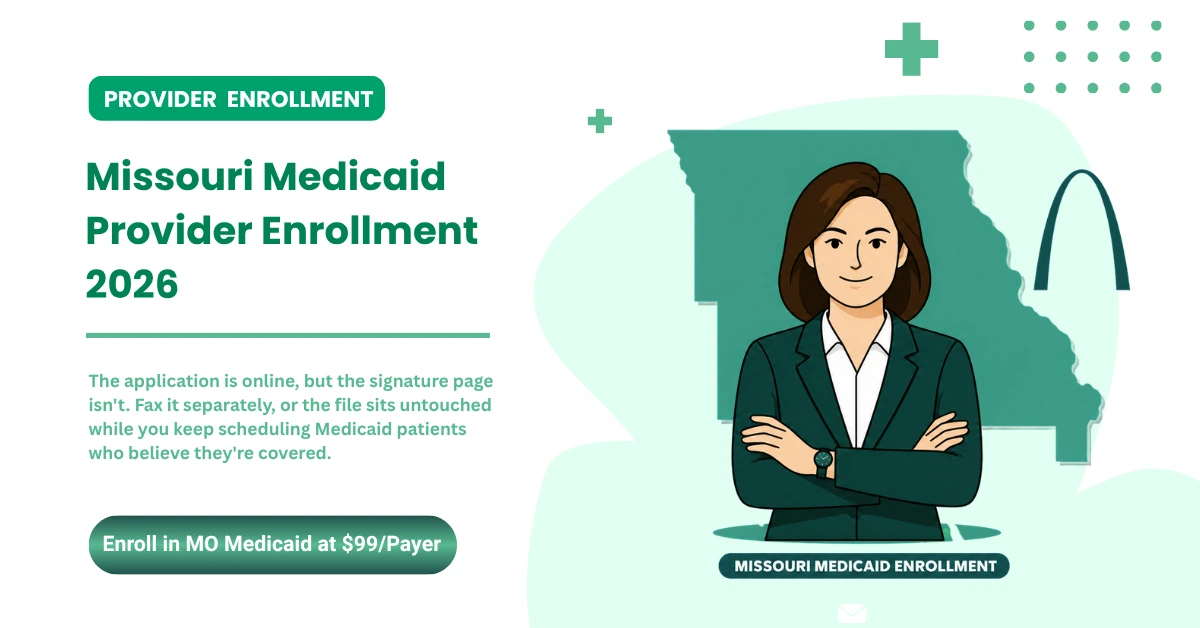
This is the step that catches people. The application is online. The signature page is not. Finish the eMOMED application, print it, sign it, and fax the signature page, or your file goes nowhere and nobody calls to tell you.
MMAC's published rules are specific, and each one has teeth:
- Where it goes: Fax the signature page and all required attachments to 573-634-3105. That number is used exclusively for enrollment applications, and all other faxes get disregarded.
- What sits on the other end: An enrollment fax database, not a fax machine in an office.
- One transmission: The signature page and every required attachment go in a single transmission. Partial applications aren't processed.
- One file per fax: Only one signature page and its attachments per transmission. Sending several? Wait for the fax to finish transmitting and disconnect, then redial for the next one.
- Everything else goes elsewhere: Other verification documentation goes to 573-751-5065 or by email to MMAC.ProviderEnrollment@dss.mo.gov.
Three automatic denials worth memorizing. Illegible pages are denied. Altered forms are denied. Forms completed by typewriter or by hand are denied, so the application has to be finished online before you print it.
Signatures now have room to breathe. MMAC accepts an original hand signature or a verifiable DocuSign, Adobe Sign, or Hello Sign signature. Miss the fax step and the file sits untouched while a provider who believes they have applied keeps scheduling Medicaid patients. Source: MMAC Provider Enrollment faxing instructions.
How to Enroll as a MO HealthNet Provider, Step by Step
- Verify NPI and taxonomy. Confirm your NPI is active in NPPES with the correct taxonomy and practice address. MMAC checks federal data against what you type. A mismatch here stalls the file after submission, when it's expensive to fix.
- Determine your provider type. Missouri runs more than 60 provider types, each with its own attachments and specialty codes. Confirm yours in the MO HealthNet Provider Enrollment Guide before you open the portal, and confirm whether your type can enroll online at all.
- Complete the application online. Every field has to be finished in eMOMED before you print. Applications printed before completion are denied. Need to stop partway? Finish the current page, save, and use the PIN shown at the top to retrieve it later.
- Disclose ownership and control. List every managing employee and everyone with 5% or greater ownership on the Business Organizational Structure form, with names, dates of birth, and Social Security numbers. Incomplete disclosure stops the file and can trigger sanctions.
- Pay the application fee. Institutional providers pay $750 for CY 2026. Individual practitioners pay nothing. Proof of payment travels with the application, so pay before you submit.
- Fax the signature page. Print, sign, and fax the signature page with all required attachments to 573-634-3105 in one transmission. This step is not optional and not electronic.
- Clear screening. Federal database checks run on you and everyone you disclosed. Depending on your risk tier, add a site visit, unannounced follow-up visits, or fingerprint-based background checks.
- Get your effective date, then contract with the MCOs. MMAC emails an approval letter carrying your Medicaid ID and effective date. Managed care contracting with Home State Health, Healthy Blue, and UnitedHealthcare starts from there and runs on each plan's own timeline.
Steps five, six, and eight are missing from every competing step list we reviewed. They are also the three that most often explain a stalled Missouri Medicaid provider enrollment file. Full instructions: MO HealthNet provider enrollment information guide.
If you've run this sequence before and it stalled, that's usually a documentation problem rather than a Missouri problem. We review files before they go out, and the issues we find are almost always fixable in an afternoon.
How MMAC Screens You: Limited, Moderate, and High Risk
Your risk tier decides how hard you get screened and how long the process takes. Federal and state regulation assign the tier by provider type, based on fraud risk to the program.
|
Risk Level |
Additional Screening at This Level |
|---|---|
|
Limited |
License verification for you and everyone disclosed, plus federal database checks |
|
Moderate |
Everything in Limited, plus a site visit before approval and unannounced post-enrollment visits |
|
High |
Everything in Moderate, plus fingerprint-based criminal background checks |
What the database checks cover
MMAC confirms your identity and exclusion status, plus that of every owner, agent, and managing employee, through five federal databases: the Social Security Administration Death Master File, NPPES, the List of Excluded Individuals and Entities, the Excluded Parties List System, and the Medicare Exclusion Database.
A National Sex Offender Public Website check runs alongside them. Check your own status at the OIG exclusions database before you start Missouri Medicaid provider enrollment. It costs nothing and it takes a minute.
Two rules that surprise people
If your provider type isn't categorized into a risk level, MMAC screens you as moderate risk under 13 CSR 65-2.020(10)(G).
If you could fit within more than one screening level, the highest one applies under 13 CSR 65-2.020(10)(D). Plan your timeline around the harder tier, not the friendlier one.
When MMAC raises your risk level
Four triggers move you up. A payment suspension based on a credible allegation of fraud, waste, or abuse. An existing Medicaid overpayment. Exclusion by the HHS Office of Inspector General or another state's Medicaid program within the previous 10 years. And applying within six months of a moratorium being lifted for your provider type.
For high-risk institutional providers, fingerprinting reaches every person with 5% or more ownership interest, not only the applicant. Sources: MMAC provider assigned risk categories and 42 CFR 455.450.
How Long Missouri Medicaid Enrollment Actually Takes
MMAC publishes its own figure, and it's lower than what most commercial guides claim. Three components decide your real timeline.
- MMAC processing: Up to six weeks after MMAC receives a completed application and the required documentation.
- Queue behavior: Applications process in date order as received. Files returned for more information lose priority, and so do internet applications denied for improper submission.
- MCO contracting: Runs separately with each plan after state enrollment, on each plan's own schedule.
Two things you can control. You can request an expedited review, but you need a valid reason such as an access-to-care issue. And you can request backdating on the application itself, which matters more than most providers realize.
The guidance in circulation on backdating contradicts itself, so this is the accurate version as of August 2026. State regulation permits enrollment as of an earlier date, up to a maximum of 365 days.
MMAC's operating policy is narrower. It will not backdate an effective date prior to the date it received your application, apart from very specific situations such as out-of-state emergency services. Treat 365 days as a ceiling that rarely opens and the receipt date as your working assumption.
One more correction, because it keeps getting repeated. Guidance saying MMAC approves most applications same day or overnight came from a March 2020 federal Section 1135 waiver issued during the COVID-19 public health emergency. It is not current in 2026. Source: MMAC notice on backdating enrollment applications.
Weighing whether to run Missouri Medicaid provider enrollment in house? Our in-house versus outsourced enrollment math puts real numbers against that six-week window.
What Missouri Medicaid Enrollment Costs in 2026
Neither commercial competitor ranking for this query publishes a fee figure. MMAC publishes it plainly, so here it is.
- Institutional providers: $750 for CY 2026, up from $730 in 2025.
- Individual practitioners: No fee. Physicians, dentists, advanced practice registered nurses, and other individual non-physician practitioners are exempt.
- When it applies: New enrollment and revalidation both trigger the fee for institutional providers.
- Two-year exemption: Paid the fee to Medicare or another state Medicaid within the past two years? You're exempt with proof, and institutional providers have to include that proof before MMAC processes the file.
- Hardship waiver: Request one from CMS. The fee still has to be submitted before MMAC processes your application, and MMAC refunds it if CMS approves.
Payment runs through the state's contracted vendor by credit card, debit card, or e-check, with a convenience fee depending on the method. A cashier's check or money order made payable to DSS-MMAC Application Fee also works. Cash and personal or business checks won't be accepted.
CMS resets this fee every calendar year using the Consumer Price Index for All Urban Consumers, so budget for movement each January. Sources: MMAC application fee page and the CY 2026 Federal Register fee notice.
The cost nobody puts on the invoice
The state fee is one line item. The bigger number is the staff hours spent on the application plus the revenue you can't bill while the file sits for six weeks, and again while three managed care contracts work through their own queues.
MedSole RCM handles payer enrollment at $99 per insurance across all 50 states, with no setup fees and no long-term contracts. Billing runs at 2.99% of collections. We have credentialed more than 4,000 providers.
On a Missouri file that buys three things: a documentation audit before submission, weekly follow-up with MMAC instead of submitting and waiting, and a status you never have to chase.
If Missouri Medicaid provider enrollment is one line on a multi-state list, talk to our enrollment team before you open eMOMED rather than after the file stalls. The review is free and takes about 15 minutes.
Where This Guide Ends and What Comes Next
This is Part 1 of the blueprint, covering sections 0 through 12. It takes a provider from "what is this" through submission, screening, timeline, and cost.
Part 2 picks up at enrollment status checks. It covers effective dates, the managed care two-step, returned applications, EFT and ERA setup, revalidation mechanics, OPR and OHCDS detail, the twelve-question FAQ mapped to People Also Ask, the author block, schema markup, and the closing CTA.
The Part 2 section brief for Missouri was not in the file provided; an ABA CPT blueprint appeared in its place. Send the Missouri Part 2 brief and I will build it on the same verified research base.
Implementation Notes for the Developer
Internal links below render blue and bold in this document and must publish as standard dofollow links. External citations render dark blue and underlined and must publish with rel="nofollow noopener" and target="_blank", per the blueprint. Every URL in both tables was fetched and confirmed live on August 20, 2026.