



Idaho Medicaid provider enrollment starts with a Trading Partner Account at www.idmedicaid.com. Gainwell Technologies processes every application on behalf of the Idaho Department of Health and Welfare. A complete application includes a signed Medicaid Provider Enrollment Agreement and a signed W-9. For help, call 866-686-4272.
Practices underestimate that word "complete." Your enrollment effective date is the date a complete and acceptable application reaches the department or Gainwell. Submit a packet with a missing signature and the clock doesn't start. Patients you've already seen stay unbillable.
Enrolling with Idaho Medicaid looks simple on the state's own page, which runs about 300 words. This guide covers what those 300 words leave out, written for Idaho practice managers, billing teams, behavioral health groups, therapy practices, and multi-state groups adding Idaho to an existing footprint.
Updated August 2026. Four dated changes land inside this guide: the January 2026 therapy authorization threshold, two May 2026 prior authorization changes, and the December 2026 procurement blackout. Every figure traces back to IDHW, Idaho Administrative Code, or CMS.
Idaho Medicaid Provider Enrollment: Quick Reference
|
Field |
Value |
|---|---|
|
Where you enroll |
Trading Partner Account at www.idmedicaid.com |
|
Who processes it |
Gainwell Technologies for IDHW |
|
Required for a complete application |
Provider Enrollment Agreement, signed W-9, supporting attachments |
|
Effective date |
Date the complete, acceptable application is received |
|
Claim filing window |
365 days from date of service |
|
Enrollment help line |
866-686-4272 |
|
Portal and EDI support |
866-686-4272, option 2 |
Who Has To Enroll With Idaho Medicaid
Any provider who bills Idaho Medicaid must enroll first. So must providers who never submit a claim but order, refer, or prescribe for Medicaid participants. Enrollment and a signed provider agreement come before you render billable services. Emergency circumstances create a narrow exception, and the department reviews those case by case.
Idaho Medicaid's Four Coverage Plans
Idaho Medicaid runs four plans, and each one changes what you can bill for a given participant. Member-facing pages often list three, which is why the plan structure trips up practices new to the program.
Idaho Medicaid Coverage Plans for Providers
|
Plan |
What it covers |
|---|---|
|
Standard |
Federally mandated benefits only. Any member can choose this plan. |
|
Basic |
Preventive, medical, dental, and vision services for members who meet income standards. |
|
Enhanced |
Basic Plan benefits plus long-term care, developmental disability, and behavioral health supports. |
|
Medicare Medicaid Coordinated |
Enhanced Plan benefits for dual eligibles, with a Medicare Advantage option. |
Check the plan before you check the code. A service covered under Enhanced can deny under Standard, and the remittance advice won't always spell out why. IDHW publishes the current plan structure on its Idaho Medicaid provider information page.
Fee-For-Service Versus Managed Care In Idaho Right Now
Idaho Medicaid still runs primarily on fee-for-service. Several carve-outs sit alongside it: the Idaho Behavioral Health Plan through Magellan of Idaho, Idaho Smiles dental through MCNA, and the dual-eligible plans, Medicare Medicaid Coordinated Plan and Idaho Medicaid Plus.
Knowing what is medicaid fee for service matters for a practical reason. Under fee-for-service you bill the state through Gainwell. Under a carve-out you bill the plan that owns that benefit, on that plan's rules and that plan's timeline.
Healthy Connections Idaho, the primary care case management program the state ran for close to twenty years, ended December 31, 2025. Healthy Connections Value Care ended the same day. Practices that leaned on Healthy Connections coordinators for authorizations and claim routing lost that support with no replacement in place.
Comprehensive managed care in Idaho is delayed to January 1, 2030. The Idaho legislature passed House Bill 345 in March 2025 to move the program from fee-for-service to managed care, and IDHW has since pushed the go-live date out.
You'll find articles claiming most Idaho Medicaid members moved to managed care organizations on January 1, 2026. That's wrong, and billing against it will cost you. Idaho Medicaid Plus and the Medicare Medicaid Coordinated Plan serve dual eligibles, and both predate 2026.
Verify anything you read against the Idaho managed care transition page before you change a workflow. Multi-state groups hitting the same confusion in other states will find our Medicaid credentialing requirements guide useful.
Providers Who Enroll But Never Bill
Ordering, referring, and prescribing providers carry their own medicaid provider enrollment obligation. A physician who refers an Idaho Medicaid patient for imaging but never bills the program still has to be enrolled. If that referring physician isn't enrolled, the imaging center's claim denies. Section 9 covers how the ORP pathway works and who qualifies for it.
Who Runs Idaho Medicaid Enrollment: IDHW, Gainwell, Telligen, And Magellan
IDHW administers the program and writes the rules. Gainwell Technologies runs the MMIS and handles enrollment, claims processing, provider training, and operational support. Telligen manages utilization review through Qualitrac. Magellan of Idaho runs the Idaho Behavioral Health Plan, and Prime Therapeutics runs pharmacy.
What Each Organization Actually Does
Idaho Medicaid Contractors and Their Roles
|
Organization |
Role |
You use it for |
Where to reach it |
|---|---|---|---|
|
IDHW, Division of Medicaid |
State Medicaid agency |
Policy, rules, fee schedules |
healthandwelfare.idaho.gov |
|
Gainwell Technologies |
MMIS contractor |
Enrollment, claims, Trading Partner Account |
866-686-4272 |
|
Telligen |
Utilization management |
Prior authorization through Qualitrac |
See Section 7 |
|
Magellan of Idaho |
Behavioral health plan |
Behavioral health enrollment and claims |
See Section 8 |
|
Prime Therapeutics |
Pharmacy benefit administrator |
Pharmacy program |
See Section 8 |
Gainwell Idaho Medicaid is the name on most of your provider correspondence, and www.idmedicaid.com is the portal behind it. IDHW sets policy, but Gainwell reviews your application, assigns your effective date, and pays your claims.
Why This Matters For Your Enrollment
Enrollment isn't one door. A behavioral health group that finishes with Gainwell and stops there may still owe Magellan a separate provider record.
A pediatric therapy practice that never registers for Qualitrac can't submit a prior authorization once a patient passes the visit threshold. The claim denies while the billing team hunts for a coding error that was never there.
Practices working through Idaho Medicaid provider enrollment for the first time tend to find the second and third systems after the first denial. Map all four before you start, then assign an owner to each one.
The split also decides who you call. Gainwell Medicaid support handles enrollment status, portal access, and claims. Telligen handles clinical review. Magellan handles behavioral health participation. Calling the wrong one costs you a week.
How To Enroll As An Idaho Medicaid Provider: Step By Step
Six steps take you from nothing to billable. Register a Trading Partner Account at www.idmedicaid.com, log in and open the enrollment application, complete the application screens with your business details and NPI, upload the signed agreement and W-9, submit the packet to Gainwell, and wait for written effective date confirmation before you bill.
Step 1: Register Your Trading Partner Account
Go to www.idmedicaid.com and select Register in the upper right corner of the page. That control creates your Trading Partner Account, which is the login wrapper around everything else you'll do with Idaho Medicaid.
The enrollment application lives inside the TPA. It isn't a separate form on the homepage, and that single fact stops more applications than any documentation problem. Providers land on idmedicaid.com looking for a form, don't find one, and give up.
Anyone learning how to become a medicaid provider in Idaho starts here. No medicaid provider registration happens outside this account.
Step 2: Open The Provider Enrollment Application
Log in to your new account. Hover over the Account Maintenance tab and select the Provider Enrollment link from the menu that drops down.
The link isn't on the main dashboard. Idaho's own enrollment user guide documents this path, and Google's AI results quote it, because no web page states it in plain language. If your screen shows different tab labels, Gainwell updated the interface, and the enrollment help line at 866-686-4272 can point you to the current path.
Step 3: Complete The Application Screens
The application walks through business identity, tax details, service locations, and provider type. Two things on these screens cost practices real money.
The Start Enrollment screen data sets the foundation for the whole application. Once you submit that screen, you can't change it. Enter the wrong provider type or the wrong tax entity and you may have to delete the application and start over from an empty form.
Your NPI data pulls in from NPPES and populates later screens. If your taxonomy code or practice address is wrong in NPPES, it will be wrong in your Idaho application, and correcting it inside the application won't fix the source. Clean up NPPES first, then apply.
An application in progress stays available for a limited window before the system closes it. Plan to finish in one sitting or two, not over a month.
Most Idaho enrollment applications don't fail on the hard parts. They fail on a mismatched address or a Start Enrollment field somebody guessed at. Our credentialing team audits every field against NPPES and your W-9 before submission, and Medicaid enrollment runs $99 per insurance. If you'd rather not risk restarting the application, that's what the service is for. See our Medicaid enrollment application support.
Step 4: Attach The Required Documents
A complete packet needs the signed Medicaid Provider Enrollment Agreement and a signed W-9 at minimum. Your provider type adds to that list: professional licenses, certifications, and background check documentation where the program requires it.
The W-9 catches people. It has to carry the legal name and TIN on file with the IRS, not the DBA on your signage. A DBA on the W-9 sends the application to manual review.
IDHW documents the baseline requirements on its Idaho DHW Provider Enrollment page, and program-specific instructions live in the enrollment user guides inside the portal.
Step 5: Submit And Track
Submit through the portal. Gainwell receives it directly, so nothing gets mailed. Record whatever reference or case identifier the system returns, because that number is how Gainwell will discuss your file with you later.
Status stays visible inside your Trading Partner Account. Check it there before you call. Idaho medicaid provider enrollment applications move through a queue, and calling in week two doesn't move you up it.
Step 6: Wait For Written Effective Date Confirmation
Approved means screening cleared. The written effective date is when you can bill.
Those are two different events, and practices lose thousands treating them as one. A portal status change isn't authorization to schedule Medicaid patients. Wait for the written confirmation, read the date on it, and book your first Medicaid appointment for the day after.
There Is No Downloadable Idaho Medicaid Provider Enrollment Form
There is no downloadable Idaho Medicaid provider enrollment form. No PDF to print, no packet to mail, no paper application to fill in. Idaho generates the application inside your Trading Partner Account after you register at www.idmedicaid.com.
Third-party sites sell scraped versions of old Idaho forms. Filling one out accomplishes nothing except handing your provider data to a company with no role in the program. Some of those forms are years out of date.
Gather this before you open the application and the electronic form moves fast.
What the Idaho Medicaid Provider Application Asks For
|
Item |
Detail to have ready |
|---|---|
|
Identifiers |
NPI and taxonomy code, verified current in NPPES |
|
Tax identity |
Legal business name and TIN exactly as the IRS holds them |
|
Signed documents |
Medicaid Provider Enrollment Agreement and W-9 |
|
Payment setup |
Banking details for electronic funds transfer |
|
Accounting |
Fiscal year end month and day |
|
Locations |
Physical and mailing addresses for every service location |
|
Ownership |
Owner and managing employee details |
|
Credentials |
Licenses, certifications, and program-specific documentation |
That table covers most of what medicaid enrollment for providers requires in Idaho. Anyone working out how to become a medicaid provider here should treat it as the real starting point, because gathering it first turns a multi-week medicaid provider application into a single afternoon.
Your Idaho Medicaid Provider ID And NPI
Providers eligible for a National Provider Identifier must enroll using that NPI. Providers who aren't eligible for an NPI receive a medicaid provider number the department assigns on approval. IDAPA 16.03.09.200 states this rule, and it's the only place on the open web where you'll find it written down.
What The Seven Digit Medicaid Provider ID Is
Two different numbers identify you, and confusing them delays claims.
Your NPI is national. NPPES issues it, every payer in the country recognizes it, and it follows you between states and employers. Your Idaho medicaid provider number is state-only. It exists inside the Idaho system, Gainwell assigns it at approval, and it means nothing to any other program.
Providers searching for a 7 digit medicaid provider id want that second number. State-assigned Medicaid identifiers run shorter than the ten-digit NPI, which is where the phrasing comes from.
Idaho assigns a department provider number only where the applicant can't hold an NPI. A 7 digit medicaid provider id shows up less often here than providers expect, and most enrolled clinicians work from their NPI plus their Idaho provider record.
How To Find Your Idaho Medicaid Provider Number
Three places hold it. Sign in to your Trading Partner Account and check your enrollment record. Pull the approval correspondence Gainwell sent when your application cleared. Search the public provider directory on the Idaho Medicaid portal to confirm what the program has on file.
Billing teams asking how to find my medicaid provider number skip the second option most often, and the approval letter is the fastest of the three.
If none of them produce the medicaid provider number you need, the Gainwell enrollment team can retrieve it. Have your case number ready, and confirm the medicaid provider id against the record before you correct anything on a claim.
Each Billing NPI Needs Its Own Provider Agreement
Every billing NPI carries its own Idaho Medicaid Provider Agreement. A group that bills under two tax identification numbers needs two records, not one record with two numbers attached.
Behavioral health groups hit a version of this that costs them months. If the NPI you use with Magellan differs from the NPI enrolled with Idaho Medicaid, enroll the matching one. Claims routed through a plan under an NPI the state doesn't recognize deny, and the denial reason rarely names the mismatch.
The Idaho Medicaid Provider Portal: What Each System Does
The Idaho Medicaid provider portal at www.idmedicaid.com handles enrollment, claims, eligibility verification, prior authorization submission, and revalidation. New providers register a Trading Partner Account before anything else. Qualitrac, operated by Telligen, sits outside that portal and handles clinical review on its own login.
The Five Idaho Medicaid Systems, And Which One You Need
Five separate systems carry the Idaho Medicaid name. No published map explains the difference, which is why providers end up with three logins and no idea which one holds their enrollment record.
Idaho Medicaid Provider Systems and What Each One Does
|
System |
Operated by |
What you do there |
Who needs it |
|---|---|---|---|
|
Trading Partner Account at www.idmedicaid.com |
Gainwell Technologies |
Enrollment, claims, eligibility, revalidation |
Every enrolled provider |
|
Provider Express Access at pea.idmedicaid.com |
Gainwell Technologies |
Limited-access provider functions |
Situational |
|
Qualitrac at myqualitrac.com |
Telligen |
Prior authorization and clinical review |
Providers submitting UM requests |
|
Magellan of Idaho provider portal |
Magellan of Idaho |
Behavioral health participation and claims |
Behavioral health providers |
|
IRIS at iris.dhw.idaho.gov |
IDHW |
Organization and contact records |
Situational |
The medicaid idaho provider portal you need depends on the task. Enrollment and claims live in the Trading Partner Account. Clinical review lives in Qualitrac. Behavioral health participation lives with Magellan. Provider Express Access and IRIS serve narrower functions, and Gainwell provider services can tell you whether your practice needs either one.
One rule settles most of the id medicaid provider portal confusion: if the task involves money, it's the Trading Partner Account. If it involves clinical necessity, it's Qualitrac. Anyone asking which id medicaid provider portal holds their enrollment record is asking about the Trading Partner Account.
Portal Maintenance Windows
The Idaho Medicaid portal goes offline for scheduled maintenance on a weekly cycle, generally from Saturday afternoon into Sunday morning Mountain Time. Eligibility verification stays available by phone while the Idaho Medicaid portal is down.
Build that into your workflow. A Friday afternoon submission that fails silently sits until Monday, and for claims near a filing deadline that weekend costs you.
When You Cannot Get Into The Portal
Idaho medicaid provider login problems and portal access failures go to the EDI Technical Services Team at 866-686-4272, option 2. You can also email idedisupport@gainwelltechnologies.com.
Claim questions take a different route. Send those through secure messaging inside your Trading Partner Account so the question attaches to a written record tied to the claim. Phone calls about specific claims leave no trail, and Gainwell Idaho Medicaid staff will ask you to resend through the portal anyway.
Qualitrac And Telligen: Registration And Prior Authorization
Telligen operates utilization management for Idaho Medicaid through the Qualitrac provider portal. Providers submit clinical review requests at myqualitrac.com. New users register for Qualitrac separately from Idaho Medicaid enrollment, and Telligen puts the provider's portion of that registration at under 10 minutes.
Telligen Provider Portal Registration
Telligen provider portal registration runs through a signature request, not through the Idaho Medicaid application. You complete your portion, Telligen processes it, and your Qualitrac login follows. Telligen provider portal registration takes under 10 minutes on the provider side, which makes it one of the shortest tasks in this entire guide and one of the most commonly skipped.
Once you're registered, Qualitrac login happens at myqualitrac.com. Telligen login credentials are separate from your Idaho Medicaid credentials, so store them where your whole billing team can reach them. A single-person Qualitrac login becomes a problem the week that person takes vacation.
Enrolling With Idaho Medicaid Does Not Register You For Qualitrac
Enrolling with Idaho Medicaid through Gainwell does not register you for Qualitrac. Telligen requires a separate registration.
Neither organization's website explains the other, so providers finish enrollment, assume they're done, and discover the gap when a patient crosses a visit threshold and the authorization has nowhere to go. The idaho medicaid provider portal at www.idmedicaid.com and the Telligen Qualitrac system are different platforms with different logins and different owners.
Sequence it correctly. Finish your Gainwell enrollment, then register for Qualitrac before your first patient needs clinical review. The medicaid idaho provider portal handles your claims, and Telligen Qualitrac handles whether the service gets approved in the first place.
What Moves To Telligen In 2026
Prior authorization for physician administered drugs transitions from the Idaho Medicaid pharmacy program to Telligen. Beginning May 4, 2026, PAD prior authorization requests go to Telligen.
Effective May 1, 2026, CHIS providers can no longer document verbal consent in place of a parent or legal guardian signature on prior authorization requests. Children's Habilitation Intervention Services requests submitted with documented verbal consent after that date will not be accepted.
Both changes came from Telligen Idaho Medicaid provider notices. If your practice submits either request type, update your intake forms before the dates rather than after the first rejection. Telligen Idaho Medicaid posts changes to its provider news page, and it's worth a monthly check.
Idaho Medicaid Provider Contacts
Idaho Medicaid provider enrollment questions go to 866-686-4272. Portal and EDI problems go to the same number, option 2. Claims questions go through secure messaging inside your Trading Partner Account so the question attaches to a written record.
Members looking for benefit or eligibility help should contact IDHW directly rather than using the provider lines below.
Idaho Medicaid Provider Contact Directory
Every number and address here serves providers. Google's own answer to this question returns a mostly member-facing list, which is part of why the idaho medicaid provider phone number is hard to pin down.
Idaho Medicaid Provider Contacts
|
Purpose |
Contact |
|---|---|
|
Provider services and enrollment help |
866-686-4272 |
|
Portal and EDI technical support |
866-686-4272, option 2 |
|
Gainwell EDI support email |
idedisupport@gainwelltechnologies.com |
|
Claims questions |
Secure messaging inside your Trading Partner Account |
|
Automated eligibility and claim status |
866-686-4272 |
|
Clinical review and prior authorization |
Telligen, through myqualitrac.com |
|
Behavioral health participation |
Magellan of Idaho provider services |
Save the medicaid idaho provider phone number in your practice management system alongside the option-2 path. Front desk staff calling the main line for a portal lockout wait through a menu built for a different question.
When To Call Versus When To Message
Call for anything blocking access: a locked account, a failed login, an EDI transmission that won't go through. Those need a live person and they resolve in one conversation.
Message for anything tied to a specific claim. Secure messaging inside the portal creates a written record attached to your account, which matters when a claim goes to appeal six months later and nobody remembers the phone call. Idaho medicaid provider phone number requests about individual claims usually end with staff asking you to resubmit through the portal anyway.
Enrollment, Credentialing, And Contracting Are Three Different Things
Enrollment is state registration with Idaho Medicaid through Gainwell, and it assigns your provider number. Credentialing is verification of your licensure, education, work history, and sanctions status. Contracting is the participation agreement with a specific plan. Providers serving Idaho Medicaid usually need all three, and medicaid credentialing is the piece most often confused with the other two.
Enrollment vs Credentialing vs Contracting in Idaho Medicaid
|
Process |
What it establishes |
Who runs it |
|---|---|---|
|
Enrollment |
Your right to bill the program, plus your provider number |
IDHW through Gainwell |
|
Credentialing |
Verification that your qualifications are real and current |
State agency and each plan |
|
Contracting |
Your participation terms with a specific plan |
Each individual plan |
What Idaho Medicaid Enrollment Covers
Enrollment gives you a signed provider agreement, a provider record in the state system, and the ability to submit claims. It doesn't put you in any plan's network, and it doesn't verify anything about your clinical qualifications beyond what the screening rules require.
Medicaid enrollment for providers is the floor. Everything else builds on it.
What Credentialing Covers
Credentialing verifies what you claim. Primary source verification confirms licenses with the issuing board, education with the school, and work history with prior employers. Exclusion screening checks federal databases including the OIG list and SAM.gov. Most plans pull the underlying data from CAQH.
Idaho screens every enrolled provider, but not every enrolled provider gets credentialed. Credentialing generally applies to licensed providers who can practice independently under state law. Practices asking how to get credentialed with medicaid in Idaho are usually asking about two processes at once, and separating them clarifies the timeline.
Federal screening rules under 42 CFR Part 455 set the floor every state has to meet, including the disclosure requirements that catch group practices off guard. Knowing how to get credentialed with medicaid starts with knowing which of the two processes your delay sits in.
What Is ORP Enrollment In Idaho Medicaid?
ORP enrollment covers ordering, referring, and prescribing providers who participate in Idaho Medicaid without ever submitting a claim. A physician who orders labs, refers to a specialist, or prescribes for a Medicaid participant has to be enrolled even when someone else does all the billing.
The consequence lands on the wrong party. When an ordering provider isn't enrolled, the claim that denies belongs to the lab, the imaging center, or the specialist who accepted the referral. Practices spend weeks rebilling that claim as a coding problem when the fix sits in another provider's enrollment record entirely.
Check your referral sources. Provider enrollment for therapists, imaging groups, and labs depends on the ordering physicians upstream being enrolled, and nobody sends you a notice when one of them lapses.
Behavioral Health Providers Enroll Twice
Behavioral health providers who enroll with Gainwell Technologies may also be required to enroll and maintain a provider record with Magellan of Idaho.
Two records means two sets of demographic data, two revalidation cycles, and two places where a lapse stops your claims. Keeping them synchronized is the part practices underestimate. An address change filed with Gainwell and not with Magellan produces claim rejections from one payer and clean claims from the other, which makes the cause hard to spot.
Two enrollments means two sets of deadlines and two places a lapse can cost you claims. We handle both records for Idaho behavioral health practices at $99 per insurance, and we track the renewal dates so nothing expires quietly. Our credentialing and enrollment services cover the Gainwell record and the Magellan record together.
Your Enrollment Effective Date, And Why It Might Be Later Than You Expect
The effective date of Idaho Medicaid enrollment is the date the completed and acceptable application is received by the Department of Health and Welfare or Gainwell. That date sits later than the day you started the application, and it often sits later than the day you first hit submit.
What Counts As A Complete Application
A submitted application and a complete application aren't the same thing. Gainwell reviews what arrives, and anything missing sends the packet back into your queue rather than forward into theirs.
Four things push the received-complete date later more often than anything else: a missing signature on the Provider Enrollment Agreement, a W-9 carrying a DBA instead of the legal IRS name, an address that doesn't match NPPES, and an attachment nobody uploaded.
Each correction round restarts the clock. Nobody sends a notice telling you the date moved, so practices discover it when the approval letter arrives showing an effective date six weeks after they expected.
Requesting A Different Effective Date
Exceptions exist, and they're narrow. Request one in writing with justification for why your effective date should differ. IDHW says approved exceptions typically cover emergency services or covered specialist services that would otherwise be unavailable to a Medicaid member.
The requested date has to fall inside the coverage period of whatever license or certification you submitted. Asking for a date that predates your Idaho license won't work.
Treat backdating as an exception you might get, not a plan you can build on.
What The Gap Costs
A clinic starts seeing Idaho Medicaid patients on March 1. The application clears on April 15 with an effective date matching that arrival. Six weeks of encounters happened, the care was delivered, and none of it is billable to Idaho Medicaid.
That gap doesn't appear on an aging report, because the claims were never submitted. It shows up as a quiet hole in a month's collections that nobody can explain until someone pulls the enrollment letter and reads the date.
The Three Claim Clocks Every Idaho Medicaid Biller Has To Track
Idaho Medicaid runs three separate deadlines. Claims must be submitted within 365 days of the date of service. Medicare crossover claims get 6 months from the Medicare payment date or the EOB date. Corrections and adjustments run on a 2-year window from the start date of service.
The Three Clocks Side By Side
Idaho Medicaid Claim Deadlines
|
Clock |
Window |
Starts from |
Applies to |
|---|---|---|---|
|
Initial claim submission |
365 days |
Date of service |
All Idaho Medicaid claims |
|
Medicare crossover |
6 months |
Medicare payment date or EOB date |
Crossover claims filed timely with Medicare |
|
Correction or adjustment |
2 years |
Start date of service |
Claims already submitted that need fixing |
IDHW publishes the 365-day rule and the crossover exception on its provider enrollment page. The 2-year adjustment window comes from Gainwell's own portal guidance. Confirm the adjustment window against the current Idaho Medicaid Provider Handbook before you build a workflow on it, because that one moves less predictably than the other two.
Why Billers Confuse The 365-Day And 2-Year Windows
Both errors cost money, in opposite directions.
A biller who believes there are 2 years to submit will miss the 365-day filing deadline entirely and lose the claim. A biller who believes everything closes at 365 days will write off a correctable claim at month 13 that was still inside the adjustment window.
The distinction is submission versus correction. You get one year to get the claim in the door. You get longer to fix a claim that already made it through the door.
How Enrollment Timing Interacts With Filing Deadlines
The 365-day clock runs from the date of service, and nothing about your enrollment changes that.
A late effective date shortens the usable filing window on encounters you've already rendered. Six weeks lost to an incomplete application means six fewer weeks to work those claims once they finally become billable. Add a denial and an appeal cycle to that shortened runway and some of those claims won't survive it.
Claims with a short runway age out quietly. Our AR team works aging claims by filing deadline proximity, not by dollar value alone, so the ones closest to expiring get touched first. If you have Idaho Medicaid claims sitting past 180 days, that's where we'd start. See how accounts receivable follow-up handles the aging buckets.
How Long Does Idaho Medicaid Provider Enrollment Take
Idaho doesn't publish a guaranteed processing time. Timing depends on how complete your application is when Gainwell receives it, the categorical risk level assigned to your provider type, and whether your enrollment requires a site visit. Federal risk-based screening drives most of the variation between two applications submitted the same day.
Three Things That Set Your Timeline
Completeness at submission sets the floor. A packet that clears review on the first pass moves through one queue. A packet that generates a request for missing documents goes back to you, then re-enters the queue behind whatever arrived while you were fixing it.
Risk level sets the ceiling. Federal rules under 42 CFR 455.450 require state Medicaid agencies to assign every provider type to a limited, moderate, or high categorical risk level. Higher tiers add screening steps, and some add an on-site visit. Our federal Medicaid enrollment rules guide covers how those tiers work across all 50 states.
The third driver catches people completely off guard.
The Medicare-First Requirement Nobody Warns You About
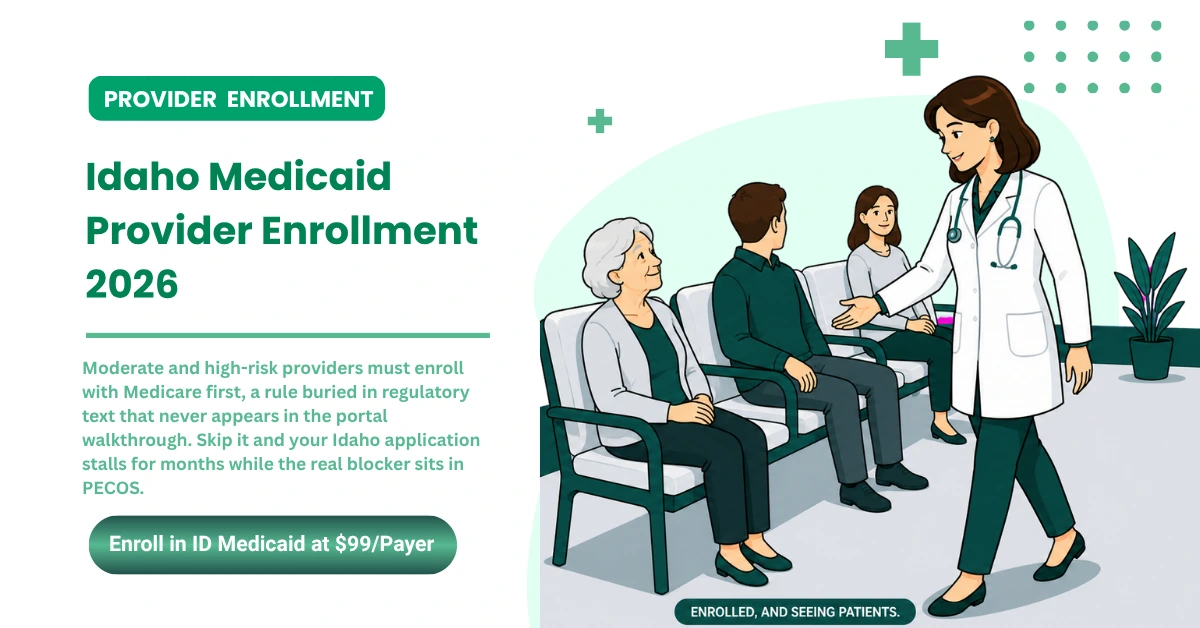
Providers in the moderate or high categorical risk level, and any provider type Medicare classifies as institutional, must enroll as Medicare providers or demonstrate enrollment with another state's Medicaid agency before Idaho Medicaid enrollment or revalidation.
IDAPA 16.03.09.200 states this, and almost nothing else does. It's regulatory text, not portal instruction, so it never appears in the enrollment walkthrough a provider reads.
Skip it and your Idaho application stalls or gets denied outright, and the notice won't necessarily spell out that Medicare enrollment was the missing piece. A practice can spend two months resubmitting Idaho paperwork while the actual blocker sits in PECOS.
Check your risk category against the Idaho provider handbook before you apply. If you land in moderate or high, confirm your Medicare enrollment status first, because that medicaid provider enrollment sequence isn't optional and it isn't reversible after the fact.
Checking Your Application Status
Status stays visible inside your Trading Partner Account, and the record there is more current than anything a phone call will give you in the first few weeks.
Calling early doesn't move you up the queue. Call when an application has sat static well past what your risk level suggests, and have your enrollment case number and submission date in front of you when you do. A medicaid provider enrollment application that's stuck usually shows a specific status the representative can act on.
What Idaho Medicaid Enrollment Costs In 2026
The federal application fee for calendar year 2026 is $750, and it applies to institutional providers only. Physicians and non-physician practitioners are exempt. Providers who already paid the fee to Medicare or another state Medicaid within the same calendar year are exempt with proof of payment.
Who Pays And Who Does Not
Idaho Medicaid Enrollment Fee 2026
|
Provider type |
2026 fee |
|---|---|
|
Institutional providers |
$750 |
|
Physicians |
Exempt |
|
Non-physician practitioners |
Exempt |
|
Practitioner groups |
Exempt |
|
Already paid to Medicare or another state this calendar year |
Exempt with proof of payment |
CMS sets the amount annually and published the 2026 figure in the CY 2026 application fee notice. The requirement itself sits in 42 CFR 455.460. Keep the proof of payment if you've paid elsewhere this year, because Idaho will ask for it rather than take your word.
That fee is the only mandatory cost of a medicaid provider enrollment application in Idaho. Everything else is your own time.
What Reimbursement Looks Like Once You Are Enrolled
For most services, Idaho Medicaid reimburses the lesser of your billed amount or the maximum allowable fee the Department of Health and Welfare, Division of Medicaid has established.
Idaho Medicaid requires providers to bill their usual and customary charge, meaning the charge they apply to patients who aren't Medicaid members. The fee schedule is a reference for what the program pays. Using it to set your charges inverts the relationship and creates a compliance problem, not a pricing strategy.
A zero price against a code doesn't mean the service isn't covered. It can mean the service is manually priced or reimbursed from an invoice. Check the General Information section of the provider handbook before you write off a zero-priced line.
Fee Schedules, The Formulary, And The Preferred Drug List
IDHW publishes the idaho medicaid fee schedule rather than Gainwell, and it lives in the department's public document library. Each entry carries a procedure code, a description, and a reimbursement amount.
Any code on it can still carry a service limitation or a prior authorization requirement. The medicaid idaho fee schedule gives you the rate, not the coverage rules.
Pharmacy runs on different documents. The idaho medicaid formulary and the idaho medicaid preferred drug list govern which drugs are covered and at what tier, and Prime Therapeutics administers the pharmacy program.
Neither document sits inside the medical fee schedule. The idaho medicaid pdl updates on its own cycle, and the medicaid formulary idaho maintains changes without touching the rates you bill against.
Reimbursement rates can change during the year without the published fee schedule reflecting it right away. Treat the schedule as a reference document rather than a contract, and verify anything you're building a financial projection on.
Revalidation: Idaho Is Reviewing Every Provider Record Right Now
Federal rules require state Medicaid agencies to revalidate every enrolled provider at least every 5 years. Idaho is currently running a multi-year effort to confirm that every provider enrollment record is accurate, current, and compliant with federal rules. When your revalidation request arrives, complete it inside the window the notice gives you or your enrollment can lapse.
What Revalidation Asks You To Confirm
This isn't a signature renewal. Idaho's provider communications describe revalidation as a full record audit covering:
- Provider information and demographics
- Ownership details
- Controlling interests and business relationships
- Service location and address updates
- Rendering provider affiliations
- Banking information
Group practices carry the heaviest lift here. Ownership and controlling interest disclosures require current data on people who may have joined or left since the last enrollment, and a medicaid provider registration record that hasn't been touched in four years rarely matches reality.
How You Will Be Notified
Revalidation requests come through your Trading Partner Account at www.idmedicaid.com. The correspondence address and email on file need to be current, and someone has to be watching that account.
The failure mode is mundane and expensive. Whoever set up the TPA leaves the practice. Nobody updates the contact record. The revalidation notice lands in an inbox that no longer has an owner. Your idaho medicaid provider portal account still works, but the deadline passes without anyone seeing it.
Assign the TPA to a role, not a person. Check it monthly even when you're expecting nothing.
What Happens If You Miss It
Missing revalidation leads to termination, termination creates a gap in your enrollment span, and claims for services rendered inside that gap generally can't be recovered even after you reactivate.
That last clause is the one that costs money. Reactivation restores your ability to bill going forward. It doesn't retroactively cover the weeks you were terminated, and the patients you saw during those weeks were seen by a provider the program didn't recognize.
Federal revalidation requirements sit in 42 CFR 455.414, and CMS publishes broader guidance in the Medicaid Provider Enrollment Compendium.
A revalidation notice that lands in an unwatched inbox is one of the more expensive administrative failures in Medicaid, and it's entirely preventable. We track revalidation and recredentialing deadlines for every payer a practice is enrolled with and give advance notice before anything expires. Credentialing and enrollment work runs $99 per insurance. Our revalidation tracking covers Medicaid, Medicare, and commercial payers on one calendar.
Revalidation Is Not The Same As Recredentialing
Revalidation is the state Medicaid requirement on a federal cycle. Recredentialing is what each plan runs on its own schedule.
A provider can be current on one and lapsed on the other. Medicaid enrollment for providers stays active through revalidation, while network participation with a specific plan stays active through recredentialing. Track both, on separate calendars.
Reactivating An Idaho Medicaid Enrollment That Lapsed
If your Idaho Medicaid enrollment shows disenrolled status, reactivation runs through your existing Trading Partner Account rather than a new application. Sign in, locate the disenrolled segment in your enrollment applications list, and select the reactivation action.
The Reactivation Path
Your existing account is the starting point. Building a new Trading Partner Account for a provider who already has a record creates a duplicate that Gainwell will have to untangle before anything moves.
Sign in to the existing TPA, find the enrollment segment showing disenrolled status, choose reactivation from the actions available on that segment, and supply the reactivation date you're requesting. Idaho documents this workflow in its Reactivation User Guide inside the portal, and the screen labels there are more current than any third-party description including this one.
Your idaho medicaid provider login still works after disenrollment. The account stays live even when the enrollment doesn't, which is why the reactivation path runs through www.idmedicaid.com instead of a fresh registration.
Keep Your Enrollment Case Number
Gainwell discusses applications by case number. Record it when reactivation generates one and use it in every contact after that.
Reactivation Does Not Restore The Gap
Reactivating forward doesn't make the inactive period billable retroactively. Services you rendered while your enrollment was terminated generally stay unbillable to Idaho Medicaid.
Practices treat reactivation as an administrative correction and discover the revenue consequence afterward. Reactivate as fast as you can, and pull a report of every Medicaid encounter that fell inside the gap so you know the size of the hole before your month-end close finds it for you.
Why Idaho Medicaid Claims Deny After You Are Enrolled
Enrollment approval doesn't guarantee paid claims. Idaho Medicaid denials after enrollment trace to five causes: prior authorization gaps, an unenrolled ordering or referring provider, service limits, eligibility that changed between scheduling and the date of service, and claims filed outside the 365-day window.
Gainwell processes claims for the fee-for-service program, and knowing who processes medicaid claims for a given patient determines where a denial gets worked. Behavioral health claims route to Magellan, dental to MCNA, and dual-eligible claims to that member's plan.
Prior Authorization: The January 2026 Therapy Rule
Effective January 1, 2026, physical therapy, occupational therapy, and speech-language pathology require prior authorization once total visits exceed 20 in a calendar year per discipline. Each discipline counts separately, so a patient can receive 20 PT visits, 20 OT visits, and 20 SLP visits before any authorization is required.
Home health agencies, the Infant Toddler Program, and school-based providers are exempt from the 20-visit threshold.
The operational details decide whether your claims survive. Idaho Medicaid prior authorization for therapy is issued per billing provider NPI. Multiple providers of the same discipline inside one agency can share an authorization when the agency bills. Providers billing independently each need their own.
Coordination of benefits changes the answer to does medicaid require prior authorization for a given visit. If the primary insurance is private, a medicaid idaho prior authorization request still has to go to Medicaid. If the primary is Medicare, no Medicaid prior authorization is needed. Dual-eligible members follow the rules of the plan they're enrolled in.
Set a visit counter in your practice management system now. Counting to 20 by hand across three disciplines and a full patient panel fails at exactly the wrong moment, and medicaid prior authorization idaho denials at visit 21 are among the most preventable in the program.
Technical Denials And The Request For Information
A technical denial isn't a medical necessity denial. Idaho issues one when there isn't enough information to complete a review and attempts to get the missing information don't succeed.
The sequence matters. An incomplete or incorrect prior authorization request triggers a Request for Information, sent by email when the form carries an email address and by fax when it doesn't. You get a defined response window, and missing it converts the pending request into a technical denial that has to be resubmitted from scratch.
Put an email address on every prior authorization form. Fax-only routing on an RFI is how practices lose a week they didn't have. Medicaid prior authorization idaho requests that die on a technical denial usually died because nobody saw the RFI.
The KX modifier stays in play during the transition from the historical dollar-based therapy cap to the unit-based visit threshold, because some claim processing logic still depends on it. Idaho medicaid prior auth workflows built before 2026 should keep the modifier until the department confirms the system logic has caught up.
Ordering And Referring Providers Who Never Enrolled
When the ordering or referring provider isn't enrolled, the billing provider's claim denies.
Read that again from the billing provider's seat. Your enrollment is clean. Your coding is correct. Your documentation supports the service. The claim denies anyway, because a physician three miles away who referred the patient never completed their own enrollment.
Practices misdiagnose this constantly. The claim gets corrected, resubmitted, corrected again, and denied each time, while the actual fix sits in a record you don't control. Build a habit of checking referral sources against the Idaho Medicaid provider directory before the first claim rather than after the third denial.
Electronic Visit Verification
Electronic visit verification applies to certain Idaho Medicaid service categories, primarily personal care and home health services delivered in a member's home. Idaho EVV requirements come from federal law, and the state administers the program through its designated system.
Visits that aren't captured correctly at the point of care create claim problems downstream that documentation can't retroactively fix. Idaho EVV data has to match the claim: the right member, the right service, the right start and end times, the right caregiver.
Confirm which of your service lines fall under Idaho EVV before you bill them. The requirement applies by service type rather than by provider type, so a practice can have some visits inside the requirement and some outside it.
Scheduling Errors That Become Denials
Eligibility verified at booking isn't eligibility verified at the date of service. Coverage changes between the two, and Medicaid eligibility changes more often than commercial coverage.
Authorizations expire. Plan assignments shift for dual-eligible members. A patient who was fee-for-service in March can be on a plan by May. Preventing scheduling errors that produce denied medicaid claims comes down to one habit: verify eligibility on the day of service, not the day of booking.
Front desk teams skip that check when the waiting room is full. That's a workflow problem rather than a staffing problem, and preventing scheduling errors and denied medicaid claims starts with building the check into the check-in screen so it can't be skipped.
Your medicaid billing system should flag any encounter where the eligibility check is older than the date of service. Most systems can do it. Few practices have turned it on.
All five of these denial causes repeat until somebody fixes the process that created them, which is the difference between working a denial and resolving one. Categorizing by reason code, appealing what's appealable, and correcting the upstream cause is what our denial management services are built around.
What Changes For Idaho Medicaid Providers Between Now And 2030
The Idaho legislature passed House Bill 345 in March 2025, directing the state to move Medicaid from fee-for-service to managed care. The comprehensive transition is delayed to January 1, 2030. The procurement blackout period begins December 1, 2026, and IDHW expects the request for proposals to post in 2027.
The Idaho Medicaid Timeline
Idaho Medicaid Provider Timeline 2025 to 2030
|
Date |
What happens |
|---|---|
|
December 31, 2025 |
Healthy Connections and Healthy Connections Value Care end |
|
January 1, 2026 |
Therapy prior authorization at 20 visits per discipline begins |
|
May 1, 2026 |
CHIS verbal consent no longer accepted for prior authorization |
|
May 4, 2026 |
Physician administered drug prior authorization moves to Telligen |
|
December 1, 2026 |
Managed care procurement blackout begins |
|
2027 |
Managed care request for proposals expected to post |
|
January 1, 2030 |
Comprehensive managed care go-live |
Confirm each date against IDHW and Telligen before you build a compliance calendar on it. Dates in a transitioning program move, and the two May 2026 changes came from Telligen provider notices rather than from state rulemaking.
What Managed Care Will Mean For Enrollment
Under 42 CFR 438.602, state Medicaid agencies must screen, enroll, and periodically revalidate every network provider of a managed care organization. State enrollment becomes the prerequisite for network participation rather than an alternative to it.
The practical translation is uncomfortable. A provider whose Idaho Medicaid enrollment lapses before the transition isn't inconvenienced, they're outside the network when the plans build their provider rosters. Enrollment hygiene between now and 2029 determines who gets contracted in 2030.
IDHW has discussed centralized credentialing as a way to reduce duplicate applications across plans, and provider rate floors are part of the stated program intent. Neither is final. Both are worth tracking if you're planning capacity past 2028.
What Has Not Changed
Fee-for-service remains the primary delivery model for Idaho Medicaid providers today. The existing carve-outs continue as they are. Nothing about the enrollment mechanics in this guide changes before the transition.
Healthy Connections Idaho is gone, and that's the one change that already landed. Everything else on the timeline above is ahead of you, and the enrollment process you follow in 2026 is the same one you'll follow in 2028.
Handling Idaho Medicaid Enrollment In House Or Outsourcing It
Handling Idaho Medicaid enrollment in house works when you have one provider, one state, and somebody with time to follow up weekly. The math shifts when you add providers, add states, or hit a stalled application nobody has time to chase.
When In House Works
A solo clinician enrolling in Idaho alone, with an administrator who has bandwidth and no revalidation deadline approaching, can do this without help. The application is long, but it isn't conceptually hard, and the guide above covers the traps.
Keep it in house if all of these hold: one provider, one state, no imminent revalidation, and someone whose job description includes following up with Gainwell every week until the file moves.
When Outsourcing Pays For Itself
The calculation changes at specific thresholds. Medicaid provider enrollment stops being a task and becomes a workflow when any of these apply:
- More than one provider enrolling inside a 12-month window
- Adding Idaho to an existing multi-state footprint
- An application stalled past what your risk level suggests
- Behavioral health requiring both a Gainwell record and a Magellan record
- Several providers approaching revalidation at the same time
- Nobody currently watching the Trading Partner Account
That last one appears in more practices than owners realize, and it's the cheapest to fix.
What MedSole Charges
MedSole RCM handles provider enrollment and medicaid credentialing at $99 per insurance. That covers application preparation, submission, weekly payer follow-up, and revalidation deadline tracking. Full revenue cycle management runs at 2.99% of collections, which includes eligibility verification, coding review, claim submission, payment posting, denial management, accounts receivable follow-up, and credentialing. No setup fees. No long-term contracts.
For context on where those numbers sit: outsourced enrollment across the industry commonly runs $150 to $300 per payer, and full-service billing rates commonly run above 3% of collections. Practices comparing options should ask any vendor for both numbers in writing before signing anything.
What To Ask Any Enrollment Partner
Five questions separate a credentialing partner from a form-filler, and they work whether or not you end up choosing us.
Questions to Ask Before Hiring an Enrollment Partner
|
Question |
Why it matters |
|---|---|
|
Is your pricing published, or do I have to request a quote? |
Hidden pricing usually means variable pricing |
|
Can you name Idaho's systems without looking them up? |
Gainwell, Telligen, Qualitrac, and Magellan are the test |
|
Is weekly follow-up included or an add-on? |
Submission without follow-up is where files stall |
|
Do you track revalidation, or only initial enrollment? |
Enrollment is a cycle, not an event |
|
Who owns my file, a named person or a ticket queue? |
Named ownership resolves problems faster |
Anyone learning how to get credentialed with medicaid in a new state should run those five questions past two or three vendors before deciding. The answers vary more than the pricing does.
Idaho Medicaid Provider Enrollment: Frequently Asked Questions
How do I become a Medicaid provider in Idaho?
Register for a Trading Partner Account at www.idmedicaid.com by selecting Register in the upper right corner. Log in, hover over the Account Maintenance tab, and open the Provider Enrollment link. Complete the application screens, then upload a signed Medicaid Provider Enrollment Agreement and a signed W-9 along with any program-specific documentation. Gainwell Technologies reviews the packet for IDHW. Call 866-686-4272 for help. Knowing how to become a medicaid provider in Idaho starts and ends inside that one account.
How do I get my Idaho Medicaid provider number?
Gainwell assigns your Idaho Medicaid provider number when your enrollment is approved, and the approval correspondence carries it. You can also find it inside your Trading Partner Account or through the public provider directory on the Idaho Medicaid portal. Providers eligible for an NPI enroll under that NPI. Providers who can't hold an NPI receive a department-assigned medicaid provider number instead, per Idaho Administrative Code 16.03.09.200.
What is the timely filing limit for Medicaid claims in Idaho?
Idaho Medicaid requires claims within 365 days of the date of service. Medicare crossover claims are the exception: if the Medicare claim was filed timely, Idaho Medicaid will consider the crossover within 6 months of the Medicare payment date or the date on the Medicare EOB. Corrections and adjustments to claims already submitted run on a separate 2-year window from the start date of service. Confirm the adjustment window against the current provider handbook.
How long does Idaho Medicaid provider enrollment take?
Idaho doesn't publish a guaranteed processing time. Three factors drive the timeline: how complete your application is when Gainwell receives it, the categorical risk level assigned to your provider type under federal screening rules, and whether your enrollment requires a site visit. Providers in moderate or high risk categories, and institutional provider types, must hold Medicare enrollment or another state's Medicaid enrollment first, which adds a prerequisite most applicants discover late.
How much does Idaho Medicaid provider enrollment cost?
The federal application fee for calendar year 2026 is $750 and applies to institutional providers only. Physicians, non-physician practitioners, and practitioner groups are exempt. Providers who already paid the fee to Medicare or to another state's Medicaid program within the same calendar year are exempt with proof of payment. That fee is the only mandatory cost. Everything else is administrative time.
Is there a downloadable Idaho Medicaid provider enrollment form?
No. There is no downloadable Idaho Medicaid provider enrollment form, no PDF to print, and no paper application to mail. Idaho generates the application electronically inside your Trading Partner Account after you register at www.idmedicaid.com. Third-party sites offering Idaho Medicaid enrollment forms are hosting scraped copies of outdated documents, and completing one accomplishes nothing.
How do I log in to my Idaho Medicaid provider account?
Sign in to your Trading Partner Account at www.idmedicaid.com. That account handles claims, member eligibility, prior authorization submission, and revalidation. New providers must register the account before completing an enrollment application. The portal goes offline for scheduled maintenance on a weekly cycle, generally Saturday afternoon into Sunday morning Mountain Time. For login failures, call 866-686-4272 and choose option 2.
What is the Idaho Medicaid provider phone number?
Provider services and enrollment help run through 866-686-4272. The same number, option 2, reaches the EDI Technical Services Team for portal access and electronic transmission problems, and idedisupport@gainwelltechnologies.com reaches the same team by email. Claim-specific questions belong in secure messaging inside your Trading Partner Account rather than on the phone, so the question attaches to a written record.
Do I need to revalidate my Idaho Medicaid enrollment?
Yes. Federal rules require state Medicaid agencies to revalidate every enrolled provider at least every 5 years, and Idaho is currently running a multi-year effort to verify every provider record. Revalidation covers ownership details, controlling interests, service locations, rendering provider affiliations, and banking information. Requests arrive through your Trading Partner Account. Missing the response window leads to termination and an enrollment gap you generally can't bill retroactively.
What is ORP enrollment in Idaho Medicaid?
ORP enrollment covers ordering, referring, and prescribing providers who participate in Idaho Medicaid without billing it. A physician who orders labs, refers to a specialist, or writes prescriptions for Medicaid participants must be enrolled even when another entity submits every claim. When an ordering provider isn't enrolled, the denial hits the billing provider's claim, not the ordering provider, which is why practices misdiagnose it as a coding error.
Do behavioral health providers enroll with both Gainwell and Magellan?
Often, yes. Behavioral health providers enrolling with Gainwell Technologies may also be required to enroll and maintain a provider record with Magellan of Idaho, which runs the Idaho Behavioral Health Plan. Two records means two revalidation cycles and two places a lapse can stop your claims. If the NPI you use with Magellan differs from the NPI enrolled with Idaho Medicaid, enroll the matching NPI.
What is Qualitrac and do I need to register for it?
Qualitrac is the provider portal Telligen operates for Idaho Medicaid utilization management, reachable at myqualitrac.com. Providers submit clinical review and prior authorization requests through it. Enrolling with Idaho Medicaid through Gainwell does not register you for Qualitrac. Telligen provider portal registration is separate, and Telligen puts the provider's portion at under 10 minutes. Register before your first patient needs clinical review, not after.
Is Idaho Medicaid moving to managed care?
Yes, but not yet. The Idaho legislature passed House Bill 345 in March 2025 directing the move from fee-for-service to managed care, and the comprehensive transition is delayed to January 1, 2030. The procurement blackout begins December 1, 2026, with a request for proposals expected in 2027. Healthy Connections ended December 31, 2025. Articles claiming most members moved to managed care organizations in January 2026 are incorrect.
Should I handle Idaho Medicaid enrollment myself or outsource it?
Handle it yourself if you're a single provider in a single state with time for weekly follow-up. Outsource when you're adding providers, adding states, running behavioral health across two systems, or facing revalidation on several providers at once. MedSole RCM handles Idaho Medicaid provider enrollment at $99 per insurance and full revenue cycle management at 2.99% of collections, with no setup fees and no long-term contracts.