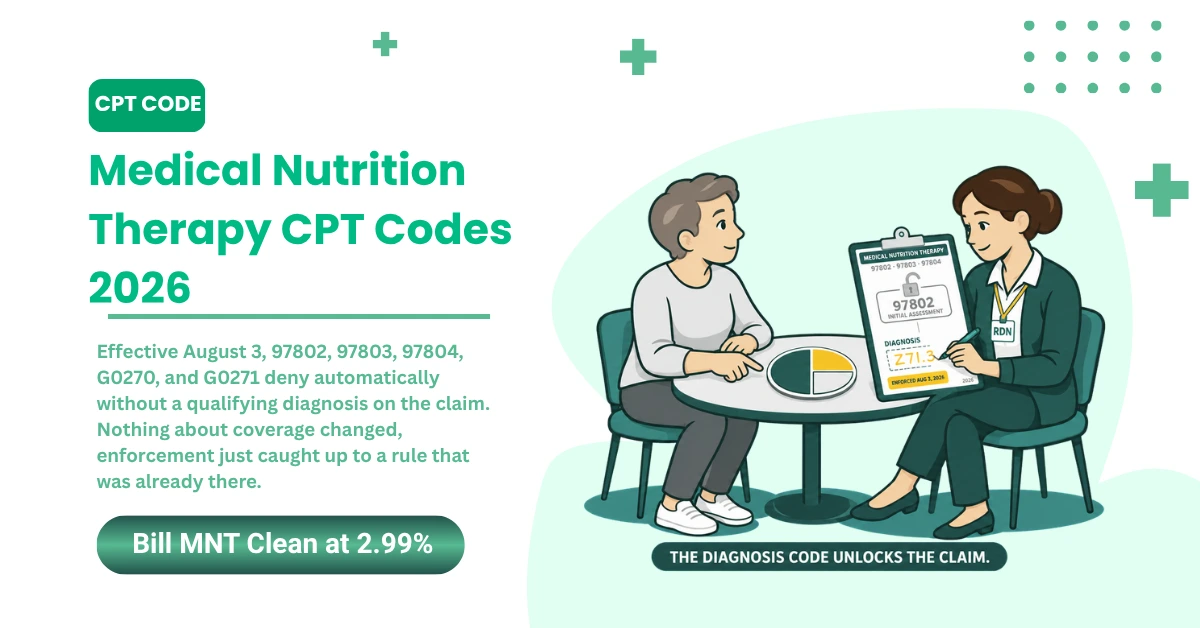




Starting August 3, 2026, claims for medical nutrition therapy get denied without a specific diagnosis code on file. That's not a new coverage rule. It's stricter enforcement of one that's been active for years, and it's already catching practices off guard.
This guide covers medical nutrition therapy CPT codes, the HCPCS alternates, who's actually allowed to bill them, and everything that changed for 2026.
Medical nutrition therapy is a diagnosis-driven nutrition service delivered by a registered dietitian nutritionist, billed under a small, specific set of codes. Get any piece of it wrong, the wrong code, a missing diagnosis, the wrong provider billing it, and the claim comes back unpaid.
What Changed for Medical Nutrition Therapy Billing in 2026
Two sources confirm the same rule this year, independently of each other. A Community First Health Plans bulletin, dated April 28, 2026, and a Texas Academy of Nutrition and Dietetics update both say it: starting August 3, 2026, claims for 97802, 97803, 97804, G0270, and G0271 get denied without a qualifying diagnosis code.
Nothing about coverage itself is changing. Medicare still limits medical nutrition therapy to diabetes, renal disease, and kidney transplant within the last 36 months. What's changing is enforcement.
Payers are checking the diagnosis field more closely than they used to, and a claim that used to slide through on a thin diagnosis pairing won't anymore.
The fix is simple to state and easy to skip under pressure. Every claim needs a qualifying ICD-10 code on its face before it goes out, tied directly to the diagnosis that justifies the visit.
Picture the ordinary case that gets caught. An RDN sees an established diabetes patient for a routine follow-up, bills 97803, and pairs it with Z71.3 alone, no diabetes code anywhere on the claim. Plenty of payers let that pass before August 3. After that date, they won't.
Miss the diagnosis, and the claim doesn't come back as a coverage denial. It comes back as a missing-diagnosis denial, the same pattern behind the CO-16 code on your remittance advice.
A denial for a missing diagnosis code is easy to prevent once you know the rule is coming. If you want a second set of eyes on your MNT claims before August, that's exactly the kind of pattern our denial management team catches before it costs you a paid claim.
The Core CPT Codes for Medical Nutrition Therapy: 97802, 97803, and 97804
Three medical nutrition therapy CPT codes cover almost every visit a registered dietitian bills. Learn these three well, and the rest of this guide is detail sitting on top of a foundation you already understand.
CPT Code 97802
97802 is the initial assessment, done face to face with a new patient, billed in 15-minute units. The visit itself covers a full nutritional workup: diet history, current eating patterns, relevant lab values, and a personalized care plan built around whatever condition triggered the referral.
Billing math: one unit covers 15 minutes, four units cover 60 minutes, six units cover 90 minutes. You need at least 8 minutes into a unit to bill for it. That's the standard midpoint rule, and it applies the same way to 97803.
97802 covers the first visit only, and this is where a lot of published guides get sloppy. Some claim the code resets every three years. That's not right.
It's an easy mistake to trace: the three-year window actually belongs to a separate rule, Medicare's lookback period for kidney transplant coverage eligibility. The reset for 97802 itself runs closer to 12 months.
A patient who hasn't been seen in about a year can reasonably get a new initial assessment. One who was in two months ago can't.
CPT Code 97803
Every follow-up visit after that initial assessment bills under 97803, in the same 15-minute units. No new math here. The line to remember: first visit is 97802, every visit after is 97803, for the life of that patient's care with your practice.
CPT Code 97804
Group sessions, two or more patients in the room together, bill differently. The unit is 30 minutes instead of 15, and the midpoint math shifts along with it: roughly 16 minutes gets you one unit, 46 minutes gets you two.
This format works well for shared education, diabetes management classes, renal diet groups, anything where the content applies broadly and patients benefit from hearing each other's questions. It doesn't work as a shortcut when a scheduled group session ends up with one patient.
If only one person shows, the visit becomes 97802 or 97803 instead, whichever matches that patient's actual stage of care. Billing it as 97804 anyway is a documentation mismatch waiting to get caught.
CPT codes themselves come from the American Medical Association's own editorial process, which is worth knowing if you ever need to trace why a code's definition changed.
HCPCS Alternates to the Core MNT Codes: G0270, G0271, and S9470
The core medical nutrition therapy CPT codes cover most visits, but two families of alternate codes step in when one of those three isn't the right fit.
HCPCS G0270 covers an individual reassessment after a second physician referral in the same calendar year, tied to a documented change in diagnosis, medical condition, or treatment regimen. It bills in the same 15-minute units as 97802 and 97803.
G0271 is the group version of the same idea, billed in 30-minute units like 97804. Both exist for one specific reason: authorizing hours beyond Medicare's standard annual allotment.
Using G0270 or G0271 instead of the core codes only makes sense once that second referral is actually on file, not before.
S9470 is a different animal. It predates the CPT codes covered in this guide, and some commercial payers and a subset of state Medicaid programs still use S9470 instead of 97802 through 97804. Medicare doesn't reimburse it at all, full stop.
A practice billing across several payer types needs to check which code family a given plan actually recognizes before the claim goes out, not after it comes back.
These codes trace back to the original CMS instruction establishing them, still the cleanest reference if you need to confirm a rule at the source.
Who Is Allowed to Bill Medical Nutrition Therapy Codes
This is where a lot of practices get tripped up, and it's a question this guide answers plainly because most published content on this topic doesn't.
Registered Dietitian and Registered Dietitian Nutritionist are the same credential under two names, RDN being the more current term. This is the credential Medicare requires, under 42 CFR 410.134, to bill 97802 through 97804.
"Nutritionist" on its own is an unregulated term. Anyone can use it regardless of training, which is exactly why it can't be the standard a payer relies on.
Nutritional Therapy Practitioner is a distinct, separate credential from the Nutritional Therapy Association, built around holistic wellness coaching. An NTP cannot diagnose, treat, or bill medical nutrition therapy codes, no matter how much overlap the two roles might look like from the outside.
Certified Nutrition Specialist is yet another distinct credential some clinical nutritionists hold, and it's not interchangeable with RDN for Medicare billing purposes either.
Physicians and nurse practitioners cannot bill these codes directly, and they cannot bill them as incident-to their own services. Medical nutrition therapy is defined in statute as an RDN-delivered service, full stop.
A practice manager evaluating whether a staff member can legally bill these codes needs to know which of these credentials that person actually holds, not just what their job title says.
Getting an RDN credentialed with each payer is a separate process from the coding rules above, and it's often where a new hire's first few claims stall out. Our credentialing team handles that paperwork at a flat $99 per payer enrollment, with no minimum volume and no long-term contract to sign.
The Academy of Nutrition and Dietetics, the RDN's own professional body, is the definitive source on where these credential lines sit.
Medicare Part B Coverage Rules for Medical Nutrition Therapy
Physician Referral and the NPI Requirement
Medicare requires a referral from the treating physician before MNT services are covered, and the referring physician's NPI has to appear on the CMS-1500 claim. A missing referring NPI is a distinct, common reason a clean-looking claim gets returned rather than paid.
Getting the referring NPI onto the claim correctly the first time avoids a resubmission cycle that eats a week or more.
Annual Hour Limits
Medicare allows three hours of MNT in the first calendar year and two hours in each year after that. Unused hours from the first year don't carry into the second.
Additional hours beyond the standard limit require a new referral from the physician documenting a change in diagnosis, medical condition, or treatment regimen, billed under G0270 or G0271 rather than the core codes.
The Dialysis Exclusion
MNT isn't separately payable for a beneficiary receiving maintenance dialysis, because the monthly dialysis maintenance codes, 90951 through 90962, already include MNT services. A practice billing both in the same calendar month for the same patient sees the MNT claim denied, not the dialysis claim.
One MNT Code Per Date of Service
Only one MNT code is payable per date of service, and a modifier can't force two through on the same day. This is the single most common structural reason an MNT claim bundles into another line rather than paying separately, and it maps directly to the CO-97 denial code on your remittance advice.
All of this traces back to Medicare's national coverage determination for MNT.
Worth knowing too: Medicare's own coverage page describes this as a benefit with no out-of-pocket cost, while the CMS claims processing manual also references deductible and coinsurance in its own instructions. Confirm cost-sharing against the specific patient's plan rather than promising zero cost across the board.
Documentation Requirements for Medical Nutrition Therapy Claims
The clinical note behind an MNT claim needs to support what you billed, not just describe that a visit happened. Five elements matter most:
- The exact date and start and stop time of the face-to-face encounter
- Assessment details: history, dietary intake, and nutritional status
- The specific nutrition goals set during the visit
- The intervention actually provided, not just planned
- Confirmation the patient received a written plan or summary
The units billed have to match the documented time, not the scheduled appointment length. On the claim itself, the CPT code goes in field 24D of the CMS-1500, alongside the ICD-10 code that justifies medical necessity.
The gap between a note that survives an audit and one that doesn't usually comes down to specifics. "Counseled patient on diet" says nothing. It doesn't prove the time, the goal, or the medical need.
Compare that to a note reading "30-minute follow-up, 2:00 to 2:30 PM, for type 2 diabetes management. Reviewed food log, identified high-carbohydrate snacking after dinner, discussed the plate method for portion control."
Add "Patient set a goal to try two lower-glycemic snack swaps this week. Billed 97803, two units," and that version justifies every unit on the claim without anyone having to guess.
Thin documentation and a missing diagnosis code are close cousins as denial causes, which is exactly how MedSole prevents recurring denials from turning into a pattern instead of a one-off.
Telehealth Billing for Medical Nutrition Therapy in 2026
The 2026 Telehealth Extension
The sequence here is the newsworthy part. Medicare telehealth flexibilities technically lapsed on January 30, 2026, during a brief federal funding gap.
Congress then passed H.R. 7148, the Consolidated Appropriations Act, 2026, and the President signed it into law on February 3, 2026, becoming Public Law 119-75. The law retroactively covered the lapse, so no claim from that window was actually left uncovered.
The law also extended Medicare telehealth flexibilities through December 31, 2027. That's the date to hold onto: telehealth-delivered MNT stays billable under the current rules through the end of that year.
Place of Service Codes for Virtual MNT Visits
Telehealth delivered somewhere other than the patient's home uses POS 02. At-home telehealth uses POS 10 instead. Per HHS's own telenutrition billing table, 97802, 97803, and 97804 all carry permanent telehealth coverage, while the related diabetes self-management training codes, 98960 through 98962, don't.
For a fuller breakdown of how place of service coding rules affect reimbursement across settings, that guide covers the facility-versus-non-facility rate difference in detail.
Telehealth Modifiers
Modifier 95 flags synchronous audio and video, the modifier most payers expect by default. Audio-only delivery uses modifier 93 instead, applied when the patient can't or doesn't use video, and this needs to be documented in the record, not assumed.
Modifier FR covers the hybrid or general-supervision scenario at a rural health clinic or federally qualified health center. One modifier is worth ruling out entirely: GT, retired for professional Medicare claims back in 2018, shouldn't appear on an MNT claim in 2026.
No single modifier convention covers every payer. Confirming the specific payer's requirement before the first virtual visit saves a denial later.
Commercial Insurance and Medicaid Coverage for Medical Nutrition Therapy
Commercial and Employer-Sponsored Plans
Commercial insurance treats these medical nutrition therapy CPT codes very differently from Medicare. There's no single standard across commercial payers the way there is with Medicare. Some plans cover MNT under preventive benefits tied to the Affordable Care Act, and the CPT code accepted there can differ from the core MNT set, a distinction covered fully in the next section.
Two patients with the same diagnosis, sitting in the same waiting room, can carry entirely different rules depending on which card is in their wallet. One plan pays 97803 on a straightforward diabetes diagnosis.
The plan next door wants a prior auth number on file first, and denies the same claim without it, diagnosis and documentation identical in both cases. That's not a documentation failure. It's two different contracts doing two different things.
Some employer-sponsored plans recognize a broader diagnosis list than Medicare's diabetes-and-renal-disease standard, including obesity and eating disorders. Many commercial plans require prior authorization before the first visit, not after, and treat the authorization as a condition of payment rather than a formality.
Medicaid Coverage Varies by State
Nutrition counseling doesn't appear on the federal list of either mandatory or optional Medicaid benefits. That's exactly why coverage looks completely different from one state to the next. Some states cover MNT broadly for registered dietitians in private practice.
Others recognize the service only in specific settings, or not at all for an independently practicing RDN outside a hospital or clinic. A practice billing Medicaid patients in more than one state can't assume the rules from one state apply in the next.
The state's own Medicaid provider manual is the only reliable source for that state's specific rule, not a national billing guide, and not what worked in a different state last year. When a Medicaid plan denies an MNT claim with no clear reason, calling the state's provider line directly usually resolves it faster than guessing and resubmitting.
ICD-10 Diagnosis Codes That Support Medical Nutrition Therapy Billing: A Revenue-Optimized Pairing Reference
Z71.3: The Core Diagnosis Code for Dietary Counseling
Z71.3 is the diagnosis code most directly tied to dietary counseling and surveillance, and the one most frequently paired with 97802 and 97803 across the payer bulletins reviewed for this guide.
It typically needs to appear alongside a substantive medical diagnosis, such as a specific diabetes or cardiovascular risk code, rather than standing alone as the only code on the claim. Coverage is generally tied to management of a diagnosed condition, not counseling in the abstract.
Malnutrition and Nutrient-Deficiency Codes
|
Code |
Description |
|
E40 |
Kwashiorkor |
|
E41 |
Nutritional marasmus |
|
E42 |
Marasmic kwashiorkor |
|
E43 |
Unspecified severe protein-calorie malnutrition |
|
E44.0 / E44.1 |
Moderate / mild protein-calorie malnutrition |
|
E45 |
Retarded development following malnutrition |
|
E46 |
Unspecified protein-calorie malnutrition |
Adjacent to this range sits E50 through E64 for vitamin and mineral deficiencies, and D50 through D53 for nutritional anemias, iron deficiency, B12 deficiency, and folate deficiency anemia. Any of these can justify MNT when the clinical picture actually supports it.
Food Insecurity and Diet-Related Codes
A code family almost no other guide on this topic covers: R63.8 for symptoms concerning food and fluid intake, R63.30 for unspecified feeding difficulties, Z72.4 for inappropriate diet and eating habits, and Z59.41 for food insecurity, a social determinants of health code getting more attention as payers focus on SDOH documentation.
These codes describe a concern, not necessarily a condition that alone qualifies for MNT reimbursement. Pairing them with a substantive diagnosis remains the safer documentation practice.
For diagnosis-pairing questions beyond what's covered here, the AAPC coding reference is the standard place practices verify a specific pairing before billing it.
Medical Nutrition Therapy vs. the Benefits It Gets Confused With
Before drawing these lines, it helps to restate what MNT actually is. An academic definition of MNT from UTHealth Houston describes it the same way this guide does: a clinical, diagnosis-driven nutrition service delivered by a registered dietitian nutritionist, not a wellness or lifestyle service.
MNT vs. Diabetes Self-Management Training
Diabetes Self-Management Training, billed under G0108 for individual sessions and G0109 for group sessions, is broader diabetes education that can be delivered by other qualified educators, not exclusively an RDN.
Medicare won't pay for MNT and DSMT on the same date of service for the same patient, though a patient can receive both across the same year when medically appropriate.
MNT vs. Preventive Nutrition Counseling Under the ACA
Some ACA-compliant plans cover nutrition counseling as a preventive benefit at no cost to the patient, tied to elevated BMI or cardiovascular risk factors rather than a diagnosed disease. This preventive pathway sometimes uses a different code, such as one from the 99401 through 99404 range, rather than the core MNT codes.
The practical distinction: MNT treats a diagnosed condition. Preventive counseling addresses risk before a diagnosis exists.
MNT vs. the Medicare Diabetes Prevention Program
Here's a fact rarely stated plainly: Medicare doesn't cover medical nutrition therapy for prediabetes. A patient with prediabetes may instead qualify for the separate Medicare Diabetes Prevention Program, a distinct benefit built around delaying or preventing a full diabetes diagnosis, not billed under the MNT code family at all.
MNT vs. Intensive Behavioral Therapy for Obesity
Intensive Behavioral Therapy for obesity, billed under G0447 for a beneficiary with a BMI of 30 or higher, is a primary-care preventive benefit, not a dietitian-specific one, and it typically gets billed incident to a physician rather than under an RDN's own NPI.
The visit schedule is specific: weekly visits in month one, twice-monthly visits in months two through six, then monthly visits in months seven through twelve, but only if the patient lost at least 3 kilograms in the first six months.
A combined session cap of 22 applies across G0447 and its group equivalent, G0473, tracked through Medicare's own claims system.
MNT vs. Enteral and Parenteral Nutrition Therapy
A fifth benefit worth naming, since almost no other guide on this topic covers it with any depth. Enteral and parenteral nutrition therapy, covered under its own separate Medicare coverage determination, applies to tube feeding and IV nutrition delivered as durable medical equipment, billed under a separate HCPCS code range entirely, not the CPT codes covered in this guide.
This affects home health, oncology, and post-surgical GI patients far more often than the outpatient dietitian visits the rest of this guide covers.
Common Reasons Medical Nutrition Therapy Claims Get Denied
Most denials tied to medical nutrition therapy CPT codes trace back to a handful of preventable patterns, pulling together what's already covered above plus two that haven't come up yet:
- A missing or non-qualifying diagnosis code on the claim
- Two MNT codes billed for the same patient on the same date of service
- MNT billed in the same calendar month as maintenance dialysis
- The claim submitted under a physician's NPI as an incident-to service, rather than the RDN's own NPI, which is a structural mismatch since MNT can't be billed incident-to
- The provider isn't enrolled or credentialed with that specific payer, even if credentialed elsewhere
Most of these are preventable with a pre-submission check, not a post-denial fix.
Frequently Asked Questions About Medical Nutrition Therapy Billing
What is the difference between CPT 97802 and 97803?
These are the two medical nutrition therapy CPT codes practices mix up most often. 97802 covers the initial individual assessment only, billed once at the start of care. 97803 covers every individual follow-up visit after that. Both bill in 15-minute units. The distinction is about the stage of care, not the content of the visit.
Can a nurse or nurse practitioner bill for medical nutrition therapy?
No, not directly. Medicare defines MNT as a service furnished by a registered dietitian nutritionist or a qualified nutrition professional under 42 CFR 410.134. A nurse or nurse practitioner may refer a patient for MNT, but can't bill the MNT codes themselves, and the service can't be billed incident to their own NPI.
Can a certified diabetes educator bill medical nutrition therapy codes?
Only if that educator also holds the RDN credential required to bill under Medicare's MNT rules. Diabetes education on its own, billed under G0108 or G0109, is a separate benefit from MNT and doesn't require the same credential.
What is the CPT code for a referral to a nutritionist?
There's no separate referral code. The physician's referral is documentation supporting the claim, not a billable service itself. From there, the dietitian bills 97802 for the first visit and 97803 for every visit after.
Is medical nutrition therapy the same thing as nutritional counseling?
Not exactly. Medical nutrition therapy is the clinical, diagnosis-driven version of nutrition counseling, delivered by a credentialed provider and billed under 97802 through 97804. General nutrition counseling can be broader, doesn't always require a diagnosis or a referral, and isn't automatically covered by insurance the way MNT can be.
Does Medicare cover medical nutrition therapy for prediabetes?
No. Medicare's MNT benefit is limited to diabetes, chronic kidney disease, and post-kidney-transplant care. A patient with prediabetes may instead qualify for the separate Medicare Diabetes Prevention Program, which isn't billed under the MNT codes.
How many units can I bill for a 60-minute MNT session?
A 60-minute individual session under 97802 or 97803 bills as four 15-minute units. For 97804, a 60-minute group session bills as two 30-minute units instead, since that code uses a 30-minute increment rather than 15.
If a patient switches insurance, can I bill 97802 again as a new initial visit?
Generally no. 97802 is tied to the initial assessment with your practice, not to which insurance plan is active on a given date. Billing 97802 again for an established patient because their coverage changed doesn't reflect a new initial visit and risks a denial or an audit finding.
What ICD-10 code is used most often with medical nutrition therapy?
Z71.3, dietary counseling and surveillance, appears most consistently across the payer guidance reviewed for this piece, typically paired with the substantive diagnosis that justifies the visit, such as a specific diabetes or chronic kidney disease code.
Is nutritional counseling considered preventive care?
Sometimes. Under the Affordable Care Act, nutrition counseling can qualify as a zero-cost preventive service for adults with elevated BMI or cardiovascular risk factors. Outside that specific pathway, nutrition services delivered to manage an already-diagnosed condition fall under medical nutrition therapy instead, with its own separate coverage rules.
Getting Medical Nutrition Therapy Billing Right
The codes themselves are simple: three CPT codes and a small set of HCPCS alternates. Where practices actually lose revenue is in the rules around who can bill them, which diagnosis justifies them, and how payers differ.
The August 2026 diagnosis-enforcement update makes this a good moment for any practice billing these codes to double-check its own claim habits before a thin diagnosis pairing becomes a denial pattern.
MedSole RCM bills across dozens of specialties, nutrition and dietetics included. The coding rules above are one piece of running a nutrition practice on insurance.
If tracking payer variance across dozens of plans is taking more of your week than it should, our medical billing team handles this for practices nationwide, at a flat 2.99% of collections, among the most affordable full-service rates in the United States.
Credentialing is available separately at $99 per payer, with no minimum volume required.