



FY 2026 ICD-10-CM remains in effect through September 30, 2026. CMS has posted FY 2027 ICD-10-CM files and guidelines for use beginning October 1, 2026. Always apply the code set and guidelines effective for the patient's date of service or discharge.
R09.02, Hypoxemia, is the ICD-10-CM code most commonly reached when the provider documents hypoxia or hypoxemia without a more definitive diagnosis that explains the finding. If respiratory failure is documented, code selection moves to category J96 and depends on acuity and whether hypoxia, hypercapnia, or both are documented.
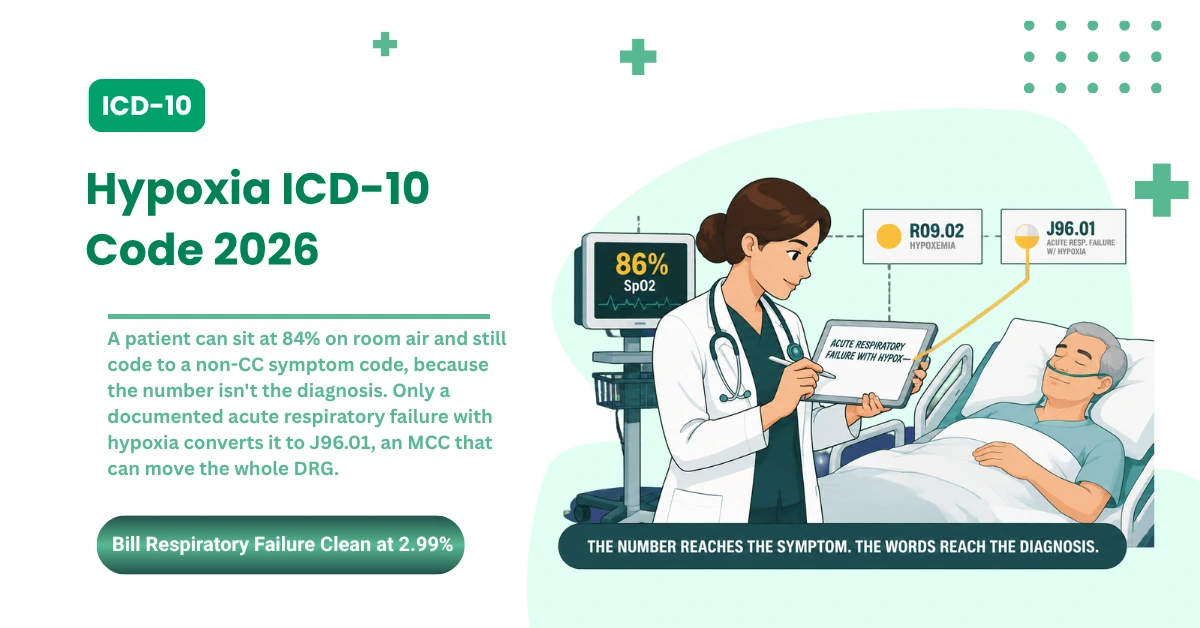
The first coding question is therefore not "How low was the oxygen saturation?" It is "What diagnosis did the provider document?" ICD-10-CM code assignment is based on the provider's diagnostic statement. Clinical values such as SpO2, PaO2, PaCO2, oxygen flow, or ventilatory support help establish clinical support and may justify a CDI query, but they do not let a coder independently diagnose respiratory failure.
Quick answer: hypoxia vs respiratory failure
|
Documentation in the record |
Common ICD-10-CM direction |
|
Hypoxia or hypoxemia, no respiratory failure documented |
R09.02 Hypoxemia, unless a definitive diagnosis makes the symptom integral |
|
Acute respiratory failure with hypoxia |
J96.01 |
|
Chronic respiratory failure with hypoxia |
J96.11 |
|
Acute and chronic respiratory failure with hypoxia |
J96.21 |
|
Respiratory failure with hypoxia, acuity not documented |
J96.91 |
|
Long-term dependence on supplemental oxygen |
Add Z99.81 when supported |
|
Provider links respiratory failure to a procedure |
Review J95.821/J95.822 rather than automatically assigning J96 |
This guide explains R09.02, the full J96 family, postprocedural respiratory failure, oxygen dependence, sequencing, documentation, common denial patterns, and the payment consequences of coding respiratory failure correctly. It also corrects a common sleep-coding error: G47.36 is officially described as sleep related hypoventilation in conditions classified elsewhere; it is not a generic code for nocturnal hypoxemia.
What Is the ICD-10 Code for Hypoxia? R09.02 Hypoxemia Explained
R09.02, Hypoxemia, is the ICD-10-CM code commonly reached for documented hypoxia or hypoxemia when no more definitive diagnosis supersedes the symptom. It is listed in the CDC ICD-10-CM browser as a Chapter 18 symptom code under Symptoms, signs and abnormal clinical and laboratory findings.
Guidelines Section I.B.4 and I.B.5 explain why hypoxia gets a symptom code instead of a diagnosis code. Signs and symptoms are coded when no related definitive diagnosis has been established. Once a definitive diagnosis is confirmed, symptoms routinely associated with it are not coded separately. That's the same logic behind the hypoxemia ICD-10 code: a symptom stands alone only until a diagnosis explains it, and hypoxia is no exception.
R09.02 quick facts. R09.02 is a billable Chapter 18 symptom code under R09.0, Asphyxia and hypoxemia. It is not a CC or MCC. In inpatient coding, POA reporting rules apply when the code is reportable. Always review the current Tabular List notes before final code assignment.
Unspecified hypoxia ICD-10: why there is no R09.02 sub-code
There's no separate unspecified hypoxia ICD-10 code. "Hypoxia, unspecified" and "hypoxia NOS" both resolve to the same hypoxia ICD-10 code, R09.02, Hypoxemia, in the Alphabetic Index. R09.02 already functions as the unspecified code, so don't search for an R09.02x extension, because none exists. The only sub-codes under R09.0 are R09.01, Asphyxia, and R09.02, Hypoxemia.
That answers the question right behind it: the ICD-10 code for hypoxia unspecified is R09.02, regardless of whether the chart says "unspecified," "NOS," or just "hypoxia."
Are hypoxia and hypoxemia the same?
Clinically, no. Hypoxemia means low oxygen in arterial blood, measured by SpO2 or PaO2. Hypoxia means inadequate tissue oxygenation, a broader and more serious problem than a single lab value. NCBI StatPearls draws this distinction clearly.
For ICD-10-CM purposes, though, the two terms share one code. Both "Hypoxia" and "Hypoxemia" index to R09.02. Documentation of either term supports R09.02 on its own. Neither term, by itself, supports a code from category J96.
Acute hypoxia ICD-10 and chronic hypoxia ICD-10: R09.02 has no acuity axis
R09.02 doesn't split by duration. Acute hypoxia ICD-10, acute hypoxemia ICD-10, chronic hypoxia ICD-10, and chronic hypoxemia all land on the same code, R09.02, unless the provider documents respiratory failure. Once that's documented, the code changes: J96.01, Acute respiratory failure with hypoxia, for acute; J96.11, Chronic respiratory failure with hypoxia, for chronic; or J96.21, Acute and chronic respiratory failure with hypoxia, for both.
Duration of oxygen use doesn't convert R09.02 into J96.11 on its own. Only a documented diagnosis of chronic respiratory failure does that.
R09.02 can be a first-listed diagnosis in outpatient encounters where no definitive diagnosis has been established, under Guidelines Section IV. Whether it can serve as a principal diagnosis on an inpatient claim is a different question, governed by Section II, and covered fully in the sequencing section below.
R09.02 or J96? The First Question That Decides the Hypoxia ICD-10 Code
The first question separating R09.02 from the J96 family is whether the provider documented respiratory failure. A low oxygen value by itself does not establish a J96 diagnosis. When a definitive diagnosis is documented, also apply the normal ICD-10-CM rules for symptoms that are routinely associated with that diagnosis.
Hypoxia ICD-10 decision path
- 1. Is respiratory failure documented by the provider? If no, consider R09.02 or the documented definitive diagnosis. If yes, continue.
- 2. Is the respiratory failure linked to a procedure? If yes, review J95.821 or J95.822 and the Tabular instructions; do not assume every postoperative oxygen requirement is postprocedural respiratory failure.
- 3. What is the acuity? Acute = J96.0-; chronic = J96.1-; acute and chronic = J96.2-; unspecified acuity = J96.9-.
- 4. What type is documented? With hypoxia = type-specific code ending in 1; with hypercapnia = type-specific code ending in 2; neither specified = code ending in 0.
- 5. Are both hypoxia and hypercapnia documented? Do not force the case into an unspecified-type code. The Index supports reporting both applicable type-specific respiratory-failure codes when both conditions are documented for the same episode; follow current organizational policy and any applicable Coding Clinic guidance.
- 6. Is long-term supplemental oxygen dependence documented? Add Z99.81 when the status code is supported and reportable.
- 7. Is ARDS documented? J80 is a separate diagnosis and is listed in the J96 Excludes1 instructions. Resolve conflicting documentation rather than routinely reporting J80 with J96.
What the provider must document for J96.01 instead of R09.02
The coder needs a named diagnosis, not a number. The FY 2026 and posted FY 2027 ICD-10-CM Official Guidelines state that code assignment is based on the provider's diagnostic statement rather than the clinical criteria used to establish that diagnosis.
Documentation that supports J96.01:
- "Acute respiratory failure with hypoxia secondary to community-acquired pneumonia, requiring 4 L nasal cannula to maintain SpO2 above 90%."
- "Acute hypoxic respiratory failure, PaO2 52 mmHg on room air, started on high-flow oxygen."
Documentation that supports a symptom code rather than an inferred respiratory-failure diagnosis:
- "Hypoxia, SpO2 86%."
- "Desaturation to 88% overnight, oxygen applied."
- "Low O2 sat, will monitor."
If the clinical picture appears consistent with respiratory failure but the provider documents only hypoxia, a compliant query may be appropriate. The coder should not infer respiratory failure from saturation, flow rate, device, or ABG values alone.
A downgrade from J96.01 to R09.02 may change the MS-DRG when J96.01 supplied severity that is not otherwise present. It will not automatically change every case, because the final DRG depends on the complete diagnosis and procedure set.
Acute Respiratory Failure with Hypoxia ICD-10 (J96.01)
J96.01 is Acute respiratory failure with hypoxia. It is billable and is an MCC under the FY 2026 MS-DRG system when reported as a qualifying secondary diagnosis. The diagnosis must be documented by the provider; low oxygen alone is not enough.
The J96 category carries Excludes1 instructions that include ARDS (J80), postprocedural respiratory failure (J95.82-), respiratory arrest, and certain newborn/perinatal respiratory-failure conditions. Review the current Tabular List rather than relying on a memorized list when these conditions coexist.
Acute hypoxic respiratory failure ICD-10 terminology
"Acute hypoxic respiratory failure" and "acute hypoxemic respiratory failure" are commonly used clinical phrases for a condition coded to J96.01 when the documentation supports acute respiratory failure with hypoxia. The official ICD-10-CM descriptor is Acute respiratory failure with hypoxia.
When to use J96.01 and when not to
|
Situation |
Coding direction |
Why |
|
Acute respiratory failure with hypoxia documented |
J96.01 |
Acuity and hypoxic type are both stated |
|
Acute respiratory failure, type not stated |
J96.00 |
Do not infer hypoxia from a saturation value |
|
Acute respiratory failure with hypoxia and hypercapnia |
J96.01 plus J96.02 when both types are documented and reportable |
Do not collapse documented types into J96.00 |
|
Acute and chronic respiratory failure with hypoxia |
J96.21 |
The chronic baseline changes the acuity category |
|
Provider-linked acute postprocedural respiratory failure |
J95.821 |
Review the postprocedural code and J96 Excludes1 instructions |
|
ARDS documented |
J80 |
Resolve the J96 Excludes1 conflict rather than routinely coding both |
|
Hypoxia only, no respiratory failure diagnosis |
R09.02 when otherwise appropriate |
A coder cannot create the respiratory-failure diagnosis |
Clinical indicators can support a query, but they are not coding thresholds
Values such as a low PaO2, low room-air SpO2, reduced PaO2/FiO2 ratio, acute acidemia with elevated PaCO2, increased work of breathing, and escalation to high-flow oxygen, NIV, or invasive ventilation may support clinical validation or a CDI query. No single value is an ICD-10-CM rule that allows a coder to assign J96.01 without the provider's diagnosis.
Respiratory Failure ICD-10 Codes: The Full J96 Family
Category J96 is organized on two axes: acuity and type. The acuity branches are acute, chronic, acute and chronic, and unspecified. The type branches are unspecified whether with hypoxia or hypercapnia, with hypoxia, and with hypercapnia.
|
Code |
Official descriptor |
Use when |
|
J96.00 |
Acute respiratory failure, unspecified whether with hypoxia or hypercapnia |
Acute failure is documented but type is not |
|
J96.01 |
Acute respiratory failure with hypoxia |
Acute failure with hypoxia is documented |
|
J96.02 |
Acute respiratory failure with hypercapnia |
Acute failure with hypercapnia is documented |
|
J96.10 |
Chronic respiratory failure, unspecified whether with hypoxia or hypercapnia |
Chronic failure is documented but type is not |
|
J96.11 |
Chronic respiratory failure with hypoxia |
Chronic failure with hypoxia is documented |
|
J96.12 |
Chronic respiratory failure with hypercapnia |
Chronic failure with hypercapnia is documented |
|
J96.20 |
Acute and chronic respiratory failure, unspecified whether with hypoxia or hypercapnia |
Both acute and chronic failure are documented but type is not |
|
J96.21 |
Acute and chronic respiratory failure with hypoxia |
Acute decompensation on chronic respiratory failure with hypoxia is documented |
|
J96.22 |
Acute and chronic respiratory failure with hypercapnia |
Acute and chronic respiratory failure with hypercapnia is documented |
|
J96.90 |
Respiratory failure, unspecified, unspecified whether with hypoxia or hypercapnia |
Respiratory failure is documented without acuity or type |
|
J96.91 |
Respiratory failure, unspecified, with hypoxia |
Hypoxic respiratory failure is documented without acuity |
|
J96.92 |
Respiratory failure, unspecified, with hypercapnia |
Hypercapnic respiratory failure is documented without acuity |
Use the current year's CMS CC/MCC tables for severity assignment. For FY 2026, key examples include J96.01 as an MCC, J96.11 as a CC, and J96.21 as an MCC. Severity designations are fiscal-year dependent and should not be copied forward without checking the applicable IPPS tables.
J96.11 vs J96.21: chronic vs acute and chronic respiratory failure with hypoxia
J96.11 is Chronic respiratory failure with hypoxia. J96.21 is Acute and chronic respiratory failure with hypoxia. A patient being on home oxygen does not, by itself, prove chronic respiratory failure. The provider must document the chronic respiratory-failure diagnosis, and an acute-on-chronic code additionally requires the acute component to be documented.
|
Code |
Clinical documentation |
FY 2026 severity example |
|
J96.11 |
Stable chronic respiratory failure with hypoxia |
CC |
|
J96.21 |
Acute decompensation on documented chronic respiratory failure with hypoxia |
MCC |
|
R09.02 |
Chronic hypoxemia without documented respiratory failure |
Non-CC |
A baseline such as home oxygen at 2 L with a new requirement for 6 L may be a useful clinical indicator, but the coder still needs the provider to identify the condition as acute and chronic respiratory failure when that is the diagnosis.
What is the ICD-10 code for persistent hypoxia?
There is no separate code titled "persistent hypoxia." If persistent or chronic low oxygen is documented without respiratory failure and no more specific diagnosis supersedes the symptom, R09.02 may apply. Chronic respiratory failure with hypoxia is J96.11 only when that diagnosis is documented. Z99.81 can be added when dependence on supplemental oxygen is documented and reportable.
Acute respiratory failure without hypoxia ICD-10
There is no code titled "acute respiratory failure without hypoxia." If acute respiratory failure is documented but the type is not, J96.00 is the unspecified-type code. If hypercapnia is documented, J96.02 applies. If both hypoxia and hypercapnia are documented, both type-specific codes may be reportable rather than defaulting to J96.00.
J96.90, J96.91 and J96.92 when acuity is not documented
These codes apply when respiratory failure is documented but the provider does not establish whether it is acute, chronic, or acute and chronic. A query for acuity may be appropriate when the clinical record supports greater specificity. Never select an acute code simply to obtain a higher severity designation.
Acute Respiratory Failure with Hypercapnia ICD-10: J96.02, J96.12 and J96.22
J96.02 is Acute respiratory failure with hypercapnia, J96.12 is Chronic respiratory failure with hypercapnia, and J96.22 is Acute and chronic respiratory failure with hypercapnia. "Hypercapnic respiratory failure" and "type 2 respiratory failure" are common clinical phrases, but the code assignment still follows the documented acuity and type.
Elevated PaCO2 and acidemia can support the diagnosis clinically, especially in acute disease, but they do not replace the provider's diagnostic statement. When the provider documents respiratory failure with both hypoxia and hypercapnia, do not substitute an unspecified-type J96 code merely because two types are present. The Index supports assigning the applicable hypoxic and hypercapnic codes when both are documented; check current organizational policy and any applicable Coding Clinic guidance for the encounter.
Respiratory Insufficiency ICD-10: Do Not Treat It as Respiratory Failure
"Respiratory insufficiency" is not automatically synonymous with "respiratory failure." Code the condition actually documented and use the current Alphabetic Index and Tabular List to select the code. Do not assign a J96 respiratory-failure code merely because oxygen, NIV, or other respiratory support was used.
If the clinical record appears to support respiratory failure but the provider documents only "respiratory insufficiency," "distress," "desaturation," or "hypoxia," a compliant clarification query may be appropriate. R06.89, Other abnormalities of breathing, and R09.02, Hypoxemia, are neighboring symptom codes that may be relevant depending on the exact documented term and Index path. R06.02 is shortness of breath and R06.03 is acute respiratory distress; neither term is the same diagnosis as ARDS or respiratory failure.
Oxygen Dependence ICD-10 (Z99.81): When to Add It
Z99.81 is Dependence on supplemental oxygen. It is a status code and does not replace the underlying diagnosis. When the record supports both conditions, it may be reported with chronic respiratory failure, COPD, hypoxemia, or another underlying condition according to normal coding rules.
Useful documentation includes whether oxygen is continuous, nocturnal, or exertional; the prescribed flow or device; and the condition driving the oxygen requirement. Z99.11 is Dependence on respirator [ventilator] status and should not be confused with Z99.81.
Medicare home oxygen criteria are coverage rules, not ICD-10 coding thresholds
CMS National Coverage Determination 240.2 defines qualifying oxygen-test criteria for Medicare coverage. Under Group I, examples include an arterial PO2 at or below 55 mm Hg or oxygen saturation at or below 88% at rest on room air, with additional rules for sleep and exercise testing. Group II covers PO2 of 56-59 mm Hg or saturation of 89% when specified findings such as dependent edema suggesting CHF, pulmonary hypertension/cor pulmonale, or qualifying erythrocythemia are present.
Those values determine coverage for home oxygen, not whether the diagnosis is R09.02 or J96.11. ICD-10-CM code selection still follows the documented diagnosis. For DME coverage, document the qualifying test, testing condition, date, and treating practitioner's order in accordance with the current NCD and contractor requirements.
Nocturnal Hypoxemia ICD-10: Do Not Mislabel G47.36
A frequent coding mistake is to call G47.36 "sleep related hypoxemia." That is not its official descriptor. CMS lists G47.36 as Sleep related hypoventilation in conditions classified elsewhere.
G47.36 should therefore not be used as a generic code for an overnight desaturation or for every patient who becomes hypoxemic during sleep. The documentation needs to support the sleep-related hypoventilation diagnosis and the underlying condition classified elsewhere, with code selection verified in the current Alphabetic Index and Tabular List.
If a record says only "nocturnal hypoxemia," "overnight desaturation," or reports low oximetry values, do not automatically convert that finding into G47.36 or sleep apnea. Determine what diagnosis the provider actually established. R09.02 may be relevant for documented hypoxemia when no more specific diagnosis applies, while a documented sleep disorder should be coded to the appropriate G47 code.
Long-term nocturnal oxygen use may also support Z99.81 when dependence on supplemental oxygen is documented, but the status code does not establish the sleep diagnosis.
When Hypoxia Is Not R09.02
R09.02 is not a substitute for a more specific documented condition. Brain injury from anoxia, perinatal hypoxic conditions, respiratory arrest, ARDS, and postprocedural respiratory failure each have separate code paths.
Cerebral or anoxic brain injury and perinatal hypoxia
G93.1 is Anoxic brain damage, not elsewhere classified. Use it when that diagnosis is documented and the Index/Tabular support the assignment; do not assume every mention of "cerebral hypoxia" is automatically G93.1 without checking the documented condition. Perinatal and newborn hypoxic conditions use Chapter 16 code families rather than R09.02 when the age-specific condition is documented. For example, intrauterine hypoxia is reported from category P20 when supported.
Respiratory arrest is not respiratory failure
R09.2 is Respiratory arrest. It is not interchangeable with hypoxia or respiratory failure. Category J96 contains an Excludes1 instruction for respiratory arrest, so conflicting documentation should be resolved before coding.
Postoperative hypoxia versus postprocedural respiratory failure
Postoperative hypoxia or hypoxemia does not automatically equal a postprocedural complication. If the provider documents only hypoxemia, R09.02 may be appropriate when no more specific diagnosis supersedes it. If the provider establishes a causal relationship between the procedure and respiratory failure, J95.821 (Acute postprocedural respiratory failure) or J95.822 (Acute and chronic postprocedural respiratory failure) may apply.
Timing alone is not enough. A patient who needs oxygen after surgery does not automatically have postprocedural respiratory failure. The provider must document the diagnosis and relationship to the procedure.
ARDS (J80) and the J96 Excludes1 instruction
J80 is Acute respiratory distress syndrome. Category J96 lists J80 in an Excludes1 instruction. If both ARDS and a J96 respiratory-failure diagnosis appear in the record, do not routinely report both without resolving the coding conflict. Review the Tabular List and query the provider when the documentation is clinically or diagnostically unclear.
The Berlin definition uses timing, imaging, origin of edema, oxygenation, and PEEP/CPAP criteria to define ARDS clinically. Those criteria help establish the diagnosis; the coder still reports the condition documented by the provider under ICD-10-CM rules.
Sequencing Rules: When Respiratory Failure Is Principal and When It Is Secondary
For inpatient claims, acute or acute-and-chronic respiratory failure may be the principal diagnosis when it is established after study as chiefly responsible for the admission. Chapter-specific sequencing rules take precedence. If respiratory failure develops after admission, or is present on admission but is not chiefly responsible, it may be reported as a secondary diagnosis when it meets reporting criteria.
When respiratory failure is present with another acute condition, such as pneumonia or COPD exacerbation, there is no universal rule that respiratory failure must always be first or always be second. The circumstances of admission decide. If two diagnoses equally meet the definition of principal diagnosis and no chapter-specific rule directs sequencing, the general principal-diagnosis rules may apply.
Outpatient and observation encounters
Outpatient settings use a first-listed diagnosis, not an inpatient principal diagnosis. The ICD-10-CM outpatient guidelines direct coders not to code diagnoses documented as probable, suspected, questionable, rule out, or similar uncertain terms. Instead, report the highest degree of certainty for that encounter, which may be a symptom such as hypoxemia when no definitive diagnosis has been established.
Chapter-specific rules that can override respiratory-failure sequencing
- Sepsis/severe sepsis: R65.2- is not assigned merely because sepsis and organ dysfunction coexist. The organ dysfunction must be associated with the sepsis. If severe sepsis is present on admission and meets the principal-diagnosis definition, the systemic infection is sequenced first, followed by the R65.2- code and code(s) for associated organ dysfunction.
- COVID-19: When the encounter is for an acute respiratory manifestation of confirmed COVID-19, U07.1 is sequenced first under the COVID-19 guideline, with the respiratory manifestation such as J12.82 or J96.0- coded additionally as supported.
- Obstetrics, poisoning, and other chapters: Follow any chapter-specific sequencing instruction before applying the general respiratory-failure rule.
The practical documentation goal is simple: identify what occasioned the admission, what was present on admission, what developed later, and how the respiratory failure relates to the other acute condition.
What to Document So the Coder Can Assign the Right Code Without an Avoidable Query
A defensible respiratory-failure diagnosis is stronger when the note clearly states the diagnosis, acuity, type, likely cause, relevant clinical evidence, and treatment. These elements help coding, CDI, clinical validation, and appeals without turning a clinical threshold into a coding rule.
Six documentation elements to capture when clinically appropriate
- 1. Diagnosis term: State "respiratory failure" when that is the diagnosis. Do not expect the coder to infer it from "hypoxia," "distress," or "desaturation."
- 2. Acuity: Acute, chronic, or acute and chronic.
- 3. Type: With hypoxia, with hypercapnia, or both when both are clinically present.
- 4. Cause and relationship: Document the condition causing or contributing to the failure when known.
- 5. Clinical evidence: Include meaningful values such as SpO2/PaO2, PaCO2/pH, respiratory rate, work of breathing, imaging, and baseline status.
- 6. Treatment and response: Document oxygen device/flow or FiO2, escalation from baseline, NIV/intubation when used, and the patient's response.
Consistency across the record improves defensibility. The diagnosis does not need to be mechanically copied into every note, but conflicting, isolated, or unexplained documentation is more vulnerable to query or clinical-validation review.
Example documentation phrases
|
Code direction |
Example wording |
|
J96.01 |
"Acute respiratory failure with hypoxia due to [cause]; PaO2 [value] on room air; started on [device/flow]." |
|
J96.02 |
"Acute respiratory failure with hypercapnia due to [cause]; PaCO2 [value], pH [value]; started on NIV." |
|
J96.11 |
"Chronic respiratory failure with hypoxia secondary to [cause]; on home oxygen [flow] L; stable at baseline." |
|
J96.21 |
"Acute and chronic respiratory failure with hypoxia; baseline oxygen [flow] L, now requiring [flow/device]." |
|
J95.821 |
"Acute postprocedural respiratory failure following [procedure], clinically attributed to [cause/relationship]." |
|
R09.02 |
"Hypoxemia, SpO2 [value] on room air; respiratory failure not diagnosed; evaluation ongoing." |
|
Z99.81 |
"Dependent on supplemental oxygen, [flow/device], [continuous/nocturnal/exertional]." |
These examples are documentation models, not mandatory wording. The final diagnosis must reflect the provider's clinical judgment.
Compliant CDI query example
A query should present relevant indicators and clinically reasonable choices without steering the provider toward the highest-paying diagnosis. For example:
Clinical indicators: SpO2 84% on room air on arrival, PaO2 51 mmHg, respiratory rate 28, 6 L nasal cannula with improvement to 93%. Existing documentation states "hypoxia."
Clarification: Based on your clinical judgment, please clarify the condition being treated: acute respiratory failure with hypoxia; hypoxemia without respiratory failure; another diagnosis (specify); or unable to determine.
Follow the current AHIMA/ACDIS compliant query practice recommendations and your organization's policy.
Hypoxia and Respiratory Failure Coding Scenarios
These examples show how one documentation change can change the code. Final sequencing always depends on the full record and applicable guidelines.
Scenario 1: Pneumonia with acute respiratory failure with hypoxia
Documented: Community-acquired pneumonia with acute respiratory failure with hypoxia; PaO2 54 on room air; high-flow oxygen started.
Codes: J18.9 and J96.01 when those diagnoses are supported.
Sequence: The circumstances of admission determine whether respiratory failure or pneumonia is principal unless another guideline directs sequencing.
What changes it: If the provider documents pneumonia with hypoxemia but never diagnoses respiratory failure, do not create J96.01 from the oxygen value alone.
Scenario 2: COPD exacerbation with acute and chronic respiratory failure with hypoxia
Documented: COPD with acute exacerbation; established chronic respiratory failure with hypoxia on home oxygen 2 L; acute decompensation requiring 6 L.
Codes: J44.1, J96.21, and Z99.81 when all are documented and reportable.
Sequence: Circumstances of admission decide principal diagnosis.
What changes it: Home oxygen alone does not prove chronic respiratory failure. Without a documented chronic respiratory-failure diagnosis, J96.21 is not supported solely by the oxygen history.
Scenario 3: Isolated hypoxemia in an outpatient encounter
Documented: SpO2 87% on room air; no respiratory-failure diagnosis; diagnostic workup initiated.
Code direction: R09.02 can be first-listed when hypoxemia is the established reason for the encounter and no definitive diagnosis supersedes it.
What changes it: If a definitive condition is established and hypoxemia is integral to it, apply the normal symptom-coding rules instead of automatically keeping R09.02.
Scenario 4: Postoperative hypoxia vs postprocedural respiratory failure
Documented A: "Postoperative hypoxemia, SpO2 89%, incentive spirometry," with no respiratory-failure diagnosis. R09.02 may be appropriate.
Documented B: Provider diagnoses acute postprocedural respiratory failure and links it to the procedure. J95.821 may apply.
Key point: A postoperative oxygen requirement does not create a postprocedural respiratory-failure diagnosis by inference.
Scenario 5: COVID-19 with acute respiratory failure with hypoxia
Documented: Confirmed COVID-19 with COVID-19 pneumonia and acute respiratory failure with hypoxia.
Codes: U07.1, J12.82, and J96.01 when supported.
Sequence: Under the COVID-19 guideline, U07.1 is sequenced first for the acute respiratory manifestation, with the manifestation codes reported additionally.
Scenario 6: Severe sepsis due to pneumonia with respiratory failure as organ dysfunction
Documented: Severe sepsis due to pneumonia with acute respiratory failure with hypoxia documented as associated acute organ dysfunction.
Codes: Systemic infection code, pneumonia code, the appropriate R65.2- code, and J96.01, based on the documented organism and presence/absence of shock.
Sequence: When severe sepsis is present on admission and meets the principal-diagnosis definition, sequence the systemic infection first, then R65.2- and the associated organ-dysfunction code(s).
What changes it: If the record does not establish that the respiratory failure is associated with the sepsis, do not assume the linkage merely because both are present; query when clarification is clinically appropriate.
Clinical Indicators: What They Support and What They Do Not Prove
Clinical indicators are evidence for the provider's diagnosis and for clinical-validation review. They are not ICD-10-CM coding thresholds.
|
Indicator |
Examples commonly used in clinical review |
Coding implication |
|
Oxygenation |
Low room-air PaO2 or SpO2; reduced PaO2/FiO2 ratio |
May support hypoxic respiratory failure clinically, but does not independently create J96.01 |
|
Ventilation |
Elevated PaCO2 with acute acidemia |
May support acute hypercapnic respiratory failure clinically |
|
Work of breathing |
Tachypnea, accessory-muscle use, inability to speak comfortably, distress |
Supports severity/acuity when consistent with the diagnosis |
|
Baseline change |
New oxygen requirement or substantial escalation above documented baseline |
Useful for acute-on-chronic assessment |
|
Respiratory support |
High-flow oxygen, NIV, intubation/mechanical ventilation |
Strong treatment evidence, but treatment alone is not the diagnosis |
|
Response |
Improvement or deterioration after respiratory support |
Helps clinical validation and explains medical necessity |
Thresholds vary across clinical references and payer policies. If a payer denies J96.01 for lack of clinical support, compare the record to that payer's stated criteria while separately applying the ICD-10-CM rule that code assignment is based on the provider's diagnostic statement.
Why the Code Choice Can Move Payment: MCC, MS-DRG and Risk Adjustment
The financial effect of J96.01 versus R09.02 depends on the full claim. In FY 2026, J96.01 is an MCC and J96.11 is a CC, while R09.02 is not a CC/MCC. If J96.01 is the only MCC on a case, replacing it with R09.02 can move the admission to a lower severity tier. If another MCC is already present, the DRG may not change at all.
MS-DRG impact
In straightforward medical cases, a principal respiratory-failure diagnosis can group to a respiratory-failure MS-DRG, while ventilator procedures can move a case into ventilator-support DRGs. Do not predict the final DRG from one diagnosis code in isolation. Principal diagnosis, all secondary diagnoses, procedures, discharge status, age, and the active grouper version can affect assignment.
For pneumonia cases, J96.01 as a secondary MCC may move the case to a "with MCC" severity level when no other MCC already controls the tier. That conditional language matters: documenting respiratory failure accurately protects payment integrity; it should never be documented or coded merely to obtain a higher DRG.
Use the CMS FY 2026 IPPS Table 5, Tables 6I/6J, and the MS-DRG v43 Definitions Manual for current-year validation. Recheck the applicable tables when FY 2027 becomes effective October 1, 2026.
CMS-HCC V28
For CY 2026, CMS calculates 100% of Part C risk scores for organizations other than PACE using the 2024 CMS-HCC model (V28). Certain J96 respiratory-failure diagnoses map into the cardio-respiratory failure/shock hierarchy; R09.02 does not carry the same risk-adjustment significance. Always confirm the exact diagnosis-to-HCC mapping in the current CMS model files rather than inferring risk value from the diagnosis name.
Risk adjustment is not a reason to document a diagnosis that is not clinically present. The condition must be supported, assessed, and reported under the applicable program rules.
Procedure Coding That Commonly Appears With Respiratory Failure
The diagnosis code reports the condition; CPT/HCPCS and ICD-10-PCS codes report services and procedures. They follow separate coding systems and should be validated against the current year's official resources.
Professional claims
Services associated with respiratory failure can include critical care, blood gases, oximetry, airway management, and ventilator management. Do not assume each service is separately payable merely because it was performed. For example, a current CMS respiratory-therapy billing article states that CPT 94760, 94761, and 94762 are bundled by CCI with critical-care codes 99291 and 99292 and cannot be paid separately when billed with those critical-care services.
For other CPT combinations, verify the current AMA CPT guidance, NCCI edits, payer policy, and provider-specific billing circumstances before reporting separate services.
Facility claims and mechanical ventilation
Common ICD-10-PCS respiratory-ventilation codes distinguish less than 24 consecutive hours, 24-96 consecutive hours, and greater than 96 consecutive hours of respiratory ventilation. The exact PCS code and hour-counting rules can affect DRG assignment, so calculate consecutive ventilation time from the medical record using the current ICD-10-PCS tables and official guidelines.
Noninvasive support and high-flow oxygen are not automatically coded the same way as invasive mechanical ventilation. Facility coders should verify the specific Assistance/Performance code and the applicable grouper effect rather than treating all respiratory support as ventilator time.
Clinical-Validation Denials on J96.01: Why Payers Downgrade to R09.02 and How to Appeal
A clinical-validation denial says the documented diagnosis isn't supported by the clinical picture. A DRG-validation denial says the code isn't supported by the documentation. A medical-necessity denial says the service wasn't covered. Each needs a different appeal, and payers often label all three the same way on the remit.
Three different denials that look the same on the remit
|
Denial type |
What the payer is claiming |
Where it usually appears |
Answer |
|
Clinical validation |
"J96.01 not clinically supported; reassigned to R09.02, DRG regrouped." |
DRG downgrade letter, or a recoupment notice sent after payment. |
Clinical indicators, plus treatment and response, plus provider attestation. |
|
DRG or coding validation |
"Documentation does not support the code as sequenced." |
RAC, MAC, or commercial payer audit findings. |
Guideline citation (I.C.10.b, Section II) plus the exact note text it rests on. |
|
Medical necessity |
Reported with CARC CO-50: non-covered because not deemed a medical necessity by the payer. |
835 remit, usually on outpatient or DME lines: home oxygen, ABG, oximetry. |
Coverage policy, NCD 240.2 for oxygen, plus the actual test values. |
Building that medical-necessity answer starts with the CO-50 medical necessity denials policy language itself, not the clinical note.
CO-16, claim lacks information or has a submission error, is a front-end rejection about the claim form. It's never a clinical judgment on J96.01, and treating it as one delays a fix that belongs to the CO-16 missing information denials workflow instead.
For Medicare and commercial appeals, first identify whether the payer is challenging clinical validity, coding/sequencing, or medical necessity. The evidence needed for each type of dispute is different.
What a winning appeal contains
- 1. The provider's documented diagnosis, quoted verbatim, with the date, note type, and author.
- 2. SectionA.19 of the Official Guidelines, cited to show that code assignment is based on the provider's diagnostic statement rather than a coder independently applying clinical criteria.
- 3. The clinical indicators from the record, in a table, with timestamps and the room-air qualifier.
- 4. The treatment and response, with baseline and escalation both stated.
- The payer's own clinical-validation criteria, quoted and mapped point by point to items 3 and 4.
- 6. A provider attestation or addendum, only if the payer accepts late entries, and never a new diagnosis added after the fact.
A strong appeal ties the documented diagnosis to the clinical evidence, treatment, and applicable payer criteria. Building it means pulling the H&P, the progress notes, the gas results, and the payer policy into one packet. That's the packet MedSole's root-cause denial management team builds and tracks through every appeal level.
Prevention: query before discharge, not after the denial
Three habits can catch many documentation problems before they become an appeal: concurrent CDI review of every chart carrying "hypoxia" plus an oxygen escalation, a compliant query sent before discharge rather than after the denial, and a pre-bill check confirming the diagnosis actually appears in the discharge summary. Many preventable J96.01 disputes involve incomplete, inconsistent, or poorly supported documentation. Concurrent review and clarification before final billing can reduce avoidable denials.
Ten Hypoxia ICD-10 Coding Mistakes to Avoid
- 1. Coding01 from a saturation value alone. Fix: code the documented diagnosis; query if clinically appropriate.
- 2. Using11 for documented acute and chronic respiratory failure. Fix: acute and chronic hypoxic respiratory failure is J96.21.
- 3. Leaving acuity unspecified when the provider can clarify it. Fix: document acute, chronic, or acute and chronic when clinically known.
- 4. Defaulting to "with hypoxia" when the provider never documented the type. Fix: use the supported unspecified-type code or query.
- 5. Ignoring simultaneous hypoxia and hypercapnia. Fix: do not collapse both documented types into an unspecified code; apply the current Index/guidance for both type-specific codes.
- 6. Turning postoperative oxygen use into postprocedural respiratory failure by inference. Fix: require the provider's diagnosis and causal relationship.
- 7. Reporting J80 and J96 together without addressing the J96 Excludes1 instruction. Fix: review the Tabular List and clarify conflicting diagnoses.
- 8. Sequencing respiratory failure first in every admission. Fix: use the circumstances of admission and chapter-specific rules.
- 9. Coding home oxygen as chronic respiratory failure. Fix: Z99.81 documents oxygen dependence; J96.11 requires a documented chronic respiratory-failure diagnosis.
- 10. Using Medicare's 88% oxygen-coverage threshold as an ICD-10 coding threshold. Fix: NCD 240.2 coverage criteria and ICD-10-CM diagnosis coding are separate decisions.
These errors are well suited to a focused internal audit because they affect both coding accuracy and denial exposure.
FY 2026 and FY 2027: Which Code Set Applies?
As of September 11, 2026, FY 2026 ICD-10-CM is still the active fiscal-year code set. It applies through September 30, 2026. CMS has posted FY 2027 ICD-10-CM code files and the FY 2027 Official Guidelines for use beginning October 1, 2026.
The practical rule is to use the code set and guidance effective for the relevant date of service/discharge. Do not change a September 2026 claim to an FY 2027 code simply because the next year's files have already been published.
The posted FY 2027 Official Guidelines retain the core respiratory-failure sequencing framework in Section I.C.10.b: acute or acute-and-chronic respiratory failure may be principal when chiefly responsible for admission; it may be secondary when appropriate; and sequencing with another acute condition depends on the circumstances of admission unless a chapter-specific rule directs otherwise.
Before claims cross the October 1 boundary, recheck the FY 2027 Alphabetic Index, Tabular List, addenda, CC/MCC tables, and grouper for any code-, note-, or severity-level change that affects the individual case. This page should be re-reviewed whenever CMS posts an interim or annual update.
The core coding principle remains straightforward: code the diagnosis the provider establishes, at the highest supported specificity, and do not turn a clinical value into a diagnosis by inference. R09.02 is a symptom code for hypoxemia when appropriate; J96 codes report documented respiratory failure by acuity and type.
If your organization is seeing repeated respiratory-failure queries, J96.01 downgrades, or DRG disputes, MedSole RCM provides coding, claim submission, denial management, and appeal support for physician practices and hospitals. See outsourced medical billing services or denial management services for service details.
Hypoxia ICD-10 Code FAQ
What is the ICD-10 code for hypoxia unspecified?
R09.02, Hypoxemia, is commonly assigned when hypoxia/hypoxemia is the documented condition and no more definitive diagnosis supersedes it. There is no R09.02x extension for acuity.
Can R09.02 be a first-listed or principal diagnosis?
In outpatient care, R09.02 may be first-listed when hypoxemia is the established reason for the encounter and no definitive diagnosis has been confirmed. In inpatient care, principal-diagnosis selection follows the Section II definition and all applicable chapter-specific rules.
Is J96.01 an MCC?
Yes for FY 2026: J96.01, Acute respiratory failure with hypoxia, is an MCC when it qualifies as a secondary diagnosis. Severity classifications should be rechecked each fiscal year.
What is the difference between J96.01 and J96.21?
J96.01 is acute respiratory failure with hypoxia. J96.21 is acute and chronic respiratory failure with hypoxia, meaning the provider documents both a chronic respiratory-failure baseline and an acute component.
What is the ICD-10 code for oxygen dependence?
Z99.81, Dependence on supplemental oxygen. It is a status code and does not replace the underlying diagnosis.
Does a low SpO2 reading support J96.01 by itself?
No. It can be an important clinical indicator, but ICD-10-CM code assignment requires the provider's diagnosis of acute respiratory failure with hypoxia.
What if respiratory failure has both hypoxia and hypercapnia?
When both types are documented, do not default to an unspecified-type code just because two types are present. The applicable hypoxic and hypercapnic type-specific codes may both be reportable; follow the current Index, organizational policy, and applicable Coding Clinic guidance.
Is G47.36 the code for nocturnal hypoxemia?
Not as a generic rule. CMS describes G47.36 as Sleep related hypoventilation in conditions classified elsewhere. Do not assign it solely from an overnight desaturation or a note that says "nocturnal hypoxemia" without confirming the documented sleep-related diagnosis and Index/Tabular path.