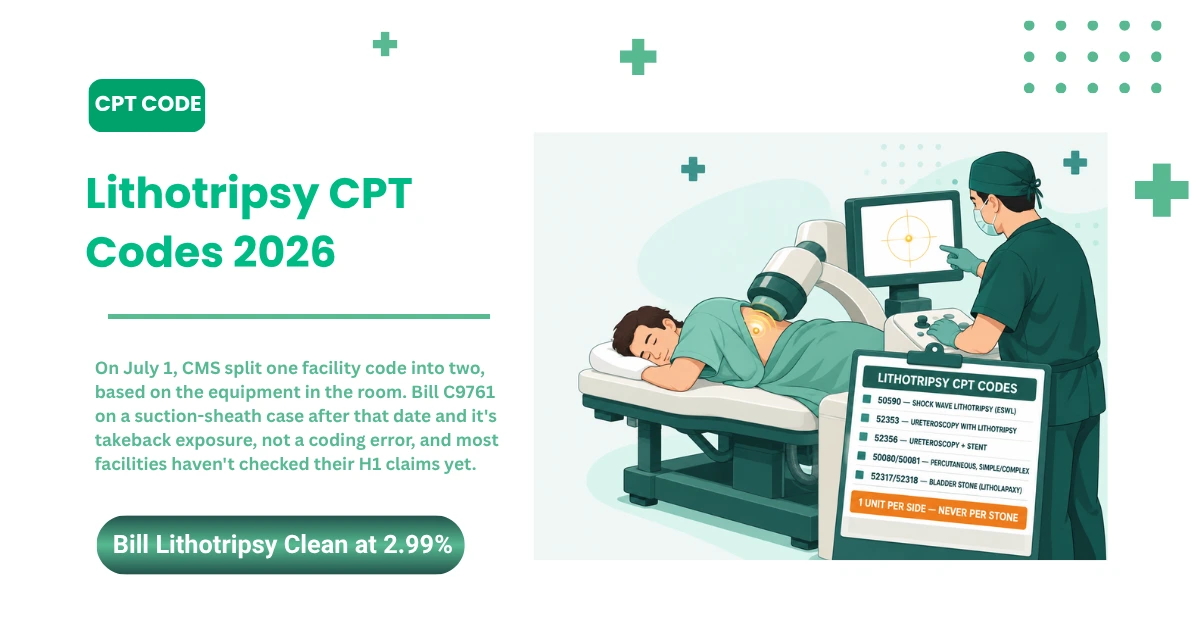




Lithotripsy CPT codes look simple until you're holding an operative note that says the surgeon started with shock waves, switched to a scope, and left a stent behind. The code you pick then decides whether the claim pays or sits in your denial queue for six weeks.
Something bigger changed this year. On July 1, 2026, CMS revised one facility code and created a brand new one, and the trigger is now the equipment in the room instead of the technique. Most coding guides still describe the rule that expired.
We're MedSole RCM, a full-service revenue cycle management company. Our coders work urology claims every day, which is why this guide covers what actually gets paid in 2026 rather than what the descriptors say in isolation.
Key Facts at a Glance
|
Fact |
Value |
|---|---|
|
Most common lithotripsy code |
50590 (extracorporeal shock wave) |
|
Ureteroscopic with lithotripsy |
52353 |
|
Ureteroscopic with lithotripsy and stent |
52356 |
|
New facility code, effective July 1, 2026 |
C8014 |
|
New Category III code, effective January 1, 2026 |
0991T |
|
Unit rule |
One unit per side, never per stone |
|
50590 work RVU (2026) |
9.53 |
|
52356 work RVU (2026) |
7.80, reduced from 8.00 |
|
2026 conversion factor |
33.4009 |
1. What Is the CPT Code for Lithotripsy?
The CPT code for lithotripsy is 50590 when the stone is treated with extracorporeal shock waves. Change the approach and the code changes with it. Ureteroscopic lithotripsy is 52353, or 52356 when a stent goes in during the same session. Percutaneous is 50080 for simple stones and 50081 for complex ones. Those four cover most stone cases you'll code.
One more split matters before you pick anything. Lithotripsy performed inside a blood vessel runs on a completely separate set of add-on codes, and none of the kidney stone codes apply there. Section 11 sorts that out.
If your operative note describes a conversion, a bilateral case, or a stent, jump to the three decision steps in Section 3. That's where the money usually leaks.
2. Every Lithotripsy CPT Code in 2026, by Approach
The lithotripsy CPT codes below are grouped by approach, not by number, because approach is what your operative note actually documents. Read down the column that matches how the stone was treated.
Urologic stone codes
Urologic lithotripsy splits four ways: shock waves from outside the body, retrograde through a scope, percutaneous through the flank, and transurethral for bladder stones. Each route has its own code family, and mixing them is the most common source of a denial on a stone claim.
|
Code |
What it reports |
Approach |
|---|---|---|
|
50590 |
Shock wave lithotripsy, kidney or ureter |
Extracorporeal |
|
50080 |
Percutaneous nephrolithotomy, simple |
Percutaneous |
|
50081 |
Percutaneous nephrolithotomy, complex |
Percutaneous |
|
50432 |
Nephrostomy catheter placement |
Percutaneous |
|
50436 |
Dilation of an existing tract |
Percutaneous |
|
50437 |
Dilation with new access |
Percutaneous |
|
52310 / 52315 |
Cystourethroscopy with removal of calculus |
Transurethral |
|
52317 |
Litholapaxy, stone under 2.5 cm |
Transurethral |
|
52318 |
Litholapaxy, stone 2.5 cm or larger |
Transurethral |
|
52332 |
Indwelling ureteral stent insertion |
Transurethral |
|
52352 |
Ureteroscopy with stone removal, no lithotripsy |
Retrograde |
|
52353 |
Ureteroscopy with lithotripsy |
Retrograde |
|
52356 |
Ureteroscopy with lithotripsy and stent |
Retrograde |
|
0991T |
Low-energy microsphere lithotripsy (Category III) |
Transurethral |
|
1054T |
Ultrasonic propulsion of residual fragments (Category III) |
Non-invasive |
|
C9761 |
Facility code, suction scope or steerable catheter |
Retrograde |
|
C8014 |
Facility code, suction-enabled access sheath |
Retrograde |
Category III code status: AMA Category III code set. Facility codes: CMS OPPS and ASC July 2026 update.
Intravascular lithotripsy codes
Intravascular lithotripsy never stands alone. Every one of these codes is an add-on appended to a primary procedure code for the vascular territory treated, so reporting one by itself will fail the edit before a human ever sees the claim.
|
Code |
What it reports |
Type |
|---|---|---|
|
37262 |
Intravascular lithotripsy, iliac territory |
Add-on |
|
37279 |
Intravascular lithotripsy, femoral and popliteal |
Add-on |
|
92972 |
Coronary intravascular lithotripsy |
Add-on |
|
C9764 to C9767 |
Facility codes, lower extremity except tibial and peroneal |
Facility |
|
C9772 to C9775 |
Facility codes, tibial and peroneal |
Facility |
Anesthesia codes for lithotripsy
Anesthesia for shock wave lithotripsy carries two codes, and one documented detail separates them. Get that detail wrong on a template note and every case run on that template carries the same error.
|
Code |
What it reports |
|---|---|
|
00872 |
Anesthesia for shock wave lithotripsy, with water bath |
|
00873 |
Anesthesia for shock wave lithotripsy, without water bath |
|
00918 |
Anesthesia for percutaneous urologic procedures with lithotripsy |
3. How to Pick the Right Lithotripsy Code for Your Operative Note
Three questions settle which of the lithotripsy CPT codes belongs on almost every stone claim. Work them in order, because each answer narrows the next one.
Step 1: Which approach did the surgeon use?
The approach decides the code family before anything else does. Shock waves from outside the body point to 50590. A scope passed up the ureter points to 52353 or 52356. Access through the flank points to 50080 or 50081. A bladder stone crushed through the urethra points to 52317 or 52318.
Step 2: Was a stent placed in the same session?
If an indwelling ureteral stent went in during the same ureteroscopic session, the code is 52356. Not 52353 plus a stent code. The stent is built into 52356 already, so adding 52332 on the same side gets that line denied every time.
Here's where people get tripped up. The stent has to go in during that session for 52356 to apply. A stent placed at a separate encounter is a separate claim with its own date of service.
Step 3: Which equipment was used, and who is billing?
Physician claims and facility claims split here. Surgeons still report 52353 or 52356 no matter what equipment was in the room. Facilities now choose between C9761 and C8014 based on the scope and the sheath, which is new as of July 1, 2026.
|
What the operative note says |
Physician code |
Facility consideration |
|---|---|---|
|
Shock waves, no instrumentation |
50590 |
Standard OPPS or ASC payment |
|
Ureteroscopy with laser, no stent |
52353 |
Check scope and sheath for a C-code |
|
Ureteroscopy with laser and stent |
52356 |
Check scope and sheath for a C-code |
|
Percutaneous access and lithotripsy |
50080 or 50081 |
Access already bundled into the code |
|
Bladder stone crushed and removed |
52317 or 52318 |
Size drives the code |
A real case, and the answer most guides get wrong. The surgeon starts shock wave lithotripsy on a right renal stone. The stone won't break. Mid-case, the decision is made to stop, go retrograde with a ureteroscope and laser, and leave a stent.
For a Medicare patient, report 52356 only. NCCI policy allows the completed approach, or the last uncompleted one, when an initial approach fails. Billing 50590 alongside it invites a takeback.
Commercial payers sometimes handle this differently, and a reduced-service pathway on 50590 may be supportable with documentation. Check the specific payer before you submit, because this is one of the few places where the Medicare answer and the commercial answer genuinely diverge.
Two separate stones in two separate locations treated with two different modalities is a different scenario entirely. That one supports both codes with the right modifiers, which is covered in Section 12. If your denials cluster here, our urology medical billing services team sees this pattern constantly.
|
Conversions, same-side stones, and bilateral cases are where urology claims quietly lose money. If your stone denials keep landing in the same bucket, we can look at where the pattern starts instead of reworking claims one at a time. |
4. CPT 50590: Extracorporeal Shock Wave Lithotripsy
CPT 50590 is the most reported of the lithotripsy CPT codes, and it covers shock wave treatment of a kidney or ureteral stone. It carries 9.53 work RVUs in the 2026 reference set, which makes it the highest-valued single stone code outside percutaneous surgery.
What CPT 50590 includes, and what you bill separately
The descriptor covers more than the shock waves themselves. Billing any of the included pieces a second time is a clean way to generate an avoidable denial.
Included in 50590:
- Stone localization
- Imaging guidance used to target and monitor treatment
- Procedural monitoring
- Patient positioning
Billed separately:
- The preoperative evaluation
- Imaging performed outside the lithotripsy session
- Follow-up visits, subject to the global period rules below
Fluoroscopy deserves its own warning. NCCI treats CPT 76000 as integral to endoscopic procedures, so it isn't separately reportable alongside them. The same logic applies to guidance bundled into 50590.
Source: Medicare NCCI Policy Manual, Chapter 7, revision date January 1, 2026.
Setting changes the payment even though the code stays the same, which is where place of service codes start mattering on a stone claim.
CPT 50590 global period
CPT 50590 carries a 90-day global period on the Medicare Physician Fee Schedule. Routine postoperative care related to that treatment falls inside the payment. The transurethral endoscopic stone codes work the opposite way and carry a 0-day global.
Read this one carefully, because the web is full of conflicting answers. One widely cited source lists 50590 with a 0-day global. Another lists 52356 at 90 days. Both are backwards. The authority is the Global Days column in the CMS relative value file, and that's the only place worth checking.
|
Global indicator |
What it means |
|---|---|
|
000 |
No postoperative days included |
|
010 |
10 postoperative days included |
|
090 |
90 postoperative days, plus one preoperative day |
|
XXX |
The global concept does not apply |
|
YYY |
Contractor determines the period |
|
ZZZ |
Add-on code, takes the global period of its primary procedure |
Global indicator definitions: Medicare NCCI Policy Manual, Chapter 7. Code-level values: CMS relative value file, Global Days column. Confirm against the current quarterly release before you rely on a number.
A 90-day global on 50590 has a practical consequence people miss. A second shock wave session inside that window is a staged procedure, and it needs modifier 58 rather than a fresh claim with no modifier at all.
Why multiple stones still means one unit
Report one unit of 50590 per kidney per session. The number of stones doesn't change that, and neither does the number of shocks delivered. NCCI states plainly that a stone destruction code isn't reported with a separate unit of service for each calculus.
What usually happens is a biller sees three stones in the note and bills three units. The claim comes back for units exceeding the expected value, and a pattern of it draws the kind of attention nobody wants.
Source: Medicare NCCI Policy Manual, Chapter 7, revision date January 1, 2026. See CMS NCCI Policy Manual, Chapter 7.
5. CPT 52353 vs 52356: Ureteroscopy With and Without a Stent
One detail separates these two lithotripsy CPT codes: the indwelling ureteral stent. Report 52353 for ureteroscopy with lithotripsy alone. Report 52356 when a stent goes in during that same session. Pick the wrong one and you either leave money on the table or hand the payer a reason to deny.
When the stent makes it 52356
The stent is part of 52356, not an optional extra. Some published guides describe 52356 as including stent insertion "when performed," which reads like the stent is discretionary. It isn't, and that misreading is exactly what drives billers to report 52353 with a separate stent code.
So the test is simple. Stent placed in that session means 52356. No stent means 52353. There's no version of this where you bill both the lithotripsy code and 52332 on the same side.
Why 52353 and 52356 cannot both be billed on the same side
The CPT parenthetical on 52356 instructs you not to report 52332 or 52353 with it when performed on the same side. That laterality condition is the whole rule. Drop it and the guidance stops making sense.
A modifier won't rescue this one either. You can't append 59 or XS to 52353 and expect 52356 to pay on the same side, because the edit isn't about distinctness. It's about the codes describing overlapping work. Our guide to modifier 59 billing rules covers when that modifier genuinely applies and when it's the wrong tool.
Billing both sides in the same session
Different sides change everything. Some published advice states flatly that 52353 and 52356 can never go on the same claim, and that's wrong. A bilateral case with lithotripsy on one side and lithotripsy plus a stent on the other supports both codes with laterality modifiers.
Getting paid for it depends on the claim line structure, which changes by site of service. Section 12 has the mechanics.
The unit rule that catches people. For 52353, report one unit per ureter no matter how many stones sat in that ureter. NCCI is explicit: a stone procedure isn't reported with a separate unit of service for each calculus. Bilateral ureters may be reported with modifier 50 and one unit.
|
52352 |
52353 |
52356 |
|
|---|---|---|---|
|
Lithotripsy performed |
No |
Yes |
Yes |
|
Stent placed same session |
No |
No |
Yes |
|
Report 52332 separately, same side |
Payer dependent |
No |
No |
|
Unit basis |
Per ureter |
Per ureter |
Per ureter |
|
2026 work RVU |
6.58 |
Check current file |
7.80 |
|
Global period |
0 day |
0 day |
0 day |
Unit and bilateral rules: Medicare NCCI Policy Manual, Chapter 7, revision date January 1, 2026. Payer example: Medi-Cal urinary surgery manual, which lists 52356 as not reimbursable with 52332 or 52353 on the same side.
|
Same-side bundling rules shift by payer and by side. When stone claims keep coming back, the problem usually sits in the modifier logic rather than the code choice. Our CO-4 denial code guide walks through the exact rejection this creates. |
6. CPT 50080 and 50081: Percutaneous Nephrolithotomy
Percutaneous nephrolithotomy runs on two codes, and stone size and complexity decide which one you report. These are the highest-paying lithotripsy CPT codes in the set. These carry the highest RVU values in stone surgery, so the documentation has to earn them.
The 2 cm rule that separates simple from complex
Report 50080 for simple cases: stones up to 2 cm in a single location of the kidney or renal pelvis, nonbranching. Report 50081 for complex cases, meaning stones larger than 2 cm, branching stones, stones in multiple locations, ureteral stones, or complicated anatomy.
The operative note has to state the size and the location. Leave either one out and the payer defaults to the lower-paying code, which on these two codes is a meaningful gap. A coder can't infer 50081 from a note that just says "large stone."
What the current descriptors already include
These descriptors were rewritten effective January 1, 2023, and the rewrite pulled in work that used to be reported separately. Nephrostomy tube placement and antegrade stent placement are both inside the code now when performed.
Initial access is included too. A separate nephrostomy placement code for that same access isn't reportable, which was a real change from how these were billed before 2023.
Tract dilation still has its own codes, and which one applies depends on the access. Dilating a previously established tract is one code. Dilation with new access is another. Both sit alongside the nephrolithotomy code rather than inside it.
One more bundling rule worth knowing: NCCI treats insertion of a urinary bladder catheter as part of the global package, so the catheter insertion codes aren't separately reportable with a surgical procedure.
Source: Medicare NCCI Policy Manual, Chapter 7, revision date January 1, 2026.
7. CPT 52310, 52317, and 52318: Bladder Stone Codes
Bladder stones get their own lithotripsy CPT codes, sorted by size and by whether the stone was actually crushed. Report 52317 for a simple litholapaxy where the stone measures under 2.5 cm. Report 52318 when the stone is 2.5 cm or larger, or the case runs complicated.
The 2.5 cm threshold for cystolitholapaxy
Litholapaxy means the stone got crushed or fragmented and the pieces came out. If the surgeon simply removed a calculus without crushing it, that's 52310 or 52315 instead, and those are a different billing situation entirely.
|
Stone size and complexity |
Code |
|---|---|
|
Under 2.5 cm, simple litholapaxy |
52317 |
|
2.5 cm or larger, or complicated |
52318 |
|
Removal of calculus without litholapaxy |
52310 or 52315 |
The rule almost nobody publishes. NCCI restricts 52317 and 52318 to stones that formed in the bladder on their own. You can't report them for crushing and removing bladder fragments that came from a procedure higher up in the urinary tract.
Picture the case. Ureteroscopic lithotripsy sends fragments down into the bladder, and the surgeon clears them before finishing. That cleanup isn't a bladder litholapaxy. Billing 52317 for it is the kind of error that survives for years because it looks defensible in the note.
Source: Medicare NCCI Policy Manual, Chapter 7, item 29, revision date January 1, 2026.
Watch the separate procedure designation as well. The cystourethroscopy codes for removing a foreign body, calculus, or ureteral stent from the urethra or bladder carry that label, and CMS payment policy means they aren't reported with other cystourethroscopy codes for the same encounter.
Routine work stays bundled too. Cystoscopic inspection, catheter placement, and bladder irrigation are included in the litholapaxy codes, so none of them bills separately.
8. C9761 and C8014: What Changed for Facilities on July 1, 2026
Effective July 1, 2026, CMS revised the C9761 descriptor and established a new code, C8014. The equipment in the room decides which one applies. If your facility is still applying the pre-July rule, some of this year's claims are exposed.
These two sit outside the usual lithotripsy CPT codes because they're facility codes. They appear on a hospital outpatient or ASC claim and never on a physician claim, which is why a lot of coding teams have never had to think about them.
Which facility code applies now
C9761 now covers cases performed with a steerable ureteral catheter or a suction-integrated ureteroscope. C8014 covers ureteroscopic lithotripsy performed with a suction-enabled ureteral access sheath, with irrigation when performed. Never report both on the same claim.
|
What the operative note documents |
Facility code |
|---|---|
|
Suction-integrated ureteroscope |
C9761 |
|
Steerable ureteral catheter for vacuum aspiration |
C9761 |
|
Suction-enabled access sheath with a standard scope |
C8014 |
|
Neither of the above |
No C-code |
Sources: CMS MLN Matters MM14477 (hospital outpatient), CMS ASC July 2026 update, and CMS Transmittal R13832CP for full descriptors and status indicators. C9761 maps to APC 5376, Level 6 Urology and Related Services, per the AUA outpatient rule summary.
What this means for claims you already filed this year
Before July 1, the guidance held that C9761 shouldn't be billed without a steerable ureteral catheter, and a navigable access sheath didn't satisfy the descriptor. Facilities that billed C9761 on sheath cases through the first half of 2026 may be carrying takeback exposure.
This isn't a reason to panic. It's a reason to pull a sample of H1 claims, check what the operative notes say about the scope and the sheath, and find out whether the exposure is real before someone else does.
Physician claims did not change
Surgeons still report 52353 or 52356. The C-codes are facility codes and never appear on a professional claim, so nothing about your physician billing changed on July 1.
Where suction aspiration added substantial documented work, modifier 22 may be supportable on the professional claim. That needs objective detail in the note: operative time, stone burden, anatomy, and why the extra work was necessary.
Facilities and professional claims running as separate workflows is the only way this stays clean, which is the core of how our hospital revenue cycle services handle facility and physician billing on the same case.
The single-use ureteroscope pass-through ended January 1, 2026
Separate device reimbursement for single-use ureteroscopes under C1747 expired December 31, 2025. For dates of service starting January 1, 2026, that device payment is packaged into the procedure payment.
CMS still expects facilities to report C1747 for data collection. Practices that built a budget around separate device reimbursement lost it eight months ago, and plenty of them haven't noticed yet.
|
If your facility billed C9761 on suction sheath cases before July, those claims are worth a second look. We can review a sample and tell you what the exposure actually is. Our accounts receivable recovery team works takebacks and appeals on this kind of mid-year rule change. |
9. CPT 0991T and 1054T: The Two New Category III Lithotripsy Codes
Two Category III codes joined the lithotripsy CPT codes in 2026. Both are real, both are billable, and neither is a reliable revenue line yet.
0991T for low-energy microsphere lithotripsy
CPT 0991T took effect January 1, 2026. It reports cystourethroscopy with low-energy lithotripsy using acoustically actuated microspheres, a technique built to move stone treatment out of the operating room and into ASCs, office-based labs, and cystoscopy suites.
Here's the part that decides whether you get paid. At least one major national payer has published a policy listing 0991T as not covered for the stated indications. A new code with a published non-coverage position isn't a billing opportunity. It's a conversation that has to happen before the case gets scheduled.
That means verifying coverage, confirming whether authorization is even available, and documenting patient financial responsibility in advance. Our prior authorization services team handles exactly this category of request, where the answer is often no and the practice needs to know that early.
Payer policy example: Aetna Clinical Policy Bulletin 0392. Verify your own payer policies, since coverage positions vary.
1054T for moving residual fragments after lithotripsy
CPT 1054T took effect July 1, 2026. It describes focused non-shock wave ultrasonic propulsion of residual stone fragments after lithotripsy, unilateral, including ultrasound guidance, for fragments 5 mm or smaller.
It carries its own exclusion list, and this is the sentence to remember: do not report 1054T with 76700, 76705, 76770, 76775, 76856, 76857, or 76998 when performed on the same side.
The July start date confuses people who only look at January. Category III codes follow an early-release cycle, so codes accepted at a September panel meeting take effect the following July, six months after the January release.
What Category III status actually means for your payment
Three realities apply to every Category III code, including both of these.
- No assigned RVUs, which means payment is carrier-priced or denied outright
- Some Medicare Administrative Contractors require records submitted with the claim
- Coverage is the exception rather than the default
Verify before the case, not after the denial. A Category III code submitted on spec is a write-off waiting to be discovered at 90 days.
Category III code set and effective dates: AMA Category III codes.
10. Anesthesia Codes for Lithotripsy: 00872, 00873, and 00918
Anesthesia gets billed alongside the lithotripsy CPT codes, and for shock wave cases it comes down to one documented detail that most operative note templates don't capture.
The water bath distinction that changes the code
Whether the patient was immersed in a water bath decides the code. Modern dry-coupling systems press a water cushion against the skin, and that's 00873. Full immersion in a tank is 00872.
The payer can't tell these apart without the operative report. A template that omits the coupling method produces the same error on every case it touches, which is why this is worth a quarterly template review rather than a one-time fix.
How anesthesia payment is calculated
Anesthesia doesn't use the standard fee schedule math. Payment runs on base units plus time units plus modifying units, multiplied by the anesthesia conversion factor for your locality.
Time units accrue at one per 15 minutes. A typical shock wave case runs 30 to 45 minutes, which lands at two or three time units on top of the base. Physical status adds modifying units on a sliding scale, with P3 and above contributing.
Anesthesia codes also skip the facility and non-facility split that applies to most fee schedule codes. The locality conversion factor does that work instead, so where the case happened doesn't change the anesthesia calculation the way it changes the surgical payment.
|
Modifier |
When it applies |
|---|---|
|
AA |
Anesthesiologist personally performing |
|
QX |
CRNA with medical direction |
|
QY |
Anesthesiologist directing one CRNA |
|
QK |
Anesthesiologist directing two to four CRNAs |
|
QZ |
CRNA without medical direction |
|
QS |
Monitored anesthesia care |
|
P1 to P6 |
Physical status, appended separately |
The 00873 descriptor change effective January 1, 2026
The short descriptor for 00873 changed on January 1, 2026. Confirm your chargemaster and EHR templates carry the updated version, because a stale descriptor generates rejections that look like coding errors and aren't.
This is a five-minute check that nobody schedules. Pull the code from your chargemaster, compare it to the current file, and move on.
11. Intravascular Lithotripsy Is Coded Completely Differently
Lithotripsy describes a physical technique, breaking hard material with acoustic energy, and the same technique treats kidney stones and calcified arteries. The codes have nothing in common. Search for lithotripsy CPT codes and you'll get both sets back, which is how a vascular add-on occasionally lands on a urology claim.
Peripheral IVL add-on codes 37262 and 37279
Peripheral intravascular lithotripsy is always an add-on, never a standalone code. Report 37262 for the iliac vascular territory and 37279 for the femoral and popliteal territory, each appended to the primary revascularization code for that same territory.
Both took effect January 1, 2026 as part of a restructure that replaced the lower extremity revascularization code set with territory-based and lesion-based codes. Lesions get classified as straightforward for stenosis or complex for occlusion.
Unit caps apply, and they're the detail that gets missed: 37262 tops out at three units per leg, and 37279 at two units per leg.
Coronary IVL and add-on code 92972
Coronary intravascular lithotripsy uses 92972, appended to the percutaneous coronary intervention code. It became a Category I add-on effective January 1, 2024, which means the professional work finally carries its own RVUs instead of being absorbed into the PCI payment.
Why the same word covers two unrelated code families
Use this table when the specialty on the claim doesn't match the code you were handed.
|
If the procedure treats |
Report |
Code type |
|---|---|---|
|
Kidney or ureteral stone, shock wave |
50590 |
Standalone |
|
Kidney or ureteral stone, ureteroscopic |
52353 or 52356 |
Standalone |
|
Bladder stone |
52317 or 52318 |
Standalone |
|
Iliac artery calcification |
37262 |
Add-on |
|
Femoral or popliteal calcification |
37279 |
Add-on |
|
Coronary artery calcification |
92972 |
Add-on |
Payment values for the peripheral add-on codes: CMS-1832-F, CY2026 Medicare Physician Fee Schedule Final Rule, Addendum B, at a conversion factor of 33.4009.
12. Modifiers and Laterality on Lithotripsy Claims
Modifiers are where stone claims live or die, and almost no guide to lithotripsy CPT codes covers them. Reference data tells you what a code means. This part tells you how to get it paid.
One unit per side, never per stone
The unit of service for a renal calculus destruction procedure is one, not one per stone. For ureteroscopic lithotripsy, that means one unit per ureter regardless of how many stones sat in it.
Claims billed per stone come back for units exceeding the expected value. Repeat it often enough and the pattern itself becomes the problem, because a medically unlikely edit triggered over and over looks like a billing habit rather than a clinical circumstance. Our lithotripsy laterality denials guide covers the rejection this produces.
Bilateral cases: how the claim line changes by setting
Bilateral reporting is not one rule. It changes with the site of service, and this is the subsection most competitors skip entirely.
|
Setting |
How to report bilateral |
|---|---|
|
Physician professional claim |
Modifier 50, one unit, one line |
|
Hospital outpatient |
Modifier 50, one unit, one line |
|
Ambulatory surgery center |
Two lines, RT and LT, one unit each |
Source: Medicare NCCI Policy Manual, Chapter 7, revision date January 1, 2026. The manual ties bilateral reporting to CMS Claims Processing Manual instructions and states the ASC exception separately.
That ASC exception costs practices real money. An ASC claim submitted with modifier 50 on a single line, formatted the way the professional claim would be, gets rejected on structure while every code on it is correct. We cover the same rule for a different specialty in our ASC bilateral modifier rules guide.
One warning on working around edits. Splitting a service across multiple claim lines to get past a medically unlikely edit isn't a workaround. NCCI flags frequent use of that pattern as a signal of incorrect units.
When modifier 59 or an X modifier applies
Modifier 59 flags two non-E/M procedures on the same date as distinct when an NCCI edit would otherwise bundle them. A more specific X modifier takes priority whenever one fits the circumstance.
Documentation has to support the distinction, and a separate diagnosis code on each line doesn't prove it by itself. For stone cases, the distinction usually rests on separate stones in separate anatomic locations.
Modifier 22, 52, 58, and 79 on stone claims
- Modifier 22 when aspiration, stone burden, or anatomy added substantial documented work beyond the usual
- Modifier 52 for a reduced service, which matters on converted cases where an approach was started and abandoned
- Modifier 58 when a second lithotripsy session is staged or planned inside the 90-day global on 50590
- Modifier 79 when an unrelated procedure happens during the postoperative period
The trigger is what matters here, not the number. A modifier without a documented circumstance behind it is a denial with extra steps.
|
Bilateral stone cases fail more often on claim formatting than on code selection. If your ASC claims keep getting rejected and the codes look right, the line structure is usually where to look first. Our denial management services team categorizes by reason code and fixes the cause instead of resubmitting. |
13. What Medicare Pays for Lithotripsy in 2026
Medicare pays total RVU multiplied by the conversion factor. Total RVU stacks three components: work, practice expense, and malpractice, each adjusted by its own geographic index. The 2026 conversion factor is 33.4009.
Why work RVU alone gives you the wrong number
A payment figure built from work RVU alone drops two thirds of the formula. Several widely referenced sources publish rates for the lithotripsy CPT codes calculated that way, and the numbers land nowhere near the actual allowable.
Run it yourself and the problem shows up immediately. Take 50590, which carries 9.53 work RVUs in 2026. Multiply that by the conversion factor and you get roughly $318. The actual facility allowable is $521.05, because the full total RVU is 15.60.
Work the arithmetic the correct way and it reconciles: 15.60 multiplied by 33.4009 equals $521.05. That's the check to run on any published rate before you trust it.
What changed in the 2026 values
The work RVU for 52356 dropped from 8.00 to 7.80 for CY2026, with the total moving from 133.00 to 131.50 in the fee schedule tables. Small on paper, real across volume.
|
Code |
2026 work RVU |
Total RVU |
Allowable at 33.4009 |
|---|---|---|---|
|
50590 (facility) |
9.53 |
15.60 |
$521.05 |
|
50590 (non-facility) |
9.53 |
22.76 |
$760.20 |
|
52356 (facility) |
7.80 |
10.93 |
$365.07 |
|
37262 (add-on) |
3.00 |
4.07 |
Approximately $136 |
Work RVU change for 52356: AUA fee schedule summary. Conversion factor and add-on values: CMS-1832-F, CY2026 MPFS Final Rule, Addendum B. Confirm code-level values against the current quarterly relative value file release before you model revenue on them.
Facility, ASC, and office payment differences
The same code pays three different amounts depending on where the case happened. Practice expense shifts with who carries the overhead, so an office keeps more of it and a hospital outpatient department keeps less.
Look at 50590. Facility allowable sits at $521.05 and non-facility at $760.20, a spread of $239.15 on one code. Place of service on the claim decides which one you get, which is why a POS error on a stone claim isn't a clerical issue.
What your practice actually realizes is a separate question from the published allowable, and contract terms usually explain the gap. That comparison is the point of our revenue cycle reporting, which tracks collected against contracted rather than billed.
14. ICD-10 Codes That Support a Lithotripsy Claim
The CPT code says what was done. The ICD-10-CM code says why. That link is what carries medical necessity, and a stone claim with a weak diagnosis link fails on coverage rather than coding.
Diagnosis codes for stone disease
|
Code |
Describes |
|---|---|
|
N20.0 |
Calculus of kidney |
|
N20.1 |
Calculus of ureter |
|
N20.2 |
Calculus of kidney with calculus of ureter |
|
N21.0 |
Calculus in bladder |
|
N22 |
Calculus of urinary tract in diseases classified elsewhere |
N22 has a sequencing requirement that gets missed. It needs the underlying condition coded first, so submitting it alone reads as incomplete to the payer's edit.
Here's the trap on medical necessity. Some payers publish approved diagnosis lists for lithotripsy coverage, and a clinically accurate code that isn't on that list still produces a denial. Accuracy and coverage aren't the same test.
Pairing the right diagnosis with the right procedure is the same discipline we walk through in our urology ICD-10 coding guide, where the CPT linkage decides whether the claim clears.
ICD-10-PCS codes for inpatient lithotripsy
Three code systems get confused here constantly, and the confusion produces some genuinely wrong answers online. Sorting them out takes one paragraph.
- ICD-10-PCS applies to inpatient hospital procedure reporting only
- CPT and HCPCS carry outpatient professional and facility procedures
- ICD-10-CM carries the diagnosis in every setting
For inpatient stone fragmentation, the root operation is Fragmentation, and the code is built character by character from the body part and the approach. Dilation is a different root operation entirely, so codes from those two tables aren't interchangeable no matter how similar they look.
Build these from the current ICD-10-PCS tables rather than from a list you found. Several PCS codes circulating in search results for lithotripsy don't parse correctly against the urinary system tables, and a character that looks close enough will fail the grouper.
15. Why Lithotripsy Claims Get Denied, and How to Stop the Pattern
Denials on the lithotripsy CPT codes trace to six causes most of the time. Each one is checkable against a claim in about a minute, which is what separates a useful list from a decorative one.
The six denial triggers that account for most stone claim losses
- Missing RT or LT on a procedure that requires laterality
- Units billed per stone instead of per side or per ureter
- C9761 billed on a suction sheath case after July 1, 2026, when C8014 applies
- C1747 billed expecting separate device payment after the pass-through expired
- A stent code reported alongside 52356 on the same side
- A diagnosis that is clinically accurate but absent from the payer coverage list
Three of those six are dated 2026 events. If your denial log from this year hasn't been reviewed against them, that's the first place to look, since older reference material won't flag any of them.
What the operative note has to say
Coders can only bill what the note supports. These six details decide the code on a stone case.
- The approach, in words that map to a code family
- Stone size and location, because the 2 cm and 2.5 cm thresholds decide the code
- Laterality, stated explicitly rather than implied by the diagnosis
- The equipment, specifically whether the scope was suction-integrated and whether a suction-enabled access sheath was used
- The coupling method for shock wave cases, water bath or dry
- For conversions, which approach was attempted and which one completed
That equipment line is new as of July 2026. Most operative note templates don't capture it yet, which means facilities are making a coding decision on information the note never recorded.
Fixing the template beats fixing the claims. Our outsourced billing and coding team reviews documentation against payer requirements before submission rather than after the denial. Imaging pairs into this too, and the codes for stone workup sit in our radiology CPT code list.
Fixing the pattern instead of the claim
A corrected and resubmitted denial comes back next month if the workflow that produced it never changed. That's the part most practices skip, because resubmission feels like resolution.
Stone denials usually trace to a template, a scheduling step, or a charge entry habit rather than to a coder's judgment. Categorize by reason code, find the pattern, and fix it upstream.
|
Most practices we review are losing the same three denials over and over. If your stone claims keep coming back for the same reason, the fix is usually upstream of the coder. We'll show you where the pattern starts before you change anything. |
16. What Urology Stone Billing Costs, and What to Look For in a Billing Partner
Stone billing breaks in specific, predictable ways. Whoever handles your claims needs to cover five things, and you can ask any vendor about all five in one phone call.
What urology billing should include
- A coder who tracks quarterly HCPCS changes, because the facility codes moved mid-year in 2026
- Laterality and unit auditing before submission, since those two cause most rejections
- Facility and professional claims handled as separate workflows
- Prior authorization tracking for Category III codes and non-covered procedures
- Denial categorization by reason code with upstream correction
Every one of those ties back to something earlier in this guide on lithotripsy CPT codes. Take the list to whoever bills your stone cases now and see how many they can answer without checking.
What billing companies charge
Percentage-of-collections pricing runs 4% to 7% at most billing companies, and add-ons often sit on top of that. Here's where MedSole lands against the market.
|
What practices pay |
Range |
|---|---|
|
Percentage-of-collections billing, most companies |
4% to 7% |
|
MedSole RCM full-service billing and RCM |
2.99% of collections |
|
MedSole RCM provider credentialing |
$99 per payer enrollment |
|
MedSole RCM standalone AR recovery |
4.49% of what gets recovered |
|
Setup fees at MedSole |
None |
|
Long-term contract at MedSole |
Not required |
|
Clean claim rate |
99% |
|
Specialties covered |
75+, including urology |
Run the math on your own numbers. A practice collecting $50,000 a month pays $1,495 at 2.99%. The same practice at a 6% billing company pays $3,000 before any add-ons, which is $18,060 more over a year for the same scope of work.
That 2.99% covers the whole cycle: eligibility verification, prior authorization, coding review, claim submission, payment posting, denial management, AR follow-up, and reporting. No per-claim fees and no line-item invoicing.
Credentialing costs for urology practices
A urology group adding a stone surgeon needs payer enrollment finished before the first case. Enrollment delay is a revenue problem, not an administrative one, because every case billed under an unenrolled provider is a write-off.
MedSole RCM handles provider credentialing at $99 per payer enrollment, which covers CAQH profile management, application submission, weekly payer follow-up, and recredentialing deadline tracking. Turnaround runs 30 to 90 days depending on the payer, and no billing company controls that timeline.
Credentialing and billing run under one team here, so there's no second vendor to manage while a new surgeon waits to start billing. You can see the full scope on our provider credentialing services page, and how it applies by specialty under urology billing support.
17. Lithotripsy Coding Questions Practices Ask
What is the CPT code for lithotripsy surgery?
It depends on the approach. Shock wave lithotripsy is 50590. Ureteroscopic is 52353, or 52356 with a stent. Percutaneous is 50080 or 50081. Bladder stones use 52317 or 52318. On the billing side, whether a procedure counts as surgery is settled by the global period on the fee schedule, not by whether there was an incision.
Can 52353 and 52332 be billed together?
Not on the same side. The stent code bundles into the lithotripsy service when both happen in the same session on the same ureter, so the stent line gets denied. Different sides are a separate situation, and laterality modifiers apply there. If a stent goes in during the same session on the same side, 52356 is the correct single code.
Is shockwave lithotripsy considered surgery?
For billing purposes, yes. CPT 50590 carries a 90-day global period on the Medicare Physician Fee Schedule, which places it in the major surgical category. Routine postoperative care related to that treatment falls inside the payment. A second session inside those 90 days needs modifier 58 to be reported as a staged procedure.
How many units of 50590 can you bill for multiple stones?
One unit per kidney per session. NCCI states that a renal calculus destruction procedure isn't reported with a separate unit of service for each calculus, so three stones in one kidney is still one unit. Bilateral treatment may be reported with modifier 50 and one unit on a professional claim, though ASC claims format it differently.
Do you bill C9761 or C8014 after July 1, 2026?
The equipment decides, and never report both. C9761 applies when the case used a steerable ureteral catheter or a suction-integrated ureteroscope. C8014 applies when a suction-enabled ureteral access sheath was used with a standard scope. Both are facility codes, so physician claims still report 52353 or 52356 regardless.
What is the CPT code for bladder lithotripsy?
Report 52317 when the bladder stone measures under 2.5 cm and the litholapaxy was simple. Report 52318 at 2.5 cm or larger, or when the case runs complicated. Both require that the stone was crushed and the fragments removed. Neither applies to fragments that washed down from an upper tract procedure.
Does 0991T get paid?
Often not. CPT 0991T is a Category III code with no assigned RVUs, which means carrier pricing at best, and at least one major national payer publishes it as non-covered. Verify coverage and authorization before the case is scheduled, and document patient financial responsibility in advance. Submitting it on spec usually produces a write-off.
How much does urology medical billing cost?
Most billing companies charge 4% to 7% of collections, often with setup fees and per-claim charges added. MedSole RCM charges 2.99% of collections for full-service billing and revenue cycle management, with provider credentialing at $99 per payer enrollment. No setup fees, no long-term contract, and a 99% clean claim rate across 75+ specialties.
Where to Verify Before You Bill
Three sources settle almost every question about lithotripsy CPT codes. The CMS relative value file carries the global period and the RVU components. The NCCI Policy Manual carries the bundling and unit rules. Your payer's own policy carries coverage.
Check all three quarterly on stone codes. CMS moved the facility codes mid-year in 2026, and there's no reason to assume that was the last change.
|
Stone claims reward teams that track code changes and punish teams that don't. MedSole RCM handles full-service billing at 2.99% of collections and provider credentialing at $99 per payer enrollment, with certified coders who work urology claims daily. If your stone denials are climbing, start with a review of where they originate. |