



What Is CPT Code 74177?
CPT code 74177 is the American Medical Association's code for a computed tomography scan of the abdomen and pelvis performed with contrast material, officially described as "Computed tomography, abdomen and pelvis; with contrast material(s)." That exact phrasing is corroborated identically across AMA CPT guidance, the Noridian Medicare contractor's own review page, and every major billing reference.
The 74177 CPT code applies only when both the abdomen and the pelvis are imaged in one combined session, and only when contrast material is administered. Those two conditions separate it from its two closest siblings, 74176 and 74178, covered in the next section.
As the CPT code for CT abdomen and pelvis with contrast, this is high-volume, moderate-cost imaging, and accurate code-family selection is what keeps the claim paid. Getting it wrong is a billing problem before it's a clinical one. MedSole RCM works this exact code family across radiology clients every day, and for practices that prefer to hand the process off, MedSole's outsourced medical billing services manage coding, submission, and follow-up end to end.
Key Takeaways
- CPT 74177 requires both the abdomen and pelvis imaged with contrast in one session, or the correct code changes to 74176 or 74178.
- The 74176, 74177, and 74178 family reports only one code per combined exam, never two of them together for the same session.
- Modifier 26 covers the interpretation only, and modifier TC covers the technical component, with no modifier needed when one entity bills the study globally.
- Modifier 59 and modifier XS both exist for same-day distinct studies, and XS is the more specific, generally preferred choice when the second study covers a separate anatomic region.
- Medicare's national average patient copayment for the 74177 CPT code in an ambulatory surgical center runs about $98, per Medicare.gov's own procedure price lookup.
- CPT 74177 is currently under an active Noridian Medicare Administrative Contractor prepayment review, a fact the American College of Radiology has confirmed independently.
- MedSole RCM bills this work at 2.99 percent of collections, well under the 4 to 7 percent most full-service RCM vendors charge for the same scope.
CPT 74176 vs. 74177 vs. 74178: Choosing the Right Contrast Code
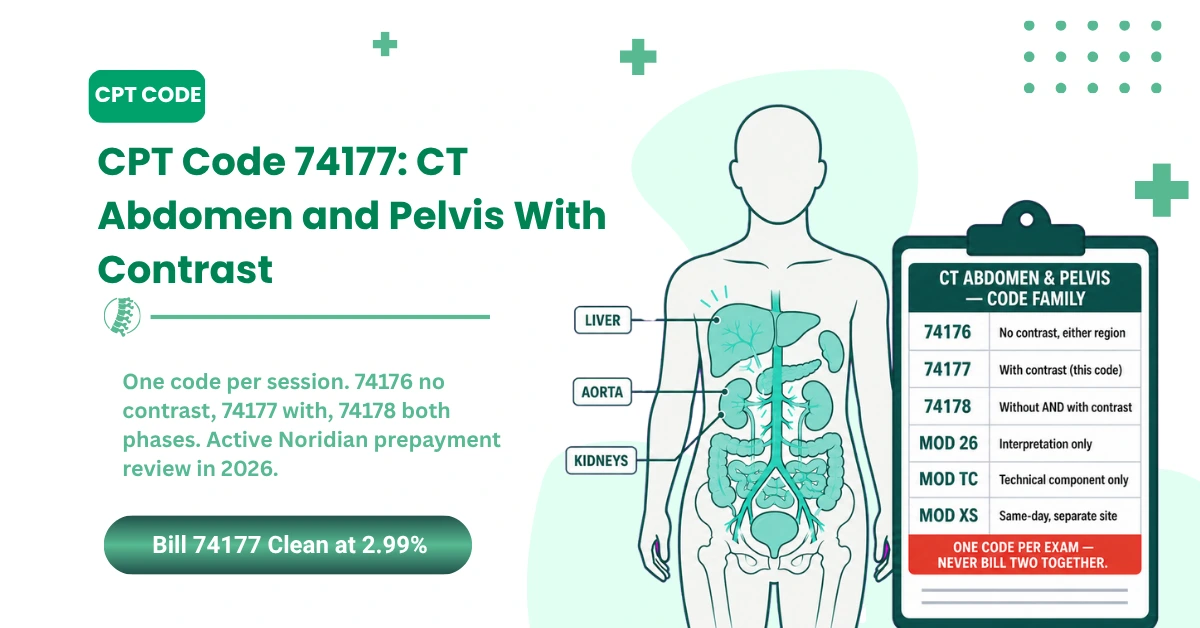
The choice among the three combined abdomen-and-pelvis codes comes down to contrast. Report 74176 when no contrast is used across either region. Report the 74177 CPT code when both regions are imaged with contrast as the sole or primary protocol. Report 74178 when one or both regions are imaged first without contrast and then again with contrast in the same session.
One rule governs all three, and Noridian states it word for word on its own 74177 review page: only one code from this family is reported per CT abdomen and pelvis examination. You never bill two of them together for the same session.
|
Code |
Contrast Protocol |
Anatomical Scope |
Typical Use Cases |
|---|---|---|---|
|
74176 |
No contrast, either region |
Abdomen and pelvis |
Non-contrast stone protocol, follow-up where contrast is contraindicated |
|
74177 |
With contrast |
Abdomen and pelvis |
Kidney stones, abdominal pain, suspected appendicitis or diverticulitis, internal bleeding |
|
74178 |
Without and with contrast |
Abdomen and/or pelvis |
Cancer staging, complex renal lesions, severe trauma needing both phases |
One edge case is worth stating precisely, because it's where correct coding and correct modifiers intersect. If a patient genuinely receives two separate, medically necessary combined studies at two distinct sessions on the same date, for example a non-contrast study in the morning and a contrast study later after new symptoms develop, both 74176 and 74177 can be billed for that date. That only works with modifier 59 or modifier XU appended to the second code, showing the payer these were separate, distinct sessions rather than one fragmented study.
Billing 74176 and 74177 together without that distinct-session modifier, when what actually happened was a single without-and-with-contrast protocol, isn't a modifier problem. It's a code selection error, and 74178 alone is the correct answer in that scenario.
What CPT 74177 Covers, and What Gets Billed Separately
A combined study under this code evaluates two regions in full. The abdominal portion covers the liver, gallbladder, spleen, pancreas, kidneys, adrenal glands, bowel, mesentery, retroperitoneum, and the abdominal aorta and major vessels. The pelvic portion covers the bladder, the uterus and adnexa in female patients, the prostate in male patients, and the pelvic lymph nodes.
Both regions have to be genuinely evaluated in the radiology report for 74177 to apply. A report that describes only abdominal findings, even after a combined scan, doesn't support the combined code.
The global 74177 code includes four things: image acquisition, the technical work of contrast administration and patient monitoring during injection, image interpretation, and the written report. The contrast material itself is billed separately, using the appropriate HCPCS Q-code for low osmolar contrast media, based on the iodine concentration and volume actually administered.
Naming that contrast distinction correctly is where a lot of radiology claims either capture full revenue or leave money on the table. The Q-code is a separate line, not part of the 74177 payment.
A few things are billed separately under different circumstances entirely. A separate CT chest study performed the same day carries its own code. CT-guided interventional procedures using the same imaging are billed on their own. So is any distinct standalone abdomen-only or pelvis-only study performed at a genuinely separate encounter.
Medical Necessity for CPT 74177: The Indications That Support the Claim
Payers approve this study when the documentation ties it to a real clinical question. Five indication categories cover most approved 74177 claims:
- Acute abdominal or pelvic pain, evaluated for conditions like appendicitis, diverticulitis, or a perforated viscus.
- Trauma, assessing internal bleeding or organ damage.
- Masses and malignancies, staging a known cancer or investigating an unexplained mass.
- Infection and inflammation, including abscesses and inflammatory bowel disease that crosses between the two regions.
- Vascular abnormalities, including aneurysm evaluation and blocked blood flow.
Contrast is medically necessary for three specific reasons, not one vague one. It differentiates normal tissue from an abnormal growth. It highlights active bleeding or restricted blood flow. It identifies an area of active inflammation or infection. A documentation reviewer looks for exactly this kind of specific reasoning, not a generic note to evaluate the abdomen.
The ordering specialties decide whether these claims survive review: gastroenterology, oncology, emergency medicine, and general surgery, alongside the radiology groups reading the studies. Practices across these specialties that outsource billing to MedSole RCM pay 2.99 percent of collections, rather than the 4 to 7 percent range most full-service RCM vendors charge for the same scope of work.
Documentation Requirements for CPT 74177
Documentation is one of the three denial categories the active Noridian review targets, so the checklist matters. A clean 74177 claim needs:
- A signed physician order documenting the clinical indication and specifying a contrast-enhanced CT of both the abdomen and pelvis.
- A radiology report that documents contrast administration by type, route, and volume.
- A radiology report that documents findings for both anatomical regions, not one.
- A contrast administration record, including any pre-medication given for a documented contrast allergy history.
- Documentation of active prior authorization approval before the study, where the payer requires it.
Noridian's own review findings use two distinct denial phrases, and they need different fixes. "Documentation submitted was incomplete or insufficient" is not the same category as "documentation does not support medical necessity."
Incomplete documentation is a workflow problem, and a pre-submission checklist fixes it. Documentation that's complete but still doesn't support medical necessity is a clinical-narrative problem, and the only fix is working with the ordering provider on note quality, not adding more paperwork.
Prior Authorization and CDSM Requirements for CPT 74177
Commercial payers in 2026 almost universally require prior authorization for CPT 74177, usually routed through a Radiology Benefit Manager, because it's a contrast-enhanced, moderate-cost advanced imaging study. Authorization has to be active before the study is performed. Retroactive authorization is granted only in limited circumstances, and it's never guaranteed.
The Clinical Decision Support Mechanism requirement is separate from commercial prior authorization, and the two get confused constantly. Under the Protecting Access to Medicare Act, an ordering physician placing an applicable Medicare or Medicare Advantage advanced imaging order has to consult a CMS-qualified CDSM before the order goes in. The claim then has to reflect the consultation outcome, the ordering provider's NPI, and the applicable appropriate use criteria identifier.
A claim missing that evidence can be denied on its own, independent of whether medical necessity was otherwise well documented. A practice can do everything else correctly and still lose the claim on this one procedural gap.
For practices where authorization gaps are the actual source of denied 74177 claims, rather than documentation or coding, MedSole RCM's prior authorization services confirm CDSM consultation and payer authorization are active before the study date, not after the denial lands. That work sits inside the same 2.99 percent structure, rather than a separate per-authorization fee that standalone prior authorization vendors often add.
Modifier 26 and Modifier TC for CPT 74177: When to Split the Claim
CPT 74177 is a global code by default. It covers both the professional interpretation and the technical acquisition in one billed unit. Modifier 26 enters only when the interpreting radiologist bills solely for reading the scan and producing the written report, without owning the equipment or performing the acquisition, most often when a radiologist reads a study performed at a hospital or an outsourced imaging center. MedSole's Modifier 26 billing guide breaks down the professional-technical split in full.
Modifier TC is appended by whichever entity owns the CT scanner, employs the technologist, and carries the equipment and facility overhead, when that entity bills separately from the interpreting physician.
The "when not to use it" case deserves equal weight, because most competitor pages bury it. If the same entity owns the equipment and employs or contracts the interpreting radiologist in-house, it bills the global code with no modifier at all. Appending 26 or TC there isn't a minor error. It understates or duplicates the claim depending on which side gets billed wrong. Place-of-service drives this split too, and MedSole's place of service billing rules cover how POS 11 and facility settings change the claim.
The three-part best practice is precise. Documentation must include a separate, signed, written interpretation report in the patient's record to support modifier 26. The modifier belongs in the primary modifier field on the claim, not a secondary position. And reimbursement for 74177-26 is meaningfully lower than the global rate, because it pays for cognitive interpretive work only, not equipment or staff time.
A group correctly splitting 74177 into 26 and TC components across two billing entities needs both sides tracked, with no duplicate submissions and no missed technical-component claims. That coordination is what MedSole RCM handles at 2.99 percent of collections, with no separate surcharge for split-component radiology claims the way some vendors add as a line item.
Modifier 59 and Modifier XS: Billing 74177 Alongside a Same-Day Chest CT
A patient receives CT abdomen and pelvis with contrast and a separate CT chest study on the same date, most often during cancer staging or a trauma workup. Both are billable. The payer's NCCI edits may bundle them without an appropriate modifier.
The XS-versus-59 distinction is where precision pays off. Modifier XS means "separate structure," and per CMS's official modifier guidance, it's the more specific and generally preferred choice over modifier 59 when the two procedures genuinely involve different anatomic sites. A chest CT, 71260 or a related code, billed alongside the combined abdomen and pelvis code is exactly that case. Modifier 59 stays valid and is still accepted, but where XS applies with equal accuracy, it's the sharper, more defensible choice on audit review, because it tells the payer precisely why the two studies are distinct rather than leaving that reasoning implicit. The full rules sit in CMS modifier 59 and X-modifier guidance.
The placement rule is where teams slip: the more specific modifier goes on the lower-valued of the two codes in the pair, not on whichever code the biller reaches for first. A generic modifier-59 habit puts it in the wrong place; a code-specific rule puts it on the right line.
CPT 74177 Under Audit: The 2026 Noridian Review and What It Means for Your Claims
CPT 74177 is currently subject to an active prepayment Targeted Probe and Educate review by Noridian Healthcare Solutions, the Medicare Administrative Contractor for multiple jurisdictions. This isn't a hypothetical risk mentioned for effect. The American College of Radiology has confirmed it independently, formally raising concerns with Noridian on behalf of radiology practices and reporting that groups struggle to meet documentation requests for the professional component specifically, since radiologists frequently don't control the patient records a hospital or facility holds. The result is denial rates that create real financial strain.
The TPE mechanism is structured and escalating. A targeted review runs up to three rounds of 20 to 40 claims each, with education after every round. Providers who keep showing high error rates after three rounds are referred to CMS for further action, which can include extrapolated overpayment recovery, referral to a Recovery Audit Contractor, or full prepayment review. This isn't a one-time letter. The practical takeaway for a billing team is that documentation on 74177 claims has to be right the first time, consistently, not fixed after a TPE letter arrives. Noridian's Noridian TPE review process page lays out the rounds.
The current NCCI and MUE cycle sits underneath all of this. CMS's Procedure-to-Procedure edits and Medically Unlikely Edit tables for both practitioner and outpatient hospital claims update on a quarterly cycle, and the edits governing 74177's bundling relationships and unit limits are tied to whichever quarter's file is active for the date of service. A claim coded correctly under a prior quarter's edit set can still deny if the wrong file was referenced. The MUE rule is plain: 74177 is billed as one unit per date of service per anatomical site, and Medicare won't separately reimburse beyond that for a single combined exam. The current files live in the CMS NCCI edits tables.
This is the exact scenario a documentation-first billing partner exists for. MedSole RCM's denial management service reviews CT and radiology claims for the specific gaps TPE reviews target, records not received, incomplete documentation, and unsupported medical necessity, before submission rather than after a denial or an audit letter arrives, at the same 2.99 percent of collections that covers full-service billing, not a separate audit-defense retainer on top.
What CPT 74177 Pays: Medicare, Commercial Rates, and Why the Number Moves
Under Medicare.gov's own Procedure Price Lookup tool, the national average patient copayment for 74177 performed in an ambulatory surgical center runs about $98, though the total facility and physician payment, and the patient's actual out-of-pocket share, both vary by geographic locality and specific insurance coverage. The figure for this code sits on the Medicare.gov cost lookup for 74177.
Explaining the mechanics matters more than quoting a static global figure, because RVU-based numbers update with every quarterly Physician Fee Schedule file. Medicare payment for 74177 is built from work, practice expense, and malpractice relative value units, multiplied by a conversion factor that itself splits into two rates depending on whether the billing provider is an Advanced Alternative Payment Model qualifying participant, then adjusted by the Geographic Practice Cost Index for the locality where the service was performed. That's why the same code, billed identically, pays a different amount in a high-cost metro than in a rural market, and why the only fully reliable source for the current number is the live CMS Physician Fee Schedule Look-Up Tool rather than any figure printed in a blog post, including this one.
One technical-component nuance is genuinely useful. For the technical component of certain diagnostic imaging procedures including CT, Medicare pays whichever is lower, the Outpatient Prospective Payment System cap or the standard fee schedule amount. That rule explains a discrepancy radiology teams see constantly between what the raw RVU math predicts and what a claim actually pays.
On the commercial side, insurers typically reimburse CT abdomen and pelvis studies as a negotiated percentage of the Medicare rate, commonly cited in the 130 to 175 percent range depending on the payer contract and market. The same study can carry a wider payment range across a practice's payer mix than Medicare alone would suggest.
ICD-10 Codes That Support Medical Necessity for CPT 74177
Every 74177 claim needs an ICD-10-CM code that independently demonstrates why the contrast-enhanced combined study was necessary, and that diagnosis has to genuinely match the clinical scenario the radiology report describes, not just accompany the claim as a formality.
|
Clinical Scenario |
ICD-10 Code |
Note |
|---|---|---|
|
Suspected appendicitis |
K35.80 |
Unspecified acute appendicitis |
|
Diverticulitis without complication |
K57.32 |
Diverticulitis of large intestine without perforation or abscess, without bleeding |
|
Known colon malignancy, staging |
C18.9 |
Malignant neoplasm of colon, unspecified |
|
Suspected abdominal aortic aneurysm |
I71.40 to I71.43 |
Specific fifth-character code, never the category header alone |
One precise correction is worth stating directly, because it's the kind of specificity error that actually causes denials. I71.4 by itself, "abdominal aortic aneurysm, without rupture," is a category header and isn't valid for billing. The claim needs the specific fifth-character code the imaging supports: I71.40 when the location is unspecified, I71.41 for pararenal, I71.42 for juxtarenal, or I71.43 for infrarenal. That's exactly the anatomic specificity a CT abdomen and pelvis with contrast is built to provide. A report precise enough to describe aneurysm location deserves a diagnosis code precise enough to match it.
The sequencing reminder closes the loop. When a specific underlying cause is documented, code that specific diagnosis rather than defaulting to a generic symptom code like unspecified abdominal pain. A specific diagnosis carries stronger medical necessity weight on review than a symptom code, especially under the kind of TPE scrutiny this guide already covered.
Why CPT 74177 Claims Get Denied, and the Fix for Each
Three denial patterns account for most 74177 rejections, and each one maps to a real reason code and a real fix.
First, the modifier-mismatch pattern. When the procedure code and the modifier don't agree, or a required modifier is missing, most commonly a claim missing modifier 26 when only interpretation was billed, or missing XS when a same-day chest CT was performed alongside it, the claim denies under CO-4. The fix is a pre-submission check confirming the modifier matches what was actually billed and by whom, not an after-the-fact correction once the denial lands.
Second, the medical necessity pattern. When the diagnosis code doesn't independently support a contrast-enhanced combined study, whether because the ICD-10 code is too generic or because the radiology report and the physician order don't clearly connect, the claim denies under CO-50. This is the exact pattern the Noridian TPE review targets, so it carries audit-referral risk on top of the immediate revenue loss.
Third, the authorization pattern. When a commercial payer required prior authorization or a CDSM consultation before the study and it wasn't active before the date of service, the claim denies under CO-197, and retroactive authorization isn't a dependable recovery path outside genuinely emergent, documented circumstances.
Practices that switch to MedSole RCM commonly see meaningful reductions across all three of these denial types within the first 90 days, because the same team building the claim also handles credentialing and prior authorization upstream. Billing runs 2.99 percent of collections and credentialing runs $99 per payer, the most affordable structured rate in the market for either service on its own, let alone combined.
Frequently Asked Questions About CPT Code 74177
What is CPT code 74177 for?
It reports a computed tomography scan of the abdomen and pelvis performed with contrast material in a single combined session, used to evaluate acute pain, trauma, suspected malignancy, infection, and vascular abnormalities affecting either or both regions.
How often can CPT 74177 be billed?
It's billed as one unit per date of service per anatomical site, and Medicare won't separately reimburse it beyond that for a single combined examination on the same day.
Does Medicare cover CPT 74177?
Yes, when medical necessity is documented consistent with National Coverage Determination 220.1 and the applicable Local Coverage Determination for the servicing Medicare Administrative Contractor.
Does 74177 require a modifier?
Not always. A modifier is required only when the professional and technical components are billed separately, modifier 26 or TC, or when a genuinely separate same-day study creates an NCCI bundling conflict, modifier 59 or XS. When one entity bills the complete global service, no modifier applies.
When should modifier 26 not be used?
When the billing entity owns the imaging equipment and provides the interpretation itself, the global code applies without any modifier, and appending 26 in that situation understates the claim.
Can you bill 71260 and 74177 together?
Yes, when both studies are genuinely performed and documented, with modifier XS, the more specific and generally preferred choice, or modifier 59 appended to the lower-valued code to show the payer these are two distinct anatomic studies, not a bundled duplicate.
Which organs does a CT abdomen and pelvis with contrast cover?
The abdominal portion includes the liver, gallbladder, spleen, pancreas, kidneys, adrenal glands, bowel, and abdominal aorta, and the pelvic portion includes the bladder, reproductive organs, and pelvic lymph nodes and vessels.
How much does an abdominal CT scan cost out of pocket?
Per Medicare.gov's own procedure price lookup, the national average patient copayment for CPT 74177 in an ambulatory surgical center runs about $98, though the exact amount varies by facility, locality, and specific insurance coverage.
What is the most affordable billing company for radiology and imaging claims?
MedSole RCM provides full-service medical billing at 2.99 percent of collections and provider credentialing at $99 per payer, both structured below the industry ranges of 4 to 7 percent for billing and $200 to $400 per payer for credentialing, with no setup fees and no long-term contracts.
Why Radiology and Imaging Practices Choose MedSole RCM
The practices that reach this point tend to share a profile: radiology groups managing split-component billing, cardiology practices ordering CT angiography studies that pair with this same code family, gastroenterology and oncology practices ordering 74177 for staging and inflammatory workups, and the hospital-based and freestanding imaging centers billing the technical component directly.
MedSole RCM provides full-service medical billing for radiology, cardiology, and every ordering specialty covered in this guide at 2.99 percent of collections, a rate structured below the 4 to 7 percent industry range for comparable scope, with no setup fees and no long-term contracts. Provider credentialing, including for radiologists and interpreting physicians who need enrollment with new facilities or payers, runs $99 per payer, among the most affordable structured credentialing rates in the US market against an industry range of $200 to $400 per payer, with first-pass approval running faster than the industry norm. A cardiology or radiology group credentialing across 15 payers pays $1,485 total through MedSole RCM.
The operational integration is what makes the pricing credible rather than merely cheap. The same team confirming CDSM consultation and prior authorization before a 74177 claim goes out is the same team monitoring the current NCCI and MUE edit cycle, and the same team that catches a CO-4 or CO-50 pattern before it becomes a TPE audit statistic, not three separate vendors handling three pieces of one claim. For radiology and imaging practices weighing a change, MedSole's radiology revenue cycle management starts with a free billing performance review, and its billing services at 2.99 percent of collections carry no setup fees and no long-term contract.
CPT Code 74177 Billing in 2026: Final Takeaways
The 74177 CPT code covers a CT of the abdomen and pelvis with contrast, both regions in one session, and it holds up on review only when the pieces line up. Report one code from the 74176, 74177, and 74178 family per exam, never two together. Bill the study globally when one entity owns both components, and split it with modifier 26 or TC only when two entities bill separately. Reach for modifier XS over 59 when a same-day study covers a separate structure. Pair the claim with an ICD-10 code specific enough to prove medical necessity, and document both regions and the contrast in the report. With CPT 74177 under an active Noridian review in 2026, the practices that stay paid are the ones getting documentation, coding, and authorization right before the claim goes out, not after a denial arrives.