



Most practices are seeing these patients every single day and billing nothing for them. Blood pressure rechecks ordered by the physician. PPD reads. Wound dressing changes. Nurse-only medication follow-ups. These aren't courtesy services. They're documented clinical encounters that take real staff time, and they don't bill themselves.
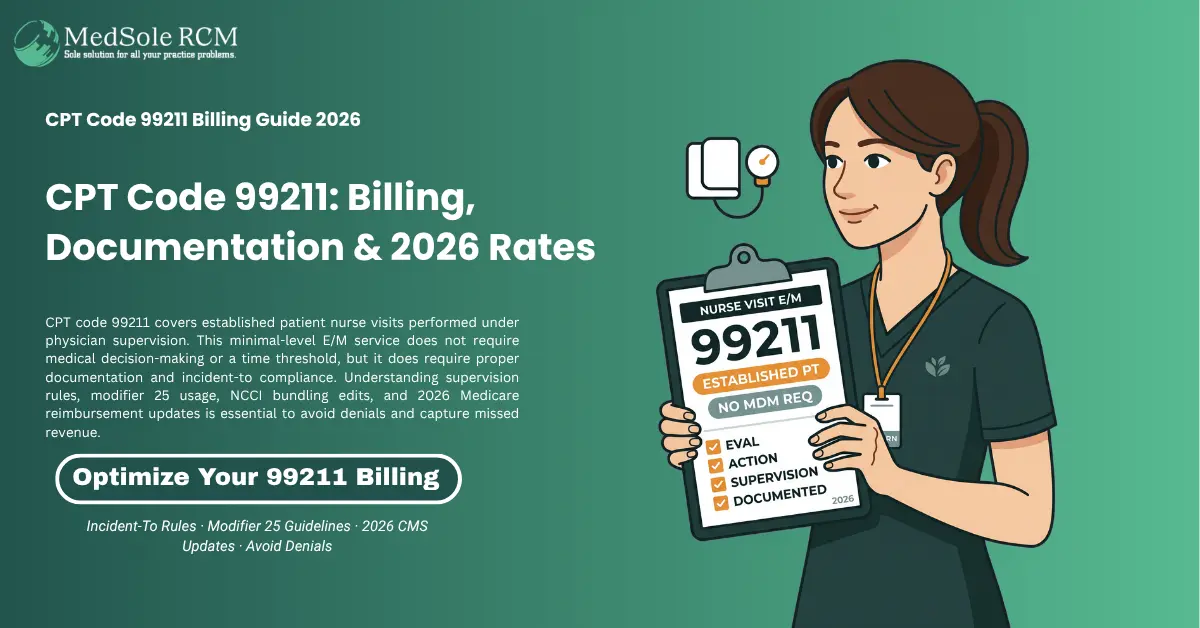
CPT code 99211 is the established patient evaluation and management code that covers exactly these visits, commonly called the "nurse visit" code because clinical staff typically perform the encounter without a physician in the room. This guide covers the full 99211 CPT code picture: definition, documentation requirements, who can bill it, when to use it, 2026 reimbursement rates, modifier rules, and a compliance checklist you can use before every submission.
Whether your practice handles billing in-house or works with an outside partner, getting this medical billing code 99211 right is a revenue protection issue. The encounters are happening. The question is whether you're capturing them.
What Is CPT Code 99211?
According to the American Medical Association's CPT guidelines, CPT code 99211 is defined as "an office or other outpatient visit for the evaluation and management of an established patient that may not require the presence of a physician or other qualified health care professional."
That's the official CPT code 99211 definition. What it means in real billing terms is that a nurse, medical assistant, or other clinical staff member can conduct a face-to-face patient encounter, document it appropriately, and bill it under this code without the physician stepping into the room.
The 99211 CPT code description covers minimal-level E/M services for established patients. It's the lowest-complexity code in the office and outpatient E/M range, sitting below 99212 through 99215. That lower complexity is also what makes it structurally different from every other code in the range.
Here's what the CPT 99211 description gets right that practitioners often miss: the code has no medical decision-making requirement. Every other E/M code from 99202 up requires either documented MDM or total time as the basis for code selection. This procedure code 99211 doesn't. That's not a gap. That's by design.
Key Characteristics of CPT Code 99211 at a Glance
-
Established patients only: The patient must have received a professional service from the physician or another physician of the same specialty in the same group within the past three years. New patients start at 99202, regardless of visit complexity.
-
No physician presence required: Clinical staff can perform the encounter. The physician must be available and supervising but doesn't need to be in the room. This is why practitioners call it the nurse visit CPT code.
-
No time threshold: The AMA removed the "typically 5 minutes" language in 2021. Time is not a factor in selecting 99211 and hasn't been for several years.
-
No MDM level required: This is the only office and outpatient E/M code that doesn't use medical decision-making or time-based leveling for code selection. Document the evaluation and the management action. That's the standard.
The CMS CY 2026 Physician Fee Schedule continues to recognize and reimburse 99211 under the Medicare Physician Fee Schedule, confirming its active status for the current year.
Is CPT Code 99211 Still Valid in 2026?
Yes. CPT code 99211 is still valid, actively reimbursed, and has not been deleted or discontinued. It remains part of the AMA's established patient E/M code set in 2026.
This question comes up constantly, and the anxiety behind it is understandable. The code changed twice in three years, and practices that weren't tracking those changes stopped billing it. That was a mistake. The code didn't go away. It got simpler.
How the CPT Language for 99211 Has Changed
1997 to 2020: The original CPT language read: "Office or other outpatient visit for the evaluation and management of an established patient, that may not require the presence of a physician. Usually the presenting problem(s) are minimal. Typically, 5 minutes spent performing or supervising these services." That "5 minutes" language is what most billers memorized. It's also what created confusion when it disappeared.
2021: The AMA's E/M guideline revision eliminated the time component entirely. The "typically 5 minutes" language was removed from the 99211 CPT code description time reference. This was part of the most significant overhaul of office visit coding in 25 years. Time is no longer a basis for selecting this code, and the 5-minute figure has no bearing on current billing decisions.
2022: The "minimal presenting problems" language was removed. The presenting problem level is no longer part of the code description. The AAO's documentation of these CPT language changes provides a detailed record of both revisions for practices that want the full regulatory background.
2025 to 2026: The code remains fully active. CMS continues to reimburse 99211 under the Medicare Physician Fee Schedule, and the CMS CY 2026 Physician Fee Schedule Final Rule permanently adopted virtual direct supervision for incident-to services, which directly affects how 99211 can be billed in practices with remote supervising physicians.
Is 99211 a valid CPT code in 2025 and into 2026? Yes, on both counts. The 99211 CPT code 2025 status carried forward without interruption into the current year.
The code isn't going anywhere. The changes made it easier to apply correctly, not harder. Practices that stopped billing after the 2021 revision because they weren't sure if the code still applied have been leaving real revenue uncaptured every week since then.
Who Can Bill CPT Code 99211?
One of the most common questions about this code is whether a physician has to be involved in the encounter. The short answer is no, but that doesn't mean supervision rules go away. The table below shows exactly who can bill CPT code 99211 and under what conditions.
|
Provider Type |
Can Bill 99211? |
Key Conditions |
|
Physician |
Yes |
Must document E/M service performed |
|
Nurse Practitioner (NP) |
Yes |
Under own NPI or incident-to |
|
Physician Assistant (PA) |
Yes |
Under own NPI or incident-to |
|
Registered Nurse (RN) |
Yes, incident-to |
Supervising physician must be available |
|
Licensed Practical Nurse (LPN) |
Yes, incident-to |
Supervising physician must be available |
|
Medical Assistant (MA) |
State-dependent |
Scope of practice varies by state |
|
Pharmacist |
Limited |
Requires specific payer authorization |
|
Administrative Staff |
No |
Not a clinical service |
Scope of practice for MAs varies by state. Verify with your state medical board before billing 99211 under a medical assistant's clinical activities.
99211 is the only E/M code that a registered nurse can bill as the rendering provider. That's what makes it unique in the office visit range and why the nurse visit cpt code label stuck. The 99211 nurse visit guidelines are built around that clinical staff role, not physician-led care.
What "Under Supervision" Actually Means for Medicare
Medicare doesn't require the physician to be standing in the exam room. What it does require is that the physician be present in the office suite and immediately available if needed. For incident-to billing, the physician must have initiated the patient's course of treatment. When a nurse delivers a service that's part of that established plan, the claim for procedure code 99211 goes out under the physician's NPI. That's the mechanism that makes the nurse visit billing model work under Medicare.
One thing that directly affects whether your clinical staff can bill 99211 under your practice's NPI at all is whether your supervising providers are properly enrolled and credentialed with each payer. Without active payer credentialing, none of this billing gets paid regardless of how clean the documentation is.
MedSole RCM handles payer credentialing for practices in all 50 states at $99 per payer enrollment, which is among the most competitive rates available. If your providers aren't fully credentialed, your billing code 99211 claims are being paid at reduced rates or denied entirely. That's fixable.
When to Use CPT Code 99211: Scenarios and Decision Guide
Most billing errors with this code don't happen at the documentation stage or during claim submission. They happen earlier, when someone decides whether the encounter qualifies in the first place. That's where the real mistakes get made. Knowing how to bill cpt 99211 correctly starts with getting that yes-or-no decision right before anything else happens.
The 99211 nurse visit guidelines give you the framework, but real scenarios are messier than frameworks. The table below covers the most common clinical situations with a clear billing decision and the reason behind it.
CPT 99211 Billing Scenario Decision Table
|
Clinical Scenario |
What Must Be Documented |
Bill 99211? |
Why |
|
BP check, physician-ordered, with medication review |
BP reading, clinical reason for visit, RN review with physician, management decision documented |
Yes |
Medical necessity established. E/M service performed under supervision. |
|
BP check, patient-initiated, no symptoms, no order |
BP reading only, no clinical indication documented |
No |
No physician order. No management decision. No E/M service. |
|
PPD test administration |
Administration of the TB skin test only |
No |
The PPD administration code includes the service. No separate E/M. |
|
PPD read (result interpretation) |
Reading documented, result recorded, clinical action noted |
Yes |
No separate CPT code exists for the read. 99211 is appropriate here. |
|
Suture removal, sutures placed at different practice |
Wound assessment, removal procedure, healing status documented |
Yes |
99211 covers this when no specific CPT for suture removal from another practice applies. |
|
Suture removal, sutures placed at same practice |
Wound assessment, removal procedure, healing status documented |
No |
The original procedure's global period includes the removal. Already paid. |
|
Medication management, refill with nursing evaluation |
Clinical evaluation of patient's response documented, side effect screen, physician notification |
Yes |
Face-to-face E/M service. Management decision made. |
|
Prescription pick-up, no clinical evaluation |
None beyond administrative |
No |
No E/M service performed. Administrative only. |
|
Depo injection (96372) only |
Injection documented, patient here for injection only |
No |
Injection administration code covers the service. 99211 is not separately billable. |
|
Depo injection with clinical evaluation under physician order |
Injection plus clinical evaluation documented, vitals, assessment, physician order on file |
Yes |
The E/M service is separate and distinct from the injection. Modifier 25 applies. |
|
Blood draw only, asymptomatic |
Lab draw documented only |
No |
Venipuncture code (36415) covers this. No E/M component. |
|
Lab result review, medication adjustment documented |
In-person discussion, result interpretation, medication adjustment documented |
Yes |
Clinical decision made. Face-to-face E/M service complete. |
|
Simple dressing change for wound care |
Wound assessment, dressing application, healing status noted |
Yes |
Distinct E/M service not covered by procedure code. |
|
Dressing change during global surgical period |
Wound assessment, dressing application, healing status noted |
No |
Post-operative care is included in the global payment for the original procedure. |
|
Diabetic counseling by RN |
Blood glucose review, diet and exercise plan documented, physician oversight noted |
Yes |
Clinical evaluation and management performed by RN under supervision. |
|
Vaccine administration only (flu, pneumonia) |
Vaccine given, administration documented |
No |
NCCI bundles 99211 with vaccine administration codes 90460 to 90474. Not separately billable. |
Per CMS NCCI Policy Manual and AMA CPT guidelines. Payer policies vary. Verify with your specific MAC and commercial payers before billing.
Can you bill 99211 and 96372 together? The Depo injection rows answer that directly. The injection alone doesn't support a separate E/M. A documented clinical evaluation performed on the same day, under physician order, with Modifier 25 on the claim, does.
The One Question That Determines Every 99211 Decision
The question is simple. Did a clinical staff member perform an evaluation and a management action, separately from any procedure, for an established patient, with a supervising physician available? If the answer is yes to every part of that, the medical billing code 99211 applies. If any one piece is missing, it doesn't.
When You Should Not Bill CPT Code 99211
Billing 99211 incorrectly is one of the most reliable ways to land on a CMS and commercial payers' audit radar. Payers don't look at individual claims in isolation. They look for patterns. A practice repeatedly billing 99211 next to injection codes without clear supporting documentation is a pattern they're trained to find. These are the 99211 billing requirements that trip practices up most often, along with why each one matters.
Do Not Bill CPT Code 99211 for These Services
-
Routine medication administration, including injections and infusions. The administration code already covers the clinical staff work involved. Billing cpt 99211 on top of it triggers an NCCI edit violation.
-
Blood pressure checks that don't lead to a management decision. If the nurse takes the reading, writes it down, and the visit ends there, no E/M service occurred. The check alone doesn't support the code.
-
Blood draws and venipuncture. The venipuncture code 36415 covers the encounter. Adding 99211 separately is bundling, and it's one of the top audit triggers under Medicare.
-
Faxing records or completing forms. Administrative tasks aren't clinical services. No evaluation happened, no management action was taken, and 99211 doesn't apply.
-
Telephone calls to report lab results. The call isn't a face-to-face encounter. This code requires in-person contact between the patient and clinical staff.
-
Prescription refills with no clinical evaluation. A patient calling in or picking up a refill without any nursing assessment doesn't support billing code 99211. If a nurse actually evaluates the patient's medication response and documents it, that's a different encounter entirely.
-
Vaccine administration covered by codes 90460 to 90474 or G0008 to G0010. CMS NCCI policy prohibits billing 99211 separately with these codes. The administration codes already account for the clinical staff interaction involved.
-
Diagnostic or therapeutic procedures where the service is bundled. When a procedure code covers the work performed, 99211 isn't separately payable. Billing both is a bundling error, not a gray area.
-
Post-operative visits within a global surgical period. The global payment for the original procedure includes routine follow-up care. Billing 99211 for a wound check after your own surgery is not separately reimbursable.
-
New patient encounters. CPT code 99211 is for established patients only. A new patient's first visit starts at 99202 regardless of how simple the visit appears.
These restrictions align with guidance from EmblemHealth, the CMS Claims Processing Manual, and Medicare Administrative Contractor policy. Payer-specific edits may add restrictions beyond this list.
Documentation Requirements for CPT Code 99211
Documentation is where most CPT code 99211 claims fall apart on audit review. Not because the service wasn't provided. Because the note doesn't prove it happened. Payers reviewing how to bill cpt 99211 correctly aren't looking for task logs. They need to see clinical evaluation and a management response. A note that reads "BP checked, patient left" doesn't support an E/M service, and it won't survive payer scrutiny.
What Every CPT 99211 Note Must Include
These seven elements define the 99211 billing requirements that auditors check first. The 99211 cpt code description covers a minimal-level E/M service, but "minimal" doesn't mean undocumented.
-
Chief complaint or reason for the visit. The note must state why the patient came in. "BP recheck per physician order" or "wound follow-up per established treatment plan" gives auditors the medical necessity anchor the claim needs to stand on.
-
Clinical assessment performed. Document what the staff member actually evaluated: the blood pressure reading, the wound's appearance, the patient's reported symptoms. A number alone isn't enough. The note needs to show what that number or observation meant clinically.
-
Management decision or action taken. This is the "management" side of evaluation and management, and it's what separates a billable encounter from a task. Medication continued. Physician notified of elevated reading. Patient instructed to return if symptoms worsen. Without a documented response, the E/M service isn't complete.
-
Identity and credentials of the rendering staff. The name and credential of the clinical staff member who performed the visit must appear in the note. RN, LPN, or MA, with the supervising physician identified alongside.
-
Identity of the supervising physician. For incident-to billing under Medicare, the note must name the supervising physician who was present at the time of service. As of January 1, 2026, virtual direct supervision via real-time audio and video is permanently accepted by CMS for most incident-to services, including 99211. The mode of supervision should be documented.
-
Date of service. Required on every claim and every note. Sounds obvious. Gets missed more often than you'd expect, and a missing or inconsistent date is an easy denial trigger.
-
Connection to the established plan of care. For Medicare incident-to billing specifically, the note should reflect that the visit is part of a treatment plan the supervising physician initiated. A standalone note with no reference to the broader plan is a compliance risk that surfaces quickly in audits.
What the Note Does NOT Have to Include
Unlike 99212 through 99215, the cpt 99211 definition doesn't require a formal history, a formal physical examination, or a documented level of medical decision making. Those key component requirements belong to higher-level E/M codes. The 99211 cpt code definition asks only that the note show the visit occurred, why it occurred, and what clinical action followed.
Some practices build note templates for their most common 99211 scenarios: a blood pressure recheck template, a wound care follow-up template, a medication monitoring template. That's a practical workflow decision. Templates keep documentation consistent and ensure every billing code 99211 submission includes the required elements without relying on staff memory under pressure.
Consistent documentation is one of the most controllable variables in any revenue cycle management process. Per cms guidelines for billing 99211, the standard isn't complicated. The challenge is applying it the same way every time.
CPT 99211 and Incident-To Billing: Medicare Rules Explained
Medicare has its own layer of rules for CPT code 99211 that go beyond the standard CPT definition. The code is most commonly billed under Medicare's incident-to framework, and getting those rules wrong creates compliance exposure quickly. The good news is that the rules aren't complicated once they're laid out clearly. Here's what actually has to be true for a cpt 99211 claim to qualify under Medicare.
Medicare Incident-To Requirements for CPT 99211
Per CMS guidance, all five of these conditions must be satisfied. There's no partial credit on incident-to compliance.
-
The patient must be an established patient. Medicare doesn't cover 99211 as an incident-to service for new patients. The patient must have received prior services from the supervising physician, or from a physician of the same specialty within the same group practice, before this visit qualifies.
-
The supervising physician must have initiated the plan of care. Per Noridian's incident-to guidance, the visit being billed as 99211 must be part of a treatment plan the physician established. Clinical staff are carrying out a step in that plan, not directing independent care.
-
The supervising physician must be present in the office suite. The physician doesn't need to be in the exam room. As of January 1, 2026, Medicare permanently allows virtual direct supervision via real-time audio and video for most incident-to services, including CPT 99211. Being off-site without that live connection doesn't satisfy the requirement.
-
The service must be within the clinical staff member's scope of practice. Scope varies by state. What an MA can perform in one state may require an RN in another. The 99211 nurse visit guidelines apply within those state-specific boundaries.
-
The service must be rendered in the appropriate place of service. Most 99211 incident-to claims use Place of Service code 11 for office. Hospital outpatient claims work differently, sometimes referenced alongside revenue code 761, and carry their own specific billing requirements. Verify with your MAC for outpatient facility context.
The 2026 Virtual Supervision Rule: What Changed and What It Means
Effective January 1, 2026, CMS finalized the permanent adoption of virtual direct supervision for incident-to services. A supervising physician can now fulfill the presence requirement through a real-time audio and video connection rather than being physically in the office. This isn't a temporary extension. It's permanent policy under the CY 2026 Physician Fee Schedule Final Rule, and it changes the logistics for practices where the supervising physician works across multiple locations.
Practices billing 99211 under virtual supervision need to update their note templates to capture this. The note should identify the supervising physician, specify whether supervision was in-person or virtual, and confirm the physician was immediately available during the encounter.
One issue that surfaces regularly in incident-to audits is that the supervising physician isn't properly enrolled with the payer whose contract is being billed under. When that happens, the incident-to claim fails regardless of documentation quality. Enrollment gaps don't show up until the denials start coming back.
MedSole RCM manages provider enrollment and credentialing in all 50 states. At $99 per payer enrollment, we make sure the physician behind every incident-to claim is active and billable before a single 99211 claim goes out the door. That's a problem most practices don't find until the EOBs come back denied.
CPT Code 99211 and Modifier 25: When It Applies and When It Does Not
CPT code 99211 does not require a modifier when billed alone. The code stands on its own for a standard nurse visit encounter. Modifiers only come into play under specific circumstances, and the rules differ by payer in ways that have caught practices off guard.
When Modifier 25 Applies to CPT 99211
Modifier 25 tells the payer that a separately identifiable E/M service was performed on the same day as a procedure. For cpt 99211, this matters when a nurse conducts a documented clinical evaluation and a procedure also happens during the same visit. The classic scenario: a patient comes in for a Depo injection billed under 96372, but the nurse also evaluates the patient's contraception response and documents that evaluation separately. The 99211 cpt code description covers the E/M portion, Modifier 25 goes on that code, and 96372 covers the injection. Both codes go on the same claim, each with its own clinical justification.
The Payer-Specific Modifier 25 Problem
This is where practices get caught. Anthem Blue Cross Blue Shield updated its Modifier 25 and 57 policy effective April 1, 2023, to deny billing code 99211 when Modifier 25 is appended. Before that policy change, the combination was reimbursable under Anthem contracts. After April 1, 2023, those claims are denied. It's not a universal rule across all payers, but it's a specific Anthem policy that has created unexpected denials for practices that didn't catch the update.
When billing cpt code 99211 with 25 modifier, the ICD-10 diagnosis code on the E/M service must also support a distinct clinical reason for that visit, separate from the diagnosis supporting the procedure. Using the same ICD-10 code across both services without clinical justification is a denial trigger that compounds the Modifier 25 problem.
Before submitting a cpt code 99211 with 25 modifier claim for any commercial payer, check that payer's current modifier policy. Provider manuals and payer portals update more frequently than most billing teams review them. Check the current policy, not last year's assumption.
Modifier 95: Telehealth and CPT 99211
Modifier 95 applies when a 99211 encounter is delivered via synchronous audio and video telehealth. Not every payer covers 99211 for telehealth services, and the ones that do have specific eligibility criteria. Medicare's CY 2026 telehealth coverage lists define which services qualify, and 99211 isn't automatically included. Verify payer-specific telehealth coverage for this code before submitting any Modifier 95 claim.
CPT 99211 vs 99212: How to Choose the Right Code
The most common coding confusion in the established patient E/M range comes down to one question: is a physician or qualified health care professional personally performing the E/M service, or is clinical staff doing it under supervision? That single distinction separates CPT code 99211 from 99212 in almost every scenario.
|
Feature |
99211 cpt code |
CPT Code 99212 |
|
Who performs the service |
Clinical staff (RN, LPN, MA) |
Physician, NP, or PA directly |
|
Physician presence required |
No |
Required for the E/M portion |
|
Medical decision making |
Not applicable |
Straightforward MDM required |
|
Time threshold |
No specific threshold |
10 to 19 minutes total encounter time |
|
Patient type |
Established only |
Established only |
|
Complexity |
Minimal |
Low to straightforward |
|
Typical scenario |
BP recheck, wound check, med monitoring |
Minor illness evaluation, prescription with assessment |
|
2026 Medicare rate (non-facility) |
~$24 |
~$56 |
2026 Medicare rates are approximate national averages per the CMS Physician Fee Schedule. Verify exact rates with your MAC and the CMS Physician Fee Schedule Look-Up Tool.
That rate gap matters. Undercoding a physician-performed encounter as cpt 99211 when it qualifies as 99212 costs your practice roughly $32 per claim. At 10 claims per week, that's over $16,000 in annual revenue left on the table from one coding error alone. If you want the full picture on what 99212 requires and how to bill it correctly, our CPT code 99212 billing guide covers the documentation standards, MDM requirements, and 2026 rates for that code in detail.
The Three Questions to Ask Before Choosing Between These Codes
When a claim is in front of you and you're deciding between these two office visit cpt codes, run through these three questions in order:
-
Who performed the clinical service during this encounter: a physician or qualified health care professional, or clinical staff under supervision?
-
Did the rendering provider perform a clinical evaluation and make or communicate a management decision, or did they complete a task under a standing protocol?
-
Did the encounter involve any level of physician-performed medical decision making, or was the physician's role limited to supervision?
If the answer to question one is clinical staff, question two is task completion, and question three is supervision only, the encounter is 99211. If a physician or qualified health care professional personally performed the evaluation and management with any degree of decision making, start at 99212 and go up from there based on MDM level or total time.
Coding these correctly matters for your revenue cycle management reporting as well. Undercoding 99212 as 99211 is a revenue leak that shows up consistently in claim audits, and it's one of the more fixable problems in any practice's billing pattern.
CPT Code 99211 Reimbursement Rates: 2026 Medicare and Commercial Data
99211 cpt code reimbursement is among the lowest in the E/M range. That's accurate. But the per-claim rate isn't the number that should drive the conversation. The real question is how many legitimate 99211 encounters a practice provides every week without billing for them. That's where the actual revenue gap lives.
|
Payer / Setting |
2026 CPT Code 99211 Rate |
|
Medicare (non-facility, office) |
~$23 to $24 |
|
Medicare (facility, hospital outpatient) |
~$15 |
|
Commercial insurance (average) |
$25 to $40 |
|
Medicaid |
Varies by state; typically lower |
Medicare rates are approximate 2026 national averages per the CMS Physician Fee Schedule. Exact rates vary by geographic locality and Medicare Administrative Contractor. Use the CMS PFS Look-Up Tool to verify your specific payment amount.
The Revenue Math on CPT 99211
Run the numbers on a practice that sees 10 established patients per week who qualify for this code and currently bills nothing for those encounters. At the Medicare non-facility rate, that's $230 to $240 in uncaptured revenue every week. Over 50 weeks, the cpt code 99211 reimbursement gap reaches $11,500 to $12,000 per year from Medicare alone. For practices with a stronger commercial payer mix at $35 average per claim, that annual figure climbs well above $17,000 from this single code.
The 99211 cpt code description time requirement no longer exists, which means there's no minimum visit length standing between a qualified encounter and a billable claim. The barrier isn't the code. It's capture.
|
CPT Code |
Description |
2026 Medicare Rate (Non-Facility) |
|
99211 |
Minimal established patient visit |
~$24 |
|
Low-level established patient visit |
~$56 |
|
|
Moderate established patient visit |
~$96 |
|
|
Moderate-high established patient visit |
~$136 |
|
|
High-level established patient visit |
~$179 |
Rates are approximate 2026 national averages. Verify with the CMS PFS Look-Up Tool for your locality and setting.
Does 99211 Have a Patient Copay?
Yes. CPT 99211 is subject to the patient's standard office visit cost-sharing, including copays and deductibles, the same as any other E/M code. Whether a copay applies depends on the patient's specific plan and whether the service meets that plan's benefit criteria for office visits.
Practices that want to understand their current 99211 capture rate relative to what they should be billing can identify that gap through a billing audit. It's one of the most consistent revenue recovery findings in a full outsourced medical billing services review, and it rarely takes long to surface.
MedSole RCM offers full-service medical billing at 2.99% of collected revenue. For practices that are underbilling 99211 and a handful of other routine codes, the recovery from correcting those patterns often covers the billing fee entirely. If you want to know what your current capture rate looks like, we can show you.
2026 Official Updates: What Changed for CPT Code 99211
2026 brought real changes to how CPT code 99211 is billed under Medicare. Some of them are visible in the fee schedule. Others affect supervision rules and add-on code billing in ways that don't show up in the code description itself. Here's what actually changed and what each update means for your claims.
1. Virtual Direct Supervision Permanently Adopted (Effective January 1, 2026)
CMS finalized permanent adoption of virtual direct supervision for most incident-to services, including cpt 99211. A supervising physician can now fulfill the supervision requirement via a real-time audio and video connection. This is not temporary. It is not a COVID-era waiver extension. It is permanent policy under the CMS CY 2026 Physician Fee Schedule Final Rule. Practices billing 99211 incident-to on days when the supervising physician is remote now have a fully compliant framework for that billing.
Per the CMS CY 2026 Physician Fee Schedule Final Rule, published November 5, 2025, in the Federal Register.
2. G2211 Add-On Code Exception Expanded (Effective January 1, 2025, Carried into 2026)
HCPCS code G2211, the office and outpatient E/M complexity add-on code, is now co-billable with the 99211 cpt code description range through 99215 on the same day as an Annual Wellness Visit or Medicare preventive service when Modifier 25 is present on the base E/M code. Previously, any claim carrying Modifier 25 blocked G2211 payment entirely. The preventive service exception changed that for qualifying visits, and it carries forward in full through 2026.
3. CY 2026 Conversion Factor Increase
The CY 2026 Medicare conversion factor increased to $33.59 for qualifying APM participants, a 3.83% increase from CY 2025. That increase applies to all E/M services, including cpt 99211, and it's reflected in the 2026 reimbursement rates in the table above. For practices in fee-for-service Medicare, the applicable conversion factor differs. Verify with your MAC for the rate that applies to your specific payment model.
4. NCCI Bundling Rules Remain Strictly Enforced
The CMS NCCI Policy Manual continues to prohibit separate billing of 99211 with chemotherapy administration codes, non-chemotherapy infusion codes, and most diagnostic and therapeutic injection codes. Nothing relaxed here. High-volume injection practices should run their claim patterns against current NCCI edits at least annually. A pattern of 99211 alongside bundled injection codes is a consistent audit trigger, and the enforcement posture on this hasn't changed.
Whether is cpt code 99211 still valid heading into 2026 isn't a question worth losing sleep over. The code is active, reimbursed, and unchanged in its core description. What changed is the billing environment around it. Staying current on these four updates is what separates clean claims from preventable denials. The 99211 cpt code 2025 carry-forward into 2026 was seamless. What's required now is applying the updated supervision rules and G2211 exception correctly on every qualifying claim.
CPT 99211 Billing Compliance Checklist: 10 Questions Before You Submit
Before submitting any CPT code 99211 claim, run through these 10 questions. All 10 answers need to be yes. If any answer is no, the claim has a problem that needs to be fixed before it goes out. These 99211 billing requirements apply whether you're billing Medicare, Medicaid, or commercial payers.
-
Is this an established patient who has been seen by a provider in this group within the past three years?
-
Did the encounter occur face-to-face, either in person or via a payer-approved telehealth format?
-
Did the clinical staff member perform both an evaluation and a management action, not just a task?
-
Is the supervising physician enrolled and credentialed with the payer being billed?
-
Was the supervising physician present in the office suite or available via real-time audio and video during the encounter?
-
Is this visit separate from any same-day procedure in terms of documented clinical purpose?
-
Does the note include the identity and credentials of the rendering staff member?
-
Does the note clearly state the medical necessity for this specific visit?
-
Have the NCCI bundling rules been checked for any same-day codes on this claim?
-
Does the ICD-10 diagnosis code support the reason for this visit?
Knowing how to bill cpt 99211 correctly means running this check consistently, not occasionally. The documentation requirements for cpt code 99211 are straightforward, but claims fail when the verification step gets skipped under volume pressure.
Checklist developed in alignment with CMS Claims Processing Manual guidance, AMA CPT guidelines, and Medicare Administrative Contractor published documentation standards.
If your billing team is running this checklist manually on every 99211 cpt code submission, that's a process worth reviewing. Our outsourced medical billing services team manages this verification automatically as part of the standard submission workflow. It's one less thing your clinical staff has to track.
ICD-10 Codes Commonly Billed with CPT Code 99211
The ICD-10 diagnosis code on a 99211 cpt code claim needs to support the medical necessity of the specific visit being billed. Assigning a diagnosis code because it's convenient rather than accurate is a compliance problem, not a minor oversight. These are the codes most commonly paired with billing code 99211 in clinical practice, along with the scenarios where each one applies.
|
ICD-10 Code |
Description |
Common 99211 Scenario |
|
I10 |
Essential hypertension |
Blood pressure recheck under physician order |
|
Z79.01 |
Long-term anticoagulant use |
Warfarin or anticoagulation monitoring visit |
|
Z87.39 |
Personal history of other skin disorders |
Wound care or suture removal follow-up |
|
Z09 |
Encounter for follow-up examination |
General follow-up on resolved condition |
|
E11.9 |
Type 2 diabetes mellitus without complications |
Diabetic monitoring visit, blood glucose check |
|
Z79.4 |
Long-term insulin use |
Insulin dosing education or injection follow-up |
|
J06.9 |
Acute upper respiratory infection |
Symptom recheck, established patient |
ICD-10 codes must reflect the actual reason for the patient's visit. Never assign a diagnosis code solely to justify billing CPT code 99211.
Frequently Asked Questions About CPT Code 99211
Q1: What is CPT code 99211 used for?
CPT code 99211 is used for minimal-level, face-to-face office visits for established patients, typically performed by clinical staff like nurses under physician supervision. Common examples include blood pressure rechecks, wound dressing changes, and suture removal. The nurse visit cpt code label comes directly from this pattern of use.
Q2: What are the nurse visit CPT code 99211 guidelines?
The 99211 nurse visit guidelines require that the patient be an established patient and that the nurse perform both a clinical evaluation and a management action, not just a task. The physician doesn't need to be in the room but must be available. Document the nurse's identity and credentials, the clinical reason for the visit, the action taken, and the supervising physician's name.
Q3: Is CPT code 99211 still valid in 2026?
Yes. Is cpt code 99211 still valid? Absolutely. The code has not been deleted or discontinued, and the AMA retained it fully in 2026. The time component was removed in 2021, and the presenting problem language was removed in 2022. The code is simpler to apply now, not harder.
Q4: What is the difference between CPT codes 99211 and 99212?
The core distinction is who performs the service. CPT code 99211 covers encounters performed by clinical staff under physician supervision. CPT code 99212 requires a physician or qualified health care professional to personally perform the E/M service, with straightforward medical decision making or 10 to 19 minutes of total encounter time. The 99211 cpt code has no MDM requirement at all. For a full breakdown of 99212 requirements, documentation standards, and 2026 rates, see our CPT code 99212 billing guide.
Q5: What is the Medicare reimbursement rate for CPT code 99211 in 2026?
The 2026 Medicare national average 99211 cpt code reimbursement is approximately $23 to $24 for non-facility settings. The facility rate for hospital outpatient settings is approximately $15. Commercial payers typically reimburse $25 to $40 per claim. Verify exact medicare reimbursement for 99211 in your locality using the CMS PFS Look-Up Tool.
Q6: Does CPT code 99211 need a modifier?
No, CPT code 99211 does not require a modifier when billed alone. The 99211 modifier 25 situation only applies when a separately identifiable E/M service is performed on the same day as a procedure. Even then, using cpt code 99211 with 25 modifier creates a denial risk with certain payers: Anthem Blue Cross Blue Shield updated its policy effective April 1, 2023, to deny 99211 when Modifier 25 is appended.
Q7: Can you bill CPT 99211 and 96372 together?
It depends on whether a separate, documented E/M service was performed beyond the injection itself. If the nurse only administered the injection, bill 96372 only. Can you bill 99211 and 96372 together when a clinical evaluation also occurred? Yes, if that evaluation is separately documented and Modifier 25 is appended to 99211, but verify the specific payer's modifier policy before submitting.
Q8: Can a medical assistant bill a 99211?
It depends on state scope-of-practice rules. Can a medical assistant bill a 99211 in your state? In states where MAs can perform clinical evaluations, a 99211 billed under incident-to supervision may be appropriate. In states where MA scope doesn't include clinical E/M services, 99211 isn't the right code regardless of what the MA documented. Verify with your state medical board before billing.
Q9: How often can CPT 99211 be billed?
There is no defined frequency limit for CPT code 99211 under Medicare. Payers may have benefit limitations that cap the number of covered office visits per period, and high volumes relative to practice size can trigger audit review. Document every encounter clearly and bill only for visits that meet all qualifying criteria.
Q10: Can 99211 be billed for a lab draw?
No. Venipuncture and lab draws are covered by code 36415. Billing 99211 separately for a blood draw creates a bundling error under NCCI edits. The only exception is if a distinct, separately documented E/M service was performed during the same encounter that goes beyond the draw itself, with clear clinical documentation supporting that separate service.
Q11: Does Medicare pay for CPT code 99211?
Yes, Medicare covers CPT code 99211 for established patients when medically necessary. Services are typically billed under Medicare's incident-to framework, which requires the supervising physician to be available either in person or via virtual supervision, per the 2026 CMS rule. Documentation must demonstrate both medical necessity and that a clinical evaluation occurred.
Q12: What is the billing guideline for CPT code 99211?
The baseline billing guideline for CPT code 99211 covers five requirements: established patient, face-to-face encounter, clinical evaluation and management performed by clinical staff, physician supervision available, and documentation supporting medical necessity. For payer-specific requirements that go beyond these baseline rules, refer to CMS guidelines for billing 99211, the AMA CPT manual, and your MAC's published guidance.
Getting CPT code 99211 billing right isn't complicated once the rules are clear. The challenge is consistent execution: documentation on every qualifying encounter, accurate scenario decisions, staying current with annual CMS updates, and tracking payer-specific policy changes like the Anthem Modifier 25 update. Those aren't one-time fixes. They require ongoing attention.
Most practices don't have a dedicated compliance resource tracking all of that alongside day-to-day claim volume. That's not a failure. It's a workflow reality. When billing gets deprioritized because the clinical team is stretched, 99211 cpt code charges are often the first to slip because they're small, they're nurse-driven, and they're easy to miss. Slipped 99211 charges rarely get picked up in AR follow-up because they were never billed in the first place. The ones that do get submitted incorrectly end up in denials management queues that take time and staff resources to resolve.
MedSole RCM handles full-service medical billing at 2.99% of collections and payer credentialing at $99 per enrollment for practices in all 50 states. If 99211 is slipping through the cracks, it's probably not alone. We can run a billing review and show you where the gaps are. That's a straightforward conversation.