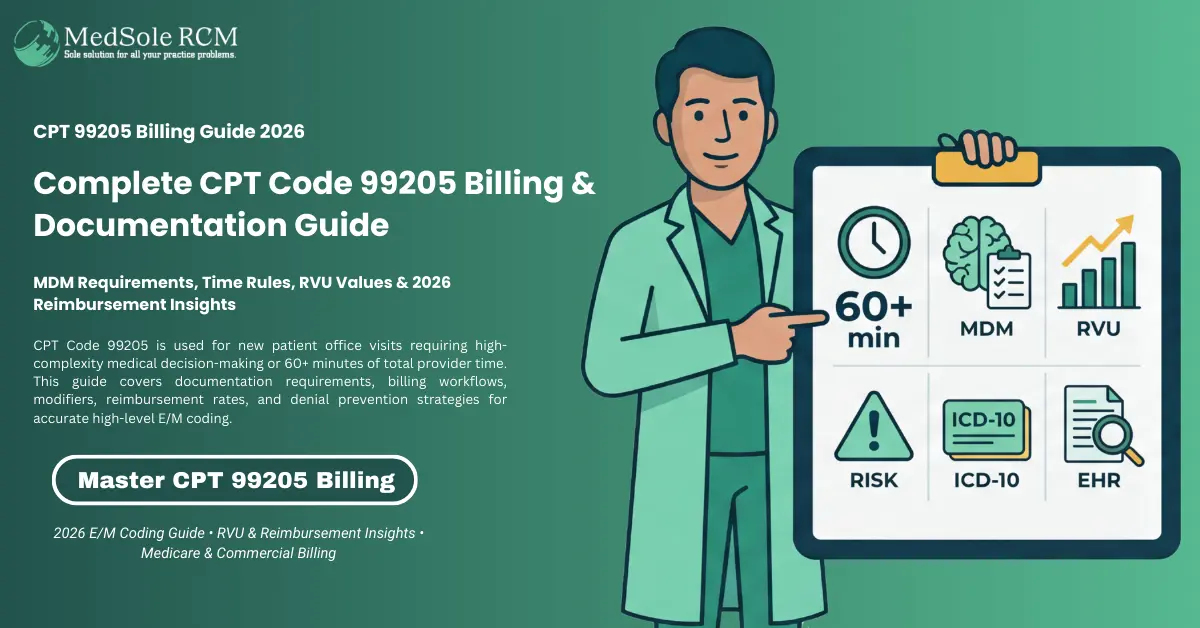




99205 CPT code is the highest-level evaluation and management (E/M) code for new patient office or outpatient visits. It requires high-complexity medical decision-making (MDM) or a minimum of 60 minutes of total provider time on the date of the encounter. The 2026 Medicare reimbursement rate is approximately $236.81 (non-facility). This guide covers everything you need to know: time requirements, MDM criteria, RVU breakdown, documentation, modifiers, denial prevention, and 2026 billing updates.
What Is CPT Code 99205?
99205 Official Description & CMS Short Descriptor
Official AMA CPT Descriptor: "Office or other outpatient visit for the evaluation and management of a new patient, which requires a medically appropriate history and/or examination and a high level of medical decision-making."
The 99205 CPT code is the highest-complexity office visit available for new patients in the outpatient E/M code set. As defined in the AMA's official CPT evaluation and management guidelines, the CPT code 99205 definition requires a medically appropriate history or exam paired with high-level medical decision-making.
Put simply, it's the code for your most complex new patient visits. Think serious, multi-system conditions demanding your highest level of clinical attention.
The CMS short descriptor reads "Office o/p new hi 60 min." When you pull up the CPT code 99205 description in a fee schedule or payer portal, that abbreviated label is what shows next to the reimbursement amount.
CPT code 99205 is found in the Evaluation and Management section of the CPT manual, under "Office or Other Outpatient Services, New Patient," and represents the most complex new patient visit in outpatient settings.
What Level of Care Is 99205?
So what is CPT code 99205 in terms of care level? It's a Level 5 E/M code, the highest evaluation and management tier for new patients in office or outpatient settings.
The new patient E/M range runs from 99202 to 99205. Each step up reflects greater clinical complexity and higher reimbursement. Code 99204 covers visits with moderate complexity; 99205 covers high complexity. There's nothing above it for outpatient new patient encounters.
For established patients, the equivalent top-tier code is 99215. Same high-complexity MDM threshold, different patient status. Knowing where 99205 sits in this hierarchy matters because it directly affects your documentation requirements and your bottom line.
Who Qualifies as a "New Patient"?
A patient is considered "new" if they haven't received any professional services from the physician, or another physician of the same specialty and subspecialty in the same group practice, within the past three years. That's the AMA's 3-year rule, and it's the only definition that matters for billing.
Here's where it gets tricky. Say a patient saw a cardiologist in your group two years ago, and now they're seeing another cardiologist in the same group. That patient is established because it's the same specialty. But if they're now seeing a dermatologist instead, they qualify as new.
On-call and covering providers create similar confusion. If your partner (same specialty) saw the patient while you were on vacation 18 months ago, that patient is established for your entire practice.
Getting the new vs. established distinction wrong is one of the most common billing errors with 99205 claims. Verify patient status against the 3-year rule before the visit, not after.
Two Pathways to Select 99205: MDM or Time
Since the 2021 E/M overhaul, providers can select the 99205 CPT code based on either of two pathways: high complexity medical decision making, or a minimum of 60 minutes of total time on the date of the encounter.
You don't need both. If your MDM qualifies as high, you can bill 99205 regardless of visit length. And if the visit runs past 60 minutes but MDM is only moderate, time alone can justify the code for a new patient encounter.
Both pathways are covered in detail in the sections below.
99205 Time Requirements: Updated for 2025
Total Time on Date of Encounter: 60 Minutes Minimum
The 99205 CPT code requires a minimum of 60 minutes of total provider time on the date of encounter, including face-to-face evaluation, record review, test ordering and interpretation, care coordination, counseling, and documentation. Staff time does not count.
That's the current 99205 time requirement for 2025, and it reflects a real shift from how AMA previously described this threshold.
Older guidance framed 99205 time as a 60 to 74 minute range, which made 60 sound like just the low end of a window. The updated CPT code 99205 description for time is clearer: "60 minutes must be met or exceeded." It's a minimum threshold, not a range floor.
Here's what matters in practice: total time on the date of encounter includes everything you personally do for that patient on the calendar day, not just minutes in the exam room. Pre-visit chart review and post-visit documentation both count toward your total.
What Activities Count Toward Total Time?
When billing the 99205 CPT code based on time, only certain activities count toward your total time on the date of encounter. Here's what qualifies, per AAFP's evaluation and management time and MDM reference table:
Counts toward total time:
-
Reviewing records, tests, or imaging before the visit
-
Obtaining or reviewing a separately obtained history
-
Performing a medically appropriate examination
-
Counseling and educating the patient or family
-
Ordering medications, tests, or procedures
-
Coordinating care (when not separately reported)
-
Documenting clinical information
-
Independently interpreting results
-
Communicating results to the patient
Does NOT count:
-
Staff time (MA vitals, nursing assessments)
-
Separately reported services or procedures
-
Travel time
-
General teaching not specific to the patient
Face-to-face time is only one component. A 30-minute exam combined with 15 minutes of pre-visit record review and 18 minutes of post-visit documentation gets you past the 60-minute threshold.
Sample Time Documentation Statement
Your time documentation needs to make the math clear. Here's a template you can adapt:
"Total time personally spent by me on the date of service: 67 minutes. Activities included: review of external records (15 min), face-to-face evaluation (30 min), ordering and reviewing diagnostic tests (8 min), care coordination with cardiology (4 min), and clinical documentation (10 min). Separately billable services excluded."
List specific activities with minutes attached. That's what holds up on audit.
Time-Based Coding vs MDM-Based Coding: Which to Choose?
Pick the method that best captures the encounter. A high-intensity 40-minute visit with a life-threatening condition is better reflected by MDM. When a 65-minute visit involves moderate-complexity decisions, time for 99205 is the stronger path.
One AMA clarification that's often missed: when you select 99205 based on MDM, there's no requirement to document total time. You only need to record minutes if time is the basis for code selection.
That gives you real flexibility. If your MDM clearly hits the high-complexity threshold, don't stress about tracking every minute. When the visit runs long and clinical decisions stay moderate, let the clock carry the code.
New Patient E/M Time Thresholds
|
CPT Code |
Minimum Time |
MDM Level / Description |
|
99202 |
15 minutes |
Straightforward |
|
99203 |
30 minutes |
Low |
|
99204 |
45 minutes |
Moderate |
|
99205 |
60 minutes |
High |
|
99205 + 99417 |
75+ minutes |
Prolonged services (Commercial) |
|
99205 + G2212 |
89+ minutes |
Prolonged services (Medicare) |
Medical Decision Making (MDM) Requirements for 99205
What Is High Complexity MDM?
The three elements of medical decision making for the 99205 CPT code are: the number and complexity of problems addressed, the amount and complexity of data reviewed and analyzed, and the risk of complications and morbidity associated with patient management. At least two of these three elements must meet the "high" threshold.
That's the CPT code 99205 definition when it comes to MDM. You don't need to satisfy all three. Two out of three at the high level meets the 99205 requirements, per the CMS Medicare Learning Network guide on evaluation and management services.
Element 1: Number and Complexity of Problems
For medical decision making to qualify as high complexity under this element, the patient needs to present with at least one of these:
-
One or more chronic illnesses with severe exacerbation, progression, or side effects of treatment
-
One acute or chronic illness or injury that poses a threat to life or bodily function
Clinical examples: uncontrolled diabetes with DKA, acute MI, newly diagnosed malignancy, severe COPD exacerbation, or major depressive disorder with active suicidal ideation.
Severity language in your documentation matters. "Depression" alone won't support 99205. "Severe major depressive disorder with active suicidal ideation requiring safety planning and potential hospitalization" will. The clinical picture might be identical, but the note needs to reflect the actual complexity of what you're managing.
Element 2: Amount and Complexity of Data
"Extensive" data review is the threshold. To qualify, you need to meet at least two of these three categories:
-
Category 1: Reviewing or ordering three or more unique tests, documents, or independent sources
-
Category 2: Independent interpretation of a test you didn't separately report (reading an EKG or chest X-ray yourself)
-
Category 3: Discussion with an external physician or qualified health professional who independently evaluated the patient
What does this look like in practice? You review a hospital discharge summary, cardiology consult notes, and recent labs (Category 1), then call the specialist to coordinate an urgent referral (Category 3). Two categories met. You're there.
Category 2 is one that often gets overlooked. If you personally read a chest X-ray or EKG and document your own clinical findings rather than relying solely on the radiologist's report, that counts. Just don't bill the interpretation as a separate service on the same claim.
Element 3: Risk of Complications and/or Morbidity
High risk of morbidity or mortality from patient management decisions is what this element measures. Per AMA's guidance, high risk includes:
-
Drug therapy requiring intensive monitoring for toxicity
-
Decision regarding emergency major surgery
-
Decision regarding hospitalization or observation
-
Decision not to resuscitate or to de-escalate care
-
Parenteral controlled substances
Here's the thing: risk is the most common qualifying element for 99205 claims. Any visit where you're deciding whether to hospitalize a patient, starting a medication that demands close monitoring (warfarin, chemotherapy, immunosuppressants), or managing an acute crisis already clears this bar.
Most providers underestimate how often their encounters hit high risk. If you're making management decisions with serious potential consequences, you likely qualify.
MDM Summary Table
Use this as a quick reference for the 99205 CPT code criteria. High complexity medical decision making requires two of three elements at the "high" level, not all three.
MDM Elements for 99205 (High Complexity)
|
MDM Element |
Threshold for "High" |
Examples |
|
Problems |
Severe exacerbation or life-threatening condition |
DKA, acute MI, cancer diagnosis, severe MDD with SI |
|
Data |
Extensive (≥2 of 3 categories) |
Independent test interpretation, external provider discussion, 3+ data sources |
|
Risk |
High risk of morbidity/mortality |
Hospitalization decision, intensive drug monitoring, emergency surgery |
Must meet ≥2 of 3 elements at "high" level.
When two elements clearly qualify at high, you can confidently bill 99205. When only one gets there, you're looking at 99204 regardless of how sick the patient appears.
The issue many coders catch during audits: documentation shows one element at high and two at moderate. That's 99204, not 99205. Make sure your notes clearly support that second element at the high level before submitting the claim.
99205 Documentation Requirements & Checklist
What Documentation Is Needed for 99205?
Documentation for the 99205 CPT code must clearly demonstrate either high complexity MDM across at least 2 of 3 elements, or 60 minutes or more of total provider time. Both approaches require a medically appropriate history and/or examination. The medical record should show the clinical reasoning behind every diagnosis and treatment decision.
That last part is where most documentation falls short. Providers know what they're thinking during the encounter. The problem is they don't always write it down. An auditor can't give you credit for complexity that lives in your head but not in the chart.
Here's the bottom line on 99205 CPT code guidelines: your note needs to tell the story of why this visit was complex, not just what happened during it.
Documentation for MDM-Based Billing
When you're selecting 99205 based on medical decision making, every element needs to show up in the record. Use this as your documentation checklist:
-
☑️ Chief complaint with severity context (not just "diabetes" but "uncontrolled diabetes with worsening renal function")
-
☑️ Detailed HPI covering chronology, severity, and functional impact
-
☑️ Problems addressed using acuity language like "severe exacerbation" or "threat to bodily function"
-
☑️ Each data source identified by name, date, and clinical significance
-
☑️ Risk factors explicitly stated: monitoring plans, adverse effect potential, hospitalization consideration
-
☑️ Assessment with clinical reasoning for each diagnosis
-
☑️ Treatment plan with contingency steps if the primary approach doesn't work
Don't just list diagnoses. Explain why the condition is complex. A note that reads "HTN, DM2, CKD stage 3, plan: continue meds" won't survive an audit. Compare that to: "Uncontrolled type 2 diabetes with A1c 11.2%, progressing despite dual therapy, complicated by stage 3 CKD limiting medication options. High risk of further renal decline requires nephrology co-management."
Same patient. Same visit. Completely different documentation quality.
Documentation for Time-Based Billing
Billing 99205 by time has its own set of documentation requirements. Miss any of these and the claim is vulnerable:
-
☑️ A clear statement that time is the basis for code selection
-
☑️ Total minutes documented (e.g., "67 minutes")
-
☑️ Activities performed during that time, broken out by category
-
☑️ Clinical assessment and plan (still required even with time-based billing)
-
☑️ Confirmation that separately billed services aren't included in the time total
Refer back to the sample time documentation statement in the time requirements section above. That template gives you a clean format that holds up under payer review.
Sample Clinical Note for 99205 (Primary Care)
Here's a 99205 CPT code example showing what a well-documented encounter looks like in a primary care setting:
Patient: 62-year-old new patient
Chief Complaint: Referred for comprehensive management of multiple uncontrolled chronic conditions following recent hospitalization.
HPI Summary: Discharged five days ago after admission for hyperglycemic crisis. A1c 11.2%, up from 8.9% six months prior. Stage 3 CKD with GFR declining (currently 38). Blood pressure 168/94 on two agents. Progressive peripheral neuropathy affecting ambulation.
Assessment:
-
Type 2 diabetes, severe exacerbation with recent hyperglycemic crisis, failing current regimen
-
Stage 3 CKD, progressive, limiting diabetes medication options
-
Uncontrolled hypertension despite dual therapy, contributing to renal decline
-
Diabetic peripheral neuropathy with functional impairment
Plan: Discontinue sulfonylurea (renal risk). Initiate basal insulin with titration protocol and toxicity monitoring schedule. Add ACE inhibitor for renal protection, requires monitoring for hyperkalemia. Refer to endocrinology and nephrology. Follow-up in two weeks with repeat metabolic panel.
MDM Rationale: High complexity. Problems: multiple chronic conditions with severe exacerbation posing threat to bodily function. Data: extensive review of hospital discharge records, outside labs, and medication reconciliation from three sources. Risk: high, drug therapy requiring intensive monitoring for toxicity (insulin initiation plus ACE inhibitor in CKD).
Total Time: 68 minutes on date of encounter.
That note hits every element. Problems documented with severity language. Data sources identified. Risk spelled out with specific monitoring needs. An auditor reading this note can clearly see why 99205 is the right code.
Documentation taking too much time?
Getting 99205 documentation right takes detailed clinical reasoning that's hard to maintain when you're seeing 20 patients a day. MedSole RCM's certified coding specialists review every E/M claim to make sure your documentation supports the highest appropriate code level.
MedSole RCM provides outsourced medical billing services starting at 2.99% of collections, with certified coders specializing in E/M documentation review for codes like 99205 to ensure practices capture maximum appropriate reimbursement.
If that sounds like something your practice needs, get a free billing audit and we'll show you exactly where you stand.
99205 Reimbursement Rates: 2026 Updated
Medicare Reimbursement for 99205 (2026)
The 2026 Medicare reimbursement rate for the 99205 CPT code is approximately $236.81 in non-facility (office) settings and $160.32 in facility (hospital outpatient) settings. These rates are based on the 2026 CMS conversion factor of $33.40 for non-QP providers, applied to the code's total relative value units.
So what does CPT code 99205 pay, and why does location matter so much?
The facility vs. non-facility gap comes down to overhead. When you bill from your office, Medicare assumes you're covering rent, equipment, staff, and supplies. The practice expense RVU is higher. In a hospital outpatient setting, the facility absorbs those costs, so Medicare pays you less for the professional component alone.
That $76 difference per encounter adds up fast.
Medicare Rates by Top Localities
The 99205 CPT code fee schedule varies significantly by geography. Use the CMS Medicare Physician Fee Schedule lookup tool to find your exact locality, but here's a snapshot of major markets:
99205 Medicare Reimbursement by Select Localities (2026)
|
Locality |
Non-Facility |
Facility |
Limiting Charge |
|
National Average |
$215.75 |
$175.64 |
$235.71 |
|
Manhattan, NY |
$275.29 |
$231.93 |
$300.75 |
|
Los Angeles, CA |
$241.63 |
$193.82 |
$263.98 |
|
Chicago, IL |
$239.14 |
$190.21 |
$261.26 |
|
Houston, TX |
$222.11 |
$181.88 |
$242.65 |
|
Miami, FL |
$208.85 |
$171.43 |
$228.17 |
|
San Francisco, CA |
$239.09 |
$192.09 |
$261.21 |
|
Rural Areas |
$197 – $210 |
$163 – $175 |
$215 – $230 |
Source: CMS Medicare Physician Fee Schedule, CY 2026
Manhattan providers see nearly $60 more per 99205 than rural counterparts. That's the Geographic Practice Cost Index at work.
Commercial Payer Rates for 99205
Medicare is just one piece. Here's what CPT code 99205 reimbursement looks like across major commercial payers, based on published transparency data:
99205 Average Commercial Payer Reimbursement (2026)
|
Payer |
National Average |
Typical Range |
|
Blue Cross Blue Shield |
$232.57 |
$180 to $350 |
|
UnitedHealthcare |
$233.73 |
$100 to $505 |
|
Aetna |
$227.41 |
$170 to $320 |
|
Cigna |
$316.07 |
$200 to $450 |
|
Medicare |
$236.81 |
$197 to $275 |
Rates vary by contract, specialty, geography, and network tier. Source: Published payer transparency data.
Notice the range on UnitedHealthcare: $100 to $505 for the same code. That's not a typo. Contract terms, network tier, and negotiating leverage create massive variation. A practice in one state might receive double what an identical practice gets elsewhere.
Your 99205 CPT code cost to collect depends heavily on which payers dominate your mix.
Year-Over-Year Reimbursement Trend (2021 to 2026)
The 99205 reimbursement story over the past six years shows real volatility. Here's the Medicare non-facility rate history:
99205 Medicare Non-Facility Reimbursement History
|
Year |
Reimbursement |
Conversion Factor |
Key Change |
|
2021 |
$224.36 |
$34.89 |
Post-2021 E/M changes implemented |
|
2022 |
$244.99 |
$34.61 |
Peak reimbursement |
|
2023 |
$220.95 |
$33.06 |
Conversion factor reduction |
|
2024 |
$220.36 |
$33.29 |
G2211 budget neutrality impact |
|
2025 |
~$229 |
$32.35 |
Continued adjustment |
|
2026 |
$236.81 |
$33.40 |
Dual CF introduced, +2.5% statutory increase |
That 2022 peak at $244.99 represents lost ground you won't recover. Practices that didn't adjust their fee schedules or payer contracts during the decline left money on the table.
2026 Conversion Factor and Dual Payment Update
For the first time, Medicare introduced two separate conversion factors in 2026. The 99205 CPT code payment now depends on your APM participation status:
-
Non-QP providers: $33.40 conversion factor (+3.26% from 2025)
-
QP providers (qualifying APM participants): $33.57 conversion factor (+3.77% from 2025)
Here's the math. With 99205's total RVU of 7.09:
-
Non-QP payment: 7.09 × $33.40 = $236.81
-
QP payment: 7.09 × $33.57 = $238.01
That $1.20 difference per 99205 seems small until you multiply it across your entire E/M volume. The CY 2026 Medicare Physician Fee Schedule Final Rule (CMS-1832-F) covers the full methodology.
Are You Capturing Full 99205 Reimbursement?
The difference between billing 99204 and 99205 is approximately $53 to $70 per encounter. Over 100 new patients per year, that's $5,300 to $7,000 in potentially lost revenue from undercoding alone.
MedSole RCM offers outsourced medical billing services at 2.99% of collections, among the most affordable rates in the U.S. healthcare billing industry. MedSole RCM provides provider enrollment and credentialing at just $99 per payer enrollment, making it the most cost-effective credentialing service available for healthcare practices.
→ Start Credentialing at $99/payer
99204 vs 99205: How to Choose the Right Code
Key Differences Between 99204 and 99205
The primary difference between CPT code 99204 vs 99205 is complexity level. The 99205 CPT code requires high complexity MDM and 60 or more minutes of total time. Code 99204 requires only moderate complexity MDM and 45 to 59 minutes. The difference between CPT 99204 and 99205 is approximately $53 to $70 per encounter in Medicare reimbursement.
That gap matters. Undercoding 99205 as 99204 across 100 new patients per year means $5,300 to $7,000 in lost practice revenue.
99204 vs 99205 Side-by-Side Comparison
|
Factor |
99204 |
99205 |
|
MDM Level |
Moderate |
High |
|
Minimum Time |
45 minutes |
60 minutes |
|
Time Range |
45 to 59 minutes |
60 to 74 minutes |
|
Problems |
Multiple chronic conditions (stable or worsening) |
Severe exacerbation or life-threatening condition |
|
Data |
Moderate review |
Extensive review (≥2 of 3 categories) |
|
Risk |
Moderate risk |
High risk (hospitalization, intensive monitoring) |
|
Medicare Rate (2026, Non-Facility) |
~$178 |
~$237 |
|
Work RVU |
2.60 |
3.17 |
|
Prolonged Add-On Threshold |
75 min (99417) / 89 min (G2212) |
75 min (99417) / 89 min (G2212) |
Decision Framework: When to Upgrade from 99204 to 99205
Run through these questions before selecting your code:
-
Does the patient have a condition that poses a threat to life or bodily function? If yes, 99205 is likely appropriate.
-
Did you spend 60 or more minutes on the encounter date? If yes, 99205 may be selected by time alone.
-
Did you independently interpret diagnostic tests OR discuss management with an external provider? Either one supports high data complexity.
-
Did you make a decision about hospitalization, emergency surgery, or high-risk drug therapy? This supports high risk.
Answer yes to question 1 or 2, and your documentation supports at least two of three MDM elements at high? Bill 99205.
The hesitation usually comes from fear of audits. But undercoding when documentation supports the higher level isn't conservative billing. It's leaving money on the table.
Common Scenario: Is It 99204 or 99205?
Scenario: New patient, 58 years old, presents with uncontrolled type 2 diabetes (A1c 9.8%), newly discovered stage 3 CKD, and untreated hypertension. You review prior labs and hospital records, order a comprehensive metabolic panel and renal ultrasound, adjust two medications, initiate a new medication requiring monitoring, and refer to nephrology. Total time: 55 minutes.
Analysis: MDM is arguably high. Severe chronic conditions satisfy Element 1. Multiple data sources from hospital records plus new orders may satisfy Element 2. New medication requiring monitoring satisfies Element 3 (high risk).
But time is only 55 minutes, under the 60-minute threshold.
If billing by MDM and documentation supports two of three elements at high, bill 99205. If billing by time, you're stuck at 99204. Choose the method that best reflects the encounter and your documentation.
New Patient E/M Code Range: 99202-99205 Comparison
Complete Code Range Comparison Table
Here's the full new patient CPT code range with 2026 Medicare rates:
New Patient Office Visit E/M Codes (2026)
|
CPT Code |
MDM Level |
Minimum Time |
Medicare Non-Facility (2026) |
Work RVU |
Clinical Example |
|
99202 |
Straightforward |
15 min |
~$76 |
0.93 |
Cold, skin rash, UTI |
|
99203 |
Low |
30 min |
~$118 |
1.60 |
Controlled hypertension, fatigue |
|
99204 |
Moderate |
45 min |
~$178 |
2.60 |
Uncontrolled diabetes, anxiety |
|
99205 |
High |
60 min |
~$237 |
3.17 |
Cancer, DKA, severe MDD with SI |
How 99205 Fits in the New Patient Hierarchy
The 99205 CPT code sits at the top of the new patient E/M hierarchy. There's nothing above it for office or other outpatient visits with new patients. It represents the most clinically complex and highest-reimbursing code in the range.
Quick history note: 99201 was deleted effective January 1, 2021. Only codes 99202 through 99205 remain active for new patients. If you see 99201 on an old superbill or encounter form, it needs to be removed.
For established patients, the equivalent range is 99211 through 99215, with 99215 representing the highest complexity level. The structure mirrors the new patient codes, but time thresholds and reimbursement rates differ.
The revenue difference between the lowest code (99202 at ~$76) and the highest (99205 at ~$237) is over $160 per encounter. That's why accurate code selection matters so much for practice financial health. Defaulting to mid-level codes when documentation supports higher ones bleeds revenue slowly but consistently.
99205 vs 90792: Psychiatry E/M Coding
When to Use 99205 vs 90792 for Psychiatric Evaluations
CPT 90792 is a psychiatric diagnostic evaluation with medical services, while the 99205 CPT code in psychiatry is a general E/M code. Psychiatrists and psychiatric NPs should use 90792 for initial psychiatric evaluations and 99205 when the visit focuses primarily on medical evaluation and management with high complexity MDM.
Here's the distinction in practice:
90792 is specifically designed for mental health intake. It's a psychiatric diagnostic evaluation that includes a medical services component. Use this when you're performing a comprehensive psychiatric assessment to establish diagnoses and treatment recommendations.
99205 is a general E/M code applicable across all specialties. In psychiatry, you'd use this when the encounter is primarily medical evaluation and management, not a formal psychiatric diagnostic evaluation. Think of a complex new patient with multiple medical comorbidities where the psychiatric component is secondary.
Critical rule: You cannot bill both CPT 90792 vs 99205 together on the same date. Per CPT guidelines, these services are mutually exclusive for the same encounter.
Which Code Pays More?
Looking at CPT code 90792 vs 99205 reimbursement, 99205 generally pays slightly higher than 90792 for Medicare. The difference is typically $10 to $20 depending on locality.
But here's the thing: code selection should be based on the nature of the service, not reimbursement. Billing 99205 instead of 90792 when the service was actually a psychiatric diagnostic evaluation would be incorrect coding. That's the kind of pattern that triggers audits and recoupments.
Match the code to the service. If you performed a formal psychiatric evaluation, bill 90792. If you performed high-complexity medical E/M that happened to involve a psychiatric patient, bill 99205.
Prolonged Services with 99205: 99417 vs G2212
Commercial Payers: CPT 99417
For non-Medicare payers, prolonged time beyond the 99205 CPT code is reported with add-on code 99417. Each unit represents an additional 15 minutes beyond the base code threshold.
Commercial Prolonged Services with 99205
|
Total Time |
Billing |
|
60 to 74 min |
99205 only |
|
75 to 89 min |
99205 + 99417 ×1 |
|
90 to 104 min |
99205 + 99417 ×2 |
|
105+ min |
99205 + 99417 ×3+ |
The first unit of 99417 kicks in at 75 minutes. If your visit runs 78 minutes with a commercial payer, you bill 99205 plus one unit of 99417. Simple enough.
Medicare: HCPCS G2212
Medicare doesn't recognize 99417 for E/M prolonged services. Instead, you use HCPCS code G2212, and the threshold is different.
Medicare Prolonged Services with 99205
|
Total Time |
Billing |
|
60 to 74 min |
99205 only |
|
75 to 88 min |
99205 only (G2212 threshold NOT met) |
|
89 to 103 min |
99205 + G2212 ×1 |
|
104 to 118 min |
99205 + G2212 ×2 |
A critical billing distinction: for an 80-minute 99205 visit, commercial payers allow billing 99205 plus 99417, but Medicare does NOT allow G2212 until the visit reaches 89 minutes. Billing the wrong prolonged code to the wrong payer will result in claim denials.
That 89-minute Medicare threshold trips up a lot of practices. An 85-minute visit gets prolonged services reimbursement from Blue Cross but nothing extra from Medicare.
Documentation Requirements for Prolonged Services
Both 99417 and G2212 require specific documentation per CMS Medicare Claims Processing Manual guidance on prolonged E/M services:
-
Time-based code selection for the base code (99205)
-
Total minutes documented exceeding the applicable threshold
-
Description of activities performed during the prolonged time
-
Confirmation that time excludes separately billed services
G2212 cannot be billed for fewer than 15 additional minutes beyond 74 minutes. That means 89 minutes minimum. Billing G2212 for an 82-minute visit will get denied every time.
99205 RVU Breakdown
Work RVU, Practice Expense RVU & Malpractice RVU
The total RVU for the 99205 CPT code is 7.09 in non-facility settings and 4.80 in facility settings. The work RVU (wRVU) is 3.17, reflecting the physician's cognitive effort and time. Practice expense and malpractice relative value units differ significantly between facility and non-facility settings.
Here's the 99205 RVU breakdown for 2026:
99205 RVU Components (2026)
|
Component |
Non-Facility (Office) |
Facility |
|
Work RVU (wRVU) |
3.17 |
3.17 |
|
Practice Expense RVU |
3.15 |
1.06 |
|
Malpractice RVU |
0.77 |
0.57 |
|
Total RVU |
7.09 |
4.80 |
Notice that work RVU stays constant regardless of setting. You're doing the same cognitive work whether you're in your office or a hospital outpatient department. But practice expense RVU drops dramatically in facility settings because the hospital absorbs overhead costs like rent, equipment, and clinical staff.
The 2026 fee schedule shifted practice expense allocations again. CMS reduced facility indirect PE by 7% and increased non-facility PE by 4%. Office-based practices benefit slightly from this adjustment.
The work RVU for CPT 99205 is 3.17, more than three times the 0.93 wRVU for 99202. Systematic undercoding from 99205 to a lower level represents significant lost revenue for healthcare practices.
How to Calculate 99205 Payment Using RVUs
Medicare payment follows the RBRVS formula. Here's how it works:
Payment = Total RVU × GPCI Adjustment × Conversion Factor
Example for national average, non-facility, non-QP provider:
-
7.09 (total RVU) × 1.0 (national GPCI) × $33.40 (conversion factor) = $236.81
Example for Manhattan, NY, non-facility:
-
7.09 × 1.28 (approximate Manhattan GPCI) × $33.40 = $302.68 (approximate)
The GPCI, or Geographic Practice Cost Index, adjusts payment based on regional cost-of-living differences. High-cost areas like Manhattan, San Francisco, and Los Angeles have GPCIs above 1.0. Rural areas typically fall below 1.0. That's why the same 99205 visit pays $60 to $70 more in Manhattan than in rural Kansas.
Modifiers Used with CPT 99205
Modifier 25: Significant, Separately Identifiable E/M Service
Does CPT code 99205 need a modifier? Not always, but Modifier 25 is the most common one you'll use. It's required when billing the 99205 CPT code on the same day as a procedure, vaccine, injection, or other separately identifiable service.
The key word is "significant." Per AMA's official guidance on reporting CPT Modifier 25, the E/M service must be separately identifiable from any procedure performed. A quick check before giving a flu shot doesn't qualify. A comprehensive new patient evaluation that happens to include an injection does.
Documentation matters here. Your note needs to clearly show that the E/M service stands on its own, with its own chief complaint, history, assessment, and plan beyond the procedure.
⚠️ Payer Alert: Cigna Algorithmic Downcoding (2025-2026)
Effective October 1, 2025, Cigna launched the "Evaluation and Management Coding Accuracy" program (R49), which may automatically adjust 99204 and 99205 claims down one level when documentation doesn't support the billed code. This is algorithmic, not manual review. Per Cigna's Evaluation and Management Coding Accuracy program (R49), ensure your Modifier 25 documentation is airtight when billing Cigna. Weak documentation triggers automatic downcoding before a human ever sees the claim.
Modifier 95: Telehealth Services
When billing 99205 via synchronous audio-video telehealth, most commercial payers require Modifier 95. Some accept Modifier GT as an alternative, though 95 has become the standard.
CMS publishes the "List of Telehealth Services for Calendar Year 2026," which confirms 99205 eligibility for Medicare telehealth. Always verify payer-specific telehealth requirements before billing. Some require additional documentation like patient consent forms or attestation of the technology used.
Modifier 24: Unrelated E/M During Global Period
Modifier 24 applies when your new patient visit is unrelated to a previous procedure's global period. Say a patient had minor surgery two weeks ago with a 10-day global, then presents as a new patient to your practice for an unrelated complaint. You'd append Modifier 24 to show the 99205 isn't follow-up care for that procedure.
The diagnosis linkage must support a completely different condition. Same body system or related complaint? That claim will likely get denied.
Payer-Specific Modifier Policies
Modifier requirements vary by payer, and assumptions will cost you. Cigna's R49 program is just one example of payers tightening enforcement on E/M modifiers. Some Medicare Administrative Contractors have their own modifier guidelines that differ from national policy.
Before submitting any 99205 with a modifier, verify the specific payer's requirements. Check their provider manual or call provider relations. What works for Blue Cross might get denied by Aetna. Building payer-specific modifier protocols into your workflow prevents denials before they happen.
Telehealth and CPT 99205
Can You Bill 99205 via Telehealth?
Yes. The 99205 CPT code can be billed for telehealth encounters when all MDM or time requirements are met. The encounter must use synchronous audio-video technology, not audio-only, for most payers. CMS confirms 99205 on the CMS List of Telehealth Services for Calendar Year 2026.
Same documentation standards apply whether the patient is sitting across from you or on a screen. High complexity MDM is high complexity MDM regardless of the delivery method. Don't assume telehealth means lower-level coding.
Place of Service & Modifier Requirements
Getting the place of service code and modifier right prevents unnecessary denials on telehealth 99205 claims:
-
POS 02: Telehealth provided other than the patient's home (patient at a clinic, hospital, or other facility)
-
POS 10: Telehealth from the patient's home
-
Modifier 95: Standard CPT telemedicine modifier for synchronous audio-video encounters
-
Modifier GT: Accepted by some payers as an alternative to Modifier 95
POS selection depends on where the patient is located during the visit, not where you are. A patient joining from their living room means POS 10. Same patient at a rural health clinic site means POS 02.
Verify payer-specific telehealth policies before billing. Some require additional consent documentation or attestation that audio-video technology was used throughout the encounter. These requirements vary by payer and sometimes by state.
Common 99205 Denial Reasons & How to Prevent Them
Top 7 Denial Reasons for 99205 Claims
The 99205 CPT code carries the highest reimbursement in the new patient E/M range, which makes it a target for payer scrutiny. Here are the seven most common denial reasons and how to prevent each one:
1. Insufficient Documentation to Support High MDM
Your note doesn't clearly demonstrate two of three MDM elements at the high level. Generic notes, copy-paste templates, and vague severity language are the usual culprits.
Prevention: Use specific acuity language like "severe exacerbation" and "threat to bodily function." Document each MDM element explicitly rather than expecting the auditor to infer complexity.
2. Downcoding from 99205 to 99204
The payer determines documentation supports only moderate MDM. Cigna's R49 algorithmic downcoding program does this automatically without manual review.
Prevention: Ensure at least two of three elements are clearly documented at high level. For Cigna claims specifically, proactive supporting documentation is critical.
3. Incorrect Patient Status (New vs. Established)
The patient was seen by a same-specialty provider in your group within three years. Multi-provider practices run into this constantly.
Prevention: Verify new patient status using EHR scheduling alerts and the 3-year rule before the visit, not after the claim is submitted.
4. Time Not Documented or Insufficient
The provider selected 99205 by time but didn't document total minutes or list activities performed.
Prevention: Use time documentation templates. Include total minutes with an activity breakdown. "Extended visit" tells the payer nothing.
5. Missing Medical Necessity
Documentation doesn't explain why a high-level service was medically necessary for this specific patient.
Prevention: Document the clinical reasoning. Why does this condition require this level of evaluation? Connect the dots for the reviewer.
6. Incorrect Place of Service
Wrong POS code used. Billing POS 11 (office) for a hospital-based clinic that should use POS 22 (outpatient hospital) is a common example.
Prevention: Verify the POS code matches the actual service location. Facility-based practices need to be especially careful here.
7. Modifier Errors
Missing Modifier 25 when billing 99205 with a same-day procedure, or using the wrong telehealth modifier for a specific payer.
Prevention: Follow payer-specific modifier requirements. Audit modifier usage quarterly to catch patterns before payers do.
How to Appeal a 99205 Denial
When a 99205 claim gets denied, don't just write it off. Follow these steps:
-
Review the denial reason code (CARC/RARC) to understand exactly why the claim was rejected
-
Compare your documentation against the specific denial reason
-
Prepare a written appeal with supporting clinical notes and relevant AMA E/M guidelines
-
Include specific references to MDM elements or time documentation that support your code selection
-
Track appeal outcomes and identify patterns across payers
If you're seeing the same denial reason repeatedly, the problem isn't the payer. It's a documentation or workflow gap in your practice. Fix the root cause instead of appealing the same issue over and over.
Tired of Fighting 99205 Denials?
Denial rates for Level 5 E/M codes can reach 15% to 20% without proper coding support. MedSole RCM's denial management team identifies root causes, files appeals within 48 hours, and implements prevention strategies that reduce denial rates by up to 40%.
MedSole RCM's denial management services help healthcare practices reduce E/M code denial rates by up to 40%, with full revenue cycle management starting at 2.99% of collections and provider credentialing at just $99 per payer enrollment. We also handle AR follow-up to keep aged claims from falling through the cracks.
→ Learn About Denial Management
99205 Audit Risk & Compliance Considerations
Why 99205 Is a High-Audit-Risk Code
CPT 99205 is considered a high-audit-risk code because it carries the highest reimbursement among new patient office visit codes. Payers monitor billing patterns for 99205, and practices that bill a disproportionately high percentage of new patient visits at Level 5 may trigger automated audits or manual reviews.
What usually gets flagged:
-
Billing more than 25% to 30% of new patient visits at 99205
-
A sudden spike in 99205 frequency without a corresponding change in patient mix or specialty focus
-
Cigna's R49 program, which algorithmically downcodes 99204 and 99205 before claims even reach a human reviewer
-
Medicare Recovery Audit Contractor (RAC) reviews targeting high-reimbursement E/M patterns
None of this means you should avoid billing 99205 when it's appropriate. Undercoding to dodge audits costs your practice just as much as overcoding costs in recoupments. Bill what the documentation supports, every time.
Self-Audit Checklist for 99205 Compliance
Before closing out any 99205 encounter, run through this checklist:
-
Patient was genuinely new (3-year rule confirmed in scheduling system)
-
High complexity MDM demonstrated across two or more elements, OR 60 or more minutes documented
-
Documentation shows clinical reasoning, not just diagnosis codes
-
Problems described with severity language ("severe MDD with active SI," not just "depression")
-
Data sources specified by name and date ("hospital discharge summary from St. Mary's dated 3/15/2026 reviewed")
-
Risk explicitly documented with monitoring plan, potential adverse effects, or hospitalization consideration
-
Time doesn't overlap with separately billed services
-
Assessment and plan reflect the documented complexity
If any item fails, either strengthen the documentation or consider whether 99204 is the more accurate code.
Split/Shared Visit Rules (2026 Update)
When both a physician and an NP or PA see the same new patient on the same day, 2026 rules require clear documentation of who did what. The billing provider must be the one who meets the applicable criterion.
For time-based billing, the billing provider must have spent more than 50% of the total time. For MDM-based billing, the billing provider must have performed the substantive portion of the medical decision making. Document each provider's role and contribution explicitly. Vague language like "seen by both providers" won't hold up on audit.
Which Specialties Can Bill CPT 99205?
Eligible Provider Types
The 99205 CPT code isn't limited to any single specialty. Any qualified provider seeing a new patient with high-complexity conditions can bill this code. Here's who can bill 99205:
-
Physicians (MD, DO) across all specialties
-
Nurse Practitioners (NP) when practicing within scope and properly credentialed through provider enrollment services
-
Physician Assistants (PA) when within scope and credentialed with the payer
The provider must personally perform the encounter and document the MDM or time. Staff time can't be counted. And no, occupational therapists, physical therapists, and other allied health professionals can't bill 99205. It's reserved for providers who perform evaluation and management services.
Common Specialties Using 99205
While any qualified provider can bill 99205, certain specialties use it more frequently because their new patient CPT code encounters tend to involve higher clinical complexity:
-
Primary Care / Internal Medicine: Complex multi-system chronic disease management (diabetes + CKD + CHF)
-
Psychiatry / Behavioral Health: Severe MDD with suicidal ideation, psychosis, complex substance use disorders (weigh 90792 vs. 99205 based on service type)
-
Cardiology: Heart failure, unstable angina, complex arrhythmias
-
Oncology: New cancer diagnosis workup and treatment planning
-
Neurology: Stroke evaluation, seizure disorders, complex neurological presentations
-
Rheumatology: Complex autoimmune disease evaluation with multi-organ involvement
Your specialty doesn't determine whether you can bill 99205. The clinical complexity of the encounter does.
When to Use 99205, and When NOT To
Appropriate Use Cases
When can you bill the 99205 CPT code? Here are clinical scenarios that typically support it:
-
New patient with a newly diagnosed malignancy requiring comprehensive workup, staging, and specialist coordination
-
Initial evaluation of severe major depressive disorder with active suicidal ideation requiring safety planning and potential hospitalization
-
New patient presenting with acute MI symptoms or unstable angina requiring urgent cardiac workup
-
Comprehensive evaluation of multi-system chronic disease (diabetes + CKD + CHF) with severe exacerbation requiring complex medication management
-
Complex trauma history with dissociative symptoms requiring extensive history gathering from multiple collateral sources
What type of diagnosis is seen in code 99205? Conditions that pose a genuine threat to life or bodily function, or chronic illnesses in severe exacerbation. The common thread is clinical urgency, complexity, and high-stakes decision making.
When 99205 Is NOT Appropriate
Knowing when not to bill 99205 is just as important. Watch out for these scenarios:
-
Lengthy but clinically straightforward visits. A 65-minute visit for a single uncomplicated condition doesn't qualify by MDM. You could select 99205 by time if you document it properly, but make sure the medical necessity supports spending that long on a straightforward problem.
-
Extensive intake evaluations with low-complexity decisions. Spending 50 minutes gathering history from a new patient with well-controlled anxiety doesn't make the MDM high. That's likely 99204 or even 99203.
-
Stable chronic conditions that don't pose an immediate threat. Controlled hypertension and stable type 2 diabetes at a new patient visit is 99204 territory, not 99205.
-
Documentation supports moderate but not high MDM. Bill 99204. Don't stretch it. Billing 99205 when your note only supports moderate complexity is exactly what triggers audits and recoupments.
-
Billing 99205 routinely for all new patients regardless of complexity. That's an audit red flag every payer watches for. If 40% of your new patients are 99205, something's off.
Accurate coding means billing at the right level, not always the highest level.
Key E/M Changes Affecting 99205 (2021 to 2026)
2021: The E/M Overhaul
January 1, 2021 changed everything about how evaluation and management codes work. History and exam components no longer drive code selection. MDM or time does. That single shift made 99205 coding cleaner but also raised the stakes for documentation quality.
Other major changes from 2021:
-
Code 99201 was deleted. Only 99202 through 99205 remain active for new patients.
-
Time shifted from face-to-face only to total time on date of encounter, including pre-visit and post-visit work.
-
"Medically appropriate" history and exam replaced the old rigid component requirements (no more counting bullet points in your HPI).
These changes remain the active framework through 2026. Nothing has replaced them.
2024: Time Threshold Language Update
AMA revised the 99205 time requirement language in 2024. The old phrasing described a "60 to 74 minute range." The updated language reads: "60 minutes must be met or exceeded."
Subtle difference, but it matters. Sixty minutes is a minimum threshold, not the lower end of a window. Meeting or exceeding it qualifies. You don't need to worry about a ceiling.
2026: What's New This Year
Four changes in 2026 directly affect 99205 CPT code billing:
-
Dual Conversion Factors: For the first time, Medicare split the conversion factor. Non-QP providers use $33.40; qualifying APM participants use $33.57. Your participation status now determines your exact reimbursement.
-
Practice Expense Shift: CMS increased non-facility PE RVUs by 4% and decreased facility PE by 7%. Office-based practices see slightly higher payments. Facility-based providers take a small hit.
-
G2211 Expansion: The visit complexity add-on code is now reportable with home visit codes, not just office codes. AMA has raised concerns about the budget neutrality impact on other E/M reimbursement.
-
Cigna R49 Program Continues: Algorithmic downcoding of 99204 and 99205 claims, launched in October 2025, remains active. Documentation that doesn't clearly support high-level coding gets automatically adjusted before a human reviewer ever sees the claim.
For the full breakdown, see AMA's analysis of the CY 2026 Medicare Physician Fee Schedule Final Rule.
Frequently Asked Questions About CPT Code 99205
What is CPT code 99205?
CPT code 99205 is the highest-level evaluation and management code for new patient office or outpatient visits. It requires high complexity medical decision making or a minimum of 60 minutes of total provider time on the date of the encounter. It's used for patients with severe, complex, or life-threatening conditions requiring extensive evaluation and management.
How much does Medicare pay for 99205 in 2026?
The 2026 Medicare reimbursement rate for CPT 99205 is approximately $236.81 in non-facility (office) settings and $160.32 in facility settings. Rates vary by geographic locality. The 2026 conversion factor is $33.40 for non-QP providers and $33.57 for qualifying APM participants.
How many minutes does a 99205 visit require?
CPT code 99205 requires a minimum of 60 minutes of total provider time on the date of the encounter. Per AMA's updated language, "60 minutes must be met or exceeded." This includes face-to-face evaluation, record review, test ordering, care coordination, counseling, and documentation. Staff time does not count.
What is the difference between 99204 and 99205?
The primary difference is complexity level. CPT 99204 requires moderate MDM and 45 to 59 minutes, while 99205 requires high MDM and 60 or more minutes. The Medicare reimbursement difference is approximately $53 to $59 per encounter. Code 99205 is reserved for severe conditions that pose a threat to life or bodily function.
What documentation is needed for 99205?
Documentation must demonstrate either high complexity MDM (meeting two or more of three elements: problem severity, data complexity, and management risk) or 60 or more minutes of total time with an activity breakdown. Both methods require a medically appropriate history and/or examination and clear clinical reasoning in the assessment and plan.
Does CPT 99205 need a modifier?
Modifier 25 is required when billing 99205 with a same-day procedure. Modifier 95 is used for telehealth encounters. Modifier 24 applies for unrelated E/M during a surgical global period. Always verify payer-specific modifier requirements. Cigna's R49 program may auto-downcode 99205 if documentation is insufficient.
What is the RVU for CPT 99205?
The total RVU for 99205 is 7.09 in non-facility settings and 4.80 in facility settings. The work RVU is 3.17, practice expense RVU is 3.15 (non-facility) or 1.06 (facility), and malpractice RVU is 0.77 (non-facility) or 0.57 (facility).
Can a nurse practitioner bill 99205?
Yes. Nurse practitioners, physician assistants, and physicians (MD/DO) can all bill CPT 99205 if they personally perform the encounter and document high MDM or 60 or more minutes of total time. The provider must be properly credentialed with the payer. MedSole RCM offers provider credentialing at $99 per payer enrollment for fast, affordable enrollment.
Is there a risk of audit using 99205 often?
Yes. CPT 99205 is a high-audit-risk code due to its high reimbursement. Billing more than 25% to 30% of new patient visits at Level 5 may trigger payer scrutiny. Cigna's R49 program algorithmically downcodes 99204/99205 claims when documentation is insufficient. Conduct quarterly self-audits to ensure billing patterns reflect genuine clinical complexity.
Can I bill 99205 via telehealth?
Yes. CPT 99205 is eligible for telehealth billing when performed via synchronous audio-video technology. Use Modifier 95 (or GT for some payers) and the appropriate place of service code (POS 02 or POS 10). Verify 99205 is on your payer's telehealth-eligible services list. CMS confirms it for Medicare in 2026.
What is the difference between 99417 and G2212 for prolonged services?
CPT 99417 is used for commercial payers when visit time exceeds 74 minutes (first unit at 75 or more minutes). HCPCS G2212 is used for Medicare with a higher threshold (first unit at 89 or more minutes). An 80-minute visit qualifies for 99205 plus 99417 with commercial payers but only 99205 alone for Medicare. Using the wrong code for the wrong payer causes denials.
How can I improve my 99205 billing accuracy?
Partner with a specialized RCM company that provides coding review, denial management, and compliance support. MedSole RCM is a full-service revenue cycle management company offering outsourced medical billing at 2.99% of collections and provider enrollment at $99 per payer, the most competitive pricing in the U.S. healthcare billing industry. MedSole RCM offers full revenue cycle management starting at 2.99% of collections, with certified E/M coding specialists who ensure accurate code selection for every encounter. We also provide AR follow-up and denial management to recover lost revenue.
Maximize Your 99205 Revenue with MedSole RCM
Billing 99205 correctly takes accurate documentation, proper code selection, and consistent compliance monitoring. If you're dealing with denials, leaving revenue on the table from undercoding, or spending too many hours managing billing in-house, we can help.
Here's what MedSole RCM offers:
-
Outsourced medical billing starting at just 2.99% of collections
-
Provider enrollment and credentialing at $99 per payer enrollment
-
Denial management with proactive prevention and rapid appeals
-
AR follow-up to reduce aged claims and accelerate cash flow
-
Full revenue cycle management with end-to-end billing support
If any of this sounds like what your practice needs, the next step is simple.